

Finding the Best LiPo Battery Charger for Your RC Hobby
Finding the best LiPo battery charger comes down to matching its power and features to your specific RC needs. For casual hobbyists, a simple AC/DC charger offers maximum convenience. For competitive racers, a powerful, feature-rich dual-port DC unit is non-negotiable.
The key is to pick a charger that can safely and efficiently handle your collection of LiPo batteries without being overkill or holding you back.
How to Choose the Right LiPo Battery Charger
Choosing the right LiPo charger ensures your batteries stay healthy, safe, and ready for action. Your decision should be guided by your experience level, the types of batteries you use, and where you'll be charging—at home on your bench or trackside in the pits.
A beginner’s needs are completely different from a seasoned racer’s, who might be juggling multiple packs under a tight race-day schedule.
A simple, user-friendly charger with a built-in power supply is perfect for someone new to the hobby. It just plugs into the wall and works. In contrast, an advanced user might prioritize a high-wattage DC charger that gives them detailed battery analytics and can juice up several batteries at once.
The goal is to invest in a charger from our collection that not only meets your needs today but also has room to grow with you in the hobby.
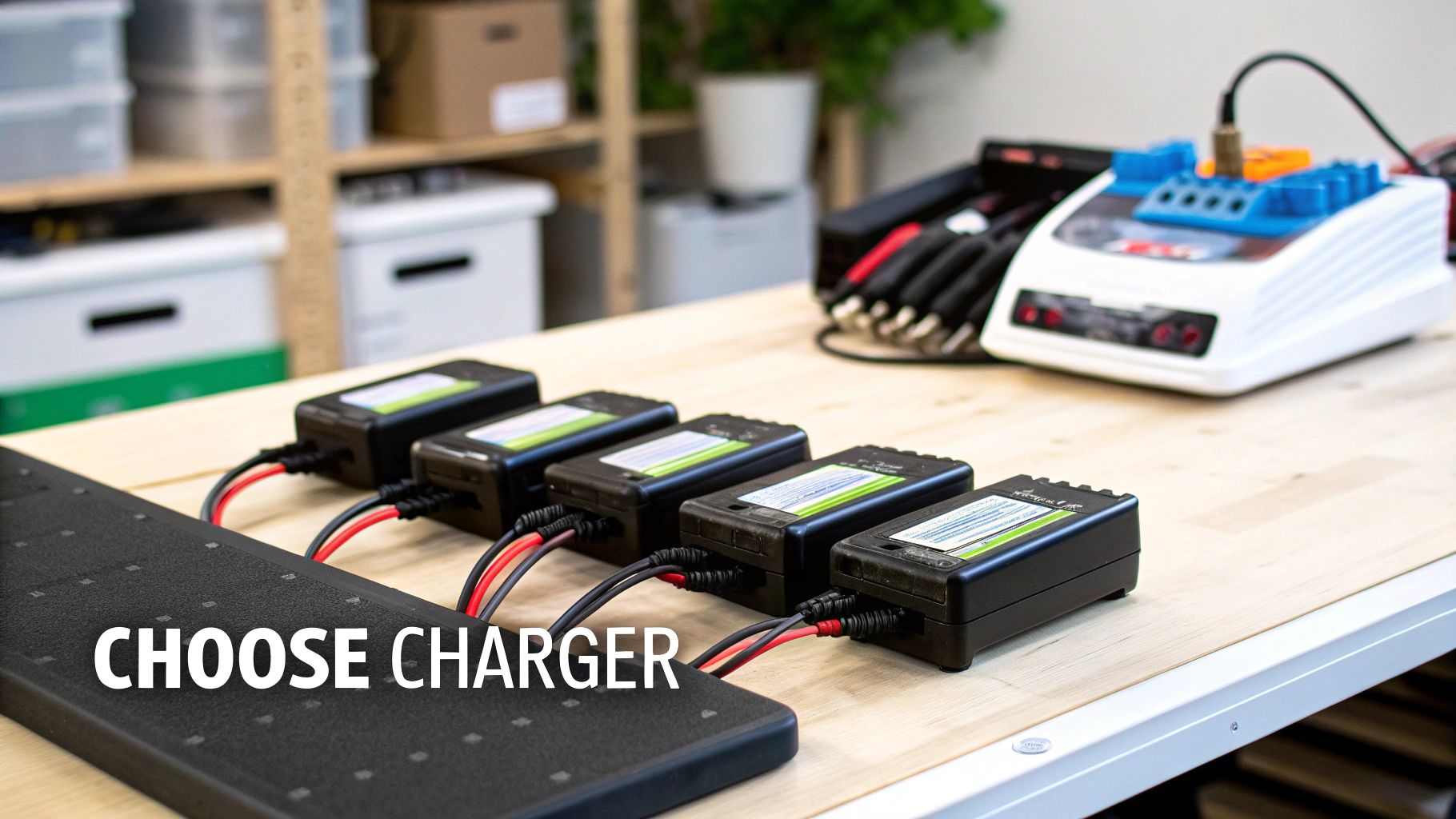
A Quick Comparison For Every User
To make the choice easier, think about where you fit in the RC world. Are you just starting out? Are you an intermediate enthusiast looking for more power? Or are you a competitive racer who needs maximum efficiency? Each of these profiles has very different needs when it comes to power, portability, and features.
This isn't just a niche concern, either. The importance of LiPo technology is growing everywhere. In fact, the industrial battery chargers market in the U.S. is projected to hit around USD 1.4 billion by 2035, with LiPo chargers seeing huge adoption thanks to their high energy density. Discover more insights about industrial battery charger growth to see how this tech is expanding.
The ideal charger isn't always the most powerful one; it's the one that best aligns with your charging habits, battery inventory, and long-term RC ambitions.
To help you pinpoint what matters for your setup, here’s a quick guide breaking down the charger features that are most important for each hobbyist level.
Quick Charger Selection Guide by Hobbyist Level
Use this table to quickly identify the charger features that matter most for your RC experience.
| Key Feature | Beginner Hobbyist | Intermediate Enthusiast | Advanced Racer |
|---|---|---|---|
| Power Source | AC/DC (Built-in power supply for convenience) | AC/DC or DC-only (Flexibility for home/track) | High-Wattage DC (For maximum power at events) |
| Port Count | Single Port (Simple, one-at-a-time charging) | Single or Dual Port (Charges multiple packs) | Dual or Quad Port (High-volume charging) |
| Max Charge Rate | 5-10 Amps (Sufficient for standard 1C charging) | 10-20 Amps (Faster charging, parallel capable) | 20+ Amps (Rapid parallel charging) |
| Essential Feature | Ease of use and clear display | Storage mode and battery health monitoring | High balance current and adjustable settings |
Ultimately, this table should give you a solid starting point. A beginner can’t go wrong with a simple AC/DC unit, while a racer will quickly outgrow anything that can't handle multiple batteries at high amperage. Choose the column that best describes you, and you'll be well on your way.
Understanding Essential Charger Specifications
To pick the right LiPo charger from our collection, you first need to speak the language on the product page. Cutting through the specs—wattage, amperage, and cell count—is the key to finding a charger that actually fits your RC needs. These numbers aren't just technical jargon; they dictate your charge speed, battery health, and safety.
Getting these fundamentals right means you buy a charger with the power and features you'll actually use. It saves you from overspending on capabilities you don't need or, worse, buying a unit you'll outgrow in a few months. Let's break down what matters.
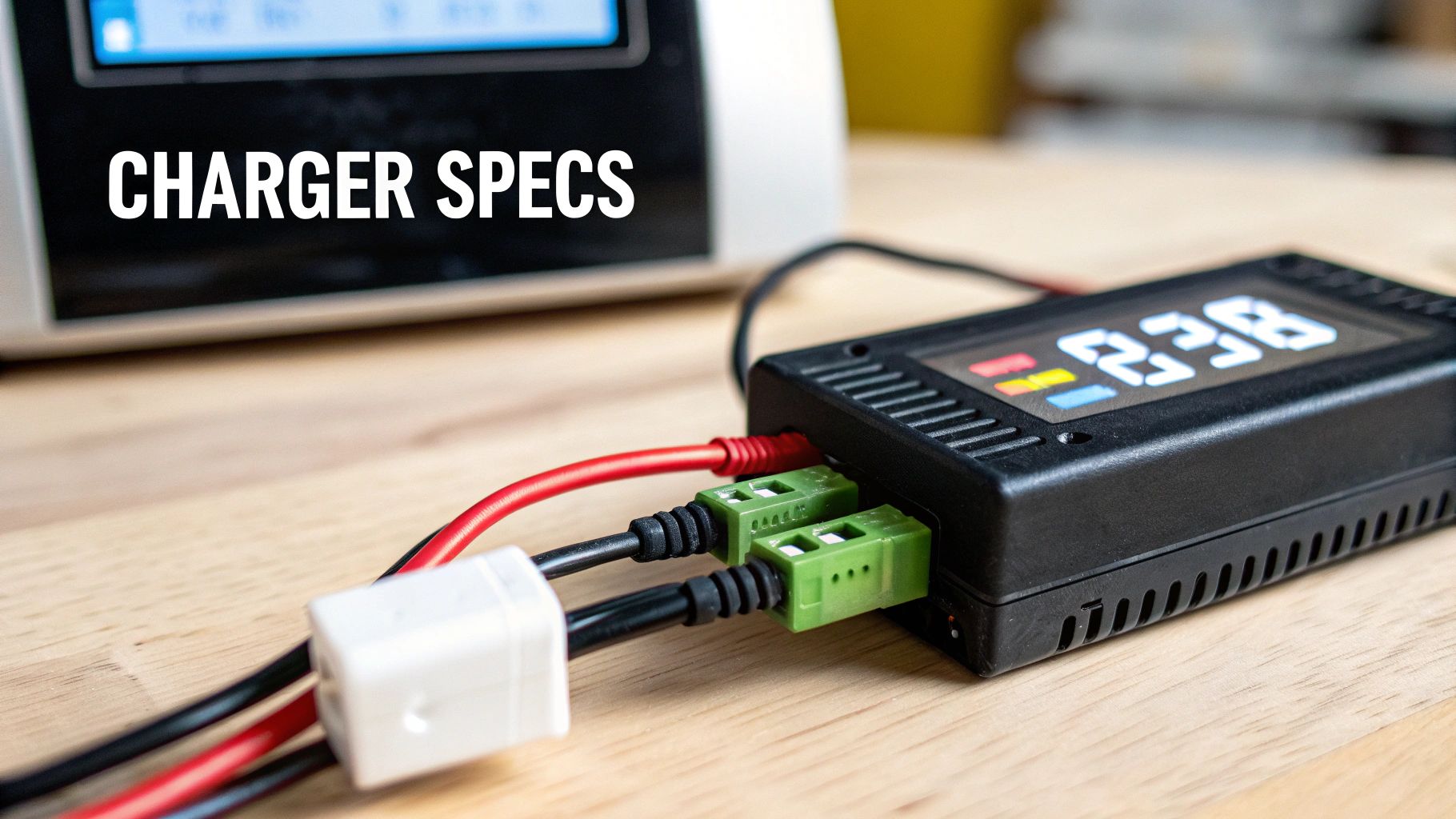
Wattage Defines Your Charger's Total Power
Think of wattage (W) as the total horsepower your charger’s engine can produce. It's the absolute limit on how much work it can do at once. A charger with a higher wattage rating can deliver more power, which becomes critical when you're charging big batteries or multiple packs at the same time.
For instance, charging a single 2S LiPo doesn't demand much wattage. But if you want to parallel charge four 2S packs to get back on the track faster, your power requirement multiplies. A low-wattage charger will be forced to crawl, dramatically slowing down the charge rate to cope.
A simple formula tells the whole story: Watts = Volts × Amps. This shows how a battery's voltage directly limits the amperage a charger can deliver. A 100W charger can push around 11.9 amps into a 2S (8.4V) battery, but that same charger can only manage 3.9 amps for a 6S (25.2V) pack.
Amperage Controls Your Charging Speed
Amperage (A), or the charge rate, sets how quickly you can fill up your battery. While it’s tempting to crank this to the max, the right setting is always determined by your battery’s capacity and its recommended charge rate, known as the "C" rating.
Charging a LiPo at a 1C rate is the universal gold standard for safety and longevity. This simply means you set the amperage to match the battery's capacity.
- A 5000mAh battery charged at 1C needs a 5.0A charge rate.
- An 8000mAh battery charged at 1C needs an 8.0A charge rate.
Pushing the amperage too high causes a battery to overheat, which kills its lifespan and introduces a serious safety risk. Always stick to the manufacturer’s recommended C-rating to protect your gear.
Cell Count and Charge Modes
Every charger is rated for a maximum cell count, usually listed as "up to 6S" or something similar. Any modern smart charger from our store will handle the batteries we carry without breaking a sweat. The important thing is making sure the charger has the right balance port for your pack.
Modern chargers also come with a few essential modes for battery care:
- Balance Charge: This is the safest and most important mode. It charges the battery while making sure every individual cell inside the pack hits the exact same voltage. This is absolutely critical for performance and a long battery life.
- Storage Charge: This mode brings each cell to its ideal storage voltage (around 3.85V). Leaving LiPo batteries fully charged or completely dead will cause permanent damage, so this feature is a must-have for proper battery maintenance.
- Fast Charge: This mode cuts corners by not balancing the cells to save time. While it's quicker, we strongly advise against using it for LiPos. It leads to an imbalanced pack and creates potential safety issues down the road.
Balance charging isn't just a feature; it's the foundation of LiPo battery health. A charger with a high balance current (measured in milliamps, mA) can level out the cells faster, which cuts down your overall charge time and gets you back to racing sooner.
Comparing Our Top LiPo Battery Chargers
Choosing the right LiPo charger isn't about finding the most powerful one—it's about matching it to your RC routine. Every racer has a different workflow. Some meticulously prep their packs at a home workbench, while others need to slam a fresh charge into a battery in the pits between heats.
The right charger should feel like a natural part of your hobby, not a bottleneck slowing you down. To help you decide, we're going beyond spec sheets and looking at how our chargers perform in real-world scenarios.
The Trackside Specialist: Junsi iCharger DX6
For the racer who lives and breathes efficiency at the track, the Junsi iCharger DX6 is an essential tool. This dual-port DC charger is built to be lightweight and take up minimal space in your pit bag, running directly off a larger power supply. Its entire purpose is focused performance, delivering up to 750W per channel to get your packs ready fast.
Imagine you just finished a qualifier and have only 15 minutes before you’re up again. This is where a dedicated high-performance charger proves its worth. You can quickly top off two race packs at a high charge rate without juggling multiple outputs or complex menus. It does its job, and it does it exceptionally well.
Many competitive drivers prefer this streamlined approach because it simplifies everything under pressure. You can monitor cell voltages, internal resistance, and charge progress for both channels at a glance without fumbling through confusing menus.
The At-Home Workhorse: Versatile Dual-Port Units
If you run multiple RC cars or have a deep collection of batteries, a dual-port charger is a game-changer. Think of it as two independent chargers living in one box. This design gives you incredible flexibility, letting you charge two completely different batteries at the same time.
For example, you could be balance charging a 2S LiPo for your touring car on one port while putting a 1S pack for your pan car into storage mode on the other. This versatility is a massive time-saver, literally cutting your prep time in half ahead of a race weekend. No more waiting around for one battery to finish before starting the next.
The best dual-port chargers make managing two packs easy with an intuitive screen. You can monitor cell voltages, internal resistance, and charge progress for both channels at a glance without fumbling through confusing menus.
This is the perfect setup for the organized hobbyist who wants to streamline their workshop. If you want to see what a high-performance dual-port unit looks like, check out the Junsi iCharger DX6 DC Dual LiPo Battery Charger—it’s a favourite among serious racers for a reason.
Model Showdown: Our Recommended LiPo Chargers
To make the differences crystal clear, here is a side-by-side comparison of our top chargers. This table focuses on the key performance metrics that directly impact your charging experience, from raw power to their ideal application in your RC hobby.
| Model | Max Wattage | Max Amperage | Port Count | Best Use Case |
|---|---|---|---|---|
| ISDT K2 Air | 500W (AC) / 600W x2 (DC) | 20A x2 | Dual (AC/DC) | The ultimate all-in-one solution for home and track, offering both plug-and-play convenience and high-power DC capability. |
| Junsi iCharger DX6 | 1500W (750W x2) | 50A per Port | Dual (DC) | The perfect race-day charger for serious competitors needing maximum power and efficiency in the pits. |
| ISDT 608AC | 200W (AC) / 600W (DC) | 8A (AC) / 25A (DC) | Single (AC/DC) | A powerful and compact smart charger for enthusiasts who need flexibility for both workbench and trackside charging. |
This breakdown highlights the core trade-off. Do you need the plug-and-play convenience of an AC/DC unit, or the raw, track-focused power of a DC-only charger like the iCharger DX6? Your answer will point you straight to the best LiPo charger for your workflow.
LiPo Charging Safety and Best Practices
When you're dealing with LiPo batteries, safety isn't a suggestion—it's the single most important part of the RC hobby. The incredible energy density that makes these packs so powerful also means they demand your full respect. Following a few non-negotiable safety rules protects you, your gear, and your home from the very real risk of a battery fire.
Every single charge needs to be treated with a clear, repeatable safety checklist. The basics are simple but critical: never, ever charge a battery unattended, always use a LiPo-safe charging bag, and triple-check your charger settings before you hit start. These rules are the absolute foundation of responsible battery management.
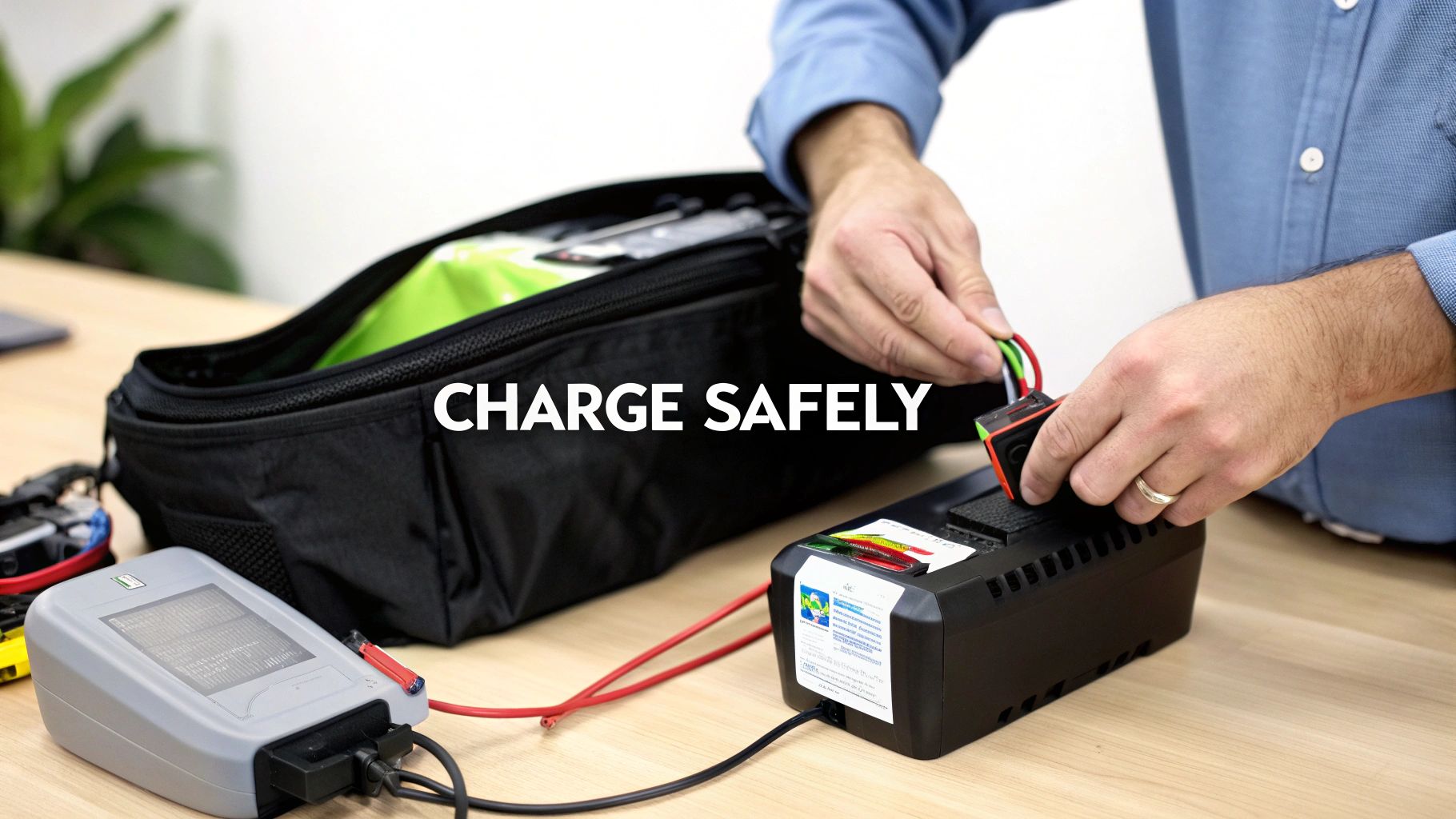
The Golden Rules of Charging
Think of these as your pre-flight checklist. Burn them into your brain until they become second nature. Getting this right ensures every charge is a safe one.
-
Never Charge Unattended: This is rule number one for a reason. You have to be present and alert to immediately pull the plug if something goes wrong, like the battery puffing or getting hot.
-
Use a LiPo-Safe Bag or Container: Always place your battery inside a fire-resistant LiPo bag or a metal ammo can while it's charging. This simple step is designed to contain a potential fire, turning a catastrophe into a minor incident.
-
Charge on a Fire-Resistant Surface: Don't even think about charging on a wooden workbench, carpet, or inside your RC car. A concrete floor in the garage, a ceramic tile, or a cinder block is the right place to set up.
-
Double-Check Your Settings: Before you press "start," look at the screen. Confirm the charger is set for LiPo chemistry, the correct cell count, and the right charge rate (stick to 1C). Almost every charging accident can be traced back to a simple mistake right here.
Understanding and Managing Risks
The big danger with LiPos is a "thermal runaway"—a nasty chain reaction where the battery rapidly overheats, vents flammable gas, and potentially bursts into flames. This is almost always caused by overcharging, physical damage, or charging way too fast. A quality smart charger is your best defence; it’s designed to stop automatically when the pack hits its peak voltage, preventing the most common cause of failure.
This focus on battery safety goes far beyond the RC world. California is putting serious money into research for next-gen nonflammable, fast-charging LiPo batteries as part of its clean transportation goals. These state-backed projects are working to create safer batteries that can handle higher temps and faster charge cycles, which will eventually trickle down to the chargers we use. To see the scale of this research, you can learn more about California's energy technology projects and how they're pushing battery safety forward.
A puffed or swollen battery is a red flag. It means there's internal damage and it's a serious fire hazard. Never try to charge, use, or fix a puffed LiPo. It needs to be safely discharged and disposed of, period.
Best Practices for Battery Longevity
Proper care doesn't just keep you safe; it also protects your investment and extends the life of your batteries. The best LiPo battery charger will have features built specifically for this, and knowing how to use them is key.
The Storage Mode is probably the most important feature for battery health. LiPos hate being left fully charged or completely dead for long. This mode automatically brings each cell to its happy place—around 3.80V to 3.85V. If you aren't using a battery within the next 24 hours, putting it in storage mode is non-negotiable.
For a deeper dive into battery maintenance, our guide to LiPo batteries in Canada covers everything from storage to proper disposal in detail. By combining safe charging habits with smart battery care, you make sure your gear is reliable and ready to go when you hit the track.
Selecting the Right Accessories for Your Setup
The best LiPo battery charger is only one piece of the puzzle. To build a truly effective charging station, you need the right gear backing it up. The proper accessories not only speed up your process but also nail down compatibility and safety, letting you get the most out of your charger.
Every component plays a role, from the specific connectors on your batteries to the power supply feeding your charger. Getting these details right from the start saves you a ton of frustration and creates a seamless workflow, whether you're prepping at your home bench or charging in the pits.
Mastering Connectors and Charge Leads
First things first, you need to make sure everything can actually connect. On our site, you’ll primarily find batteries with high-current connectors like XT60, QS8, and EC5. It’s absolutely critical that your charge leads—the cables running from your charger to your battery—are a perfect match for these connectors.
Sure, you can use adapters in a pinch, but a direct, high-quality solder connection is always the better way to go. Why? It minimizes electrical resistance. Less resistance means a more efficient charge and less heat buildup, which is always a win for both safety and performance.
Boosting Efficiency with Parallel Balance Boards
For any racer with a stack of similar batteries, a parallel balance board is one of the most powerful accessories you can own. This little device lets you hook up multiple identical LiPo packs—say, four 2S batteries—and charge them all at once as if they were a single, large battery.
This dramatically cuts down your total time at the charger. Instead of cycling through four packs one after another, you get them all done in a single go. Just be warned: this method demands strict safety protocols. You must only connect batteries that are at a very similar voltage level.
When using a parallel board, you add up the capacities of all connected batteries to determine the correct charge rate. For instance, four 5000mAh packs become a single 20,000mAh (or 20Ah) load, requiring a 20A charge rate for a 1C charge.
The Importance of a Reliable Power Supply
Many of the most powerful and feature-rich chargers, like the Junsi iCharger series, are DC-only units. This means they need an external power supply unit (PSU) to convert the AC power from your wall outlet into the DC voltage the charger can use. The PSU is the heart of your entire charging station, and choosing the right one is non-negotiable.
Your power supply's wattage has to meet or exceed your charger's maximum output. Pairing a beefy 1500W DC charger with an undersized 500W power supply will severely bottleneck its performance. The charger will be starved for power and won't be able to deliver the high charge rates you paid for, especially when you're loading it up with multiple batteries. Always invest in a PSU that gives your charger plenty of headroom to operate at its full potential.
Finally, pulling all these components together safely is paramount. Always charge your batteries inside a protective container. To make sure you're prepared, look into something like a fire-resistant LiPo safety bag, which is an essential and affordable layer of protection for any charging setup.
Making Your Final Purchase Decision
Alright, let's put it all together. The final step is turning what you know you need into a confident purchase. Choosing the right LiPo charger isn't about finding the "best" one—it's about finding the best one for you. It's a process of elimination guided by your specific habits in the RC hobby.
A clear, action-oriented approach ensures you pick a unit that will serve you well for years, not one you'll outgrow by next season.
Your Quick Purchase Checklist
Run through these questions. Your answers will act as a filter, narrowing down the options and pointing you straight to the right category of charger for your race program.
- How many batteries do you own? If you have more than two or three packs, a dual-port charger like the Junsi iCharger DX6 or ISDT K2 Air is a massive time-saver. If you only run one or two, a single-port unit will do the job just fine.
- What's your largest cell count and capacity? All our chargers handle common LiPo batteries with ease. But if you plan to parallel charge multiple high-capacity packs, you'll need a charger with higher wattage and amperage to keep up.
- Where do you charge most often? If you're mostly charging at home, a convenient AC/DC unit like the ISDT K2 Air is perfect. For serious racers needing maximum power at the track, a dedicated DC charger paired with a robust power supply is the winning combination.
This simple decision tree shows how your battery choice dictates the rest of your charging setup—from connectors right through to your power supply.
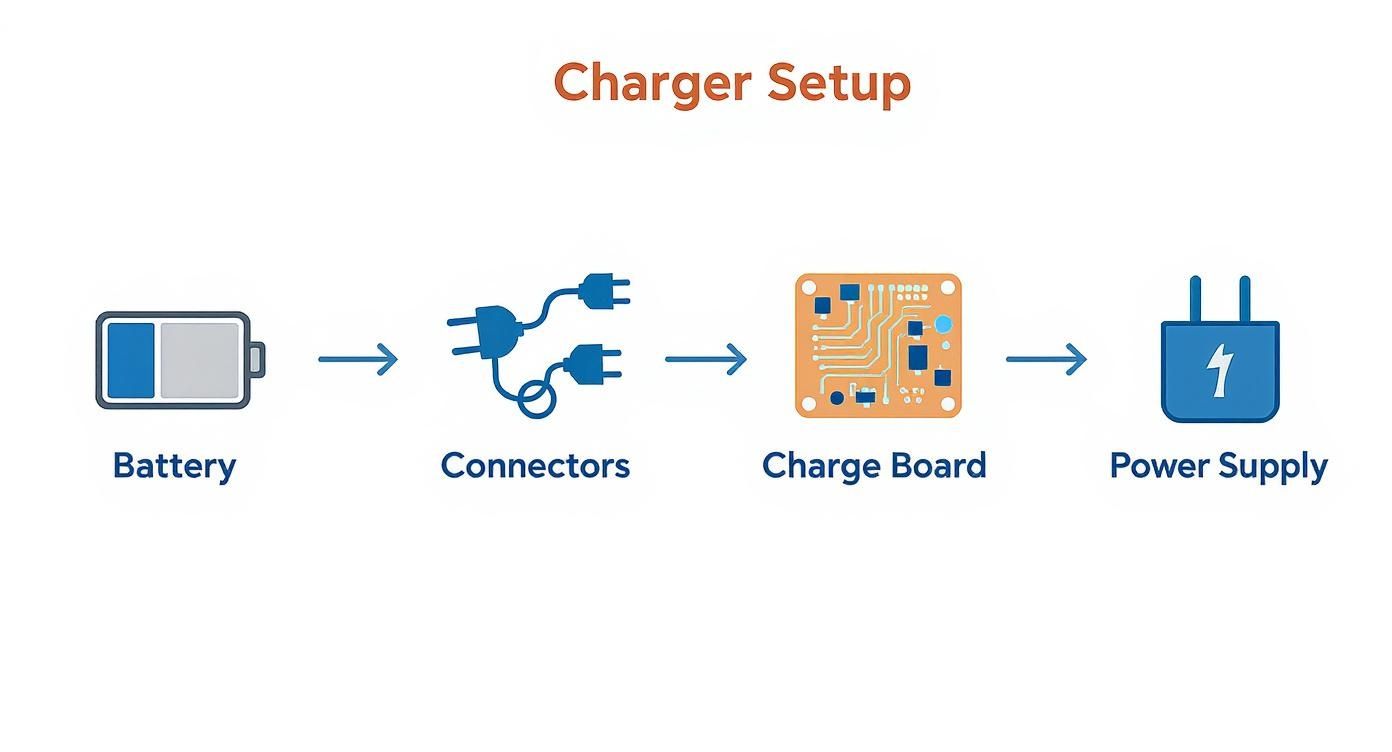
As you can see, every component has to work together for an efficient and safe system.
By clearly defining your battery inventory, where you'll be charging, and how fast you need to do it, you can confidently pick a charger that fits your racing workflow perfectly.
This approach ensures you invest in a charger that's a perfect fit, not one you’ll quickly find cumbersome or inadequate. The demand for smarter charging solutions is growing, reflecting bigger trends in energy storage. For instance, you can learn more about California's energy technology projects to see how massive investments are driving innovation in chargers optimized for LiPo cells.
Frequently Asked Questions About LiPo Chargers
When you’re dealing with LiPo chargers, a few key questions always come up. Getting the answers right is the difference between safe charging and putting your gear—and yourself—at risk. It’s also what keeps your batteries performing at their peak on race day.
Let's clear up some of the most common questions we hear from racers.
How Do I Calculate the Correct Charge Rate for My Battery?
Figuring out the right charge rate is straightforward. The gold standard for safety and battery longevity is a 1C charge rate. This simply means you match the charger's amperage setting to the battery's capacity in amp-hours (Ah).
To get that number, just divide your battery's milliamp-hour (mAh) rating by 1000.
- For a 5000mAh battery, a 1C charge rate is 5.0 amps.
- For an 8200mAh battery, a 1C charge rate is 8.2 amps.
Sure, some batteries are rated for faster charging, but sticking to 1C is the best practice for getting hundreds of healthy cycles out of your LiPo packs.
Can I Charge NiMH Batteries with a LiPo Charger?
Absolutely. Most modern smart chargers are multi-chemistry units, which means they’re designed to handle more than just LiPos. A quality charger from our shop, like those from ISDT or Junsi, will safely charge other common RC battery types, including NiMH and NiCd.
The critical step is to manually select the correct battery chemistry from the charger’s menu before you start. Charging a NiMH pack on a LiPo setting (or vice versa) is a recipe for disaster. Always double-check your settings.
How Do I Confirm My Battery Is Properly Balanced?
A balanced battery is a healthy battery, period. You can see how well your pack is balanced by checking the individual cell voltage screen on your charger. During a balance charge, the charger actively works to bring every cell to the exact same voltage—typically 4.20V for a fully charged LiPo.
A healthy, well-balanced pack will show all cell voltages within an extremely tight range, ideally no more than 0.01V to 0.02V apart. For example, you want to see all cells reading 4.20V, 4.19V, or 4.21V. If you see a major difference between cells, it's a red flag that one cell may be failing.
Ready to find the perfect charger for your setup? Digital RC offers a curated selection of chargers and accessories to keep you race-ready. Explore our collection and get fast, tax-free shipping across Canada.