

A Racer's Guide to Your Electronic Speed Control RC System
An electronic speed control (ESC) is the brain of your RC car. It's the critical link that takes the commands you send from your radio and turns them into smooth, precise action at the motor. This sophisticated little box masterfully manages the flow of power, making sure your car does exactly what you tell it to, when you tell it to.
The Conductor of Your RC Car Orchestra
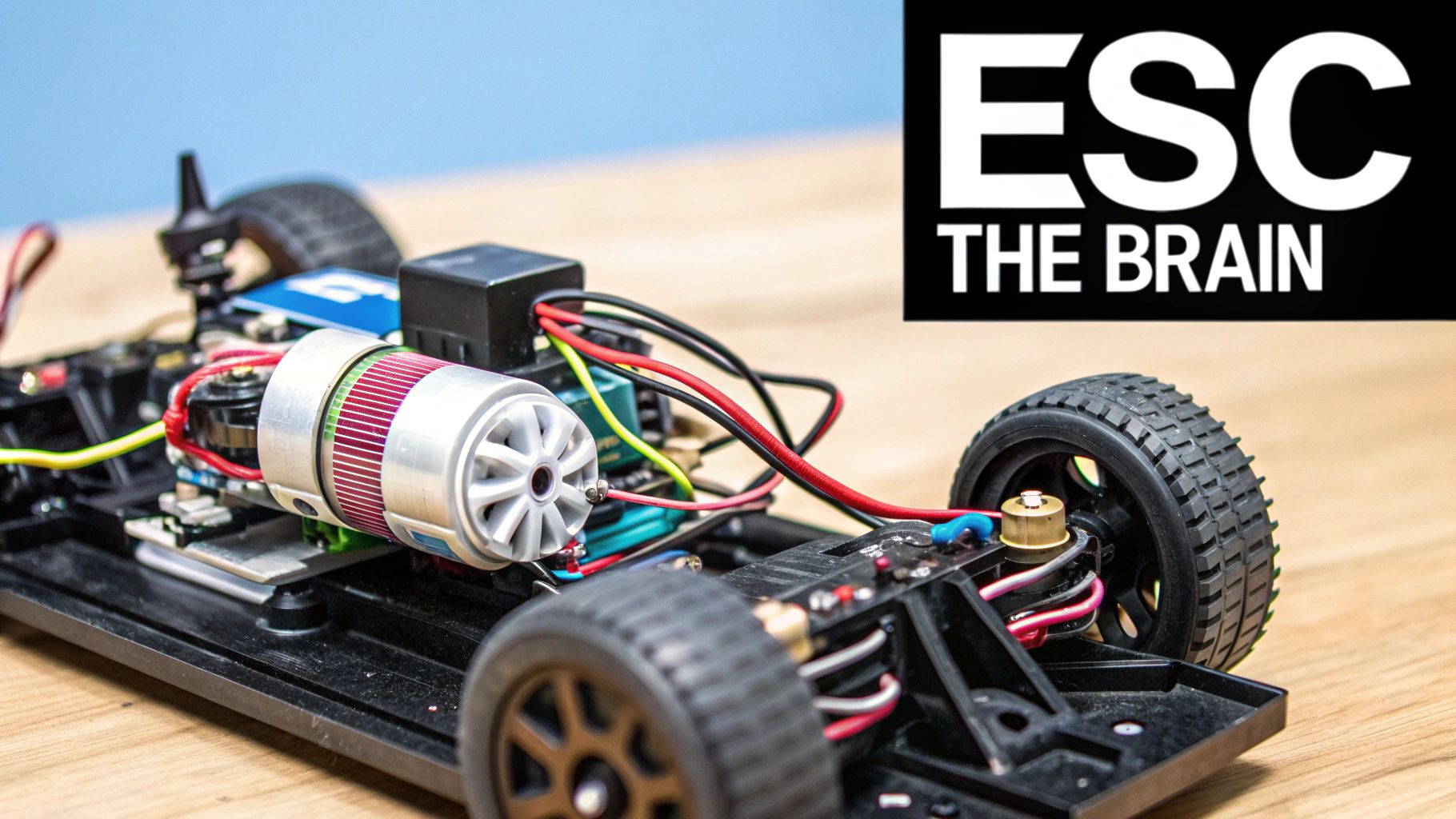
Think of your ESC as the conductor of a high-performance orchestra. The battery is the raw power source, the motor is the instrument section ready to unleash incredible speed, and your transmitter is the sheet music. The ESC stands in the middle, interpreting every subtle instruction and directing the flow of energy with absolute precision.
When you squeeze the throttle, the ESC doesn’t just flood the motor with power. Instead, it pulses the power on and off thousands of times per second, creating a perfectly controlled stream of current. This is what gives you the nuanced control you need for competitive on-road racing.
This precise management is what separates a chaotic wheelspin from a controlled launch off the line. It’s the difference between locking up the brakes and executing a perfect trail-braking move into a tight corner.
More Than Just a Throttle Switch
The role of an electronic speed control goes far beyond just making the car go forward. It's a multi-talented component responsible for several key functions that define your car's feel and performance on the track.
- Acceleration Control: It delivers power smoothly, preventing wheel spin and maximizing every bit of available traction.
- Dynamic Braking: By reversing the motor's electrical field, it provides strong, consistent braking without any mechanical parts.
- Reverse Functionality: For some applications, it seamlessly manages the switch to drive in reverse.
- Power Regulation: It often includes a Battery Eliminator Circuit (BEC) to safely power your receiver and steering servo.
For competitive 1/10 and 1/12 scale on-road racers, mastering the ESC is non-negotiable. It is the core component that enables the smooth power delivery and controlled braking that wins championships, setting the foundation for peak performance.
A Growing Hobby Fuelled by Technology
The sophistication of modern ESCs is a testament to the passion within the RC community. The remote control toy car market in North America has established itself as a dominant force, commanding approximately 36% of the global market share. This growth is driven by tech that makes RC racing more accessible and exciting than ever.
The core principles of managing a motor's speed aren't unique to the RC world. To get a better grasp of the fundamentals, you might find it interesting to learn about industrial variable frequency drive basics. Understanding these concepts provides a great foundation as we dive into the more advanced features of the ESCs we offer here at Digital-RC—all tailored for the specific demands of high-level on-road racing.
Translating ESC Specs Into On-Track Performance
Flipping through an electronic speed control rc product page can feel like trying to read a foreign language. You’re hit with a wall of numbers and technical terms—but what do they actually mean for your car’s behaviour on the track? Let's decode these critical specs so you can look at any ESC and know exactly what it’s built for.
Think of an ESC's spec sheet as its resume. Each number tells a story about its capabilities, its limits, and the kind of racing it excels at. Understanding these figures is the first step toward building a power system that’s not just fast, but also reliable and perfectly matched to your needs.
Amperage: The Power Handling Capacity
The first number you'll almost always see is the amperage, or "amp" rating. This is usually broken down into two key figures: continuous and burst.
-
Continuous Amps: This is the maximum current the ESC can handle nonstop without overheating. Think of it as your car's cruising speed on a long straightaway—it’s the steady, sustainable power level you can depend on for the entire race. For a 17.5T spec touring car, a 100A to 120A continuous rating is a solid target.
-
Burst Amps: This tells you the maximum current the ESC can handle for short periods, usually just a few seconds. This is your car's sprinting ability—that instant surge of power you need to launch off the line or accelerate hard out of a tight corner.
Getting this wrong is a recipe for disaster. If you run a power-hungry, low-turn modified motor (like a 4.5T) with an ESC that has a low continuous amp rating, it's going to overheat and likely fail. The ESC simply can't keep up with the motor's demand for electricity.
Voltage Limits: Matching Your LiPo Battery
Every ESC has a specific voltage range it can safely handle. In the world of 1/10 and 1/12 on-road racing, this is almost always listed as a LiPo battery cell count, like "2S LiPo" or "1S-2S LiPo."
A 2S LiPo battery has a nominal voltage of 7.4V, making it the standard for nearly all 1/10 scale touring car classes. A 1S LiPo battery, with its 3.7V nominal voltage, is the go-to for 1/12 scale pan car racing.
This is a non-negotiable compatibility check. Hooking up a 3S battery to an ESC rated only for 2S will cause immediate, permanent damage. Always double-check your ESC’s voltage limit against the battery you plan to use.
The Unsung Hero: The BEC
Tucked away in the spec list is the Battery Eliminator Circuit (BEC). This clever bit of internal hardware takes the high voltage from your main LiPo pack and steps it down to a safe, lower voltage (usually 6.0V or 7.4V).
The BEC's primary job is to reliably power your receiver and steering servo, eliminating the need for a separate, small receiver battery pack. This simplifies your wiring, saves weight, and is a crucial part of a modern RC car's electronics package.
The BEC's output is also rated in amps. High-torque, high-speed servos are thirsty for current, so a robust BEC with a higher amp rating (like 3A or more) ensures your steering stays crisp and consistent, even under heavy load. An underpowered BEC can cause "brownouts," where the receiver momentarily loses power—and you lose control of your car.
To help you match these specs to specific racing classes, here’s a quick guide.
ESC Specification Guide for 1/10 & 1/12 On-Road Racing
This table breaks down the typical ESC requirements for some of the most popular on-road racing classes, helping you find the right balance of power and reliability.
| Racing Class | Typical Motor Turn | Recommended Continuous Amps | Common LiPo Voltage | BEC Voltage |
|---|---|---|---|---|
| 1/10 Spec Touring | 17.5T or 21.5T | 100A - 140A | 2S LiPo (7.4V) | 6.0V / 7.4V |
| 1/10 Modified Touring | 4.5T - 6.5T | 160A - 200A | 2S LiPo (7.4V) | 6.0V / 7.4V |
| 1/12 Spec Pan Car | 13.5T | 100A - 120A | 1S LiPo (3.7V) | 6.0V (Booster needed) |
| 1/12 Modified Pan Car | 3.5T - 5.0T | 120A+ | 1S LiPo (3.7V) | 6.0V (Booster needed) |
Choosing the right ESC involves more than just picking the one with the biggest numbers. It's about creating a balanced and reliable system. For a deeper dive, check out our complete ESC selection guide for matching your electronic speed controller to your motor for even more detail.
By understanding these core specifications—Amps, Volts, and BEC—you’re ready to select the perfect electronic speed control for your racing class right from our product pages.
Why Sensored Systems Dominate Competitive Racing
In competitive RC racing, every millisecond counts. The technology powering your car can be the difference between standing on the podium and watching from the sidelines. When it comes to the heart of your power system—the electronic speed control RC and motor—one choice stands out above all else: sensored technology.
For any serious 1/10 or 1/12 scale on-road racer, it's the undisputed champion.
Imagine trying to drive a high-performance sports car with a vague, unpredictable throttle. It might feel okay at full speed, but the moment you need to crawl through a tight corner, the car lurches and stutters. That’s the reality of a sensorless system at low RPMs. While powerful, sensorless systems are essentially "guessing" the motor's position, which makes them clumsy and inconsistent at slow speeds.
A sensored system, on the other hand, operates with perfect clarity. It feels like a direct link between your throttle finger and the drivetrain, giving you flawless control at any speed.
The Magic of the Sensor Cable
The key difference comes down to a small, flat cable that connects the motor directly to the ESC. This sensor cable is the lifeline. It feeds the ESC precise, real-time information about the motor's rotor position. The ESC no longer has to guess—it knows exactly where the motor is in its rotation at all times.
This constant communication unlocks a level of control that's simply non-negotiable for racing. The result is a system that feels telepathic, responding instantly and smoothly to your every input.
Sensored technology is the foundation of modern on-road racing. It provides the ultra-smooth throttle response, precise low-speed finesse through technical sections, and consistent, predictable braking needed to execute clean, fast laps.
Unpacking the On-Track Advantages
So, how does this all translate into faster lap times? The benefits are tangible and immediately noticeable on the track, especially in the demanding world of on-road racing.
- Flawless Low-Speed Control: Sensored systems eliminate "cogging"—that jerky, stuttering motion common in sensorless setups at startup. This allows for incredibly smooth acceleration out of tight hairpins and chicanes where finesse is everything.
- Predictable and Powerful Braking: Because the ESC knows the motor's exact position, it can apply brakes with much greater precision and consistency. You can brake later and harder into corners with complete confidence.
- Instantaneous Throttle Response: There is zero hesitation. When you pull the trigger, the power delivery is immediate and linear, giving you a direct, connected feel to the car's drivetrain.
This is exactly why our selection focuses on high-performance sensored systems. A motor like the Actinium V6S 21.5T Turn Brushless Sensored Motor is specifically designed to pair with a sensored ESC to deliver this championship-winning control.
For any racer serious about competing, a sensored electronic speed control RC system isn't just an upgrade; it’s a fundamental requirement.
Creating Your Ultimate Power System Trifecta
Winning on the track isn't about slapping the most powerful part you can find into your chassis. It's about creating a perfectly balanced and synergistic power system. Your electronic speed control rc, brushless motor, and LiPo battery form a critical trifecta.
When these three parts work in harmony, your car is efficient, reliable, and brutally fast. When they don't, you're left with bottlenecks, overheating, and performance that just falls flat.
Think of it as a high-performance supply chain. The battery supplies the juice, the ESC manages and delivers it, and the motor turns it into raw speed. A weak link anywhere in that chain compromises the entire system.
Matching Your Motor and Electronic Speed Control RC
The most important relationship to get right is between your motor and ESC. A motor's turn rating—like a 17.5T spec motor or a fire-breathing 4.5T modified motor—is a direct indicator of how much power it needs.
A lower turn number means the motor will draw significantly more current (amps) to hit its higher RPM and produce more torque. It's hungry for power.
If you pair that power-hungry 4.5T motor with an ESC only rated for 100 amps, you're pushing the ESC past its limits on every pull of the throttle. This mismatch generates a ton of heat, which is the number one enemy of all electronics. The result? Thermal shutdowns mid-race or, even worse, a permanently fried ESC.
The rule is simple: match the equipment. A high-current motor demands a high-current ESC. For the modified racing classes we focus on at Digital-RC, a robust ESC isn't an upgrade—it's a requirement for finishing the race.
The Battery: The Unseen Bottleneck
The final piece of this power puzzle is your LiPo battery. Don't overlook it. A battery's C-rating determines how quickly it can push out current. Pairing a low C-rating battery with a high-demand modified motor and a capable ESC creates a massive bottleneck.
You'll feel it on the track. The car will have a noticeable lack of punch and top speed because the battery simply can't keep up with what the motor and ESC are asking for. It's starving the system. For a deeper dive, check out our guide on LiPo battery selection to power your RC setup for maximum performance.
This is why motor control feedback is so vital for on-track precision.
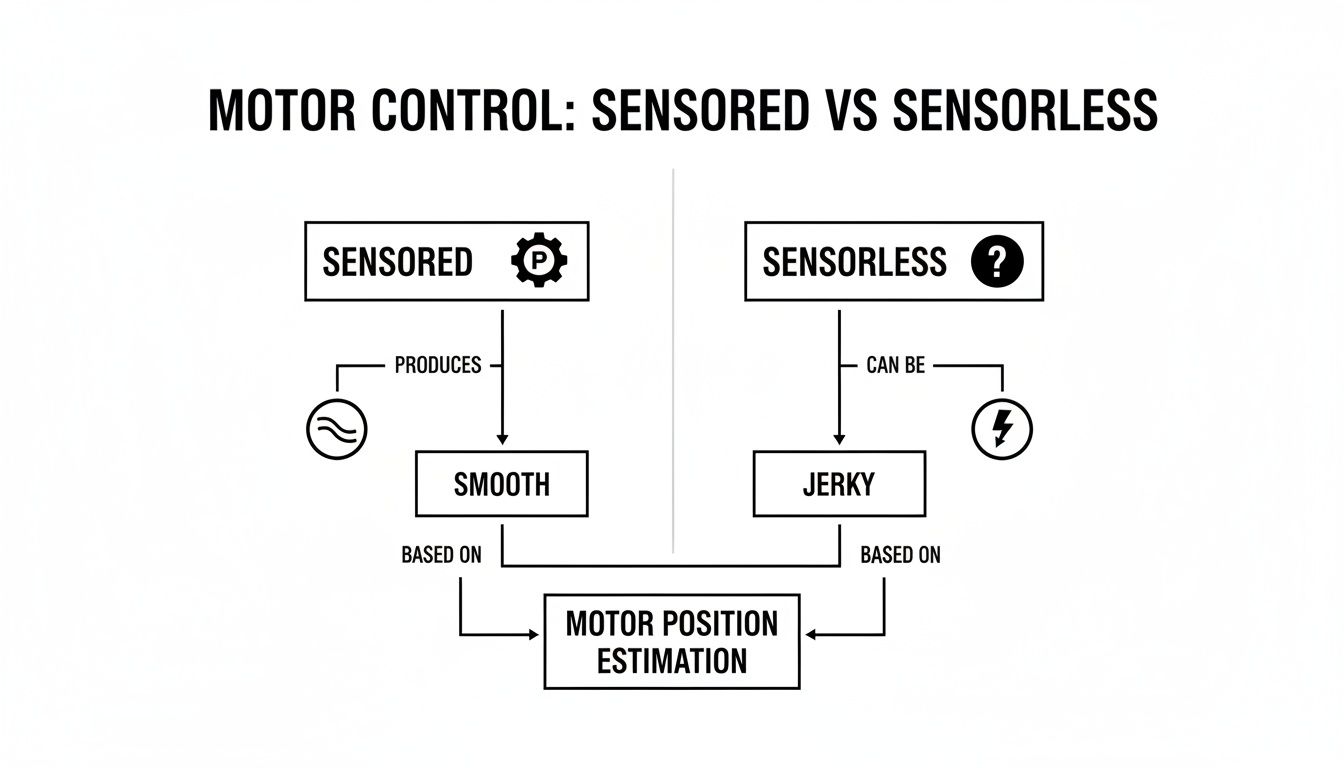
As you can see, a sensored system knows the motor's exact position, leading to buttery-smooth control. A sensorless system has to guess, which can cause that jerky feeling, especially when you're trying to ease onto the throttle out of a tight corner.
Building Your System with Confidence
RC technology is always moving forward. The shift to 2.4 GHz control systems and brushless motor technology has completely changed the game, making the synergy between your components more critical than ever.
Even the wiring you choose plays a role. When you're running a high-power modified setup, selecting the right wire gauge is paramount for efficiency and safety. It's worth understanding 0 AWG wire for high-current systems to see just how important proper wiring is for optimizing your car's performance.
At Digital-RC, we curate compatible, race-proven components to take the guesswork out of building a winning combination. By selecting a balanced trio of motor, ESC, and battery from our collections, you can build a powerful, reliable, and efficient system that's designed for the podium.
Professional Installation and Wiring Techniques
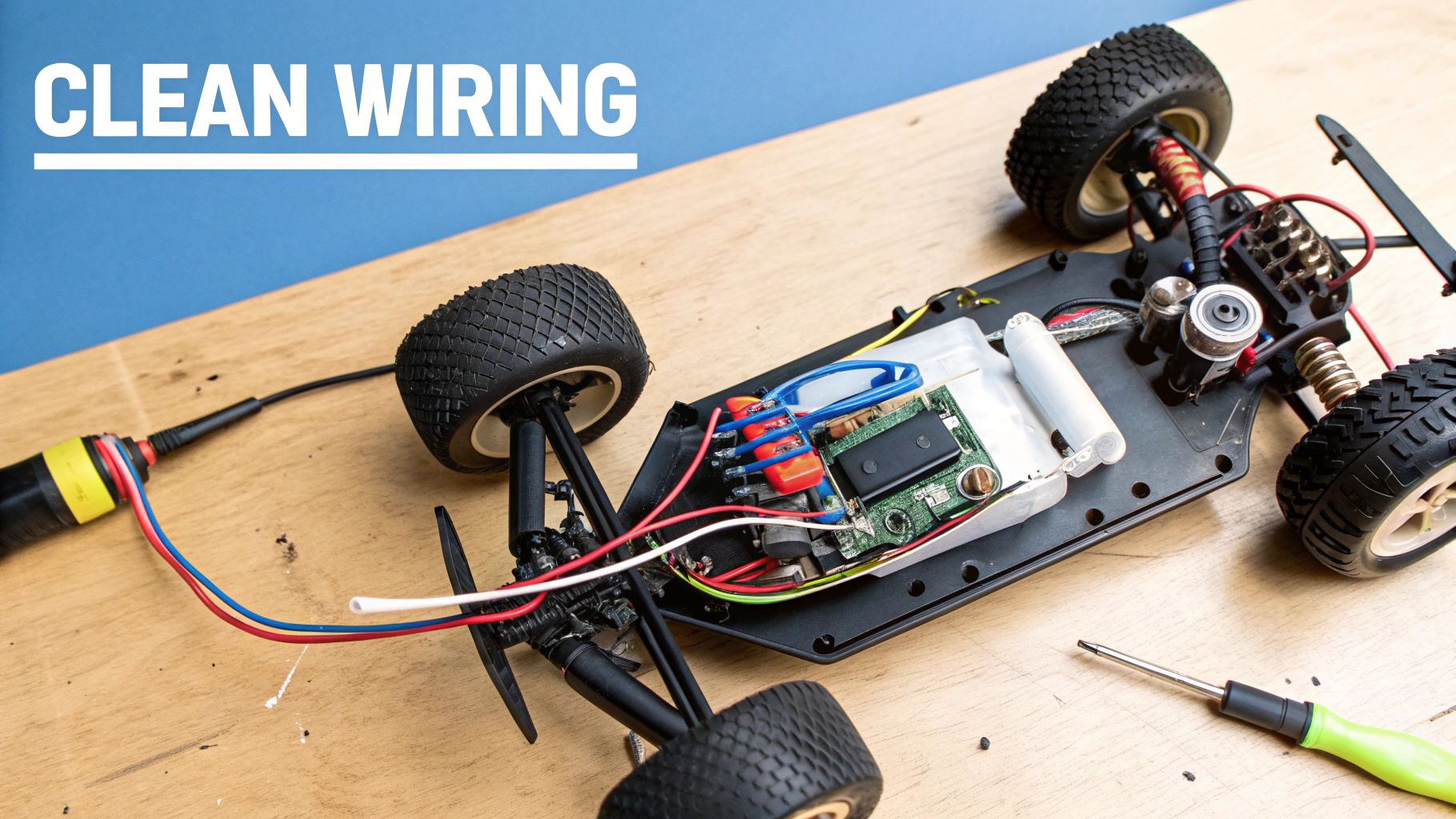
A clean installation isn't just about looks—it’s the bedrock of a reliable, high-performance RC car. Getting your new electronic speed control rc installed correctly means solid electrical connections, better cooling, and protection from the brutal vibrations of the racetrack. This guide will walk you through setting up your ESC like a seasoned pro, so you can hit the track with confidence.
Follow these techniques, and you’ll know your electronics will perform flawlessly, lap after lap. It’s all about getting it right the first time.
Mounting Your ESC for Success
First thing's first: where does the ESC go? Placement is a big deal, affecting both cooling and the car's weight balance. In 1/10 and 1/12 scale on-road cars, you want a spot with decent airflow to help it shed heat during a hard run.
Use high-quality, double-sided servo tape to stick the ESC to the chassis. This stuff is made to soak up vibrations, which is crucial for protecting the delicate components inside your speed control from getting shaken to death over time.
A secure, vibration-dampened mount is one of the best things you can do for the lifespan of your ESC. Constant rattling can cause solder joints to fail, so a solid mounting job is your first line of defence.
Perfecting Your Soldering and Wiring
Clean, strong solder joints are absolutely non-negotiable. A sloppy connection creates resistance, which chokes off power and generates a ton of heat. That's a fast track to melted wires or a cooked ESC.
For a pro-level soldering job, follow these steps:
- Pre-tin Your Wires: Always apply a small amount of solder to the stripped end of each wire first. This makes the final connection quick and clean.
- Heat the Post, Not the Solder: Touch your hot iron to the ESC post for a moment, then feed the solder onto the heated post. Let the post do the work of melting the solder.
- Make a Clean Joint: Bring the pre-tinned wire to the molten solder on the post. Hold it steady for a couple of seconds until it solidifies into a shiny, solid joint.
Once everything is soldered, think about your wire routing. Keep wires as short as you can without putting stress on them—this cuts down on resistance and looks tidy. A few zip ties or some heat shrink tubing will keep your wiring bundled up and safely away from spinning gears, belts, or the steering linkage.
Connecting to Your System and Calibration
With the hard part done, the final connections are simple. The three motor wires from the ESC plug right into the motor. If you're running a sensored setup, gently plug the sensor harness into its port on the ESC.
Next, plug the ESC's receiver wire into the throttle channel on your receiver, which is usually channel 2. Pay attention to polarity: the black or brown wire is negative, red is positive, and the white or orange wire is the signal.
The last, absolutely critical step is ESC calibration. This process syncs the ESC to your radio, teaching it where your specific neutral, full throttle, and full brake points are. Every ESC manual will have a simple procedure for this, which usually involves holding the throttle at certain positions while powering up the ESC. Never skip this step. It’s essential for having smooth, predictable control on the track.
Tuning Your ESC for a Competitive Edge
A stock ESC setup gets you on the track, but it’s just a starting point. The real secret to shaving tenths off your lap times and making the car feel like an extension of your hands is in the programming. This is where you fine-tune the power delivery and truly separate yourself from the pack.
To get into these advanced settings, you’ll need a dedicated program box or a USB link for your specific ESC. These tools let you plug in right at your pit table and make precise adjustments, giving you the power to adapt your car’s behaviour for any track, any time.
Translating Settings Into On-Track Speed
Getting faster is all about understanding what each setting actually does. While the names might change slightly between brands, most high-performance ESCs, like the ones we stock at Digital-RC, share a core set of game-changing adjustments.
-
Timing Advance: Think of this like advancing the ignition on a real engine. More timing boosts RPM and top speed, which is a massive advantage on long straights. The trade-off? More heat and less efficiency. It's a balancing act to find that sweet spot.
-
Punch or Throttle Rate: This setting dictates how hard the ESC hits when you first squeeze the throttle. On a high-grip surface, cranking up the punch gives you explosive, neck-snapping acceleration. On a dusty, loose track, you’ll want to turn it down for a smoother, more controllable launch.
-
Drag Brake: This mimics the natural engine braking of a full-scale car. As soon as you let off the throttle, it applies a bit of brake automatically. This is a powerful tool for cornering—a higher drag brake setting can help the car pivot and rotate more aggressively into tight turns.
-
Throttle and Brake Curves: These let you reshape the response of your trigger inputs. A linear curve is straightforward: 50% trigger pull equals 50% power. But an exponential curve can soften the initial throttle hit, making it easier to manage on slick surfaces, or make your brakes feel more powerful late in the pull.
Tuning is all about making small, deliberate changes. Adjust one thing, run a few laps to feel the difference, and take notes. This methodical approach is the fastest way to learn how each setting really affects your car's handling.
Building Your Starting Setups
A setup that’s dialed for a high-grip carpet track will feel like a nightmare on low-grip asphalt. The advanced features in the ESCs available in our store let you build and save different profiles, so you’re always ready for the conditions.
Here are a couple of proven starting points to get you going.
High-Grip Carpet or Blacktop
When traction is high, you can get aggressive.
- Timing: Start with a moderate to high setting to maximize your speed on the straights.
- Punch: Set it high for instant, explosive power out of the corners.
- Drag Brake: A lower setting usually works best, as the car's natural grip will do most of the work slowing you down.
Low-Grip Dusty Asphalt or Concrete
On slicker surfaces, smooth and predictable is the name of the game.
- Timing: Back the timing down. This makes the power delivery softer, more manageable, and helps keep motor temps under control.
- Punch: Turn this way down to keep the tires from lighting up every time you touch the throttle.
- Drag Brake: A moderate amount of drag brake can help the car turn in without making the rear end feel loose.
By using these as a baseline, you can start fine-tuning your electronic speed control rc to perfectly match the track, your driving style, and the high-performance components you trust from Digital-RC.
Common Questions About RC ESCs
Even with a perfectly dialled-in setup, questions and issues can pop up at the track. This section gives you quick, clear answers to some of the most common problems racers face with their ESCs.
Think of this as your trackside cheat sheet to diagnose problems fast and get your car back on the tarmac.
Why Is My Electronic Speed Control Getting Hot?
An overheating ESC is almost always a symptom of being overworked. It’s the system's way of screaming for help because it's under too much load.
The usual suspects are:
- Over-gearing: Slapping on a pinion gear that’s too large for the motor or the track layout forces the entire system to pull way too much current.
- Aggressive Timing: Pushing too much timing advance, either in your ESC or on the motor's endbell, is a surefire way to generate massive heat.
- Drivetrain Bind: A seized bearing, a poorly meshed gear, or any other source of friction creates a constant strain on your electronics.
Start with the basics. Take the motor out and make sure your car rolls freely. If it does, the next step is to try a smaller pinion gear or dial back the timing settings in your ESC.
Can I Run a 3S LiPo on My 2S ESC?
No. Absolutely not. This is one of those hard-and-fast rules you can't bend. An ESC's voltage rating is its absolute maximum limit, period.
Plugging a 3S battery (11.1V) into an ESC that’s only rated for 2S (7.4V) will instantly fry the internal components like capacitors and MOSFETs. The damage is permanent. Always double-check your ESC’s specs on our product pages before you even think about connecting a new battery.
A blinking light on your ESC is its way of talking to you. It's a diagnostic error code, and each brand uses different patterns. Common signals include low voltage cutoff (LVC), thermal shutdown, a lost receiver signal, or a motor sensor error. Keep your ESC's manual handy to decode exactly what it's trying to tell you.
At Digital-RC, we stock a curated selection of race-proven ESCs and electronics built for one thing: peak performance. Find the perfect, compatible electronic speed control for your 1/10 or 1/12 on-road car and get it fast with our free same-day shipping. Explore our collection of ESCs at digitalrc.ca.