

Mastering Your ESC RC Car for On-Road Racing Dominance
Your competitive edge in RC racing doesn't come from just one part—it's about the entire system working in harmony. At the centre of that system is your Electronic Speed Controller, or ESC. This little box is the brain of your car's power delivery, translating every pull of the throttle into precise, controlled power for your motor.
For any serious on-road racing, a high-quality brushless ESC isn't just an upgrade; it's a necessity for speed, control, and the reliability you need to finish the race, let alone win it.
Your Competitive Edge Starts with the Right ESC
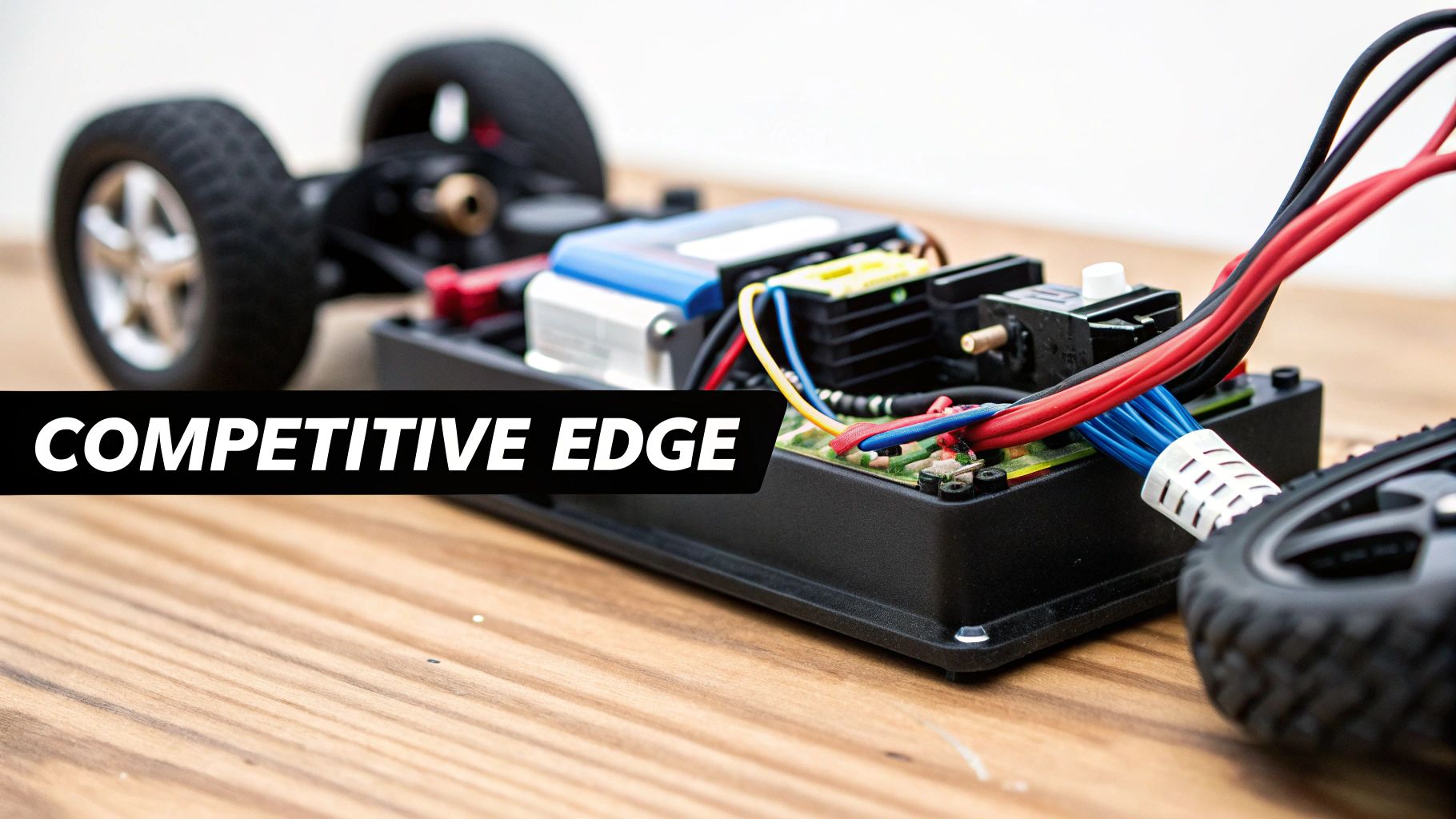
In the world of 1/10 touring and 1/12 pan car racing, your ESC is much more than just a component. It’s the central nervous system of your entire setup. It takes every subtle input from your transmitter and turns it into smooth, predictable power at the wheels.
Think of it as the conductor of an orchestra. Your battery is holding all the potential power, and the motor is ready to unleash it, but it’s the ESC that dictates exactly how and when that power is delivered. A top-tier ESC gives you that instant response and consistent delivery needed to handle intense racing without a single hiccup.
Why Your ESC Choice Matters
For anyone serious about racing, moving to a brushless ESC system is fundamental. The advantages over older brushed technology are so significant that they form the foundation of nearly every car on the podium. The benefits are clear and you can feel them on the track:
- Unmatched Precision: Modern brushless ESCs, especially sensored models from top brands like Hobbywing and Team Powers, offer incredibly smooth low-speed control and a perfectly linear power band. This is what allows you to feather the throttle through tight corners and put the power down with absolute confidence on exit.
- Greater Efficiency: These systems convert battery voltage into motor rotation with minimal energy loss. That means longer runtimes and less heat, keeping your car's performance consistent from the start of the race to the finish line.
- Higher Speeds: Brushless tech allows for much higher motor RPMs, which translates directly into more speed down the straights and faster lap times.
Choosing the right ESC isn't just an upgrade; it's a foundational decision for any competitive build. A well-matched ESC from our selection at digital-rc provides the precise control and reliability needed to shave seconds off your lap times.
This performance advantage is why the Canadian RC racing scene has completely embraced brushless technology. In fact, recent surveys among hobbyists show that over 62% of high-performance builds now rely on brushless ESCs for their superior speed and efficiency. The results speak for themselves, with ESC-equipped cars achieving win rates up to 40% higher in sanctioned events. You can discover more insights on the growing RC car market and see why making the right choice matters.
Choosing the Perfect ESC for Your Racing Class
Picking the right ESC can feel like a black art, but it’s actually pretty straightforward once you know what to look for. Forget the marketing jargon—your focus should be on a few key specs that determine whether your car will be a rocket or a paperweight.
Getting these numbers right is the foundation of a reliable, competitive electronics package. For on-road racing, it all boils down to three critical specs.
Demystifying Core ESC Specs
Every ESC has a list of specifications, but the ones that truly matter for performance are its continuous amperage rating, motor limit, and the Battery Eliminator Circuit (BEC) output. Each plays a huge role in how your car feels on the track.
- Continuous Amperage: You'll see this listed as 100A or 160A. Think of it as the ESC's endurance—it’s how much current it can handle lap after lap without overheating. A higher number means a tougher ESC that can run hotter motors in demanding conditions without breaking a sweat.
- Motor Limit (Turns): This spec, shown in turns like 5.5T or 13.5T, is non-negotiable. It tells you the most powerful motor the ESC can safely run. Mismatching this is the fastest way to fry your electronics, so always make sure your motor falls within the ESC’s recommended range.
- BEC Output: The BEC is what powers your receiver and steering servo. Its output is shown in volts and amps, like 6V/7.4V @ 5A. Modern high-voltage servos demand a powerful BEC to deliver that lightning-fast, precise steering response you need to hit your apexes perfectly.
One of the most common mistakes I see at the track is racers trying to run a motor that's too hot for their ESC. It's a guaranteed recipe for thermal shutdowns, poor performance, and eventually, a dead speed controller. Always respect the manufacturer's motor limit.
Matching the ESC to Your Class
Let's put this into practice with a couple of real-world examples from the digital-rc shop. The needs of a stock touring car are miles apart from a fire-breathing modified machine.
For a 1/10 stock touring car running a 17.5T or 21.5T motor, the Hobbywing XR10 Stock Spec G2 ESC is the go-to choice for a reason. Its 100A rating is more than enough, and it’s specifically designed to deliver buttery-smooth power for stock motors. It’s a perfect match for any competitive touring chassis where precise throttle control wins races. For a deeper dive, check out our detailed guide on matching your ESC to your motor.
On the other end of the spectrum, a modified touring car with a 5.5T motor needs a serious powerhouse. The Team Powers Radon V4 is built for exactly that kind of abuse. It handles the insane current draw of a mod motor with ease, ensuring you get maximum punch down the straightaways in a high-grip chassis.
This focus on specialized gear is a huge part of racing today. In Canada, the on-road scene has exploded, with most racers now running sophisticated electronics. According to the Canadian RC Federation, a whopping 60% of competitive 1/10 and 1/12 cars now use advanced ESCs. That's a massive leap from just 35% in 2018, showing how much brushless technology has pushed the hobby forward in terms of speed and reliability.
ESC Feature Comparison for 1/10 and 1/12 Racing Classes
To make your decision easier, here's a direct comparison of key features for popular ESCs we stock at digital-rc. This table will help you quickly see which model is the right tool for the job based on your racing needs.
| Feature | Hobbywing XR10 Stock Spec G2 | Team Powers Radon V4 | Ideal Racing Class |
|---|---|---|---|
| Continuous Amps | 100A | 160A | Stock: 100A is plenty. Mod: 160A is ideal. |
| Motor Limit | ≥ 10.5T (Touring Car) | ≥ 3.5T (Touring Car) | Matches the motor turn for your specific class. |
| BEC Output | 6V / 7.4V @ 4A | 6V / 7.4V @ 5A | Higher amperage supports powerful servos. |
| "Blinky" Mode | Yes (Zero-Timing) | Yes (Zero-Timing) | A must-have for sanctioned stock racing. |
| Key Advantage | Ultra-smooth throttle response, optimized for stock racing. | High power handling, built for extreme modified demands. | Choose based on your primary racing focus. |
Ultimately, choosing between these two comes down to your class. The XR10 Stock Spec is a scalpel, designed for the precision of stock racing, while the Radon V4 is a hammer, built to unleash the raw power of a modified motor. Pick the one that aligns with your goals, and you'll have a reliable foundation for your race program.
Installing and Wiring Your ESC Like a Pro
A top-tier ESC is only as good as its installation. You can have the best speed controller on the market, but if it’s wired poorly or mounted incorrectly, you’re just waiting for a race-ending failure. A clean, professional installation is the foundation of reliability—it’s what separates podium finishers from drivers chasing electrical gremlins in the pits.
It's about more than just looking good. The goal is to nail three things: optimal weight balance, maximum airflow, and low-resistance electrical connections. Get these right, and your electronics will survive the abuse of on-road racing and perform consistently from the first lap to the last.
This flowchart breaks down the high-level thinking that goes into matching your class, ESC, and chassis for a winning setup.
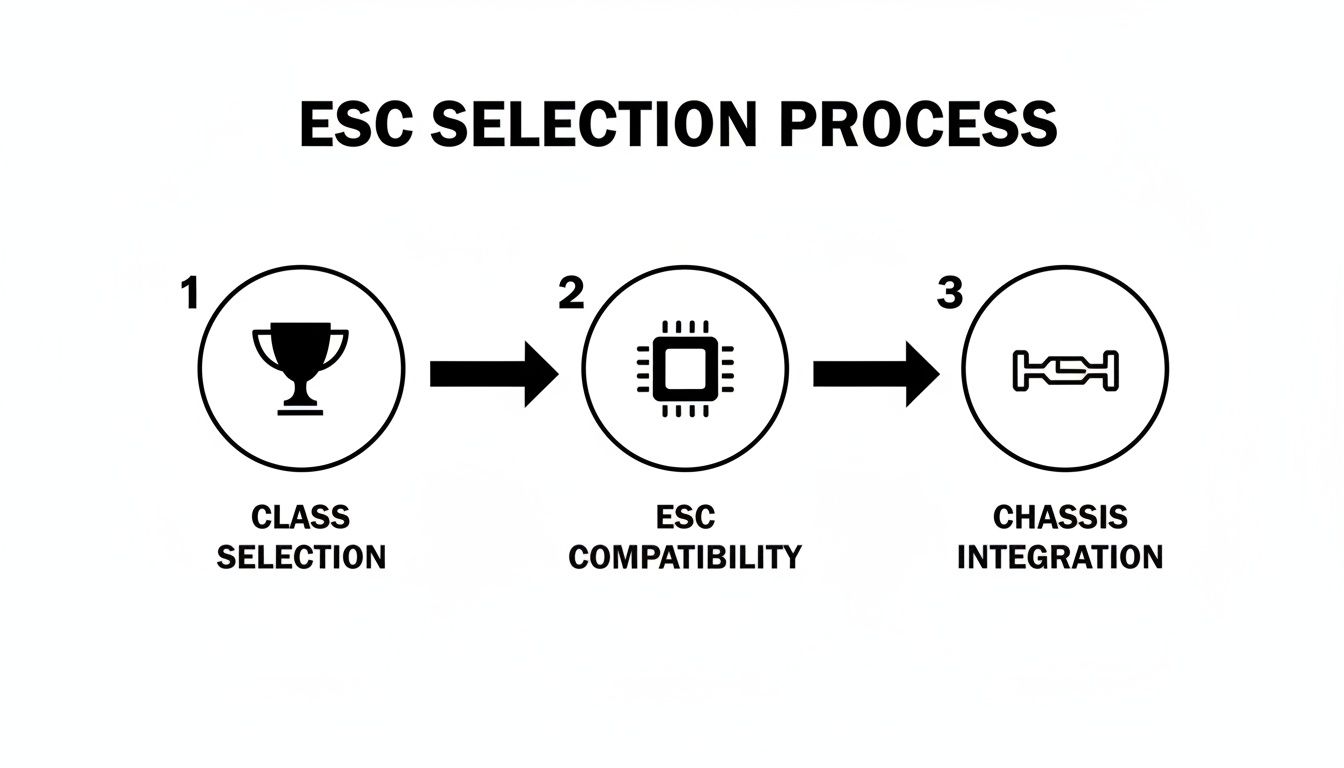
As you can see, your ESC choice is directly tied to your racing class and must physically work with your chosen chassis, whether it's an Awesomatix, XRAY, or another competitive platform.
Mounting Your ESC for Performance
Where you place the ESC on the chassis directly impacts your car's handling. Most modern touring car chassis have specific mounting spots designed to keep the car perfectly balanced left-to-right. Always use high-quality, thin double-sided tape to lock it down—you don't want it shifting or coming loose from vibrations.
Even more important is airflow. The ESC's fan is its lifeline. You have to mount the speed controller where the fan gets an unobstructed path to pull in cool air and push out heat. Avoid cramming it up against the motor or letting the body shell block it, as that just creates hot spots and invites thermal shutdowns. For instance, mounting the ESC slightly forward in most touring chassis creates a clear channel for air to flow right over the heatsink.
Soldering and Wire Management
Messy wiring is a one-way ticket to failure. Your solder joints on the motor and battery connectors need to be perfect—shiny, strong, and with no cold spots. A bad connection creates resistance, and resistance generates heat while robbing your system of precious power.
A clean wiring job isn't just for looks; it's for reliability. Every extra centimetre of wire adds resistance, and every loose connection is a potential DNF. Keep your wires as short as you can while still allowing for normal chassis flex.
Once you’ve soldered everything up, routing those wires is the next critical step. The goal is to keep them from interfering with any moving parts like the drivetrain or suspension arms. Use small zip ties or shrink tubing to bundle wires neatly and secure them to the chassis.
Here’s a pro tip: always route the sensor wire away from the motor and power wires. This helps minimize signal interference, ensuring your ESC gets a clean, crisp reading from the motor. A tidy setup should look intentional, like something you'd see on a factory team car.
To take it a step further and quiet down any electrical noise that can mess with your receiver and servo, adding a Team Powers Compact Size Noise Filter Power Capacitor is a simple but incredibly effective upgrade. This little component plugs right into your receiver and helps stabilize voltage, giving you more consistent performance from your entire electronics package.
Programming Your ESC for Maximum Performance
With your ESC installed and wired up, it's time to unlock its real potential. Programming is what turns a stock component into a precisely tuned part of your race-winning setup. This is where you dial in the esc rc car to match your driving style, motor, and the specific track you're on.
The very first thing you need to do is calibrate the ESC to your radio transmitter. This simple process teaches the ESC the exact endpoints for your neutral, full throttle, and full brake. Get this wrong, and you’ll be chasing problems all day—like a car that creeps forward on its own or brakes that feel inconsistent.
Getting the Basics Right with Calibration
Before you even think about advanced settings, you have to nail the calibration. It’s usually a straightforward process: hold down the ESC's set button as you power it on, then follow the beeps and flashes to register neutral, throttle, and brake from your transmitter.
So many racers run into frustrating issues simply because of a poor calibration. Here’s a pro tip: always check that your radio’s throttle trims and sub-trims are set to zero before you start. A clean calibration ensures that when you pull for 100% throttle on your radio, you’re getting exactly 100% output from the ESC. It's all about creating predictable, repeatable control.
Tuning Key Parameters with a Program Box
While you can make some basic tweaks with the set button, a dedicated program box is a must-have for any serious racer. Something like the Hobbywing OTA Programmer or LCD Program Box makes fine-tuning your ESC's behaviour incredibly simple.
Let’s get into the settings that will make the biggest difference on the track.
- Low Voltage Cutoff (LVC): This isn't a performance setting; it’s a critical safety feature to protect your expensive LiPo batteries. The LVC tells the ESC to cut power when the battery voltage drops too low, preventing irreversible damage. For a standard 2S LiPo, a setting between 3.2V and 3.4V per cell is the sweet spot. Don't skip this.
- Punch (Initial Throttle Feel): This controls how aggressively the power comes on from a dead stop. On a high-grip carpet track, a high punch setting can give you explosive, holeshot-winning acceleration. But on a dusty, low-grip surface, that same setting will just spin the tires. A smoother, lower punch setting will give you far more control.
- Drag Brake: This handy feature automatically applies a slight braking force the moment you let off the throttle. It feels a lot like the natural engine braking in a full-scale car and helps slow the car down into a corner without you having to touch the brake pedal. This can make your driving feel much more fluid and precise.
A well-programmed ESC does more than just make the car go; it makes it an extension of your intentions. Small adjustments to punch and drag brake can completely transform how your car feels, allowing you to attack corners with more confidence and precision.
Think of these settings as your primary trackside tuning tools. A high-bite carpet track might need aggressive punch and a bit of drag brake to help the car rotate sharply. Out on a slippery asphalt track, you’ll likely want a much softer punch and almost zero drag brake to carry as much momentum as possible. The key is to experiment and find what works for you and the conditions on the day.
Advanced Tuning and Trackside Troubleshooting
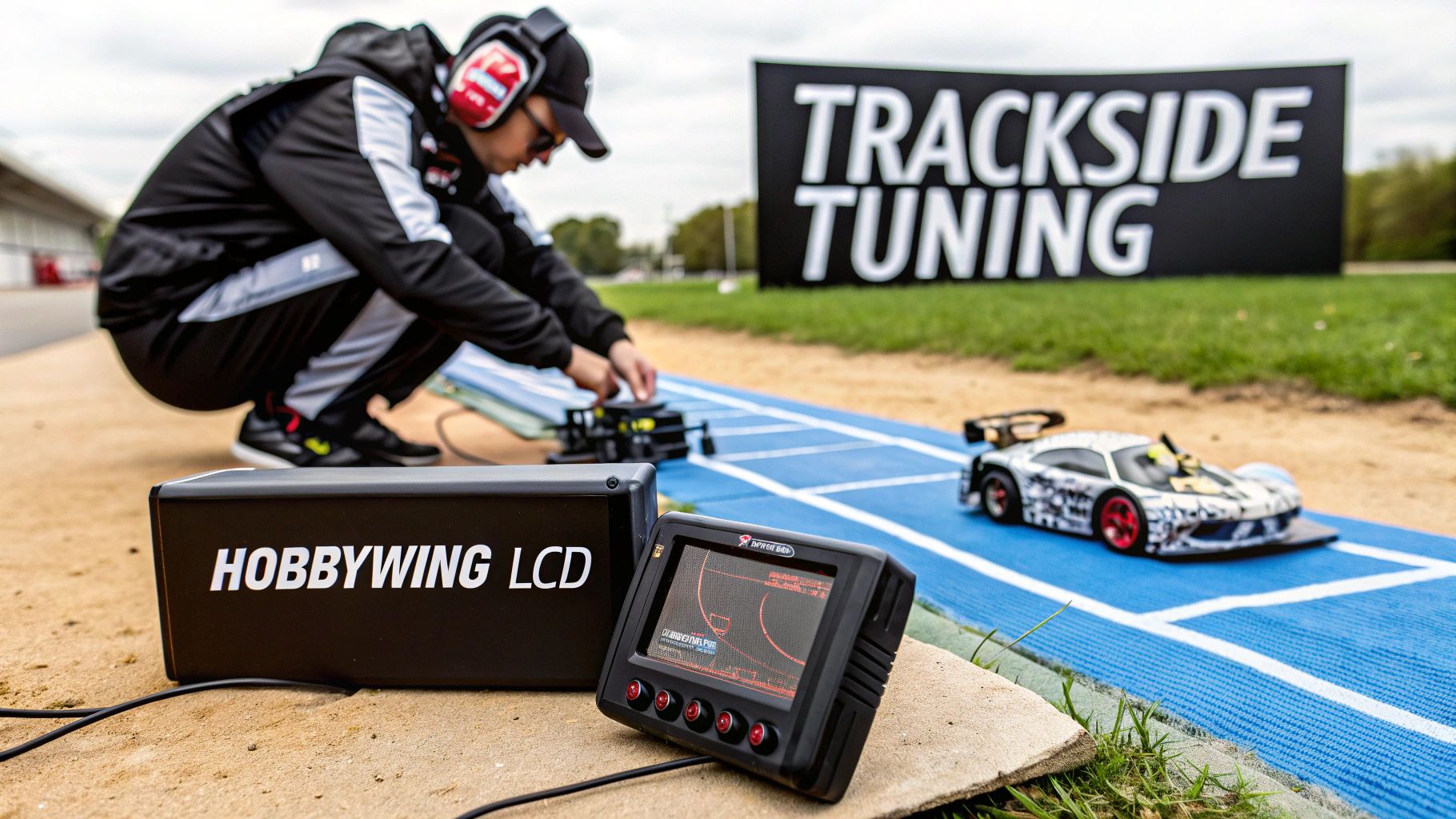
With your ESC installed and the basics dialled in, the real work begins—finding that last tenth of a second on the clock. This is where trackside tuning separates the field, turning a solid car into a real podium threat.
It’s all about making small, smart adjustments to timing, boost, and brakes to squeeze every drop of performance from your electronics. More importantly, it’s about knowing how to solve problems quickly when they pop up. A race day can be won or lost in the pits, and a solid troubleshooting game plan is your most valuable tool.
Fine-Tuning for Track Dominance
For modified class racers, tweaking motor timing and ESC boost is your ticket to blistering straight-line speed. These settings electronically advance the motor's timing as the RPMs climb, giving you a powerful surge right when you need it.
But this extra power comes at a cost: heat. Pushing the timing too far is a surefire way to cook a motor or send your ESC into thermal shutdown. The secret is to make small, incremental changes—maybe 2-3 degrees at a time—and check temperatures immediately after a short run. Your goal is to find that sweet spot of maximum speed without exceeding safe operating temps.
Another powerful setting you can play with is the brake frequency. A lower frequency (like 2kHz) gives you aggressive, punchy brakes that are perfect for tight 180-degree corners. A higher frequency (around 8kHz) delivers much smoother, more linear braking, which is often better for flowing corners where you want to carry momentum. Experimenting here can completely change your confidence on corner entry.
On-The-Fly Troubleshooting Guide
No matter how well you prep, things go wrong. Knowing what to look for lets you diagnose and fix problems in minutes, not hours.
- Blinking Lights Mean Something: Your ESC talks to you through its LEDs. A constant flashing light in neutral usually means you're in "blinky" (zero-timing) mode for stock racing. If you see an unusual sequence after a run, check your ESC manual. It could be signalling a thermal shutdown, low-voltage cutoff, or a sensor wire problem.
- Cogging or Stuttering: If your car hesitates off the line, the very first thing to check is your sensor wire. Make sure it's plugged in securely at both the motor and the ESC. This is the cause of cogging 90% of the time. Seriously.
- Inconsistent Brakes: Brakes that feel strong one moment and weak the next often point to a bad radio calibration. Before you do anything else, re-calibrating your throttle and brake endpoints is a quick fix that solves this more often than not.
A thermal shutdown is your ESC's self-preservation mode. When it happens, don't just let it cool down and go back out. It's a clear signal that something in your setup—gearing, timing, or airflow—is pushing the system past its limits.
One of the most common race-day killers is heat. Understanding why proper cooling is critical for RC racing performance is non-negotiable. If your ESC keeps shutting down, your gearing is likely too aggressive or your boost settings are too high. Start by dropping your pinion size, as that has the biggest impact on load and heat.
Your Top ESC Questions Answered
Even with a perfectly dialled-in car, questions always pop up in the pits. Here are some straightforward answers to the most common things we hear from on-road racers, drawing from our own experience with the gear we trust and sell here at digital-rc.
Getting these fundamentals right can solve a lot of frustrating issues and keep your car running at its peak.
Sensored vs. Sensorless: What's the Real Difference?
One of the first questions racers ask is about sensored versus sensorless systems. It's simple: a sensored setup uses a dedicated cable to tell the ESC the motor rotor's exact position at all times.
This constant feedback loop allows for incredibly smooth low-speed throttle control and completely eliminates "cogging"—that stuttering you sometimes see when trying to crawl away from a dead stop. For the kind of precision you need in 1/10 and 1/12 on-road racing, a sensored combo from a brand like Hobbywing or Team Powers is the only way to go. You get predictable, linear control every time.
For competitive on-road racing, a sensored ESC and motor combination is non-negotiable. The smooth, linear power delivery is essential for navigating technical track sections and putting down consistent lap times.
Choosing the Right BEC Voltage: 6.0V or 7.4V?
Your ESC's BEC (Battery Eliminator Circuit) is what powers your receiver and steering servo. Most modern race ESCs let you choose between different voltages, typically 6.0V or 7.4V.
So, which one should you pick? Always check your servo's specs first. The vast majority of modern racing servos are "high-voltage" (HV) compatible, which means they're built to handle 7.4V. Switching to the higher voltage setting will give your servo noticeably faster transit speeds and more torque, resulting in quicker, more responsive steering. If you're unsure or running an older servo, stick with 6.0V—it's the safe default.
Why Is My ESC Overheating?
An overheating ESC is a huge red flag. When this happens, it almost always comes down to one of three common culprits:
- Over-Gearing: This is the number one cause, by a long shot. Running a pinion gear that’s too large for the track layout puts a massive load on the entire system, which generates a ton of heat.
- Aggressive Settings: Pushing your motor timing or ESC boost settings to the absolute maximum will send temperatures soaring.
- Poor Airflow: Make sure your cooling fan is working properly and isn't clogged with debris. It’s also critical that the ESC is mounted where it can get plenty of cool, unobstructed air.
If your ESC hits thermal shutdown, the first thing to do is check your gearing. Drop your pinion down a tooth or two and try again. Your motor can safely run up to around 70-80°C, but your ESC should always stay significantly cooler than that.
Ready to build a reliable, podium-finishing electronics package? At digital-rc, we stock a curated selection of race-proven ESCs, motors, and accessories from Hobbywing, Team Powers, and more, all chosen to give you a competitive edge. Explore our collection and experience fast, free delivery across Canada. Find your next upgrade at https://digital-rc.ca.