

The Winning Guide to Li-Po 7.4V Battery Performance
A 7.4V LiPo battery is the beating heart of nearly every competitive 1/10 scale on-road RC car today. It's the go-to power source for a reason, offering a perfect trifecta of high energy density, consistent power, and low weight. We call it a "2S" pack because it uses two (2) lithium-polymer cells connected in series (S) to hit that nominal voltage, giving modern race cars the punch and runtime they need to win.
Why the 7.4V LiPo Is the Heart of Your RC Race Car
Walk through any competitive pit lane and you’ll see the 7.4V LiPo battery is the undisputed champion. This technology didn't just improve on the old Nickel-Metal Hydride (NiMH) packs; it completely rewrote the rules for performance in modern on-road RC racing. Its dominance is why it’s become the standard for everything from 1/10 touring cars to nimble 1/12 pan cars.
The changeover from old tech was fast and for good reason. When Canadian RC racers talk about a “2S 7.4V LiPo,” they’re referring to the battery that has become the national default for 1/10 on-road competition. Data from Natural Resources Canada backs this up, showing that lithium-based rechargeable batteries jumped from under 10% of Canada’s market in the early 2000s to over 40% by the late 2010s, with the RC hobby being a key driver. Racers ditched their 7.2V NiMH packs for 7.4V LiPo technology that delivered 20–30% more energy per gram and a much flatter, more consistent discharge curve.
The Winning Combination of Power and Precision
So, what makes this specific battery the weapon of choice for racers? It really boils down to a few key advantages that directly lead to faster lap times and more predictable handling on the track.
- Incredible Energy Density: LiPo batteries simply cram more power into a smaller, lighter package. This shaves weight off your car, which means better acceleration, sharper braking, and more agile cornering.
- Rock-Solid Power Delivery: Remember how NiMH batteries would "fade" during a run? A LiPo holds a higher, more stable voltage right until it's nearly empty. This means your car feels just as punchy on the last lap as it did on the first.
- Lightweight by Design: Every single gram counts in racing. The reduced weight of a LiPo gives you more freedom in your chassis setup, letting you add ballast exactly where you need it to perfect your car's balance.
For a racer, consistent power is everything. The flat discharge curve of a 7.4V LiPo ensures your motor performs predictably from the start tone to the finish line, eliminating the guesswork that came with older battery types.
Whether you're a newcomer building your first kit or a seasoned pro fine-tuning a high-end chassis, understanding this technology is non-negotiable. Throughout this guide, we’ll dive into the core specs, proper maintenance, and performance tuning tricks, all focused on the high-performance packs we stock right here at Digital-RC. To get started, check out our complete guide to LiPo battery selection for powering your RC setup for maximum performance.
Understanding the Numbers on Your LiPo Battery
Picking up a 7.4V LiPo battery from our store can feel a bit like reading a secret code. The label is covered in numbers and letters—7.4V, 2S, 5200mAh, 120C—and every single one is a critical piece of the performance puzzle.
Think of these specs as the battery's DNA. They tell you everything about its power, how long it will last on the track, and even how it will affect your car's handling. Let's break down this technical language into simple terms so you know exactly what you’re putting into your race car.
Voltage (V) and Cell Count (S)
The first number you'll usually see is 7.4V, which is the nominal voltage of the pack. This is the undisputed industry standard for 1/10 scale on-road racing. But where does that number come from?
It's determined by the cell count, marked by the letter "S". A "2S" battery means it contains two (2) individual 3.7V lithium-polymer cells wired together in Series (S). When you connect them in series, their voltages add up: 3.7V + 3.7V = 7.4V. This setup delivers the perfect amount of power for the motors and Electronic Speed Controls (ESCs) used in competitive racing classes.
This simple combination is why LiPo batteries, especially the 7.4V variant, have become the only real choice for serious RC racers.
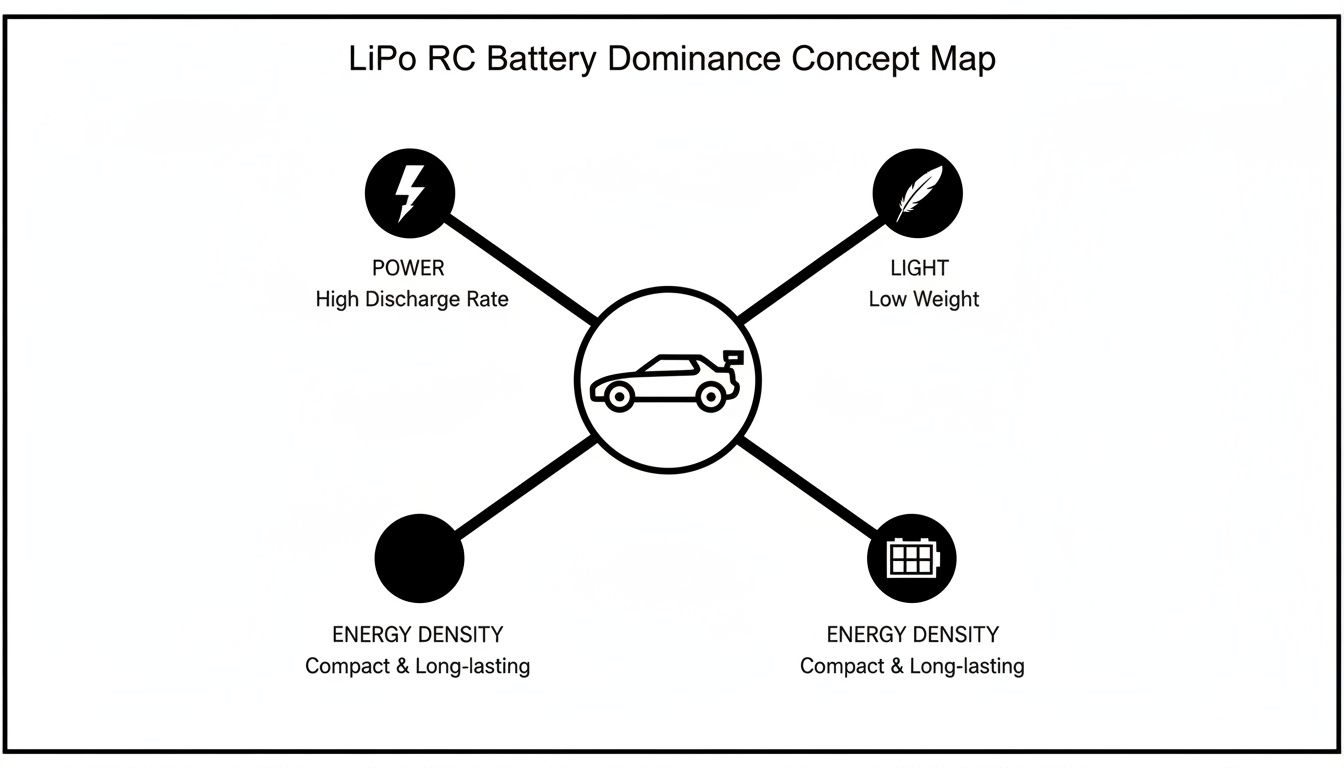
As you can see, it's that trifecta of raw power, minimal weight, and high energy density that gives racers the edge they need to win.
Capacity (mAh): Your Fuel Tank
Next up is capacity, measured in milliamp-hours (mAh). The easiest way to think about capacity is to see it as your car's fuel tank. A battery with a higher mAh rating, like 6000mAh, holds more energy and will generally give you a longer runtime than a pack with a lower rating, like 4000mAh.
But in racing, more isn't always better. A bigger fuel tank adds more weight. In a precision-tuned race car, an extra 30-40 grams can completely change the chassis balance and handling. Your goal is to find a capacity that gets you through a 5-minute qualifier or an 8-minute main event without adding any dead weight that could slow you down.
C-Rating: The Punch
The C-rating is probably the most important—and most misunderstood—spec on the label. It represents the battery’s discharge rate, or how quickly it can deliver its stored energy. Simply put, it's the "punch" or raw acceleration you feel when you pull the trigger.
A higher C-rating means the battery can supply more current to your motor on demand, without breaking a sweat. You'll often see two C-ratings listed:
- Continuous Rating: This is the maximum current the pack can consistently deliver without damage. For example, a 5200mAh (5.2Ah) battery with a 100C continuous rating can theoretically supply 520 amps (5.2Ah x 100C).
- Burst Rating: This is a much higher number, indicating the current the battery can deliver for just a few seconds—perfect for that explosive acceleration out of a tight corner.
A battery with a weak C-rating will struggle to feed a powerful motor, causing a "voltage sag" that makes the car feel flat and sluggish. For competitive racing, a rating of 100C or higher is what you want. It ensures your ESC and motor get all the juice they can handle.
A high C-rating is your performance insurance. It guarantees the battery can meet the peak current demands of your motor, maintaining higher voltage under load and giving you a real advantage down the main straightaway.
Physical Size and Hardcase Construction
Finally, let's talk about the physical stuff. For the safety and durability needed in on-road racing, a hardcase LiPo is mandatory, not optional. The tough plastic shell protects the delicate internal cells from impacts during a crash, which helps prevent dangerous punctures.
The battery's dimensions (length, width, and height) are just as critical. You have to make sure the pack you choose actually fits into your chassis's battery tray. A battery that's too tall or too long is useless, which is why all our batteries at Digital-RC are hand-picked to fit popular racing platforms.
To help you see how these specs translate to the real world, here’s a quick comparison of our common stock.
7.4V LiPo Spec Comparison for On-Road Racing
This table breaks down how different capacity and C-rating combinations affect performance in a typical 1/10 touring car. It’s all about finding the right trade-off between runtime, weight, and power delivery for your specific racing class.
| Battery Spec | Typical Runtime (5-min Qualifier) | Approx. Weight | Best Use Case |
|---|---|---|---|
| 4500mAh / 120C | Ample, with a comfortable margin | ~190-210g | Stock racing where minimum weight is key for agility |
| 5200mAh / 120C | More than enough for one run | ~210-230g | All-purpose for stock and modified, balancing punch and weight |
| 6000mAh / 120C | Can potentially run two qualifiers | ~230-250g | Modified racing where maintaining voltage under heavy load is critical |
As you can see, choosing a battery isn't just about picking the biggest numbers. It’s a strategic decision that directly impacts how your car behaves on the track.
Choosing the Right 7.4V LiPo from Our Collection
Picking the perfect li-po 7.4v battery from our collection isn't just about grabbing the one with the biggest numbers. Real performance comes from matching the pack's characteristics to what you're trying to accomplish on the track. This guide will walk you through the Digital-RC catalogue, helping you make a strategic choice that leads to better results.
Every racing class has its own power demands. The battery that helps you win in a 17.5T stock touring class could be the wrong choice entirely for a high-powered modified car. It’s all a game of balancing weight, power delivery, and runtime to find that competitive edge.
Matching Battery Specs to Your Race Class
In the world of spec racing, like the popular 17.5T touring class, shaving off weight is often a direct path to victory. A lighter car just accelerates faster, brakes later, and changes direction more quickly. For this kind of racing, a lower-capacity, high-punch battery is a race-winning tool.
Modified racing, on the other hand, is a different beast. The insane current draw from low-turn motors puts a massive strain on a battery. Here, a higher-capacity pack is essential not just for runtime, but to fight off voltage drop under that heavy load. A bigger pack acts like a more stable power reservoir, helping maintain higher voltage all the way down the straightaway.
- For Stock 17.5T Touring: Prioritize a lighter, high-punch battery. Look for packs in the 4500mAh to 5200mAh range with a high C-rating (120C+) to deliver that explosive acceleration without bogging the car down with unnecessary weight.
- For Modified Touring: Focus on higher capacity to keep your voltage up. A pack in the 5500mAh to 6200mAh range gives you the stability needed to power demanding motors through an entire race without fading.
Pairing the Right C-Rating and Capacity
The C-rating tells you how well your battery can deliver its power, and it has to be matched to your electronics. An under-specced battery will struggle, get hot, and kill your performance. Luckily, modern LiPo technology gives most racers a pretty significant performance buffer.
This trend is reflected in Canadian purchasing patterns, which show a strong shift toward mid-capacity, high-C-rate packs for 1/10 cars, with most racers comfortable in the CAD 60–100 price range. Take a typical 2S 7.4V hardcase pack with 5200mAh capacity and a 50C rating—it can theoretically deliver 260 amps (5.2Ah x 50C). This is way above the 80–120 amp bursts you’ll see in 17.5T to 10.5T racing, giving you a huge safety margin against voltage sag and making sure your motor gets all the power it needs. You can find more insights on these trends over on Ampow's Canadian warehouse page.
Think of it this way: choosing a battery with a high C-rating is like installing wider pipes for your water supply. Even if you don't need all that flow all the time, the system is never strained, ensuring you get consistent pressure (voltage) whenever you open the tap (throttle).
Standardizing Your Connectors for Reliability
One of the most overlooked parts of a bulletproof electronics setup is standardizing your connectors. Mixing and matching different plugs is a recipe for poor connections, high resistance, and frustrating failures at the worst possible time. At Digital-RC, we stock batteries with the most common and reliable connectors used in competitive racing.
This makes sure you can quickly and easily swap packs between practice, qualifiers, and the main event without ever fumbling with an adapter. A clean, direct connection is the key to minimizing power loss.
Common Connector Types in Our Store:
| Connector Type | Best For | Key Advantage |
|---|---|---|
| T-Style (Deans) | All-purpose reliability | Secure, low-resistance connection that is difficult to plug in backwards. A long-time industry standard. |
| 5mm Bullets | Modified and high-current racing | Offers the lowest possible resistance for maximum power delivery directly from the battery to the ESC. |
By carefully thinking about your race class and standardizing your connectors, you can confidently pick a li-po 7.4v battery from our collection that is perfectly matched to your car, your budget, and your goals on the track.
Mastering Your LiPo Charging and Storage Routine
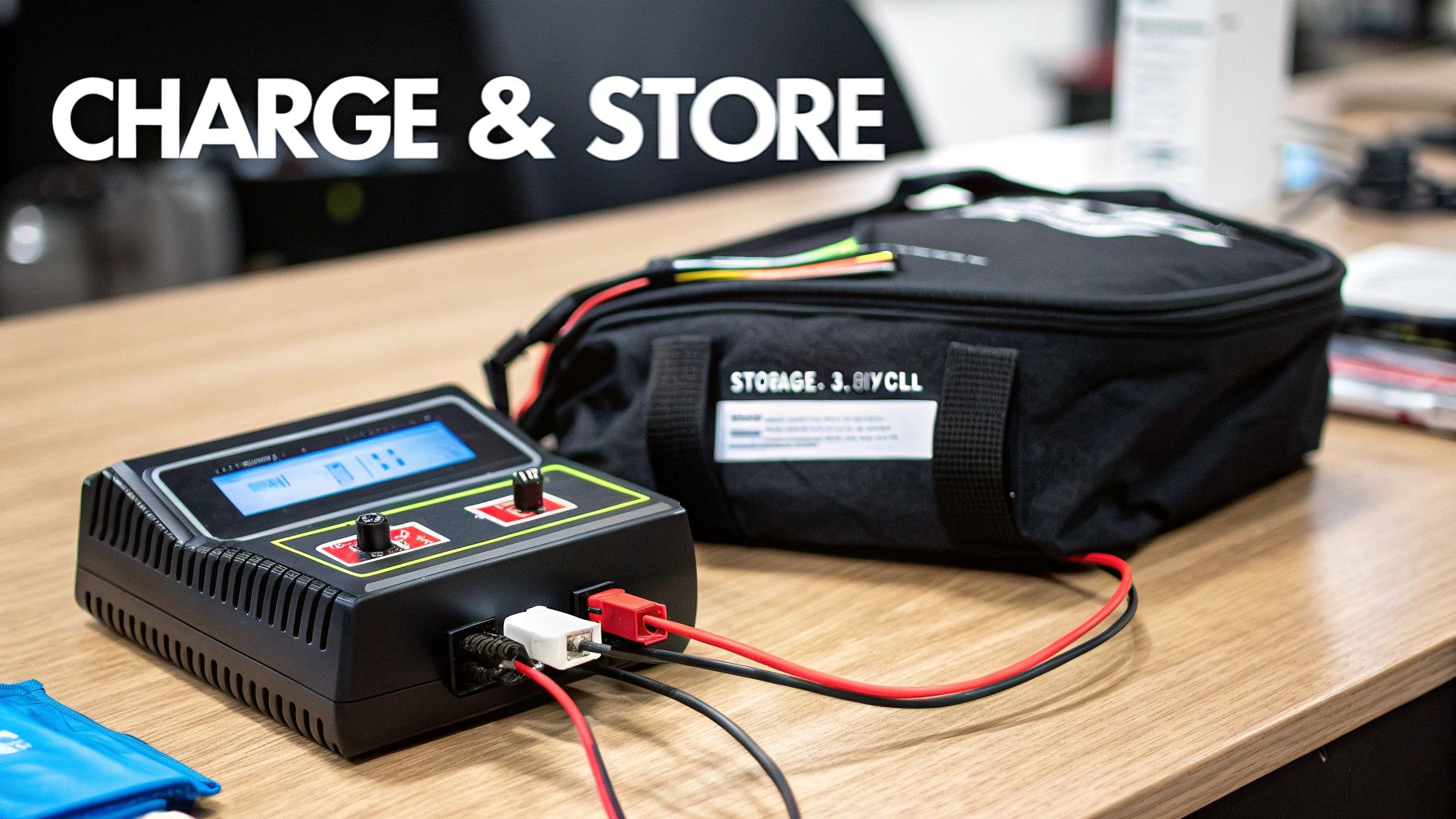 Great performance from your li-po 7.4v battery is built on a foundation of disciplined care. A consistent, correct routine for charging and storage doesn't just extend the life of your packs—it ensures they’re safe, healthy, and ready to deliver maximum punch when you hit the track.
Think of this routine as your best defence against premature battery degradation. It protects your investment and keeps you competitive. Neglecting these simple steps is the fastest way to turn a powerful battery into a weak one.
The Critical Role of the Balance Charger
Your smart charger is the most important tool in your RC pit box. Its main job isn’t just to pump electricity into your battery, but to do it intelligently and safely. This is where the "balance charge" function becomes non-negotiable.
A li-po 7.4v battery contains two individual 3.7V cells. During a race, these cells can discharge at slightly different rates, creating a voltage imbalance. A balance charge uses that small white plug on your battery to monitor and charge each cell independently, making sure they both hit a perfect 4.20V without one getting overcharged.
Think of it like filling two tires on a car. If you only check the total pressure, one could be dangerously overinflated while the other is low, making the car unstable. A balance charger makes sure each "tire" is inflated to the exact same pressure for peak performance and safety.
Skipping the balance charge means one cell will degrade faster than the other, killing your pack's performance, shortening its lifespan, and creating a potential safety risk. For this reason, you should always use the balance charge mode for your 2S packs. To maximize the lifespan and ensure the safe operation of your 7.4V LiPo, understanding proper charging techniques is paramount. For a deeper dive into charging lithium batteries safely and efficiently, this resource offers excellent guidance.
Setting Your Charge Rate: The Easy 1C Rule
Once you’ve selected the balance charge mode, the next step is setting the right charge amperage. Thankfully, this is incredibly simple with the "1C rule." The 'C' stands for capacity, and charging at a 1C rate is the universally accepted standard for safety and battery longevity.
To calculate the 1C rate for your battery, just take its capacity in mAh and move the decimal point three places to the left.
- For a 5200mAh battery, 1C is 5.2 amps.
- For a 6000mAh battery, 1C is 6.0 amps.
- For a 4500mAh battery, 1C is 4.5 amps.
While some modern batteries claim they can handle higher charge rates (like 2C or 5C), sticking to the 1C rule is a smart move. It puts less stress on the cells, which helps maintain low internal resistance and consistent power over hundreds of cycles. A quality charger is just as critical as the battery itself, and we've put together a guide on finding the best LiPo battery charger to help you make the right choice.
The Golden Rule: Storage Voltage
Perhaps the single most important habit for LiPo care is putting your batteries to a proper storage voltage after a race day. Leaving a li-po 7.4v battery fully charged for more than 24-48 hours causes its internal chemistry to degrade rapidly. Leaving it fully drained is just as bad.
The universally agreed-upon safe zone for storage is 3.80V to 3.85V per cell.
Every modern smart charger has a dedicated "Storage" function. When you're done racing, just connect your packs, select this mode, and the charger will automatically bring each cell to this optimal voltage. This one simple step can literally double the effective lifespan of your batteries.
Essential Safety Gear and Best Practices
Safety is absolutely non-negotiable when dealing with LiPos. Modern packs are very reliable, but they store a tremendous amount of energy and must always be handled with respect.
Essential Safety Checklist:
- Always Use a LiPo-Safe Bag: When charging, storing, or transporting your batteries, always keep them in a fire-resistant LiPo sack or container.
- Never Charge Unattended: Stay present during the entire charging process. This lets you immediately spot any potential issues, like a battery starting to swell.
- Charge on a Fire-Resistant Surface: Use a concrete floor, a ceramic tile, or a dedicated charging station—never on a flammable surface like a wooden workbench or carpet.
These practices aren't just suggestions; they are often mandatory at RC tracks. In Canada, regulations and logistics have shaped how 7.4V LiPo batteries are handled. Because Transport Canada classifies them as dangerous goods for air shipment, many hobby retailers restrict them to ground service only. At the track, Canadian clubs often mirror international guidelines that require storage at 3.7–3.85V per cell and strictly prohibit unattended charging. Combined with local fire-code guidance, many indoor tracks mandate LiPo sacks in the pits for all 7.4V race packs.
Using Your Battery as a Chassis Tuning Tool
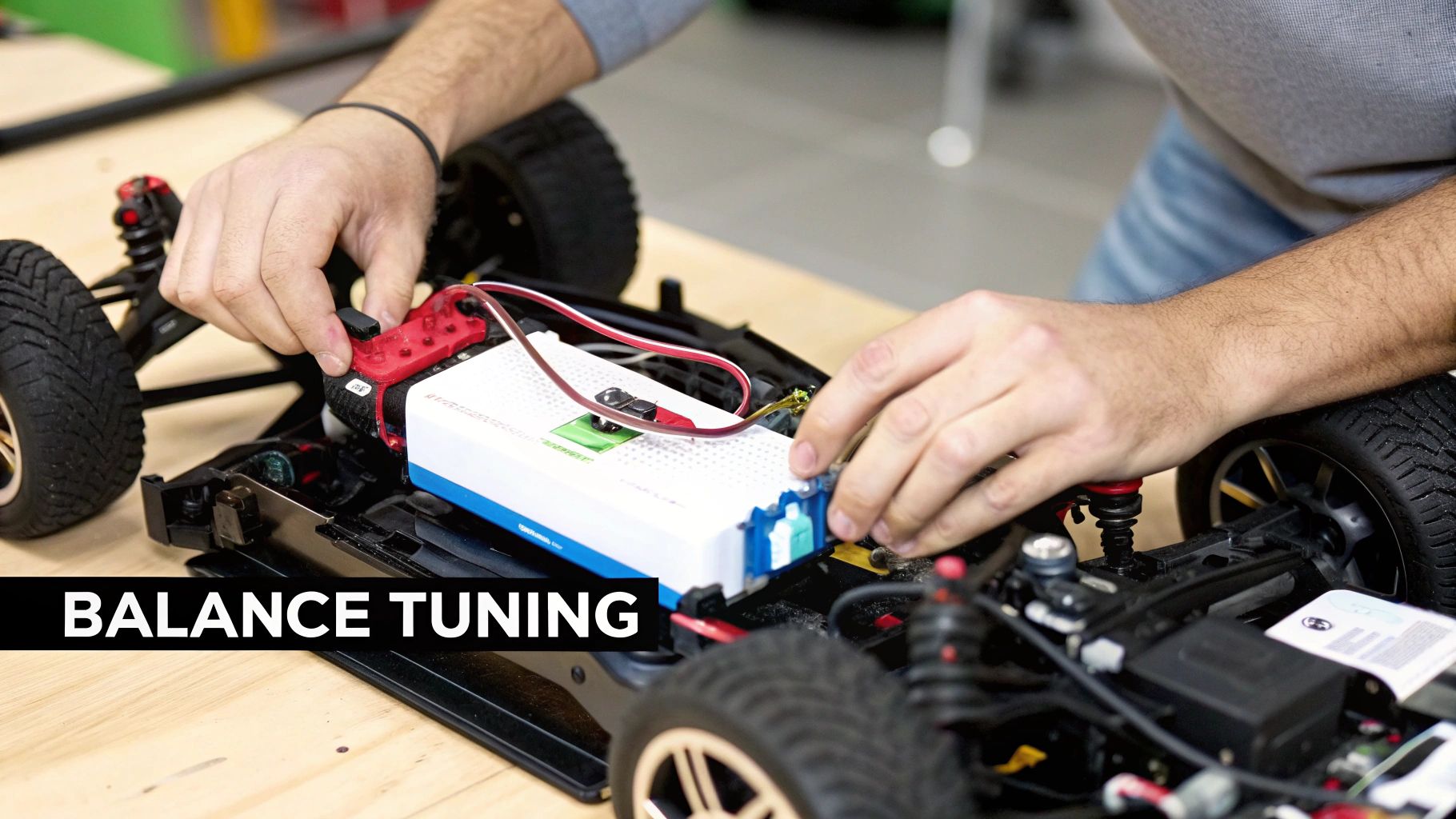
A li-po 7.4v battery is so much more than just a power source—it's one of the most effective tuning tools you have. Experienced racers understand that a battery's weight and position can change a car’s handling just as much as shock oil or spring rates. This is where you find a real competitive edge.
Moving past basic charging routines and into strategic battery management is how you start shaving tenths off your lap times. When you know how to shift your battery’s position and keep an eye on its health, you unlock a new level of setup control.
Tuning with Weight Distribution
Nearly every modern 1/10 scale touring car chassis lets you adjust the battery placement. This simple feature allows you to shift the battery forward or backward, which completely changes the car's weight bias and how it behaves on the track. Just make sure it’s secured properly with strapping tape or a dedicated mount so your adjustments stay consistent.
This is one of the quickest and most effective ways to alter corner entry and exit characteristics. It's a small change with a massive impact.
-
Battery Forward: Pushing the battery toward the front axle adds more weight over the front tires. This usually gives you more aggressive steering on corner entry, helping the car bite and turn in sharply. It’s a go-to adjustment for tight, technical sections of a track.
-
Battery Backward: Sliding the battery to the rear puts more weight over the back end. This typically increases rear traction, especially when you’re on the power and accelerating out of a corner. If your car feels loose, this can help calm it down and provide more stability.
Think of your battery as a movable weight block. Just a few millimetres of adjustment can transform a car from twitchy to planted, or from pushing wide to nimble and responsive. Experimenting with its position is a critical step in dialling in your car for any track.
Knowing how to measure these changes is key to building a consistent setup. The principles of chassis balance apply directly to on-road tuning, and you can learn more by reading about why every serious 1/10 offroad racer needs a setup board.
Advanced Tuning with Internal Resistance
Beyond its physical location, the electrical health of your li-po 7.4v battery is a huge performance factor. For any serious racer, the single most important metric is Internal Resistance (IR), measured in milliohms (mΩ). Lower IR is always better.
A battery with low IR delivers its power more efficiently, wasting less energy as heat. On the track, this translates directly to more "punch" and higher sustained voltage throughout a run. A fresh pack from our store with an IR of 1-2 mΩ per cell will feel explosive. An old pack with an IR climbing to 8-10 mΩ will feel flat and sluggish.
Essential Maintenance for Peak Performance
Keeping your batteries in race-ready condition requires a consistent routine. These checks ensure they perform reliably and, most importantly, safely.
- Inspect for Puffing: Before every single charge, give the hardcase a visual check for any swelling or puffing. A puffed battery has internal damage and must be retired and disposed of safely—immediately.
- Clean Your Connectors: Keep your battery’s bullet or T-style connectors clean and free from dirt and corrosion. A bad connection creates resistance, which robs your motor of precious power.
- Monitor IR: Use a quality charger to check the IR of each cell before a race day. Tracking this number over time is the best way to know a pack's health and when it's time to replace it.
On race day, you'll see top drivers "cycle" their packs—discharging and then recharging them—to gently warm them up and ensure they're at peak readiness. By identifying your battery with the lowest IR and saving it for the A-Main, you're giving yourself the best possible shot when it counts.
Your 7.4V LiPo Battery Questions Answered
Even with a solid grasp of how to choose and tune your 7.4V LiPo, questions always pop up in the pits. This section tackles the most common queries we hear from on-road racers, giving you clear, straightforward answers to solve problems and get your power setup dialled in.
Think of this as your trackside FAQ. From decoding the numbers on the label to knowing when it's time to retire an old pack, these answers will fill in the gaps and get you back to focusing on your lines.
What Does '2S' Mean on a 7.4V LiPo?
That '2S' on your battery label is a simple but critical piece of info. It stands for "2 Cells in Series." A single LiPo cell has a nominal voltage of 3.7V, which just isn't enough juice for the high-performance motors we use in 1/10 scale RC.
To hit the industry-standard 7.4V, manufacturers wire two of these cells together in series (positive to negative). This move doubles the voltage (3.7V + 3.7V = 7.4V) while the pack's capacity (mAh) stays the same as a single cell.
This is also why your balance plug has three wires—one ground and a separate positive tap for each of the two cells. It lets your balance charger see and charge each cell individually, keeping them perfectly matched for peak performance and safety.
How Do I Know When to Replace My LiPo Battery?
Knowing when to retire a pack is key for both speed and safety. A worn-out battery won't just cost you lap time; it can be a serious hazard. There are three clear signs that a 7.4V LiPo is past its prime.
First and most obvious is physical swelling, or "puffing." If your battery's hardcase is bulging or feels soft, it means there's a problem with the internal chemistry. The battery is damaged and must be taken out of service immediately and disposed of safely.
Second, check the Internal Resistance (IR) with a quality charger. A fresh, healthy race pack will have a super low IR, usually between 1-3 milliohms (mΩ) per cell. As a battery ages and degrades, this number climbs. Once the IR is consistently above 8-10 mΩ per cell, you'll feel a noticeable drop in power on the track.
Finally, trust your gut. You'll notice the car lacks its usual punch out of the corners and fades much earlier in a five-minute run. When you see or feel these signs, it’s time for a fresh pack from our collection.
A high IR is like a clog in a fuel line. No matter how much energy is in the tank, the engine can't get it quickly enough. Retiring a high-IR battery is a performance upgrade, not just a maintenance task.
Can I Use Any 7.4V LiPo in My RC Race Car?
Not quite. While plenty of batteries are labelled 7.4V, not all are cut out for the demands of competitive on-road racing. Using the wrong type of pack is unsafe and will definitely hurt your performance.
For racing, you absolutely must use a "hardcase" battery. That rigid plastic shell is non-negotiable—it protects the fragile cells inside from impacts during a crash. You also have to check the battery's dimensions (length, width, height) to make sure it physically fits into your chassis.
Most importantly, the battery's C-rating has to be high enough for your motor and ESC. A rating of 100C or higher is a safe benchmark for modern 1/10 racing to prevent overheating and voltage sag under load. Lastly, make sure the connector type—like 4mm or 5mm bullets—matches your ESC. We specifically stock batteries at Digital-RC that meet these critical competitive standards.
What’s the Safest Way to Dispose of an Old LiPo?
Proper disposal is the final step in a battery's life, and it has to be done with care. Never, ever throw a LiPo battery in your regular household rubbish.
To safely retire a pack, you first need to discharge it completely to 0 volts. The best way is to use your charger's dedicated "Discharge" function, setting the end voltage as low as it will go. Once the pack is fully inert and a voltmeter confirms it's at 0V, you can cut the connectors off one at a time to prevent any chance of a short.
The neutralized battery is then ready for recycling. Take it to a local battery recycling depot or a hobby shop that offers a disposal service. Many Canadian municipalities have dedicated e-waste programs that will accept them, ensuring the materials are handled correctly.
Ready to power your race car with a battery that delivers proven performance and reliability? The collection at Digital-RC is curated specifically for competitive on-road racers. Explore our selection of high-performance 7.4V LiPo batteries and find the perfect match for your chassis today.