

Your Essential Guide to the LiPo Battery 7.4V
When you're chasing podium finishes in 1/10 and 1/12 scale on-road RC, your power source is everything. The lipo battery 7.4v, more commonly known in the pits as a 2S LiPo, has become the standard for a reason. It delivers the perfect blend of voltage, low weight, and consistent power that both top-tier racers and dedicated hobbyists demand.
This battery isn't just a component; it's the heart of your car's performance.
The Heart of Your RC Car
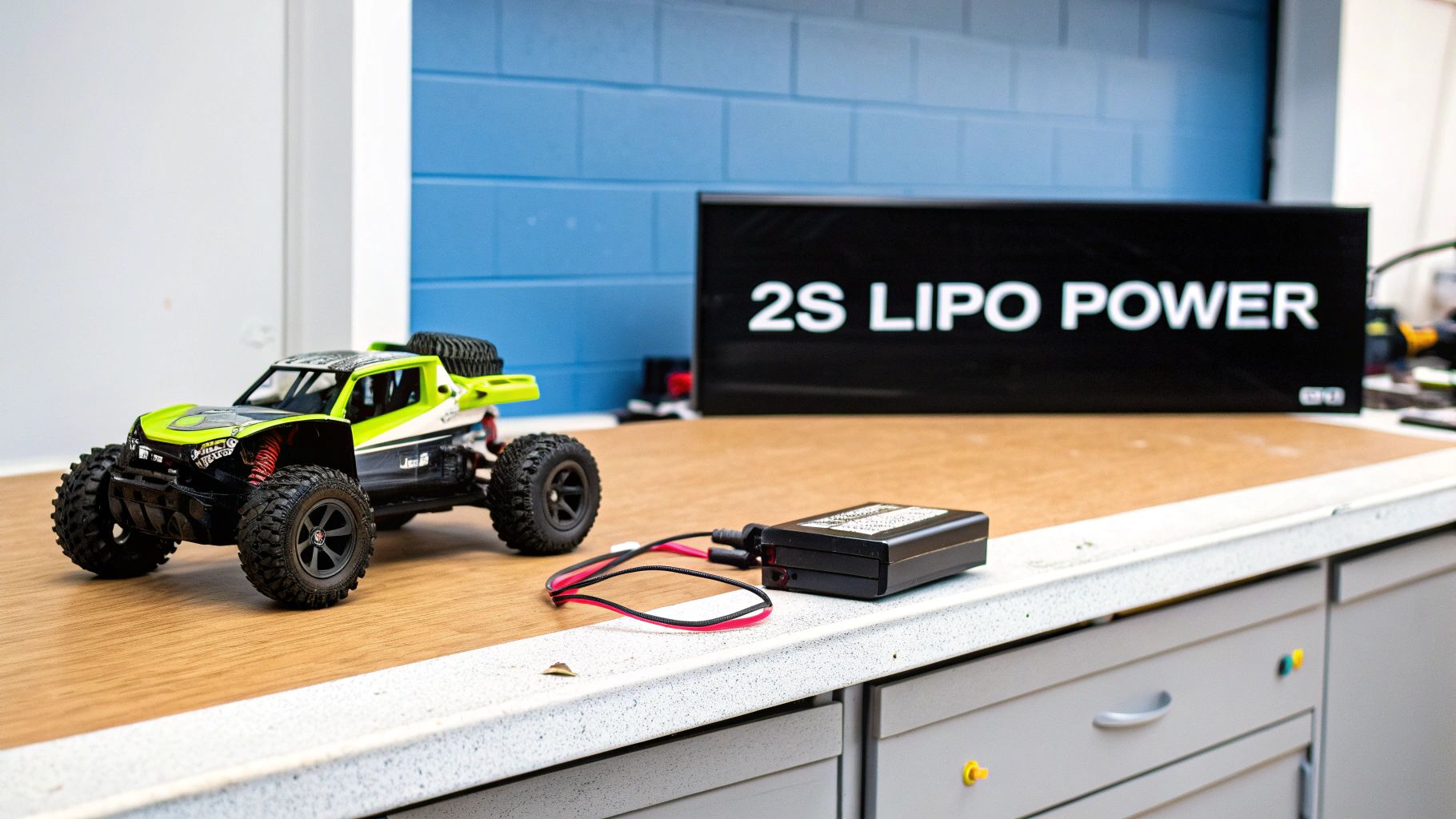
Think of your RC car’s battery as its engine. It’s what dictates your acceleration out of the corners, how long you can stay on the track, and how consistently the car performs lap after lap. For nearly all modern on-road racing, the 7.4V LiPo battery is the undisputed champion, having long since replaced older, heavier NiMH (Nickel-Metal Hydride) packs.
The secret to its dominance is in its construction. A 7.4V LiPo is built from two individual lithium-polymer cells, each with a nominal voltage of 3.7V. By connecting these two cells in series—think of it as linking them end-to-end to create a more powerful battery—their voltages combine for a total of 7.4V.
This is where the term “2S” comes from: 2 cells in Series.
Understanding the 2S Advantage
This 2S configuration is the sweet spot for modern RC electronics. It provides plenty of voltage to unleash the full potential of high-performance brushless motors and electronic speed controllers (ESCs) without adding unnecessary weight. In competitive racing, where every gram can mean the difference between winning and losing, this balance is absolutely critical.
Unlike older NiMH batteries that would fade and feel sluggish as they discharged, a lipo battery 7.4v maintains a much flatter discharge curve. This means your car feels just as punchy and responsive on the last lap as it did on the first.
A stable voltage output translates directly to consistent and predictable handling on the track. When your car responds the same way every time you pull the trigger, you can focus on hitting your lines and improving your lap times.
To put it simply, here’s a quick look at what defines a 7.4V LiPo pack.
7.4V (2S) LiPo Battery At a Glance
| Specification | What It Means For You | Typical Value |
|---|---|---|
| Nominal Voltage | The standard operating voltage; determines the power sent to your motor. | 7.4V |
| Cell Count | Two internal cells connected in series. This is the "2S" in the name. | 2 Cells |
| Fully Charged Voltage | Each cell charges to 4.2V, giving the pack a fresh-off-the-charger punch. | 8.4V |
| Chemistry | Lithium-Polymer, offering high energy density and low weight. | LiPo |
| Primary Use | The go-to power source for 1/10 & 1/12 on-road RC cars. | Competition & Hobby |
These specs combine to create the ideal power source for competitive on-road racing.
Powering Your Passion
At Digital RC, we know that consistent power is the foundation of a winning setup. That's why we offer a hand-picked selection of high-performance 7.4V LiPo batteries from top brands like Trinity, Team Powers, and XPS. These batteries are chosen specifically for the demands of 1/10 and 1/12 scale on-road racing.
Our batteries are engineered to deliver the reliable punch and extended runtime you need, whether you're at a national event or just turning laps at your local club. Choosing the right power source is the first step toward unlocking your car's true potential.
Decoding the Numbers on Your Battery
When you pick up a lipo battery 7.4v, the label can look like a foreign language. All those numbers and letters—mAh, C-Rating, and the 'S' count—aren't just technical specs. They're the battery's DNA, and they tell you exactly how it's going to perform when you hit the track. Learning to read them is the first step to unlocking your RC car's true potential.
Think of these numbers as a simple performance equation. Each one tells a critical part of the story, from how many laps you can run to how hard your car will pull out of a corner.
Capacity (mAh): Your Fuel Tank
The first number you’ll probably notice is the capacity, measured in milliamp-hours (mAh). This one’s easy to get your head around: it’s your battery’s fuel tank. A bigger mAh number means the battery stores more energy, which translates directly to longer runtimes.
It's that simple. One of our Team Powers 8000mAh packs will keep you on the track longer than a 6000mAh pack, assuming you're driving the same way. If you’re trying to dial in your setup and need those extended practice sessions, grabbing a battery from our store with a higher mAh rating is the way to go. More laps between charges.
C-Rating: Your Horsepower
While capacity tells you how long you can drive, the C-Rating tells you how fast that energy can be delivered. Think of it as the horsepower of your battery. It dictates the maximum rate the battery can safely push out power to your motor.
A higher C-Rating lets the battery feed current to your motor more aggressively, giving you that explosive punch you need off the line. This is absolutely critical in competitive racing, where a split-second advantage can be the difference between winning and second place. Our 120C batteries from Team Powers, Trinity, and XPS are designed for racers who demand instant power to clear a jump or out-accelerate the competition down the main straight.
Choosing the right C-Rating is about matching the battery's power delivery to your motor's demand. A higher C-Rating provides a safety margin, ensuring the battery is never the bottleneck in your power system.
Understanding these ratings helps you choose the perfect lipo battery 7.4v from our collection, whether you're looking for endurance for a weekend bash or raw power for a race day. The interplay between these specs is what shapes the entire driving experience.
The core component of these batteries, lithium, is becoming increasingly strategic globally. California is developing a 'Lithium Valley' which could significantly impact the battery industry. With state mandates pushing for zero-emission vehicles by 2035, demand for lithium is soaring. The region's Salton Sea holds vast lithium reserves, potentially positioning the U.S. to reduce its reliance on foreign supplies and build a domestic battery production ecosystem. Learn more about California's strategic lithium initiatives and their potential impact on the global market.
By getting a handle on these key metrics, you can move beyond just buying a battery and start strategically picking the right power source for your specific needs. That way, you get the performance you expect, every single time.
Choosing the Perfect 7.4V LiPo for Your RC Car
Picking the right lipo battery 7.4v is about more than just grabbing the one with the biggest numbers off the shelf. It’s about finding the perfect match for your RC car and your driving style. This is what separates a car that feels pretty good from one that feels absolutely dialed in. For 1/10 and 1/12 scale on-road cars, it really comes down to three things: physical size, C-Rating, and the connector.
The first check is always the most practical one: will the battery actually fit? RC chassis have purpose-built battery trays with tight tolerances. If a pack is too long, wide, or tall, it's a non-starter. Before you even look at the specs, measure your car’s battery compartment and check it against the dimensions we list on our product pages. Don't forget about weight, either—it plays a huge role in the car's balance and how it feels on the track.
Matching Power to Your Drivetrain
Once you know it fits, the next big decision is matching the C-Rating to your motor and Electronic Speed Controller (ESC). As we've covered, the C-Rating tells you how much juice the battery can deliver at once. A powerful, low-turn motor in a touring car is going to pull a ton of current when you punch the throttle.
If your battery’s C-Rating is too low, it just can't keep up. This starves the motor of power, making the car feel sluggish and potentially overheating both the battery and your expensive electronics. You should always pick a battery from our collection with a C-Rating that meets—or even better, exceeds—what your system needs. This gives you that crucial power on tap for a burst of speed down the main straight.
This choice often boils down to what you're trying to achieve on the track. Are you looking for long practice sessions or raw, aggressive power for the A-main?
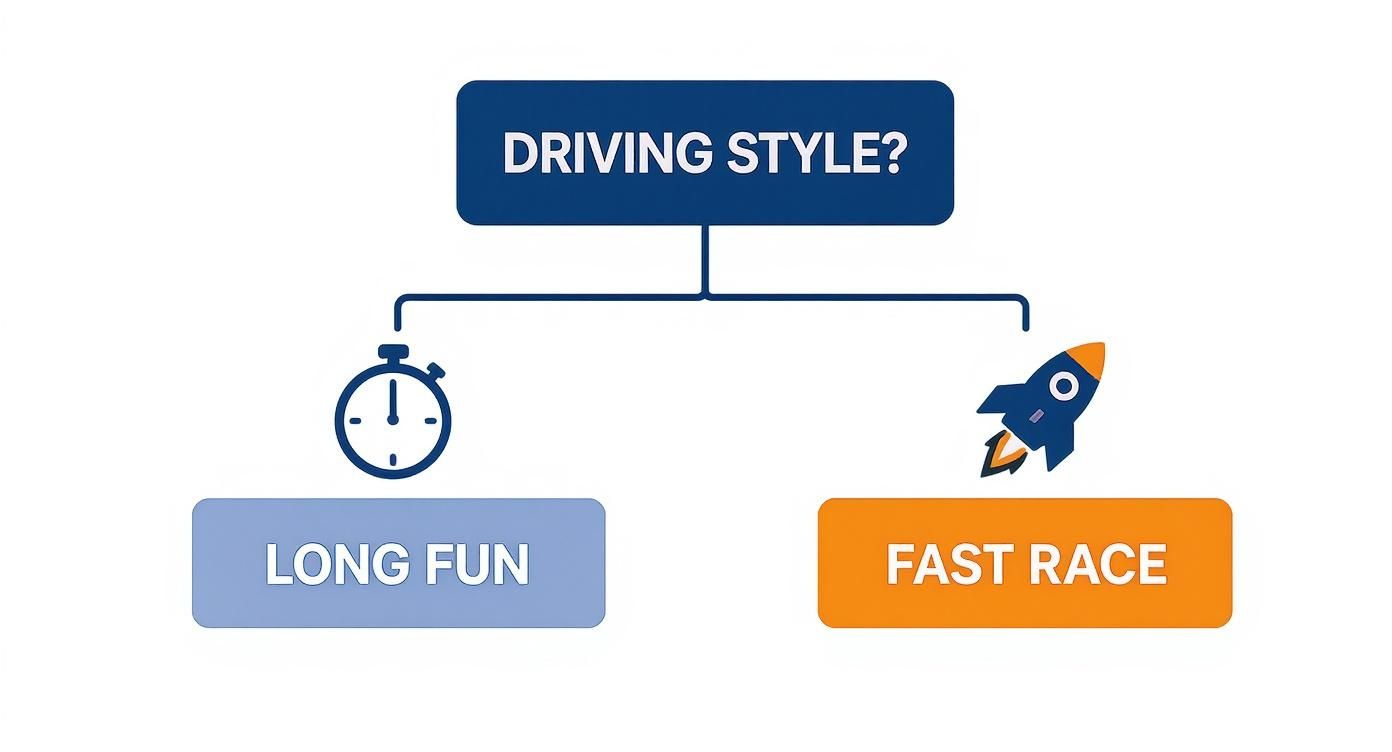
As you can see, the path is pretty clear. If you're focused on extended runtimes for fun or practice, prioritize a higher mAh like our Team Powers 8000mAh pack. If you're chasing podiums and need maximum punch, a high C-Rating pack like the Trinity White Carbon 6000mAh is your ticket.
Connectors and Final Checks
Last but not least, make sure the battery connector is compatible with your ESC. The most common plugs you'll see in on-road racing are 5mm bullet connectors, but some use Deans (T-Plugs) or XT60s. Sure, you can use adapters, but a direct connection is always going to be more reliable and efficient. We clearly list the connector type on all our product pages so you can find a battery that plugs right in, no fuss.
Getting this choice right completely transforms the driving experience. If you want to go even deeper into these concepts, check out our guide on LiPo battery selection for maximum performance.
To make things even easier, we've laid out a few of our top-performing batteries to help you find the perfect power source for whatever you're doing, whether it's competitive racing or weekend bashing.
Pro Tip: Don't get fixated on a single number. The best 7.4V LiPo battery for your car is a balanced combination of capacity (mAh), discharge rate (C-Rating), and physical dimensions that perfectly suits your vehicle and how you drive it.
Our Recommended 7.4V LiPo Batteries for Your RC Car
We've put together this quick-reference table to highlight some of our go-to 7.4V packs. Each one is a solid performer, but they shine in slightly different applications. Use this to zero in on the best option for your race day or bash session.
| Product Name | Best For | Capacity (mAh) | C-Rating | Key Feature |
|---|---|---|---|---|
| Team Powers 6000mAh 120C | Maximum Punch for Racing | 6000mAh | 120C | High discharge rate for instant acceleration. |
| Team Powers 8000mAh 120C | Extended Runtime for Bashing | 8000mAh | 120C | High capacity for longer, powerful sessions. |
| XPS Graphene 6400mAh 120C | Balanced Performance | 6400mAh | 120C | Graphene tech for lower internal resistance. |
| Trinity White Carbon 6000mAh | Competitive Stock Racing | 6000mAh | 120C | Ultra-low resistance for consistent power. |
No matter which you choose, you're getting a proven battery that delivers reliable power. The key is simply aligning its strengths with your goals on the track.
Essential Charging and Maintenance Habits
Great performance comes from great care, and your lipo battery 7.4v is no different. Proper charging and maintenance habits are what separate a battery that lasts a full season from one that gives up early. This isn't just about longevity—it's about safety and getting consistent power every time you hit the track.
The single most important tool in your pit box is a dedicated LiPo balance charger. Unlike older NiMH packs, a 2S LiPo contains two individual cells that must be kept at an equal voltage. A balance charger watches each cell independently, making sure one doesn't get overcharged while the other lags behind. This process is absolutely critical for the battery's health and your safety.
At our store, we stock a range of smart chargers from top brands like iCharger and SkyRC, designed specifically for this job. These units make the process almost foolproof, automatically detecting the cell count and walking you through a safe charging procedure.
Mastering the Charge Rate
The next key habit is charging at the correct rate, which you'll often hear called the "C" rate. For nearly all LiPo batteries, the standard and safest charge rate is 1C. It's a simple calculation: you just set the charger's amperage to match the battery's capacity.
- For a 6000mAh battery: A 1C charge rate is 6.0 amps.
- For a 6400mAh battery: A 1C charge rate is 6.4 amps.
Pushing a charge faster than 1C generates excess heat, and heat is the enemy of a LiPo battery. It shortens the pack's overall lifespan and, in extreme cases, can become a safety risk. Our smart chargers let you set this limit easily, taking all the guesswork out of it.
Always charge your LiPo batteries inside a fire-resistant LiPo safety bag. We carry these essential safety accessories in our store. They provide an added layer of protection and peace of mind while you're charging.
The Importance of Storage Voltage
What you do after race day is just as important as what you do before. You should never leave your 7.4V LiPo battery fully charged or fully discharged for more than a day or two. When you do, it causes irreversible chemical damage inside the cells, which leads to less capacity and weaker punch.
The sweet spot for storage is 3.8V to 3.85V per cell. All of our recommended LiPo chargers have a "Storage" mode that automatically brings the battery to this perfect level. It's a simple, one-button process that will seriously extend the life of your investment.
These maintenance practices aren't so different from what happens in large-scale energy systems. For instance, California's electric grid has massively expanded its lithium-ion battery storage, jumping from 500 MW in 2020 to about 11,200 MW by mid-2024. This growth, essential for grid stability, depends on sophisticated battery management systems that follow the same principles of voltage control and maintenance we use in RC. Explore more on how large-scale battery storage is transforming the grid.
By adopting these professional habits—using a balance charger, charging at 1C, and always using storage mode—you're not just protecting your batteries. You're ensuring they deliver peak performance for countless races to come.
Handling Your LiPo Batteries Safely
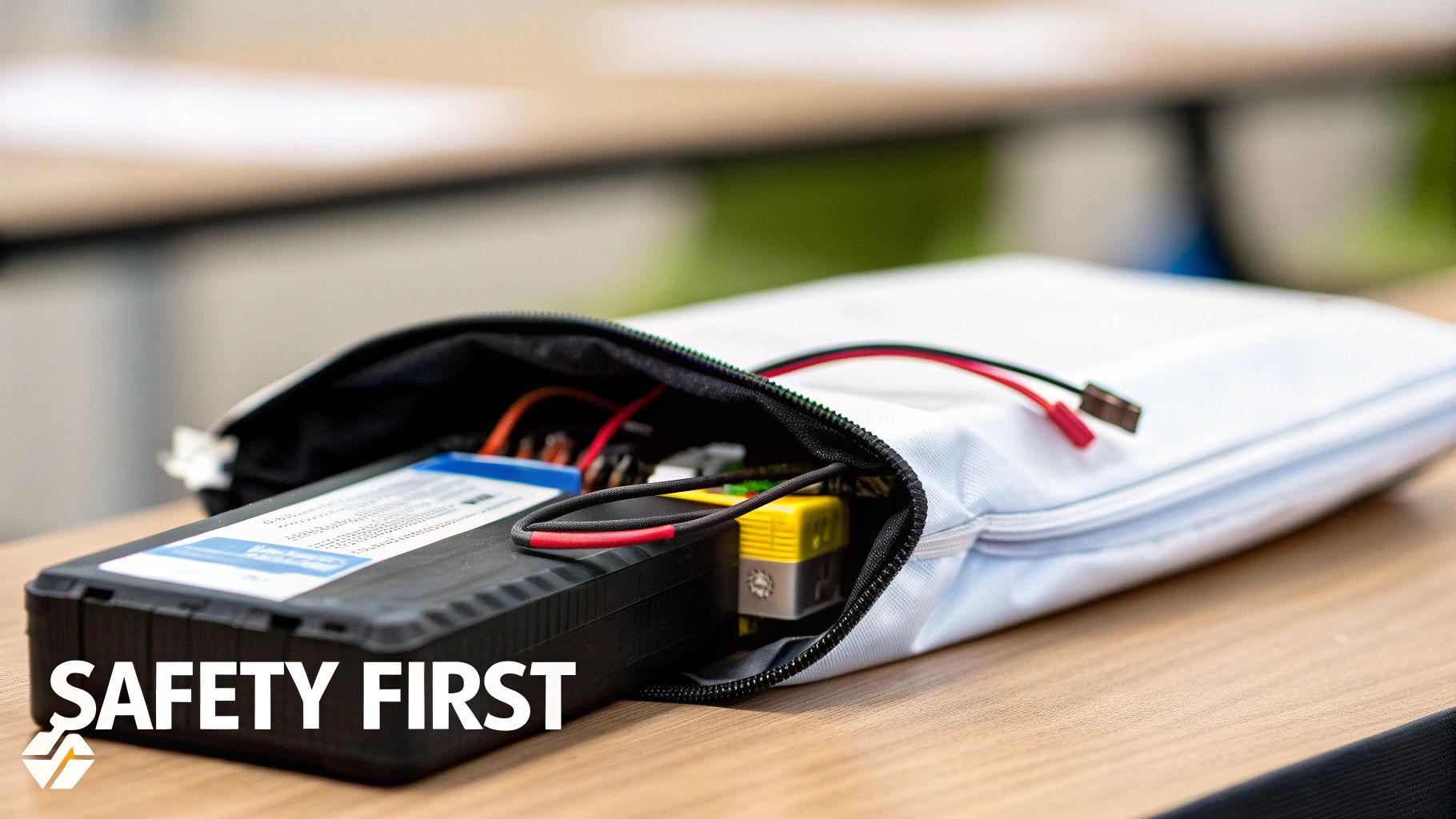
The incredible power density of a lipo battery 7.4v demands respect. Safety isn't just a suggestion; it's the absolute top priority. Following a few non-negotiable rules ensures you can enjoy the insane performance of LiPo technology with complete peace of mind.
Think of these as essential practices for every single RC enthusiast, from beginner to pro. The most critical rule? Never charge a LiPo battery unattended. The charging process is when a battery is at its most volatile, so always stay within sight and earshot of your setup.
Spotting the Warning Signs
A healthy LiPo battery should be firm and perfectly rectangular. You need to learn how to spot the signs of a failing battery and take immediate, decisive action. If you see any of the following, that battery’s day is done.
- Puffing or Swelling: This is the classic sign of internal cell damage. The battery casing will look inflated, bloated, or "puffy." It's the most common red flag.
- Physical Damage: Any dents, punctures, or deep scratches in the battery's soft outer casing mean its integrity is compromised.
- Leaking or Odour: A strange, sweet chemical smell or any sign of liquid means a cell has been breached.
If a battery shows any of these signs, do not attempt to charge or use it again. Ever. The risk of a fire skyrockets. Safely discharge it and get it ready for proper disposal.
Safe Charging and Storage Practices
The best way to prevent problems is to build a safe charging and storage environment from day one. This starts with using a high-quality, fire-resistant container made specifically for lithium polymer batteries.
A simple but incredibly effective tool for this is a LiPo safety bag. These are designed to contain flames in the unlikely event of a battery failure. Always place your batteries inside one of these bags during charging, storage, and even transport to the track.
Responsible Battery Disposal
When a 7.4V LiPo battery reaches the end of its life, it absolutely cannot be tossed in the regular garbage. It must be fully discharged and taken to a designated battery recycling centre.
This responsible approach is just one part of the battery's lifecycle. It's an interesting thought, because while regions like California have massive lithium reserves, a recent study pointed out that the state is only projected to capture about 2.4% of new supply chain jobs. It highlights how the whole process, from creation to disposal, is a global effort.
By following these safety guidelines, you protect yourself, your equipment, and your passion for the RC hobby. It's that simple.
Shipping LiPo Batteries to Our Canadian Customers
For our RC community across Canada, getting your hands on a new lipo battery 7.4v is a simple, worry-free process. We know the shipping regulations inside and out, so we handle all the complexities for you. Your performance and safety are our top priorities from the moment you place your order.
We follow all Transport Canada regulations to the letter when shipping lithium polymer batteries. That means every battery is packed in specialized, secure materials designed to prevent any issues while it's on its way to you. Our process is meticulous, ensuring your high-performance power source arrives safely and ready for the track.
Your confidence is key. We've built our shipping system around transparency and reliability, ensuring a smooth purchasing experience for every Canadian racer.
You can expect clear communication and realistic shipping estimates right from checkout. Our goal is to get you the power you need, fast, so you can spend less time waiting and more time racing.
If you want to get into the nitty-gritty of the regulations, you can read our detailed guide on shipping LiPo batteries in Canada. We're committed to serving the entire Canadian RC community with excellence.
Common Questions About 7.4V LiPo Batteries
When you’re stepping into the world of lipo battery 7.4v packs, a few questions always pop up. Here are the answers we give racers and hobbyists based on our hands-on experience with the batteries we stock.
Can I Use a Higher C-Rating Than My Motor Needs?
Absolutely. In fact, it’s often a good idea. Think of the C-rating as the battery's ability to deliver power without breaking a sweat. Your motor will only pull the amps it needs, so there's no risk of damage.
A higher C-rating just means the battery can supply that current more easily, which keeps it running cooler and can even extend its lifespan. It's like having a bigger engine in your car—you don't have to use all the power, but it's there when you need it and the engine isn't working as hard.
What Does the S in 2S Stand For?
The "S" in a 2S battery stands for Series. It tells you the pack is made of two individual 3.7V LiPo cells connected in series, which means their voltages are added together.
The result is a combined nominal voltage of 7.4V (3.7V + 3.7V). This is the standard for most 1/10 and 1/12 scale on-road racing classes.
A quick note on safety: Your ESC’s Low Voltage Cutoff (LVC) is your battery's best friend. It constantly watches the voltage and kills power to the motor when it dips too low (usually around 3.2V per cell). This single feature prevents you from over-discharging the pack and causing permanent damage.
How Many Charge Cycles Can I Expect?
With the right care, a quality lipo battery 7.4v from our shop will typically give you somewhere between 150 to 300 charge cycles.
This isn't a hard number—it really depends on how you treat it. Sticking to a 1C charge rate, always using the storage charge function when you're done for the day, and never running it completely dead are the keys to getting the most out of your investment.
Find the perfect power source for your 1/10 or 1/12 scale RC car at Digital RC. Explore our curated selection of high-performance 7.4V LiPo batteries designed for competitive racing and reliable fun. Visit us today at https://digitalrc.ca.