

A Racer's Guide to Radio Transmitter and Receiver Systems
At its core, your radio transmitter and receiver are the dedicated communication link that turns what you do with your hands into what your car does on the track. The transmitter is the radio you hold, and the receiver is the small box inside your car listening for commands. This pair is the command centre for your entire setup.
Your Direct Link to On-Track Performance
Think of your radio system as a high-speed, direct conversation between you and your car. Your transmitter is your voice, converting every tiny movement of the wheel and every bit of pressure on the throttle into a digital signal. The receiver is the car's ear, instantly translating that signal into instructions for the steering servo and electronic speed controller (ESC).
For competitive 1/10 and 1/12 scale on-road racers, this connection is everything. A split-second delay or a moment of interference can be the difference between hitting an apex perfectly and clipping a corner board. That’s why a high-quality Sanwa system isn't just another accessory—it’s a critical performance component.
The Foundation of Control
The relationship between your radio transmitter and receiver has to be flawless. They work as a perfectly matched pair, ensuring your inputs are the only ones your car ever responds to. This rock-solid reliability is the foundation of consistent lap times and confident driving.
- Translating Motion to Signal: The transmitter reads your physical movements and encodes them into radio waves.
- Receiving and Directing Traffic: The receiver decodes these signals and sends precise commands to your car's electronics.
- Maintaining a Secure Link: Modern systems create an exclusive, interference-resistant connection so you never control another driver's car by mistake.
This idea of a secure, dedicated radio link isn't new. In fact, its importance was proven long before RC racing even existed. In the freezing Canadian North during the 1930s, radio transmitters and receivers shattered the isolation of remote Hudson's Bay Company posts, with a network growing from just four stations to over 100. This northern saga shows how battle-tested radio technology evolved into the precision systems we rely on today, ensuring your car responds without a hiccup.
More Than Just Steering
Beyond the basic controls, this system is central to your car's entire electronic nervous system. It communicates with vital components, including the transponders used for race timing, like the MyLaps RC4. A clean, reliable signal from your radio setup ensures that every single lap is counted accurately.
For racers running an Awesomatix or XRAY chassis, investing in a top-tier Sanwa radio system is the first step toward gaining a real, tangible advantage on the track.
Understanding How Your Radio System Communicates
At its core, your radio system is speaking a language—a protocol that turns your commands into precise, on-track action. The difference between a basic protocol and a modern one is like the difference between shouting vague directions and having a crystal-clear conversation. For competitive racing, a fast, reliable, and noise-free digital language is non-negotiable.
This whole process, from your hands to the car’s electronics, is a simple but critical communication chain.
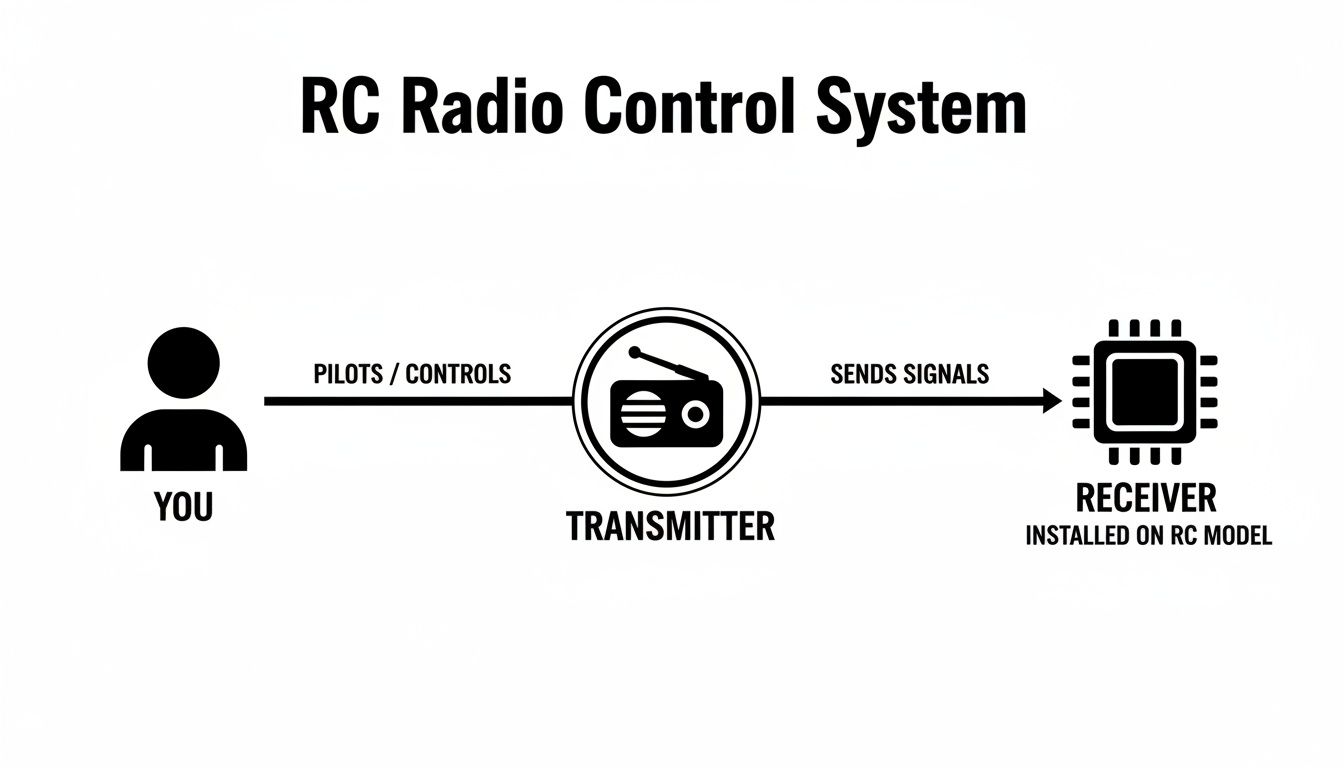
It all boils down to this: you command the transmitter, and it sends a wireless signal to the receiver. Speed and accuracy are everything. If you're curious about the fundamental physics, there's a simple step-by-step guide on how radio communications work that covers the basics. Grasping these concepts helps you understand why modern protocols give you a real competitive edge.
From Analog Pulses to Digital Streams
The original language of RC control was Pulse Width Modulation (PWM). Think of it as sending a series of timed electrical pulses down a wire for each channel—one for steering, one for throttle, and so on. The length, or "width," of each pulse tells the servo or ESC what to do. A long pulse might mean full throttle, while a short one means neutral.
It works, but PWM has a huge downside: it needs a separate wire for every single channel running from your receiver to each component. In a modern Awesomatix or XRAY touring car, where space is gold, this creates a wiring nightmare. For a serious racer, every gram of weight and every disruption to airflow matters, making a messy web of wires a major liability.
Pulse Position Modulation (PPM) was a small step forward, bundling all the channel signals into a single stream on one wire. But at the end of the day, both PWM and PPM are old-school analog technologies. They’re slow and far more susceptible to electrical noise than their modern digital counterparts.
The Digital Advantage in Racing
Today’s racing scene demands faster, cleaner communication. This is where digital serial protocols completely change the game. These systems send all your channel data—and sometimes more—as a single, high-speed digital packet. This doesn't just simplify your wiring; it drastically reduces latency, that tiny delay between your input and the car’s reaction.
In competitive on-road racing, lower latency makes the car feel directly connected to your fingertips. It lets you make corrections faster and hold a more precise line, which translates directly into better consistency and quicker lap times.
Let’s take a look at the most common protocols you'll run into and what they mean for a racer.
Comparing RC Radio Signal Protocols
This table gives a quick glance at the common signal protocols to help you understand the pros and cons for competitive on-road racing.
| Protocol | Type | Key Advantage | Best For |
|---|---|---|---|
| PWM | Analog | Simple, universal compatibility | Basic RC applications, not competitive racing. |
| PPM | Analog | Single-wire connection for multiple channels | Older flight controllers and budget systems. |
| Sanwa FH5 | Digital | Industry-leading low latency and telemetry | High-performance racing where speed and data are critical. |
| Futaba S-FHSS | Digital | Strong signal resistance to interference | Popular in many brands, offering solid performance. |
For a competitive racer, the choice is clear. A digital protocol like one of Sanwa's proprietary high-speed systems delivers the fastest possible response rates.
When you pair that low-latency signal with a high-speed servo and a responsive Hobbywing ESC, your car reacts to your inputs almost instantaneously. This is the high-fidelity connection that gives elite drivers the confidence to push their cars right to the absolute limit, knowing their equipment will keep up every step of the way.
How 2.4GHz Technology Creates a Rock-Solid Signal
Remember the days of frequency crystals and waiting your turn for an open channel at the track? Thankfully, those are long gone. The move to the 2.4GHz band was one of the biggest leaps forward for RC racing, allowing packed events to run smoothly without constant signal drops and glitches. This is the technology that provides the foundation for that rock-solid connection between your modern radio transmitter and receiver.
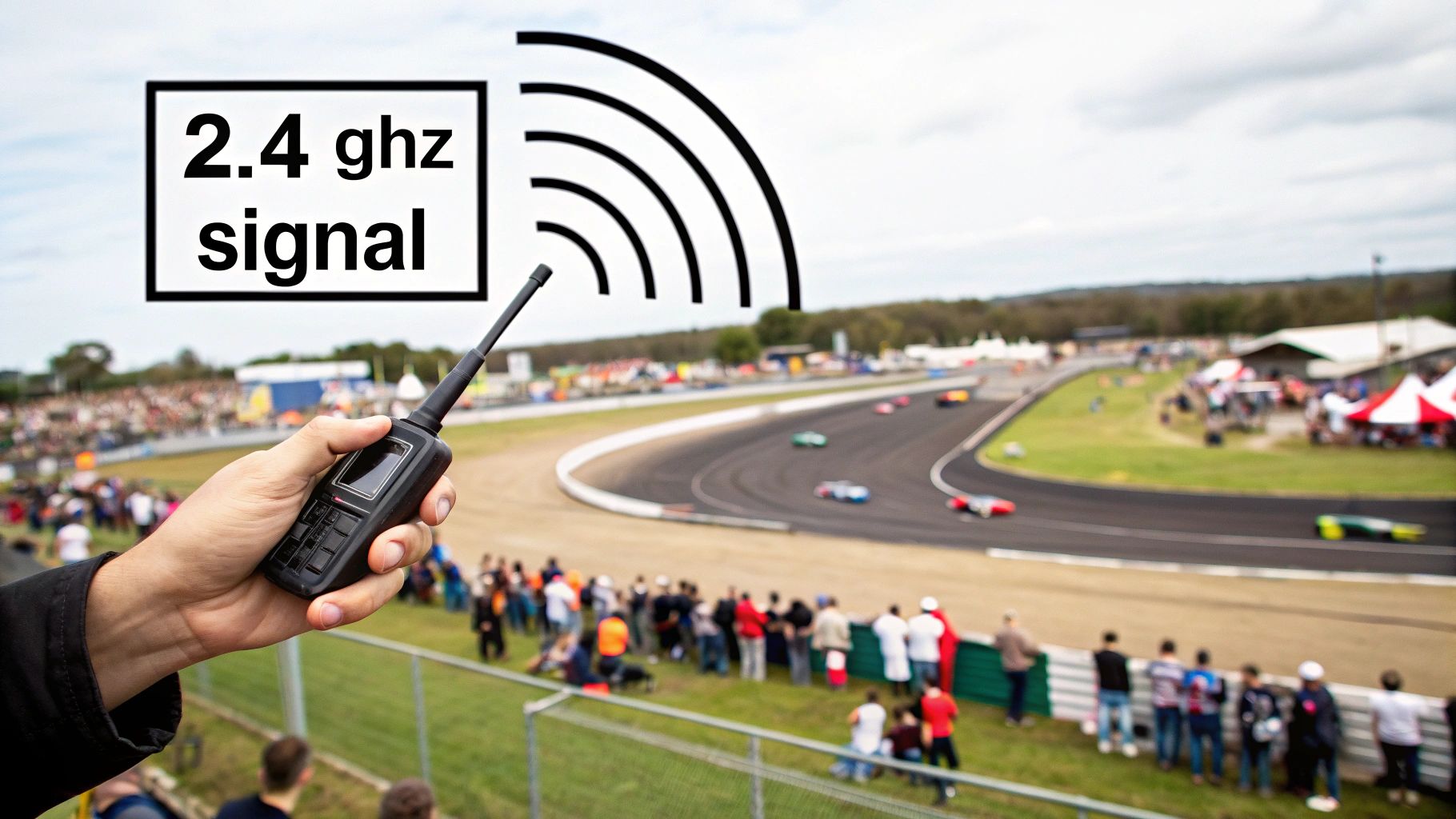
Unlike the old AM and FM systems that were stuck on a single, fixed frequency, the 2.4GHz spectrum is like a massive highway with dozens of lanes. This allows for far more advanced communication methods that are designed to dodge traffic jams—or in our world, signal interference.
The magic behind this is a technology called spread spectrum. Instead of putting all its eggs in one basket by broadcasting on a single frequency, a spread spectrum system spreads its signal out across a wide band. This simple change makes it incredibly resilient to noise.
The Power of Frequency Hopping
The secret sauce in most high-performance RC systems today is a specific type of spread spectrum called Frequency-Hopping Spread Spectrum (FHSS). It’s a brilliant solution to a noisy problem.
Imagine you and your car are trying to have a private conversation in a crowded, noisy room. With FHSS, you aren’t just standing in one spot shouting to be heard.
Instead, you and your receiver have a secret plan. You both agree to jump to a new, quiet spot in the room thousands of times every second. Even if someone starts a loud conversation right where you were, it doesn’t matter. You’re already gone, continuing your chat seamlessly in a different spot. This constant, lightning-fast "hopping" across dozens of frequencies makes it almost impossible for outside interference to break your connection.
This is exactly how your radio maintains a flawless link to its receiver, even when it’s surrounded by dozens of other racers, Wi-Fi networks, and Bluetooth devices. The system isn't just shouting louder; it's being smarter.
This intelligent frequency management is the core reason why a modern Sanwa system feels so locked-in. The transmitter and receiver are constantly working together, thousands of times per second, to find the clearest possible path for your commands, ensuring your car never misses an input during a critical moment of a race.
Why This Matters on Race Day
At any competitive event, the air is completely saturated with radio signals. Every driver's radio, every phone in the pits, and even the track’s timing system are all broadcasting. In an environment like that, a radio system that can intelligently navigate the chaos isn't just a nice-to-have—it's essential.
An FHSS system gives a competitive racer several huge advantages:
- Immunity to Interference: By never staying on one frequency for more than a few milliseconds, the system dodges potential signal conflicts from other radios before they can cause a problem.
- Enhanced Security: The unique hopping pattern is known only to your paired transmitter and receiver, which prevents any chance of accidental cross-control.
- Increased Driver Capacity: Because each radio system carves out its own dynamic path through the spectrum, many more drivers can race at the same time without interfering with each other.
Of course, the physical hardware plays a role here too. The design of the antenna and internal components is critical for performance. To get a better sense of how the physical parts work, you can find parallels in guides on Wifi Antennyas and Boosters, as many of the core principles are the same. This technology has been refined over many years, leading to the incredibly robust systems we rely on today.
The end result is a driving experience built on pure confidence. You can push your car to its absolute limits, diving into tight corners and hammering the throttle on exit, knowing that your control link is bulletproof. This reliability, born from 2.4GHz and FHSS technology, is what lets you focus entirely on your lines, not on whether your car will actually listen.
Key Specifications That Win Races
Not all radio systems are created equal, and on the race track, that difference is measured in fractions of a second. While most modern systems give you a reliable link between your radio transmitter and receiver, the specs are what separate a decent hobby setup from a race-winning command centre. If you want a competitive advantage, you need to understand the numbers.
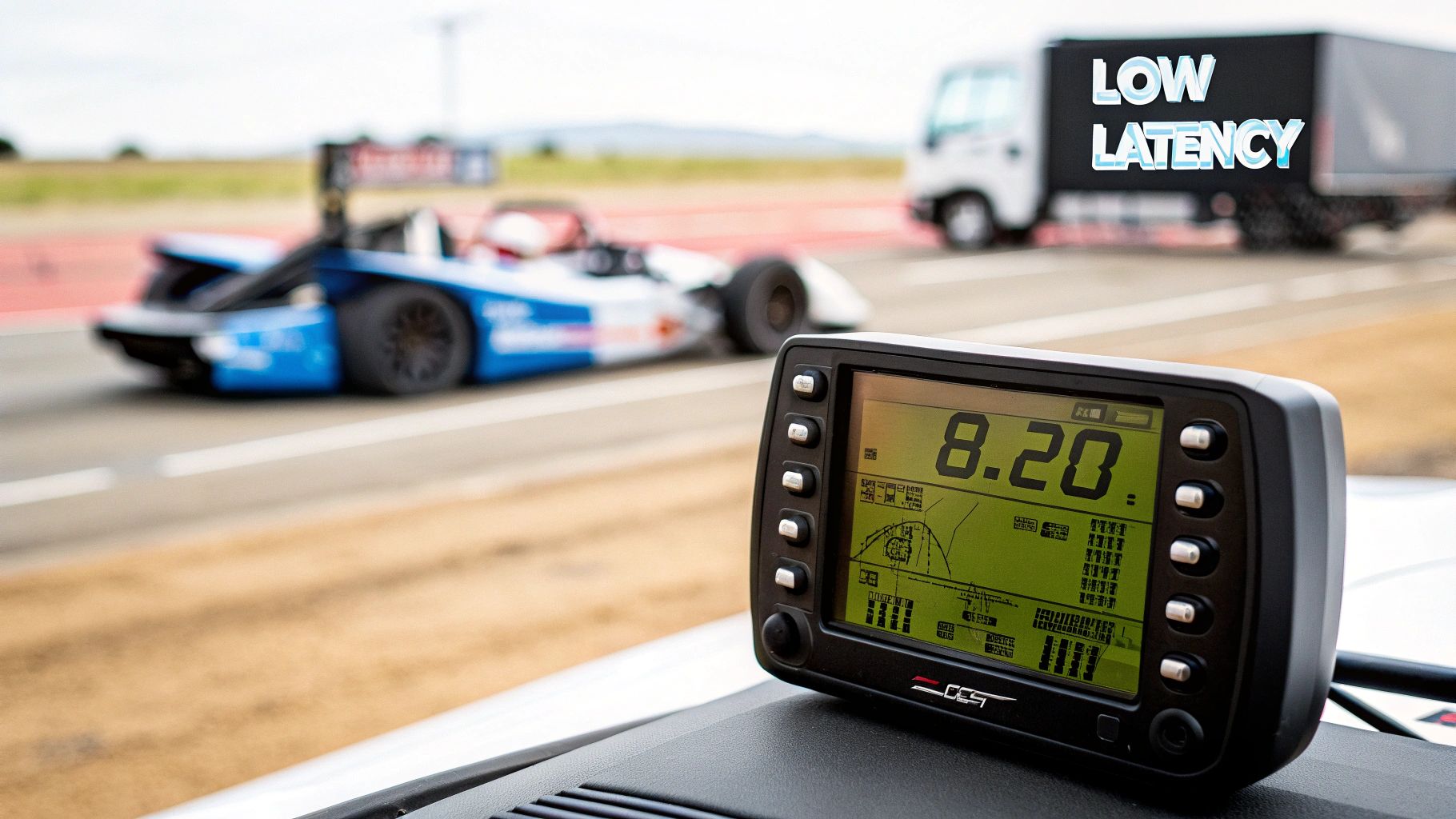
We're going to break down the metrics that truly matter on track, focusing on how top-tier systems from Sanwa give you the edge needed to shave time off your laps. These numbers directly impact how connected you feel to your car and its ability to react the instant you give a command.
The Race Against Latency
For any competitive racer, the single most important spec is latency—often called response time. This is the tiny delay, measured in milliseconds (ms), between you turning the wheel and the receiver telling the servo to act. A delay of 20ms might be unnoticeable when you're just bashing around, but in high-speed on-road racing, it's a lifetime.
Think of it this way: a lower latency number means the car feels like a direct extension of your thoughts. High-end systems from Sanwa boast ultra-low latency, often dipping below 3ms. This near-instantaneous response lets you make those tiny steering corrections with absolute confidence and nail the throttle timing perfectly, which is everything when you're trying to hit every apex, lap after lap.
For a competitive racer, low latency isn't a luxury; it's a fundamental requirement. It builds the trust you need to push your car to its absolute limit, knowing it will react precisely when you need it to, without any perceptible lag.
For a clearer picture, here’s a breakdown of what the most critical specs mean for your on-track performance.
Essential Radio System Specs for Racers
| Specification | What It Measures | Why It Matters for Racing | Target for Competitive Racers |
|---|---|---|---|
| Latency | The delay (in ms) between your input and the car's response. | The most critical spec. Lower latency means a more connected, responsive feel, allowing for faster, more precise corrections. | Below 5ms. Elite systems like Sanwa can achieve under 3ms. |
| Channels | The number of separate functions you can control. | Steering and throttle are essential (2 channels). Extra channels allow for on-the-fly adjustments like brake mixing. | Minimum 3 channels. 4 channels offer more flexibility for advanced tuning. |
| Telemetry | The ability for the car to send data back to your transmitter. | A game-changer. Monitor motor temp, battery voltage, and RPM in real-time to prevent failures and optimize your setup. | Essential. Look for systems with integrated temperature and voltage monitoring at a minimum. |
| Range | The maximum distance the signal can travel. | Less critical for on-road tracks, as modern systems far exceed the necessary distance. Signal integrity is more important. | Any modern 2.4GHz system will be more than sufficient. |
Ultimately, a radio system with the right specs gives you the data and responsiveness you need to not just drive fast, but drive smart.
Understanding Channels and Range
When you look at a radio's specs, you'll see it listed with a certain number of channels, usually two to four or more for surface cars.
- Channel 1: This is almost always for steering.
- Channel 2: This controls the throttle.
- Channels 3 & 4: These are auxiliary channels, perfect for things like adjusting brake bias on the fly, controlling a cooling fan, or other custom functions. A four-channel system is a smart choice for any serious racer.
Range is another spec you'll see, but for on-road track racing, it's honestly not a concern. Modern 2.4GHz systems have a range that far exceeds the size of any RC track. The real battle isn't distance; it's maintaining a clean, interference-free signal within that range—which is exactly what FHSS technology handles. This focus on signal integrity has deep roots. In fact, Canada began regulating its airwaves with the Radiotelegraph Act in 1913, requiring licenses to ensure clear communication. That same principle enables the rock-solid performance we depend on today. You can discover more about Canada's broadcasting history and how these early rules shaped modern wireless tech.
The Strategic Advantage of Telemetry
This is where modern radio systems really shine. Telemetry is an absolute game-changer because it turns your radio's signal into a two-way street. Your transmitter doesn't just send commands out—the receiver sends critical data back to you in real-time.
With telemetry sensors in your car, you can watch vital stats right on your transmitter's screen:
- Motor Temperature: Get an early warning before your motor gets too hot, preventing costly damage and a DNF.
- Battery Voltage: Track your battery's power curve during a run to manage your pace and avoid an unexpected power drop-off near the end of a race.
- Receiver Voltage (BEC): Make sure your receiver is getting stable power from your ESC, which is critical for consistent servo performance.
- RPM: Monitor motor RPM to fine-tune your gearing for maximum speed and efficiency on different track layouts.
This data lets you make smart decisions during a race and completely dial in your setup during practice. By seeing exactly what’s happening inside your car, you can push your equipment right to its performance peak without crossing the line into a failure. High-performance radios from Sanwa integrate these features seamlessly, giving you a pit crew's worth of data right in your hands.
Binding and Compatibility for Your Radio Gear
Your transmitter and receiver are a team, but they don't know each other right out of the box. To get them talking, you need to perform a quick but essential process called binding. This is the digital handshake that pairs your transmitter to a specific receiver, creating an exclusive connection that ensures your car only listens to you.
Think of it like pairing a Bluetooth speaker to your phone. It creates a private, secure link so that your control inputs—and only your inputs—are what the car responds to. Without it, your receiver is just an open ear, unable to tell your commands from the dozen other signals flying around the pits.
Creating the Secure Handshake
Binding is the very first thing you'll do after installing a new receiver. While the exact steps might vary a little from brand to brand, the basic idea is always the same. It's a one-time setup you'll only need to repeat if you move that receiver to a new car or reset your radio system.
For a top-tier system like a Sanwa radio, the process is dead simple:
- Power Everything Down: Make sure both the car and your radio are off. Plug the bind plug into the designated "BIND" port on the receiver.
- Activate Bind Mode: Turn on your car’s ESC. The receiver’s LED will usually start flashing quickly, signalling it's ready to pair.
- Initiate the Link: Power on your transmitter and find the "Bind" function in its menu.
- Confirm the Connection: Hit the bind command on the transmitter. In a moment, the receiver's light will stop flashing and turn solid. That solid light is your confirmation of a successful, locked-in link.
- Finalize: Power everything off, pull the bind plug out, and you're good to go.
Why Brand Compatibility Is Non-Negotiable
One of the most common questions new racers ask is if they can mix a transmitter from one brand with a receiver from another. The answer is almost always a hard no. Each manufacturer—Sanwa, Futaba, Spektrum—uses its own proprietary communication protocol and frequency hopping algorithm. A Sanwa transmitter speaks a unique "Sanwa language" that a Futaba receiver simply won't understand.
This isn't just to lock you into an ecosystem; it's a feature that guarantees performance. By controlling the entire communication chain from end to end, manufacturers can squeeze out every last drop of speed and signal integrity. Trying to use an incompatible receiver will just result in a total failure to connect. For rock-solid reliability, always use a receiver designed for your specific radio. If you're running a Sanwa system, for instance, a compatible model like the Sanwa RX-492i receiver is the only way to get the speed and features you paid for.
Troubleshooting Common Binding Issues
Sometimes the digital handshake doesn't work on the first try. The most common sign of trouble is a receiver light that just keeps flashing, no matter what you do.
A flashing receiver light is a clear signal that it is not receiving a valid, bound command from the transmitter. This is your cue to check the connection, re-initiate the binding process, or check for compatibility issues.
If you run into a binding problem, don't sweat it. It's usually a simple fix. Double-check your wiring, make sure the bind plug is in the right port, and confirm your transmitter and receiver are set to the same protocol (e.g., FH5 on both). A clean, interference-free radio link is what gives you a competitive edge. It’s why Canada’s wireless spectrum auctions have raised over $14 billion—controlled frequencies are incredibly valuable for preventing signal chaos. That heavy regulation by ISED Canada is what keeps the 2.4GHz band stable enough for the high-performance gear we rely on in RC racing. You can discover more insights about Canadian spectrum management on crtc.gc.ca.
Once you master this simple pairing process, you'll be able to solve radio issues in the pits in seconds and get back on the track, confident that the link between your hands and your car is unbreakable.
Choosing the Right Radio System for Your Race Program
After breaking down all the tech, what really matters is this: which radio transmitter and receiver is going to give you an edge on race day? For serious 1/10 and 1/12 on-road racers, the right system isn't just about a reliable signal—it's about finding something that feels like a direct extension of your hands.
The radio you choose has a massive impact on how connected you feel to the car. A top-tier system with almost zero latency lets you push your Awesomatix chassis harder and get on the power from your Team Powers motor with absolute precision. This is where the last few tenths are found.
The Dominance of Low Latency Systems
Step into the pits at any serious on-road race, and you'll see one brand on the top driver's stands over and over: Sanwa. This is no accident. Sanwa radios are built with one goal in mind—achieving the lowest possible latency. Their FH5 protocol creates a near-instant link between your inputs and the car's servo and ESC.
When you're threading the needle through a high-speed chicane, that sub-3ms response time is the difference between thinking and doing. Your car reacts the instant you command it, not a split-second later. This builds incredible confidence, letting you drive a more aggressive and precise line, lap after lap.
For any top-level racer, the radio is the single most important electronic component. A fast, intuitive transmitter makes the car feel predictable and alive, which translates directly into faster, more consistent laps when the pressure is on.
Ergonomics and Usability on Race Day
Raw speed is critical, but practical features are what make a radio system truly work for a racer. A long day at the track demands a transmitter that feels comfortable and balanced in your hands, helping you avoid fatigue during a tense A-Main final.
Beyond comfort, think about the user interface. When you’ve only got a few minutes between heats, you need a menu that’s quick and logical. You can't afford to be fumbling through confusing menus to tweak your steering expo or throttle curve. A clear screen and a simple menu structure can save you precious time and a lot of stress.
Other must-have features for any serious racer include:
- Model Memory: This is non-negotiable if you run multiple cars or have different setups for various track conditions. It lets you save and load complete settings for each car with just a few button presses.
- Adjustable Triggers and Wheels: The ability to customize the tension and position of the throttle trigger and steering wheel lets you dial in the radio's ergonomics to perfectly match your driving style.
- Telemetry Alarms: Setting up alarms for motor temps or low battery voltage can be a race-saver. An audible or vibrating warning can turn a potential DNF into a smart decision to pit.
In the end, choosing the right system is an investment in confidence and consistency. When all your high-performance parts are connected by a world-class radio transmitter and receiver, you remove one of the biggest variables from the equation. You can check out a handpicked selection of competition-ready radio controllers and receivers to find the perfect match for your race program.
Frequently Asked Questions About Radio Systems
When you're in the pits, staring down the clock before the next heat, questions about your radio gear are the last thing you need. Let’s tackle some of the most common practical questions that pop up at the track, so you can solve problems fast and keep your focus on the win.
Can I Use One Transmitter for Multiple Cars?
You absolutely can, and it's one of the biggest advantages of modern radio systems. A high-end transmitter from a brand like Sanwa includes model memory, letting you save the complete setup for dozens of different cars.
Each model memory slot stores everything—steering expo, throttle curves, trim adjustments, you name it. Once you bind a unique receiver in each car to your transmitter, you can switch from your touring car to your pan car with just a few button clicks. All your custom settings load instantly.
Why Does My Servo Glitch or Seem Slow?
If your brand-new, high-speed servo is acting twitchy or feels sluggish, don't blame the servo just yet. More often than not, the problem is the power being fed to it from your Electronic Speed Controller’s (ESC) Battery Eliminator Circuit (BEC).
A "brownout" is what happens when your receiver's voltage drops too low, causing it to reboot or lose its connection for a split second. On the track, this looks like a steering glitch, a total loss of control, or even a complete system shutdown mid-race.
To fix this, make sure your Hobbywing ESC’s BEC is set to the right voltage (usually 7.4V for high-voltage servos) and can supply enough amperage to keep up. Sometimes, just plugging in an external capacitor (often called a "glitch buster") is enough to stabilize the voltage and keep everything running smoothly.
How Often Should I Replace My Receiver?
Unlike parts that see mechanical wear, a radio transmitter and receiver can last for years if you take care of them. Receivers have no moving parts, so their lifespan is fantastic.
That said, it’s time for a replacement if you notice any of these issues:
- The antenna is damaged: A frayed, kinked, or cut antenna wire will kill your signal range and reliability. Don't risk it.
- The case is cracked or broken: A compromised case lets dirt and moisture get to the circuit board, which is a recipe for failure.
- You've upgraded your transmitter: If you jump to a transmitter with a newer, faster protocol (like moving from FH4 to FH5), you’ll need a matching receiver to get all that extra performance.
Ultimately, a quick check of your gear before race day is the best way to catch problems before they cost you a podium spot.
At digital-rc, we stock the race-proven radio systems and components you need for a reliable, lightning-fast connection to your car. Explore our selection and feel the difference a top-tier system makes. https://digital-rc.ca