

RC Car Build Your Own The Ultimate Touring Car Guide
There's nothing quite like the satisfaction of building a competitive RC car from a kit. This is way more than just following instructions; it's about crafting a high-performance machine tuned exactly to your driving style and the demands of the track. An RC car build your own project gives you total control over every single component, from the chassis right down to the last screw.
Your Blueprint For a Race-Winning RC Car Build
When you take on a custom build, you stop being just a driver and start thinking like an engineer. This guide is your detailed roadmap for putting together a top-tier 1/10 touring car, zeroing in on the precision and reliability it takes to win races. Think of this as going beyond the manual to master the small details that transform a box of parts into a podium-ready machine.
We'll walk through everything you need to get it right. That means selecting a world-class chassis from a brand like Awesomatix or XRAY and pairing it with a perfectly matched Hobbywing electronics package. You can find all these premier components right here at digital-rc, your go-to Canadian source for serious racing gear.
What Makes a Custom Build Superior?
The real advantage of building your own RC car is choosing every part for maximum performance and perfect compatibility. A pre-built, ready-to-run (RTR) car is a fantastic starting point, but a kit build unlocks a much higher performance ceiling. Here’s why:
- Component Synergy: You can create an electronics package where the motor, ESC, and servo work in perfect harmony—like pairing a powerful Hobbywing motor with a lightning-fast servo for unmatched response.
- Precision Assembly: Building it yourself means every screw is tightened perfectly, every gear mesh is exact, and every moving part is free of friction. These are the critical details often overlooked in mass-produced RTR models.
- Deeper Knowledge: The assembly process gives you an intimate understanding of your car's mechanics. You'll know exactly how to diagnose issues and make the small trackside adjustments that give you a competitive edge.
A well-executed build is the foundation of speed. When you know every shim and screw in your car, you gain the confidence to push its limits on the track because you built its reliability.
This guide focuses on the specific techniques the pros use. For those who want to take it even further, exploring 3D design software can let you create your own custom components, pushing the boundaries of what's possible. The goal here isn't just to assemble parts—it's to dive into the art of true vehicle engineering.
Planning Your Build: The Parts Checklist
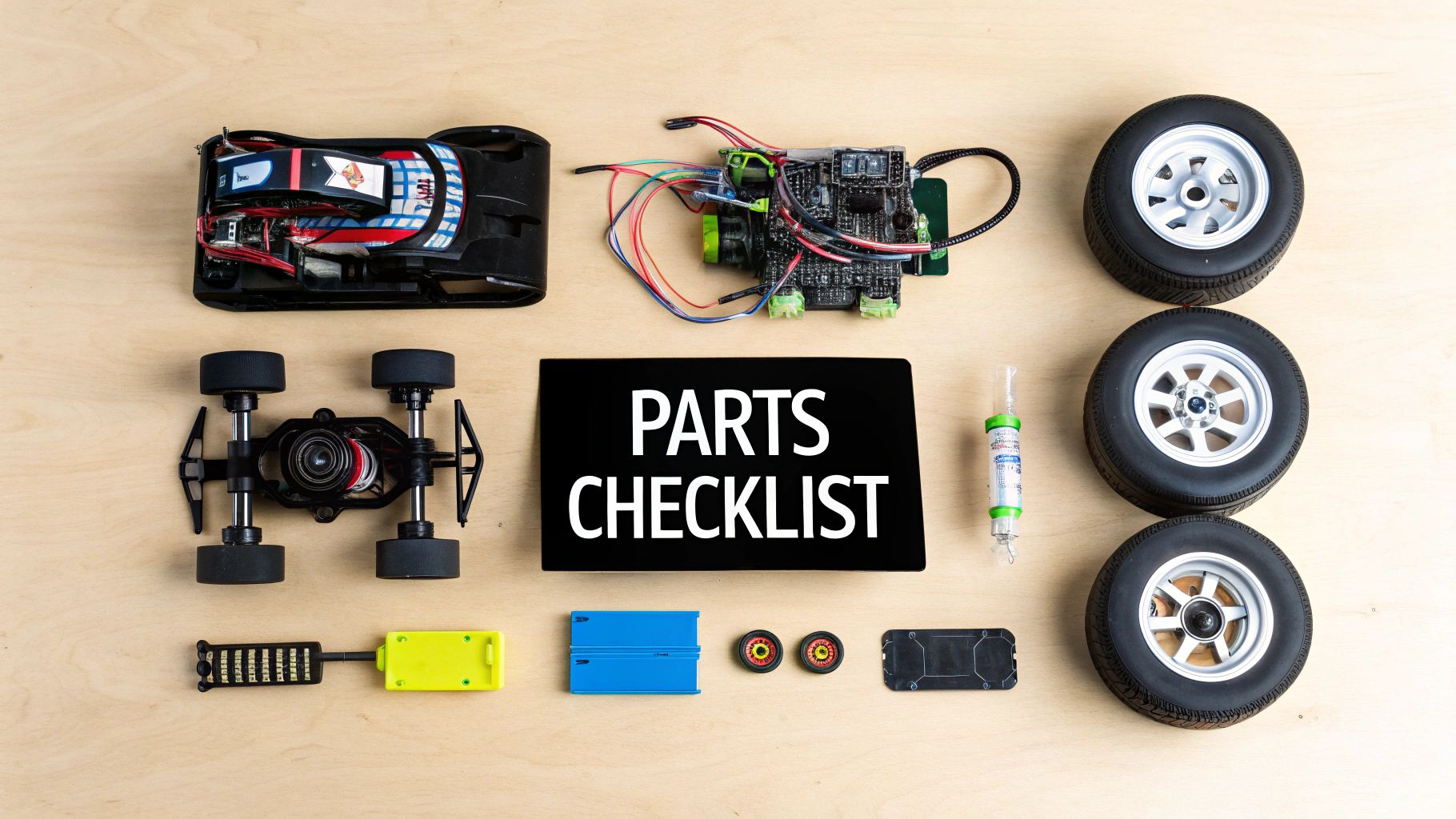
A successful build is all about the details, and it starts with choosing the right parts. Think of it like putting together a championship team—every single component has a critical role, and how they work together determines your performance on the track. This is your game plan for sourcing everything you need from our catalogue at digital-rc, ensuring perfect synergy and peak performance right out of the box.
The Foundation: Your Chassis Kit
The chassis is the absolute foundation of your build. It’s more than just a frame; it’s the skeleton that defines your car's handling, durability, and tuning potential. For competitive 1/10 touring, brands like Awesomatix, XRAY, and ARC represent the pinnacle of engineering, offering specialized kits for different track surfaces and racing classes.
Your choice here really sets the tone for the entire project. An Awesomatix A800FX Evo, for example, is a front-wheel-drive specialist, while an XRAY X4 is a legendary all-rounder known for its versatility on both carpet and asphalt.
The Heartbeat: Your Electronics Package
With the chassis sorted, it's time to select the electronics. The motor, Electronic Speed Controller (ESC), and steering servo are the nervous system and powerhouse of your car. They have to work together seamlessly to deliver controlled, explosive power when you demand it.
-
Motor and ESC: This pair is your car's heart and brain. A high-performance motor from Hobbywing or Team Powers provides the raw speed, while a matching ESC translates your throttle inputs into smooth, precise power. Compatibility is everything here; a sensored motor and ESC combo is essential for the smooth low-speed control you need to navigate tight, technical sections.
-
Steering Servo: Never overlook the servo. It’s your connection to the car's steering and is vital for accuracy. A fast, high-torque servo ensures your car reacts instantly and precisely to every command, letting you hit the perfect apex, lap after lap.
The custom RC building scene here in Canada is a huge part of a booming hobby. On-road cars like these make up 30% of the market, a trend that’s amplified by our strong local racing culture. In 2024, a whopping 55% of sales were for individual performance parts like pinions, spur gears, and bearings—exactly the bits needed for dialing in setups on the popular indoor carpet tracks in Quebec and Alberta.
Here’s a quick checklist to help you organize your build. These are the core components you’ll need to get your 1/10 touring or 1/12 pan car on the track.
Essential RC Car Build Component Checklist
| Component Category | Essential Parts | Recommended Brands (digital-rc) | Key Consideration |
|---|---|---|---|
| Chassis | Chassis Kit, Suspension, Shock Towers | Awesomatix, XRAY, ARC | Choose a kit designed for your primary race surface (carpet or asphalt). |
| Drivetrain | Differential, Spur Gear, Pinion Gear, Bearings | Kit-specific, Team Powers | Match your gearing to the motor and track layout. Smoothness is key. |
| Electronics | Motor, ESC, Steering Servo, Receiver | Hobbywing, Team Powers | Ensure the motor and ESC are compatible (sensored is best for racing). |
| Power System | LiPo Battery, Charger, Power Supply | Team Powers, GNB, iCharger | Select a battery that fits the chassis and meets class regulations (e.g., 2S). |
| Wheels & Tires | Wheels, Tires, Tire Inserts | Mon-Tech, Rush, Gravity RC | The single most important tuning item. Match the compound to the track. |
| Body & Aero | Bodyshell, Wing, Body Mounting Hardware | Zoo Racing, Mon-Tech | Body choice significantly impacts downforce and high-speed stability. |
| Hardware | Screws, Shims, Nuts, Turnbuckles | Kit-specific, various brands | Having a good assortment of spares is a must for race day adjustments. |
This table should give you a solid starting point. Remember, every part contributes to the final result, so choose wisely.
Power, Grip, and Aerodynamics
With the core components decided, we can focus on the parts that connect your car to the track and cut through the air: the batteries, tires, and body. These choices directly influence the car's balance, grip, and stability at speed.
Your LiPo battery choice is about more than just runtime; it's about weight distribution and consistent power delivery. A low-profile "shorty" pack, for instance, can lower the car's centre of gravity, giving you a tangible tuning advantage. We carry proven brands like Team Powers and GNB.
Pro Tip: Always, always select your tires based on the specific track surface. A world-class chassis with the wrong rubber will never perform to its potential. It is the single most important tuning decision you will make on race day.
Tires are your only contact with the racing surface. Brands like Mon-Tech, Rush, and Gravity RC offer compounds specifically formulated for different conditions, from high-grip carpet to abrasive asphalt. Finally, the body isn't just for looks. A properly designed body from Zoo Racing or Mon-Tech can generate serious downforce, keeping your car planted in high-speed corners and improving stability down the straights.
For a deeper dive into selecting your power plant, check out our guide on how to choose the right motor for your RC car to help you make the best decision for your electronics package.
Your Essential Toolkit And Workspace Setup
When you decide to build your own RC car, you're not just assembling parts—you're stepping into the role of a precision mechanic. The tools you use aren't just for convenience; they're the difference between a frustrating night of stripped screws and a smooth, professional-grade build. The reliability of your car on the track starts right here.
A messy pile of tools on the floor just won't cut it. To build a machine that's competitive and reliable, you need an organised, well-lit space where tiny parts won’t disappear into another dimension. This is about setting yourself up for success and avoiding simple mistakes that can cost you time, money, and a race win.
Building Your Core Toolkit
Forget the basic hex drivers that come in the box. A serious builder needs tools that offer precision and durability. The single best investment you can make is a high-quality set of hex and nut drivers from a brand like Hudy. They fit better, feel better, and prevent the stripping of expensive titanium and aluminum screws—a classic headache for new builders.
But a proper toolkit goes beyond the basics. Here are a few specialized items that make the technical parts of a build so much easier:
- Digital Caliper: Absolutely essential for making exact measurements. Whether you're checking shim thickness or verifying part dimensions, precision is everything in a competitive build.
- Shock Pliers: These are a game-changer. This multi-purpose tool is designed to hold shock shafts without scratching the surface and helps pop on ball ends, guaranteeing a perfect, leak-free shock build every time.
- Soldering Iron: A good, temperature-controlled soldering station is non-negotiable for clean, reliable electronics work. A weak solder joint is one of the most common points of failure on race day.
Setting Up Your Workspace For Success
Your build environment plays a huge role in the quality of your finished car. A clean, organized workspace prevents the loss of critical little parts like shims and e-clips. It’s all about creating an efficient and enjoyable workflow.
The state of your pit table often reflects the state of your car. An organized workspace leads to an organized build, where attention to detail becomes second nature. This discipline translates directly into on-track performance and reliability.
Start with a good pit mat. These mats give you a non-slip surface that stops screws from rolling away and protects your table from scratches and fluids. Next, get your lighting sorted. Good, direct light is crucial for seeing fine details, especially when you're deep in the drivetrain or soldering electronics.
Finally, get a system for managing your parts. Magnetic trays are fantastic for holding screws, while small, labelled containers are perfect for organizing shims, bearings, and other hardware by size. This one simple step will save you an incredible amount of time and stop you from grabbing the wrong part in a hurry.
For anyone looking to perfect their trackside setup, our article on essential tool organization with the Hudy Compact Carrying Case has some great tips for keeping your gear ready for action. By establishing these habits from your very first build, you're not just putting a car together; you're building the skills of a serious racer.
Assembling Your Chassis Like A Pro
With your parts laid out and your workspace ready, it’s time for the best part of any rc car build your own project. This is where a box of components transforms into a precision racing machine. Building a kit is an art form—patience and attention to detail here will pay off massively in performance and durability on the track.
The instruction manual is your road map, but the real magic comes from the techniques the manual doesn't teach you. These are the small, pro-level details that guarantee every part moves freely, without any binding or unnecessary friction.
Chassis Preparation and Drivetrain Precision
Before you even think about electronics, the foundational work on the chassis and drivetrain has to be perfect. This stage sets the tone for the entire build, making sure the core of your car is mechanically sound and ready for the abuse of racing.
A crucial first step for any carbon fibre chassis is sealing the edges. Just run a thin layer of CA glue (cyanoacrylate) along all the exposed carbon edges. This simple five-minute job prevents the layers from delaminating after a hard hit, dramatically extending the life of your expensive chassis plate.
With the chassis prepped, turn your attention to the drivetrain. The goal is a silky-smooth system with zero slop. You get there through careful shimming—the process of adding thin washers to remove side-to-side play in moving parts like the differential and suspension arms. A properly shimmed car has virtually no play, which translates directly to better power transfer and more consistent handling.
A bind-free, perfectly shimmed drivetrain is the mechanical heart of a fast car. Every minute you spend here eliminating friction is a tenth of a second gained on the track. It's the invisible advantage that separates good builds from great ones.
Building your differentials and shocks also requires serious attention to detail. Always assemble your diff on a clean surface to keep debris out of the gears or oil, which can cause a gritty, inconsistent feel. When building shocks, meticulously bleed every last air bubble to guarantee consistent damping performance, lap after lap.
Installing Your Electronics Package
Now it's time to bring your chassis to life. Installing the electronics is where mechanical skill meets electrical precision. A clean, well-organized electronics layout isn't just for looks; it prevents failures, makes maintenance easier, and ensures nothing interferes with the car's suspension or drivetrain.
This is where a good workspace really shines. Having everything organized makes a huge difference in the quality of your build.
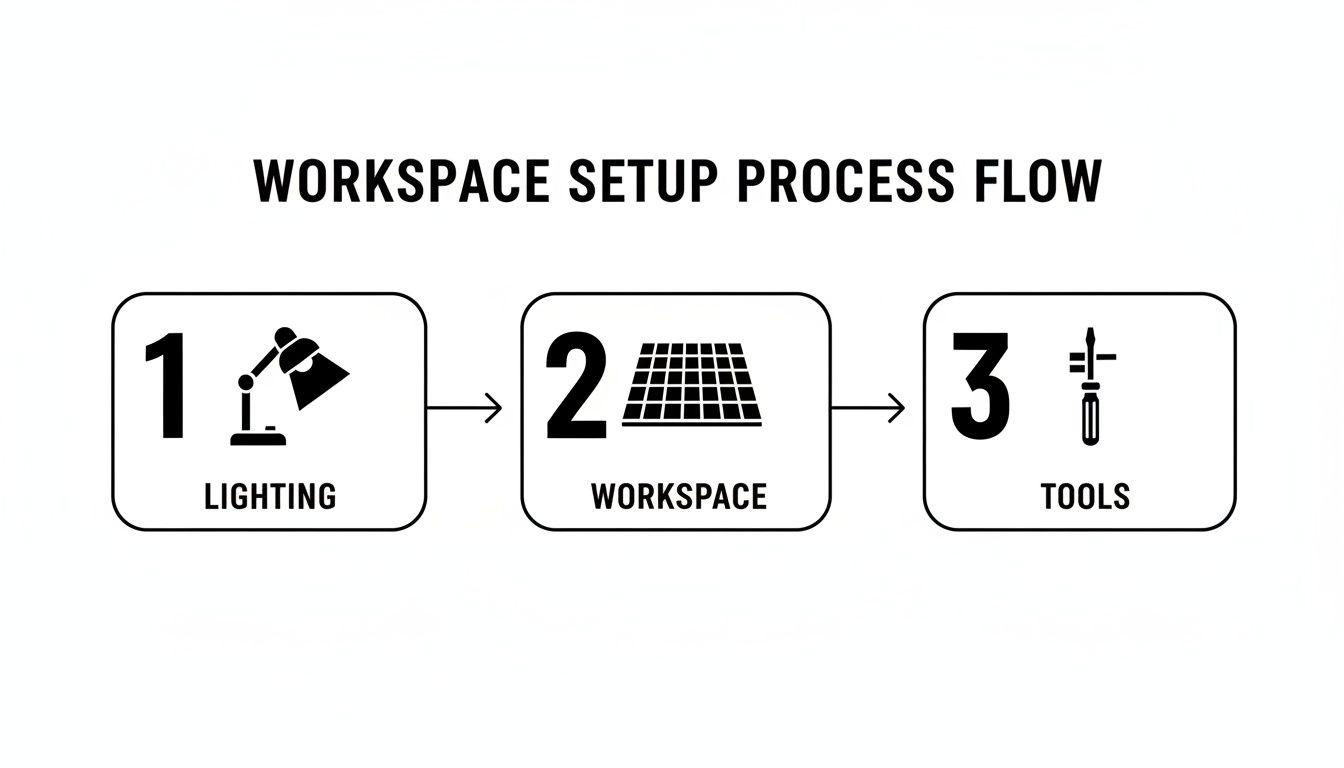
As the visual shows, it all starts with good lighting, a dedicated workspace like a pit mat, and having the right tools within reach.
A quality, temperature-controlled soldering iron is your best friend here. Use it to create strong, clean joints for your motor and ESC wires. Pro builders always "tin" both the wire and the connector tab before joining them. This little step ensures a rock-solid electrical connection that won’t fail under the high current demands of a modern brushless system.
Mastering Wire Management and Gear Mesh
Once everything is soldered, wire management becomes the next focus. Route your wires carefully to keep them away from any moving parts like belts, driveshafts, or the steering linkage. Use small zip ties or heat shrink tubing to bundle wires neatly and secure them to the chassis. This stops them from snagging in a crash or limiting suspension travel.
Here are a few pro tips for clean wiring:
- Measure twice, cut once: Cut your motor and sensor wires to the perfect length. Any extra wire just adds clutter and a tiny bit of weight.
- Go all-black: For that stealthy, professional look, using all-black wiring for your motor and ESC makes the final install look incredibly clean.
- Secure the receiver antenna: Make sure your receiver's antenna is routed safely up through an antenna tube to maintain a strong, clear signal.
The final critical mechanical step is setting the gear mesh—the spacing between the motor's pinion gear and the main spur gear. Too tight, and you’ll cause binding, strain the motor, and build up a ton of heat. Too loose, and you risk stripping the teeth off your spur gear under acceleration. A perfect mesh has just a tiny amount of backlash, enough to feel but not really see. A classic trick is to slide a small strip of paper between the gears, push them together, tighten the motor down, and then pull the paper out. That usually creates the ideal gap.
The rising popularity of kit builds in Canada reflects a community that's serious about this level of precision. North American sales of remote control toy cars hit $92.88 million in 2023, with a huge part of that growth coming from the competitive racing scene. Local RC clubs in Ontario and British Columbia report that over 40% of members now choose customizable kits, allowing them to fine-tune high-end chassis from brands like Awesomatix and XRAY for major events. You can learn more about these market trends and the growth of RC racing. This dedication is what drives the hobby forward. By mastering these assembly techniques, you're not just building a car—you're crafting a competitive edge.
Dialing In Your Baseline Setup For The Track
Having a fully assembled car is a great milestone, but it's just the beginning. The real speed is found on the setup station, where your rolling chassis transforms into a precision-tuned machine ready for the track. We're talking about a game of millimetres and degrees, where tiny adjustments can shave tenths off your lap times.
The goal here isn't to find the magic setup on the first try. It's to establish a solid, repeatable baseline. This gives you a known starting point, so when you make changes at the track, you know exactly what you're adjusting and why. Without that baseline, you're just guessing.
Establishing Your Fundamental Parameters
Before you even think about hitting the track, your car needs to spend some quality time on a setup station. Every serious racer goes through this routine, and the three most critical settings to nail down are ride height, camber, and toe. We recommend the high-precision setup tools from Hudy for this task.
- Ride Height: This is simply the distance from the bottom of your chassis to the setup board. Lowering the ride height lowers your car's centre of gravity, which reduces body roll and typically improves handling on smooth, high-grip tracks. For a 1/10 touring car on carpet, a good starting point is usually around 5.0mm in the front and 5.2mm in the rear.
- Camber: Look at the car from the front—camber is the angle of the tires. Negative camber means the tops of the tires lean inwards. This helps maximize the tire's contact patch during cornering, giving you more grip when you need it most. A baseline of -1.5 to -2.0 degrees is common.
- Toe: Now look at the car from above. Toe is the angle of the tires along their vertical axis. Rear toe-in (front of the tires pointing inward) adds stability, especially under acceleration. Front toe-out can make the car feel more aggressive on turn-in. I'd suggest starting with 0.5 degrees of toe-out at the front and a solid 3.0 degrees of toe-in at the rear.
Get these three settings right, and you'll have a car that's predictable and consistent. That makes it a whole lot easier to drive on the limit.
A car that is easy to drive is a car that is fast. Your baseline setup isn't about finding the absolute quickest setting for one lap; it's about creating a stable platform that you can push confidently for an entire race.
Demystifying Advanced Tuning Concepts
Once your basic geometry is dialled in, you can start exploring the more advanced adjustments that fine-tune your car's behaviour. These are the settings that really impact weight transfer, traction, and steering response.
The front differential is a perfect example. Most modern touring car kits, like those from XRAY or Awesomatix, give you the option of a gear differential or a spool.
A spool is just a solid axle that locks the front wheels together. It delivers incredible pull out of corners and very direct steering, which is why it's so popular for high-grip carpet racing. A gear diff, on the other hand, lets the wheels rotate at different speeds. This can make the car feel smoother and less aggressive, which is often a benefit on lower-grip asphalt tracks. The choice between them fundamentally changes how the car feels on the track.
Fine-Tuning Shocks And Gearing
Your shocks control how the chassis reacts to bumps and weight transfer, and the viscosity of the oil inside them plays a massive role. Thicker oil (a higher cSt number) slows the shock's movement, making the car feel more stable but less responsive. Thinner oil (a lower cSt number) lets the suspension react faster, which can generate more grip but might make the car feel a bit twitchy.
Your kit's setup sheet is a great place to start, but don't be afraid to experiment. A small change of just 50 cSt is definitely noticeable on the track. If you want to go even deeper, learning how to dial in perfect suspension settings with the Hudy droop and upstop gauge is a game-changer for advanced tuning.
Finally, there's gearing. The right gear ratio is essential for getting the most out of your motor. You want a pinion and spur combination that gives you strong acceleration without causing your motor to overheat before the five-minute race is over. Always check your motor temp after a run—if it’s too hot to comfortably touch, you're probably over-geared. This whole process, from camber to gearing, is what turns a well-built kit into a truly competitive race car.
Why Your Next Build Should Be Sourced From digital-rc
When you decide to build your own RC car, getting the right parts without delay is everything. We’ve all been there—stuck waiting weeks for an order from overseas, completely killing your momentum and maybe even ruining a race weekend. This is where sourcing your build from a dedicated Canadian partner like digital-rc gives you a serious edge.
We’ve built our entire operation around what serious Canadian racers actually need. Our selection of premium kits and factory parts from brands like Hobbywing, Team Powers, Awesomatix, and XRAY isn't just a random catalogue; it's a curated inventory. We only stock components proven for performance and compatibility, so you can spend less time guessing and more time building a car that wins.
Get Your Build Done Faster
The real game-changer is our logistics. In racing, speed matters both on and off the track, and we get that. That’s why we offer free same-day local delivery for orders placed before noon. Think about it: you’re mid-build and realize you need a different pinion gear or a spare arm. With us, that’s not a weekend-ending disaster. It’s a minor hiccup that can be fixed in a few hours.
This kind of rapid access to parts means your project never grinds to a halt. It keeps you on schedule, whether you’re prepping for a national event or just excited to get your new car on the track.
The Smart Way to Buy in Canada
Beyond speed, there are real financial advantages to sourcing your build locally. When you shop with digital-rc, every price is in Canadian Dollars (CAD). No more gambling on exchange rates or getting hit with surprise credit card fees. It makes budgeting for a high-end build clean, simple, and transparent.
Partnering with a local, specialized supplier isn't just about convenience—it's a strategic move. You get an expert-curated inventory, faster delivery, and clearer costs, letting you focus on what really matters: building the best car possible.
On top of that, we've structured our business to give racers maximum value. All orders placed through digital-rc have no tax applied, which adds up to a substantial saving on a full 1/10 touring car kit and its electronics package. This makes top-tier components more accessible. We're not just another store; we're your partner in racing, here to provide the performance-focused parts and speed you need to stay competitive.
Common Questions About Building Your Own RC Car
Jumping into your first serious RC build is an awesome experience, but it’s natural to have a few questions before you start wrenching. Getting a handle on these key areas early on can make the difference between a smooth, rewarding build and a box of expensive parts sitting on your bench.
Let's run through some of the most common questions we hear from builders, both new and experienced. Understanding these points will help you plan your build, set a realistic budget, and put your focus where it counts—on the track.
What Is The Hardest Part of The Build?
For most builders, the trickiest part is always the electronics—specifically soldering and wire management. Getting those clean, reliable solder joints takes a steady hand and a bit of practice. But the real art is routing the wires so they don't interfere with the suspension or drivetrain. Tidy wiring isn't just for looks; it's essential for consistent performance.
The other two areas that often trip up newcomers are building shocks and differentials. Getting them perfectly smooth and, more importantly, leak-free can be a challenge. Take your time here. A little extra patience during assembly will pay you back tenfold in performance and reliability.
How Much Does a Competitive Build Cost?
This is the big one. A competitive 1/10 touring car build usually starts with a top-tier chassis kit from a brand like XRAY, Awesomatix, or ARC, which will run you between $700 and $1,000 CAD. That’s your foundation.
From there, you'll need a full electronics package—motor, ESC, servo, and receiver—which typically adds another $500 to $800 CAD. We recommend proven combinations from Hobbywing and Team Powers.
When you factor in the essentials like LiPo batteries, a quality charger, tires, and a body, a complete race-ready car usually lands somewhere between $1,800 and over $3,000 CAD. Shopping with us at digital-rc helps manage that budget, since you're paying in CAD with no tax on any orders.
The best initial "upgrade" isn't a part; it's a tool. A high-quality set of setup tools will provide far more performance gains than any optional aluminum or carbon fibre component by allowing you to tune your car precisely.
What Upgrades Should I Consider First?
Honestly, modern racing kits from brands like XRAY and Awesomatix are incredibly capable right out of the box. Instead of immediately hunting for "upgrade" parts, your first investment should be in tuning options.
We're talking about things like different spring sets, a range of sway bars, and shims to adjust your car’s handling for specific track conditions. These are the components that let you adapt and find real speed, not a fancy-looking aluminum part.
Ready to start your championship-level build? digital-rc has the curated selection of Awesomatix chassis, Hobbywing electronics, and all the essential parts you need, with fast, local delivery across Canada. Explore our full catalogue of high-performance RC components at digitalrc.ca and get your project on the fast track.