

RC Car Chassis A Racer's Guide to Winning Setups
Think of your RC car chassis as the backbone of your entire race program. It’s not just a flat piece of carbon you bolt parts to; it's the engineered foundation that translates every input from your transmitter into real, on-track performance. How it accelerates, how it carves through a corner, and how it responds to your commands all starts right here.
Your Car's Foundation for Speed
Welcome to the absolute heart of your race car. The chassis is much more than a simple plate—it's an integrated system where every single component has to work together perfectly. For any serious racer in Canada, a deep understanding of this foundation is the first real step toward the podium.
When you open a high-performance kit from a brand like XRAY or Awesomatix, you're looking at the result of countless hours of engineering and track testing. These aren't just parts in a box; they're a carefully designed ecosystem built for one purpose: to win.
The anatomy of a modern racing chassis is a lesson in synergy. It’s where materials science meets dynamic engineering to create a platform that is both rigid enough to handle immense power and flexible enough to generate mechanical grip.
The Core Components of Your Chassis
To really get a feel for how a chassis works, you need to know the key players. Each piece has a specific job, whether it's managing forces, controlling flex, or just providing a rock-solid base for your suspension and electronics.
- Main Chassis Plate: This is the big one, the most recognizable part, usually cut from high-grade carbon fibre or aluminum. Everything bolts to this.
- Top Deck: Running like a spine above the main plate, the top deck connects the front and rear of the car. Its shape, material, and even how it’s mounted are your primary tools for tuning the car's torsional (twisting) flex.
- Bulkheads: These beefy, machined aluminum parts are the strongholds of the chassis. They lock down the differentials and suspension mounts, providing the hardcore rigidity needed to survive high-speed racing.
- Suspension Mounts: Bolted to the bulkheads, these are the pivot points for your suspension arms. Their exact placement is what determines critical geometry settings like roll centre and anti-squat.
Every one of these elements contributes to the car's behaviour, from the main plate of an XRAY T4 touring car to the trick motor mount on an Awesomatix A12 pan car. The way they connect—for instance, how many screws you use in the top deck—is a fundamental tuning option. A tiny adjustment here can be the difference between a good lap and a winning one, making your chassis knowledge absolutely essential.
Touring Car vs. Pan Car Chassis Designs
In the on-road racing world, a 1/10 touring car and a 1/12 pan car might look like close cousins, but their design philosophies are worlds apart. One is a complex, highly adjustable machine built for any surface you can throw at it; the other is a brutally simple weapon engineered for pure, unadulterated speed on carpet.
For any Canadian racer serious about winning, understanding these fundamental differences is the first step to mastering a class.
The Intricate World of the Touring Car Chassis
A top-tier touring car chassis, like the XRAY T4, is a true marvel of modern RC engineering. It’s built around a sophisticated four-wheel-drive system and features fully independent suspension with oil-filled shock absorbers at all four corners.
This complexity serves one critical purpose: generating mechanical grip in a massive range of conditions. The independent suspension lets each wheel react to tiny bumps and imperfections in the track surface, keeping the tire patch glued to the ground for maximum traction. The belt-driven drivetrain delivers buttery-smooth power to all four wheels, making the car stable and predictable.
The name of the game for a touring car chassis is adaptability. Its intricate design gives racers a huge tuning window, letting them dial in the car for anything from a bumpy, low-grip parking lot to a high-bite carpet track.
This infographic breaks down the core components that make these advanced chassis designs work.

As you can see, the main chassis plate is the foundation, but the top deck and bulkheads are what give the car its structural integrity and allow for critical flex adjustments.
The Pure Simplicity of the Pan Car Chassis
Now, let's switch gears and look at a 1/12 pan car, like the championship-winning Mon-Tech M23. The first thing you'll notice is its stark, minimalist design. It gets the name "pan car" from its single, flat chassis plate that forms almost the entire structure. There’s no complex A-arm suspension or traditional shock absorbers here.
Instead, a pan car uses a much more direct, efficient system:
- Rear Suspension: A "pivot ball" system and side links allow the entire rear motor pod to move independently from the main chassis. Damping is handled by a single centre shock and side tubes filled with thick grease or oil.
- Front Suspension: The front end relies on a simple kingpin-and-spring setup. It offers adjustments for camber, caster, and toe but lacks the complex linkages found on a touring car.
- Drivetrain: Power goes straight from the motor to a solid rear axle. It's incredibly efficient but also makes the car a real handful to drive.
This stripped-down approach results in an unbelievably lightweight and responsive car. On the smooth, high-grip carpet tracks common in Canadian indoor racing, this direct connection gives a pan car blistering acceleration and corner speeds that are simply untouchable.
Chassis Comparison 1/10 Touring vs 1/12 Pan Car
To really see the difference, it helps to put them side-by-side. This table breaks down the key design distinctions between these two dominant on-road platforms.
| Feature | 1/10 Touring Car Chassis (e.g., XRAY T4) | 1/12 Pan Car Chassis (e.g., Mon-Tech M23) |
|---|---|---|
| Drivetrain | 4WD (typically belt or gear driven) | 2WD (direct drive to a solid rear axle) |
| Suspension | Fully independent with 4 oil-filled shocks and upper/lower A-arms | Pivot-ball rear pod with a single centre shock; kingpin-and-spring front end |
| Primary Surface | Versatile (asphalt, carpet, treated surfaces) | Specialist (high-grip indoor carpet) |
| Complexity | High; many components and extensive setup adjustments | Low; minimalist design with fewer moving parts |
| Weight | Heavier, due to 4WD system and complex suspension | Extremely lightweight for maximum efficiency |
| Driving Style | Stable, predictable, and forgiving under power | Aggressive, twitchy, and requires precise throttle control |
The bottom line is that neither chassis is "better"—they are just different tools for different jobs. The trade-off for the pan car's raw speed is a platform that is highly specialized and far less forgiving on bumpy or low-grip surfaces. Your choice ultimately comes down to your racing goals and the tracks you plan to hit.
Understanding Chassis Materials and Performance
The material your RC car chassis is made from isn't just a technical spec—it's one of the most critical performance variables you can control. A chassis is a dynamic component. Its material directly influences flex, weight, and rigidity, which ultimately defines how your car behaves on the track.
Getting your head around these materials is the key to unlocking your car’s full potential. The science behind modern racing platforms is all about finding that perfect balance of properties, and for the main plates and top decks, one material has proven itself time and time again.
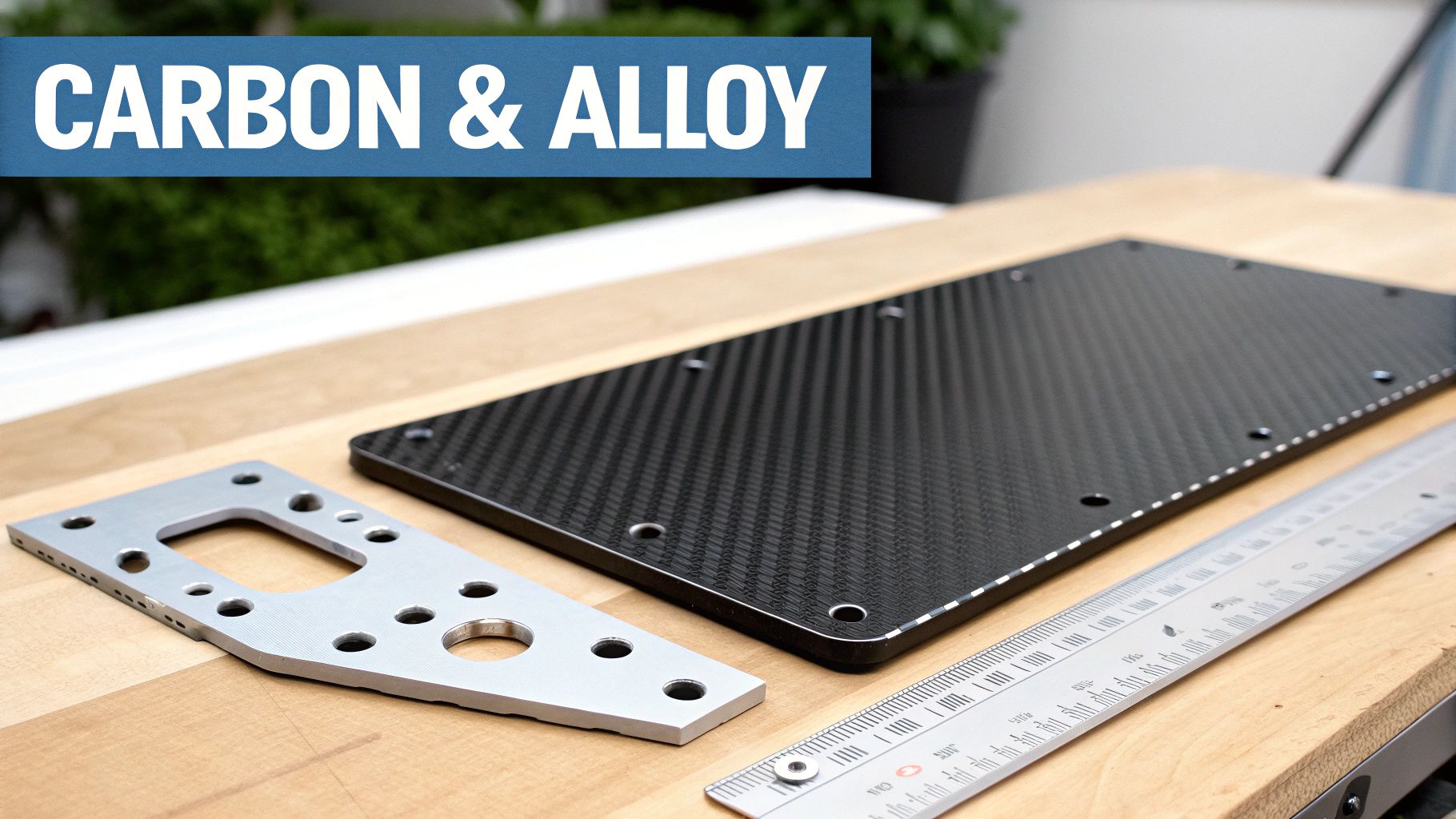
Carbon Fibre: The Champion of Flex and Weight
Carbon fibre is the undisputed king for the main structural parts of any modern touring or pan car. Its incredible strength-to-weight ratio allows designers to build chassis that are both extremely light and remarkably strong—essentials for achieving the low centre of gravity and minimal weight needed for competitive racing.
But its real magic lies in its tunable flex. Unlike metals, the direction of the carbon weave can be engineered to let the chassis twist torsionally while staying stiff from front to back. This controlled flex is what generates mechanical grip, helping the tires maintain better contact with the track surface through the corners.
Think of a carbon fibre chassis not as a rigid board, but as a finely tuned spring. It stores and releases energy with every turn, helping the car settle into the corner and power out with maximum traction.
7075 Aluminum: Unyielding Rigidity Where It Counts
While carbon fibre excels at managing flex, some parts of an RC car chassis demand absolute, unyielding rigidity. This is where 7075 aluminum steps in. This high-grade alloy is the go-to material for components that must handle immense forces without deforming, like motor mounts, bulkheads, and suspension holders.
A motor mount, for example, has to hold the motor perfectly still to ensure a consistent gear mesh, even under the brutal torque of a modern brushless motor. Any flex here would lead to lost power and potential gear damage. Precision-machined mounts and bulkheads from brands like XRAY and Awesomatix deliver this essential stiffness, ensuring all that power gets transferred straight to the drivetrain. This rigidity also creates a solid foundation for the suspension to do its job properly.
If you want to dive deeper into how different materials can transform a car's handling, you can learn more about an XRAY aluminum chassis setup in our dedicated article.
This choice of material is especially important in the Canadian indoor racing scene. Focusing on 1/12 pan car chassis dominance, data from the 2023–2024 season shows these lightweight frames powered 81% of class A-B wins at tracks like Montreal's RCXtreme and Edmonton's Fast Lane Hobbies. For Canadian racers battling harsh winters, chassis with billet 7075 aluminum arms can withstand -20°C trackside tweaks, extending their lifespan by up to 40%.
Advanced Composites: Durability and Strategy
Beyond pure carbon and aluminum, advanced composite materials play a strategic role. These are essentially plastics reinforced with fibres like glass or carbon, offering a fantastic balance of durability, performance, and cost-effectiveness.
You'll often find composites used for parts like suspension arms, steering knuckles, and hubs. Their key benefits are clear:
- Impact Resistance: Unlike carbon fibre, which can crack on a hard hit, composite parts can often absorb impacts and flex right back into shape. This is a race-saver.
- Tunability: Manufacturers offer these parts in different stiffness levels (soft, medium, or hard composites), giving racers another tool to fine-tune grip and handling for specific track conditions.
By intelligently combining these three core materials—carbon fibre for controlled flex, 7075 aluminum for a rock-solid foundation, and advanced composites for strategic durability—engineers create an RC car chassis that is a true high-performance machine.
How to Master Chassis Flex for Maximum Grip
Chassis flex is the secret weapon in almost every top racer’s arsenal, but it’s still one of the most misunderstood concepts in the pits. It’s not about having a chassis that’s floppy or one that’s stiff as a board. True mastery comes from controlling how the rc car chassis dynamically twists to generate mechanical grip when you need it most.
Think of it as an engineered spring. As your car loads up into a corner, the chassis twists just enough to help the suspension do its job, keeping all four tires pressed firmly into the track. This controlled movement is the key to maintaining traction through fast sweepers and getting the power down out of tight hairpins.
For competitive racers, learning to manipulate this characteristic is non-negotiable. It’s often the difference between a car that feels planted and one that’s constantly fighting you.
The Art of Tuning Flex
Adjusting chassis flex isn’t black magic. It’s a methodical process of changing how different components bolt together, which in turn changes how the entire platform behaves under load. On a modern touring car, you have several key adjustment points that directly influence this behaviour.
The goal is to match the chassis's flex to the track’s grip level. A dusty, low-grip parking lot track demands a very different setup than a high-bite, black-carpet indoor circuit.
The core principle is simple: more flex generally creates more mechanical grip, but it can make the car feel less responsive. Less flex sharpens the car's reactions but can make it feel edgy and difficult to drive on lower-traction surfaces.
Practical Flex Adjustments
Let’s get into the most common ways to actually tune the flex on your touring car. These adjustments are your primary tools for adapting to changing conditions and finding that last tenth of a second.
- Top Deck Screws: This is your first and most common adjustment. Removing screws that connect the top deck to the bulkheads allows the entire chassis to twist more freely. A popular starting point is to remove the screws closest to the chassis centreline.
- Motor Mount Connection: Many high-end kits feature motor mounts that can be attached to the chassis in different ways. A "floating" mount that doesn't bolt directly to the centreline increases torsional flex, while adding screws will stiffen up the whole assembly.
- Stiffeners and Braces: A lot of kits include optional carbon fibre or aluminum braces. Adding a brace between the front bulkheads, for example, will stiffen the front end, making the steering feel more direct and aggressive.
Figuring out how to tune for different grip levels is where the magic happens. For a closer look at how chassis design influences handling, check out our analysis of the Awesomatix A12X Soft Steel Chassis engineered for high grip surfaces.
Chassis Flex Tuning Guide
Knowing which screws to turn is one thing, but knowing why you're turning them is what wins races. The table below breaks down some common touring car adjustments and what they do to the car's handling on the track.
| Adjustment (e.g., Top Deck Screws) | Action (e.g., Remove Centre Screw) | Resulting Handling Change |
|---|---|---|
| Top Deck Screws | Remove centre screws | Increases overall chassis twist, improves rear traction, especially on corner exit. Can feel less responsive. |
| Top Deck Screws | Install all screws | Stiffens the chassis, makes the car more reactive and direct. Best for high-grip surfaces. |
| Motor Mount Screws | Remove centreline screw ("float" the mount) | Allows more torsional flex through the middle of the car, helping generate grip on low-bite tracks. |
| Motor Mount Screws | Install all screws | Locks the motor mount to the chassis, reducing flex and increasing responsiveness. Good for carpet. |
| Bumper Brace | Remove brace screws from chassis | Softens the very front of the car, can increase initial steering feel on lower grip. |
| Bumper Brace | Install brace with all screws | Stiffens the front, making steering more aggressive and precise. |
Use this as a starting point. Every car and track is different, so don't be afraid to experiment to find what works for your driving style.
Connecting Adjustments to Results
The theory is great, but what really matters is how these changes feel on the track. Translating an adjustment into a real-world result is what separates the front of the pack from the midfield.
Imagine you're at a track where the grip is low, and your car feels like it's skating on top of the surface, desperate for rear traction on corner exit. This is a classic scenario that calls for a softer, more flexible setup. You’d start by removing the centre screws from your top deck to let the chassis twist more, helping the rear tires dig in.
On the flip side, on a high-grip carpet track, an overly flexible rc car chassis can feel lazy, unresponsive, and might even traction roll. Here, you would do the opposite: add screws back into the top deck and make sure the motor mount is locked down to stiffen everything up. This will make the car change direction faster and feel much more precise.
Choosing Upgrades for Your Winning Setup
A world-class RC car chassis is a phenomenal starting point, but the components you bolt onto it are what truly create a winning package. Building a cohesive, high-performance car isn't about just picking parts; it’s a strategic process of finding components that work together to maximize speed and, just as importantly, reliability.
Think of your chassis as the foundation of a professional race car. You wouldn't just throw in any engine or transmission; you'd select parts known to work in perfect harmony. The same logic applies here—every single component, from the servo to the smallest bearing, has to complement the chassis and your driving style.
Selecting Compatible High-Performance Electronics
Your electronics are the heart and brains of your car. Getting this combination right is non-negotiable if you want consistent, predictable performance on the track. An overpowered motor paired with an under-specced ESC is a recipe for a meltdown, just as a slow, sloppy servo completely wastes the potential of a responsive chassis.
At Digital-RC, we stock the race-proven combinations that Canadian racers depend on:
- ESCs and Motors: Pairing a Hobbywing ESC with a matched motor gives you a seamless power delivery system. This synergy is key for smooth throttle control and efficiency, which is absolutely critical for staying in control on high-grip tracks.
- Servos: A high-speed, high-torque Sanwa servo is essential for translating your steering inputs into immediate, precise action on the track. A top-tier servo lets the chassis react instantly, giving you the confidence to dive into corners and hit your lines perfectly.
A winning setup isn't about having the single most expensive part in every category. It's about creating an ecosystem where the ESC, motor, and servo work together to elevate the performance of the entire RC car chassis.
Strategic Upgrades for Speed and Reliability
Beyond the big-ticket electronics, small mechanical upgrades can deliver huge performance gains. These are the parts that often get overlooked but are absolutely essential for turning power into on-track speed and ensuring your car actually finishes every race.
For immediate results, focus on these key areas.
- Premium Bearings: Upgrading to high-quality bearings is one of the easiest ways to reduce friction in the drivetrain. Less friction means more of your motor's power actually makes it to the wheels, giving you higher top speeds and even slightly longer run times.
- Pinions and Spur Gears: A precise, durable set of gears is vital. Using top-quality pinions and spur gears ensures you get a perfect mesh. This not only minimizes power loss but dramatically reduces the risk of a stripped gear ending your race day early.
Chassis customization trends in Canadian on-road RC racing have exploded, with 59% of competitive builds now incorporating aftermarket components by 2024. A key stat shows that 74% of national podium teams used setups with +5° caster shims and 48-pitch spur gears, which slashed understeer by a massive 18% on high-grip astro turf. For racers wanting to fine-tune handling, servo upgrades boosted steering precision by 25%—a critical advantage for 1/10 touring cars on tight, technical layouts. You can discover more insights on how chassis technology impacts performance by reviewing the latest automotive chassis market findings.
Tuning your chassis is an ongoing process of refinement. For those running an XRAY platform, finding that perfect balance of flex and stiffness is everything. Check out our detailed guide on XRAY X4 '25 Performance Upgrades and Chassis Tuning for advanced setup techniques. By choosing proven components and avoiding common build pitfalls, you can create a fast, consistent car that's ready for any challenge.
Essential Maintenance for Your Chassis
A high-performance RC car chassis is a serious investment in your race program, and like any precision tool, it needs consistent care. Think of it like a professional race team prepping their car between heats—every single detail matters. A solid maintenance routine keeps your car at peak performance and, more importantly, stops small issues from turning into race-ending failures.
This isn't just about wiping off some dust. It's about a proactive inspection that tells you the story of your last race. For any competitive racer, a thorough check-up after every single race day is non-negotiable.
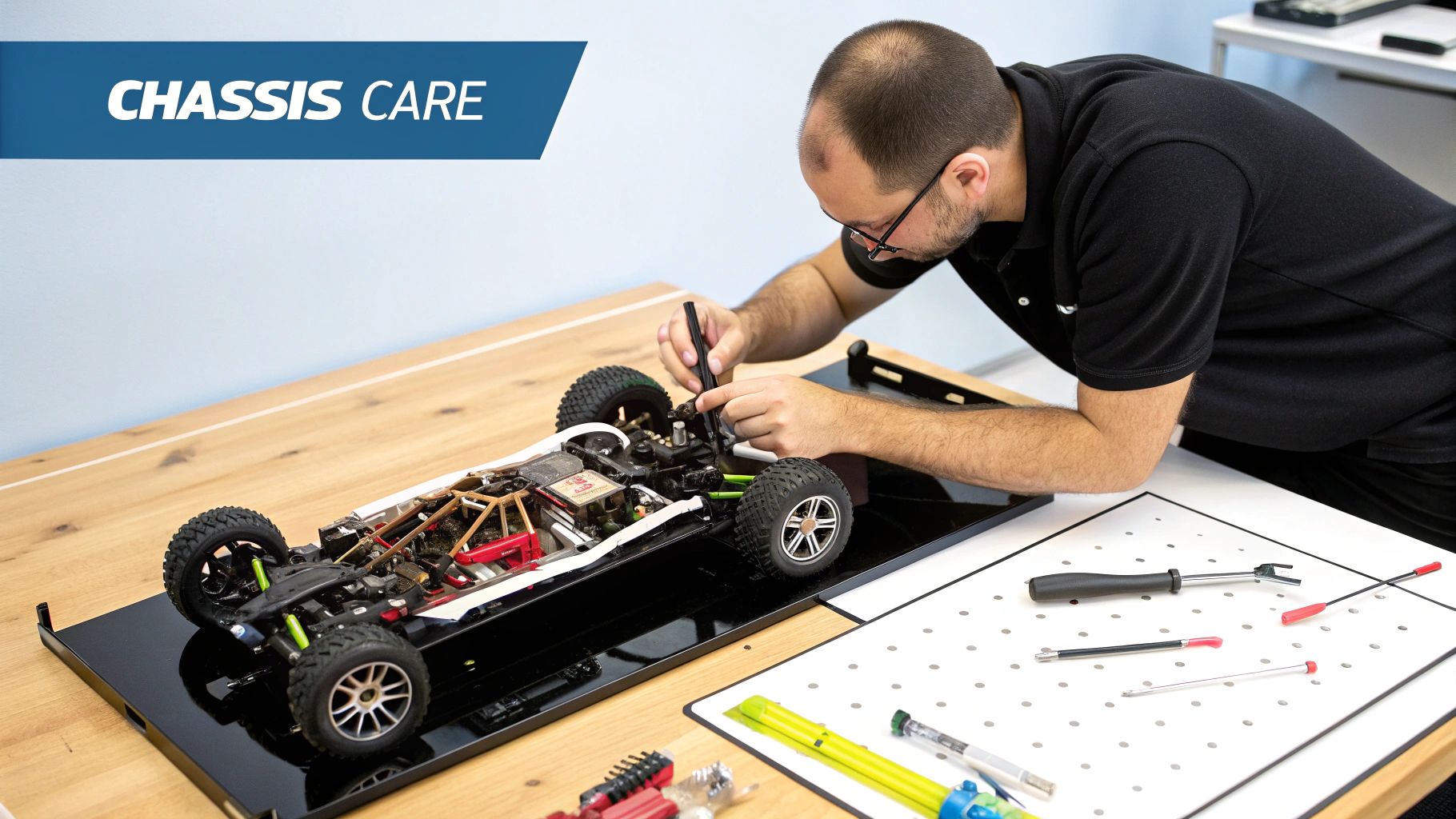
Core Chassis Inspection Tasks
Your post-race routine needs to be methodical. Always start by getting the car clean, then dive into a detailed inspection of the most critical structural parts.
- Check for Tweak: Pop your bare chassis onto a dead-flat setup board. Does it rock from corner to corner? If so, it's "tweaked." This imbalance will make the car handle completely inconsistently, turning one way differently than the other. A gentle twist can often straighten out minor tweaks, but a severe one might point to a bigger problem.
- Inspect Carbon Fibre: Go over the main chassis plate and top deck with a fine-toothed comb. Look for any signs of cracking or delamination, which is where the carbon layers start separating. Pay extra close attention to the areas around screw holes and the outer edges. A compromised carbon part loses its engineered flex characteristics and its strength.
Regular inspection isn't just maintenance; it's data collection. Noticing recurring stress marks or damage patterns can help you identify setup issues or driving habits that are putting unnecessary strain on your car.
Protecting Your Carbon Fibre
Carbon fibre edges are incredibly vulnerable to damage from track barriers and even small taps. This kind of impact can cause delamination, which will quickly ruin an expensive chassis plate.
To head this off, you should always seal the edges of any new carbon fibre part before you even build the kit. Applying a thin layer of cyanoacrylate (CA) glue, like the stuff from Bob Smith Industries, creates a hard, protective barrier. Use a glue tip for a clean, precise application and let it dry completely. It’s a simple step that can dramatically extend the life of your RC car chassis.
Keeping your pit space organized with the right setup tools and chemicals from Digital-RC means you’re always prepared for trackside adjustments and post-race maintenance. This level of preparedness is what separates good racers from great ones, guaranteeing your equipment is ready to perform every time you hit the track.
Your Questions Answered: A Racer's Guide to RC Chassis
Even the most seasoned racers have questions when it comes to dialling in their RC car chassis. It’s not just a flat piece of material; it's a dynamic, critical part of your setup, and understanding its nuances can unlock serious speed on the track.
Let's dive into some of the most common questions we hear, covering everything from material choices to the advanced tuning concepts that will get you ready for race day.
Which Chassis Material Is Better: Aluminum or Carbon Fibre?
This is a classic question, but the truth is, neither one is universally "better." Think of them as different tools for different jobs.
Carbon fibre is the go-to for most touring and pan car kits for a reason. Its engineered flex is perfect for generating mechanical grip on a huge variety of surfaces. It essentially acts like a big, flat spring, twisting just enough to keep your tires planted and digging in for traction.
Aluminum chassis, on the other hand, are much stiffer. That rigidity is exactly what you want in extremely high-grip conditions, like on black carpet, where the car needs to react instantly and resist traction rolling. For most Canadian tracks, though, a good carbon fibre chassis is the more versatile and forgiving starting point.
How Often Should I Replace My RC Car Chassis?
There’s no magic number or set schedule for replacing your chassis. Its lifespan really depends on how often you race and the kinds of hits it takes along the way. Instead of marking your calendar, get in the habit of regular, careful inspection.
It’s time for a replacement when you spot any of these tell-tale signs:
- Cracks or fractures: Any visible crack, no matter how small, compromises the chassis's structural integrity and its designed flex characteristics.
- Delamination: If you see the layers of carbon fibre starting to separate or peel, especially around the edges, the chassis has lost its strength.
- Deep scratches or gouges: Minor scrapes are just battle scars, but deep cuts can create weak points that are just waiting to fail under the stress of a race.
- Permanent tweak: If the chassis won't sit perfectly flat on your setup board—even after you've loosened all the top deck and bulkhead screws—it's likely bent for good and will cause nothing but inconsistent handling.
In the competitive world of Canadian RC racing, the shift to advanced 1/10 touring car chassis is undeniable. At the Canadian National Championships, a staggering 68% of top-10 finishers were running either an XRAY or Awesomatix chassis. These platforms, with their finely-tuned carbon fibre tubs and adjustable suspension, are delivering lap time reductions of up to 1.2 seconds per minute on 300mm GTP tracks. You can dig into the broader data behind these recreational vehicle market trends in Canada.
At Digital-RC, we stock the race-proven chassis, parts, and electronics you need to build a winning car. Explore our curated collections from XRAY, Awesomatix, and more to find the perfect foundation for your setup.
Shop high-performance RC car chassis and parts at digitalrc.ca