

Find an RC Car Track Near Me Today
So you've got the RC bug, but running in the street is getting old. Finding a dedicated track is where the real fun begins—it’s the difference between just driving your car and actually racing it.
Discovering a great local spot can feel like a secret handshake, but a few smart moves will get you in the door and onto the driver's stand in no time. This isn't just about finding any patch of dirt or carpet; it's about plugging into a community where you can push your skills, test your car’s limits, and have an absolute blast doing it.
Your Guide to Finding the Perfect Local RC Track
Your search starts online, but getting the right results means being specific. Let's dig in.
Mastering Digital Search Tools
Hitting up Google Maps is the obvious first step, but the key is using the right search terms. A generic "rc car track" will pull up all sorts of random stuff, including go-kart tracks and parks where people happen to drive their bashers.
Be more specific. If you have a buggy, search for "off-road RC track." If you’re running a touring car, try "indoor carpet RC track." This small tweak makes a huge difference and filters out the noise.
You’ll get a map with pins showing track locations, club names, and sometimes even reviews from other racers. It’s a perfect starting point.
Once you have a few names, it's time to go a level deeper. RC-specific forums and club directories are goldmines. Websites that list tracks by province are often run by hardcore racers who keep them updated with schedules, contact info, and track conditions.
Pro Tip: Don't sleep on social media. Jump on Facebook and search for groups like "RC racing [Your City]" or "[Your Province] RC Racers." This is where the local scene lives. You'll find race announcements, practice day discussions, and a direct line to the people who run the tracks.
Before you go all-in online, here's a quick breakdown of the best tools for the job.
Quick Guide to Finding RC Car Tracks
This table summarizes the most effective methods and tools for locating RC car tracks in your area.
| Method | Best For Finding | Pro Tip |
|---|---|---|
| Specific Map Searches | Geographic locations and club names quickly. | Use terms like "indoor carpet" or "1/8 scale off-road" to filter results. |
| Social Media Groups | Real-time race schedules and community chatter. | Search Facebook for your city or province + "RC racing" to find active groups. |
| RC Forums & Directories | Official club websites and contact information. | Look for regional sub-forums where locals post track-specific updates. |
| Local Hobby Shops | Insider info and beginner-friendly recommendations. | Ask the staff which tracks are running and check for flyers on the bulletin board. |
Each of these methods gives you a different piece of the puzzle. Combining them is the fastest way to find a track that fits what you're looking for.
Tapping Into Local Knowledge
As good as online tools are, nothing beats boots-on-the-ground intel. Your local hobby shop is more than just a place to buy parts—it’s the nerve centre of the local racing community. The people who work there and the regulars who hang out there are almost always involved in the scene.
Walk in and start a conversation.
- Ask them which tracks are good for beginners.
- Check for a bulletin board—it’s often covered in flyers for upcoming races.
- Get the inside scoop on which tracks have the best pit setups or the most popular classes.
This is how you don't just find an "rc car track near me," but find the right one for your first day out.
Decoding Different RC Track Types
Finding a track is just the first step. The real challenge—and where the fun begins—is knowing what you're getting into before you arrive. Showing up at a high-grip indoor carpet track with a monster truck built for mud is like bringing a hockey stick to a soccer match. It just won’t work.
Each track surface demands a completely different vehicle setup, from tire compounds and tread patterns to suspension geometry and ride height. Knowing the track type lets you prep your car for success instead of spending your day frustrated in the pits.
This map gives you a quick breakdown of the main ways racers find their local haunts.
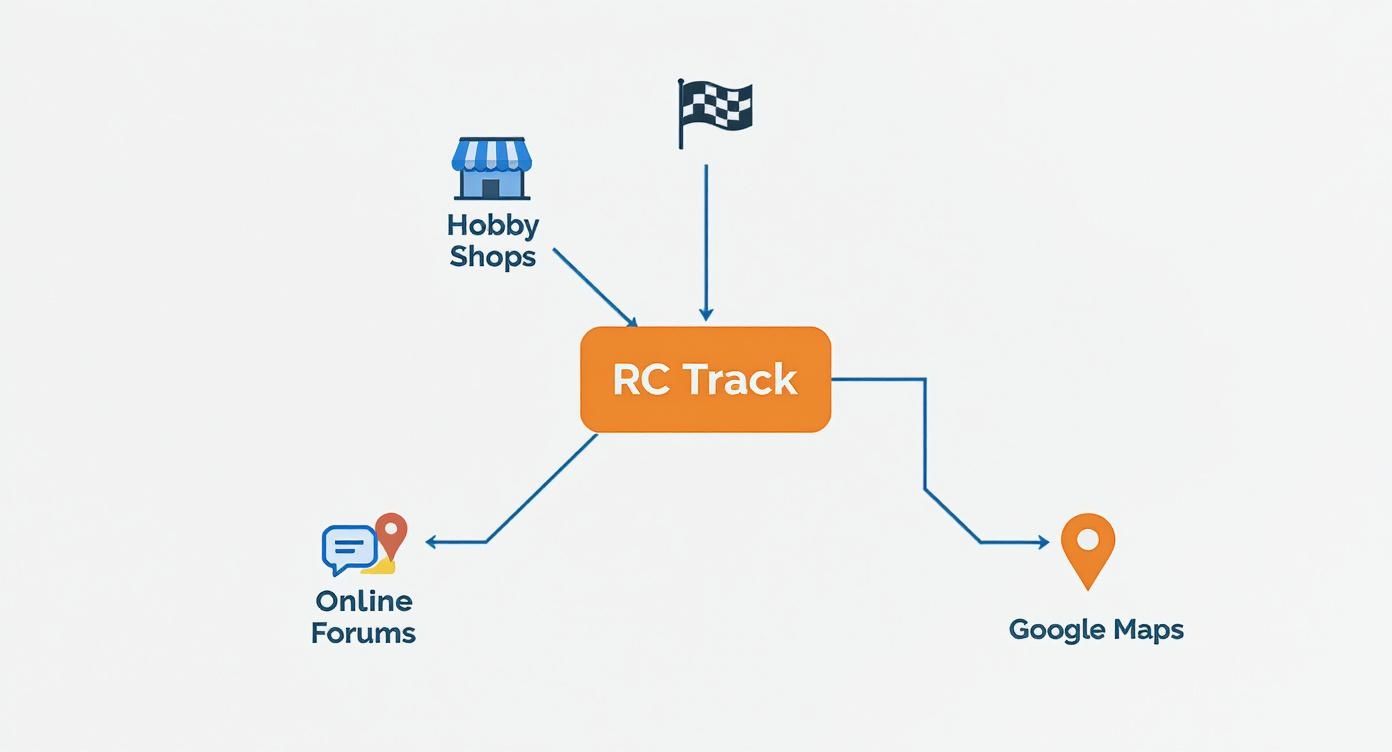
Think of it as a network. Online searches, local hobby shops, and racer forums all connect, giving you different pieces of the puzzle to find the perfect spot.
Indoor Carpet and Turf Tracks
Step inside an indoor facility, and you’re in the world of precision on-road racing. These tracks, typically laid with high-grip carpet or artificial turf, offer an incredibly consistent surface where your setup is everything. Weather is a non-issue, so the racing is always tight and competitive.
This is the home turf for vehicles like 1/10 scale touring cars and the lightning-quick 1/12 scale pan cars. The insane traction from carpet-specific rubber or foam tires allows for blistering corner speeds, demanding a low centre of gravity and a perfectly balanced chassis. If that sounds like your kind of racing, you should check out our guide on the ultimate 1/12 pan car for competitive carpet racing.
These venues are a tuner's paradise, where shaving milliseconds off your lap time comes down to tiny adjustments.
Outdoor Off-Road Dirt and Clay
This is where things get messy—in the best way possible. Outdoor off-road tracks are where buggies, truggies, and short-course trucks really come alive. The surface can be anything from loose, loamy dirt that gets blown out to a high-bite, grooved clay that feels like you’re racing on Velcro.
Here, it's all about suspension travel, tire tread, and raw durability. A track can be smooth and tacky one day, then dry, dusty, and full of ruts the next. That variability is what makes it so exciting; you're constantly forced to adapt your car and your driving style. Jumps, bumps, and ever-changing lines make every single lap an adventure.
The big takeaway for outdoor tracks is they test both driver skill and the car's ability to take a beating. You need a rig that can soak up punishment and stay stable over rough, unpredictable terrain.
Of course, there are other specialized tracks out there, too. You might find technical rock-crawling courses dotted with natural obstacles or high-speed ovals built for pure velocity. The bottom line? Always confirm the track type before you load up the car, making sure your gear is a perfect match for the challenge ahead.
What to Expect on Your First Track Day
Rolling up to an RC track for the first time can be a little intimidating. It often feels like you've stumbled into a private club where everyone knows the secret handshake. The pits are a hive of activity, cars are flying around the driver's stand with practiced precision, and you're just hoping you brought the right gear.
Relax. Every single person there had a "first day" once. They get it.
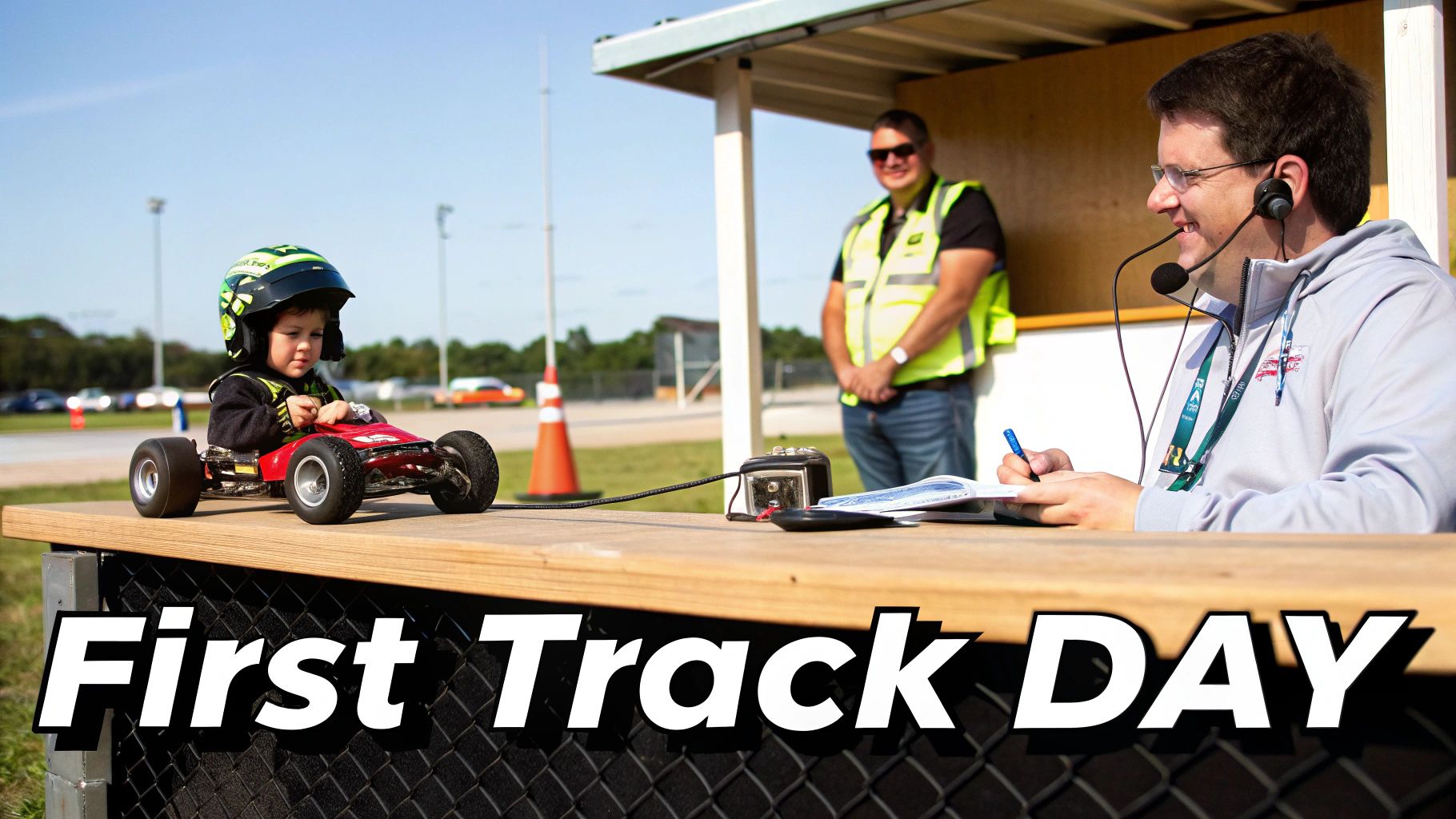
The key is to walk in with a basic understanding of how the day flows. A little prep work—from setting up your pit space to figuring out race classes—will make your first visit a massive success instead of a stressful one.
Navigating the Pits and People
Your first mission is to claim a spot in the pit area. This is your home base for the day. Find an open table, roll out your pit mat, and get your car, tools, and charger organised. Don't hesitate to introduce yourself to the racers next to you—they’re your best source of on-the-ground info.
Most tracks don't just let everyone on the track at once. They run timed practice sessions or race heats to keep things organised and give everyone a shot at clean, unobstructed laps. Keep an ear out for announcements from the race director over the PA system; they'll tell you when your group is up.
A crucial piece of track etiquette is marshalling. After your run is done, you’ll walk out to a designated corner of the track. Your job is simple: flip over any crashed cars in your zone so those drivers can get back to racing. It’s a pay-it-forward system that keeps the action moving for everyone.
Understanding Race Day Essentials
You're going to hear a lot of new terms, but two of the most important are "transponder" and "race classes." They're fundamental to organised racing but are actually pretty simple concepts.
A transponder is a tiny electronic device that you mount inside your RC car. As you cross the start/finish line, it sends a unique signal to a scoring loop buried under the track surface. This system automatically and precisely logs all your lap times. While you might not need one for an open practice day, it's absolutely essential for any official race.
Race classes are there to keep the competition fair by grouping similar vehicles together. You’ll typically run into a few common categories:
- Novice/Beginner: This is the perfect place to start. The rules are relaxed, and the focus is 100% on learning the track and having a good time.
- Stock: This class is all about driver skill and car setup. Motor power is limited (usually to a 17.5T or 21.5T brushless motor) to even the playing field.
- Modified: This is the "gloves off" class. Racers run the most powerful motors and electronics they can get their hands on for pure, unadulterated speed.
Bigger events, like The California RC Super Show, pull together every corner of the hobby, from drag racing to crawling, showing off the wild diversity in our community. Seeing these massive gatherings, which you can learn more about on the Fairplex event page, gives you a great look at all the different classes you might want to try down the road.
When in doubt, just find the track director. They'll help you figure out the best class for your car and skill level. All you have to do is ask
The Essential Trackside Gear Checklist
Nothing ruins a great day at the track faster than a simple broken part or a forgotten tool. When you're searching for an "RC car track near me," the goal is to spend your time turning laps, not packing up early because you're missing a 2.0mm driver.
A well-stocked tool bag is your best insurance against a short day.
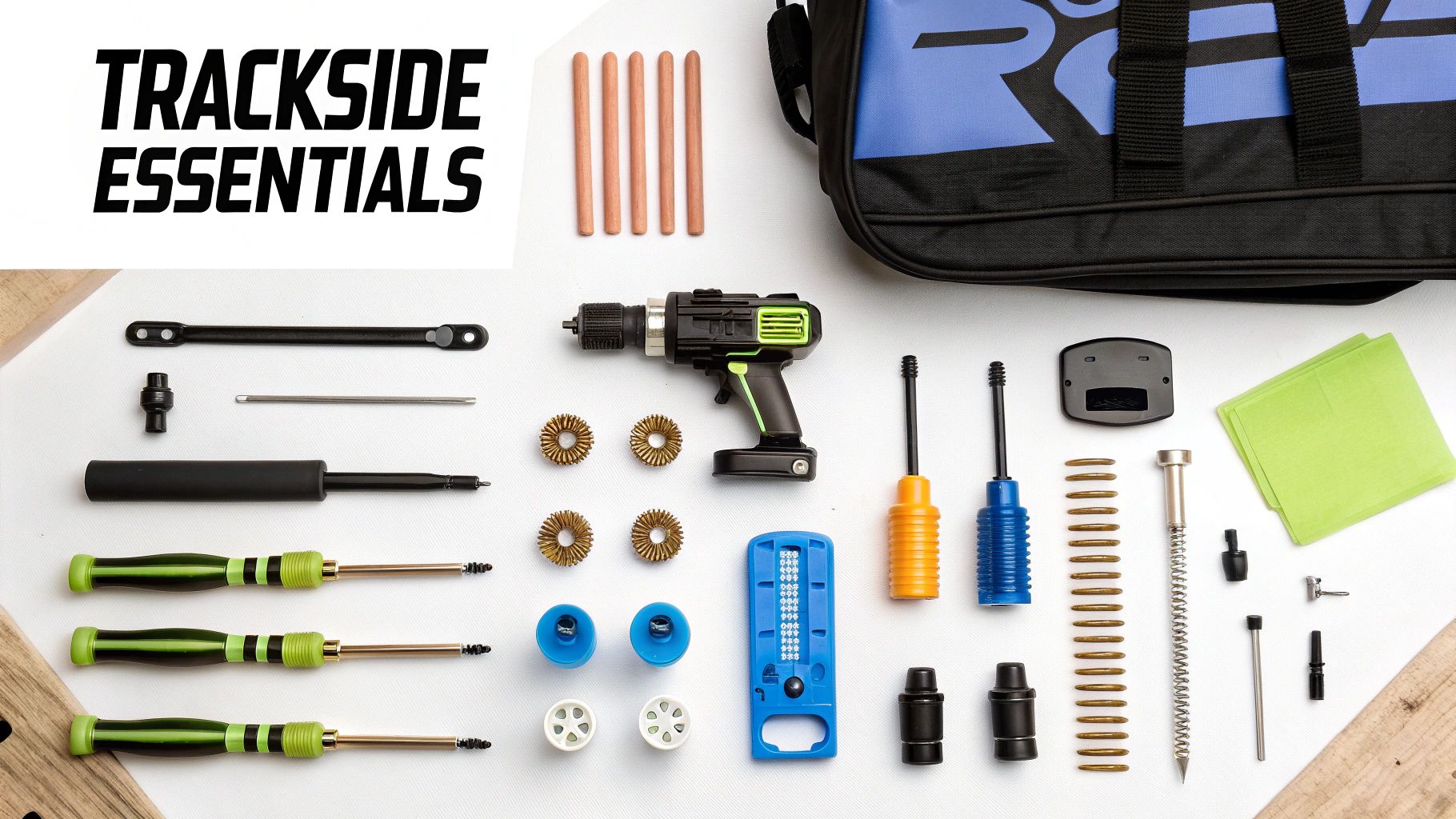
Sure, you need the obvious stuff—your car, radio, and batteries. But a solid trackside kit is really about anticipating the most common problems you'll run into. It’s about having the right tool for a quick fix and the right spare part to get you back out there for the next heat.
Core Tools You Cannot Forget
Your toolbox is the heart of your pit space. You could lug every single tool you own to the track, but a handful of core items will handle over 90% of the repairs and adjustments you'll ever need to make. Don't leave home without these.
- Hex Drivers: A quality set of hex drivers (1.5mm, 2.0mm, and 2.5mm) is completely non-negotiable. Almost every screw on a modern RC car uses one of these sizes.
- Nut Drivers: You'll need 5.5mm and 7.0mm drivers for wheel nuts and other hardware.
- Shock Pliers: These specialized pliers are a game-changer for rebuilding shocks, letting you grip delicate shock shafts without scratching them.
- Turnbuckle Wrench: A small, dedicated wrench for adjusting your camber and toe links is crucial for making quick setup changes between runs.
Keeping everything organized in a dedicated R/C tool bag means you can grab what you need instantly instead of digging through a messy box. Investing in a purpose-built solution like an R/C carry tool bag just makes life at the track that much easier.
High-Impact Spares to Pack
You can't bring a whole spare car, but you can definitely pack the parts most likely to break. Think about the components that take the most abuse from bad landings, clipping a board, or getting tangled up with another car.
The most common race-day-enders are broken front-end components. A hard hit on a front wheel can easily snap a suspension arm or a steering block. Always have those on hand.
Here’s a quick list of must-have spares:
- Front and Rear Suspension Arms: Trust me, these are the most frequently broken parts on any RC car. Pack a set.
- Steering Blocks and Hub Carriers: This is another high-impact area that's super vulnerable in a crash.
- Spur Gears: A tiny rock getting into the drivetrain can chew up a spur gear in a second. Having a spare will save your whole day.
- Assorted Screws and Shims: It's amazing how easily a tiny screw can vibrate loose and disappear into the void. A small organizer with common sizes is an absolute lifesaver.
Essential Consumables and Fluids
Finally, don't overlook the small bottles and tubes that are just as critical as the hard parts. These consumables are what keep your car running smoothly and consistently all day long.
Your consumables checklist should include:
- Shock Oil: Bring a few different weights so you can tune your suspension as the track conditions change.
- Thread-Locking Compound: Use a dab of this on any metal-to-metal screw to keep it from backing out from vibration.
- CA Glue (Super Glue): Perfect for gluing tires, making quick body repairs, or tacking down wires.
- Cleaning Supplies: A simple brush and some motor spray will help you keep your car clean and let you spot potential problems before they turn into major failures.
How Digital-RC Keeps You on the Track
Finding a great "rc car track near me" is the first step. Staying on it when things go wrong? That's a whole different challenge.
Nothing kills a great race day faster than a snapped A-arm or a fried speed controller—especially when the spare part you need is sitting at home. This is exactly why having a reliable, local parts supplier isn't just a convenience; it's a critical part of any serious racing program.
For us racers in Canada, waiting days for an online order to cross the border just isn't an option. It means missing out on valuable practice laps or, even worse, entire race weekends. Downtime in the pits can feel like an eternity.
The Same-Day Delivery Advantage
Picture this: you're in your first qualifier, pushing for a fast lap. You clip an inside corner just a little too hard and hear that dreaded snap—a broken front steering block. Your day is done, right?
Not necessarily. With Digital-RC's local same-day delivery service right here in Canada, you can order the part from your phone and have it delivered directly to the track. Often, you can have the part in hand before your next heat is even called.
This isn't just about convenience. It’s a genuine competitive edge that keeps you in the race.
Having a responsive supplier is like having a professional pit crew on standby. It minimizes downtime and transforms what would have been a day-ending failure into a minor setback, letting you focus on your driving instead of parts logistics.
The ability to get critical components trackside on the same day is an absolute game-changer.
Here's a look at the Digital-RC homepage, designed from the ground up to get Canadian racers the parts they need without the wait.
The clean layout immediately gets you to race-proven brands and new arrivals, making it easy to find exactly what you need to stay on track.
Access to Race-Proven Parts
A great supplier does more than just ship boxes quickly; they curate a selection of parts that are proven to perform under pressure. That means stocking essential gear like a reliable MY-LAPS RC4 transponder for accurate lap timing—something that’s mandatory at pretty much every organized race.
The competition is fierce everywhere, from local club tracks to major national events. Out in California's massive RC drag racing scene, for example, competitors are pushing their cars to insane limits, hitting speeds over 69.5 miles per hour. Read more about these stunning RC racing statistics at RC Garage. Competing at that level requires durable, high-performance parts, and that same principle applies to every form of RC racing.
Ultimately, partnering with a dedicated Canadian RC shop means you spend less time hunting for parts and more time perfecting your lines on the track.
Alright, let's get into the real-world questions that pop up the moment you decide to move from the driveway to the track. Finding a place to race is one thing, but figuring out the unwritten rules, the costs, and how not to look like a total rookie is another.
Don't sweat it. Every single person in that pit area started exactly where you are now. The RC community is built on helping each other out, so let's walk through the stuff you're probably wondering about.
What Fees Should I Expect to Pay?
Running a track costs money—rent, power, and maintenance aren't free, so showing up to race or practice almost always has a cost.
You'll definitely run into a track fee for practice days or race days. This covers your spot in the pits and your time on the track. The price can swing a bit depending on the facility, but you can generally expect to pay somewhere between $15 and $30 for a full day.
On an organized race day, you'll pay an entry fee for each class you sign up for. This is usually a little more than a practice fee because it helps cover the race director, the scoring system, and awards. Pro tip: always bring some cash. Smaller tracks might not be set up for debit or credit.
Do I Need a Membership Right Away?
Nope. This is one of the best parts about trying out a new track. Just about every facility will let you pay the daily fee as a non-member, no strings attached. It’s the perfect way to get a feel for the place, learn the layout, and see if the local vibe is right for you.
Most tracks offer an annual membership that knocks a good chunk off the daily fees. If you find your home track and plan on being there a lot, a membership pays for itself pretty quickly. But for your first few visits? Just pay the daily rate.
How Should I Ask for Help?
Walking into a busy pit area can feel like walking into a pro garage during a race. Everyone seems to know what they're doing, and it can be a little intimidating. The trick is to be smart about when you ask for help. If someone is frantically wrenching on their car between heats, it’s probably not the best time.
Here’s how to get the advice you need without stepping on any toes:
- Ask Specific Questions: Instead of saying, “My car is slow,” try something like, “I can’t seem to get enough steering in that tight hairpin. Any ideas?” You’ll get a much better answer.
- Be an Observer: Watch what the fast guys are doing. What tires are they on? What line are they taking through the tricky sections? You can learn a ton just by paying attention.
- Pitch In: The RC community is all about give and take. If you see a corner marshal is needed and you're free, jump in and help. Building a little goodwill goes a long, long way.
Honestly, the easiest way is to just find someone who doesn't look too busy and say, "Hey, it's my first time here, and I'm a bit lost." You'll be surprised how many people will stop what they're doing to get you sorted out. That's how we all learned, and it's how the hobby keeps growing.
When you're ready to get serious and need parts that can keep up with your new skills, digital-rc has you covered with race-proven components and same-day delivery in Canada. Visit https://digitalrc.ca to get everything you need delivered trackside.
Article created using Outrank