

A Racer's Guide to High-Performance RC Cars Motors
Welcome to the engine room of competitive RC racing. This guide dives straight into the most critical component determining your success on the track—the motor.
For 1/10 touring and 1/12 pan cars, picking the right motor isn't just about raw top speed. It’s the heart of your car's power delivery, dictating how it accelerates, how it feels, and how consistently it performs lap after lap. Think of it as the heartbeat of your vehicle, pumping power to the wheels with every squeeze of the throttle.
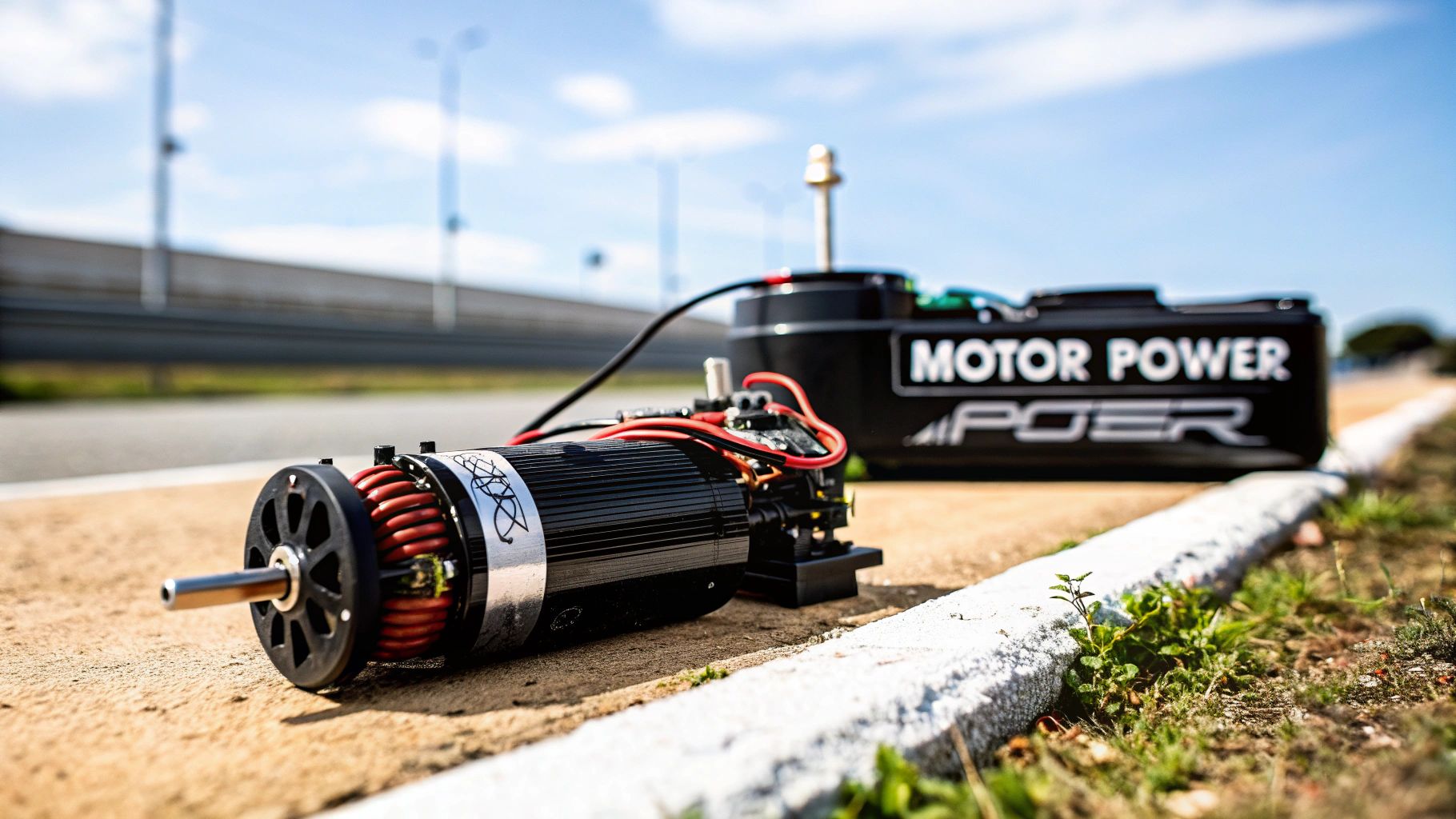
We'll look at the fundamental shift from older brushed motors to the high-efficiency brushless technology that now completely dominates the racing world. This wasn't just a minor update; it was a performance leap that has reshaped competitive RC. A well-chosen brushless motor from a trusted brand like Hobbywing or Team Powers is your key to shaving precious tenths off your lap times.
The Modern Powertrain Partnership
A motor doesn't work in a vacuum. It forms a critical partnership with three other components to create a complete powertrain, and understanding how they work together is essential before we get into the motor specifics.
- Electronic Speed Control (ESC): This is the motor's brain. It translates your throttle inputs into precise electrical signals. A well-matched ESC is crucial for smooth power delivery without creating a bottleneck.
- Battery: The battery is your fuel tank. Its voltage and discharge capability (C-rating) determine how much power is on tap for the motor to use. Our guide on LiPo battery selection is a must-read for this.
- Gearing: Your pinion and spur gears are the transmission. They're responsible for translating the motor's raw RPM into usable speed and torque at the wheels.
A perfectly balanced system—where the motor, ESC, battery, and gearing are all correctly matched—is what separates a podium finish from the middle of the pack. Each part has to complement the others to wring every last bit of performance out of the car.
Why Brushless Motors Dominate Racing
The move to electric power, especially brushless motors, has been a complete game-changer. Here in Canada, electric motors are the undisputed powerhouse, commanding the largest segment of the RC market. The numbers don't lie: the market hit USD 43.63 million and is projected to rocket towards USD 153.39 million by 2033 at a blistering 15.18% annual growth rate.
This isn't just hype. For on-road racing with 1/10 touring and 1/12 pan cars, electric motors deliver the pinpoint power control and explosive acceleration needed to win.
This guide will focus exclusively on brushless RC car motors. We’ll break down the technology, explain what the specs really mean for your on-track performance, and help you choose the ideal motor for your car and driving style.
Understanding Brushed vs. Brushless Motors for Racers
When you get into RC car motors, you’ll run into two core technologies: brushed and brushless. While they both get your car moving, for a competitive racer, the difference is night and day. It’s the gap between a podium finish and just making it to the last lap. The choice is clear, but understanding why is the first step to unlocking real speed.
Think of a classic brushed motor as old-school tech. It uses physical carbon brushes that make direct contact with a spinning commutator to get power flowing. This constant friction is its biggest weakness—it creates heat, wears down parts, and wastes precious battery life. It works, sure, but it just doesn't have the efficiency or punch needed for high-level racing.
Now, picture a brushless motor as a modern, digitally controlled powerhouse. There are no brushes, no physical contacts, nothing to wear out. Instead, your Electronic Speed Control (ESC) sends perfectly timed electrical pulses to electromagnets, making the motor’s rotor spin with incredible efficiency and precision. This is exactly why brushless technology is the only real option for serious 1/10 touring and 1/12 pan car racing.
The Brushless Advantage on the Track
For a racer, the move to brushless isn't just a small upgrade; it's a game-changer. With no physical friction to slow it down, a brushless motor is significantly more efficient. We're talking 85-90% efficiency compared to the 75-80% you'd get from a brushed setup. That means longer run times and more of your battery's power turning into raw speed instead of wasted heat.
This efficiency translates directly into massive power and a much better power-to-weight ratio. Brushless motors spin at incredibly high RPMs, giving you the brutal acceleration needed to rocket out of a corner and the top-end speed to own the straightaways. Plus, with no brushes to wear down, they last far longer and require almost no maintenance—a huge plus when you need consistent, reliable performance race after race.
For competitive racing, the precision, power, and reliability of a brushless system are non-negotiable. Investing in a quality brushless motor and ESC from brands like Hobbywing or Team Powers is the foundational step towards building a winning car.
Head-to-Head Comparison
Let’s get right to it. To make the difference perfectly clear, here's a breakdown of the characteristics that actually matter on race day. This comparison shows exactly why the entire competitive RC scene has gone all-in on brushless power.
Brushed vs. Brushless Motor Performance for Racers
| Characteristic | Brushed Motor | Brushless Motor |
|---|---|---|
| Efficiency | Lower (75-80%). Energy is lost to friction and heat. | Higher (85-90%). More battery power goes to the wheels. |
| Power Output | Limited by brush friction and heat buildup. | Significantly higher due to efficient design and higher RPM. |
| Lifespan | Shorter. Brushes wear out and require replacement. | Much longer. No wearing parts means exceptional durability. |
| Maintenance | High. Requires regular cleaning and brush replacement. | Minimal. Typically only requires bearing inspection/cleaning. |
| Speed Control | Less precise, especially at low RPMs. | Extremely precise and smooth across the entire throttle range. |
| Cost | Lower initial cost. | Higher initial investment, but better long-term value. |
When it's all said and done, brushed motors still have a place in entry-level, ready-to-run cars. But for racing, they're simply outclassed in every way that counts. For any driver looking to be competitive in 1/10 touring or 1/12 pan car, the conversation begins and ends with brushless RC cars motors.
Decoding Motor Specs: Turns, KV, and Timing
Looking at the side of an RC motor can feel like trying to crack a secret code. You'll see numbers like "17.5T" or "4800kV" stamped right on the can, but what do they actually mean for your car on the track? Let’s translate this tech-speak into real-world speed and control.
Think of these specs as the primary dials for tuning your car's behaviour. Once you get a feel for them, you can pick the perfect motor for any situation, from a tight indoor carpet track to a wide-open asphalt circuit. Nailing this choice is a massive step towards building a winning setup.
Turns: The Primary Dial for Your Powerband
The first and most common spec you’ll see on RC car motors is the 'Turn' rating, usually written as 17.5T, 21.5T, or 5.5T. This number refers to how many times a copper wire is wrapped around the motor's internal stator arms. The technical details get complicated, but what it means for your driving is actually pretty simple.
Motor Turns dictate the fundamental trade-off between torque and RPM. It's the main control you have for defining your motor's powerband—whether it delivers instant punch out of corners or blistering speed down the straights.
For racers, the Turn rating is often decided by class rules:
- Higher Turn (e.g., 21.5T, 17.5T): These are the go-to motors for "spec" classes. With more wire wraps, they produce higher torque and lower RPM. This makes them incredibly controllable and ideal for tight, technical tracks where getting out of a slow corner fast is more important than raw top speed.
- Lower Turn (e.g., 8.5T, 5.5T): Welcome to "modified" racing. With fewer wraps, these motors scream at insane RPMs and deliver massive top-end speed. They really shine on large, flowing tracks with long straights where you can keep the throttle pinned.
Choosing the right turn is your first big decision. For instance, our selection of Team Powers motors covers the whole spectrum, letting you match a motor directly to your class rules and track layout.
KV: The Predictor of Raw Speed
Next up is 'kV', which stands for RPM per volt. This spec is your most direct and honest predictor of a motor's maximum speed potential. The kV rating tells you exactly how many revolutions per minute (RPM) the motor will try to spin for every single volt of power you feed it from your battery.
The formula is dead simple: kV x Battery Voltage = Maximum Motor RPM.
Let’s say you have a 4,000kV motor and you’re running a standard 7.4V 2S LiPo pack. That motor will have a theoretical top RPM of 29,600 (4,000 x 7.4). A higher kV motor, like one rated at 6,000kV, would aim for 44,400 RPM with the same battery. It's a straight line—more kV means more potential RPM. Simple as that.
While the Turn rating sets the general character of the powerband, kV gives you a hard number to compare the raw speed potential between different motors. This is super useful in modified classes where you have a lot more freedom of choice.
Timing: The Tunable Turbocharger
Finally, there’s timing. This is probably the most misunderstood yet most powerful tuning option on a modern brushless motor. The best way to think of timing is as a tunable turbocharger. By adjusting it, you can alter the motor’s power delivery to gain a tactical advantage on the track.
You can adjust timing in two ways:
- Mechanical Timing: This is a physical adjustment made by rotating the motor's endbell.
- Electronic Timing (Boost/Turbo): This is a more advanced setting you program into your ESC, like those from Hobbywing, which adds timing dynamically once the motor hits a certain RPM.
Advancing the timing (adding more) tells the motor to fire its electrical pulses earlier. The result? A serious boost in top-end RPM and straight-line speed. But this power comes at a cost. More timing dramatically increases heat and kills efficiency, putting a ton of strain on both your motor and battery.
For a track with a long straightaway, that extra kick might be exactly what you need to make a pass. But on a smaller track, it could just lead to overheating and a noticeable power fade halfway through the race. Setting timing is all about finding that delicate balance between raw speed and race-long reliability.
Building a Winning Powertrain with ESCs and Batteries
A world-class motor is a powerhouse in waiting, but it can't win races on its own. To unlock its full potential, you need the right support system: the perfect synergy between your motor, Electronic Speed Control (ESC), and battery. This trio is the heart of your car’s electrical system, and any weak link will immediately cap your performance on the track.
Think of the ESC as the motor's brain. It’s a sophisticated piece of hardware that translates your throttle inputs into smooth, precise commands for the motor. It dictates exactly how power is delivered, making it just as critical as the motor itself.
Matching Your ESC to Your Motor
When pairing an ESC with one of our RC cars motors, the most important spec to look at is its amperage (amp) rating. This number tells you the maximum continuous current the ESC can safely handle. A high-performance motor under heavy load—like when you’re punching the throttle out of a tight corner—draws a massive amount of current. If the ESC can't keep up, it'll overheat, cut power, or fail completely.
A good rule of thumb is to pick an ESC with an amp rating that comfortably exceeds your motor's maximum current draw. For example:
- For Spec Racing (17.5T/21.5T): A Team Powers Radon V4.1 100A Stock Spec ESC is a perfect match for a Team Powers Actinium V4 17.5T Motor. That 100-amp capacity provides plenty of overhead for the demands of spec racing, ensuring cool, consistent power delivery.
- For Modified Racing (Low-Turn): A beast of a motor like a Team Powers Actinium V4 5.5T needs a much more robust ESC. The Hobbywing XR10 Pro G2S is rated for 160 amps, making it the ideal choice to handle the extreme current draw of a modified motor without breaking a sweat.
This infographic shows the core motor specs that your ESC and battery must be able to support.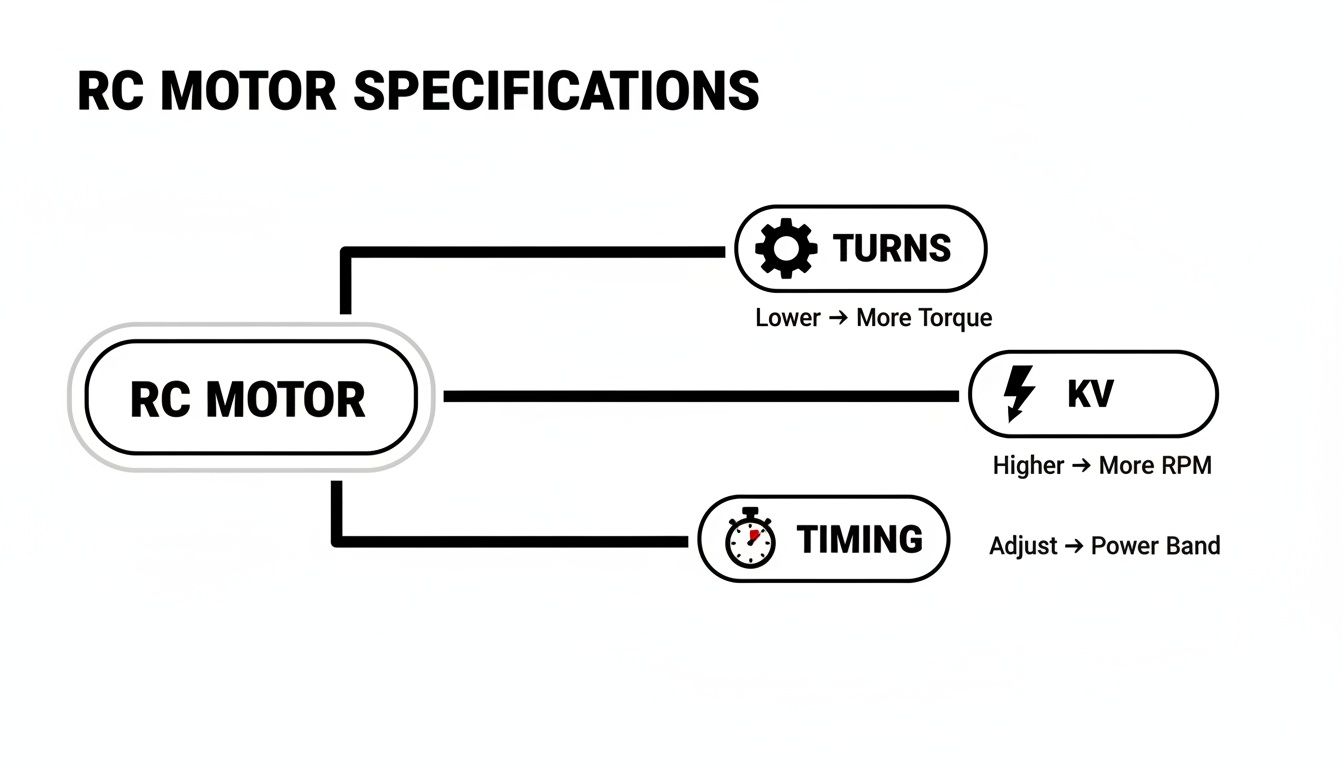
It really highlights how Turns, KV, and Timing are all connected, determining the load placed on your electronics.
The Battery: Your Fuel Tank
If the ESC is the brain, the battery is the heart of your powertrain, pumping the electrical energy to the motor. Two key specs directly impact your motor's performance: voltage and C-rating.
Voltage, listed as 1S (3.7V) for 1/12 pan cars or 2S (7.4V) for 1/10 touring cars, directly multiplies your motor’s kV rating to determine its final RPM. Higher voltage means a higher potential top speed from the same motor.
But the C-rating is arguably more important for race performance. This rating measures the battery’s ability to discharge current quickly and safely.
A high C-rating is non-negotiable for competitive racing. It ensures your battery can deliver the massive, instantaneous burst of current a high-performance motor demands during hard acceleration. A low C-rating battery will "voltage sag," starving the motor of power just when you need it most.
The Canadian RC racing scene has seen incredible growth recently, underscoring just how important optimized electronics have become. The market has jumped from USD 28.5 million to USD 43.63 million in 2024 and is projected to hit USD 153.39 million by 2033. On-road categories, our specialty here at digital-rc, now make up 35% of Canadian sales. This proves that racers are investing heavily in balanced powertrain components to find that competitive edge.
By carefully selecting an ESC and battery that match your motor's demands, you create a balanced, reliable system. This eliminates bottlenecks and ensures every ounce of performance is put directly onto the track. For a deeper dive, check out our guide on how to match your electronic speed controller to your motor.
How to Install and Maintain Your Race Motor
Even the best motor on the market won't perform if it's not installed and maintained correctly. Let's walk through the hands-on steps to get your motor running flawlessly, ensuring it lasts for seasons to come. It all starts with a perfect installation.
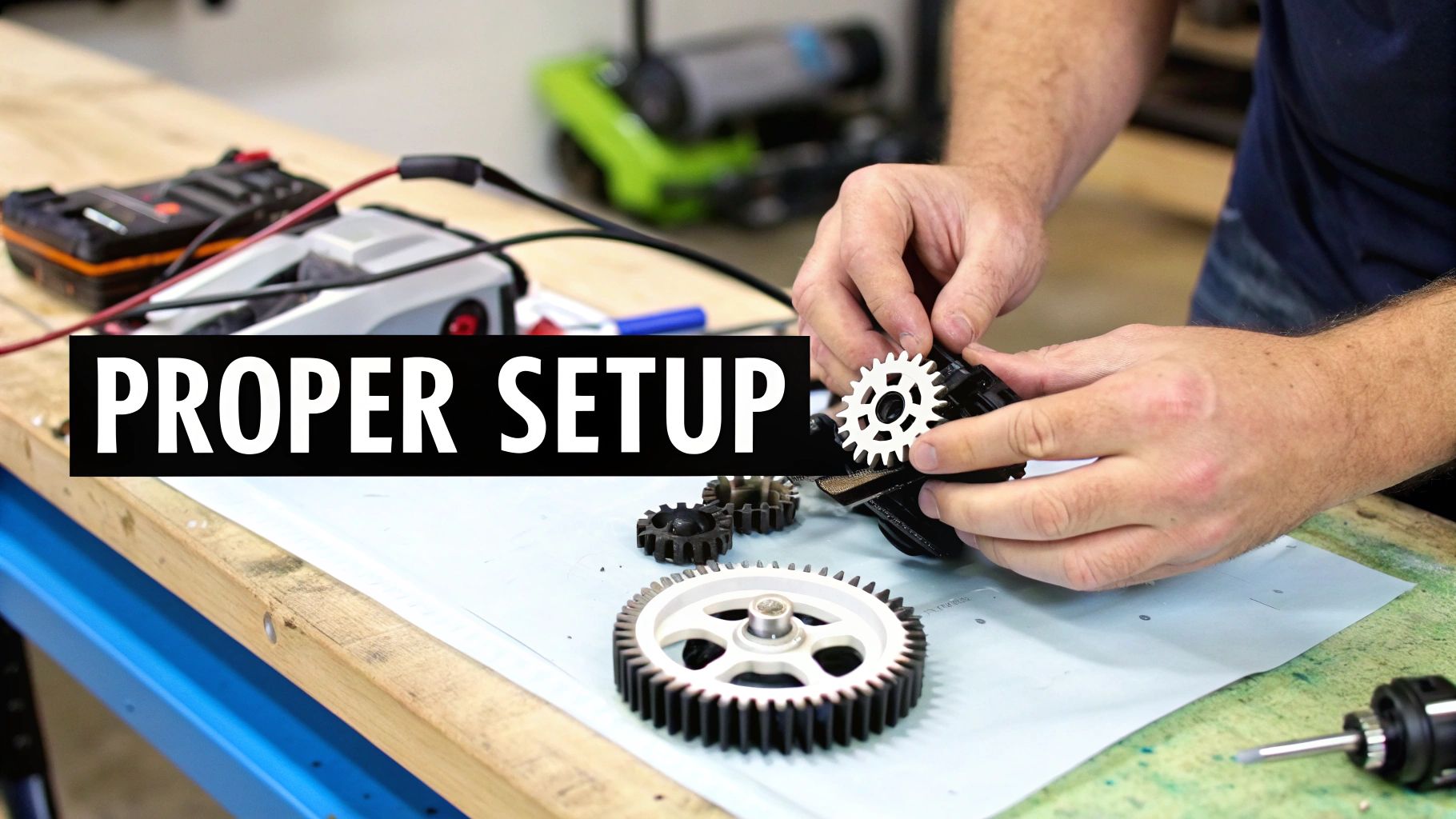
Your first job is to set a quiet and efficient gear mesh. This is the critical spacing between the motor’s pinion gear and the car’s spur gear. If it’s too tight, you’ll create binding, friction, and heat. Too loose, and you’ll strip the teeth right off the spur gear the first time you punch the throttle.
The classic paper trick is still the best way to get it right. Just slide a small strip of regular printer paper between the gears, push the motor in snugly, and tighten the mounting screws. Pull the paper out, and you’re left with the perfect tiny bit of backlash for a free-spinning, reliable drivetrain.
Soldering and Thermal Management
With the motor mounted, it's time for clean, solid electrical connections. That means proper soldering joints between the motor tabs and the ESC wires. A bad solder joint creates high resistance, which chokes power and generates a ton of heat right where you don't want it. Using quality insulation like heat shrink tubing is non-negotiable for durable, safe wiring.
This brings us to heat—the number one killer of motor performance and longevity. When a motor gets too hot, you'll feel "power fade" during a race as its internal magnets temporarily weaken. The car just gets slower and slower.
Consistently running a motor over its limit (usually 80-90°C or 175-195°F) will permanently damage the rotor’s magnets. This permanently robs it of torque and efficiency. An infrared temp gun is a mandatory trackside tool.
A high-quality motor fan is your best defence against overheating. Don't forget about airflow, either. Cutting a few strategic vents in your car body can make a massive difference. You can dive deeper into this topic in our article explaining why proper cooling is critical for RC racing performance.
Routine Maintenance for Lasting Speed
A well-maintained motor is a fast motor. After every couple of race days, a few simple checks will keep your investment running at its peak and help you catch problems before they end your race day.
Here's a quick trackside checklist to follow:
- Clean the Exterior: Use motor spray and compressed air to blow out any dust, carpet fuzz, or track debris from the motor can and especially from the fan. A clean motor runs a cooler motor.
- Inspect the Bearings: Pop the pinion gear off and spin the motor shaft by hand. It should feel perfectly smooth. Any grittiness, notchiness, or resistance means the bearings are dirty or worn out and need replacing.
- Check for Shaft Play: Gently pull the motor shaft in and out, then try to wiggle it side to side. A tiny amount of in-and-out (axial) play is normal. Any significant side-to-side (radial) play means a bearing is failing and needs immediate attention.
- Listen for Noises: When you run the motor on the bench, listen closely. Any unusual grinding sounds or high-pitched whines are early warnings that something is wrong inside.
How to Choose the Right Motor for Your Race Class
Picking the right motor is where it all comes together. This is the moment you translate all the specs, electronics, and setup theory into a single, critical decision. This isn't just about grabbing the most powerful motor off the shelf; it's about finding the one that perfectly syncs with your car, the track, and your own talent.
It all boils down to three key factors.
First and foremost, you have to start with your racing class. This one rule immediately defines the landscape of your motor choice and is non-negotiable.
- Spec Class (e.g., 17.5T Touring, 21.5T F1): The choice here is simple—you’re locked into a specific turn count. The game isn’t about finding the most powerful motor overall, but the best one for you within that spec.
- Modified Class: Here, the rulebook opens up completely. Your decision will be guided by the track size and, just as importantly, your own throttle control. Common choices range from a blistering 4.5T to a more manageable 8.5T.
Matching the Motor to the Track
Once your class is set, the track layout is your next filter. The size and flow of a circuit demand totally different power characteristics from a motor. A motor that absolutely dominates on one track could be a serious, undriveable handful on another.
A tight, technical track full of hairpins and chicanes is all about instant acceleration. This is where a motor with strong bottom-end torque is king. It helps the car punch hard out of slow corners, shaving tenths off your lap time with every single turn.
On the other hand, a big, flowing track with long straights is all about high RPM. Top speed is the name of the game here. A motor that can keep pulling hard all the way to the end of the straightaway will give you a massive advantage. When you're trying to win, understanding how to apply principles like calculating motor torque can make a real difference in how your car performs.
The perfect motor feels like an extension of your throttle finger, giving you power exactly when and where you need it. A mismatch between your motor and the track layout leads to a car that feels either sluggish or uncontrollably aggressive.
Aligning with Your Driving Style
Finally, you need to be honest about your personal driving style. Are you a smooth, precise driver who carries a ton of corner speed, or do you prefer an aggressive, point-and-shoot approach? Different RC cars motors are built to reward these distinct styles.
Let’s look at a couple of real-world scenarios to make this crystal clear:
- Scenario 1: Smooth Driver, 17.5T Spec Class: A driver who is gentle on the throttle and focuses on maintaining momentum will get the most out of a motor with a smooth, linear powerband and high RPM, like a Hobbywing G4. This motor rewards a clean driving line with killer top speed.
- Scenario 2: Aggressive Driver, 17.5T Spec Class: A driver who likes to brake hard and rocket out of the corners needs a motor with that aggressive bottom-end punch. A Team Powers Actinium V4 motor is perfect here, delivering the instant torque needed for that explosive acceleration.
Common Questions About RC Racing Motors
When you're fine-tuning your car for the podium, a few motor questions always seem to pop up. Let's clear up some of the most common ones we hear from racers at the track.
What’s the Difference Between Sensored and Sensorless Motors?
Think of a sensored motor as having a direct line of communication with your ESC. An extra wire constantly tells the ESC exactly where the rotor is, which gives you incredibly smooth throttle control right from a dead stop. That precision is everything in on-road racing.
A sensorless motor, on the other hand, is basically guessing the rotor's position. This can lead to that jerky, stuttering start we call "cogging." For competitive 1/10 and 1/12 scale racing, there’s no debate: sensored motors are the only way to go.
How Often Should I Rebuild My Racing Motor?
If you're racing regularly, it’s a good habit to pop the motor open and check the bearings every 10-15 race days. You're looking for any grittiness or signs of wear that could slow you down.
As for a full rebuild—swapping bearings and giving the rotor a thorough inspection—plan on doing that once or twice per racing season to keep it in peak condition.
If you hear a new noise, feel a weird vibration, or notice your lap times dropping while temps are climbing, that's your motor telling you it needs attention. Don't ignore it.
What Should I Do If My Motor Is Running Hot?
An overheating motor is a cry for help, and it’s usually telling you something is binding up. First, check your drivetrain for any resistance or an overly tight gear mesh. The car should roll freely.
Next, look at your gearing. A pinion gear that's too large is the most common culprit for high temps. Also, double-check your motor timing—too much electronic or mechanical advance will generate a ton of heat. Finally, make sure your cooling fan is actually working and that its airflow isn't being blocked by messy wiring or the car's body.
At digital-rc, we stock a curated selection of race-proven motors and electronics to give you the competitive edge. Find the perfect heart for your race car and get back on the track faster. Explore our collection of RC cars motors today.