

Your Guide to RC Electronic Speed Control Systems
If you're new to RC racing, the Electronic Speed Control (ESC) can seem like just another black box in your car. But in reality, it's the brain of your entire power system. It’s the critical link between your radio, battery, and motor, translating your finger movements on the throttle into smooth acceleration, sharp braking, and precise power.
The Brains Behind the Brawn
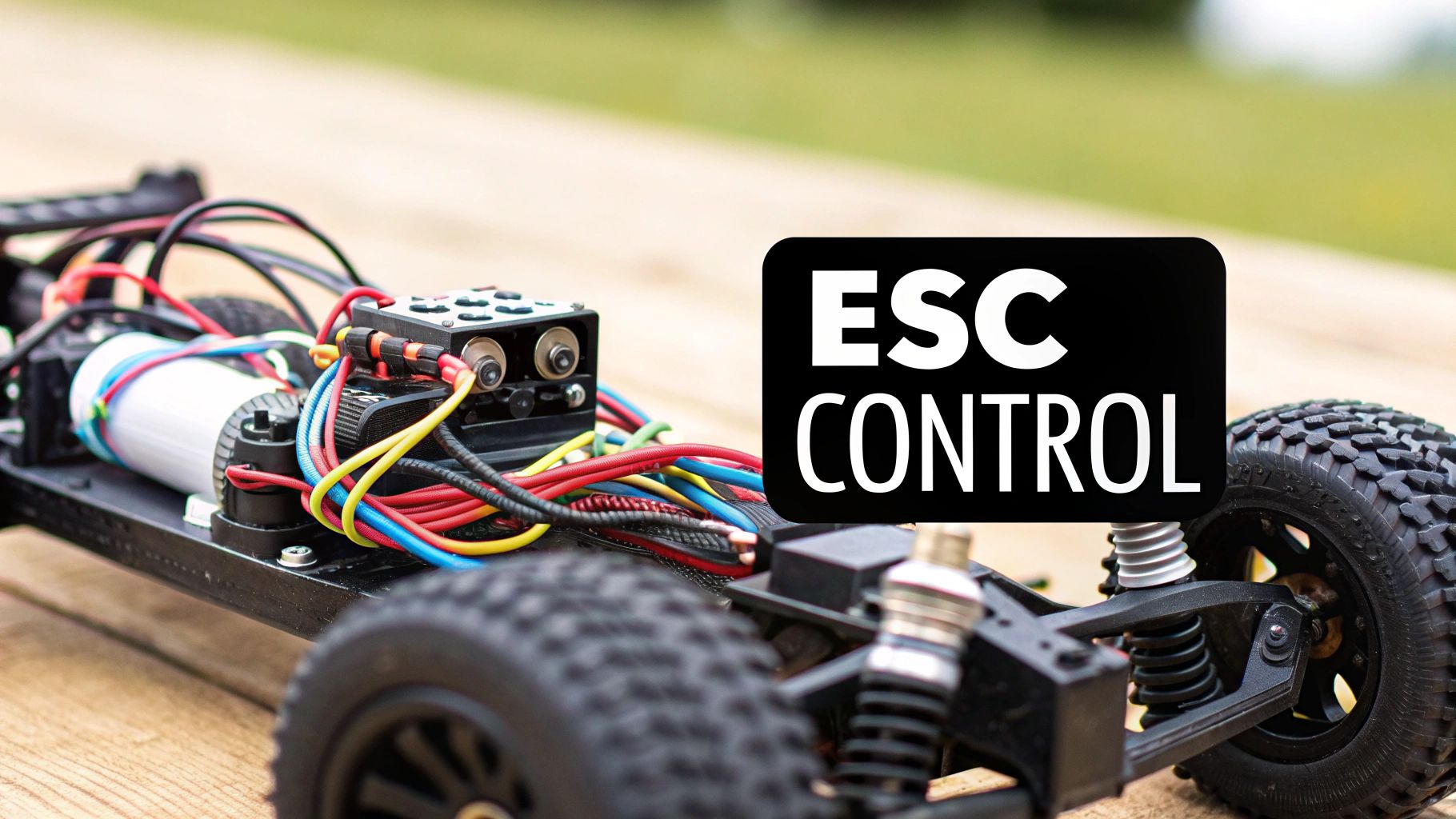
Think of your RC car’s power system like a high-performance orchestra. Your battery holds all the raw energy, and the motor is the instrument ready to unleash it. Your radio transmitter is the sheet music, holding the instructions for the performance.
The ESC is the conductor.
It reads every subtle command from your radio and directs the flow of power from the battery to the motor with perfect timing and precision. When you squeeze the throttle, it doesn’t just flood the motor with raw power. Instead, it carefully meters out the voltage, giving you that silky-smooth acceleration you need to nail the perfect racing line. When you hit the brakes, it instantly reverses the flow, creating resistance to slow the car down exactly when you need it to.
Why Is the ESC So Important?
Without a quality rc electronic speed control, your motor would be either off or running at full, uncontrollable power. Not only would this make driving impossible, but it would also be a recipe for destroying your motor and batteries in seconds. The ESC is both a performance manager and a sophisticated safeguard for your expensive electronics.
The market has taken notice of just how crucial this component is. The global electronic speed controller market size was on track to hit $500 million in 2025, with a compound annual growth rate of 15% between 2019 and 2024. This isn't just a random statistic; it shows how essential high-performance ESCs have become, especially with the powerful brushless motors that are now standard in competitive racing. You can discover more insights about the expanding ESC market and see where the technology is heading.
Key Takeaway: The ESC is far more than an on/off switch. It’s a complex microprocessor that modulates power, protects your electronics from overload, and gives you the fine-tuned control needed to be competitive on the track.
Core Functions of an RC Electronic Speed Control
To truly appreciate why choosing the right ESC matters, you need to understand the jobs it’s doing every millisecond you're on the track. Let’s break down its core functions.
Core Functions of an RC Electronic Speed Control
Here’s a quick overview of the essential roles an ESC plays in your RC car's power system.
| Function | Description | Impact on Performance |
|---|---|---|
| Throttle Control | Translates the signal from your radio into variable power for the motor. | Gives you smooth, linear control over speed for precise driving. |
| Braking & Reverse | Manages braking force and, if enabled, the reverse function. | Provides critical control for cornering and avoiding accidents. |
| Battery Protection | Features a Low Voltage Cutoff (LVC) to prevent over-discharging LiPo batteries. | Protects your expensive batteries from permanent damage. |
| Power Regulation | Supplies a steady, regulated voltage to the receiver and servo via its BEC. | Simplifies wiring and ensures consistent performance from your electronics. |
Each of these functions directly impacts how your car feels and performs. A great ESC makes the car feel connected and predictable, while a poor one can make it feel erratic and difficult to control.
Choosing a reliable ESC from our collection of high-performance speed controls is your first step toward building a consistent and competitive power system for your 1/10 touring or 1/12 pan car.
Choosing Between Brushed and Brushless ESCs
Deciding between a brushed and brushless system is one of the first, and most important, choices you'll make for your RC car. It's a decision that fundamentally shapes your car's performance, maintenance schedule, and even your budget. The two technologies work on completely different principles, and knowing which one fits your needs is key to picking the right rc electronic speed control for your goals on the track.
A brushed motor is the classic, old-school way of doing things. It's a beautifully simple design that relies on physical carbon "brushes" making contact with the motor's spinning commutator. This direct connection sends power to the coils, creating the magnetic field that gets everything moving.
Because the motor is so straightforward, the brushed ESC that powers it is also simpler. Its main job is to control the amount of DC voltage heading to the motor. This simplicity makes brushed systems incredibly affordable and a fantastic starting point for new racers or for specific builds where outright speed isn't the name of the game.
The Case for Brushed Systems
Even though brushless tech is king in modern competitive racing, brushed systems absolutely still have their place. Their biggest advantage is their incredibly smooth, linear control at very low speeds. Since the power delivery is so direct, they're brilliant in disciplines that require a delicate touch on the throttle.
This makes them a perfect fit for:
- Rock Crawling: When you're trying to ease over a tricky obstacle, you need that instant, buttery-smooth response that a brushed motor provides.
- Budget Builds: If you're just getting into the hobby or putting together a fun car for the backyard, you can't beat the low cost of a brushed ESC and motor combo.
- Vintage Racing: To get that authentic feel from an older or re-released RC kit, running the brushed motor it was designed for is the only way to go.
The Power and Precision of Brushless ESCs
Brushless systems, on the other hand, are a massive leap forward in technology. Just like the name says, there are no brushes. Instead, a brushless ESC acts like a mini-computer, using sophisticated transistors (MOSFETs) to send a precisely timed, three-phase AC signal to the motor. This creates a rotating magnetic field that pulls the motor's rotor around with incredible efficiency.
By eliminating the friction and wear of physical brushes, you unlock a ton of performance benefits. The brushless rc electronic speed control is constantly managing the power flow to squeeze out every last drop of performance and efficiency. For a deeper dive, our ESC selection guide helps match your electronic speed controller to your motor to ensure you build a balanced system.
Brushless technology is the undisputed standard for competitive racing for a simple reason: it converts more energy from the battery into rotational force with less waste. This translates directly into higher speeds, longer run times, and significantly less maintenance.
The efficiency gains are huge. A good brushless motor can run at 85-90% efficiency, while a brushed motor is closer to 75-80%. That difference means less power is wasted as heat, allowing you to push more current through the system for longer. For competitive 1/10 touring and 1/12 pan car racing, the raw power, insane RPMs, and bulletproof reliability of brushless systems aren't just an advantage—they're a requirement.
How to Read RC Electronic Speed Control Specs
Staring at the technical specs on an RC electronic speed control can feel like trying to read a foreign language. It's just a wall of numbers, acronyms, and jargon. But those specs tell you everything you need to know about how that ESC will perform on the track. Think of this as your decoder ring for confidently reading any product listing on our site.
Translating these key numbers into real-world impact is the secret to building a truly competitive power system. Once you know what each spec actually means, you can look past the marketing hype and pick the perfect component for your 1/10 touring car or 1/12 pan car.
This knowledge is more important than ever. The global RC car market is valued at $402 million in 2025 and is projected to hit $775 million by 2030—that's a compound annual growth rate of 14.1%. Electric RC cars are leading the charge with a 60% market share, all powered by advanced brushless motors and LiPo batteries that demand precise control. Understanding your ESC is how you harness that power. You can read the full research about RC car engine trends to see just how quickly the technology is moving.
Current Ratings: Continuous and Burst
The first numbers you’ll almost always see are the current ratings, usually listed as two values like "160A Continuous / 1200A Burst." These are probably the most important specs for both performance and reliability, seen on high-end models like the Hobbywing XR10 Pro G3.
-
Continuous Current (e.g., 160A): This is the maximum amperage the ESC can handle constantly without getting too hot. Think of it as the ESC's marathon pace. It absolutely must be high enough to keep your motor fed with power for a full five-minute race without a hiccup.
-
Burst Current (e.g., 1200A): This tells you the maximum amperage the ESC can handle for just a few seconds, like when you're punching the throttle hard out of a tight corner. This is the ESC's all-out sprinting ability.
A higher continuous rating usually points to a more robust ESC with better heat management. For competitive racing, matching this spec to what your motor demands is the key to preventing a dreaded thermal shutdown halfway through a main.
Voltage Limits and LiPo Cell Count
Next up is the voltage limit, which you'll often see expressed as a LiPo cell count, like "2S LiPo." This number dictates your car's ultimate speed potential because, simply put, more voltage equals more motor RPM.
A "2S" rating means the ESC is built for a 2-cell Lithium Polymer battery, which gives you a nominal voltage of 7.4V. This is the universal standard for 1/10 scale touring car racing. For 1/12 pan cars, you’ll typically see a "1S" rating on ESCs like the Hobbywing Xerun XR10 Pro 1S, as they are designed for a single-cell (3.7V) battery.
Crucial Tip: Never, ever exceed the ESC’s specified voltage limit. Plugging a 3S battery into an ESC rated for 2S is a surefire way to instantly fry the electronics. Always match your battery to what your ESC can handle.
Understanding the BEC Specification
The Battery Eliminator Circuit (BEC) is a small but absolutely critical part of the ESC. Its only job is to take the main battery's high voltage (7.4V from a 2S LiPo) and step it down to a lower, stable voltage (like 6.0V or 7.4V) that can safely power your receiver and steering servo.
You'll see the BEC spec listed as something like "6.0V/7.4V @ 4A." This means you can choose either a 6.0-volt or 7.4-volt output, and it can supply up to 4 amps of current. Modern high-speed, high-torque servos are incredibly power-hungry, so a strong BEC is essential for keeping your steering precise and consistent from the start of the race to the finish.
Advanced Settings: Motor Timing
Finally, most competition-level ESCs give you adjustable motor timing. Timing is an advanced setting that changes when the ESC energizes the motor's coils in relation to the rotor's position. It’s a powerful tuning tool.
Cranking up the timing can squeeze more RPM and top speed out of your motor, but it’s not free performance. It comes at the cost of generating more heat and running less efficiently. This setting lets you fine-tune your power band for a specific track—maybe add a little timing for a track with a long straightaway, or dial it back for a tight, technical infield. For "blinky" or stock class racing, timing is always set to zero to keep the playing field level.
Here’s a quick look at how these specifications come together for a couple of popular racing classes.
ESC Specification Comparison for Different RC Classes
This table gives you a snapshot of what to look for when selecting an ESC for either a high-power 1/10 modified touring car or a precision-focused 1/12 stock pan car. Notice how the demands of each class dictate the required specs.
| Specification | 1/10 Touring Car (Modified) | 1/12 Pan Car (Stock) |
|---|---|---|
| Continuous Current | 160A or higher | 80A - 120A |
| Voltage Limit | 2S LiPo (7.4V) | 1S LiPo (3.7V) |
| BEC Output | 6.0V/7.4V @ 4A+ | 6.0V/7.4V @ 3A+ |
| Motor Timing | Fully adjustable ("Boost & Turbo") | Zero timing ("Blinky Mode") |
As you can see, the modified touring car setup is all about handling massive current and delivering high voltage, while the 1/12 pan car focuses more on efficiency and precise control within tighter stock-class rules. Choosing the right ESC starts with understanding the unique needs of your chosen racing discipline.
Creating the Perfect Power System
A high-performance RC electronic speed control is the heart of your car, but it doesn’t work alone. To get that blistering speed and nail consistent lap times, you need to build a balanced power system where every single component works in harmony. Think of it as a trio: the ESC, the motor, and the battery all have to be perfectly in tune to deliver a race-winning performance.
When one part is out of sync, the whole system suffers. A powerful ESC paired with an undersized motor just creates inefficiency and heat. On the flip side, a weak battery will starve your high-end electronics of the juice they need to perform. Getting this balance right is the secret to repeatable results on the track and ensuring your components last.
Matching Your ESC and Motor
The relationship between your ESC and motor is the most critical one in your car. The key is to make sure your ESC's continuous current rating is comfortably higher than the motor's maximum current draw. Mismatching these two is a recipe for disaster, and it usually ends with a fried ESC.
For example, in the competitive 1/10 touring car class, a lot of drivers run a low-turn motor, like a 4.5T. This kind of motor is incredibly power-hungry and pulls a massive amount of current, especially when you punch the throttle. To handle that demand safely, you need a seriously robust ESC with a high amp rating, like the Hobbywing XR10 Pro G3, which is rated for 160A. If you tried to run that same motor with an 80A ESC, it would hit thermal shutdown in no time—or worse, suffer permanent damage.
The Golden Rule: Always pick an ESC with a current rating higher than what your motor will ever ask for. This gives you a crucial safety margin, keeping temperatures down and ensuring you get consistent power throughout the entire race.
The Battery: Your Powerhouse
Your LiPo battery is the fuel tank for the entire system, and its specs are just as critical as your ESC and motor. Picking the right battery ensures your electronics get a steady, powerful stream of electricity without creating a bottleneck that kills performance.
There are two main numbers to pay attention to:
- Voltage (Cell Count): This determines the raw RPM potential of your motor. For 1/10 touring cars, a 2S (7.4V) LiPo is the standard. For 1/12 pan cars, a 1S (3.7V) pack is usually required by class rules.
- C-Rating (Discharge Rate): This tells you how quickly the battery can deliver its energy. A higher C-rating means the battery can handle big current draws without its voltage sagging—which is what gives you that punch out of the corners.
A battery with too low a C-rating will struggle to keep up with a powerful motor and ESC. This doesn't just hurt your lap times; it puts a ton of strain on the battery itself, leading to puffing and a much shorter lifespan. For a complete breakdown of what these numbers mean for your build, check out our guide on LiPo battery selection for maximum performance.
This simple diagram shows the core ESC specs you have to balance in your power system.
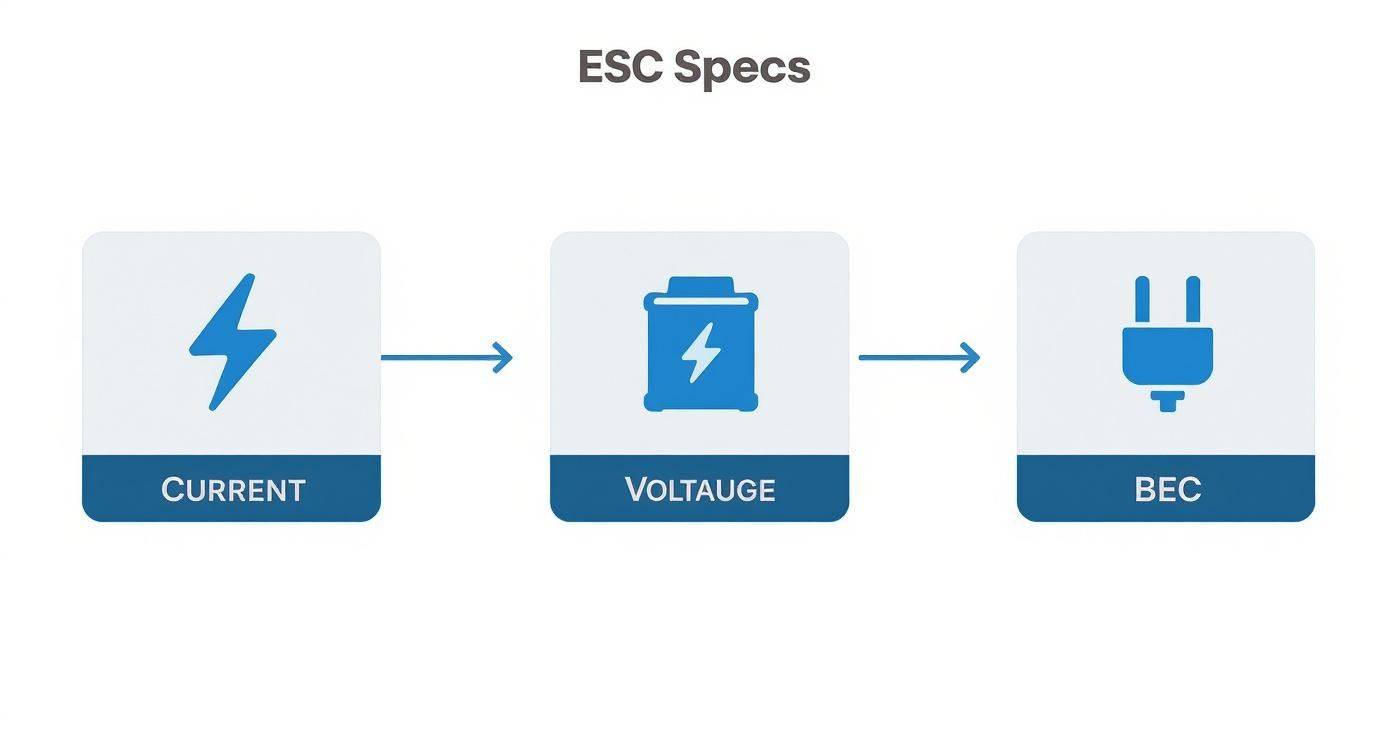
It really boils down to those three pillars: current handling, voltage input, and the BEC's power output. Get those right, and you'll have a stable and powerful setup.
By carefully selecting an ESC, motor, and battery that are perfectly matched, you’re building more than just a fast car—you’re building a reliable and consistent racing machine. This synergy is what separates podium finishers from the rest of the pack, ensuring your equipment performs flawlessly from the first lap to the last.
Installing and Programming Your New ESC
There's nothing quite like unboxing a brand new, high-performance RC electronic speed control. This is where all the theory gets put aside and the real, hands-on fun begins. Getting the installation and programming right is what turns that powerful little box into a seamless extension of your driving skill, unlocking the full potential of your 1/10 touring car or 1/12 pan car.
This process is about more than just plugging in a few wires. It's about building a solid foundation for reliability and peak performance. A clean, secure installation and a perfectly calibrated setup are your first steps toward consistent, race-winning results on the track.
Physical Installation Best Practices
Before you even think about software, a clean physical setup is absolutely essential. Where and how you mount your ESC has a huge impact on its performance and lifespan. Your main goals here are simple: secure all your connections and get as much airflow as possible to keep things cool.
Start by finding a flat, stable spot on your chassis, usually opposite the motor to keep the weight balanced. Use a good quality, double-sided servo tape to stick the ESC down firmly. This stops vibrations from shaking connections loose or, even worse, damaging the sensitive circuit board inside.
Next, turn your attention to the wiring. You want your wires as short as they can be without putting any strain on the solder tabs. Any extra length just adds resistance and clutters up your chassis. A clean wiring job not only looks professional but makes maintenance a breeze and stops wires from getting tangled in the drivetrain or suspension.
- Secure Mounting: Use strong, vibration-dampening servo tape on a clean, flat surface.
- Optimal Airflow: Position the ESC where it can catch direct airflow, especially across the heatsink and fan.
- Clean Wiring: Trim motor and battery wires to the perfect length for a tidy, efficient setup.
Pro Tip: When you're soldering your motor wires, make sure you get a strong, shiny solder joint. If it looks "cold" or dull, it has high resistance. That resistance generates heat and robs your system of power before it ever gets to the motor.
The Critical Calibration Step
Once your ESC is mounted, the very first thing you need to do is calibrate it to your radio transmitter. This is a non-negotiable step. It teaches the ESC the precise neutral, full-throttle, and full-brake points of your specific radio. If you skip this, you’ll run into all sorts of problems—weak brakes, no punch, or maybe a car that won't move at all.
Thankfully, the calibration process is straightforward:
- Turn on your radio transmitter. Make sure all throttle trims are set to zero.
- Press and hold the ESC's setup button while you power on the car.
- Just follow the sequence of beeps and LED flashes, moving your throttle trigger to neutral, then full throttle, and finally full brake as the ESC prompts you.
This simple routine ensures your ESC understands exactly what you're telling it to do, giving you the precise and predictable control you need on the track.
Programming Your Way to Victory
With the physical setup sorted, it’s time to dive into the programming. This is where you get to customize the ESC’s behaviour to match your driving style and the track conditions. Many racers in North America, a region that commands a massive 36% share of the global RC car market, rely on these fine-tuning adjustments for their competitive edge. The growth in electric power is a huge part of this, which just shows how important a perfectly tuned ESC is. You can discover more insights about the North American RC car market trends and its projected growth here.
There are two main ways to program your ESC:
- Program Cards: These little handheld devices, like the Hobbywing LCD Program Box G2, are perfect for quick adjustments in the pits. You just unplug the ESC's receiver wire, plug it into the card, and you can tweak common settings like drag brake, punch, and timing without hauling out a laptop.
- PC Software: For the most detailed tuning, connecting your ESC to a computer gives you access to every single parameter. This lets you dial in advanced settings, update the firmware, and even save different setup profiles for various tracks.
Take a high-end speed control like the Hobbywing Xerun XR10 Pro G3. Its software opens up a world of options for tuning boost and turbo timing for modified racing. Mastering these settings is what separates a good setup from a great one, giving you the power to tailor your car’s handling and dominate no matter the racing condition.
Troubleshooting Common ESC Problems
Even with the best gear and a perfect install, things can still go wrong at the track. There's nothing more frustrating than having your rc electronic speed control act up mid-race. Let’s walk through how to quickly diagnose and fix the most common ESC gremlins so you can get back to turning laps.
Knowing how to troubleshoot saves precious time in the pits and stops a small hiccup from turning into a DNF or a fried component. We'll cover the usual suspects—from that annoying low-speed stutter to a complete power shutdown—and give you clear, actionable steps to solve them.
Problem 1: Motor Stutters or 'Cogs' at Low Speed
This is probably the most common headache, especially with sensored brushless systems. "Cogging" is that jerky, hesitant feeling when you first crack the throttle, making it impossible to drive smoothly out of a corner. Nine times out of ten, it’s a communication breakdown between your ESC and motor.
Here’s what to check first:
- The Sensor Wire: This is culprit number one. Make sure the sensor wire is plugged in firmly at both the motor and the ESC. Give the delicate pins a quick inspection for dirt or damage—even a tiny bit of interference can throw the signal off.
- Motor Timing: Too much motor timing can sometimes lead to cogging. Try dialling back the timing in your ESC's programming and see if it smooths things out.
- Damaged Sensor Board: It's rare, but the sensor board inside the motor can fail. If a new sensor wire doesn't solve the problem, the issue might be deeper inside the motor itself.
Problem 2: ESC is Overheating or Shutting Down
You’re halfway through a race, and your car suddenly coasts to a stop. You pick it up, and the ESC is blazing hot. That’s a thermal shutdown. It's a great safety feature that just saved your ESC from melting, but it's also a massive red flag that your setup is being pushed too hard.
Key Insight: An ESC shutting down from heat is a symptom, not the root problem. The heat is caused by the system drawing too much current, and your job is to find out why.
The most common reasons for overheating are:
- Wrong Gearing: Being over-geared (using a pinion that's too big) is the classic mistake. It forces the motor to labour, which pulls way too much current and puts a huge strain on the ESC. Drop down a tooth or two on your pinion gear to lighten the load.
- Drivetrain Binding: Anything that makes your drivetrain hard to turn forces the motor to pull extra current. Lift the car and spin the wheels by hand. They should spin freely with minimal resistance. If not, hunt down the tight spot in your gears, bearings, or belts.
- Undersized ESC: Your ESC's continuous current rating might just be too low for your motor. A Hobbywing Justock G3 might be perfect for a 21.5T stock motor, but it would struggle with a hot 4.5T modified motor. Make sure your ESC has enough headroom for your power system.
Working through these simple checks will help you make quick trackside fixes and keep your high-performance gear running in peak condition, race after race.
Your ESC Questions Answered
We get a lot of questions from racers about their rc electronic speed control, and this section tackles the most common ones. We've put together clear, straightforward answers to help you feel confident whether you're choosing a new ESC or tuning your current setup.
Think of this as the expert advice you'd get at the track. Our goal is to clear up any confusion so you can build a power system that's not just fast, but reliable.
What Does Blinky Mode Mean?
If you've spent any time around 1/10 touring or 1/12 pan car racing, you've heard the term "blinky mode." It’s the standard for stock class racing and simply means the ESC is operating with zero electronic timing advance.
It gets its name from a blinking LED on the ESC, which is a visual signal to tech inspectors that your settings are legal. This rule levels the playing field, making sure success comes down to your driving and setup, not who has the most aggressive ESC tune. Every stock-class ESC we carry, like the Hobbywing Xerun XR10 Stock Spec G2, has a certified blinky mode for this exact reason.
Can I Use a Higher Voltage Battery?
In a word: no. Pushing more voltage through an ESC than it's rated for (like using a 3S battery on a 2S-rated ESC) is the fastest way to kill it. The internal components—especially the MOSFETs and capacitors—are built for a specific voltage window.
Exceeding that limit isn't a small mistake; it's a catastrophic one. You'll likely fry the ESC instantly and could easily take your receiver and motor out with it. Always stick to the manufacturer's specified voltage to protect your gear.
Sensored Versus Sensorless Systems
This all comes down to how the ESC knows where the motor's rotor is.
- Sensored Systems: A dedicated sensor wire feeds precise, real-time positional data from the motor to the ESC. The result is incredibly smooth acceleration and low-speed control, which is non-negotiable for serious racing.
- Sensorless Systems: The ESC has to guess the rotor’s position by reading electrical feedback (back-EMF) from the motor. It’s a simpler and more rugged setup, but it can lead to that jerky, stuttering feeling known as "cogging," especially from a dead stop.
For competitive on-road racing, a sensored system is the only way to go. The precision and smoothness it delivers are essential for consistent lap times.
Why Purchase From Our Store?
When you buy an rc electronic speed control from us, you’re getting more than just a part in a box. You’re getting a partner who is just as invested in your racing as you are. We’ll help you match the right ESC to your motor and car, preventing those expensive and frustrating compatibility mistakes.
You’re also getting genuine, factory-fresh electronics backed by proper warranty support. Best of all, you’re buying from a trusted Canadian source that lives and breathes on-road RC racing. We know what works because we use it ourselves.
At digital-rc, we provide the race-proven electronics and expert support you need to reach the podium. Explore our curated collection of high-performance ESCs today and build your next winning power system.