

The Ultimate Guide to Rechargeable AAA NiMH Batteries
Stop treating your transmitter's power source as an afterthought. If you're serious about racing, switching to rechargeable AAA NiMH batteries isn't just a simple swap—it's a critical performance upgrade. They deliver the stable, reliable power that high-end electronics need, keeping your connection to the car flawless, lap after lap.
Why NiMH AAA Batteries Are Essential for RC Racing
Think of single-use alkalines like a set of inconsistent practice tires. They'll get you around the track, but their performance is unpredictable and they're disposable at the end of the day. NiMH batteries, on the other hand, are like a perfectly balanced set of race slicks—delivering consistent, repeatable power every single time you hit the track.
This consistency is what modern RC electronics thrive on. A stable voltage output from your batteries protects the integrity of your transmitter signal, preventing those dreaded glitches or brownouts that can cost you a race.
A Smarter Investment for Racers
Beyond the clear technical advantages, switching to rechargeable AAA NiMH batteries just makes financial sense over a long race season. That initial investment pays for itself quickly when you stop buying disposable packs every weekend. It's an approach that aligns perfectly with the high-performance, value-driven gear you'll find on Digital-RC.
This shift to reusability is also gaining momentum across Canada, driven by a growing focus on sustainability. In fact, Statistics Canada reported that by 2023, over 65% of households were participating in battery recycling programs, helping drive the adoption of NiMH cells that can be recharged 500-1000 times. This trend fits perfectly with the convenience offered by Digital-RC, with its CAD-priced, tax-free products and same-day delivery. You can discover more insights about the growing battery market and its trends.
In competitive RC racing, every single component matters. Viewing your batteries as a piece of performance equipment—not just a power source—is the first step toward building a more reliable and consistent race program.
Ultimately, making the switch is about more than just power. It’s about control, confidence, and building a smarter, more sustainable toolkit for race day success.
Decoding NiMH Specs for Peak RC Performance
Looking at the numbers on a battery wrapper can feel like deciphering a complex setup sheet. But just like on the track, understanding what those specs mean gives you a real-world advantage. Knowing what to look for ensures the rechargeable AAA NiMH batteries you choose are a perfect match for your high-performance equipment.
Let's break down the three most important metrics you’ll find on batteries from Digital-RC and what they mean for you in the pit lane and on the driver's stand.
Milliamp-Hours (mAh) Your Run-Time Fuel Tank
Think of a battery's Milliamp-hour (mAh) rating as its fuel tank. It's that simple. A higher mAh number means the battery holds more energy, allowing your transmitter or peripherals to run longer before needing a recharge.
This is the difference between your radio lasting a full day of qualifiers and mains versus dying right before the A-final.
While a bigger tank seems better, it's really about matching capacity to the job. For RC electronics, AAA NiMH capacities typically range from 800-1100 mAh. This range delivers the consistent voltage crucial for precision gear like Sanwa transmitters used in demanding 1/12 pan car races. It's no surprise that in North America's NiMH battery sector, where Canada holds a significant revenue share, these small AAA NiMH batteries dominate 59% of global NiMH revenue. You can learn more about these battery market findings and see how they reflect this growing demand.
Internal Resistance (IR) The Power Bottleneck
If mAh is the fuel tank, then Internal Resistance (IR) is the bottleneck in your fuel line. Measured in milliohms (mΩ), IR tells you how much the battery fights against delivering its stored energy.
A lower IR is always better. It means the battery can supply power instantly and efficiently the moment your servo or transmitter demands it. High IR can cause voltage sag under load, leading to signal glitches or brownouts—a racer's worst nightmare. Quality cells maintain low IR throughout their life, ensuring your equipment gets crisp, uninterrupted power from the first lap to the last.
For a competitive racer, a battery with low internal resistance is non-negotiable. It ensures your transmitter and electronics respond with the immediate precision required for high-stakes racing, eliminating lag and delivering pure control.
Low Self-Discharge (LSD) Your Race-Ready Guarantee
Finally, Low Self-Discharge (LSD) technology is a feature you can't afford to ignore. Standard NiMH cells can lose up to 20-30% of their charge in the first month just sitting in your toolbox.
LSD batteries, on the other hand, are a total game-changer. They can retain up to 85% of their charge even after a year in storage. This means the batteries you charged last week are still ready to go when you show up at the track, giving you one less thing to worry about on race day.
When you choose quality LSD cells from Digital-RC, you're investing in reliability and the confidence that your gear will be powered up and ready when you are.
To make it even clearer, here's a quick-reference table translating these specs into what matters most on race day.
Key NiMH Battery Specifications for RC Applications
| Specification | What It Means for RC Racers | Recommended Value |
|---|---|---|
| Capacity (mAh) | Your equipment's runtime. Higher mAh means longer life between charges. | 800-1100 mAh for a balance of runtime and consistent voltage. |
| Internal Resistance (IR) | The battery's ability to deliver power on demand. Lower is always better. | As low as possible for crisp, glitch-free electronic response. |
| Low Self-Discharge (LSD) | How well the battery holds a charge when not in use. | LSD technology is a must for race-ready reliability. |
Think of these three specs as the trifecta of battery performance. Getting them right ensures your electronics never let you down when the pressure is on.
Choosing the Right NiMH Batteries for Your RC Gear
Not all RC gear has the same power needs, and picking the right battery for the job is one of the keys to consistent performance. When you're looking through the Digital-RC catalogue for the perfect rechargeable AAA NiMH batteries, it's all about matching the cell's strengths to the device's demands. This ensures every piece of your equipment, from your transmitter down to your pit tools, runs with flawless reliability.
It's a common mistake to think that more mAh is always better. While high capacity gives you longer runtime, it often comes at the cost of other critical specs like internal resistance and voltage stability. Let's debunk that myth so you can make smarter choices for your race program.
High-Drain Gear: Your Transmitter
Your transmitter is the single most critical link to your car. High-end radios from Sanwa and Futaba are power-hungry, constantly drawing current to maintain that rock-solid signal you depend on. For these devices, you need batteries that prioritize low internal resistance (IR) and stable voltage above all else.
Think of it this way: a high-capacity, high-IR battery is like a massive fuel tank with a clogged filter. It holds plenty of fuel, but it just can't deliver it fast enough when you mash the throttle.
- Priority Specs: Low Internal Resistance (IR) and a solid mAh rating (e.g., 900-1100 mAh).
- Why It Matters: A low-IR cell gives your transmitter instant access to the power it needs, preventing voltage sag that can lead to signal glitches or a dreaded system reboot mid-race.
- Our Recommendation: Look for premium Low Self-Discharge (LSD) cells designed for high-performance electronics. These batteries provide the consistent, stable power required for a flawless connection from the first lap to the last.
Lower-Drain Tools: Pit Lane Essentials
Your pit lane is full of essential tools that don't demand the same instant power as your transmitter. Things like digital calipers, tire warmers, and temperature guns have completely different power needs. For these tools, the focus shifts from raw power delivery to longevity and convenience.
Here, the "more mAh is better" mindset is definitely misleading. A battery with a slightly lower capacity but excellent LSD properties is far more practical, since it'll be ready to go even after sitting in your toolbox for weeks. Reliability beats raw output every time. This is where a dependable 800mAh cell excels, offering long-lasting readiness over raw power.
The secret to a well-prepared race program is matching the battery to the mission. A high-performance transmitter cell is wasted in a set of calipers, just as a low-drain battery would be a liability in your radio.
By sorting your equipment and choosing batteries accordingly, your investment translates directly into better consistency and more confidence on race day. This strategic approach makes sure every component in your setup performs exactly as it should.
Mastering the Charge for Maximum Battery Life
Your charger is the key to unlocking the full potential—and lifespan—of your rechargeable AAA NiMH batteries. A smart charging routine does more than just top off your cells; it’s a genuine performance advantage that protects your investment in quality batteries.
Think of it like using the right fuel for a high-performance engine. Your NiMH cells need the right charging "pressure" and care to deliver consistent, race-winning reliability. Treat this process with precision, and you’ll turn a routine task into a powerful form of battery maintenance. It’s the difference between having cells that last an entire season and cells that fade after just a few race weekends.
Understanding Charge Rates: The C-Rating
The speed at which you juice up your batteries is measured by its "C" rating, where "C" stands for the cell's capacity. It’s a simple but crucial concept. Charging at 1C means you’re charging a 1000mAh battery at 1000mA (or 1.0 amp), which would theoretically fill it up in one hour.
Here’s how it breaks down for RC use:
- Fast Charge (0.5C to 1C): This is your go-to for a quick top-up at the track. For a standard 1000mAh AAA battery, this means setting your charger to 500mA to 1000mA. It’s fast and convenient, but it generates more heat, which can shorten the battery's overall lifespan if you do it every single time.
- Forming Charge (0.1C): This is a slow, gentle charge used for breaking in brand-new batteries or reconditioning older ones that feel a bit tired. For that same 1000mAh battery, you’d use a very slow 100mA rate. Sure, it takes a lot longer (around 14-16 hours), but it works wonders for balancing the internal chemistry and squeezing out every last bit of the cell's capacity.
This handy decision tree helps visualize which batteries are best suited for different applications in your RC toolkit.
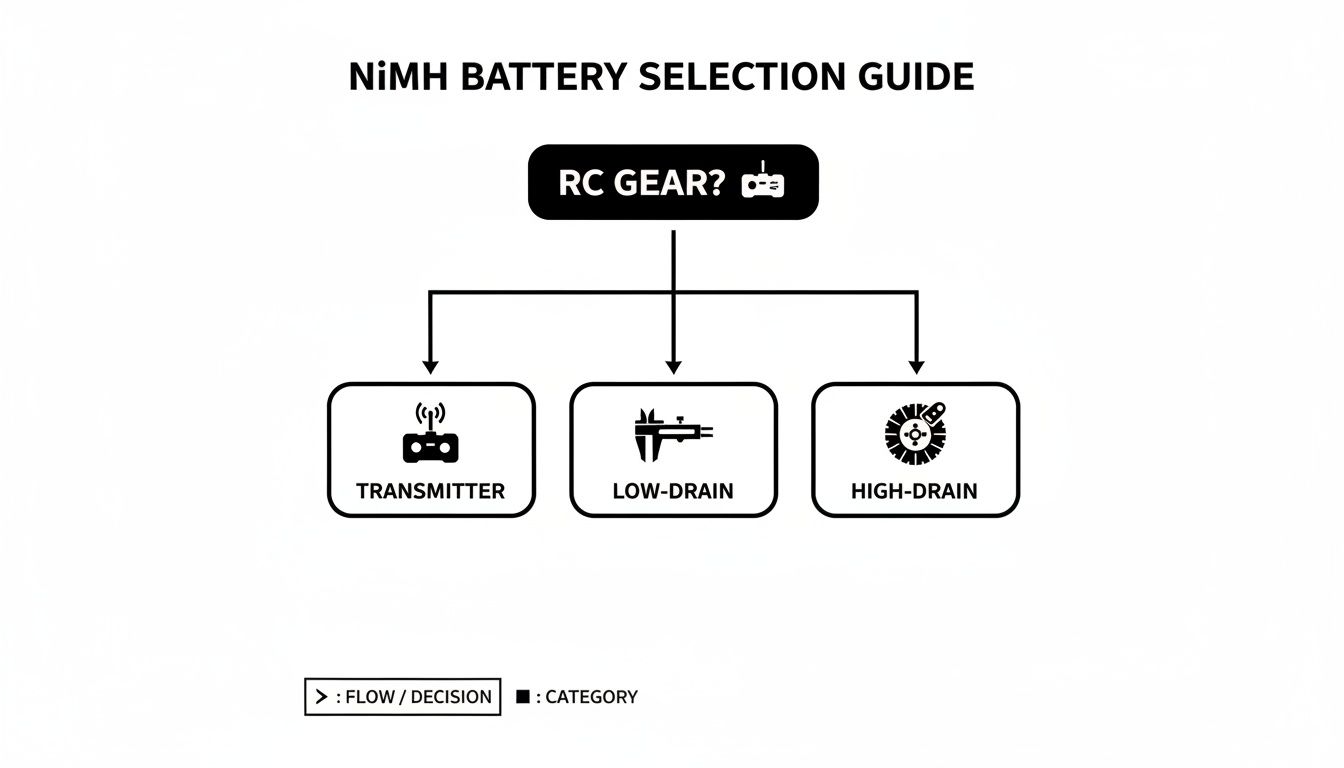
As you can see, what works for a transmitter isn't necessarily the best choice for your other gear.
Recommended NiMH Charging Rates for RC Gear
Choosing the right charge rate often comes down to balancing speed against long-term battery health. Here’s a quick guide to help you decide.
| Charge Type | Recommended Rate (C-Rating) | Best Use Case | Impact on Battery Life |
|---|---|---|---|
| Gentle / Forming Charge | 0.1C – 0.3C | New batteries, reconditioning old cells, overnight charging. | Excellent. Minimal heat stress extends cycle life significantly. |
| Standard Charge | 0.3C – 0.5C | Everyday charging when speed isn't critical. | Good. A great balance of reasonable speed and low heat generation. |
| Fast Charge | 0.5C – 1.0C | Trackside charging between heats or when you're in a hurry. | Fair. Generates more heat, which can reduce overall lifespan if used exclusively. |
For maximum longevity, stick to standard rates whenever possible and save the fast charges for when you really need them on race day.
Your Smart Charger's Secret Weapon: Negative Delta V (-ΔV)
So how does a smart charger know when a NiMH battery is actually full? It’s not just a timer. It’s looking for a tiny, specific voltage drop, a signal known as Negative Delta V, or -ΔV. As a NiMH cell reaches full capacity, its voltage peaks and then dips ever so slightly. A quality smart charger is sensitive enough to detect this dip and immediately stop the charging process.
This feature is the single most important defence against overcharging—the absolute number one killer of NiMH cells. Overcharging keeps forcing energy into a full battery, which has nowhere to go but to be converted into heat. That heat damages the internal structure, permanently butchering its capacity and cycle life.
Pairing your premium NiMH cells with a quality charger is non-negotiable. A cheap, timer-based wall charger lacks the -ΔV detection needed to protect your batteries, virtually guaranteeing they will be damaged over time.
Investing in a proper charger is just as important as the batteries themselves. For RC racers who demand precision, you can learn more about advanced multi-chemistry chargers that offer the control and safety features needed for all your battery types.
Ultimately, a quality charger paired with the correct settings ensures every charge cycle strengthens your batteries rather than degrading them. It's a simple practice that pays massive dividends in reliability and performance when the race is on the line.
Storage and Maintenance for Race Day Readiness
A winning race program isn’t just about what happens on the track. How you care for your gear between weekends is what truly sets you up for success. This is especially true for your rechargeable AAA NiMH batteries—proper storage and maintenance are non-negotiable if you want consistent, reliable power when the tone goes off.
Think about it this way: you wouldn't leave your car on the setup station for a month and expect it to be perfect. The same logic applies here. One of the biggest mistakes racers make is leaving their NiMH batteries sitting at full charge. Storing them at peak voltage puts constant stress on the internal chemistry, slowly chipping away at their capacity and overall health.
The Ideal Storage Voltage
If you're packing things away for more than a couple of weeks, you need to get your NiMH cells to their happy place: a partial charge. They don't want to be full, and they definitely don't want to be empty.
The sweet spot for long-term NiMH storage is around a 40-50% charge. This works out to a stable voltage of about 1.2V per cell. At this level, you're minimizing internal stress, which goes a long way in preserving capacity and extending the battery's cycle life for the next race season.
This isn't a concept unique to NiMHs. Many modern chargers, like the Junsi iCharger DX6, have automated storage functions that make this process effortless, ensuring your batteries are always kept in optimal condition.
Battery Cycling for Peak Performance
Cycling your batteries isn't just about maintenance; it's a vital diagnostic tool. Every so often, run a full discharge-and-recharge cycle—most modern chargers have a "Refresh" or "Analyze" function for this. This simple routine helps you spot a weak or fading cell before it costs you a main event.
This process also helps recondition the cells and can fight off the old "memory effect," where a battery starts losing capacity because it's always being topped off instead of fully used. A good cycling habit keeps all the cells in a pack performing as a matched, reliable set.
Rejuvenating Older Cells
Before you toss out those older cells that just don't seem to have the same punch, give them one last chance. A simple rejuvenation trick can often bring them back from the brink.
Try running them through one to three slow "forming charge" cycles. This involves charging at a very gentle 0.1C rate, followed by a full discharge. This process can reactivate the internal chemistry and recover a surprising amount of lost capacity. It's a great way to maximize the value of the batteries you get from Digital-RC and make sure your gear is always ready to go.
Your Essential RC Battery FAQ
Even with a solid grasp of battery specs and maintenance, questions always pop up in the heat of a race weekend. This FAQ cuts right to the chase with trackside-ready answers for the most common headaches racers run into with their rechargeable AAA NiMH batteries. Let's troubleshoot a few real-world scenarios to keep your gear running perfectly.
Why Does My Transmitter Show Low Battery With Fresh NiMH Cells?
This is a classic problem, and it almost always comes down to how your transmitter reads voltage. A fresh alkaline battery starts around 1.5V and its voltage steadily drops as it drains—that's the discharge curve most transmitters are programmed to expect.
A fully charged NiMH cell, on the other hand, quickly settles to a super-stable 1.2V and holds that voltage for most of its runtime. Your transmitter sees that 1.2V, thinks the battery is nearly dead, and throws a low-voltage warning even when there's still 80% or more capacity left. High-end radios from brands like Sanwa or Futaba often let you adjust the low-voltage cutoff in the settings menu to properly match the NiMH profile for accurate readings.
Can I Use My LiPo Charger for NiMH Batteries?
Most modern multi-chemistry RC chargers, like the Junsi iChargers we carry at Digital-RC, have a dedicated NiMH setting. The key word here is dedicated. You absolutely have to manually select the "NiMH" program on your charger before you even think about plugging in your batteries.
Accidentally charging NiMH cells on a LiPo setting is extremely dangerous. It completely bypasses the correct end-of-charge detection (-ΔV) and can cause the batteries to severely overheat, vent, or even burst. Always, always double-check your charger's screen to confirm the battery chemistry is correct before you hit start.
How Do I Know When My NiMH Batteries Need Replacing?
There are two dead giveaways that a set of batteries is ready for retirement. The first is a major drop in runtime. If cells that used to last a full race day are now dying after just a couple of qualifiers, their effective capacity has faded for good.
The second, more precise sign is high internal resistance (IR). A healthy NiMH AAA cell should have a very low IR, typically somewhere in the 20-50mΩ range. As a battery wears out, this number can creep up well over 200mΩ, which means it’s struggling to deliver power efficiently. If your smart charger is showing high IR or you're just not getting the runtime you used to, it’s time for a fresh set.
When your NiMH AAA batteries eventually reach the end of their useful life, understanding available battery recycling solutions is a crucial part of responsible maintenance and disposal.
What Is the Break-In Process for New NiMH Batteries?
A proper "break-in" or "forming" cycle is key to unlocking a new battery's full potential. This process essentially wakes up the internal chemistry and makes sure you're getting the maximum advertised capacity right from the very first use.
The best way to do this is with one to three slow charge and discharge cycles:
- Charge the new batteries at a really low rate, around 0.1C (for example, 100mA for a 1000mAh battery), for about 16 hours.
- Discharge them at a rate of 0.2C down to a cutoff voltage of 1.0V per cell.
- Repeat this process up to two more times.
This initial conditioning ensures your new cells are perfectly matched and ready to deliver consistent, dependable power for many race seasons ahead.
For race-proven rechargeable AAA NiMH batteries and the advanced chargers needed to maintain them, check out the curated selection at Digital-RC. Equip your gear with the reliable power it deserves. Visit us at https://digitalrc.ca for tax-free pricing and same-day delivery.