

Your Ultimate Guide to Remote Control Car Kits
When you’re serious about RC racing, a high-performance remote control car kit isn’t just a box of parts—it’s the absolute foundation for a podium-finishing machine. Unlike the ready-to-run models you see in hobby shops, these kits require a complete, ground-up assembly. This gives you the power to hand-pick every single component to match your driving style and the specific demands of the track.
From Box to Podium: Your Journey Into RC Racing
Welcome to the world of competitive on-road RC racing, where precision engineering and pure driving skill collide. A true racing kit is all about the build. It’s a rewarding process that gives you total control over how your car performs, pulling you out of casual backyard bashing and into the realm of serious competition.
This guide will demystify the high-performance kits we stock here at Digital RC, focusing on the two premier classes that dominate the Canadian racing scene: 1/10 touring cars and 1/12 pan cars. We'll walk you through everything, from choosing the right chassis to final setup, all with the goal of finding measurable performance gains on the track.
The Heart of a Passionate Community
This drive for ultimate customization and peak performance is what fuels the competitive scene. In the Canadian RC car market, dedicated hobbyists account for over 40% of all sales, a number that really highlights the passionate community of racers and builders who turn to specialist shops like Digital RC for premium kits. This isn't just a niche hobby; Canada's on-road scene has been expanding significantly since the early 2010s. You can read the full research about the remote control car market to see the trends for yourself.
A competitive remote control car kit is more than a collection of parts; it's a statement of intent. It signifies a commitment to understanding vehicle dynamics, mastering setup, and pushing the limits of performance.
Sourcing your kit and components from a specialist like Digital RC gives you a real advantage. We've curated a selection of top-tier brands like Awesomatix and XRAY, offer clear CAD pricing, and have same-day delivery options to get you on the track faster and with total confidence. This journey—from a box of precision parts to a podium contender—is what makes RC racing such a compelling sport.
Choosing Your Chassis: The Heart of Your Build
The chassis is the skeleton of your race car—it's the first big decision you'll make, and it dictates everything that follows. Your choice here determines how the car handles, the tracks it excels on, and the very style of racing you'll be doing. In the world of competitive on-road racing, this usually comes down to two main platforms: 1/10 scale touring cars and 1/12 scale pan cars.
Think of a 1/10 scale touring car as the rally car of the RC world. These are incredibly versatile machines, built with all-wheel-drive systems and four-wheel independent suspension. This setup allows them to generate massive grip and stay planted on just about any surface, from high-traction indoor carpet to outdoor asphalt tracks. It's no wonder they're such a popular choice for racers all across Canada.
On the other end of the spectrum is the 1/12 scale pan car. If the touring car is a rally car, the pan car is a purebred Formula 1 machine, built for one thing: dominating indoor tracks. They are brutally simple and efficient—lightweight, rear-wheel-drive platforms with a direct-drive system that has very few moving parts. The result is lightning-quick acceleration and razor-sharp, nimble handling, making them the undisputed kings of indoor carpet where agility is everything.
This concept map helps visualize how all the core elements of a competitive kit come together.
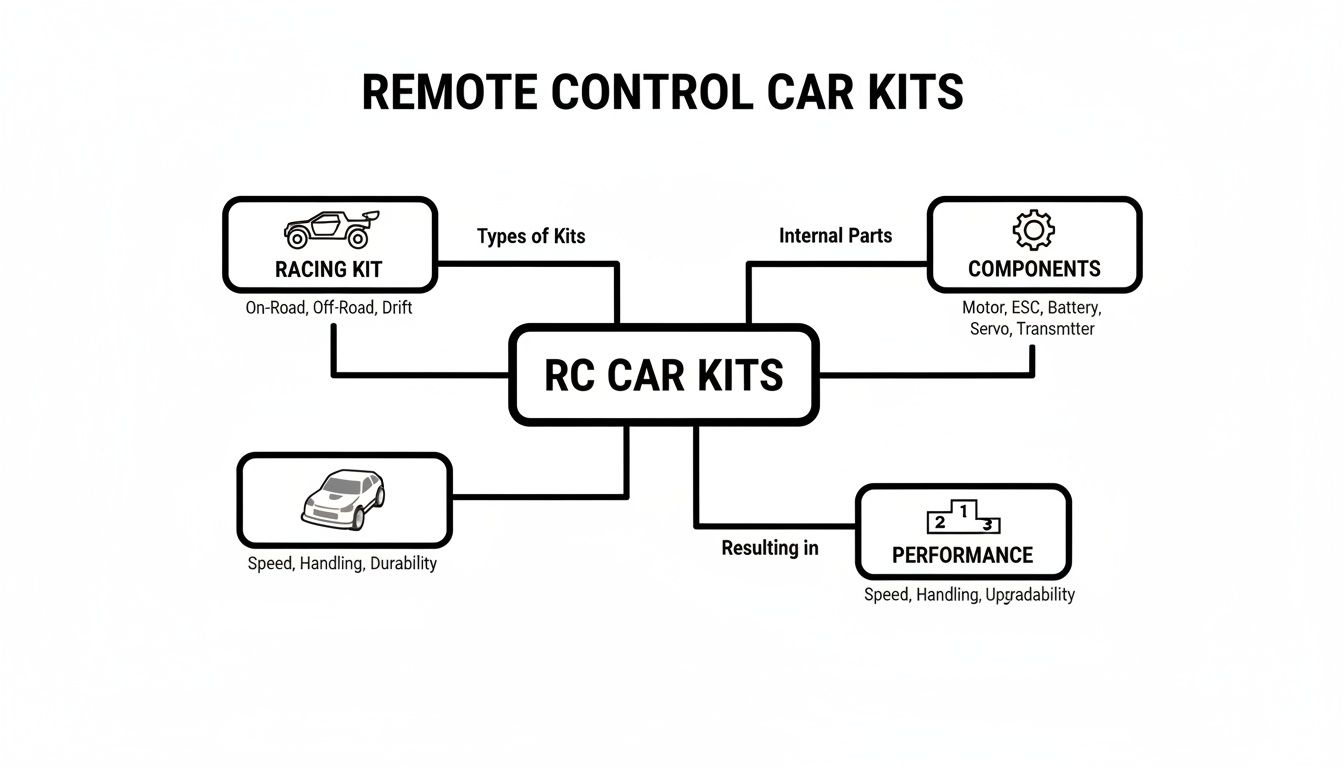
As you can see, your choice of racing kit, the core components you add, and your car's ultimate performance are all tightly connected.
Top-Tier Brands and Design Philosophies
At Digital RC, we focus on the elite brands that consistently win at the highest levels, each with its own unique engineering philosophy. XRAY, for example, is famous for its evolutionary design. They focus on refining a proven platform year after year, using high-quality materials to deliver exceptional durability. An XRAY chassis is known for being consistent and easy to drive fast, which makes it a fantastic choice for racers who value reliability and predictable handling.
Then you have a brand like Awesomatix, which is known for its revolutionary innovation. Their touring cars feature truly unique suspension designs, like their rotary dampers and leaf spring systems, that offer a massive tuning window for experienced racers. An Awesomatix kit is for the driver who loves to tinker and extract every last hundredth of a second through meticulous setup changes.
To help you decide, here’s a quick breakdown of the two main chassis types.
Comparing 1/10 Touring Cars and 1/12 Pan Car Kits
This table gives you a quick-glance comparison to help you figure out which chassis platform is the right fit for your competitive goals and your local track.
| Feature | 1/10 Scale Touring Car | 1/12 Scale Pan Car |
|---|---|---|
| Drivetrain | 4WD (Belt or Shaft Drive) | 2WD (Direct Drive) |
| Best For | All-around performance on carpet and asphalt | Maximum agility on indoor carpet tracks |
| Suspension | 4-wheel independent with oil-filled shocks | Rear pod with friction dampers |
| Complexity | More complex, more tuning options | Simpler, fewer moving parts |
| Handling | Stable, forgiving, high-grip | Nimble, ultra-responsive, requires precision |
| Top Speed | Very high, especially on large tracks | Extreme acceleration, high corner speed |
Ultimately, choosing between a touring car and a pan car comes down to where you plan to race and what kind of driving experience you're after.
Your local track is your best guide. Spend some time watching the fast drivers in your preferred class. Their success is a powerful indicator of which chassis platform and brand performs best under those specific conditions.
So, what’s it going to be? The all-around capability of a 1/10 touring car or the focused precision of a 1/12 pan car? By exploring our selection of top-tier remote control car kits from brands like Awesomatix and XRAY, you can be confident you’re starting your build with a championship-proven foundation.
Assembling Your Performance Package: What You Get and What You Need
Cracking open a high-performance remote control car kit from a brand like Awesomatix or XRAY is the start of a seriously rewarding process. Unlike a ready-to-run car, a competition kit gives you the precision-engineered skeleton of a race car, putting the most critical performance decisions right where they belong—in your hands. For any serious racer, this is a massive advantage.
Inside the box, you’ll find the core mechanical parts that form the car’s foundation. We're talking about the main chassis plate, suspension arms, bulkheads, shock towers, and all the drivetrain components like belts, gears, and driveshafts. These are the high-quality bones of your build, all designed for durability and peak performance on the track.
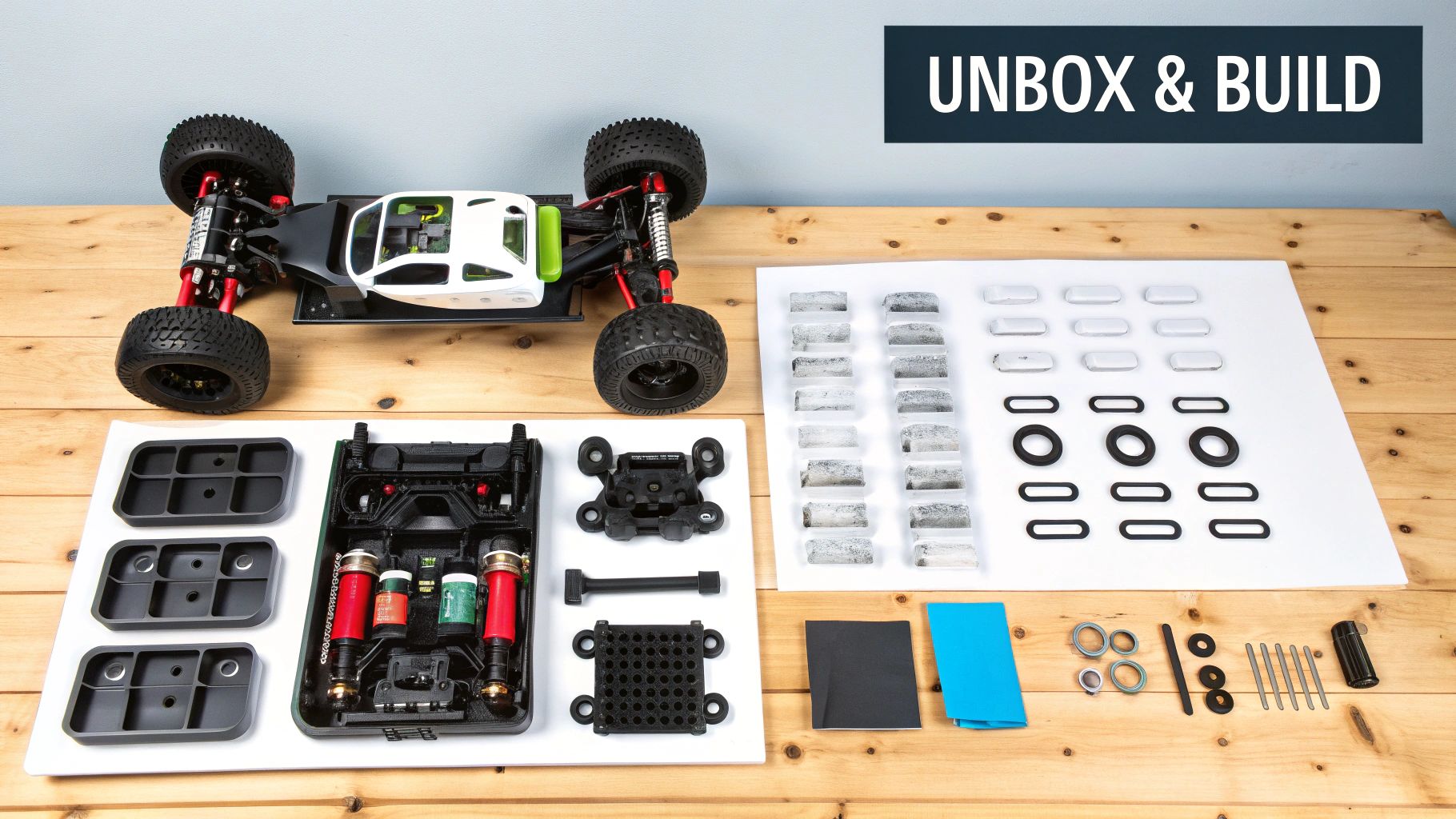
But the "soul" of the car—its entire electronic nervous system—is up to you. This is where you get to create a personalized performance package, dialled in perfectly for your racing class and driving style.
Your Electronics and Running Gear Checklist
To get your kit race-ready, you'll need to source a few key items separately. Think of these as the engine, brain, and tires for your new race car. Here’s a quick checklist of what you'll need to get on the track:
- Electronic Speed Control (ESC): The brain that translates your throttle inputs into power for the motor.
- Motor: The powerhouse that delivers your speed and acceleration.
- Steering Servo: The muscle providing sharp, precise steering control.
- LiPo Battery: The fuel tank that powers the entire system.
- Receiver: The vital link connecting your car to your radio transmitter.
- Personal Transponder: Your car's unique ID for the track's lap timing system.
- Tires and Wheels: The single most important connection between your car and the track.
- Body Shell: The aerodynamic skin that provides downforce and finishes the look.
This separation of mechanics and electronics is what defines a true racing kit. It empowers you to build a car with a specific purpose, using proven components from top brands to gain a competitive edge.
The growth in Canada's online RC car market, up 18% according to federal trade data, has made getting these components easier than ever. This trend puts the spotlight on retailers like Digital RC, which offer straightforward CAD-priced shopping and free same-day delivery, putting everything you need right at your fingertips. You can learn more about these market insights in this detailed report on remote control cars.
This freedom of choice lets you pair your chassis with race-winning electronics from leaders like Hobbywing, Sanwa, and Mon-Tech, all available at Digital RC. You can find everything you need to complete your build right here, ensuring perfect compatibility and podium-worthy performance. If you need a hand pairing your ESC and motor, check out our guide on how to choose the right Electronic Speed Controller.
Selecting Electronics for a Competitive Edge
With your chassis built, it’s time to bring your kit to life with its electronic nervous system. This isn't just about plugging in components; it's about creating a perfectly matched package that dictates your car’s speed, responsiveness, and reliability over a gruelling five-minute race.
Choosing your electronics wisely is the key to unlocking the chassis’s true potential.
The motor and Electronic Speed Control (ESC) are the heart and brain of your power system. For competitive racing, your choice here is often decided by the class rules.
In "blinky" spec racing, the ESC timing is locked to a zero-degree setting, creating a level playing field where driver skill and car setup are what get you to the podium. A 17.5T or 21.5T motor from a proven brand like Team Powers is a common choice here, delivering smooth and predictable power.
On the other hand, modified classes are all about raw, unadulterated power. These classes let you use faster, low-turn motors and advanced ESC timing settings for explosive acceleration and top speed.
For a deeper dive, our guide on how to choose the right motor for your RC car breaks down everything you need to know. At Digital RC, we stock proven motor and ESC combinations from Hobbywing that deliver consistent, race-winning power for any class.
Steering Precision and Power Delivery
Your steering servo is what translates your commands at the wheel into precise cornering on the track. It’s a constant trade-off between speed (how fast it turns) and torque (how much force it can apply).
In modern 1/10 touring cars, chassis space is at a premium and reactions have to be instant. This is where a low-profile servo like those from Sanwa becomes essential. It keeps the centre of gravity low, maintains optimal chassis balance, and delivers the lightning-fast steering response you need.
Think of your LiPo battery as the fuel tank, but its specs tell a much bigger story. For a typical 5-minute race, two numbers matter most:
- Capacity (mAh): This is your runtime. More mAh means more fuel, but it also adds weight.
- C-Rating: This tells you how quickly the battery can deliver its energy. A higher C-rating gives you more "punch" or instant acceleration out of the corners.
The goal isn't just to finish the race; it's to maintain consistent power from the first lap to the last. A high-quality LiPo ensures your car feels just as strong on minute five as it did on minute one.
The trick is to choose a battery with enough capacity to finish the race strong without carrying unnecessary weight that will slow you down. By selecting from our curated collection of electronics, you can build a perfectly harmonized package, ensuring every component works together to give you a true competitive edge on the track.
Building Your Winning Formula With Tools and Upgrades
A perfectly built kit is a great start, but it’s the setup that wins races. A fast car is only half the battle. Consistent performance comes from having the right tools and a mindset that's always looking for that next small adjustment. For any serious racer, quality setup gear isn't a luxury—it's essential.
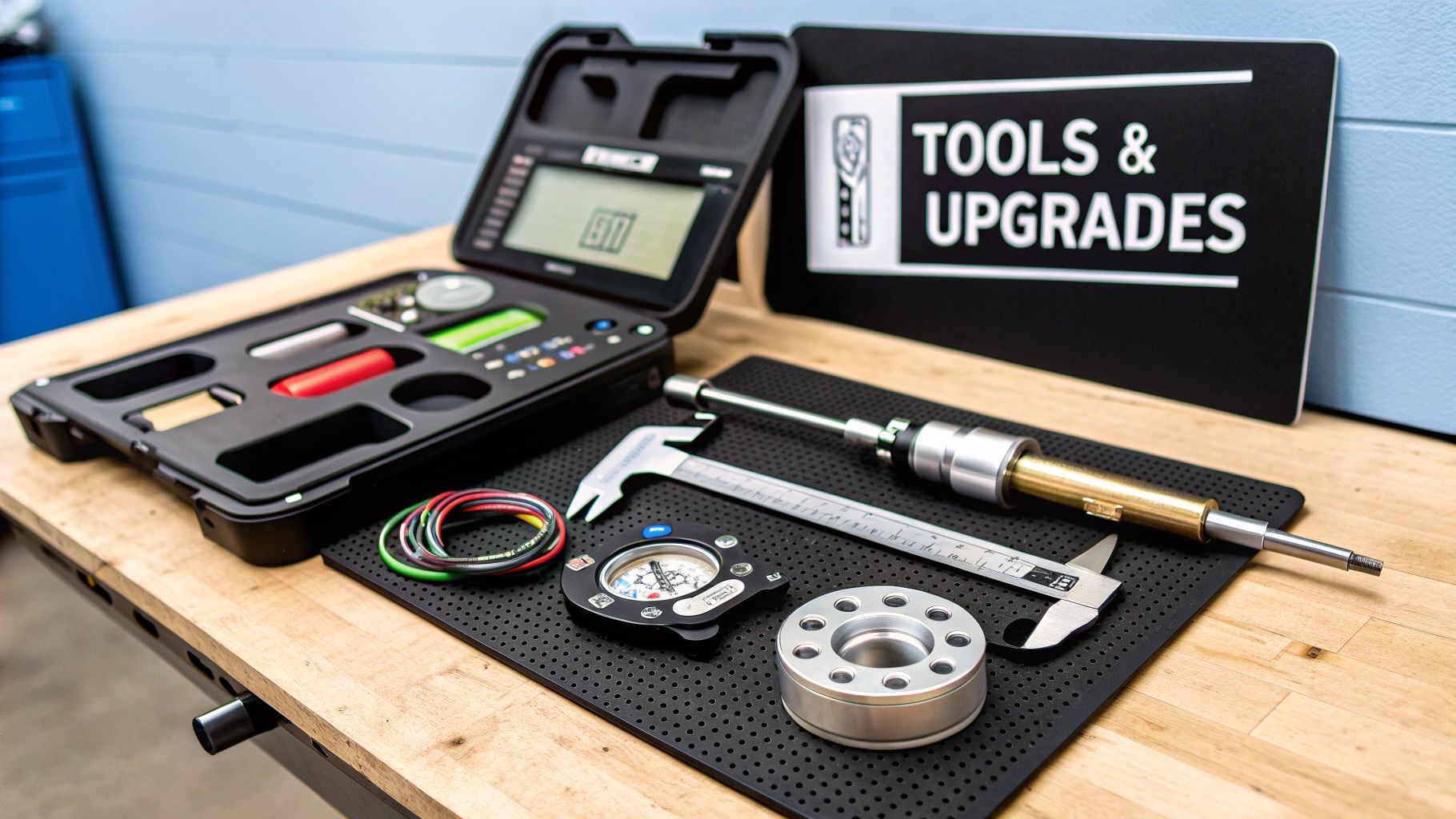
This is about moving beyond the basic wrenches that came with your kit and getting the gear that lets you make repeatable, accurate adjustments. These tools are the foundation of a competitive pit space, making sure your remote control car kit performs the same way every single time you put it on the track.
Must-Have Tools for Precision Setup
To really dial in your car, you need tools that measure, not just tighten. Think of them as the translator between the changes you make and how the car actually behaves on the track. Here are the essentials every competitive racer should have:
- Setup Station: This is your most critical tool for geometry. It lets you accurately check and adjust camber, toe, and caster, ensuring your car is perfectly symmetrical and handles exactly how you expect it to.
- Digital Calipers: When you need precision down to a fraction of a millimetre, digital calipers are non-negotiable. Use them for setting ride height, droop, and getting your turnbuckle lengths perfect.
- Shock Pump: This is an air removal tool that guarantees your shocks are built perfectly every time with zero rebound. The result is consistent damping, lap after lap.
Take camber, for example. Adjusting it changes how much the tire leans into a corner, which directly affects its contact patch and grip. Without a setup station, you’re just guessing.
The secret to going faster isn't always a bigger motor; it's often found in small, precise setup adjustments. A well-tuned car is easier to drive at the limit, which is where races are won.
This obsession with precision is a huge part of what's driving the hobby forward. Here in Canada, revenue from remote control cars is steadily climbing, and analysts are projecting major growth in the kind of hobby-grade kits we focus on. North America holds a massive 36% global share of the market, and Canada's strong hobby culture carves out a vital piece of that. You can discover more insights about these RC market trends to see just how much the community is expanding.
Smart upgrades go hand-in-hand with a good setup, refining your car's handling even further. Things like titanium turnbuckles cut down on weight, ceramic bearings reduce drivetrain friction for a little more top-end speed, and carbon fibre stiffeners let you tune chassis flex for different track conditions. At Digital RC, we're constantly dropping new products so you have access to the latest race-proven parts. That way, you can always find that next small advantage to stay ahead of the pack.
Your Pre-Race Checklist for a Perfect First Run
You’ve spent hours on the build, and the excitement to hit the track is huge. But before you do, a quick, systematic check can be the difference between a great race day and packing up early. This isn't about diving into complex setup changes; it's about making sure the fundamentals are solid.
First up, the drivetrain. Getting the gear mesh right is absolutely critical. You’re looking for just a tiny bit of play between the pinion and spur gear. If it's too tight, you’ll put a ton of strain on your motor and risk overheating your electronics. Too loose, and you'll be stripping that spur gear on your first hard acceleration.
Next, let's get your electronics talking to each other. Calibrating your Electronic Speed Control (ESC) to your radio is a step you can't skip. This process teaches the ESC your exact throttle and brake limits, which is key for smooth, predictable power delivery.
Mechanical Integrity and Baseline Setup
With the electronics dialled in, it’s time for a final mechanical once-over. Check that your suspension moves freely without any binding by cycling each arm through its full range of motion. Everything should be smooth as silk. After that, do a quick nut-and-bolt check across the entire car to make sure nothing has vibrated loose since you finished the build.
If you just built a brand new Awesomatix or XRAY kit, do yourself a favour and start with the recommended 'box stock' setup. This factory baseline is a proven, drivable starting point that lets you actually learn the car's handling traits before you start chasing a setup.
Finally, make sure your LiPo battery is fully charged and strapped in securely. If you're new to the hobby or just want a refresher on battery safety and performance, our guide on LiPo battery selection is a great resource.
Running through this quick checklist ensures your first run is a success. And hey, if you get to the track and realize you forgot a crucial part like a pinion gear, don't let it ruin your weekend. At Digital RC, our same-day delivery for orders placed before noon means you can get last-minute parts and get back on the track without missing a beat.
Frequently Asked Questions About RC Car Kits
Jumping into the world of competitive remote control car kits always brings up a ton of questions. It doesn't matter if you're building your first chassis or you’re a seasoned pro trying to shave off another tenth of a second—getting the right answers is what leads to better performance on the track. We've put together some of the most common questions we hear to help you out.
The biggest difference comes down to assembly and the quality of the parts. A Ready-To-Run (RTR) car is perfect for beginners because it shows up already built with basic electronics. But a competitive kit from a brand like XRAY? That's a different beast entirely. You build it from the ground up and choose your own high-performance electronics for a completely custom setup.
This hands-on approach is what racing is all about. It gives you the power to fine-tune every single part of the car's behaviour to match the track, your driving style, and the competition. That’s where the real advantage comes from.
How Do I Choose the Right Motor and ESC?
Your choice of motor and ESC almost always comes down to the racing class you plan to run in. This is a massive decision, as it directly controls your car's power, speed, and overall feel on the track.
For "spec" or "stock" racing—often called "blinky mode"—the rules are very strict. They'll tell you exactly which motor turn to use, like a 17.5T or 21.5T. The ESC also has to be on an approved list to keep the racing fair and competitive. But in "modified" racing, the gloves are off. You have the freedom to run seriously powerful, low-turn motors for mind-blowing speed.
At Digital RC, our product descriptions are written to help you easily pair proven Hobbywing ESCs with championship-winning Team Powers motors. We want to make sure you have a potent, reliable combination for whatever class you choose.
Why Are Awesomatix and XRAY So Popular?
Simple: they win. These brands completely dominate the racing scene because of their incredible precision engineering, top-shelf materials, and innovative designs that have been proven on tracks all over the world. Their kits just handle better, last longer, and give you a massive range of tuning options.
They also have excellent factory support and a huge network for spare and option parts, which is non-negotiable for any serious racer. When you shop at a specialized store like Digital RC, you know you're getting authentic components and the latest chassis updates straight from these top-tier manufacturers.
At Digital RC, we focus on putting together complete solutions for 1/10 touring and 1/12 pan car racers. From the best kits on the market to all the electronics, tires, and tools you need to build a winner, we’ve got you covered. Check out our collections and get on the track faster with our free same-day delivery. Visit https://digitalrc.ca to start your next build today.