

Choosing The Right Battery For RC Racing Success
When you get serious about on-road RC racing, you quickly learn one thing: the battery for rc cars is way more than just a power source. It’s the beating heart of your entire setup.
For competitive 1/10 scale touring cars, this almost always means a 2S (7.4V) LiPo, while the nimble 1/12 scale pan cars rely on a 1S (3.7V) LiPo. Getting the right one is a delicate balancing act between voltage, capacity, and its ability to deliver current when you punch the throttle.
The Heart Of Your Race Car: Why Your Battery Choice Matters
In the world of high-stakes on-road racing, your battery dictates nearly everything. Whether you're wheeling a precision-engineered touring car or a lightning-fast pan car, the battery is what gives your car its personality on the track. It defines your raw acceleration, influences your top speed down the main straight, and, most importantly, keeps that power consistent over a gruelling five-minute qualifier.
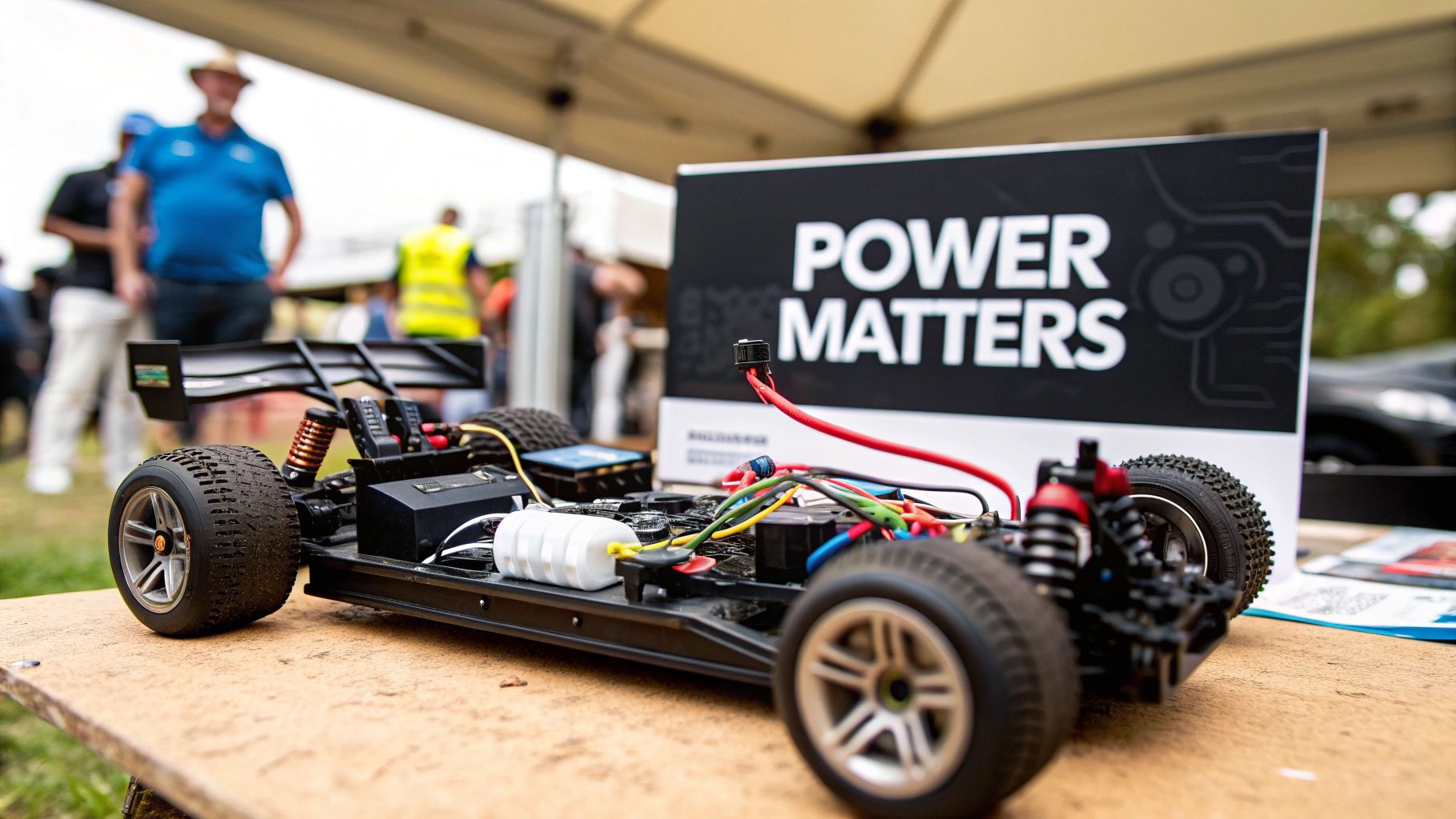
This guide isn't about reciting basic specs. It’s built to connect the technical details directly to the choices you make in the pits, because understanding your power system is how you shave those precious tenths off your lap times.
More Than Just Power
Think of your battery for rc racing as a core tuning component, just like you would your suspension or tires. Its physical weight and dimensions have a massive impact on your car's handling balance and centre of gravity. A heavier battery might add stability on a high-grip track, while a lighter "shorty" pack can make the chassis feel more agile and quick to change direction.
From the starting tone to the finish line, your choice affects it all:
- Acceleration: A high-quality battery delivers that instant surge of current your motor needs for explosive power out of the corners.
- Consistency: Premium race packs are built to minimize voltage drop, or "fade," ensuring your car feels just as strong on the last lap as it did on the first.
- Handling Dynamics: You can use the battery’s weight and position to fine-tune your car's balance for perfect cornering.
Choosing the right battery isn't just about winning the power war; it's about achieving perfect harmony between your electronics and your chassis. A well-matched power source unlocks the full potential of your car, giving you a tangible competitive edge.
This deep dive will give you the knowledge to select the ideal battery from our curated collection at digital-rc, making sure your power system is perfectly dialled in for the win.
Understanding The Shift To Modern LiPo Power
In the world of competitive RC racing, battery technology has completely changed the game. It wasn't that long ago when Nickel-Metal Hydride (NiMH) packs were the standard. Today, you won't find a serious race car on the track—from club level to national championships—running anything but Lithium Polymer (LiPo) batteries.
This wasn't just a minor upgrade; it was a fundamental shift in how our cars deliver power. Think of it this way: a LiPo is like a world-class sprinter, ready to explode off the starting line with instant, massive power. An NiMH pack, on the other hand, is more like a marathon runner—steady and reliable, but it just doesn't have that race-winning kick.
Why LiPo Is The Champion Chemistry
For on-road racing, the advantages of a modern LiPo battery for rc cars are crystal clear. LiPo batteries hold their voltage much more consistently throughout a run. This means your car feels just as punchy on the last lap of a five-minute main as it did on the first. That dreaded "voltage fade" we all remember from NiMH packs is a thing of the past.
This consistent power delivery gives you a real-world advantage right where it counts:
- Explosive Punch: The ability to dump current instantly gives your car a massive edge when accelerating out of tight corners.
- Higher Top Speeds: A higher sustained voltage means your motor spins at its maximum RPM for longer, giving you more speed down the straights.
- Lighter Weight: LiPo batteries have a far better power-to-weight ratio, which is critical for the nimble, responsive handling we need in 1/10 and 1/12 scale racing.
This is exactly why top-tier brands like Team Powers and Hobbywing, which we're proud to carry here at digital-rc, focus entirely on engineering high-performance LiPo batteries built for the insane demands of modern racing.
The Real-World Impact On Racing
The move to LiPo technology is part of a bigger trend toward more powerful and efficient electric systems. In fact, RC-specific data shows North American toy car sales hit $92.88 million in 2023, with electric models leading the charge thanks to a projected 7-9% annual growth rate. Our focus at digital-rc on pairing high-grade LiPos with components like Hobbywing ESCs and motors gives racers up to 25% better efficiency than old NiMH setups, slashing recharge times by as much as 40%.
The real magic of a LiPo is its ability to deliver current on demand, without any hesitation. This is the 'punch' you feel in the throttle—the characteristic that lets you clear a double jump or out-accelerate a competitor down a long straightaway. It’s a tangible advantage you can feel every time you pull the trigger.
If you want to dive deeper into how different battery chemistries stack up, resources on understanding different battery technologies like LiFePO4 vs AGM can be useful. While the applications are different, the core principles of energy density and discharge capability are universal. For a more detailed guide tailored to RC, check out our article on how LiPo battery selection can power your setup for maximum performance. Mastering this is essential for any racer aiming for the top step of the podium.
Decoding Battery Specs: C-Rating, Capacity, And Voltage
When you first look at a high-performance battery for RC racing, the label can seem a bit intimidating. It's covered in numbers and technical terms that, to a new racer, might look like a complex equation.
But here’s the secret: those numbers are the key to unlocking your car’s true potential. They directly translate to runtime, acceleration, and top speed. Once you understand what they mean, you can confidently choose the perfect power source for your racing class and driving style. Let's break them down.
Capacity Is Your Fuel Tank
The first spec you'll probably spot is the capacity, measured in milliamp-hours (mAh). The easiest way to think about this is as the size of your car's fuel tank. It's that simple.
A higher mAh number means a bigger tank, giving you more runtime on the track. A 6000mAh battery, for instance, will almost always outlast a 4000mAh pack under the same conditions. But—and this is a big "but" in racing—a bigger tank adds more weight. This creates a critical trade-off: do you want the security of longer runtime or the nimbleness of a lighter car? In a tight five-minute qualifier, that extra weight might hurt your lap times more than the extra capacity helps.
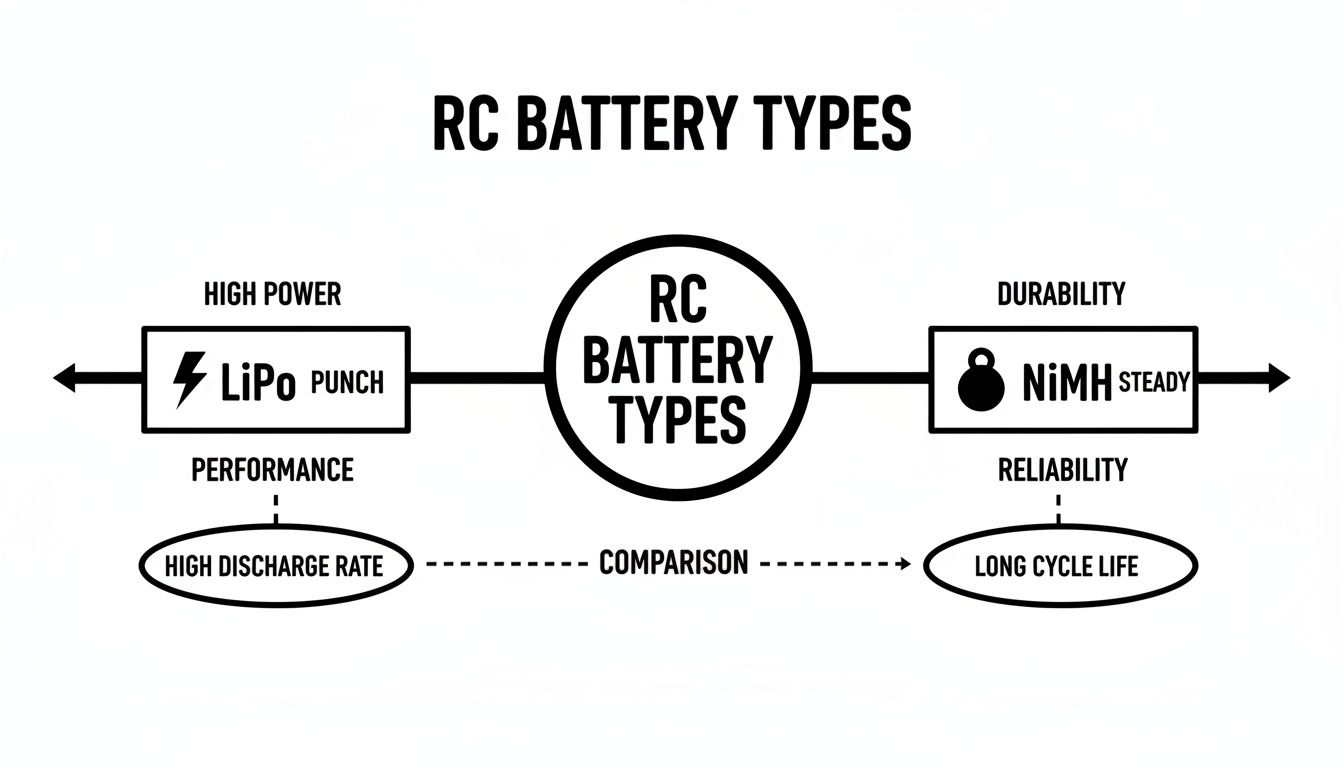
As you can see, LiPo batteries are engineered for that explosive "punch" racers crave, while older NiMH technology provides a much steadier, less aggressive power delivery.
Voltage Is Your Horsepower
Next up is voltage, which is determined by the number of cells inside the battery. This is shown as an "S" rating on the label. Each LiPo cell has a nominal voltage of 3.7V, so a 1S pack is 3.7V and a 2S pack is 7.4V.
- 1S (3.7V): The undisputed standard for 1/12 scale pan car racing.
- 2S (7.4V): The mandatory choice for virtually all 1/10 scale touring car classes.
Think of voltage as the raw horsepower of your power system. More voltage lets your motor spin faster, giving your car a higher potential top speed. This is precisely why racing classes have strict rules on cell counts—it keeps the playing field level by putting a cap on the outright power everyone has on tap.
C-Rating Dictates Power Delivery
Finally, we get to the most critical—and most misunderstood—spec of all: the C-Rating. This number tells you the maximum rate at which the battery can safely push out its stored energy. If capacity is your fuel tank and voltage is your horsepower, then the C-Rating is the size of the fuel line delivering that power to the motor.
A higher C-Rating means a bigger fuel line, allowing a massive surge of power to reach your motor instantly. This is what creates that incredible "punch" you feel accelerating out of a tight corner.
To put these concepts into perspective, here’s a quick reference guide on how these specifications impact on-road racing performance.
RC Battery Specifications At A Glance
| Specification | Simple Analogy | Impact On Performance | Typical For 1/10 Touring | Typical For 1/12 Pan Car |
|---|---|---|---|---|
| Capacity (mAh) | The size of your fuel tank. | Determines runtime. More mAh = longer run, but also more weight. | 5000mAh - 8000mAh | 7000mAh - 9600mAh |
| Voltage (S-Rating) | Your engine's horsepower. | Dictates potential top speed. Higher voltage = higher motor RPM. | 2S (7.4V) is mandatory. | 1S (3.7V) is mandatory. |
| C-Rating | The size of your fuel line. | Governs acceleration "punch." Higher C = faster power delivery. | 100C - 140C+ | 120C - 140C+ |
This table shows how each spec has a different priority depending on the class you're running.
Let's use a real-world example. A 5000mAh battery with a 100C rating can theoretically deliver a massive 500 amps of current (5.0Ah x 100C = 500A). That immense delivery capability is absolutely essential for modified racing, where powerful motors are hungry for current. For a spec class with a less demanding motor, a lower C-Rating is often perfectly fine and can even save you a few crucial grams of weight.
Choosing the right battery for RC racing is all about finding the perfect balance of these three elements for your specific needs.
Ensuring A Perfect Fit: Connectors and Chassis Integration
All the C-rating and capacity in the world won't do you any good if the battery doesn't plug into your ESC or fit properly in your chassis. Once you’ve sorted out the electrical specs, the next critical step is the physical connection. This is where raw potential gets turned into on-track performance.
The connection point itself is a make-or-break component. In competitive racing, a poor connection creates resistance, which means heat—and heat is just wasted power that never reaches your motor. Think of it like a kinked fuel line; the flow is choked off, and you’re losing precious horsepower. This is why serious racers obsess over high-quality, low-resistance connectors.
The Right Connection For Racing
While a bunch of different plugs exist in the RC world, the on-road racing scene has settled on a few options known for their efficient and solid designs.
- Bullet Connectors (4mm & 5mm): This is the standard for modern competition LiPo batteries. The plugs connect directly into the battery case, giving you a clean, direct, and very low-resistance link.
- Deans (T-Style): A long-time favourite, known for being incredibly secure. They can handle high current, but you see them less and less on brand-new, high-end race packs.
- XT60: Super popular in other RC hobbies like drones, but not as common in on-road racing. They’re known for being easy to grip and fitting together snugly.
For pure, maximum power delivery in 1/10 and 1/12 scale racing, direct-soldered bullet connectors are the only way to go. A clean, solid solder joint on a quality connector minimizes electrical resistance, ensuring your ESC and motor get the unrestricted current they crave for that explosive punch out of the corners.
Stepping up to premium connectors is one of the easiest and most effective upgrades you can make. A quality set of 5mm golden plugs for your LiPo battery ensures you have a superior and reliable connection, race after race.
Form Factor and Chassis Balance
Beyond the plug, the battery's physical shape and size are powerful setup tools. Modern race chassis are designed with battery placement in mind, letting you fine-tune weight distribution for the perfect handling balance.
- Standard Pack: The traditional full-size battery case. This is often the choice when you’re trying to squeeze in the most runtime possible.
- 'Shorty' Pack: A shorter, lighter battery that opens up a ton of tuning flexibility. It lets you shift weight forward or backward in the chassis to dial in your car's handling characteristics.
- LCG (Low Centre of Gravity): These packs are thinner than standard batteries, dropping the overall weight lower in the chassis. The result is less body roll and faster cornering speeds.
This choice is happening amidst a major boom in battery technology. Canadian RC racers are benefiting from a broader market explosion, where the overall Canada battery sector is projected to hit USD 14.95 billion by 2030. For digital-rc customers running premium electronics from Team Powers or Hobbywing, this translates to better LiPo batteries with superior energy density, boosting both runtime and punch. Discover more insights about this rapidly growing market on nextmsc.com. Selecting the right battery for rc cars from digital-rc ensures you get a pack that is a perfect physical and electrical match for your specific car and goals.
Mastering LiPo Battery Care And Safety
Proper battery care isn't just a chore—it's a non-negotiable part of racing. It’s what maximizes performance, extends the life of your investment, and keeps you safe in the pits.
A well-maintained battery for rc racing is a reliable one. It gives you the confidence to push hard from the starting tone all the way to the finish line. This guide breaks down the essential practices every serious racer needs to master.
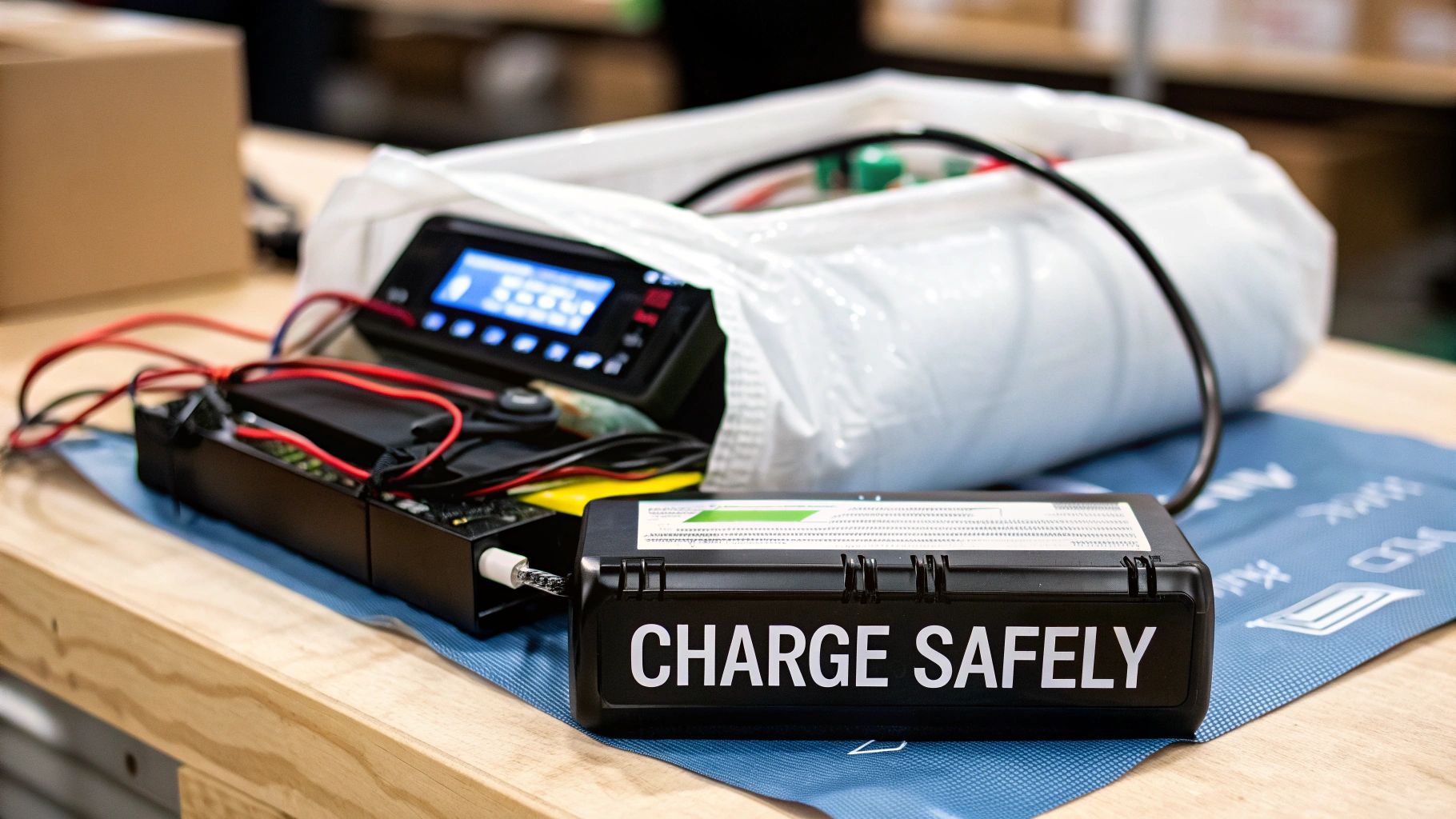
Treating your LiPo batteries correctly from day one pays dividends in consistency and longevity. The alternative—neglect—leads to poor performance, premature failure, and even dangerous thermal events.
The Golden Rules Of Charging
The single most important tool in your arsenal is a quality balance charger. A LiPo pack is made of individual cells (two for a 2S pack, one for a 1S), and it's absolutely critical that these cells maintain an identical voltage. This is what "balance charging" accomplishes.
When you balance charge, your charger monitors each cell independently, making tiny adjustments to ensure they all hit a full charge of 4.20V at the exact same time. This keeps one cell from becoming dangerously overcharged while ensuring the pack is perfectly balanced for optimal power output.
Follow these essential charging habits without fail:
- Always Balance Charge: Make this your default mode. It's the safest and healthiest way to charge your LiPos, period.
- Use a LiPo-Safe Bag: Always place your battery in a fire-resistant charging bag while it's on the charger. It's a simple, cheap safety measure that can contain any potential issues.
- Never Leave a Charging Battery Unattended: This one is non-negotiable. Stay within sight of your batteries while they're charging.
- Charge at a Safe Rate: A charge rate of 1C is the universally accepted standard. For a 6000mAh battery, that means charging at 6.0 amps. While some modern batteries claim they can handle more, 1C is always the safest bet for longevity.
A healthy LiPo battery is a balanced LiPo battery. Imbalanced cells don't just kill performance and runtime; they put immense stress on the pack, drastically shortening its competitive life. Consistent balance charging is the cornerstone of protecting your investment.
Understanding Storage Charge
What you do with your batteries after race day is just as critical as how you charge them. Leaving a LiPo fully charged (at 4.20V per cell) or completely dead for more than a day or two will cause permanent damage to its internal chemistry. You'll notice it as reduced capacity and a loss of punch.
This is where "storage charge" comes in. This setting on your charger brings each cell to its ideal resting voltage, right around 3.80V to 3.85V per cell. At this voltage, the battery is in a chemically stable state, safe for long-term storage without degrading. Make it a habit to storage charge your packs as soon as you get home from the track if you don't plan on using them again within 24 hours.
For a deeper dive into this crucial topic, you can learn more about the specifics of LiPo battery storage voltage in our detailed guide.
Broader Trends And Longevity
In the competitive world of Canadian RC racing, the demand for high-performance LiPo batteries has surged, influenced directly by the nation's booming electric vehicle sector. As EV sales push toward 100% by 2035, the technology in your race-day battery will evolve right alongside it, promising even faster and safer power.
To make sure your LiPo packs last as long as possible, it helps to understand the general principles of battery health, like those discussed in guides on maximizing electric bike battery lifespan. The core concepts of proper charging, discharging, and storage are universal across all high-performance lithium batteries. By adopting these best practices, you protect your gear, ensure your safety, and keep your race program running smoothly.
Gain Your Winning Edge With Digital-RC
Throughout this guide, we've broken down how a deep understanding of your battery for rc racing is your ticket to the top step of the podium. From decoding specs to mastering maintenance, every detail translates into a real, measurable advantage on the track.
Choosing the right power source is all about finding that perfect balance of punch, weight, and consistency for your specific racing class. Winning in competitive on-road racing ultimately comes down to a simple formula: combining your driving skill with meticulously prepared equipment. The battery is the very heart of your car’s performance.
Your Trusted Partner in Canadian RC Racing
At digital-rc, we're more than just a shop; we're your partner in the pursuit of speed. We were built by racers, for racers, and we live and breathe the Canadian on-road scene. That’s why we’ve hand-picked a range of batteries from proven, race-winning brands like Team Powers and Hobbywing.
We take the guesswork out of it. We only stock products that have proven they can perform under the immense pressure of competition. This means every battery you see on our site is one we would confidently bolt into our own cars.
Success in RC racing isn't about finding a secret part; it's about building a consistent, reliable program. Your battery choice is the cornerstone of that program, and partnering with a supplier who understands your goals gives you an undeniable edge.
Our commitment to Canadian racers goes beyond just stocking the right products. We’ve designed our entire service to help you focus on what really matters—your performance at the track.
- Transparent CAD Pricing With No Tax: The price you see is the price you pay. All orders are in Canadian dollars with no tax, making it easy to budget for your race season.
- Free Same-Day Delivery: Place your order before noon and get your parts delivered the same day. We know what it's like to need a last-minute battery for a race weekend, and this service is built to get you back on track, fast.
Put Your Knowledge Into Action
Now it’s time to take everything you've learned and apply it. Armed with a clear understanding of C-rating, capacity, and voltage, you can confidently browse our collection and select the perfect battery for rc competition.
Whether you're prepping for a major event or just want to find an edge at your local club race, the right power source is waiting for you. Explore our curated selection today and discover how the right battery—backed by unparalleled service from digital-rc—can power your next victory.
Your Top RC Battery Questions, Answered
Even after getting the basics down, you’ll always run into specific questions in the pits. Here are quick, straight-to-the-point answers to the most common things we hear from on-road racers, designed to get you sorted and back on the track.
How Do I Know When My LiPo Is Done?
The most obvious sign of a tired battery for rc racing is a clear drop in performance. Your car will feel “soft” off the line, losing the punch and sharp acceleration it had when the pack was fresh. This happens as the battery's internal resistance (IR) creeps up over time, making it harder to deliver the current your motor is demanding.
Another dead giveaway is any puffing or swelling. If the hard case on your LiPo starts to bulge, even a little, that’s a non-negotiable sign the cells inside are failing. For your safety, you must immediately and safely discharge, then dispose of any puffed LiPo. Don't even think about using it again.
Finally, just pay attention to runtime. A battery that used to easily clear a five-minute race but now dumps before the tone is telling you its effective capacity is gone. It's time for a replacement.
Can I Use a Higher C-Rating Than I Need?
Absolutely. A battery's C-Rating is its maximum discharge potential, not what it's putting out all the time. Think of it like the redline on your car's tachometer; you don't drive everywhere at 8,000 RPM just because the engine can handle it.
Running a battery with a higher C-Rating than your motor requires is perfectly safe and often better. A higher-rated pack runs cooler and is under far less stress, which usually means it will last longer. You can’t have “too much” C-Rating—your motor and ESC will only ever draw the current they need.
A battery with a high C-Rating is like an engine with horsepower to spare. It’s not working nearly as hard to deliver the power you need, which means less heat, lower internal resistance, and more consistent voltage from the start of the race to the finish.
What's The Best Battery For Spec Racing?
In spec classes like 17.5T or 21.5T touring car, the game changes. You're not looking for brute force power delivery; you're looking for maximum efficiency and minimum weight. Spec motors draw far less current than wild modified motors, so you don’t need the highest C-Rating on the market.
Often, the winning choice is a battery that has a solid C-Rating but comes in a lighter package. This is why LCG (Low Centre of Gravity) and "shorty" packs are so dominant. They let you play with your car's weight balance to dial in the handling, which can give you a much bigger advantage on the track than a tiny bit of extra punch ever could in a spec class.
How Often Should I Balance Charge My LiPo?
Every. Single. Time. It might be tempting to save a few minutes between heats by doing a fast "charge" without the balance lead, but it's a terrible habit to get into.
Consistent balance charging makes sure that every cell inside the pack holds the exact same voltage. This simple step prevents one cell from being over-discharged on the track or over-charged on your bench—both of which cause permanent damage and create a serious safety risk. Making balance charging a non-negotiable habit is the single best thing you can do for the health and longevity of your LiPos.
At digital-rc, we stock a curated selection of race-proven batteries from the best brands in the business. We make sure you have the perfect power source for any class you run. Explore our LiPo battery collection today and get the competitive edge you need, backed by same-day shipping and no-tax CAD pricing. Find your next winning battery at https://digital-rc.ca.