

Your Guide to LiPo Battery Storage Voltage
If you want your LiPo batteries to last, there’s one number you absolutely need to know: 3.8V per cell. This isn't just a random guideline—it's the sweet spot for keeping your batteries healthy and ready for action.
When you’re done for the day, getting your packs to a storage charge of 3.8V to 3.85V per cell is the single most important thing you can do to protect your investment. It minimizes the internal chemical stress that slowly kills a battery’s performance over time.
Why 3.8V Per Cell is the Magic Number
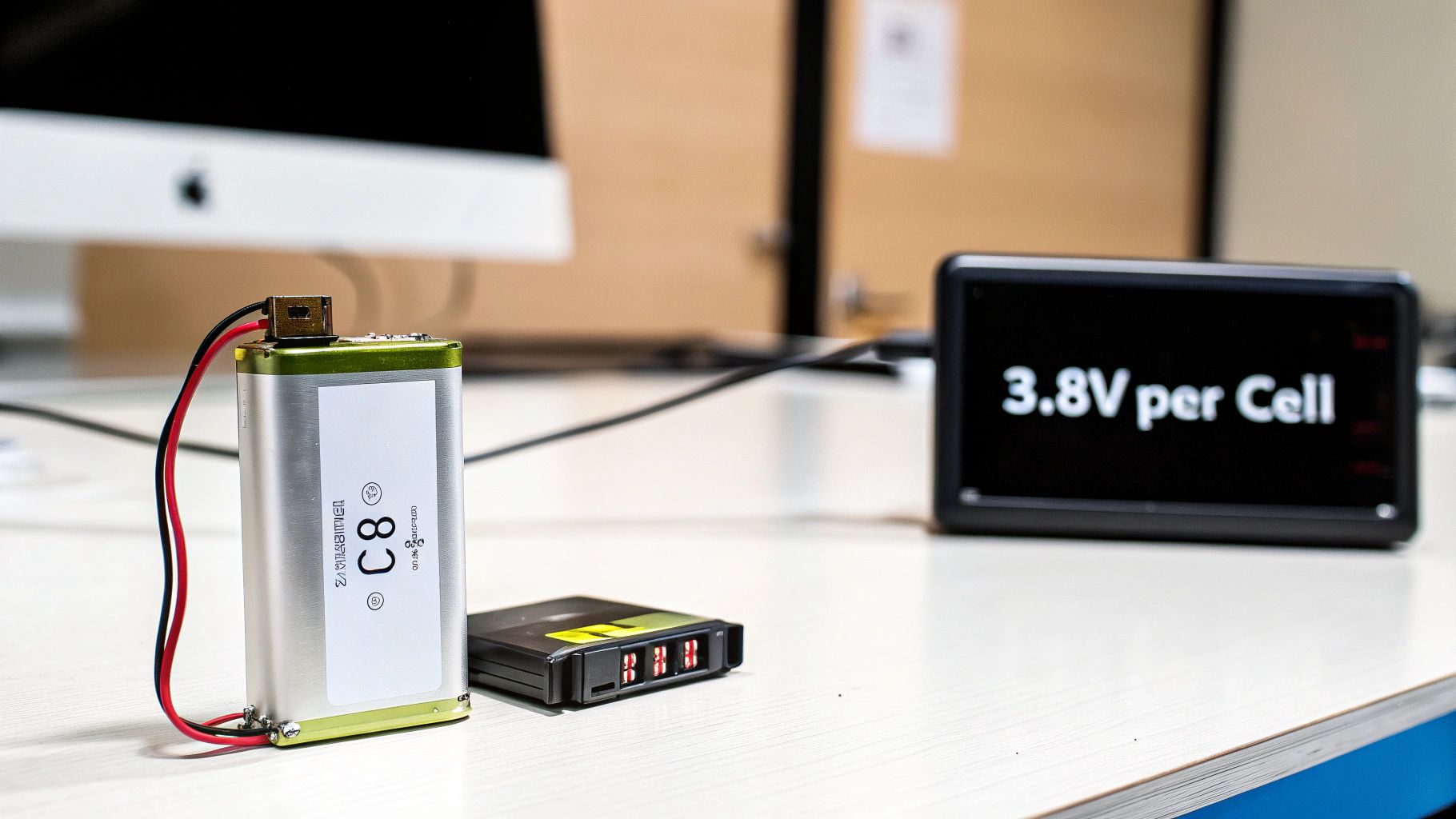
Think of a LiPo battery like a muscle. Leaving it fully flexed (charged to 4.2V) or completely stretched out (discharged below 3.2V) for too long causes strain. The 3.8V storage voltage is that perfectly relaxed, neutral state where the battery is under the least amount of stress.
Leaving a battery fully charged at 4.2V per cell builds up internal pressure, which leads to that dreaded puffing and a permanent drop in capacity. On the flip side, letting a pack sit fully discharged can cause its voltage to dip below a critical point, damaging the cells beyond repair and making it unsafe to ever charge again.
The Key Voltage Levels to Keep in Mind
Here's a quick look at the critical voltage states for a LiPo battery cell, showing why storage voltage is so different from other states.
LiPo Battery Voltage States at a Glance
| Battery State | Voltage Per Cell (V) | Risk/Condition |
|---|---|---|
| Fully Charged | 4.2V | High internal stress; not safe for storage. |
| Storage Voltage | 3.8V–3.85V | Ideal stable state for long-term health. |
| Nominal Voltage | 3.7V | The "at rest" voltage used for pack ratings. |
| Low Voltage Cut-off | ~3.0V–3.2V | The lowest safe point; discharging further causes damage. |
As you can see, the 3.8V range is a unique state designed purely for preservation. It's not for running your car and it's not fully charged, but it's perfect for when your batteries are sitting on the shelf.
Getting it Right Every Time
Thankfully, you don't have to guess. Nearly all modern smart chargers, like the Protek RC "Prodigy 610ez" we carry, come with a dedicated "Storage Mode." Just select that function, and the charger will automatically charge or discharge each cell until it hits that perfect 3.8V level. It’s a simple step that pays huge dividends.
For quick spot-checks at the track or in your workshop, a small handheld battery checker like the Protek RC "SureStart" is an invaluable tool. It gives you an instant reading of each cell’s voltage so you always know where your packs stand.
A great example of how voltage adds up is a standard 7.4V LiPo battery. It's called a 7.4V pack because it has two 3.7V nominal cells (2S). For storage, you'd want each of those cells at 3.8V, for a total pack voltage of 7.6V.
Why Storing LiPos at the Right Voltage Matters
Ever had a once-punchy LiPo feel sluggish after a few months? Or worse, seen it start to puff up at the seams? The culprit often isn't how you use your batteries, but how you store them. Getting the storage voltage right is the single most important thing you can do to protect your investment.
Think of a fully charged LiPo—sitting at 4.2V per cell—as a tightly wound spring, buzzing with energy. That high-tension state is great on race day, but it puts the battery's internal chemistry under constant stress. Leave it like that for more than a few days, and you're actively accelerating chemical decay, leading to permanent capacity loss and higher internal resistance. That's why a battery that was a powerhouse can suddenly feel lazy.
The Dangers of Extreme Voltages
Storing a battery at the wrong voltage is a problem at both ends of the scale. A full charge causes slow, creeping damage. A fully depleted battery, on the other hand, is downright dangerous.
- High Voltage Storage (Above 4.0V): This puts constant pressure on the cells. The electrolyte begins to break down, releasing gasses that cause the battery to swell or "puff." Puffing is an undeniable sign of irreversible damage and a major safety risk.
- Low Voltage Storage (Below 3.0V): Storing a battery completely dead is even worse. If a cell’s voltage drops too low, the internal copper anode can dissolve. The next time you try to charge it, this can create an internal short circuit, triggering thermal runaway—a nasty situation that can easily lead to a fire.
Thankfully, our quality Protek RC chargers are smart enough to recognize an over-discharged battery and will refuse to charge it for your own safety.
The ideal lipo battery storage voltage of 3.8V to 3.85V per cell is the "sweet spot." It's a chemically stable middle ground where the battery is relaxed. There's enough charge to keep the cells from dipping into the danger zone, but not so much that it causes the high-pressure stress of a full charge.
Protecting Your Investment
At the end of the day, taking a few minutes to put your LiPos into storage mode is all about preservation and safety. A battery stored correctly will hold its capacity and deliver consistent power for hundreds of cycles. One that's left fully charged or completely dead might only survive a fraction of its intended lifespan.
It's a simple habit that protects your gear, keeps you safe, and ensures your RC equipment is ready for peak performance whenever you are.
Alright, you've got the why down, so let's get into the how. Getting your LiPo batteries to that perfect 3.8V per cell sweet spot is actually pretty simple, especially if you have the right gear. The safest and most foolproof method by far is using a modern smart charger.
The beauty of a quality charger is that it does all the heavy lifting for you. Most decent models these days have a dedicated LiPo Storage Mode that takes all the guesswork out of the equation. This function is designed to either charge your battery up or discharge it down until every single cell is perfectly balanced at that ideal storage voltage. No babysitting required.
Using Your Smart Charger: A Step-by-Step Guide
Putting your battery into storage mode is a straightforward, can't-miss process. Just follow these simple steps, and your charger will handle the rest.
- Connect Securely: Plug in both your battery's main power lead (the big connector) and its balance plug (that smaller, white connector). Don't skip the balance plug—it’s critical. It’s what lets the charger see and manage the voltage of each individual cell.
- Select the Right Program: Cycle through your charger’s menu until you find the "LiPo Storage" program. This is a separate function from "LiPo Charge" or "LiPo Balance Charge," so make sure you pick the right one.
- Confirm Battery Settings: The charger will ask you to confirm the battery’s specs—usually the voltage and cell count (e.g., 2S for 7.4V, 3S for 11.1V). Always double-check that these settings match what's printed on your battery's label.
- Start the Process: Once you've confirmed everything is correct, press and hold the start button. The charger will take a moment to analyze the battery and then begin its work, either charging or discharging until it hits that 3.8V per cell target.
This simple visual breaks down the three main states of a LiPo battery from a storage and safety standpoint.
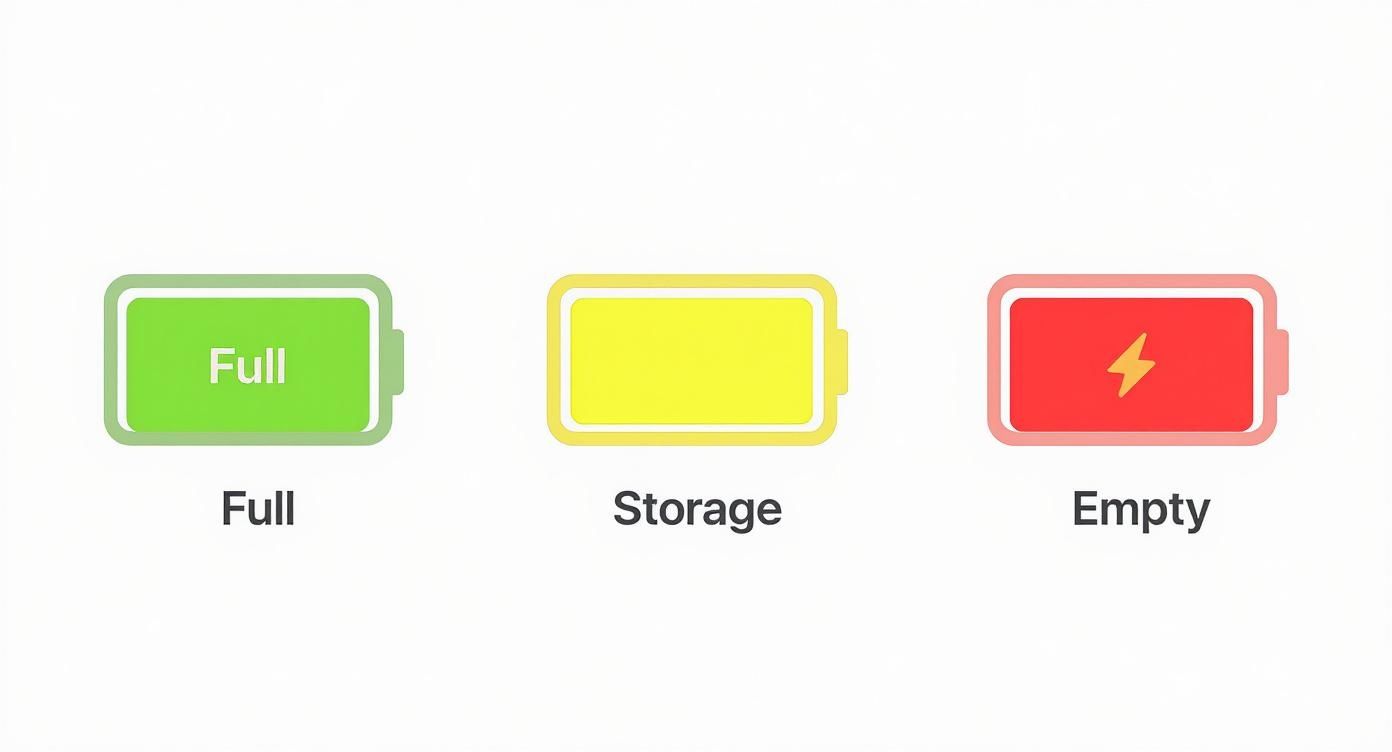
You can see the green "Full" state, ready for action; the yellow "Storage" state, which is the safe resting point; and the red "Empty" state—the danger zone you want to avoid completely for storage.
What If You Don't Have a Storage Mode?
Okay, so what if your charger is a bit older and doesn't have a dedicated storage function? You've still got a backup plan, but it requires you to pay close attention. You'll need a handheld LiPo battery checker, like the Protek RC "SureStart", to keep an eye on the voltage.
If your battery is fully charged, you can carefully run your RC car or truck for a few minutes to bring the voltage down. Check the pack constantly with your battery checker. Stop as soon as you get close to a total voltage that equals 3.8V per cell—for instance, 7.6V for a 2S pack or 11.4V for a 3S. It's not as precise, but it'll get the job done in a pinch.
Essential Gear for LiPo Maintenance and Safety
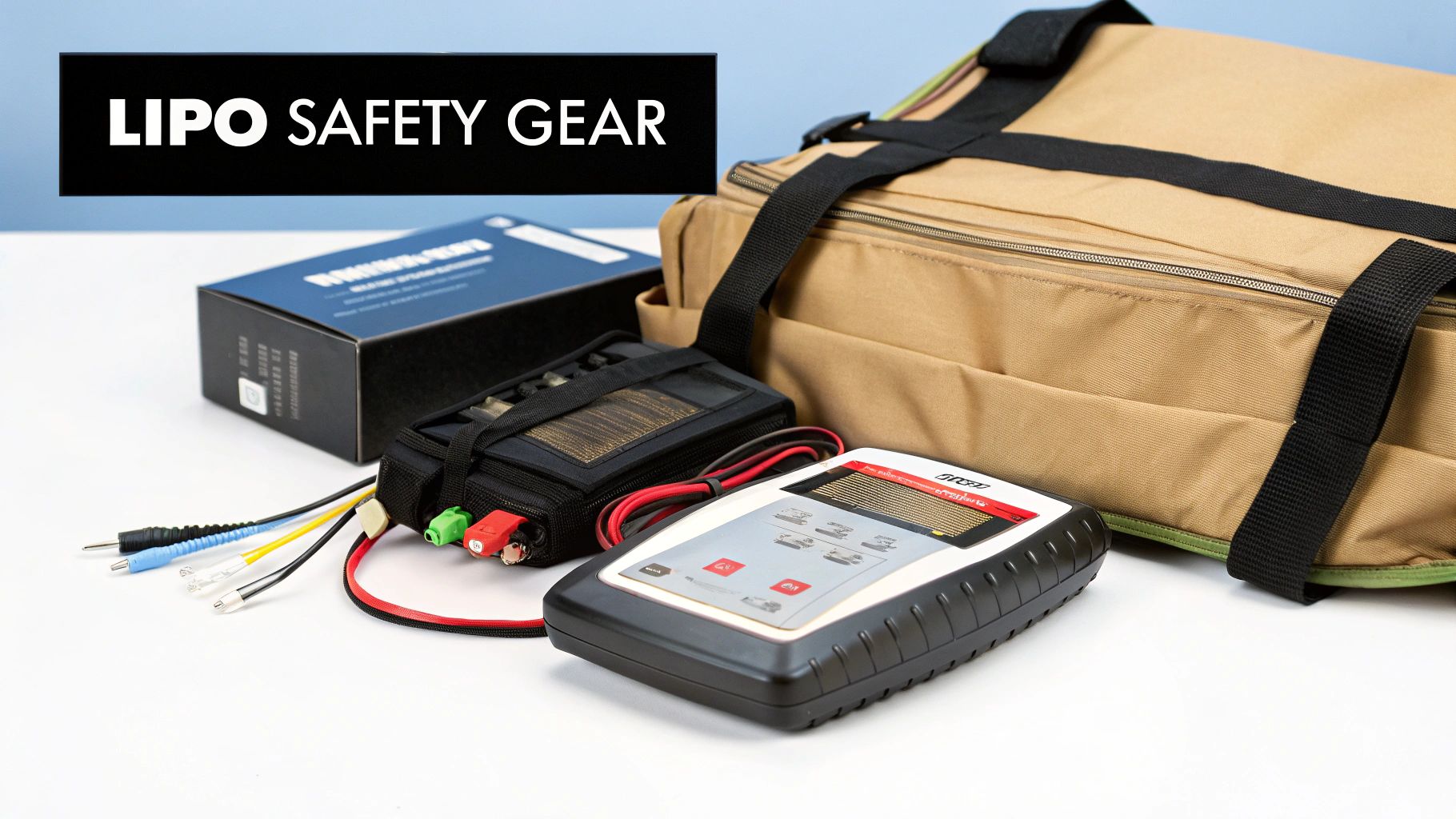
Consistently hitting the ideal LiPo battery storage voltage isn't about guesswork; it's about having the right tools for the job. Investing in a few key pieces of equipment simplifies your maintenance routine and protects your entire RC collection. Think of it as an investment in safety and longevity.
These tools give you peace of mind and make proper battery care an effortless part of your hobby, not a chore.
Smart Chargers: The Foundation of LiPo Care
A modern smart charger is a non-negotiable item for any serious RC enthusiast. This is your command centre for battery health, and its most valuable feature is the automated storage function.
Our selection of Protek RC chargers features dedicated "Storage Mode" programs that automatically bring every cell to the perfect 3.8V level. Whether your pack is fully charged after a rained-out race day or depleted after a practice session, the charger handles it all safely and precisely.
This automated function takes the human error out of the equation, ensuring your batteries are always put away in their healthiest state. Just connect the battery, select the program, and let the charger do the rest.
Quick Voltage Checks Anywhere
While a charger is essential for setting the voltage at home, a handheld LiPo battery checker is your go-to tool in the field. The compact, affordable Protek RC "SureStart" gives you an instant reading of your battery's total voltage and the status of each individual cell.
Before a race, you can quickly confirm a pack is fully topped up. After a run, you can see if you've discharged it too far. Most importantly, it lets you verify that your batteries are at a safe storage voltage before you pack up, ensuring no pack gets left behind in a dangerous state.
Safety First: The Non-Negotiable LiPo Bag
No discussion of LiPo gear is complete without mentioning a fire-resistant LiPo safety bag. The Protek RC "Super Hauler" Fire Resistant LiPo Bag is an inexpensive but absolutely vital piece of equipment designed to contain a fire in the unlikely event of a battery failure. You should use one every single time you charge, discharge, transport, or store your batteries. It's a small price to pay for priceless protection.
For RC enthusiasts in Canada looking to explore more about battery safety and performance, our comprehensive guide on LiPo batteries in Canada offers valuable insights and tips.
Recommended LiPo Maintenance Gear
Having the right equipment on hand makes proper LiPo care a simple, repeatable process. Here are the essential tools we recommend to keep your batteries performing their best while prioritizing safety.
| Tool Category | Recommended Product | Key Benefit for Storage |
|---|---|---|
| Smart Charger | Protek RC "Prodigy 610ez" AC LiPo/LiFe AC/DC Charger | Automated "Storage Mode" brings batteries to the perfect 3.8V/cell with one button press. |
| Battery Checker | Protek RC "SureStart" LiPo Battery & Motor Checker | Provides instant, accurate cell voltage readings in the field to confirm storage state. |
| Safety Bag | Protek RC "Super Hauler" Fire Resistant LiPo Bag | Safely contains batteries during charging, transport, and storage, minimizing fire risk. |
| Charging Leads | Protek RC "Pro" 4mm & 5mm Bullet to 4mm Bullet Charging Lead | Ensures a secure, reliable connection between your battery and charger every time. |
Each of these tools plays a critical role in a complete battery management system. By investing in quality gear, you're not just buying a product—you're buying confidence and extending the life of your LiPo packs.
Best Practices for Long-Term LiPo Storage
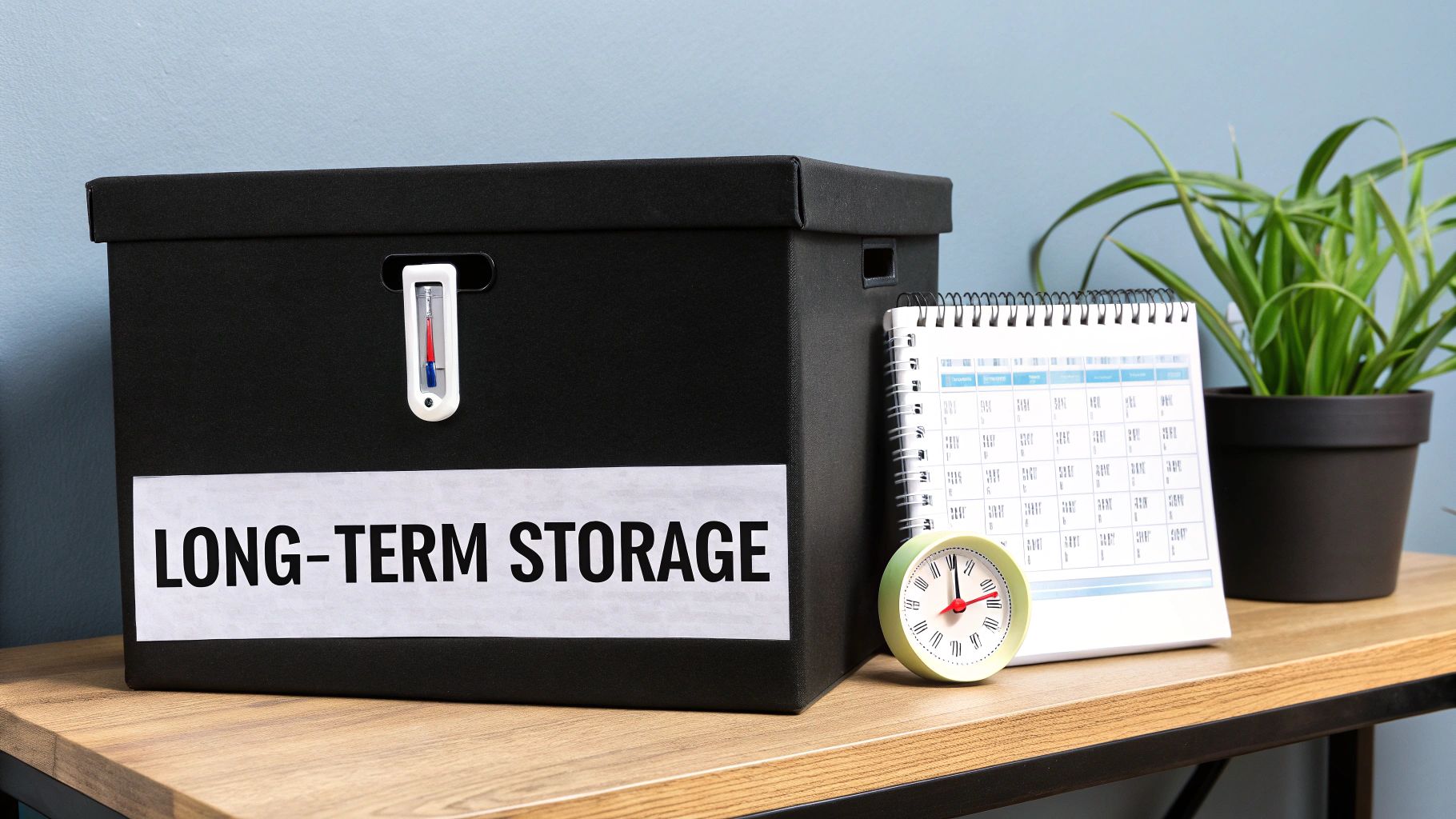
Putting your RC gear away for the off-season? Getting the lipo battery storage voltage right is a great start, but it's not the whole story. When you’re storing batteries for more than a couple of weeks, a few extra steps are absolutely critical for preserving their health and ensuring your safety.
Think of long-term storage as a complete system. It's a combination of the right voltage, a safe environment, and a simple maintenance routine.
Control the Environment
Where you keep your batteries matters just as much as their voltage. LiPo chemistry is sensitive to extreme temperatures, which makes garages and sheds poor choices for long-term storage. A hot garage will speed up chemical degradation, while a freezing shed can cause internal damage to the cells.
The best spot is always inside your house in a climate-controlled area. A cool, dry place like a closet or a dedicated cabinet is perfect. This stable environment prevents temperature-related stress on the battery, helping maintain its performance and extend its lifespan.
The Golden Rule of Storage Safety: Never store LiPo batteries without placing them inside a high-quality, fire-resistant LiPo bag. This is non-negotiable. It’s a simple practice that contains potential issues and gives you invaluable peace of mind. We trust and recommend the Protek RC "Super Hauler" bag for its robust construction.
Establish a Maintenance Routine
Even at the perfect storage voltage, LiPo batteries will slowly self-discharge over time. If you just forget about them all winter, you could come back to find their voltage has dropped into a dangerously low state. A simple check-up is all it takes to prevent this.
Get into the habit of setting a calendar reminder to check your batteries every one to two months. This quick maintenance check ensures they never fall into the danger zone.
- Step 1: Check Voltage: Grab your Protek RC "SureStart" battery checker and get a quick voltage reading on each pack.
- Step 2: Top Up if Needed: If any battery has dipped below 3.7V per cell, it's time to plug it into your smart charger.
- Step 3: Restore Storage Voltage: Just use the "Storage Mode" function to bring the cells right back up to the perfect 3.8V level.
This tiny bit of effort keeps your investment protected and ready for action when the racing season returns. For a closer look at specific battery types, like the compact 1S LiPo packs common in 1/12 scale racing, check out our detailed guide on 1S LiPo batteries.
Common Questions About LiPo Storage Voltage
Even when you know the basics, a few specific questions always pop up about LiPo storage voltage. Let's clear up some of the most common ones to help you care for your batteries with confidence and avoid making a costly mistake.
Getting these details right is just as important as knowing the main rules.
How Long Can a LiPo Stay Fully Charged?
Ideally, you shouldn't leave a LiPo battery fully charged for more than a few hours. The best practice, by far, is to charge your packs on the day you plan to use them.
Leaving a battery sitting at its peak voltage of 4.2V per cell for more than 24 to 48 hours puts a constant strain on its internal chemistry. This is a surefire way to speed up degradation, which leads to puffing and a much shorter lifespan. If your race day gets rained out, just use your smart charger’s storage function to bring the voltage back down to a safe 3.8V.
What Happens if I Store a LiPo When It Is Dead?
Storing a LiPo at a very low voltage (anything below 3.0V per cell) is one of the most dangerous things you can do. As the battery sits, its voltage can dip even lower, causing irreversible internal damage.
This kind of damage can create an internal short circuit the next time you try to charge it, which is a serious fire risk. Thankfully, quality smart chargers like those from Protek RC are smart enough to recognize an over-discharged battery and will refuse to charge it, protecting you from a potential disaster.
Is Storing LiPo Batteries in the Garage Okay?
It's strongly discouraged to store your LiPo batteries in a garage or shed. Extreme temperatures, whether hot or cold, are incredibly damaging to LiPo chemistry.
- Hot Environments: A hot garage in the summer will dramatically speed up chemical degradation and seriously increase the fire risk.
- Cold Environments: A freezing environment can permanently harm the cells' internal structure, leading to reduced performance and a shorter life.
The best spot is a cool, dry area inside your home, well away from direct sunlight and anything flammable. Most importantly, they should always be stored inside a reliable fireproof LiPo bag like the Protek RC "Super Hauler" for maximum safety.
Do I Need to Balance Charge for Storage Mode?
Yes, you should always connect the balance lead when using your charger’s storage function. The "Storage Mode" on a smart charger relies on that balance connection to monitor each individual cell and bring it to the 3.8V target precisely.
If you skip the balance lead, you can end up with an imbalanced pack where some cells are above the target voltage and others are below. This leads to poor performance, a shorter lifespan, and potential safety issues down the road. Consistent balancing is the key to a healthy, long-lasting battery.
At digital-rc, we stock the essential gear you need for safe and effective battery maintenance, from Protek RC smart chargers with automated storage modes to fireproof safety bags. Equip yourself with the right tools to protect your investment.
Explore our full range of chargers and battery accessories at digitalrc.ca