

Your Expert Guide to LiPo Battery 1S Performance
In the world of competitive RC racing, the lipo battery 1s is the single-cell, 3.7V powerhouse that defines speed and agility. This specialized battery is the heart of specific race classes, like 1/12 scale pan cars, where its lean configuration is a non-negotiable requirement for winning.
Think of it less as just a battery and more as the high-octane fuel system for your RC car.
Why a 1S LiPo Is Your Competitive Edge
Every component in a competitive RC car is chosen for a reason, and the 1S LiPo is perhaps the most critical strategic decision a racer makes. Unlike the more common 2S batteries used in many other applications, the single-cell design of a lipo battery 1s is all about achieving the perfect balance of power, weight, and runtime.
It's a game of fine margins where every gram shed and every volt maintained on the track translates directly into faster lap times. This lean configuration is mandated in certain racing classes to create a level playing field, forcing racers to master setup and driving skill rather than relying on raw power. This is where the quality of your battery becomes a clear advantage.
The Single-Cell Advantage
The "1S" in the name simply means one cell in series. This straightforward design offers several distinct benefits for the competitive racer:
- Reduced Weight: With only one cell, 1S packs are significantly lighter than their multi-cell counterparts. This lower weight improves acceleration, enhances braking efficiency, and allows for much nimbler handling through tight corners.
- Lower Centre of Gravity: A single, slim cell allows for a lower battery placement in the chassis. This lowers the car's overall centre of gravity, which is critical for maximizing cornering speed and stability on high-grip surfaces like carpet.
- Simplified Power System: A 1S setup requires electronics specifically designed for its lower voltage range. This creates a highly optimized and efficient power delivery system tailored for classes where finesse trumps brute force.
While a 1S battery delivers a nominal 3.7V, many racers seek out higher-voltage options for that extra punch. Of course, it's important to understand the differences between single and multi-cell packs. For those curious about higher voltage setups, you can learn more about the popular 7.4V configuration in our detailed article on 2S LiPo batteries.
For a 1/12 scale car, the battery is more than just a power source—it's a core component of the car's balance and handling. A top-tier 1S LiPo provides consistent power from the start of the race to the finish, which is the key to repeatable, fast laps.
Our curated selection of 1S batteries at Digital RC is engineered precisely for this purpose. We stock packs that are proven on the track, offering the ideal blend of high C-ratings for explosive punch and robust capacity for endurance, giving you that winning advantage right out of the box.
Mastering the Language of 1S LiPo Specs
Choosing the right 1S LiPo battery can feel like staring at a secret code. The label is covered in numbers and acronyms, but cracking that code is the key to unlocking real-world track performance. Let's break down the three pillars you'll find on every battery in our shop: voltage, capacity, and C-rating.
Think of your RC car's power system like a high-performance engine. In this analogy, the battery's specs define exactly how that engine behaves. Getting this right is what separates a good race from a great one.
Voltage: The Engine's Horsepower
Voltage, measured in volts (V), is the raw power potential packed inside your battery. For a standard 1S LiPo battery, the nominal voltage is 3.7V. When it comes off the charger, it sits at a peak of 4.20V.
This number represents the electrical "pressure" the battery can deliver. A higher, more stable voltage under load translates directly to more punch out of the corners and higher top speeds down the straight. It’s the horsepower rating of your miniature engine—the fundamental force that gets your car moving.
Capacity: The Fuel Tank Size
Capacity, measured in milliamp-hours (mAh), tells you how much energy the battery can store. Think of it as the size of your car's fuel tank. A higher mAh rating means you can run longer before needing to pit and recharge.
A 6400mAh battery, for example, can deliver its power for a longer duration than a 4200mAh pack. But there's a catch: a bigger fuel tank adds weight, which can slow your car down and affect its agility. This creates a critical trade-off every single racer has to manage.
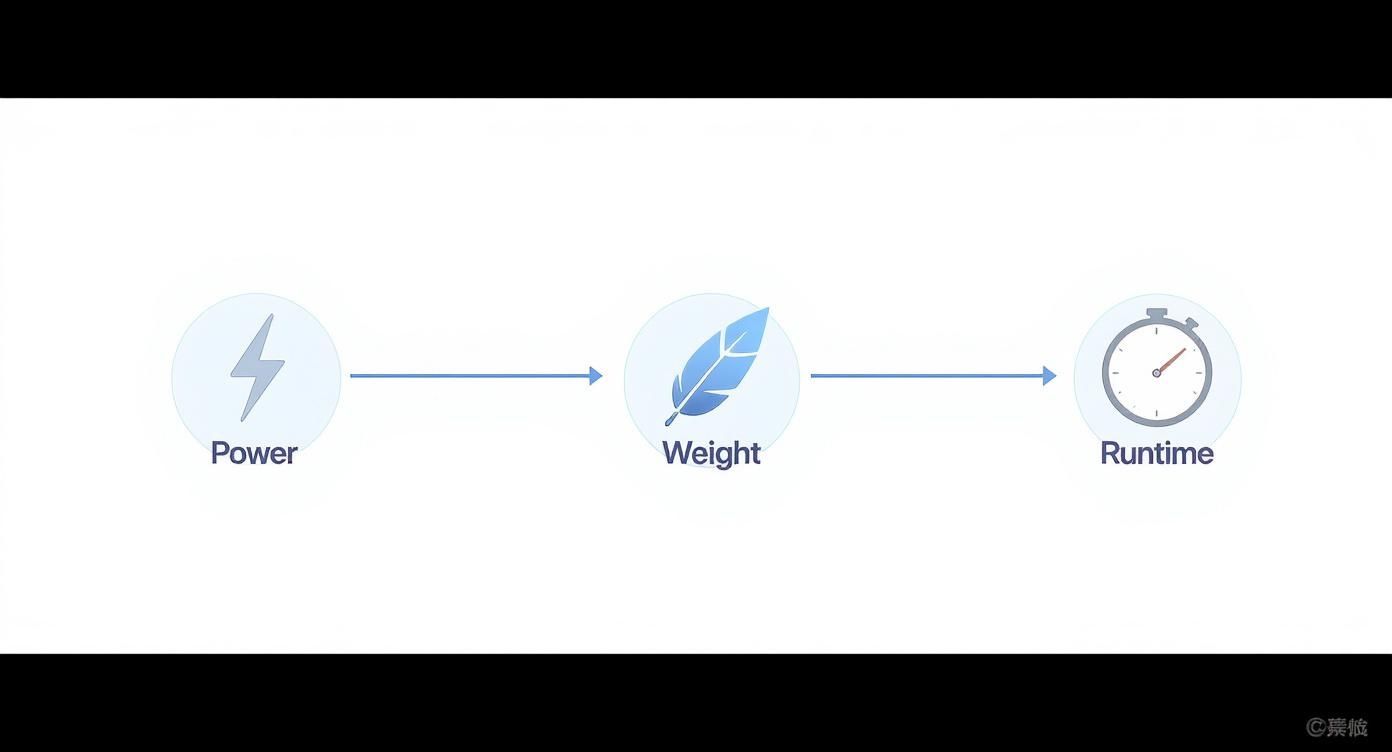
The key takeaway here is that you're always balancing these three factors. Pushing one up often means compromising another, and mastering that balance is a huge part of race strategy.
C-Rating: The High-Flow Fuel Pump
The C-Rating is probably the most critical spec, yet it's also the most misunderstood. It represents the battery’s maximum safe continuous discharge rate. If voltage is your horsepower and capacity is the fuel tank, the C-Rating is the size of the fuel pump.
A high C-Rating means the battery can dump its stored energy incredibly quickly without getting damaged. This is what gives your car that explosive, out-of-the-corner acceleration or "punch." A battery with a low C-Rating will struggle to supply the current your motor demands, leading to sluggish performance and potential overheating.
To figure out the maximum continuous amperage, you just multiply the C-Rating by the battery's capacity (in amp-hours).
- Example Calculation: A 6400mAh (which is 6.4Ah) battery with a 150C rating can theoretically deliver 960 amps (6.4Ah x 150C = 960A).
This number tells you everything about the battery’s ability to handle the intense power demands of competitive racing.
To tie it all together, here’s a quick-reference table that translates these technical specs into what you'll actually feel on the track.
How 1S LiPo Specs Translate to Track Performance
| Specification | Racing Analogy | On-Track Impact |
|---|---|---|
| Voltage (V) | The engine's horsepower | Higher, stable voltage means more punch and top speed. |
| Capacity (mAh) | The fuel tank's size | Determines your total runtime but adds weight, affecting handling. |
| C-Rating | The fuel pump's flow rate | A higher rating delivers instant power for aggressive acceleration. |
Seeing how these specs work together is crucial. A battery isn't just a power source; it's a key piece of your setup that needs to match your car, motor, and driving style perfectly.
A higher C-Rating doesn't make your car faster on its own. It just ensures the battery can deliver the power your motor is asking for without struggling. It's about having power on demand, not creating more power.
Understanding this is what separates good racers from great ones. Knowing how these three core specs work together allows you to look at any 1S LiPo battery and immediately know what it's built for—whether that's raw punch, long-race endurance, or a strategic balance of both. You're no longer just buying a battery; you're making a calculated performance decision that gives you an edge on race day.
Choosing Connectors and Managing Weight
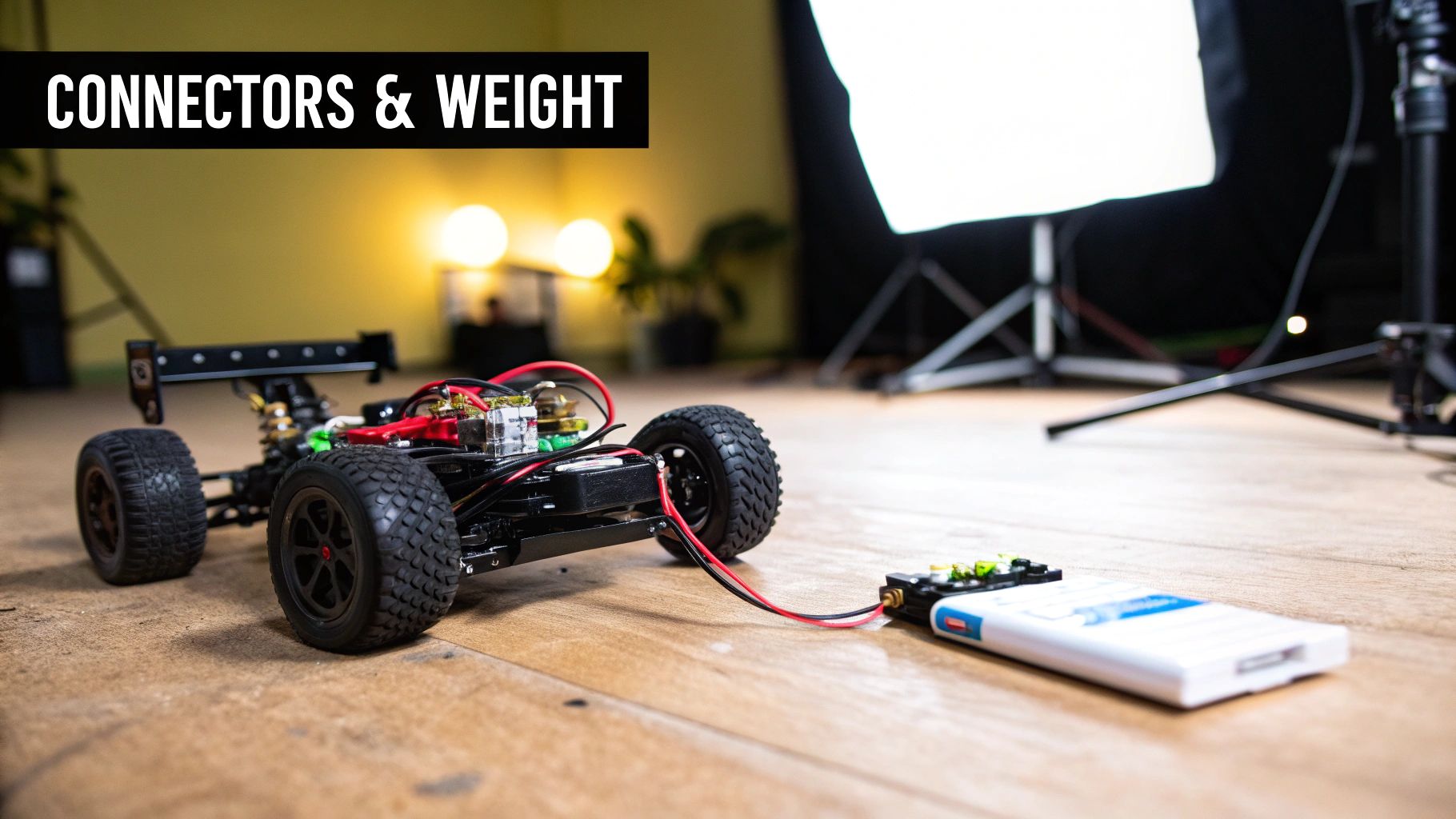
Picking the right lipo battery 1s goes way beyond the numbers on the label. It's a physical part of your car, and it has to work perfectly with your chassis. Once you’ve got voltage and C-ratings sorted, the next step is to nail down the physical details that directly impact how your car puts power down and handles on the track.
First, we’ll look at the critical link between your battery and ESC: the connectors. Then we’ll get into the balancing act of weight versus capacity—a decision that can make or break your car’s agility and stamina. This is where the real chassis tuning begins.
Why Your Choice of Connector Matters
Think of your battery connector as the main artery for your car’s power. A cheap or undersized connector acts like a bottleneck, choking the flow of electricity, generating heat, and adding resistance. That resistance steals precious voltage from your motor, leaving you with less punch and a lower top speed.
For competitive 1S racing, a solid, low-resistance connection is non-negotiable. You need to know that every bit of power you paid for is making it from the cells to the motor.
You’ll notice that most of our high-end lipo battery 1s packs come with 5mm bullet connectors. There’s a good reason why they’re the standard for serious racers:
- Low Electrical Resistance: The huge surface area of a 5mm bullet creates a clean electrical path, minimizing power loss. In stock racing, every millivolt counts.
- Secure Connection: A good bullet connector offers a firm, reliable fit that won't vibrate loose, even during the most intense main event.
- Direct Power Path: By soldering bullets straight to your ESC wires, you get rid of extra plugs and joints. This creates the cleanest, most efficient route for power to travel.
While other connector types are out there, the proven performance of 5mm bullets makes them the go-to choice. A weak link here can completely cancel out the benefits of a top-tier battery.
The Power-to-Weight Ratio Explained
In racing, weight is the enemy. Every single gram your car carries is something you have to accelerate, brake, and turn. That's why managing your car’s power-to-weight ratio is everything, and your lipo battery 1s is a huge piece of that puzzle.
You're always faced with a strategic trade-off:
- Higher Capacity (mAh): A battery with more capacity, like one of our 8400mAh packs, gives you longer runtimes. That's a massive advantage in a long A-main, ensuring you have consistent power right to the finish line. The trade-off is more weight, which can make the car feel a little less responsive.
- Lower Capacity (mAh): A lighter pack, like a 4200mAh battery, makes the car feel incredibly sharp. It will launch harder, change direction faster, and be easier on the tires. The catch is a shorter runtime, which makes it perfect for qualifying or shorter races where all-out speed is the goal.
Choosing your battery's capacity isn't just about runtime; it's a deliberate chassis tuning decision. A lighter pack can make a car feel more nimble and aggressive, while a heavier pack can sometimes help a car feel more planted and stable on high-grip tracks.
Optimizing Your Car's Handling with Battery Shape
Beyond its weight, the physical shape of your lipo battery 1s plays a huge role in how your car handles. The golden rule is to get the heaviest components as low and as close to the chassis centreline as possible.
This is where specialized battery shapes make a difference. On our product pages, you’ll see terms like Low Center of Gravity (LCG). An LCG battery is built with a shorter case, which lets it sit lower in the chassis. This one small change lowers the car's overall centre of gravity, and the effect on handling is immediate.
A lower centre of gravity reduces body roll in the corners, letting the car carry more speed with greater stability. It makes the car feel glued to the track. By browsing our options, you can find a battery that not only fits your chassis perfectly but actively makes it handle better—giving you one more tool to dial in your setup for any track.
Matching the Perfect 1S LiPo to Your Race Class
Alright, you've got the technical specs down. You know what voltage, capacity, and C-rating mean. Now it’s time to apply that knowledge where it really counts—on the track. Choosing the right battery isn't about just grabbing the one with the biggest numbers; it's a strategic decision that needs to match the unique personality of your racing class.
Whether you're threading the needle through tight corners with a 1/12 pan car or trying to tame the raw speed of a modified touring car, the right battery is often the difference between keeping up and setting the pace. This is where your hardware choice becomes part of your racecraft.
Stock Touring: The Game of Efficiency
Stock Touring is all about discipline and efficiency. The motors are limited by the rules, so every bit of power you can squeeze from your battery matters. Races are frequently won or lost by fractions of a second, and the main goal is to maintain strong, consistent voltage from the first lap to the last.
For this class, you need a lipo battery 1s that delivers unwavering voltage under load without fading. A battery with a slightly higher capacity, like an 8400mAh pack, tends to provide a much more stable voltage curve over a full five or six-minute run. Sure, it's a little heavier, but that sustained power helps you maintain corner speed and punch late in the race when everyone else's car is starting to feel flat.
Key characteristics for Stock Touring batteries:
- High Capacity (e.g., 7600mAh - 8400mAh): This is your weapon against voltage fade during long mains.
- High C-Rating: A solid 130C rating is more than enough to handle the demands of a stock motor while maintaining low resistance.
- Low Internal Resistance (IR): This is absolutely critical for minimizing voltage drop and maximizing every drop of power.
Modified Touring: All-Out Power Delivery
Modified Touring is the complete opposite of stock—it's an explosive show of raw power and brutal speed. The motors are wickedly fast and demand a massive amount of current, especially when you're grabbing the throttle hard out of a corner. Your battery has to be able to deliver that huge surge of power instantly, without a hint of hesitation.
In this class, a high C-rating is your best friend. A lipo battery 1s with a 150C or higher rating is non-negotiable if you want to properly feed a power-hungry modified motor. This is what gives your car that "rip" when you need it most. Because modified races are so intense, a lighter battery can also be a huge advantage, making the car feel more agile and easier to drive. This is where a slightly lower capacity pack, maybe around 6400mAh, can be a smart trade-off for its weight savings.
The ideal Modified Touring battery:
- Ultra-High C-Rating (150C+): Absolutely essential for delivering the current that modified motors demand.
- Lower Weight: A lighter pack improves acceleration and how quickly the car changes direction—key for handling so much power.
- Robust Construction: The battery must be built tough to handle the heat and stress of extreme discharge rates.
1/12 Pan Car: The Art of Agility
1/12 Pan Car racing is a masterclass in precision and agility. These cars are incredibly lightweight and direct-driven, which means every little input is felt instantly. The battery in a 1/12 car isn't just a power source; it's a huge part of the car's overall weight and balance. Because of this, finding the lightest possible lipo battery 1s is almost always the top priority.
Racers in this class will often choose batteries with the lowest weight and smallest footprint to make the car as nimble as possible. A lower-capacity battery, sometimes as low as 4200mAh, can provide a serious handling advantage, allowing the car to rotate faster and carry more speed through tight chicanes. The runtime is just enough for a competitive heat, but the performance gain from shedding that weight is undeniable.
"In 1/12 scale, I'll always choose the lightest battery that can comfortably finish the race. Shaving 20 or 30 grams makes a huge difference in how the car feels and responds. It's not about runtime; it's about pure, unfiltered agility."
To find the perfect match for your car, explore our full range of 1S LiPo batteries designed for competitive racing. We've put together a collection that meets the specific needs of each class, from high-capacity packs for stock endurance to lightweight powerhouses for modified and 1/12 scale. Making the right choice here is a crucial step toward the winner's circle.
Your Guide to LiPo Charging and Safety
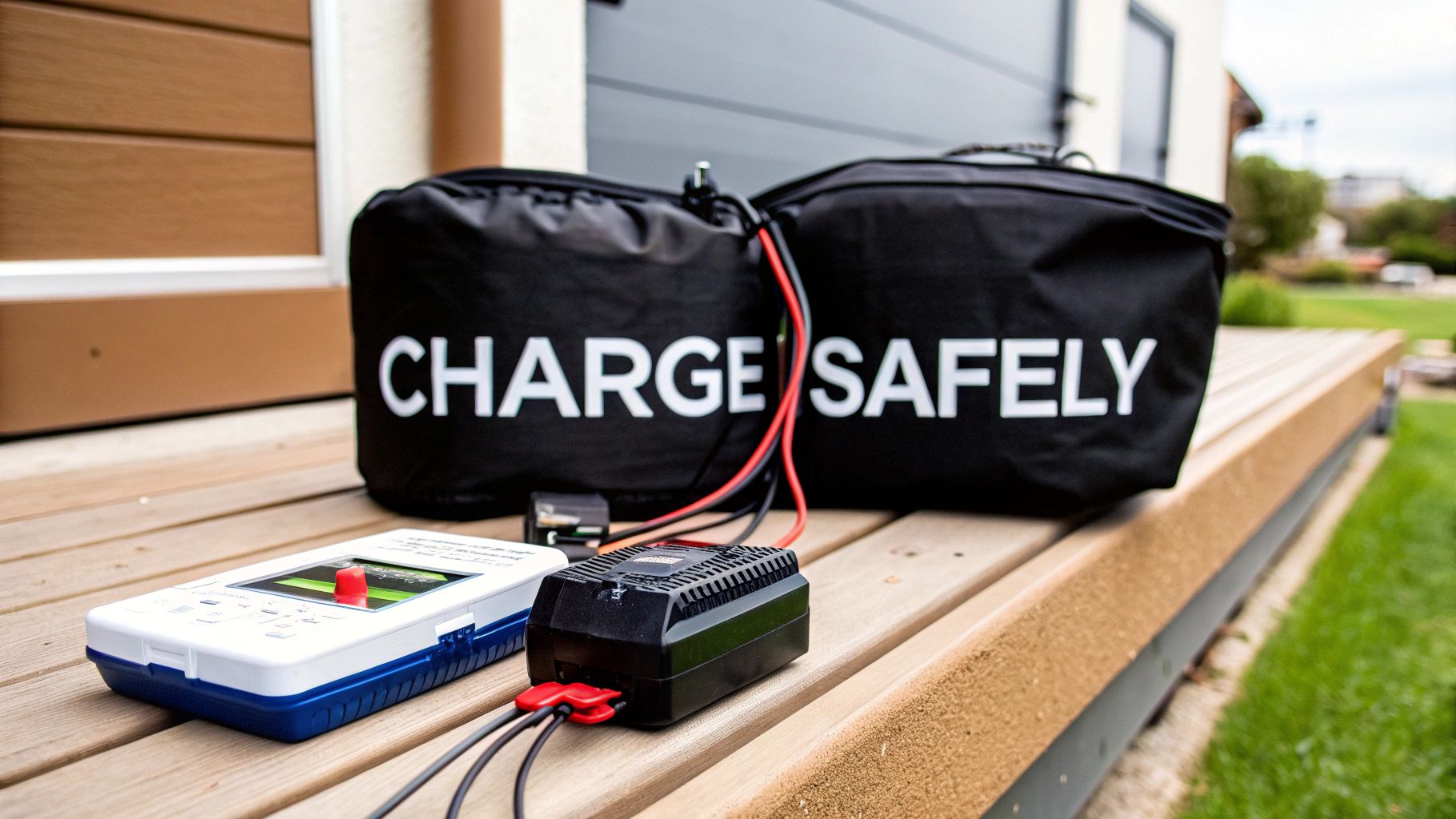
Getting the most out of your lipo battery 1s boils down to proper care. A high-quality battery is an investment, and treating it with respect is the only way to ensure it delivers consistent, punchy power race after race. This is your essential guide to LiPo safety, covering the proven protocols for charging, storage, and race-day handling.
Think of it like the maintenance routine for your car's engine—neglect it, and performance will inevitably suffer. Following these practices is the best way to protect your equipment and make sure you're always ready for the track.
The Golden Rules of Charging Your LiPo
Charging is the most critical interaction you'll have with your battery. Doing it right is simple, but getting it wrong can be costly and dangerous. Stick to these fundamental principles to ensure safety and preserve the health of your cells.
First and foremost, always use a quality charger specifically designed for LiPo batteries. These smart chargers understand the unique chemistry of a lipo battery 1s and have built-in safety features that automatically stop the charge once the cell hits its peak voltage of 4.20V. Never, ever try to use a charger meant for other battery types, like NiMH or NiCd.
Here are the non-negotiable steps for a safe charge cycle:
- Set the Correct Amperage: The safest charge rate is 1C, which means charging at an amperage equal to the battery's capacity. For an 8400mAh pack, a 1C charge rate is 8.4 amps. While some modern batteries can handle faster charging, sticking to 1C is much gentler on the cells and promotes a longer lifespan.
- Always Supervise Charging: This one is simple: never leave a charging LiPo battery unattended. Stay within earshot and check on it periodically.
- Use a Fire-Safe LiPo Bag: This is mandatory. Always place your battery inside a fire-resistant LiPo bag or another fireproof container while it charges. It's a simple precaution that contains potential issues and is a cornerstone of RC safety.
Proper Storage for Long-Term Health
How you store your battery between race days is just as important as how you charge it. Leaving a lipo battery 1s fully charged or completely drained for an extended time will permanently damage its internal chemistry, leading to reduced capacity and a loss of punch.
The ideal state for storage is a storage charge, which is roughly 3.80V to 3.85V per cell. This voltage level keeps the internal chemistry stable and prevents degradation.
Your LiPo charger will have a dedicated "Storage" mode. After a race day, always use this function to bring your batteries back to the correct storage voltage. It’s the single best thing you can do for battery longevity.
Store your batteries in a cool, dry place, tucked inside a LiPo safety bag. Avoid spots with extreme temperature swings, like a garage or inside your car. Consistent, moderate temperatures are key to preserving your battery's health over the long term.
Race Day Safety and Transport
On race day, safety is still the top priority. Always transport your batteries in a LiPo bag to protect them from physical damage and contain any problems should one arise.
You also need to be vigilant about battery condition. Before every single run, give your lipo battery 1s a quick visual inspection. If you notice any puffing (swelling), denting, or damage to the case or wires, do not use it. A damaged LiPo is a serious safety risk and should be safely discharged and properly disposed of immediately. For a deeper dive into these protocols, check out our comprehensive guide on LiPo battery safety in Canada.
Even with the best care, every RC racer eventually runs into a battery problem. Let's be honest, a high-performance lipo battery 1s is a consumable item. It works hard every single time you hit the track, and eventually, it's going to show some wear. Knowing how to diagnose the common issues is key to keeping your fleet of batteries both competitive and safe.
Think of this section as your go-to manual for troubleshooting. We’ll break down the most frequent problems you'll encounter, from that frustrating drop in power mid-race to the much more serious issue of battery puffing. The goal is to help you spot the signs early, understand the cause, and take the right action.
Diagnosing Voltage Sag and Loss of Punch
One of the most common complaints you'll hear in the pits is voltage sag. You know the feeling: your car is a rocket for the first minute, but then it quickly loses its punch and starts to feel flat. That crisp acceleration is gone. More often than not, this is a clear sign that the battery’s internal resistance is climbing.
Internal resistance, or IR, is the silent performance killer. It acts like a bottleneck, restricting how fast the power can get from the battery to your motor. As a battery gets older and racks up charge cycles, its IR naturally goes up. But you can speed up this process—and not in a good way—by pushing a battery too hard or over-discharging it.
A modern LiPo charger with an IR measurement function is your best friend here. It gives you a clear look at your battery's health:
- Healthy Battery: A fresh, top-quality lipo battery 1s should have an IR between 1-3 milliohms (mΩ).
- Aging Battery: Once it starts creeping up to 5-8 mΩ, you'll definitely feel a drop in performance on the track.
- Time to Retire: If your charger is consistently showing numbers above 10-12 mΩ, that battery is done for racing. It just can't deliver the power needed anymore and should be retired.
The Dangers of a Puffed or Swollen Battery
This is the one you can't ignore. Battery swelling, or "puffing," is a serious red flag that requires immediate and careful action. It happens when the electrolyte inside the battery starts breaking down, releasing flammable gases that cause the soft polymer case to blow up like a little pillow.
The main culprits for puffing are over-discharging (running the battery below 3.0V), taking a hard hit in a crash, or simply old age. A puffed battery is dangerously unstable and poses a real fire risk.
If you ever notice your lipo battery 1s is swollen—even slightly—it is no longer safe. Do not try to charge it, discharge it, or use it again. It needs to be safely discharged and taken to a proper battery recycling facility for disposal.
While we deal with these issues on a small scale, it’s interesting to see how battery health is managed in massive applications. The battery storage market in California, for example, has exploded past 10 gigawatts of capacity as of April 2024. These grid-scale systems are vital for renewable energy and are expected to grow to around 50 GW by 2045, showing just how critical battery health is at every level. You can find out more about California's advancements in battery storage on caiso.com.
By regularly checking your battery's IR and keeping a close eye out for any physical damage, you can make sure your power source stays both competitive and safe.
Frequently Asked Questions About 1S LiPo Batteries
To wrap things up, let's go through a few of the most common questions I hear from racers about their lipo battery 1s packs. These are the quick-and-dirty answers you need to solve real problems at the track and in the pits.
What Is the Maximum Safe Voltage for a 1S LiPo?
A standard lipo battery 1s should never, ever be charged past 4.20V. While some High Voltage (HV) LiPos can be pushed to 4.35V, you absolutely need a battery and charger specifically built for HV use. Don't guess—always rely on a quality LiPo charger that automatically stops at the correct voltage. It's the only way to prevent damage and keep things safe.
How Do I Know When My 1S LiPo Needs Replacing?
You'll spot three key signs that a battery is past its prime and ready for retirement. The first is pretty obvious: a noticeable drop in power or runtime during a heat. If your car feels sluggish or dumps before the buzzer, the battery is often the culprit.
The other two signs are more definitive and mean it's time to retire the pack immediately:
- Physical Swelling: Any puffing or swelling, no matter how small, means the battery is compromised. Don't risk it. Take it out of service right away.
- High Internal Resistance (IR): A fresh, healthy battery has a super low IR, usually around 1-3 milliohms. Once that number starts creeping up past 8-10 milliohms, the battery just can't deliver the punch needed for competitive racing anymore.
Can I Use a 2S LiPo in a 1S RC Car?
Absolutely not. The electronics in a 1S car—especially the Electronic Speed Control (ESC)—are engineered specifically for the lower voltage of a single-cell battery.
Plugging a 2S (7.4V) battery into a 1S system will almost certainly fry the ESC instantly, and it could take other electronics with it. Always stick to the battery type recommended for your car and your race class.
Ready to find the perfect power source for your race car? Explore our curated collection of high-performance 1S LiPo batteries at digital-rc. We have the ideal pack to give you a competitive edge, whether you're racing stock, modified, or 1/12 scale. Find your winning battery today at https://digitalrc.ca.