

A Realist's Guide to Drift with FWD
Of course you can drift with fwd, but throw out everything you think you know about traditional RWD drifting. This is a totally different game. It’s all about finesse, momentum, and deliberately manipulating weight transfer—not just mashing the throttle to light up the rear tires. Honestly, getting it right is a true test of a driver's skill.
Challenging the RWD Drifting Myth
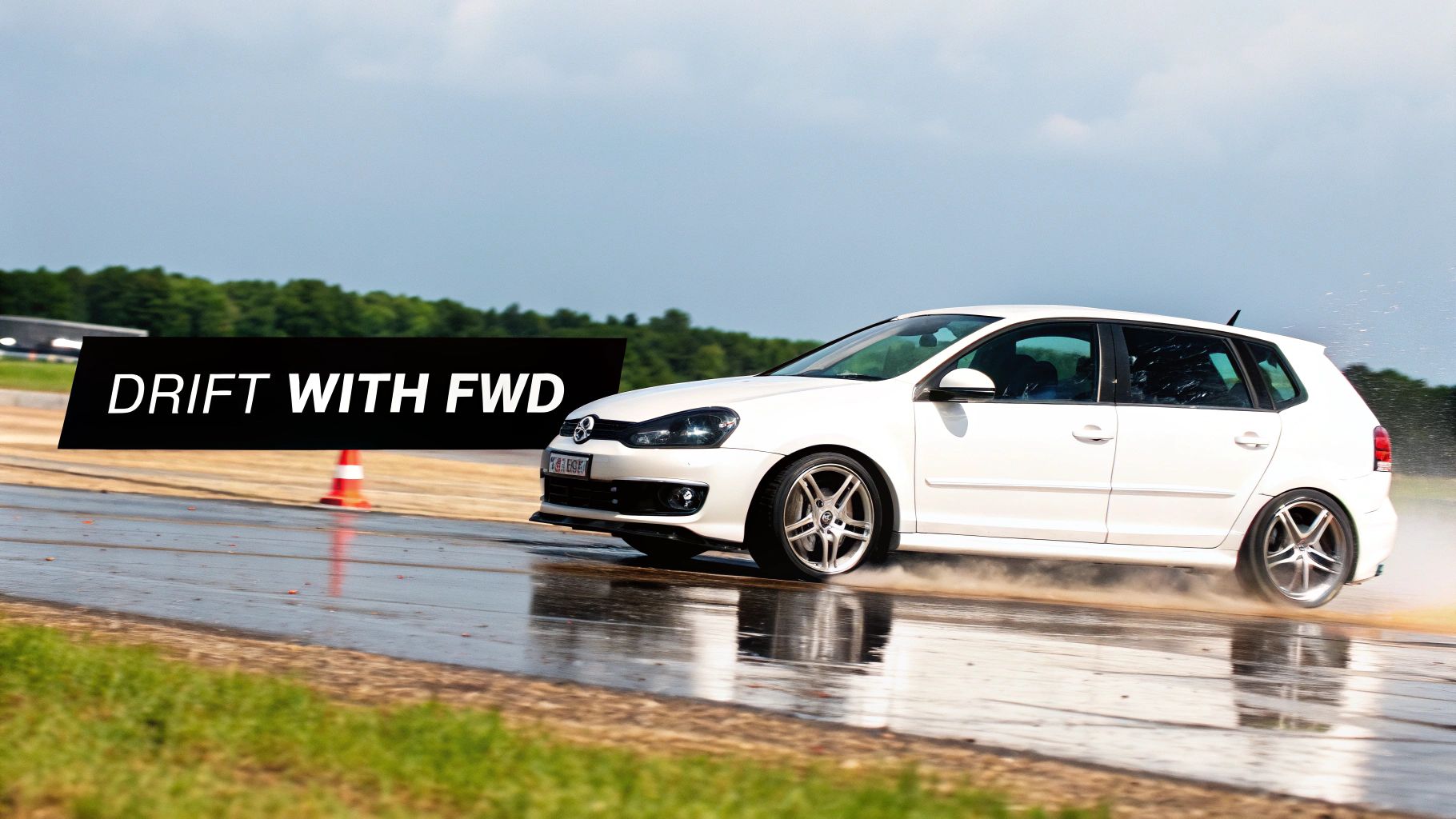
One of the biggest myths in car culture is that only rear-wheel drive cars can drift. It just isn't true. While RWD cars have the simple advantage of power-over-steer, FWD drifting is more of an art form, one that relies on physics and surgically precise inputs from the driver. You're not pushing the rear end out with power; you're strategically forcing it to lose traction.
This is a critical distinction to make. In a front-wheel drive car, your front wheels are doing double duty—steering and putting the power to the ground. By design, this setup naturally wants to understeer, meaning the front tires lose grip first and the car plows straight ahead in a turn. Your entire goal is to fight this tendency and make the rear let go first.
Understanding the Physics of FWD Drifting
So, how do you make it happen? You have to aggressively shift the car's weight forward to unload the rear tires, which dramatically reduces their grip. This weight transfer is the absolute cornerstone of every single FWD slide.
Once those rear tires are light, a sharp steering input or a quick pull of the handbrake is all it takes to break their traction and kick the car into a controlled pivot.
Unlike RWD, where you use the throttle to hold and steer the drift, in an FWD car, the throttle's main job is to pull you out of the slide. It’s a constant, delicate dance between braking, steering, and throttle modulation to keep things sideways.
The essence of FWD drifting is creating temporary instability. You’re using momentum and weight shift to turn the car’s inherent stability into a tool for controlled rotation, a skill that demands precision over brute force.
Why This Skill Matters
Learning to drift with fwd is way more than just a cool party trick; it's an advanced lesson in car control. It forces you to become acutely aware of exactly how your car behaves at the absolute limit of adhesion.
These principles—managing understeer, initiating oversteer, and controlling a slide—are directly applicable to performance driving and even staying safe in slippery road conditions. And for all the RC car enthusiasts out there, these same physics apply, making it an incredibly challenging and rewarding setup to master on a smaller scale.
Your Essential FWD Drift Setup Checklist
Getting a front-wheel drive car to slide predictably starts in the garage, not on the track. Before you even think about yanking the handbrake, you need to re-engineer the car’s natural tendency to understeer and grip. This is your workshop manual for getting that sideways action from both a real car and an RC model.
The core principle is simple: stiffen the rear, soften the front. Your goal is to make the rear suspension as rigid as possible so it can't easily absorb bumps or body roll.
This rigidity forces the inside rear tire to lift off the ground during hard cornering, drastically reducing grip and inviting a slide. For a real car, this means a much thicker rear sway bar and stiff rear springs or coilovers. In the RC world, you achieve the same effect with heavier shock oil and harder springs in the rear.
Tire Selection Is Everything
The single most impactful change you can make is your tires. To successfully drift with fwd, you need a massive grip imbalance between the front and rear of the car.
You need the front tires to be as sticky as possible, while the rear tires should have very little grip. This setup ensures that when you shift the car's weight, the front end holds its line while the rear breaks traction with ease.
- For Real Cars: Look for cheap, hard-compound tires for the rear. Some people even over-inflate them to reduce the contact patch, but be careful with this approach. The front needs high-performance summer tires.
- For RC Models: This is where you can get creative. Hard plastic or PVC drift tires are the standard. They offer almost no friction, letting the chassis glide smoothly.
Remember, the goal isn't to have zero grip at the back—it's to have less grip than the front. This differential is what makes the car pivot predictably instead of just spinning out uncontrollably.
Dialing In Your Alignment for Rotation
Your alignment settings are a powerful tool for influencing how the car behaves. The right adjustments can make the difference between a car that fights you and one that eagerly steps its tail out. You're basically programming the car to oversteer.
Start with the rear. Adding a few degrees of negative camber (where the top of the tires tilt inward) reduces the tire's contact patch in a straight line, making it easier to break traction. More importantly, a small amount of toe-out at the rear will make the back end feel nervous and eager to rotate under load.
In contrast, the front alignment should be set for maximum grip and steering response. A little negative camber and slight toe-out can help with turn-in, but the focus remains on keeping the front planted.
To see how these principles apply across the board, here’s a quick comparison of the setup changes for a full-scale car versus an RC model.
FWD Drift Setup Comparison Real Car vs RC Model
| Component | Real Car Adjustment | RC Model Adjustment |
|---|---|---|
| Suspension | Install a stiff rear sway bar and coilovers. Keep front suspension softer. | Use heavier oil and stiffer springs in rear shocks. Softer setup in front. |
| Tires | High-grip performance tires on the front; low-grip, hard-compound tires on the rear. | Sticky rubber or foam tires on the front; hard plastic or PVC tires on the rear. |
| Alignment | Add negative camber and slight toe-out to the rear wheels for instability. | Adjust rear turnbuckles for negative camber and toe-out to encourage rotation. |
While the physics are the same, the execution is a bit different. The key takeaway is that you're always trying to create that front-to-rear imbalance.
For RC builders, your electronics are just as critical as the mechanical setup. A good motor and ESC combination gives you the precise throttle control needed to manage a slide. If you're building a chassis from scratch, you can learn more about how to choose the right motor for your RC car in our detailed guide. Getting the power delivery right is essential for having the torque to pull yourself out of a drift effectively.
Learning the Core FWD Drifting Techniques
Once your car is set up, the real work begins. Mastering how to drift with FWD is less about raw power and more about finesse and precision. It’s all about learning the specific inputs that intentionally break the rear end loose and get you into a controlled slide.
The setup changes we just covered are the foundation for everything that follows.
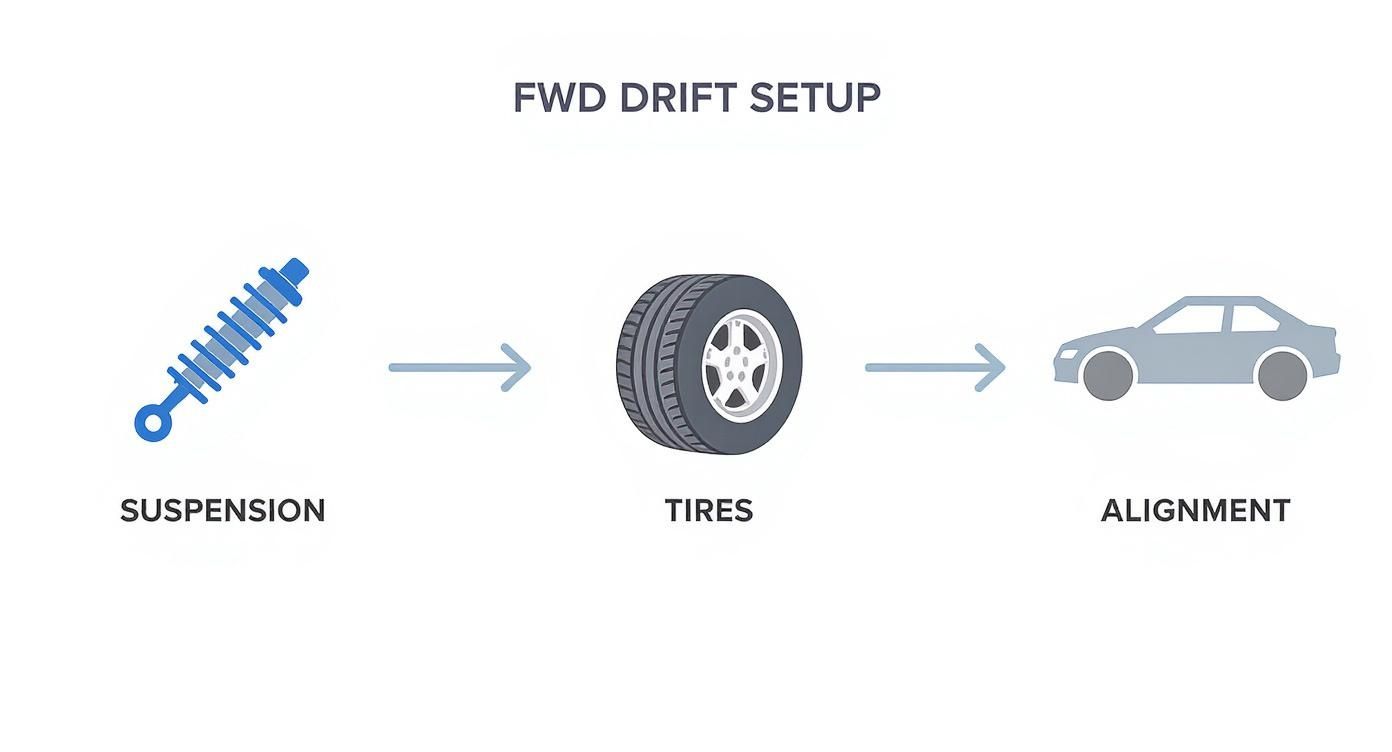
This diagram lays it all out—from suspension to tires and alignment, each component builds on the last to create a car that’s ready to pivot on command. Without this groundwork, the techniques below just won't be as effective or predictable.
The Scandinavian Flick (or Feint Entry)
The Scandinavian Flick is a classic rally technique perfectly suited for FWD drifting. At its core, it's a way to use aggressive weight transfer to kick the rear out without yanking the handbrake. You're basically tricking the car into a slide.
Here’s how it works: as you approach a corner, you give the wheel a small but sharp turn away from the corner. This little flick loads up the suspension on one side of the car.
Immediately after, you snap the steering wheel back hard into the corner. This violent shift in momentum unloads the rear tires, causing them to lose grip and swing out. The key is to be smooth but decisive—a weak feint won’t have enough energy to break traction.
Mastering the Handbrake Entry
The handbrake is your most direct tool for initiating a drift in a FWD car, but it demands a delicate touch. Just yanking the lever and holding it will kill your momentum and send you into a jerky, uncontrolled spin. The goal is a quick, sharp lock-up of the rear wheels to start the rotation, followed by an immediate release.
Picture a tight hairpin turn.
- Approach with good speed and turn in slightly.
- Right before the apex, clutch in (on a manual) and give the handbrake a short, aggressive pull to lock the rears.
- The second the rear starts to rotate, let go of the handbrake and clutch.
- Now, you use your steering and throttle to manage the slide and pull the car through the turn.
Timing that release is everything. Hold it too long, and you'll bleed off too much speed, leaving you dead in the water mid-corner.
A common mistake is using the handbrake as a crutch for every single corner. The most fluid FWD drifts often blend a feint entry with just a tap of the handbrake to fine-tune the angle, rather than relying on it for the entire entry.
Leveraging Lift-Off Oversteer
Lift-off oversteer is probably the most nuanced FWD technique out there. It’s all about using the throttle to manipulate the car’s balance while you're already in a corner. Since FWD cars are naturally nose-heavy, abruptly lifting off the gas pedal mid-turn shifts weight forward, lightens the rear end, and can induce a slide.
This works best in long, sweeping corners where you can carry a lot of momentum. As you enter the sweeper and feel the front tires starting to push wide (understeer), a sudden lift off the throttle can tuck the nose back in and swing the rear around beautifully.
From there, controlling the slide becomes a delicate dance. A little bit of throttle will stabilize the car and pull it straight, while another lift can increase your drift angle. This is where seat time is king, as it teaches you to feel exactly how your inputs are shifting the car's balance.
Finding a safe, open space to practice is absolutely essential. For RC drivers, finding a local RC car track near me gives you the perfect controlled environment to nail down these skills without any risk.
Advanced Drills to Refine Your Control
Getting consistent with FWD drifting is all about building muscle memory. Once you understand the core mechanics, the next step is drilling them over and over until your reactions become second nature.
These exercises are designed to bridge the gap between knowing what to do and instinctively feeling what the car needs. This is how you move from jerky, forced slides into a much smoother, more controlled style.
The Nuance of Left-Foot Braking
Left-foot braking is an absolute game-changer for FWD control. It lets you fine-tune your drift angle and speed at the same time. While your right foot stays on the throttle to keep the front wheels pulling, your left foot can gently feather the brakes.
This simple action adds just enough drag to shift weight forward, keeping the rear tires light and happy to keep sliding. It’s an advanced technique, for sure, but it gives you an incredible level of precision. Say you feel the car starting to straighten out mid-drift—a light touch on the brake with your left foot can bring the slide angle right back without you having to lift off the gas.
Left-foot braking is your dynamic balance tool. It lets you manage weight transfer on the fly, making subtle corrections that a handbrake pull or throttle lift simply can't achieve with the same grace.
Practicing with Purposeful Drills
Theory is one thing, but seat time is what really builds skill. Find a large, empty parking lot (with permission, of course) or a proper skidpad to work on these patterns. Your focus should be on smoothness and consistency, not raw speed.
-
Sustained Circle Drifts: Start by trying to hold a steady drift around a single cone. This forces you to master that delicate balance of steering, throttle, and subtle brake inputs needed to maintain a constant angle. It's the best way to really feel how each input affects the car.
-
Slalom Courses: Set up a simple line of cones and practice initiating drifts back and forth between them. This is where you’ll learn to nail the Scandinavian Flick and manage rapid weight transfers. The goal is to flow from one slide directly into the next without any hesitation.
-
Figure-Eight Patterns: The figure-eight is the ultimate test of transitions. It combines everything: initiating the drift, holding it, and then smoothly shifting the car’s weight to slide in the opposite direction. Nailing a clean figure-eight means you truly understand how to drift with fwd.
While less common, some drivers use a quick clutch kick—rapidly stabbing the clutch with high revs—to shock the drivetrain and help unsettle the rear. It’s a harsh technique, best saved for sharp, aggressive initiations when other methods aren't enough.
For building a solid foundation, though, the drills above will give you 99% of the skill set you need. These aren't just about showing off; they're the fundamental practice that makes advanced car control feel effortless.
Common Mistakes and How to Fix Them
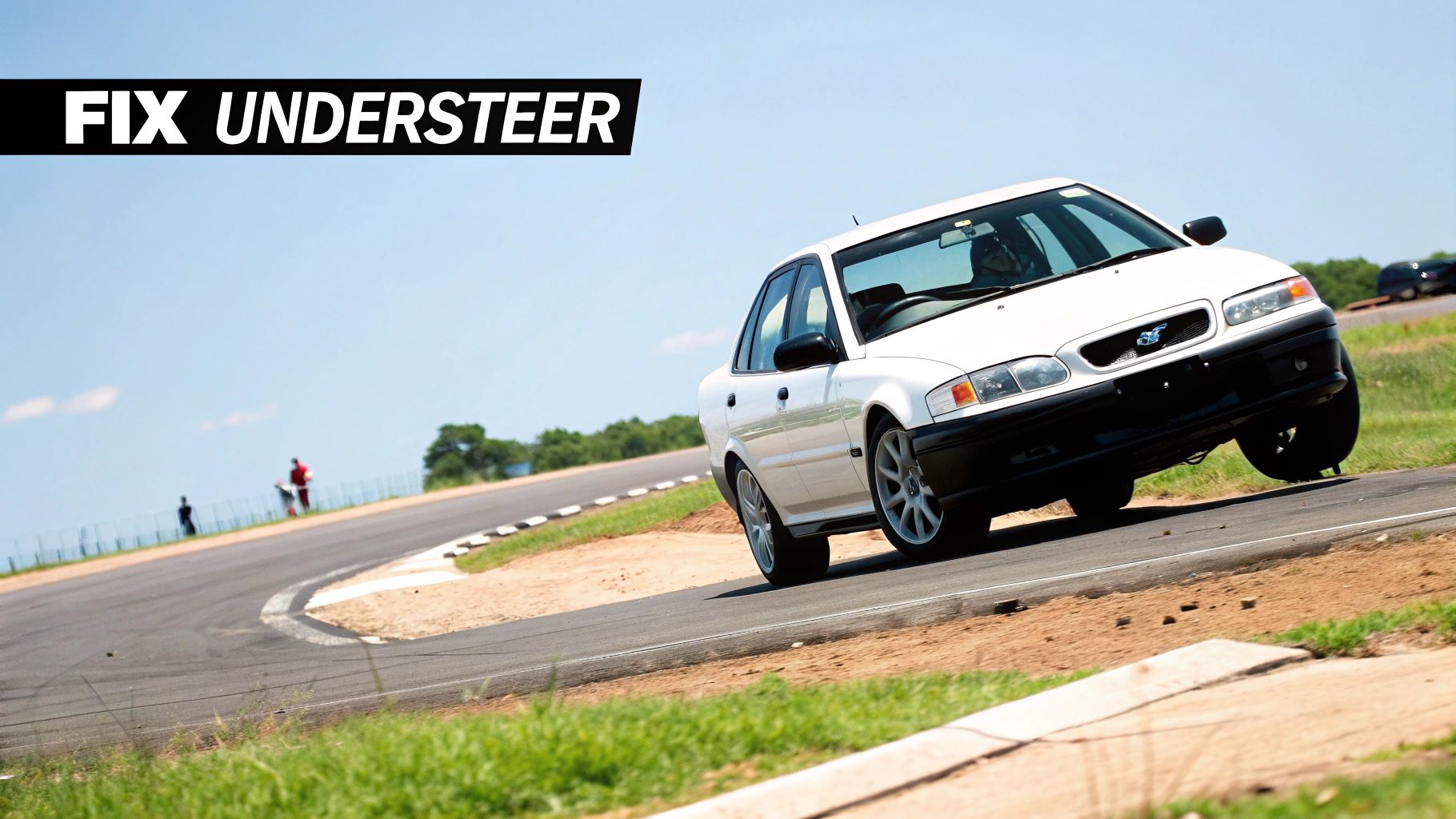
Learning to drift with FWD means fighting everything the car wants to do naturally. It’s a completely counter-intuitive skill, so you're going to hit a few walls—figuratively, I hope. Understanding the common pitfalls is the fastest way to shorten that learning curve.
The most common frustration? Terminal understeer. This is when the car just plows straight ahead, completely ignoring your steering inputs. It’s a dead giveaway that you didn't get enough weight transferred onto the front tires to unstick the rear.
The fix is to be more aggressive on your entry. Whether it’s a sharper feint, a quicker lift off the throttle, or a more decisive tug on the handbrake, you have to force the car’s weight onto its nose. No excuses.
Over-Rotation and Spinning Out
On the complete opposite end of the spectrum is the classic spin-out. This almost always happens when you hold the handbrake for too long, killing all your momentum and causing the car to pivot on the spot. Remember, the handbrake is a trigger, not a switch you just leave on.
To fix this, think in short, sharp pulls. The second you feel that rear end start to come around, get off the handbrake and be ready to catch the slide. Recovery is all about counter-steering—steering into the slide—and using the throttle to pull the car straight. It's a delicate dance; too little throttle and you'll keep spinning, but too much can cause the car to snap back violently.
A jerky, inconsistent slide often comes from hesitant inputs. Confidence is key. Commit to your steering and handbrake actions decisively. A timid attempt will only confuse the car’s balance and lead to an unpredictable, sloppy drift.
Troubleshooting RC FWD Drifters
For the RC folks, a lot of the same physics apply, but you'll run into some unique scale-specific issues. The most common one is the dreaded "death wobble," where the front wheels oscillate like crazy. This is almost always a setup problem.
- Check Your Gyro: If the gain is set too high, the gyro will constantly over-correct and cause that wobble. Turn it down until the steering action is smooth and controlled.
- Review Your Alignment: Too much front toe-out can make the car incredibly twitchy and prone to oscillating at speed.
- Tire Compounds Matter: If your RC's rear tires are too grippy, they simply won't slide properly. You might even consider using a traction compound for RC cars like SXT 3.0 Traction Compound on the front tires to really exaggerate the grip difference you need for a stable FWD drift.
FWD Drifting: Your Questions Answered
When you start talking about drifting a front-wheel-drive car, a lot of questions come up. It goes against everything most people think they know about performance driving. Let's tackle some of the most common ones head-on.
What Makes a Good FWD Drift Car?
Not every FWD car is a great candidate for this. You're looking for something lightweight with a shorter wheelbase, as this combination helps the car pivot and rotate much more easily.
A critical piece of the puzzle is a real, mechanical handbrake. That old-school lever is your main tool for getting the rear to step out. The electronic parking brakes you find in newer cars are completely useless for this kind of driving.
Good chassis balance is another huge advantage. Cars that are extremely nose-heavy will fight you at every turn, constantly pushing into understeer and making it a real chore to initiate a smooth drift.
Is FWD Drifting Bad for Your Car?
To be blunt, yes, it can be. Like any motorsport, you're pushing components well beyond their intended limits, which means accelerated wear and tear.
You'll see the most stress in a few key places:
- Handbrake Cable: Yanking on it repeatedly will stretch the cable over time, and in some cases, it can even snap.
- Rear Hubs and Bearings: Locking up the rear wheels puts a massive side-load on these parts, which they were never designed to handle continuously.
- Tires: This one's obvious. You'll be chewing through rear tires much faster than you would with normal driving.
This is where regular maintenance becomes non-negotiable. Keep a close eye on your handbrake's adjustment, and listen for any humming or grinding noises from the rear wheel bearings. Catching these things early saves a lot of headaches later.
Drifting any car is a trade-off. You're exchanging component lifespan for skill and fun. The key is to be aware of the mechanical stress and budget for the inevitable maintenance that follows.
The Best Surfaces for Practice
Where you choose to practice makes a massive difference in your progress and how much you spend on tires. For anyone just starting out, low-grip surfaces are your best friend.
A wet tarmac parking lot is pretty much the perfect learning environment. It gives you enough slip to initiate drifts easily without needing a ton of speed or aggressive inputs. This lowers the risk and saves your tires.
Snow and ice are also incredible teachers. They force you to be incredibly smooth and precise with your steering, throttle, and braking—skills that translate directly to every other surface.
Ready to build the ultimate RC drift machine? At digital-rc, we stock everything from high-performance chassis to the precise electronics you need for peak on-road performance. Find all your competition-grade parts at https://digitalrc.ca.
Article created using Outrank