

Esc for rc car: Find the Best ESC for RC Car Racing
An Electronic Speed Controller (ESC) is the real brain of your RC race car. It does way more than just turn the motor on and off; it's the critical link that translates your commands from the remote into smooth, precise power at the wheels. A high-quality ESC for an RC car is what separates a car that just drives from one that wins races.
What Is An ESC And Why It Matters
Think of your ESC as the central nervous system connecting your fingers to the motor. When you squeeze the throttle on your transmitter, you're not directly telling the motor what to do. You're sending a tiny signal to the ESC, which then interprets your input and feeds a perfectly measured dose of power from the LiPo battery to the motor.
This entire process happens thousands of times a second, giving you that seamless acceleration and controlled braking you need to be competitive. A basic, run-of-the-mill ESC will get your car moving, sure. But a proper race-spec unit opens up a whole new world of adjustability. It's the difference between feeling disconnected from your car and feeling like it's a natural extension of your hands.
The Brain Behind The Brawn
So, what's inside this little black box? At its core, an ESC is a sophisticated circuit board packed with a microcontroller, gate drivers, and powerful transistors known as MOSFETs. The microcontroller is the processor—it receives your throttle signals and runs the software that dictates exactly how the motor should behave. It then tells the gate drivers to switch the MOSFETs on and off at incredible speeds, creating the three-phase electrical current that makes a brushless motor sing.
The magic of a high-performance ESC lies in its ability to manage this power delivery with incredible precision. This control over throttle curves, braking strength, and motor timing is what separates a podium finish from a mid-pack result.
From Simple Commands To Winning Performance
For competitive 1/10 touring and 1/12 pan car racing, the quality of your ESC is everything. A top-tier model from a trusted brand like Hobbywing gives you the reliability and, more importantly, the tuning options you need to find a real on-track advantage. These ESCs let you fine-tune every single aspect of your car's power delivery, including:
- Throttle Feel: Adjusting the "punch" or initial hit of acceleration to match the available grip on the track.
- Braking Force: Dialing in the perfect amount of stopping power to dive into corners aggressively without locking up.
- Motor Timing: Electronically advancing the motor's timing to squeeze out more RPM on long straights.
- Drag Brake: Simulating the engine braking of a full-scale car, which helps the car rotate better off-throttle.
Ultimately, a premium esc for rc car racing isn't just another electronic part; it's one of your most powerful tuning tools. Investing in a good one unlocks your car's true potential and gives you the consistent, predictable control needed to really push your limits on the racetrack.
How To Decode ESC Specifications Like A Pro
Staring at an ESC's spec sheet can feel like trying to read another language. But trust me, those numbers are the secret to unlocking consistent, reliable performance on the track. When you know what they mean, you can perfectly match an ESC to your motor, battery, and race class without any guesswork.
The most important specs all come down to power handling, motor limits, and how the ESC powers your other electronics. Get these right, and your car will run cool, fast, and efficient, lap after lap. Let's break down the numbers that really matter.
This diagram shows you exactly how the whole system works together. Your transmitter sends a signal, and the ESC translates it into the precise amount of power your motor needs to put down.
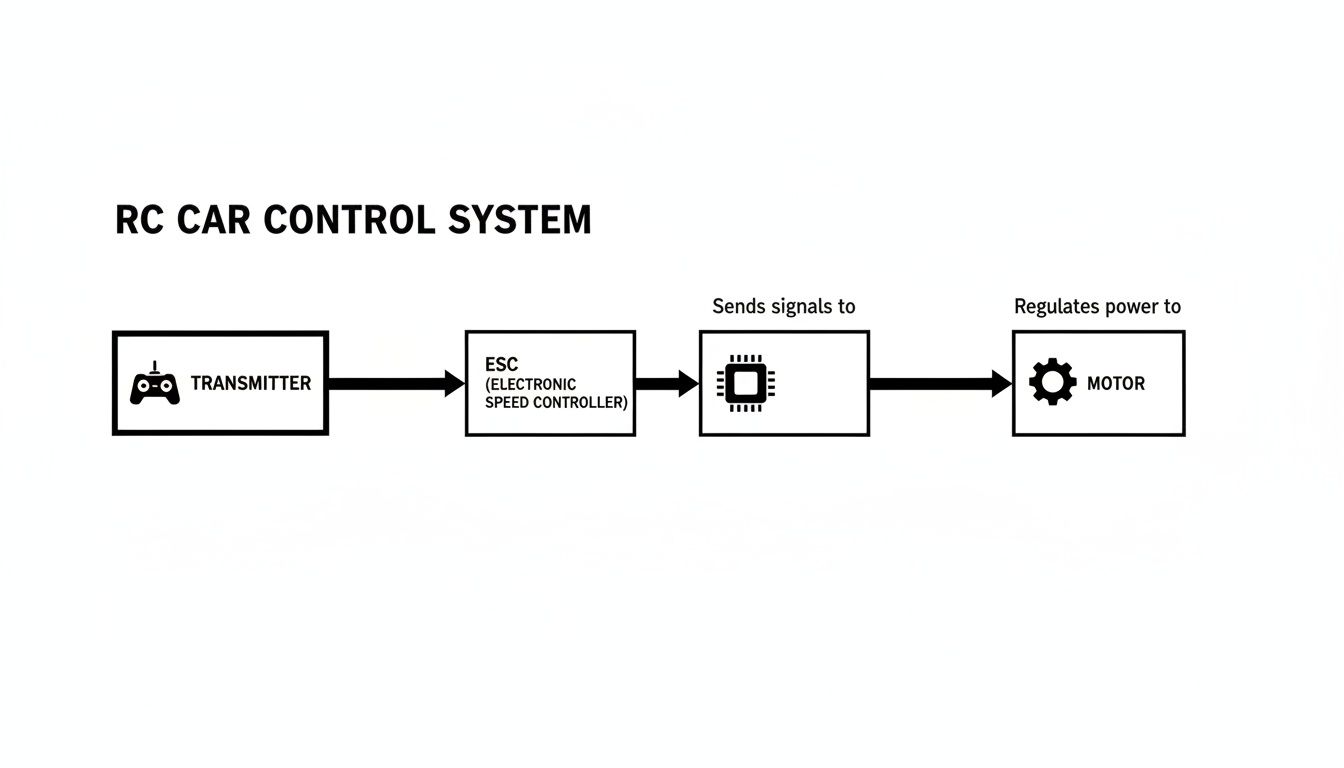
Think of the ESC as the central nervous system, taking commands and executing them instantly to control the motor.
Current Ratings: Continuous vs. Burst
Every ESC has two current ratings, measured in amps (A). These are probably the single most important specs you need to look at.
- Continuous Current: This is the maximum current the ESC can handle all day long without breaking a sweat. For a high-demand class like modified 1/10 touring, you'll want a high rating like 160A to keep up with the power draw.
- Burst Current: This tells you how much power the ESC can dump for a few seconds—perfect for that massive punch you need when accelerating out of a tight corner.
If you mismatch these ratings, you’re asking for a thermal shutdown. An under-specced ESC will constantly overheat and cut power, which is a guaranteed way to end your race early.
Motor Limit and Type
The motor limit, usually listed in turns (T), tells you the hottest motor the ESC can safely handle. An ESC might have a 3.5T limit for blistering-fast modified racing, or it might be limited to 10.5T and above for stock classes.
It’s also critical to match the motor type. In modern racing, we exclusively use sensored brushless motors, and your ESC must be built for them. A sensored system uses an extra wire to tell the ESC exactly where the motor’s rotor is, giving you that buttery-smooth throttle feel you need for precise on-road control.
A key takeaway is that the ESC's specs must always exceed the demands of your motor. Pushing an ESC to its absolute limit is a formula for failure; always leave a safety margin of at least 20-25% to ensure reliability under race conditions.
This need for robust electronics is a huge part of the market. In fact, Dataintelo pegs the global RC ESC market at USD 1.28 billion in 2024. North America's share, including Canada, is driven by 32% demand for better connectivity in wireless RC setups. For our customers dialing in an XRAY or Awesomatix chassis, that means top-tier ESCs from brands like Hobbywing that can handle 40% higher current draws for sustained speeds over 100 km/h on 1/12 pan car tracks.
Understanding The BEC Output
The Battery Eliminator Circuit (BEC) is a small but mighty feature built into your ESC. It takes the high voltage from your main LiPo battery and steps it down to a safe level (usually 6.0V or 7.4V) to power your receiver and steering servo.
A strong BEC is non-negotiable. The high-torque servos we use in touring cars can draw a surprising amount of current, especially when fighting for traction in a corner. If the BEC can’t keep up, your receiver can "brownout," causing you to lose control for a split second—which is more than enough time to find a barrier. Look for a BEC with an adjustable voltage and a solid amperage output (4A or more) to keep your steering crisp and responsive.
When you learn to analyze these key specs, you stop guessing and start making informed choices. You can pick an esc for rc car racing that becomes a true partner for your motor and your driving style.
Hobbywing ESC Spec Comparison For On-Road Racing
To help put it all together, here’s a quick look at some of the most popular Hobbywing ESCs we see at the track, showing how their specs line up for different racing classes.
| ESC Model | Continuous Current | Motor Limit (2S Touring) | BEC Output | Best For |
|---|---|---|---|---|
| XR10 Pro G2S | 160A | ≥ 3.5T | 6.0V / 7.4V @ 5A | Pro-level Modified & Stock Touring, 1/12 Pan Car |
| XeRun XD10 Pro | 100A | ≥ 8.5T | 5.0-7.4V @ 5A | Pro-level Drifting (Specialized) |
| Justock G3 | 60A | ≥ 10.5T | 6.0V / 7.4V @ 4A | Spec/Club-level Stock Touring, F1 |
| QuicRun 10BL120 | 120A | ≥ 3.5T | 6.0V / 7.4V @ 4A | Budget-friendly Modified & high-power Stock |
Choosing the right model comes down to your class rules and how much power you're putting down. The XR10 Pro is the go-to for serious competition, while the Justock is a fantastic and reliable choice for spec racing.
Selecting The Perfect ESC For Your Racing Class
Choosing the right ESC for your RC car is about more than just grabbing the one with the biggest numbers. It’s about creating a perfectly balanced system where your ESC, motor, and battery work in total harmony. For anyone running a high-performance chassis like an Awesomatix or XRAY, getting this synergy right is the foundation of a competitive setup.
The needs of a stock touring car are a world away from a modified 1/12 pan car. Each class has its own rules and performance demands, and your ESC has to be up to the job. Understanding these differences is the first step toward building a car that's not just fast, but also legal for race day.
Blinky Mode for Stock Racing
In the world of stock racing, the entire goal is to level the playing field. It's all about making driver skill and chassis setup the real deciding factors. To make this happen, race organizers mandate "blinky mode" on all ESCs. This setting shuts down all the fancy electronic timing advance features, like boost and turbo, that could give a driver an unfair power advantage.
When an ESC is in blinky mode, a small LED on the unit flashes at a steady rate. This is a dead giveaway for tech inspectors that you're playing by the rules and not using any electronic timing. That’s why a ROAR-approved ESC with a reliable, non-programmable "blinky" profile is absolutely essential. The Hobbywing XeRun XR10 Stock Spec is a perfect example of an ESC engineered specifically for this kind of fair competition.
Unlocking Power in Modified Classes
Modified racing is the complete opposite. Here, the rulebook is wide open, and your job is to squeeze every last drop of performance out of your electronics. An advanced, programmable ESC becomes your most powerful tuning tool, letting you fine-tune the motor's power delivery with incredible precision.
Key features you'll be leaning on in modified racing include:
- Boost Timing: This adds timing advance based on your motor's RPM, giving you a stronger pull through the infield.
- Turbo Timing: This feature kicks in a massive burst of timing at full throttle, dramatically boosting your top speed on the long straights.
- PWM Frequencies: Tweaking these can completely change the throttle feel, taking it from super smooth and linear to aggressive and punchy.
An ESC like the Hobbywing XR10 PRO G2S gives you the tough hardware and sophisticated software you need to manage all this immense power, ensuring you can lay it down reliably, lap after lap.
Your Compatibility Checklist
Guesswork has no place on the setup stand. Before you pull the trigger on an ESC, run through this simple compatibility checklist. It ensures all your components will work together flawlessly and prevents costly mistakes and frustrating race days.
A common pitfall is overlooking the small details of compatibility. Ensuring your ESC, motor, battery, and connectors are all aligned not only guarantees performance but also prevents potential damage to your valuable electronics. A methodical check is your best insurance policy.
- Motor Type: For on-road racing, a sensored brushless motor is non-negotiable. Make sure your ESC is designed for sensored operation to get that smooth, precise throttle control you need.
- Battery Voltage: Match the ESC's voltage rating to your battery. 1/10 touring cars typically use 2S LiPo batteries, while 1/12 pan cars run on 1S LiPo packs. The ESC must be rated for the correct cell count.
- Connectors: Standardize your connectors to avoid problems. While many ESCs come with bare wires, soldering on a common plug like a Dean's or XT60 ensures a secure, low-resistance connection to your battery.
By focusing on these key areas, you can confidently pair a high-performance ESC for RC car racing with the right motor and battery. For a deeper dive into the technical side, check out our comprehensive ESC selection guide matching your electronic speed controller to your motor. This will help you pair the perfect Hobbywing ESC from our collection with your chosen motor.
Unlocking Speed Through ESC Programming And Tuning
Getting the right hardware is only half the battle. If you're chasing podium finishes, the real, measurable gains come from mastering your ESC's programming. A modern ESC for an RC car isn't just a piece of electronics; it's a powerful tuning tool. Once you understand its settings, you can turn it into your secret weapon on the track.
Diving deep into the programming lets you build a custom power profile that’s perfectly matched to your driving style, your car, and the specific track conditions you're facing. Settings that seem minor on the bench can easily shave tenths off your lap time—and that's often the difference between winning and losing.
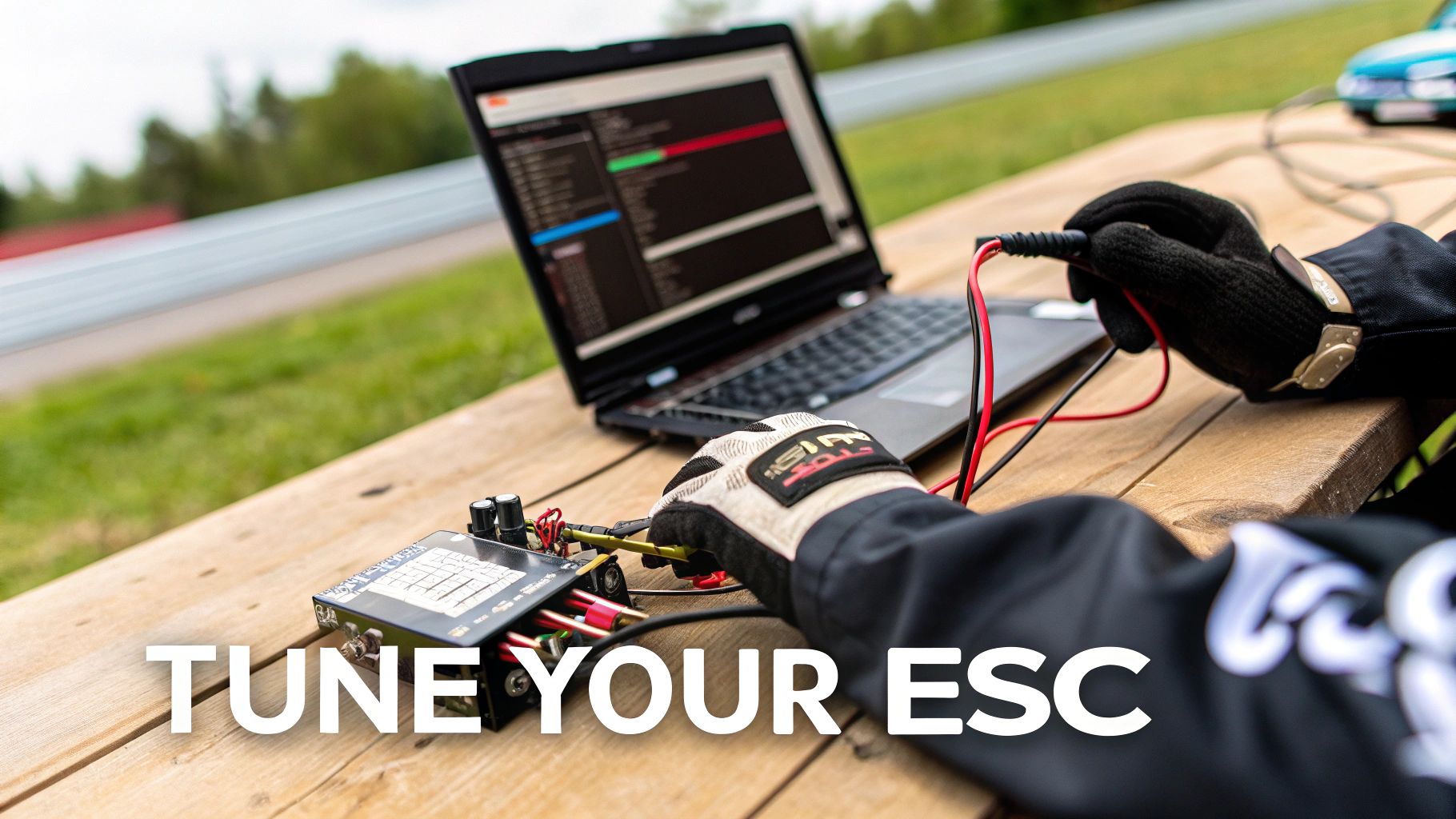
The Essential Role Of The Programming Box
While you can make some basic tweaks with your transmitter, a dedicated ESC programming box is an essential piece of kit for any serious racer. Think of it as the high-resolution monitor for your car's brain. It gives you a clear, user-friendly way to get in there and fine-tune every single parameter with total precision.
Without one, you’re basically flying blind, trying to count beeps and flashes to change complex settings. A programmer, like the Hobbywing LCD Program Box G2 or OTA Programmer, gets rid of all the guesswork and lets you make quick, confident adjustments in the pits between heats.
Fine-Tuning Your Power Band With Timing
In modified racing, boost and turbo timing are where you find that explosive, straight-line speed. These settings electronically advance the motor’s timing as it spools up, which dramatically increases its RPM and top-end power.
- Boost Timing: This is RPM-based timing that feeds in gradually as you accelerate. It's perfect for getting more punch out of corners and building speed through the infield. On a tight, technical track, for example, you might add a bit of boost to help your touring car pull harder out of the slow chicanes.
- Turbo Timing: This is a massive shot of timing that only kicks in at full throttle after a short delay. You use this to get a huge advantage on the long straights. In a modified touring car race, applying turbo at the right moment can make you untouchable on the main straightaway.
Mastering the blend of boost and turbo is an art form. Too much timing will cook your motor and drain your battery fast. Too little, and you'll be left in the dust. The goal is finding that sweet spot for maximum speed without compromising reliability for the whole race.
Mastering Control With Brake And PWM Settings
All that speed means nothing without control. That’s where your brake and frequency settings come into play. These parameters define how your car behaves when you're off the power, which is just as important as when you're on it.
A critical setting here is the drag brake. This automatically applies a small amount of braking force whenever you're at neutral throttle. For a 1/12 pan car, adding a touch of drag brake helps the car pivot more sharply on corner entry, letting you carry more speed right through the apex.
On top of that, the Pulse Width Modulation (PWM) frequencies for both throttle and brake can completely change how your car feels. A lower throttle PWM frequency will give you a more aggressive, punchy feel, while a higher frequency delivers a much smoother, more linear powerband. Tuning these helps you adapt to changing grip levels. For a deeper look at how these advanced settings work on track, check out our detailed review of the tournament-grade Hobbywing Xerun XR10 Pro G3, which really showcases its tuning capabilities.
This constant push for better control is driving real advancements. For tinkerers optimizing setups, stats show that ESCs with features like gyro stabilization contribute to 28% of product innovations, helping racers achieve repeatable handling gains. As EV trends influence RC—with zero-emission vehicle registrations hitting 16.5% of new sales in Q3 2024—inspired battery tech is boosting ESC efficiency, reducing heat and extending run times by up to 30% in race conditions. Discover more insights about these RC market trends.
Installation And Maintenance For Maximum Reliability
A top-tier ESC for an RC car is built to handle extreme demands, but its long-term reliability comes down to a clean installation and consistent maintenance. Getting this right not only prevents frustrating failures but also makes sure your ESC is delivering every bit of power as efficiently as possible.
Let's walk through the hands-on practices that will keep your electronics bulletproof and ready for race day. The foundation of any reliable system is clean, strong connections. You'd be surprised how many issues trace back to a bad solder joint.
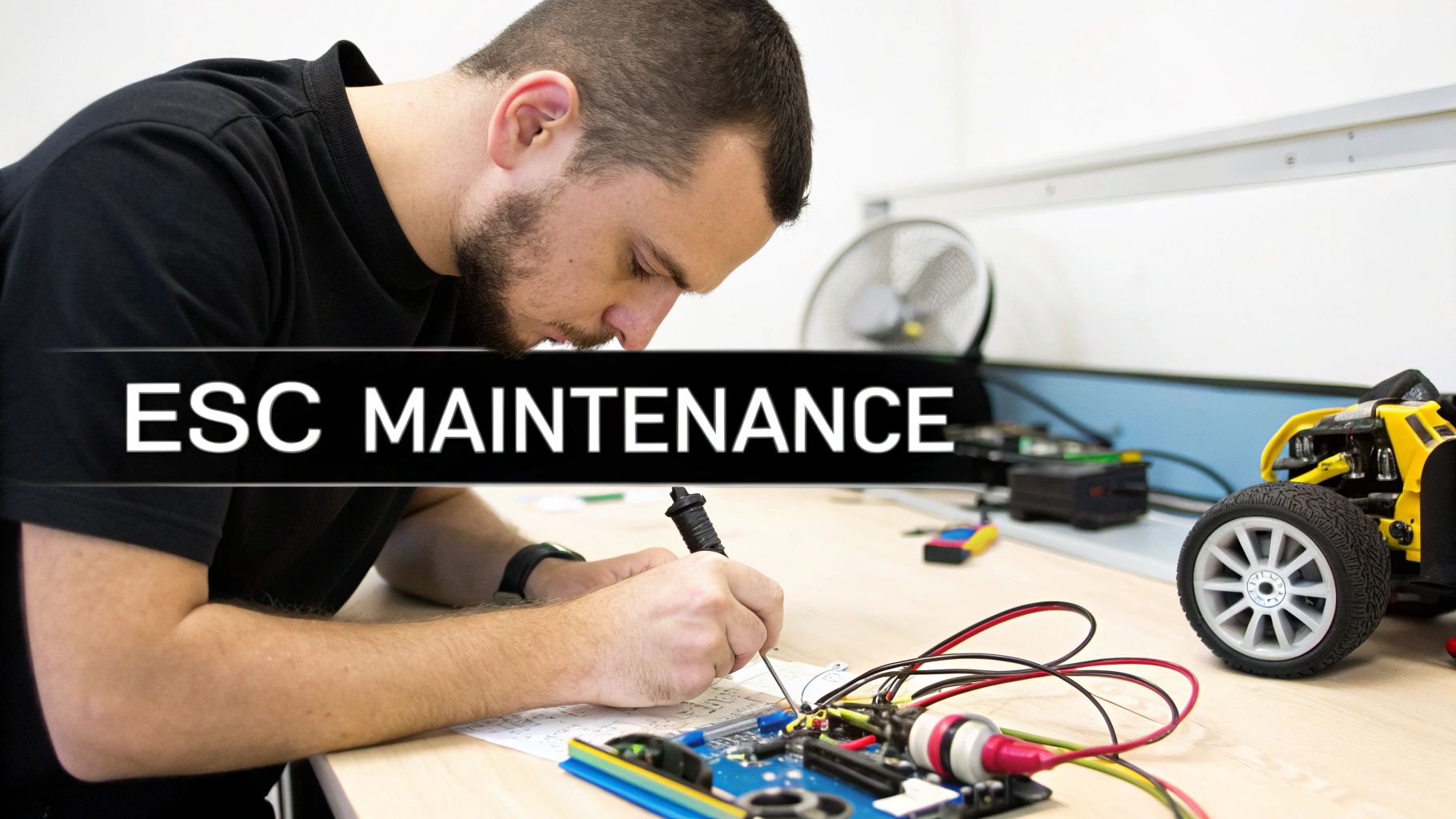
Soldering And Chassis Placement
Poor soldering is easily one of the most common failure points in RC electronics. A "cold" joint creates high resistance, which generates heat, robs your motor of power, and can fail at the worst possible moment—usually on the last lap.
To create bulletproof connections, always pre-tin both the wire and the ESC post before you join them. Use a quality soldering iron that gets hot enough (around 400°C or 750°F) to make the solder flow quickly. You're looking for a shiny, smooth joint. That low-resistance connection is absolutely critical for maximum power delivery.
Where you mount the ESC is just as important. You want to balance the chassis weight while giving it as much airflow as possible. In a crowded 1/10 touring car, try to position the ESC to get direct air from the body's vents and make sure nothing is blocking the cooling fan. Tidy wire management is key; use zip ties or heat shrink to route wires away from moving parts like belts and steering linkages. This prevents chafing that can lead to a short circuit.
Troubleshooting Common ESC Issues
Even the best setups run into problems. Knowing how to diagnose them quickly in the pits is a skill that will save you a lot of grief. Most common headaches like cogging, thermal shutdowns, and calibration errors can be traced back to just a few causes.
- Cogging: That stuttering you feel at low speeds is almost always a poor connection or a damaged sensor wire. Double-check every solder joint between the motor and ESC, and carefully inspect the sensor cable for any pinches or cuts.
- Thermal Shutdowns: If your ESC cuts power mid-race, it's just protecting itself from overheating. First, make sure your cooling fan is working and clear of debris. You might also need to gear down (use a smaller pinion) or back off the boost and turbo settings to reduce the load. A high-performance fan from a brand like Zoo Racing can make a massive difference here.
- Calibration Errors: If the car isn't responding correctly to your throttle inputs, a simple recalibration with your transmitter will usually fix it. This process just syncs the neutral, full throttle, and full brake points between your radio and the ESC.
A methodical approach to troubleshooting saves time and frustration. Always start with the simplest fix first—check your connections and calibration before you assume a major hardware failure. This simple rule will solve 90% of common ESC headaches.
Your Simple Maintenance Checklist
Regular maintenance turns a reliable ESC into an indestructible one. A quick check after every race day can prevent a DNF the next time you hit the track. This isn't a chore; it's just protecting your investment so it performs at its best for seasons to come.
- Inspect Solder Joints: Give each solder connection a gentle tug to make sure it’s solid. Look for any dull or cracked joints—that’s a sign of a pending failure.
- Clean the Fan and Heatsink: Dust and carpet fluff are the enemies of cooling. Use compressed air to blow any debris out of the fan blades and heatsink fins. This is essential for maintaining optimal airflow.
- Check for Firmware Updates: Manufacturers like Hobbywing periodically release firmware updates that improve performance and fix bugs. It's good practice to connect your ESC to its programming box and make sure you're running the latest version.
By following these installation and maintenance habits, you're making sure your esc for rc car operates at its full potential, giving you the consistent and reliable power you need to stay competitive.
Still Have Questions? Let's Clear Them Up
Even with the basics covered, a few common questions always pop up when racers are choosing or setting up a new ESC for their RC car. Let's tackle the ones we hear most often so you can finalize your electronics package with total confidence.
What Is Blinky Mode And Why Do I Need It?
You'll hear the term "blinky mode" constantly in stock racing. It's a specific setting on your ESC where a flashing LED light confirms that all electronic timing—like boost and turbo—is completely turned off.
This is mandatory for stock classes to keep the playing field level. The whole point is to make sure the race comes down to driver skill and car setup, not who has the most aggressive ESC programming. If you plan to compete in any sanctioned stock event, you'll need a ROAR-approved ESC with a dedicated "blinky" firmware, like the Hobbywing XR10 Stock Spec.
Can I Use My Car ESC In A Boat Or Plane?
Don't do it. We strongly advise against it, because every ESC for an RC car, boat, or plane is a purpose-built tool designed for a very specific job.
- Car ESCs are built for quick bursts of power, hard braking, and are cooled by air flowing over the chassis.
- Marine ESCs are almost always water-cooled because they're under a constant, heavy load pushing a hull through the water.
- Airplane ESCs are designed around propeller physics, usually don't have reverse, and need constant airflow from the prop to stay cool.
Mixing them up is a recipe for disaster. You'll get terrible performance, massive overheating, and will almost certainly fry your expensive electronics. Stick with parts designed for your specific RC discipline.
An ESC is not a one-size-fits-all device. Mismatching your ESC to its application is one of the fastest ways to end your day at the track—or on the water—with a puff of smoke. Always use an ESC built for the job.
How Do I Know If My ESC Is Overheating?
The most obvious sign is thermal shutdown. This is a built-in safety feature that cuts power to the motor to protect the ESC from damage. Your car will suddenly slow down or stop completely mid-run.
To stop this from happening, first, make sure your ESC's fan is spinning freely and isn't blocked by wires. You can also ease the load by dropping down a pinion size, turning down your boost and turbo settings, or upgrading to an ESC with a higher continuous current rating. For really demanding tracks or hot weather, a high-performance fan from a brand like Zoo Racing can make a huge difference in keeping those temps in check.
At digital-rc, we stock the race-proven ESCs and cooling solutions you need to build a reliable, competitive on-road machine. Find your perfect Hobbywing or Zoo Racing components today and experience the difference. Shop our full collection of ESCs and electronics at digitalrc.ca.