

Your Ultimate Guide to Kyosho Mini Z in Canada
The Kyosho Mini-Z isn't just another small RC car. It's a line of high-performance, 1:28 scale radio-controlled cars famous for their incredible detail and true hobby-grade precision. Think of them as high-performance sports cars shrunk down to fit on your coffee table, but with the guts to deliver a complete racing experience.
An Introduction to The Kyosho Mini-Z Phenomenon
Picture this: the thrill of precision RC racing, the satisfaction of tuning your own car, and the excitement of a perfectly executed drift—all happening in your living room. That's the world of the Kyosho Mini-Z, a unique hobby that mashes up the realism of scale modelling with the raw performance of competitive racing.
These are not toys. They're sophisticated machines engineered for enthusiasts who appreciate quality and speed.
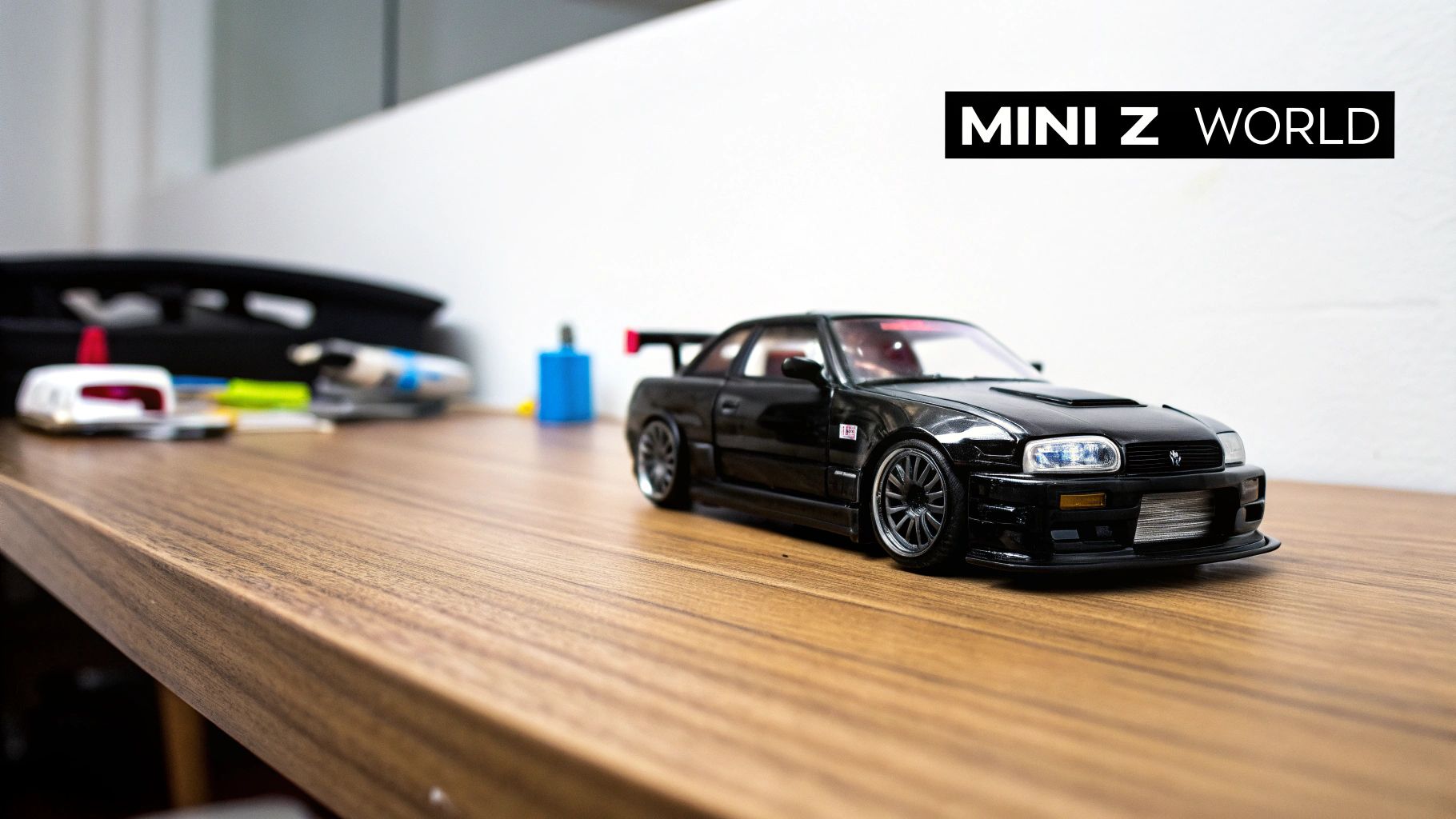
From the moment you open a "ReadySet" box, you know these are different. The bodies are finished to display-model quality, replicating iconic cars with stunning accuracy. But under that shell is a race-proven chassis packed with features you'd find on much larger models. It's an experience that hooks both newcomers and seasoned RC veterans alike.
A Legacy of Small-Scale Dominance
The Kyosho Mini-Z didn't just join the market; it practically created a new one. When they first launched back in 1999, these 1:28 scale electric cars brought a level of precision that was unheard of in such a small package, and they quickly built a dedicated following among Canadian hobbyists.
By 2004, global sales had already blown past 500,000 units. Canada's growing scene, especially in urban centres like those in Ontario and British Columbia, was a big part of that success, thanks to how perfect these cars are for indoor tracks. If you want to dive deeper into the history, you can check out the details on its Wikipedia page.
The core appeal of the Mini-Z is its ability to deliver a full-scale racing experience in a small-scale format. It’s a platform that grows with you, from your first drive out of the box to a fully tuned, competitive racing machine.
This guide will be your roadmap to the world of Kyosho Mini-Z. We'll break down everything from decoding the different chassis types to unlocking serious performance with the right upgrades. We'll also cover setup basics, maintenance, and give you some buying advice tailored for Canadian hobbyists. Whether you're in it for casual fun or the top step of the podium, this is where you start.
For a broader look at the world of radio-controlled vehicles, have a look at our insights on RC cars in Canada.
Here is the rewritten section, crafted to match the requested human expert style and tone.
Decoding The Mini-Z Chassis Families
At the heart of every Kyosho Mini-Z is its chassis—the skeleton that defines its entire personality on the track. Getting a handle on these platforms is the first step to picking the right car for your driving style. It’s a lot like choosing a real car; you wouldn't take a rear-wheel-drive sports car on a rally stage, and the same logic applies here, just on a much smaller scale.
Those seemingly complex names like "MR-04" or "MA-020" are actually simple codes. They tell you everything you need to know about the car's foundation, from its drivetrain to its intended purpose. Each chassis family is built for a specific type of driving, whether it's gripping tight corners on a carpet track or sliding sideways with perfect control.
RWD: The Precision Racer (MR Series)
The Rear-Wheel Drive (RWD) chassis, known as the MR series (Mini-Z Racer), is the quintessential platform for on-road racing. The latest iteration, the MR-04, is a huge leap forward from the already legendary MR-03. It boasts a lower centre of gravity for rock-solid stability and a totally redesigned front end that delivers sharper, more direct steering.
Think of a finely tuned track car—that’s the MR series in a nutshell. All the power goes to the rear wheels, which demands a smooth and precise driving technique. This setup absolutely excels at carrying speed through corners on high-grip surfaces like RCP or EVA foam tracks. It rewards a skilled driver with lightning-fast lap times and a truly connected feel. For competitive club racing in Canada, an RWD chassis like the MR-04 is the weapon of choice.
AWD: The All-Round Drifter (MA Series)
Next up is the All-Wheel Drive (AWD) platform, or MA series. The current flagship, the MA-020, is a versatile machine famous for one thing in particular: drifting. By sending power to all four wheels and fitting it with special low-friction drift tires, the MA-020 becomes a master of controlled slides. It’s like a sure-footed rally car built for tarmac, capable of executing beautiful, long drifts around a tight, custom-built course.
But its skills don't end there. Swap those drift tires for a set of high-grip rubber ones, and the MA chassis transforms into a stable, easy-to-drive touring car. This dual personality makes the AWD series a fantastic starting point for beginners who want to try a bit of everything. The included 2.4GHz Syncro KT-531P transmitter even has a Training Mode to dial back the car's speed, making it much easier for new drivers to learn the ropes.
The choice between RWD and AWD is the first major decision for any new Mini-Z owner. RWD offers the highest potential for on-road racing speed, while AWD provides unmatched versatility for both gripping and drifting.
Kyosho Mini Z Chassis Comparison
To make sense of the core options, here's a quick-reference guide to the primary Mini-Z chassis types. Think of this as your cheat sheet for understanding which platform aligns with your driving goals.
| Chassis Series | Drivetrain | Best For | Common Wheelbase |
|---|---|---|---|
| MR-04 | RWD | Competitive on-road racing, high-grip tracks | 98mm (LL) |
| MA-020 | AWD | Drifting, all-around grip driving, beginners | 90-98mm |
This table covers the main on-road platforms. While the MR-04 is the latest and greatest for racing, the MA-020 is the go-to for drifting and all-around fun, making it an excellent entry point into the hobby.
Specialized Chassis For Off-Road Adventures
Beyond the asphalt, Kyosho has engineered specialized Mini-Z platforms built for rugged terrain. While our focus is on the competitive on-road scene that many Canadian clubs prioritize, it's good to know these other options exist for a different kind of fun.
- Mini-Z Buggy: This is a purpose-built, 1:24 scale off-road racer with long-travel suspension and a shaft-driven 4WD system. It's designed to tackle dirt, small jumps, and uneven surfaces with impressive agility.
- Mini-Z 4x4: Focusing on realism and insane scale detail, the 4x4 series brings the world of rock crawling to a miniature scale. These models replicate iconic off-road vehicles with solid axles and incredible suspension articulation for climbing over obstacles.
Choosing Your First Kyosho Mini-Z Chassis
So, which one is right for you? It really comes down to your goals. If your ambition is to join a local Canadian racing club and chase the fastest lap times, the RWD MR-04 is your definitive starting point. Its precision and tuning potential make it the champion of the circuit.
However, if you're more drawn to stylish drifting, casual driving, or just want a platform that’s a bit more forgiving for a newcomer, the AWD MA-020 is an exceptional choice. Grabbing a "ReadySet" package from a Canadian retailer like digital-rc is the best way to start. It gives you a complete kit with a factory-finished body, a transmitter, and everything you need to start driving right out of the box—a solid foundation you can build upon with performance upgrades down the road.
Unlocking Performance With Essential Upgrades
A stock Kyosho Mini-Z ReadySet is an incredible amount of fun right out of the box. It’s the perfect introduction to precision RC. But for anyone with a competitive streak, that ReadySet is just the starting point—a blank canvas waiting for the right upgrades to turn it from a living room warrior into a legitimate race contender.
This is where the real hobby begins. Upgrading a Mini-Z isn't about slapping on shiny parts for looks. It's a calculated process of improving power, sharpening handling, and boosting consistency on the track. We'll walk through the foundational upgrades that deliver the biggest performance gains.
First, it helps to understand the core chassis families. Your upgrade path will depend heavily on whether you're starting with an RWD or AWD platform.
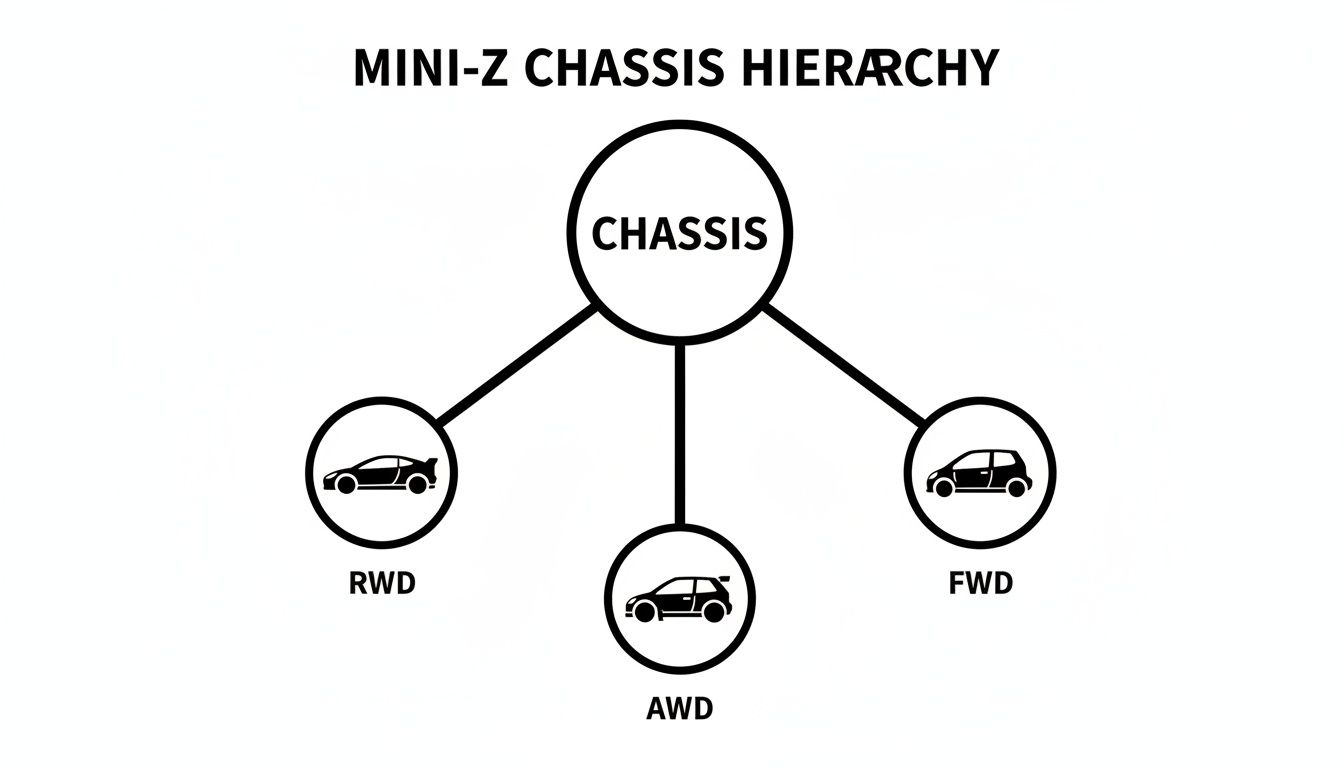
Each drivetrain layout is designed for a specific driving style, from high-grip circuit racing to technical drifting. Knowing your chassis is the first step in making smart upgrade decisions.
From Brushed To Brushless Motors
The motor is the heart of your Mini-Z. Swapping it out is one of the most dramatic performance boosts you can make. The stock ReadySet includes a reliable brushed motor, which is perfect for getting a feel for the car. Think of it as a dependable daily driver—it’s simple, effective, and gets the job done.
But to unlock serious speed and control, you need a brushless motor. A brushless setup is the high-performance racing engine of the Mini-Z world. It’s far more efficient, significantly more powerful, and requires almost no maintenance. Brands like Hobbywing and Team Powers are race-proven in the Canadian scene, delivering the explosive acceleration and top-end speed needed to be competitive.
The jump to brushless isn't just about raw power. It gives you smoother, more precise throttle control—absolutely critical for navigating tight corners and managing traction on high-grip carpet. That level of control lets you put the power down exactly when you need it, helping you shave precious tenths off every lap.
The Brains Of The Operation: ESCs And Servos
If the motor is the heart, the electronics are the brain and nervous system. To properly harness the power of a new brushless motor, you need to upgrade the Electronic Speed Controller (ESC) and servo to match.
The ESC is what translates your throttle inputs into power for the motor. A quality brushless ESC, like the Hobbywing EZRUN MINI28, provides a much smoother power curve and a more connected throttle feel than the all-in-one stock board. It lets you fine-tune your car's response and can handle the demands of a powerful motor without breaking a sweat.
A well-matched motor and ESC combination is the foundation of a competitive race car. It’s not just about going faster in a straight line; it's about having controllable, consistent power through every part of the track.
The servo controls your steering. Upgrading to a faster, more precise servo from a brand like AGFRC makes a night-and-day difference in handling. A high-performance servo delivers lightning-quick steering response and holds your line with unshakable accuracy, giving you the confidence to dive into corners harder and faster. For expert advice on pairing your electronics, you can explore our in-depth ESC selection guide that matches your electronic speed controller to your motor.
Powering Your Passion: AAA vs. LiPo Batteries
Stock Mini-Z cars are designed to run on four standard AAA batteries. While convenient, they just can't supply the consistent power needed for racing. As AAA batteries drain, you'll feel a noticeable drop-off in performance, lap after lap.
The solution is a move to Lithium Polymer (LiPo) batteries. This upgrade is like swapping out a standard fuel tank for a high-octane racing fuel cell. LiPo batteries give you several key advantages:
- Higher Voltage: They deliver more punch and maintain a flat, consistent voltage throughout the entire run. Your car stays fast from the first lap to the last.
- Lighter Weight: A LiPo pack is lighter than four AAA cells, which helps lower the car's centre of gravity and improve its agility.
- Faster Charging: With a proper balance charger, LiPo batteries can be recharged much more quickly, getting you back on track in no time.
For any serious racer, this upgrade is non-negotiable. The consistent power delivery means you can focus entirely on your driving without worrying about the car fading mid-race.
Where The Rubber Meets The Road: Tires
Finally, we get to what is arguably the most critical upgrade of all: tires. You can have the most powerful motor and the slickest electronics, but if your tires can't put that power to the ground, it's all wasted. It's like putting economy tires on a supercar—you'll never unlock its true potential.
The stock rubber tires are fine for driving around the house, but for racing on prepared surfaces, you need specialized compounds. For indoor racing, your main choices are:
- High-Grip Rubber Slicks: These are the go-to for most carpet and RCP tracks. Different compounds (measured in "degrees" of hardness) are available to match specific track conditions. A softer tire will offer more grip but will also wear out faster.
- Foam Tires: Often required for ultra-high-grip surfaces or specific race classes, foam tires provide immense traction. They do require more maintenance, like "truing" them on a lathe to keep them perfectly round, but they can offer a significant handling advantage.
Experimenting with different tire compounds is a massive part of tuning your Mini-Z. Finding the right set for your local track can shave seconds off your lap time and is often the final piece of the performance puzzle.
Mastering Setup And Tuning Fundamentals
Upgrades give your Kyosho Mini-Z its raw potential, but tuning is what turns that potential into pure performance on the track. This is where the magic really happens—turning a fast car into a winning car. Tuning is all about making small, precise adjustments to your car’s geometry and balance to make it faster, more stable, and easier to drive.
Think of it like a professional musician tuning their instrument before a concert. The instrument is capable of producing beautiful music, but it can only reach its full potential when every string is perfectly adjusted. Your Mini-Z is the same; a few careful tweaks can be the difference between fighting the car every corner and feeling completely connected to the track.
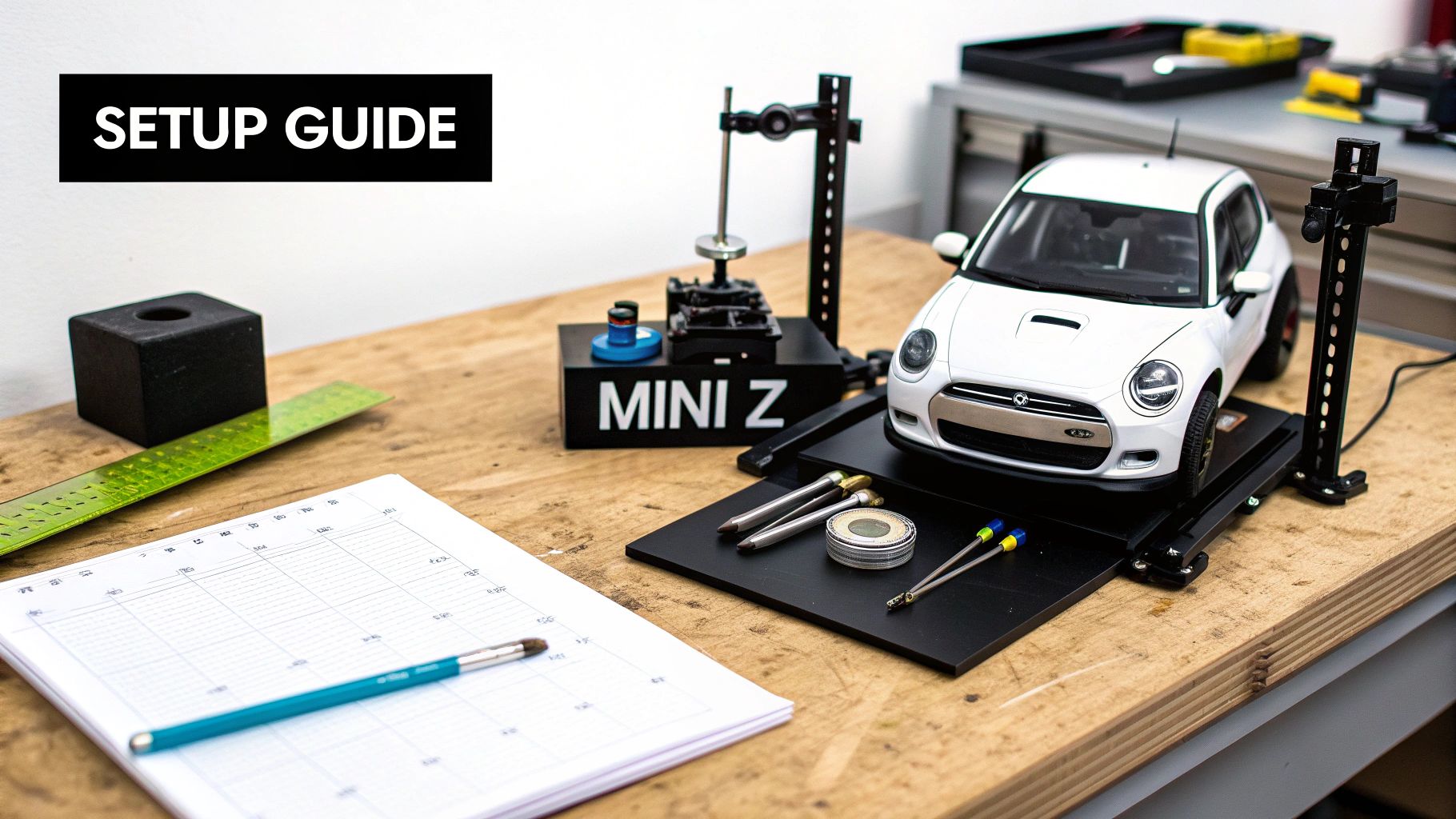
This process isn’t about guesswork. It’s about understanding how each little adjustment affects handling and then using that knowledge to fix specific problems. When you learn these fundamentals, you stop being just a driver and become the engineer of your own success.
Understanding Key Suspension Geometry
Suspension geometry might sound complex, but it really just boils down to the angles of your wheels relative to the chassis and the ground. Three core concepts—camber, toe, and caster—are the foundation of any good setup. Mastering them is your first big step toward total control.
- Camber: This is the vertical tilt of your wheels when you look at the car from the front. Negative camber means the tops of the tires lean inward. This is crucial for maximizing the tire's contact patch during cornering, giving you way more grip when you need it most.
- Toe: This refers to the angle of the wheels when viewed from above. “Toe-in” means the front of the tires point toward each other, which adds stability. “Toe-out” means they point away, which sharpens up your steering response and helps the car dive into turns more aggressively.
- Caster: This is the angle of the steering pivot when you look at the car from the side. More caster generally improves straight-line stability but can make the steering feel a bit heavier.
Adjusting these angles with different knuckles or tie rods is a fundamental part of dialing in your car for a specific track. A little toe-out on the front might help a car whip around hairpins, while a touch of negative camber all around can dramatically boost your cornering speed.
Real-World Tuning Scenarios
Theory is one thing, but actually applying it on the track is what really counts. Let’s break down some common handling problems and see how a simple tuning adjustment can be the solution.
Your goal in tuning is to create a car that is predictable and consistent. When you can trust what the car will do, you can push it to its limits with confidence, lap after lap.
Problem: Your car spins out when you accelerate out of a corner (oversteer).
- The Fix: This often means the rear of the car is losing traction too abruptly. Try softening the rear suspension by using a softer T-plate. This allows the chassis to flex more, making the rear end more predictable and less likely to snap loose under power.
Problem: Your car doesn’t want to turn and just pushes wide in corners (understeer).
- The Fix: This is a classic sign that the front end lacks grip. You can increase front-end bite by switching to softer front springs. Softer springs let more weight transfer to the front tires during braking and turn-in, planting them firmly on the track and pulling the car through the corner.
A Foundational Setup For The MR-04
For Canadian racers hitting indoor carpet or RCP tracks, having a solid baseline setup for a popular chassis like the MR-04 is a game-changer. It gives you a neutral, well-behaved starting point that you can then tweak to match your driving style and the track conditions.
Here’s a great starting setup for a Kyosho Mini-Z MR-04:
- Front Springs: Red (Medium)
- T-Plate: #4 Carbon (Medium-Hard)
- Rear Damper: Stock friction damper with medium grease
- Front Camber: -1.5 degrees
- Front Toe: 0 degrees (neutral)
- Ride Height: As low as possible without the chassis scraping the track
This setup is all about balance. It gives you enough steering to be agile without making the rear end too loose. From here, make small, one-at-a-time adjustments. If you need more steering, try the orange (soft) front springs. If the rear feels too planted, try a slightly harder T-plate. The key is to change only one thing at a time so you can clearly feel its effect.
With quality tools and shims readily available from Canadian suppliers like digital-rc, you have everything you need to start engineering your car's path to the podium.
Sourcing Your Mini-Z Gear in Canada
For Canadian RC enthusiasts, getting into the Kyosho Mini-Z hobby can sometimes feel like an uphill battle. Sourcing the right cars, parts, and upgrades often means looking at international retailers, which brings a whole host of headaches—currency conversion, surprise import duties, and painfully long shipping delays.
That initial excitement can quickly fade when you're stuck in a frustrating waiting game. The good news? There's a much better way. Choosing a dedicated Canadian-based specialist transforms the entire experience, removing all the guesswork and getting you on the track faster.
The Benefits of Shopping Local
Shopping with a Canadian online store like digital-rc offers immediate, practical advantages that make all the difference. The entire process is built around what local racers actually need, creating a smooth path from browsing to driving.
Here’s what that looks like in practice:
- CAD Pricing: What you see is exactly what you pay, in Canadian dollars. No more nasty surprises on your credit card statement from currency conversion fees.
- No Tax On All Orders: The price listed is the final price. This simplifies budgeting and means no extra costs pop up at checkout.
- Free Same-Day Delivery: For orders placed before noon, this service is an absolute game-changer. You can get essential parts when you need them most—sometimes even before your next race day.
This approach makes getting your Kyosho Mini-Z gear as straightforward and predictable as any other local online purchase. It just works.
By choosing a Canadian supplier, you eliminate the biggest points of friction in the hobby—cost uncertainty and shipping delays. You get transparent pricing and incredibly fast access to the parts you need to keep racing.
Finding the Right Parts and Upgrades
Beyond the initial car, your racing journey depends on having a reliable source for compatible parts and performance upgrades. This is where a curated inventory becomes crucial. Instead of sifting through thousands of parts, you get access to a hand-picked selection of race-proven brands like Hobbywing, Team Powers, and AGFRC. These are the components known to perform well in the Canadian racing scene.
This curated approach is especially helpful for newcomers. You can confidently start with a budget-friendly ReadySet kit, knowing that a clear upgrade path with compatible, high-performance electronics is right there when you're ready to get more competitive. It ensures you invest in parts that work together to get the most out of your car. Of course, for those times you have to source specialized items from global suppliers, learning how to track international packages is also a valuable skill.
If you're looking for more options, our guide to finding the best RC car stores near you can point you in the right direction. Ultimately, it’s about building your car strategically, with every component sourced efficiently and affordably right here in Canada.
Essential Maintenance And Troubleshooting Tips
A well-maintained Kyosho Mini-Z is a fast and reliable car. But consistent performance on the track doesn't just come from slick upgrades; it’s born from a solid routine of care and a few preventative checks. Spending a little time on the bench saves you a lot of frustration later and keeps your car feeling crisp and responsive, lap after lap.
Think of it like a pilot's pre-flight checklist. You wouldn't want to find a problem mid-air, and you definitely don't want a simple mechanical issue taking you out of a race. A few key checks before and after each run will make all the difference.
A Practical Maintenance Checklist
Regular maintenance keeps your Mini-Z running at its absolute peak. It makes sure all those high-performance parts you've installed can actually do their job without being held back by dirt, wear, or unnecessary friction.
Here are the core tasks to build into your routine:
- Clean Your Bearings: Those tiny ball bearings in your wheels and drivetrain are everything for efficiency. After a race day, pop them out and give them a quick clean with motor spray or a dedicated bearing cleaner to blast out dust and carpet fibres. A single drop of light oil before putting them back in keeps them spinning like new.
- Check Gear Mesh: The connection between your motor’s pinion gear and the main spur gear is critical. It needs to be snug, but not too tight. A tight mesh creates drag that can burn out your motor, while a loose one will shred your gear teeth in a heartbeat.
- Inspect Tire Wear: Your tires are your only connection to the track. Always check them for uneven wear, bits of debris, or signs of the tire coming unglued from the wheel. A quick wipe with a simple tire cleaner is all it takes to restore grip for your next run.
Common Problems And Quick Fixes
Even with perfect maintenance, things can and will go wrong. Learning how to diagnose problems methodically is a key skill. Instead of getting frustrated, just think of it as a process of elimination.
A common issue can often have a very simple solution. The key is to check the most obvious potential causes first before you start taking the entire car apart.
Here’s a quick guide to some of the most frequent Kyosho Mini-Z troubles:
Problem: The car pulls to one side on a straight.
- Solution: Your steering trim is the first thing to check. Make sure it's centred on your transmitter. If that doesn't fix it, take a close look at your front steering knuckles and tie rods for any damage or binding. A misaligned servo saver can also be the culprit here.
Problem: The motor feels sluggish or lacks its usual punch.
- Solution: For brushed motors, this is a classic sign they need a good cleaning with motor spray or may be nearing the end of their life. On a brushless setup, check your battery connections first and make sure your LiPo is fully charged. Beyond routine checks, safe handling and storage of batteries are critical for longevity and safety; explore safe lithium battery storage techniques to minimize risks.
Having a reliable Canadian source like digital-rc for essential spares like pinions, bearings, and spur gears means you can fix these issues quickly and get back to racing without missing a beat.
Your Kyosho Mini-Z Questions Answered
Jumping into the world of Kyosho Mini-Z is exciting, but it naturally brings up a lot of questions, especially if you're new to the hobby. Here are the answers to some of the most common things Canadian racers ask, designed to get you on the track and having fun with total confidence.
What Scale Are Kyosho Mini Z Cars?
The overwhelming majority of on-road Mini-Z cars, like the ones you'll see in the MR and MA series, are built to a precise 1:28 scale. It's this specific scale that allows Kyosho to pack in so much detail and performance into such a small footprint.
You will find some outliers, though. The Mini-Z Buggy, for instance, is a slightly larger 1:24 scale to give it the ground clearance and presence it needs to handle off-road driving.
How Fast Can a Mini Z Go?
Straight out of the box, a standard "ReadySet" Mini-Z with its stock brushed motor will hit speeds around 20-25 km/h. Now, that might not sound like a lot, but at 1:28 scale, it feels incredibly quick and is more than enough for some seriously thrilling indoor racing.
Once you get into performance upgrades, things get a lot faster. A fully built Mini-Z with a high-end brushless motor and a LiPo battery can easily blow past 60-70 km/h on a long straight. That kind of speed delivers blistering acceleration and takes real skill to master.
Can I Use My Own Transmitter?
This is a common question, and the answer depends entirely on the chassis you choose. The standard ReadySet kits you see everywhere come with a Kyosho Syncro KT-531P transmitter. These cars are built to work only with that specific radio. They won't bind to high-end transmitters from brands like Futaba or Sanwa.
If you want to use your own hobby-grade radio, you need to step up to an EVO chassis, like the MR-04 EVO2. These are sold as kits without a transmitter, allowing you to install a separate receiver module that's compatible with your preferred radio system.
What Batteries Do I Need to Start?
Getting a ReadySet up and running is simple—all you need is a good set of AAA batteries. You'll want four high-quality AAA alkaline or, even better, rechargeable Ni-MH batteries for the car itself. You'll need another four for the KT-531P transmitter.
What is the Best Kyosho Mini Z to Start With?
If you're a complete beginner or you think you might want to try both grip racing and drifting, the AWD MA-020 ReadySet is a phenomenal starting point. It's stable, incredibly versatile, and even has a "Training Mode" to help you ease into the controls without feeling overwhelmed.
But, if you know you want to get into competitive on-road racing at a Canadian club, your best bet is to start with a RWD MR-04 ReadySet. It puts you on the premier racing platform from day one, so you're learning on the same chassis the top drivers use.
Ready to find the perfect Kyosho Mini-Z chassis and the race-proven upgrades to match? Explore our curated collections at digital-rc and get everything you need with fast, free Canadian delivery. Visit us today at https://digitalrc.ca.