

rc cars canada: Your Guide to On-Road RC Racing & Tuning
So, you're looking to get into the world of RC cars in Canada? You’ve come to the right place. From the tight indoor tracks in Vancouver to the sprawling asphalt circuits out east, there's a vibrant community of racers and builders waiting for you.
This guide is your complete roadmap. Whether you’re trying to pick out your very first on-road touring car or scouting for local tracks to burn some rubber, we'll get you sorted.
Your Starting Grid for RC Racing in Canada
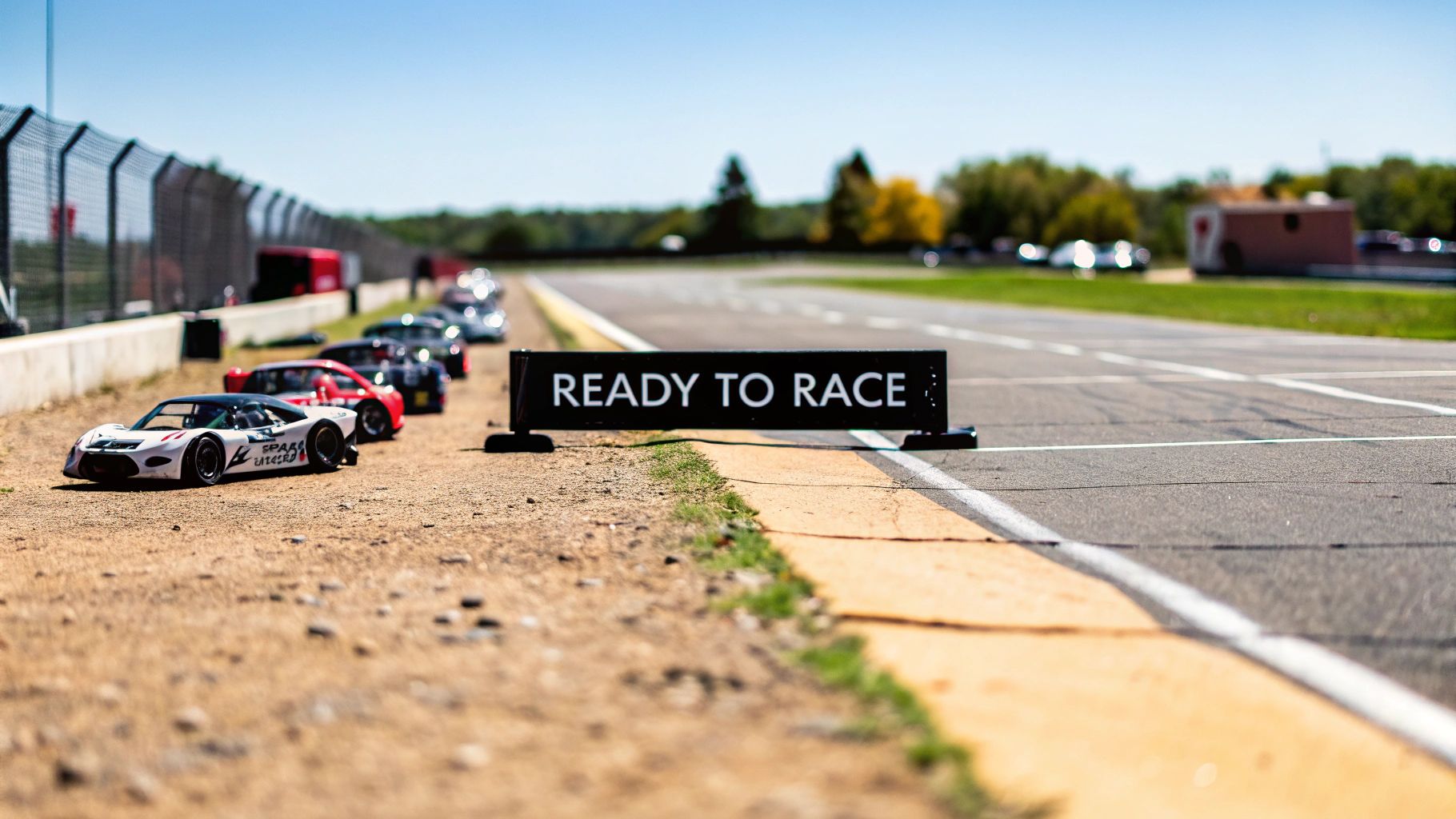
Welcome to the seriously addictive world of on-road radio-controlled car racing. Forget what you think you know about "toy cars"—these are high-performance machines engineered for speed, precision, and flat-out competition.
Think of this guide as your personal pit crew briefing, designed specifically for the Canadian RC scene. We’re here to demystify the core concepts and show you just how accessible this hobby really is. We’ll focus on the most popular on-road classes, helping you understand what makes them tick so you can find the perfect fit for your racing ambitions.
Understanding the Main On-Road Classes
In Canada, two classes really dominate the on-road racing circuit: 1/10 scale touring cars and 1/12 scale pan cars. Each one offers a completely unique driving experience, with its own set of challenges and rewards. Let's break them down.
Here’s a quick look at how these two popular classes stack up against each other.
On-Road RC Car Classes Quick Comparison
| Feature | 1/10 Scale Touring Car | 1/12 Scale Pan Car |
|---|---|---|
| Drivetrain | 4WD | RWD |
| Suspension | Fully Independent | Pivot-Ball Link (Simple) |
| Best For | Versatility (carpet & asphalt) | High-Grip Carpet Tracks |
| Driving Feel | Stable, predictable, realistic | Nimble, fast, requires precision |
| Complexity | More complex (shocks, diffs) | Simpler, direct drive |
| Body Style | Realistic touring/sedan cars | Le Mans-style prototypes |
This table gives you a solid starting point, but the real difference is in how they feel on the track.
1/10 Scale Touring Cars
These are the versatile workhorses of the RC world. With four-wheel drive and independent suspension, they look and handle a lot like real-world touring race cars. They’re fantastic all-rounders that can be set up for almost any surface, from smooth indoor carpet to bumpy outdoor asphalt.
1/12 Scale Pan Cars
Now, these are a different beast entirely. Pan cars are lightweight, rear-wheel-drive rockets. Their design is much simpler, but don't let that fool you—they are incredibly fast and agile. Their direct-drive systems deliver instant, explosive acceleration, making them absolute specialists for high-grip indoor carpet tracks.
The choice between a touring car and a pan car often comes down to your local track. A 1/10 touring car is a great choice if you want to race anywhere, while a 1/12 pan car is a precision instrument built to dominate on carpet.
This hobby is bigger than you might think. The remote control car market in Canada has been growing steadily, fueled by a renewed interest in hands-on activities. In fact, revenue in the market segment that includes RC cars is projected to hit US$586.86 million in 2025, with solid annual growth expected. This isn't just a niche hobby anymore; it's a thriving community.
What This Guide Will Cover
This guide is built to give you a clear path forward, from unboxing your first car to crossing the finish line with a grin on your face. We’ll cover everything you need to know to hit the track with confidence.
Whether you're trying to find an RC car track near you or want to master the art of suspension tuning, we’ve got you covered.
Our goal is to be a complete resource that helps you sidestep the common rookie mistakes and get you up to speed fast. We'll dive deep into selecting the right chassis, electronics, and tires, along with practical tips for buying and racing right here in Canada.
Get ready. It’s time to ignite your passion for speed.
Choosing Your First On-Road RC Car
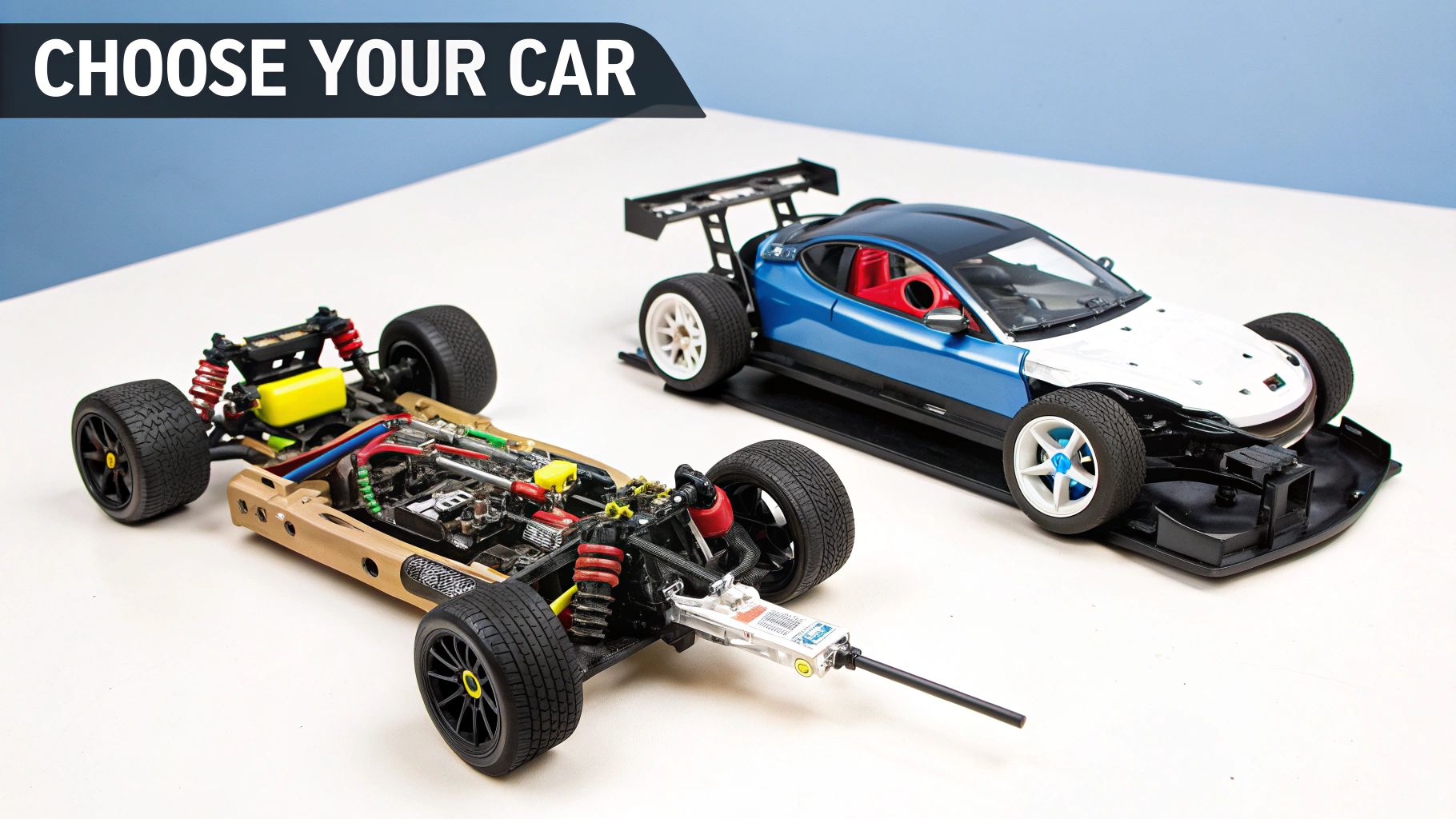
Stepping into the world of performance RC cars is an exciting moment. At first, picking your first car can seem complicated, but it really just boils down to a few key choices.
Think of it like buying a real car: the chassis is the frame and suspension, the motor and ESC (Electronic Speed Control) are your engine and transmission, and the battery is the fuel tank. Each piece plays a massive role in how your car feels and performs on the track.
Your first big decision is whether to go with a Ready-to-Run (RTR) package or build from a kit. An RTR is like driving a brand-new car off the dealership lot—it’s fully assembled and has everything you need to get going. Kits, on the other hand, are for those who want a more hands-on, custom experience, almost like building a project car in the garage.
For most newcomers to RC cars in Canada, an RTR is the perfect place to start. It gets you on the track faster with a lot less fuss.
Ready to Run Versus Building a Kit
So, RTR or a kit? The right answer depends entirely on your goals, your budget, and how much you enjoy tinkering.
- Ready-to-Run (RTR): These packages are all about convenience. They come pre-built with all the essential electronics installed. All you have to do is charge the battery, and you're ready to hit the track. It's the absolute fastest way to get driving.
- Kits: A kit is a box of parts. You get the chassis components in bags and build the car from the ground up following a detailed manual. You’ll also need to buy your motor, ESC, servo, radio system, battery, and charger separately.
While a kit gives you total control over customization and a much deeper understanding of how your car works, an RTR gives you a reliable, factory-tested setup that's ready for action straight away. You can always upgrade the parts on an RTR car later as your skills improve.
The Power Plant: Brushed or Brushless Motors
The motor is the heart of your RC car, and this choice has a huge impact on speed and maintenance. You’ll be choosing between two main types: brushed and brushless.
Think of a brushed motor as a dependable, classic engine. It's proven technology that’s simple and affordable, which is why you’ll find it in most entry-level RTR cars. It delivers good, predictable performance and is perfect for learning the basics of throttle control.
A brushless motor, however, is the modern, high-performance option. It's far more efficient, way more powerful, and requires practically zero maintenance. This translates directly to higher top speeds and longer run times. While they do cost more upfront, most serious racers eventually upgrade to a brushless system for that competitive edge.
The technology inside these tiny powerhouses actually reflects much bigger trends. For instance, the Canadian automotive electronics market—which includes many components similar to those in high-end RC cars—hit USD 16,094.30 million in 2024. It's projected to keep growing, driven by better batteries and smarter control systems. You can discover more about these market trends and see how they're shaping the technology in our hobby.
Understanding Your Fuel: LiPo Batteries
Gone are the days of the old NiMH (Nickel-Metal Hydride) batteries. Today, the standard for any serious RC car is the LiPo (Lithium Polymer) battery. They are the high-octane fuel of the electric RC world.
A LiPo battery offers a powerful advantage because it delivers consistent voltage throughout its discharge cycle. This means your car performs just as strongly on the last lap as it did on the first—a crucial factor in competitive racing.
LiPo batteries come with some important terms you'll need to know:
- Voltage (S Rating): The "S" tells you the number of cells. For on-road racing, you'll almost always be using 2S (7.4V) packs for 1/10 scale touring cars and 1S (3.7V) packs for 1/12 scale pan cars.
- Capacity (mAh): Measured in milliamp-hours, this is the size of your fuel tank. A higher mAh rating (like 6000mAh) means a longer run time before you need to recharge.
- Discharge Rate (C Rating): This number tells you how quickly the battery can safely deliver its power. A higher C rating provides more "punch" or acceleration, which is absolutely critical for racing.
Choosing the right combination of chassis, motor, and battery is your first step toward building a car that matches your ambition and skill level, setting you up for success on Canadian tracks.
Where to Buy RC Cars and Parts in Canada
Once you’ve got a good idea of the car you want, the next big question is where to get it. For RC cars in Canada, your choice really boils down to supporting a local hobby shop or clicking "buy" on a big international website. Each route has its pros and cons.
This decision is more important than you might think. It can affect your initial cost, how quickly you get parts, and the support you have down the road. Getting this right from the start makes the whole hobby a lot more fun.
Local Canadian Hobby Shops
There’s nothing quite like walking into a real hobby shop. It's more than just a store—it's where you get real-world advice from seasoned racers who know the local tracks and what actually works. You just can't get that kind of personalized recommendation from a product description page.
Buying from a local Canadian business also means you’re putting money back into your own racing community. These shops are often the ones sponsoring races and helping maintain tracks, keeping the hobby strong for everyone. Plus, you get to walk out with your gear in hand. No waiting, no tracking numbers.
International Online Retailers
On the other hand, it's hard to ignore the massive international online stores. Their inventory can seem endless, and they sometimes carry obscure brands or parts that are tough to find in Canada. At first glance, the prices can look pretty attractive, too.
But that sticker price is often just the beginning. Ordering from outside of Canada means you’re signing up for a whole host of extra costs that can wipe out any initial savings in a hurry.
Be prepared for cross-border logistics. You will almost certainly face customs delays, and you’ll be on the hook for Canadian taxes (GST/PST/HST) plus brokerage fees and import duties. These fees can easily add 15-30% or more to your total cost.
This is a huge deal for anyone buying RC cars in Canada. That great price on a US website can turn into a nasty surprise when the courier shows up asking for a pile of cash for taxes and duties.
Shopping Options for RC Cars in Canada
To make the choice clearer, here’s a quick comparison of your main options.
| Shopping Option | Advantages | Potential Disadvantages |
|---|---|---|
| Local Canadian Hobby Shops | - Instant gratification—get your gear today. - Expert, hands-on advice from experienced racers. - Supports the local racing community. - Easy returns and in-person support. |
- May have a smaller selection of niche brands. - Prices might be slightly higher due to overhead. |
| International Online Stores | - Massive inventory and brand selection. - Can sometimes offer lower initial sticker prices. |
- Surprise costs: duties, taxes, and brokerage fees. - Long shipping times and potential customs delays. - Complicated and expensive international returns. - No local support or warranty handling. |
Ultimately, weighing these factors helps you decide what's most important: immediate access and community support, or a wider selection with potential hidden costs.
The Canadian E-Commerce Advantage
Thankfully, there’s a sweet spot. A growing number of Canadian-based online specialty shops are giving racers the best of both worlds. You get the curated, race-proven gear you want with the convenience of online shopping, but without any of the cross-border headaches.
Here’s what to look for when shopping from a Canadian online store:
- CAD Pricing: The price you see is the price you pay. No mental math trying to figure out currency conversion.
- No Surprise Fees: When you buy from a Canadian retailer, taxes are clear upfront, and there are no import duties or brokerage fees waiting for you.
- Fast, Local Shipping: Many Canadian online shops offer same-day or next-day delivery in major cities, which means less waiting and more racing.
- Local Warranties and Support: Handling a return or a warranty claim is a thousand times easier when you aren't shipping parts back across the border.
The demand for high-performance RC cars in Canada is fuelled by a seriously dedicated community of hobbyists—it’s no wonder that over 40% of RC cars sold here go to them. The shift to e-commerce has made top-tier models more accessible than ever, with online sales jumping by 18% as racers move toward reliable Canadian sources.
At the end of the day, choosing a solid Canadian supplier isn't just about convenience—it's a smart financial move. When you add up the fast shipping, local support, and zero surprise fees, buying from a dedicated Canadian RC racing shop is almost always the most practical and cost-effective way to go. And speaking of essential gear, check out our guide on finding the right LiPo batteries in Canada to power up your new ride.
Finding Your Place in the Canadian RC Community
Sure, the thrill of speed and the challenge of a perfect setup are what draw you in. But the real heart of RC racing? It’s the people. The moment you move from ripping a car around an empty parking lot to joining the local race scene is when the hobby truly comes alive. Canada has a fantastic, welcoming community, and getting involved is easier than you think.
This community is the lifeblood of RC cars in Canada. It's where you'll learn the fast way around the track, get a hand troubleshooting a stubborn setup, and share the buzz of a close race. It transforms a solo pastime into a shared passion.
Locating Local Clubs and Tracks
First things first: you need to find where people are racing. From major hubs like Toronto and Vancouver to smaller towns, dedicated groups of racers are organizing events everywhere. A quick search for "RC car club [Your City]" or "RC track [Your Province]" is the best place to start.
A lot of Canadian clubs are super active on Facebook. These groups are goldmines for race schedules, setup questions, and just getting a feel for the local scene before you show up. Don't be shy—jump in, introduce yourself, and ask when the next race day is.
The vibe at a local club race is incredibly supportive. Racers are almost always willing to lend a hand, offer setup advice, or even let you borrow a tool you forgot. Everyone there started as a beginner, and they remember what it was like.
Your local hobby shop is another indispensable resource. The staff are almost always plugged into the local racing scene and can point you straight to the nearest tracks and the people who run them.
Different Venues for Racing
On-road RC racing in Canada plays out on a couple of different surfaces, and each one brings its own unique challenge. The track you race on will dictate your car setup, especially your tire choice.
- Temporary Carpet Tracks: These are a huge deal during the long Canadian winters, often popping up in community halls, school gyms, or arenas. The super high-grip surface is perfect for nimble 1/12 scale pan cars and demands a specific setup to maximize corner speed.
- Permanent Asphalt Circuits: These outdoor tracks offer a more traditional racing experience, a lot like full-scale motorsport. The surface is more abrasive and less consistent than carpet, making tire selection and suspension tuning absolutely critical for a fast 1/10 scale touring car.
Understanding the difference is key. A setup that dominates on a smooth, high-bite carpet track will be a handful on a bumpy, lower-grip asphalt circuit. Hitting up both types of tracks is the fastest way to learn how to adapt your car and your driving.
Race Day Etiquette and Getting Involved
Once you've found a club, showing up for a race day is the next big step. It can feel a bit intimidating, but a few simple rules of etiquette will help you fit right in. Pay attention during the driver's meeting, learn how to marshal (putting crashed cars back on the track), and give faster drivers room to pass.
Most importantly, just get involved. Ask questions in the pits, offer to help marshal between your heats, and stick around to watch the fast guys race. By jumping in, you’ll quickly go from being the new face to a regular, and you’ll discover the Canadian RC community is one of the most rewarding parts of the hobby.
Tuning Your Car for Canadian Tracks
Getting your new RC car is just the start—the real magic happens when you dial it in for the track. This is the process of transforming a great car into your car. Tuning might sound complex, but it's really just a series of small, logical adjustments that make a huge difference in performance.
Think of it like getting a wheel alignment on your daily driver. Tiny changes to how the tires meet the pavement can dramatically improve handling, stability, and even how quickly the tires wear out. We apply those same principles in RC to make the car faster, more consistent, and easier to drive right on the edge.
Core Suspension Adjustments Explained
Let's break down some of the most common tuning terms. You don't need to be a mechanical engineer to get this; simple analogies make it easy to picture what each adjustment actually does on the track.
- Camber: This is the vertical angle of your tires when you look at the car from the front or back. Negative camber (where the top of the tire tilts inward) is key for increasing cornering grip, much like how a figure skater angles their blades to carve into the ice.
- Toe: This is the angle of your tires when viewed from above. "Toe-in" (front of the tires pointing toward each other) adds stability on the straights, while "toe-out" makes the car dive into corners more aggressively.
- Ride Height: This one's simple—it's just the distance between your chassis and the ground. A lower ride height is great for reducing body roll on smooth, high-grip tracks. A higher setting helps the car float over bumpier surfaces without slapping the chassis on the ground.
These three adjustments are the foundation of any good setup. Getting comfortable with them is your first big step toward unlocking your car’s true potential.
The Role of Shocks and Droop
Beyond the basic geometry, your car's handling is dictated by the shocks and a critical setting called droop. Your shocks work just like the ones in a full-size car, absorbing bumps and controlling how the car’s weight shifts as you accelerate, brake, and corner.
The secret ingredient here is shock oil viscosity. Thicker oil (a higher "cSt" or "wt" number) slows down the suspension's reaction, which is perfect for smooth, grippy tracks. Thinner oil lets the suspension move faster, helping it soak up bumps on lower-grip surfaces. It's like the difference between pouring molasses and water—one is slow and controlled, the other is quick and responsive.
Droop is a related but crucial adjustment that controls how far the suspension arms can travel downwards. More droop allows for more weight transfer, which can generate more grip, especially on bumpy or slick tracks. Less droop limits this movement, making the car feel sharper and more direct on high-grip surfaces.
Tuning is always a balancing act. The perfect setup for a high-grip indoor carpet track in Calgary will feel completely wrong on a sun-baked asphalt circuit in Montreal. Your goal is to find the setup that best suits the track, the conditions, and your personal driving style.
Racing isn't just about the car; it’s about being part of a community where knowledge and experience are shared. This is how the best drivers get even better.

This diagram shows how Canadian clubs, tracks, and events all connect. Getting involved is the fastest way to learn and improve.
Tire Selection Is Everything
You can have the best-tuned chassis and the most powerful motor on the planet, but if your tires aren't right, you won't be fast. Period. Tires are the single most important tuning option you have—they're your car's only connection to the track.
For carpet racing, you'll be using specific rubber compounds designed for insane levels of grip. For asphalt, the compounds are harder to stand up to the abrasive surface. Just as important are the tire inserts, which are the foam rings inside the tire that provide support. A softer insert can generate more grip, while a harder one provides more stability at high speed.
Your motor choice also plays a role here, as a smoother power delivery is always easier on your tires. If you want to dive deeper, you can learn more about how to choose the right motor for your RC car in our detailed guide. The key is to make small, methodical changes to your setup until you find what works, helping you nail those faster, more consistent laps.
Your Top Questions About RC Cars in Canada, Answered
Jumping into any new hobby brings a flood of questions, and high-performance RC is no different. We've gathered the most common questions from racers just starting out in the Canadian scene to give you clear, direct answers. Think of this as your quick-start guide to get you on the track faster and with more confidence.
Getting these fundamentals right from the start will help you make smarter buying decisions, save some cash, and ultimately have a lot more fun.
What’s a Realistic Budget for a Beginner RC Car in Canada?
For a solid, entry-level 1/10 scale on-road Ready-to-Run (RTR) package, a realistic starting budget is between $350 and $550 CAD. This price point typically gets you a fully assembled car, a basic radio, a battery, and a charger—literally everything you need to hit the ground running.
If you're looking to dive straight into competitive racing, a kit chassis alone will start in the $400-$700 range. From there, you'll need to add another $500-$800 for your electronics, tires, and a body. Whichever path you take, it’s always a good idea to set aside an extra $100 for essential tools and a few common spare parts.
Are Electric or Nitro RC Cars Better for Beginners?
For anyone starting with RC cars in Canada, electric is the clear winner. There’s really no contest. They are infinitely cleaner, much quieter, and far simpler to maintain and tune than their nitro-powered cousins. Electric motors give you instant, predictable power without the mess and hassle.
The most compelling reason to go electric is track access. Nearly all indoor tracks across Canada—where you'll be racing all winter—only allow electric cars because of ventilation rules. This alone makes electric the only practical choice for year-round racing.
How Do I Find an RC Race Track Near Me in Canada?
Your best bet is to start online. A quick search for "RC car clubs in [Your Province]" or "RC tracks near [Your City]" will usually point you toward local club websites or, more often, their active Facebook groups. These online communities are goldmines for race schedules, locations, and connecting with other racers.
Don't forget your local hobby shop. The staff are almost always plugged into the local scene and can give you the best advice on nearby tracks, clubs, and upcoming events. They're a fantastic resource for getting pointed in the right direction.
What Basic Tools Do I Absolutely Need to Start?
While most RTR kits toss in a few simple L-wrenches, investing in a small set of quality tools will make your life a thousand times easier. Your essential toolkit should have:
- Hex Drivers: You'll need 1.5mm, 2.0mm, and 2.5mm sizes for virtually every screw on your car.
- Nut Driver: A 7mm driver is the standard for wheel nuts.
- Needle-Nose Pliers: Incredibly handy for holding small parts or making fine adjustments to turnbuckles.
- Phillips Screwdriver: A good #1 or #2 Phillips will always come in useful.
Beyond those basics, a car stand and a pit mat are highly recommended. They keep your workspace clean and organized, and more importantly, they stop those tiny, mission-critical screws from disappearing into the void.
Ready to gear up for the track? At digital-rc, we provide Canadian racers with the premium parts, electronics, and support they need to compete and win. Enjoy fast, free, same-day delivery with no surprise fees. Find everything you need to build your next winning car at https://digitalrc.ca.
Article created using Outrank