

Your Guide to lipo battery 11.1 v: RC Power and Performance
If you're serious about competitive RC racing, you know that moving up from a standard 7.4V (2S) pack to an 11.1V (3S) LiPo battery is a total game-changer. It's not just a minor bump in power; it's the kind of upgrade that delivers a significant boost in speed and acceleration, giving you a critical edge on the track.
Understanding the 11.1V LiPo Battery Advantage
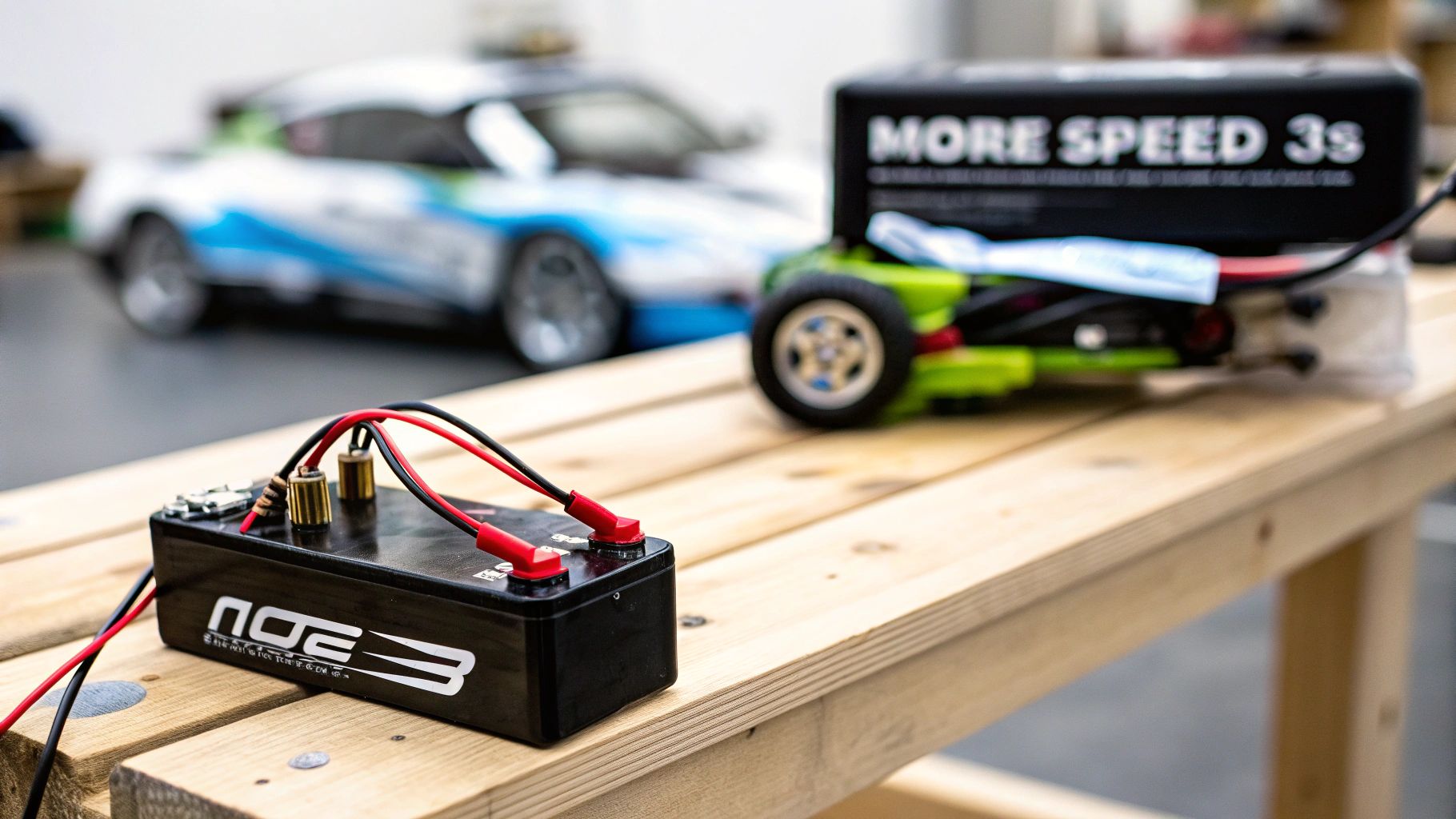
In competitive on-road racing, every single component choice is a strategic decision. When it comes to your power system, the jump from a 7.4V battery to an 11.1V LiPo is easily one of the most impactful upgrades you can make.
Think of it like shifting your full-size car into a higher gear. You get an immediate and very noticeable surge in performance. This gives you the raw speed needed to dominate the straightaways and that punchy acceleration required to power out of tight corners. It's why mastering the 11.1V LiPo is a non-negotiable step for anyone serious about winning.
Here at Digital RC, we see firsthand how top racers use this technology to gain a real competitive advantage. That's why our selection of high-performance batteries, like our premium Team Powers packs, is specifically curated to meet the intense demands of serious 1/10 and 1/12 scale on-road racing.
Let's break down the essential specs so you know exactly what you're working with.
11.1V (3S) LiPo Battery at a Glance
This table gives you a quick rundown of what makes up a standard 11.1V pack.
| Specification | Value | What It Means for Your RC Car |
|---|---|---|
| Nominal Voltage | 11.1V | The battery's standard operating voltage. This is the baseline power level. |
| Cell Count | 3S (3 cells in series) | Three individual cells are combined to achieve the higher 11.1V output. |
| Fully Charged Voltage | 12.6V | The peak voltage right off the charger, delivering maximum initial punch. |
| Nominal Voltage Per Cell | 3.7V | The standard "resting" voltage of a single LiPo cell. |
| Fully Charged Voltage Per Cell | 4.2V | The maximum safe voltage for each cell. A proper charger stops here. |
Understanding these numbers is key to managing your power effectively throughout a race.
Demystifying the Numbers: 3S and 11.1V
At first, the terminology can seem a bit technical, but it's actually pretty straightforward. "3S" is just shorthand for "3 cells in Series." Inside your battery pack, there are three individual lithium-polymer cells connected end-to-end, almost like train cars. This series connection is what combines their power to achieve a much higher total voltage.
Here’s how the math works out:
- Single Cell Voltage: Each LiPo cell has a standard operating voltage—what we call its nominal voltage—of 3.7V.
- Series Connection: By connecting three of these cells in series (3S), their individual voltages add up: 3.7V + 3.7V + 3.7V = 11.1V.
- The Result: This simple addition gives you the 11.1V nominal voltage that defines the battery's class.
Getting this basic structure down is the first step toward appreciating the serious power you're about to put on the track.
Nominal vs. Fully Charged Voltage
That 11.1V rating is the battery's average, or "nominal," voltage, but it doesn't tell the whole story. A LiPo battery's voltage actually changes as it charges and discharges. When you pull a 3S LiPo off a proper balance charger, it's sitting at its peak voltage, ready to unleash maximum power.
A fully charged 3S LiPo battery will read 12.6V (4.2V per cell). This peak voltage is what delivers that incredibly powerful punch when you first hit the track.
As you run your car, the voltage gradually drops back toward the 11.1V nominal level and continues to decrease until it hits your ESC's low-voltage cutoff.
For any competitive racer, recognizing the difference between nominal and peak voltage is essential. It helps you understand your car's performance curve throughout a race and explains why that first lap often feels the fastest.
Choosing the Right C-Rating and Capacity
When you're dialing in your RC car for the track, two numbers on your 11.1V LiPo battery pack become everything: the C-rating and the capacity (mAh). These specs are the difference between a car that feels sharp and one that falls flat. They dictate your car's power delivery and its stamina during a race, and getting the balance right is a massive part of building a winning setup.
Think of the C-rating as the width of a fuel line feeding your motor. A wider line lets more fuel—or in this case, electrical current—surge through all at once. That's what gives you that explosive acceleration out of the corners and the raw punch you need for a quick overtake.
Capacity, measured in milliamp-hours (mAh), is much simpler: it's the size of your fuel tank. A bigger tank holds more fuel, letting you stay on the track longer before you have to pit. But just like a real car, a bigger tank adds weight, and that can mess with your car's handling and agility.
Finding that sweet spot between punch and runtime is the key to tailoring your car's performance for a specific track or race format.
Decoding the C-Rating for Maximum Punch
The C-rating is just a multiplier. It tells you the maximum safe continuous discharge rate of your battery. A higher C-rating means the battery can dump current into your motor more aggressively without risking damage or a big drop in voltage.
For competitive 1/10 and 1/12 scale on-road racing, where instant throttle response is everything, a high C-rating is non-negotiable. When you pull the trigger, you need the battery to respond right now, especially in demanding modified classes.
A higher C-rating reduces internal resistance, allowing the battery to maintain a more stable voltage under heavy load. This means your car feels consistently powerful from the start of the race to the finish line.
Let's look at a couple of common race-day scenarios:
- Qualifying Laps: For a short, all-out qualifying run, a battery with a very high C-rating—think 130C or more—is perfect. It delivers maximum punch for the fastest possible lap time, and you don't care about the shorter runtime.
- Club Racing: For a typical 5-minute race, a battery with a solid 120C-130C rating gives you a great blend of power and consistency. You'll have enough punch for the whole heat without any fade.
Many of the premium batteries we stock here at Digital RC, like those from Team Powers, feature high C-ratings chosen specifically for their proven performance in the heat of competition.
Matching Capacity (mAh) to Your Racing Needs
While C-rating is all about punch, capacity (mAh) is all about runtime. Picking the right capacity is a strategic decision that comes down to balancing race duration against vehicle weight.
A higher mAh rating means a longer runtime, but it also means a heavier battery. That extra weight can make your car feel less nimble and can definitely alter your cornering balance. For a deeper dive into this, you can check out our detailed guide on powering your RC setup for maximum performance.
Here’s a quick breakdown of how to think about capacity for different races:
| Race Type | Recommended Capacity | Rationale |
|---|---|---|
| Short Qualifying | Lower mAh (e.g., 4000-5000mAh) | Reduces overall weight for maximum agility and acceleration over just 1-2 laps. |
| Standard Heats (5-8 mins) | Medium mAh (e.g., 5000-6500mAh) | This is the sweet spot. It offers the ideal balance of sufficient runtime and manageable weight for most races. |
| Endurance Mains | Higher mAh (e.g., 6500-8000mAh+) | Here, you prioritize runtime to make sure you can finish a long main event without dumping. |
A top-level racer might use a lighter, lower-capacity battery for their qualifying runs just to shave off a few precious milliseconds. Then for the A-Main, they'll swap to a higher-capacity pack to ensure they have enough power to fight for the win in those critical final minutes. That kind of strategic choice is what separates the experienced competitors from the rest of the pack.
Ensuring a Perfect Fit in Your RC Car
Choosing a lipo battery 11.1 v pack isn't just about the specs. A battery with massive power is useless if it doesn't physically drop into your chassis and plug into your electronics. This is where the practical side of RC racing comes in—getting the fit and connections right is what separates a clean, reliable build from a headache on race day.
Before you can even think about hitting the track with that 3S power, you need to make sure your battery and Electronic Speed Control (ESC) can talk to each other. That critical link happens at the connector, and a mismatch here will stop you dead. While there are a few types out there, a handful have become the go-to standard in competitive racing for their rock-solid reliability and low electrical resistance.
Matching Connectors for a Flawless Link
Think of the connector as the handshake between your battery and ESC. A sloppy or low-quality connection can bleed power or, worse, fail completely mid-race. Making sure your battery and ESC plugs are a perfect match is non-negotiable for any serious racer.
The most common high-performance connectors you'll run into are:
- Deans (T-Plug): A long-time favourite in RC racing, known for their compact footprint and solid, dependable connection.
- XT60: These yellow connectors are popular because they're easy to grip and create a very secure connection that's tough to pull apart by accident.
- EC3: Instantly recognizable by their blue housing and bullet-style pins, EC3s are another reliable choice for high-current setups.
At Digital RC, our selection of 11.1V LiPo batteries is already fitted with these race-proven connectors, so you can find a direct match for your setup and get back on track without any soldering.
Why Hardcase Protection Is a Must
When you're looking at a lipo battery 11.1 v, you’ll see two main styles: softcase and hardcase. For the brutal, high-impact world of on-road RC racing, this isn't even a choice—a hardcase battery is the only way to go.
A hardcase LiPo has a tough plastic shell that shields the delicate battery cells inside from punctures, impacts, and the intense vibrations of a race. This protection is absolutely essential to prevent damage that could lead to a dangerous failure or even a fire.
A softcase battery, which is just wrapped in shrink tubing, offers zero protection. It's completely unsuitable for an on-road chassis where one bad crash could easily crush the pack. Every battery we stock for 1/10 and 1/12 scale racing is a hardcase model because we prioritize your safety and the life of your gear.
Measuring Twice for a Secure Fit
Finally, you have to check the battery's physical dimensions. Get out your calipers or a ruler and measure the length, width, and height of your car’s battery tray. A battery that’s too big won't fit at all, while one that's too small can slide around during cornering, completely messing up your car's weight balance and handling.
Your goal is a snug, secure fit with almost no movement. We take the guesswork out of it by listing the exact dimensions for each 11.1V LiPo battery on its product page. For instance, our popular Team Powers 6000mAh pack is a proven fit for top-tier 1/10 touring car chassis like the Awesomatix and XRAY platforms. Choosing a battery designed for your car means a perfect, drop-in installation every time, letting you focus on your setup, not on making it fit.
Mastering Safe Charging and Balancing
Charging your 11.1V LiPo battery properly isn't just a good idea—it's the single most important thing you can do to keep it safe, performing at its peak, and lasting for seasons to come. Unlike the old NiMH packs you could just plug in and forget, LiPos demand a specific charging routine. That's why a dedicated LiPo balance charger is a non-negotiable piece of kit for any serious racer.
Think of your 3S pack as three separate glasses of water. A basic, non-balancing charger just dumps water in, hoping they all fill evenly. But a balance charger? It monitors each glass—each individual cell—making sure every single one is filled to precisely 4.2V. This balancing act is crucial. It prevents overcharging, which is the number one cause of battery damage and a serious fire risk.
Your Step-By-Step Charging Guide
Getting your charger set up correctly is a simple process that needs to become muscle memory. Do it the same way every time, and you'll protect your gear and get consistent, reliable power on race day.
- Select LiPo Mode: Your charger can handle different battery types (like NiMH or Li-Ion). The very first step, always, is to make sure it’s set to "LiPo" or "LiPo Balance" mode.
- Confirm the 3S Cell Count: The charger has to know it's working with a 3-cell battery. Most modern chargers will auto-detect this when you plug in the small white balance lead, but it’s your job to double-check the screen. It must say "3S" or "11.1V."
- Set a Safe 1C Charge Rate: "C" stands for capacity. A 1C charge rate is the industry standard for battery health and longevity. To figure this out, just take your battery's mAh rating and turn it into amps. For a 5000mAh battery, the 1C charge rate is 5.0 amps. Simple as that.
- Always Use a LiPo Safety Bag: This isn't optional. Before you start the charge, place the battery inside a fire-resistant LiPo bag. This simple container can prevent a catastrophe if something goes wrong, giving you critical peace of mind.
This straightforward routine—measure, connect, and protect—is the foundation of safe LiPo handling.
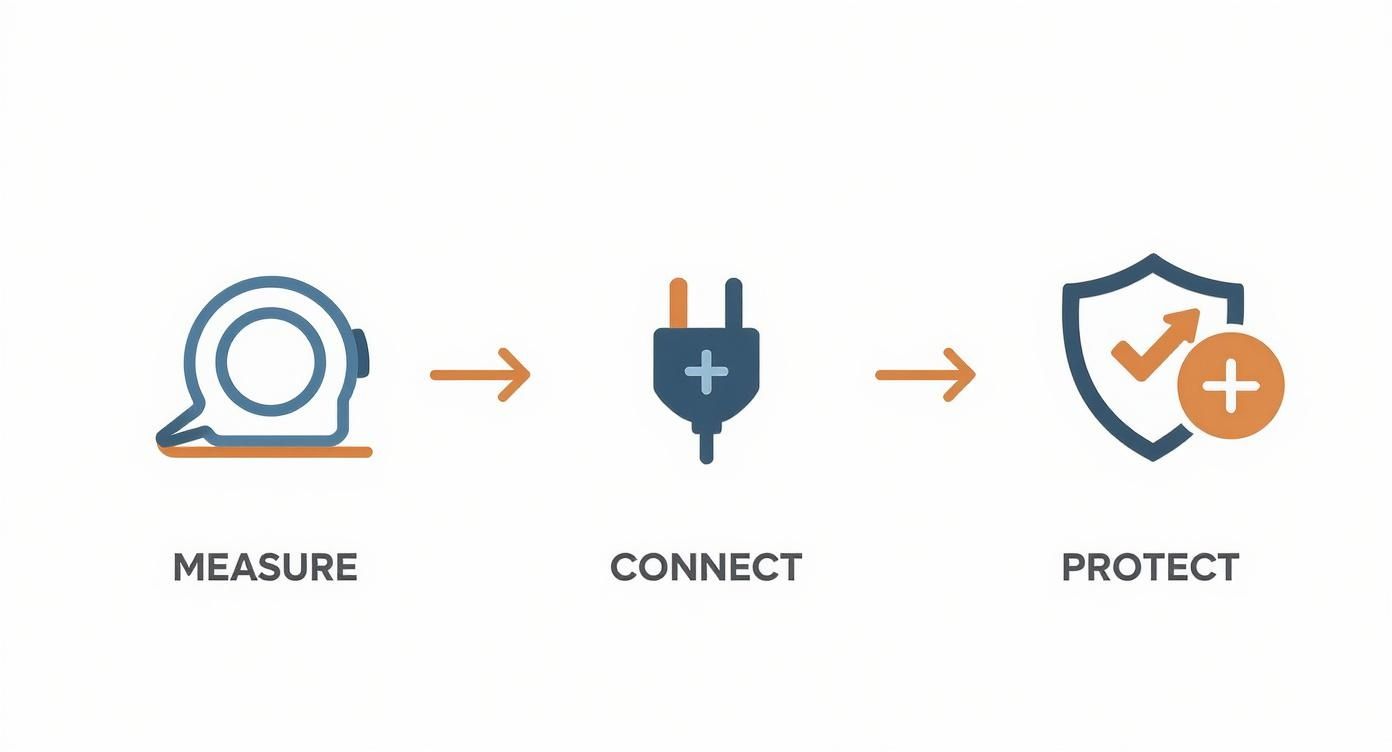
This process flow is a great mental checklist to run through every time you hit the pits, making sure you never miss a step.
To make setting your charge rate even easier, here’s a quick reference table for common battery sizes.
Safe Charging Settings for 11.1V (3S) LiPo Batteries
| Battery Capacity (mAh) | Recommended 1C Charge Rate (Amps) | Estimated Charge Time (approx.) |
|---|---|---|
| 3500mAh | 3.5A | ~60 minutes |
| 5000mAh | 5.0A | ~60 minutes |
| 6500mAh | 6.5A | ~60 minutes |
| 8000mAh | 8.0A | ~60 minutes |
Sticking to these 1C rates is the best way to ensure your batteries have a long and healthy service life.
Choosing a Reliable Charger
Not all chargers are built the same. A high-quality balance charger from a brand like SkyRC or iCharger is one of the best investments you can make in RC racing. It protects your expensive batteries, charges them safely, and gives you the features you need to stay competitive.
A quality charger provides accurate cell voltage readings and precise balancing, which directly translates to a healthier battery that delivers consistent power run after run. It's the foundation of a winning power program.
The market for LiPo batteries is growing fast, which means more options—and more responsibility for safe charging. That's why it's so important to pair your high-performance batteries with equally high-performance charging gear.
For our competitive racers, we always recommend chargers that not only handle a 11.1V LiPo battery but also offer essential features like storage charging and discharging. To help you sort through the choices, we put together a guide on how to choose the best LiPo battery charger for your specific racing needs. This ensures you get a unit that's a perfect match for your batteries, creating a safe and effective power system for your RC car.
Making Your Batteries Last: Proper Care and Maintenance
Getting the most out of your high-performance 11.1V LiPo battery isn't about how fast you can charge it—it’s about the habits you build to protect your investment. The right care routine ensures your packs deliver consistent, punchy power race after race, maximizing their lifespan and keeping them safe.
It all starts the moment you place the battery in your RC car. A loose pack is a disaster waiting to happen. During high-speed cornering or quick transitions, a shifting battery throws off your car's delicate weight balance, making it feel unpredictable and difficult to drive. Always use dedicated battery straps or foam blocks to lock your pack securely in the tray. No movement, period.
Routine Safety Checks: Your First Line of Defence
Before every charge and after every run, take 30 seconds to give your battery a quick once-over. This simple habit is the single most important thing you can do to catch problems early. It's a non-negotiable step for any serious racer.
Make this your pre-charge checklist:
- Check for Puffing: Gently squeeze the sides of the hardcase. If it feels soft, swollen, or puffy in any way, that battery is done. Puffing signals internal damage, and the pack is no longer safe to use.
- Inspect the Case: Look for any cracks, deep scratches, or dents in the hardcase. A compromised case leaves the delicate cells inside vulnerable to impact.
- Examine Wires and Connectors: Check for frayed wires, exposed metal, or any damage to the main power and balance connectors. A damaged wire is a short circuit waiting to happen.
If you spot any of these red flags, stop immediately. Do not try to charge it, run it, or fix it. A damaged LiPo is a serious safety risk and needs to be safely discharged and disposed of according to your local regulations.
The Secret to Long-Term Health: Storage Voltage
One of the quickest ways to kill a LiPo is to leave it fully charged or completely dead for more than a day or two. Both extremes put a ton of stress on the battery's chemistry, causing a permanent drop in performance and a much shorter lifespan. The key to long-term health is storage voltage.
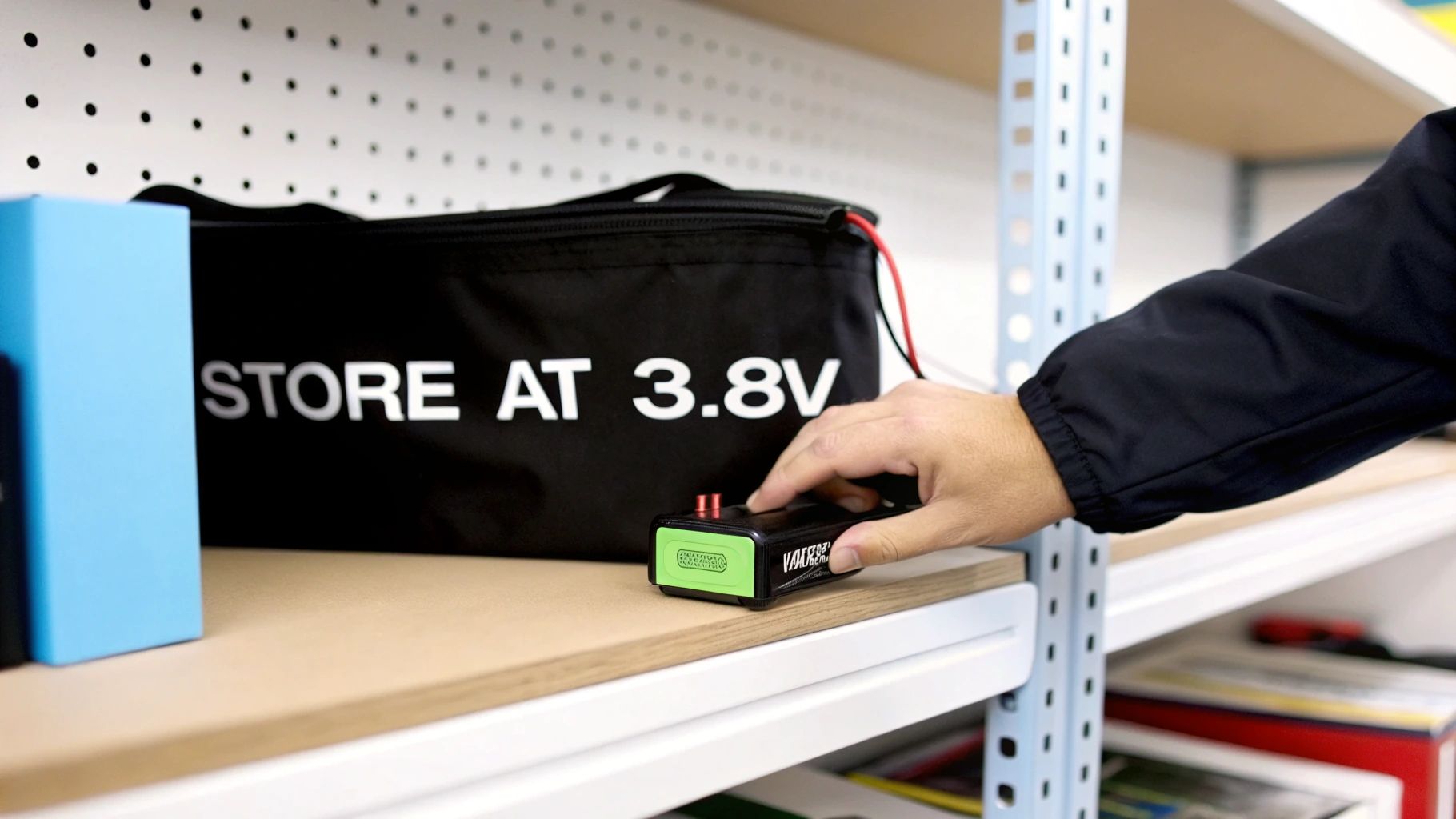
Storage voltage is the ideal "resting state" for a LiPo battery, sitting at roughly 3.80V to 3.85V per cell. For a 3S 11.1V pack, that’s a total voltage of about 11.4V. Keeping your battery at this level stabilizes its internal chemistry, preventing degradation.
This isn't just a minor tip—it's critical maintenance. Thankfully, any modern charger worth its salt has a dedicated "Storage" function. At the end of a race day, just plug in your pack, select that mode, and the charger will automatically bring each cell to the perfect 3.8V level. It's the single best thing you can do to ensure your batteries stay healthy for the next event.
Best Practices for Safe Storage
Once your 11.1V LiPo battery is at the correct storage voltage, where you keep it matters just as much. Never leave your batteries inside your RC car, and definitely don't store them somewhere with wild temperature swings, like in your real car on a hot day.
Follow these simple rules for safe storage between race days:
- Always use a fire-resistant LiPo bag or a metal ammo can.
- Find a cool, dry place with stable temperatures.
- Keep them away from anything flammable.
Following these care and storage rules protects your batteries, your equipment, and your home. It ensures your gear is always in top condition and ready to perform when you hit the track.
Common Questions About 11.1V LiPo Batteries
Stepping up to a lipo battery 11.1 v pack is a serious performance upgrade, but it definitely brings up some important questions. We get asked these all the time at the track, so let's clear the air on what you absolutely need to know.
Getting these fundamentals right is about more than just speed—it’s about protecting your investment in high-performance electronics and making sure your setup is safe and reliable every time you hit the track.
Can I Use an 11.1V LiPo in Any RC Car?
This is the big one, and the answer is a hard no. Before you even think about plugging in a 3S pack, you have to confirm your car’s Electronic Speed Control (ESC) and motor are specifically rated to handle it. Slapping an 11.1V battery into a system designed for 7.4V (2S) will overwhelm the electronics, almost guaranteeing you’ll let the magic smoke out. That’s an expensive mistake.
Most modern 1/10 and 1/12 scale racing kits are built for 3S power, but never assume.
Always check your vehicle's manual or the manufacturer's specs for the ESC and motor. This is the only way to be 100% certain your setup can safely handle the extra juice of a lipo battery 11.1 v.
If you're not sure, ask. A quick question can save you from frying your gear.
What Happens If I Over-Discharge My LiPo?
Running a LiPo below its minimum safe voltage is the fastest way to kill it. That magic number is generally 3.0V per cell. Drop below that, and an irreversible chemical reaction starts inside the cells, crippling their ability to hold a charge and deliver power.
Here’s what you’ll notice:
- Shorter Runtimes: The battery just won't hold the same amount of energy it used to.
- Less Punch: It will feel sluggish off the line because its ability to deliver high current is shot.
- Puffing: In a worst-case scenario, the battery becomes chemically unstable and starts to swell. That’s when it becomes a serious fire risk.
Thankfully, nearly every modern ESC has a built-in safety net called a Low Voltage Cutoff (LVC). This feature keeps an eye on the battery’s voltage and automatically cuts power when it hits a preset minimum, saving your pack from over-discharge. Make sure your ESC's LVC is on and set correctly for a 3S battery—usually around 3.2V to 3.4V per cell.
How Do I Safely Dispose of an Old LiPo?
Proper disposal isn't optional; it's a critical part of owning LiPos. Never, ever just toss one in the regular garbage. Even a "dead" battery can hold enough residual charge to spark a fire if it gets punctured in a trash compactor.
To dispose of a LiPo safely, you first have to drain it completely to 0 volts. Here’s the safe way to do it:
- Find a Fire-Safe Spot: Do this outside, far away from anything flammable. A bucket of sand on a concrete patio is perfect.
- Connect a Load: Use a small, low-wattage 12V car light bulb or a dedicated LiPo discharger to slowly bleed off the remaining energy.
- Confirm It's at Zero: Once the bulb goes out, use a multimeter or LiPo checker to make sure the voltage across the main leads is 0.0V. This can take hours, sometimes even a full day.
- Recycle It: Once it's fully discharged and inert, you can take the battery to a proper battery recycling centre or a local hazardous waste collection day.
What Should I Do If My LiPo Is Puffed?
A puffed or swollen lipo battery 11.1 v is a massive red flag. Puffing happens when gas builds up inside the cells from internal damage, overcharging, or being run too low. That gas is flammable, putting the battery at high risk of bursting or catching fire.
If you see any puffing at all, that battery’s racing career is over. It’s not safe to use, charge, or even keep in your workshop.
Here's your immediate action plan:
- Isolate It: Carefully move the battery to a fire-safe location outside, like on concrete or in that bucket of sand.
- Safely Discharge It: Follow the disposal steps above. Connect a load and slowly drain it all the way to 0 volts.
- Get Rid of It Properly: Once it's fully discharged, take it straight to a hazardous waste or battery recycling facility.
Don't be tempted to run it "just one more time." It's not worth the risk. A seasoned racer knows when to prioritize safety.
At Digital RC, we’re committed to helping racers get peak performance safely. Our selection of premium 11.1V LiPo batteries is hand-picked for proven reliability and power. Find the right pack for your winning setup by visiting https://digitalrc.ca today.