

Lipo Battery 3.7v: The Ultimate Guide to lipo battery 3.7v for RC Racing
In competitive RC racing, especially in 1/12 scale and certain 1/10 classes, the 3.7V LiPo battery, or 1S LiPo, is the go-to power source. Its incredible power-to-weight ratio is the secret sauce for the explosive acceleration and razor-sharp handling you need to win.
The Racer's Edge: Your Guide to 3.7V LiPo Batteries
Welcome to the definitive guide for RC racers looking to master their power setup. In the world of high-stakes on-road racing, every component matters, but none more so than your battery. A 3.7V LiPo battery isn't just a power source; it's the heart of your race car, dictating its speed, agility, and endurance.
This guide goes beyond textbook definitions. We’re here to give you a practical, track-focused understanding of what makes these single-cell powerhouses so effective. A lighter battery means less mass to accelerate and a lower centre of gravity, translating directly into quicker cornering and more responsive handling. It's the key to unlocking blistering lap times.
Understanding the Core Concepts
To dominate the track, you have to master the fundamentals. Let's break down the critical specs that determine how your battery performs under the extreme pressure of a race.
- Capacity (mAh): Think of this as your fuel tank. A higher mAh rating gives you longer runtimes, which is crucial for surviving long main events without your car fading in the final minutes.
- C-Rating: This is your punch. A high C-rating delivers that instant, explosive power needed to launch out of tight corners and get the jump on your competitors.
- Internal Resistance (IR): This number reflects your battery's health and efficiency. The lower the IR, the more power gets to your motor and the less is wasted as heat.
Your Canadian Source for Race-Winning Power
In the competitive Canadian RC scene, 3.7V LiPo batteries have become the standard for 1/10 touring and 1/12 pan cars. Our selection at Digital-RC includes high-performance packs ideal for minimizing chassis weight where every gram counts. These packs operate reliably in variable track weather, giving you a consistent edge. You can check out the technical details of these specialized RC batteries on Canada Robotix to learn more.
At Digital-RC, we are obsessed with giving Canadian racers a competitive edge. We don't just sell parts; we offer a curated selection of race-proven batteries and electronics from premier brands like Awesomatix and XRAY. Our goal is to get you the right components, fast.
We are Canada's expert source, backing our premium product lineup with fast, local Canadian service. This guide is an extension of that commitment, designed to arm you with the knowledge to make informed decisions that lead to lower lap times and more wins.
Translating Battery Specs Into Lap Times
Picking the right lipo battery 3.7v can feel like trying to read a secret code. The label is covered in numbers and abbreviations that look confusing, but those specs are the key to unlocking faster lap times. Let's break down what those numbers actually mean for your performance on the track.
Think of the specs on any battery you find at Digital-RC not as random data, but as a complete performance profile. Each number tells a story about how your car will behave during a race—from the explosive launch off the grid to that last push for the finish line. Mastering this language is the first step toward building a winning setup.
Capacity (mAh): Your Racing Fuel Tank
The first thing you’ll probably notice is the capacity, measured in milliamp-hours (mAh). The easiest way to think about this is as your car's fuel tank. A higher mAh rating means a bigger tank, giving you more energy to burn and a longer runtime.
For a five-minute qualifier, a smaller, lighter "tank" might be perfect. But in an eight-minute A-main, running out of fuel before the finish is a disaster. A battery with a higher capacity, like 6000mAh or more, ensures you have consistent power from the start tone to the checkered flag.
C-Rating: Your Throttle Punch
Next up is the C-Rating, which is short for discharge rating. If capacity is your fuel tank, the C-rating is the size of the fuel line feeding your engine. It dictates how quickly the battery can deliver its power, which translates directly to the punch and acceleration you feel on the track.
A higher C-rating, like 120C or 130C, lets your motor draw a massive amount of current instantly. This is what gives you that blistering burst of speed out of a tight corner, helping you blast past a competitor on the straightaway. For modified racing where instant power is everything, a high C-rating is a non-negotiable part of a winning formula.
To really get the most out of that power, it's critical to understand the relationship between the battery's output and your motor's performance through efficient motor control circuit design. This ensures every bit of that electrical punch is converted into raw, usable speed.
Internal Resistance: The Health of Your Power Plant
Internal Resistance (IR) is one of the most important specs, yet it's often overlooked. Think of IR as the internal friction inside your engine. The lower the resistance, the more efficiently your engine runs, sending maximum power to the wheels instead of wasting it as heat.
A brand new, high-performance battery will have a very low IR, typically just a few milliohms (mΩ). As a battery ages and goes through charge cycles, its IR will slowly climb. Higher IR means the pack has to work harder to deliver power, resulting in less punch and more heat.
Checking your battery's IR with a quality charger is like giving your power plant a regular health checkup. It’s the best way to know when a pack is past its prime and needs to be retired from race duty.
For a quick breakdown, here’s how these specs translate directly to what you'll experience on race day.
3.7V LiPo Spec Sheet Explained
| Specification | What It Means | Impact on the Track |
|---|---|---|
| Capacity (mAh) | The battery's "fuel tank" size. | Determines your total runtime. Higher mAh means longer run times but more weight. |
| C-Rating | How fast the battery can deliver power. | Higher C-rating provides more punch and faster acceleration out of corners. |
| Internal Resistance (IR) | The battery's internal efficiency. | Lower IR equals less power lost to heat, delivering more punch and consistent voltage. |
| Weight & Size | The physical dimensions and mass. | Affects chassis balance, handling, agility, and stability. |
These four specs work together to define your car's power delivery and handling characteristics.
Physical Size and Weight: Fine-Tuning Your Chassis
Finally, the physical dimensions and weight of your 3.7V LiPo battery have a huge impact on how your car handles. In a precision chassis like an Awesomatix or XRAY, even a few grams can completely change the car’s balance and cornering.
- Weight: A heavier battery can add stability on high-grip tracks, but might make the car feel sluggish in quick transitions. A lighter battery makes the car more agile and nimble.
- Dimensions: The battery's footprint affects where you can place weight. A shorter pack gives you more room to shift electronics forward or backward, letting you fine-tune the weight bias for different track conditions.
By understanding these four key specs, you can look at any battery on the Digital-RC site and know exactly how it will perform. You're no longer just buying a power source—you're making a strategic choice to match your equipment to your driving style and the demands of the track.
Choosing the Right 3.7V LiPo for Your Race
Picking the right lipo battery 3.7v is more than just a tech choice—it's a race-winning strategy. The perfect pack is a careful balance of weight, power, and runtime, giving you a serious edge that’s tailored to the track, your class, and even the specific heat you're running. This is a game of calculated trade-offs, where understanding the details can shave precious tenths off your lap times.
This isn't about finding one "best" battery for everything. It's about grabbing the right tool for the job. A blistering two-minute qualifying run needs a completely different battery strategy than a gruelling eight-minute A-main. The choice you make before you even hit the track often determines where you'll end up on the podium.
This flowchart breaks down the trade-offs between runtime, punch, and battery health when you're making that choice.
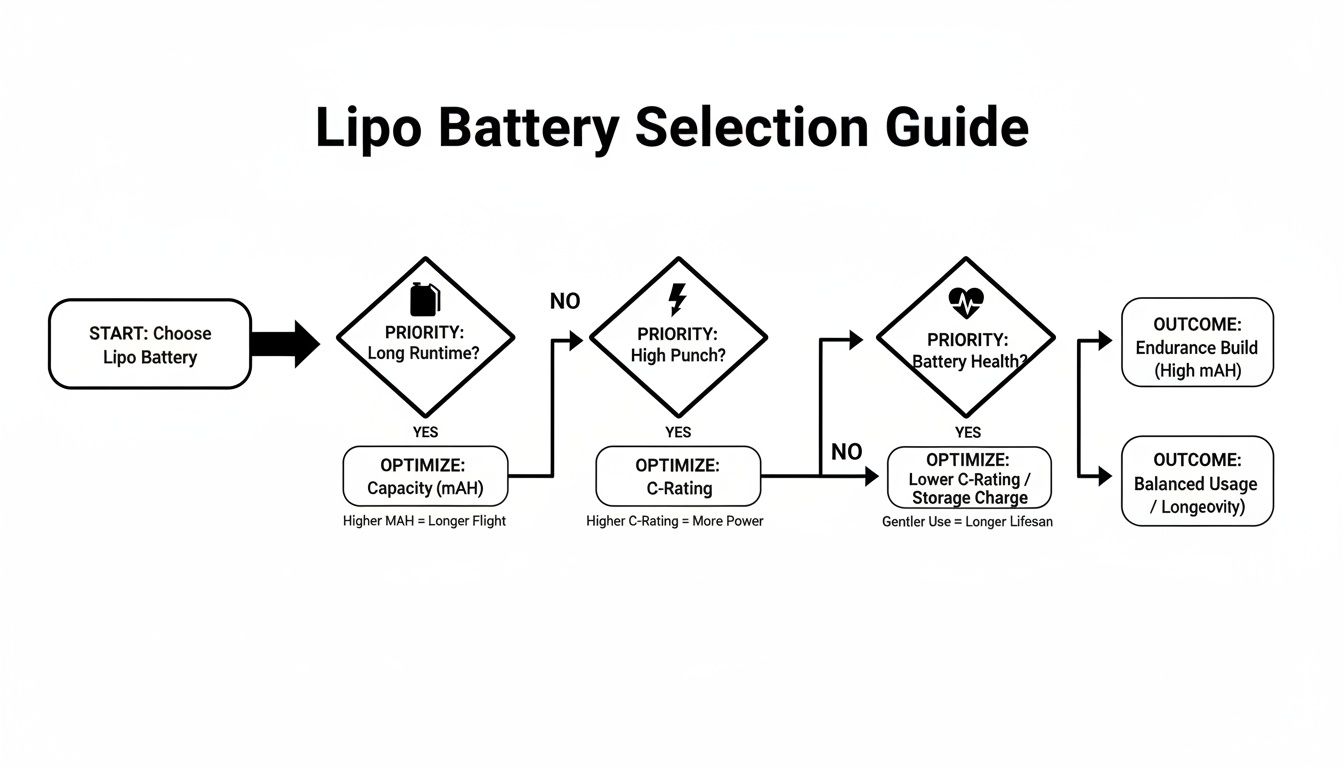
The key takeaway? When you push hard for one thing, like insane punch, you usually have to give up a little somewhere else, like total runtime.
Matching Battery to Racing Class
Your racing class is the starting line for your battery choice. The rules for Stock and Modified create totally different power demands, and you need a specific battery strategy for each to stay competitive.
- Stock Racing: In spec classes with limited motors, efficiency is king. The goal is to keep your voltage as high as possible for the entire run to maintain corner speed. A battery with a super low internal resistance (IR) and high capacity is often the winning ticket here.
- Modified Racing: This is all about raw, explosive power. With monster motors, your battery has to dump massive current in an instant. Racers will almost always go for the highest C-rating they can find to get that incredible punch out of the corners, sometimes even picking a lighter, lower-capacity pack to make the car more agile.
For Canadian RC racers, lightweight 3.7V LiPo batteries are a hot ticket for classes like 1/12 pan cars, thanks to their killer energy density. Their low weight and high efficiency can sharpen cornering speeds by up to 15% in 1/10 touring cars, based on feedback from the track.
Pairing With Your ESC and Motor
Real performance comes from synergy—matching your battery to your electronics. A high-punch battery doesn't do you any good if your ESC and motor can't handle the current.
A top-tier Hobbywing ESC paired with a high-C-rating battery lets you dial in the power delivery through software, giving you exact control over how the throttle feels. On the flip side, a high-torque Team Powers motor will suck down a ton of current, so it needs a battery that can deliver without the voltage sagging.
Think of your electronics as a complete system. Mismatching parts means you're just leaving speed on the table. Choosing a battery that plays nice with your Hobbywing ESC or Team Powers motor ensures you get every ounce of power you paid for, delivered smoothly every time. For a deeper dive, check out our guide on LiPo battery selection to power your RC setup for maximum performance.
Real-World Scenarios Track-Specific Choices
Let's take this from the bench to the track. Your battery choice should change with the circuit's layout to give you that competitive edge.
Scenario 1: Tight, Technical Track A track with lots of tight corners and short chutes is all about explosive acceleration. Here, a battery with the highest possible C-rating is your best friend. The name of the game is blasting out of every corner with maximum punch. A slightly lighter, lower-capacity pack might even make the car feel more nimble and flickable through the chicanes.
Scenario 2: Flowing, High-Speed Circuit On a big, open track with long straights, it’s all about maintaining top speed. A battery with higher capacity (mAh) and ultra-low internal resistance will hold its voltage better under a constant, heavy load. This stops your car from "fading" at the end of the straight, making sure you have the power to defend your line or set up a pass.
Essential LiPo Charging and Safety Protocols
A powerful **lipo battery 3.7v** is the heart of any winning race car, but it absolutely demands respect. Getting your handling and charging routine right isn't just about squeezing out more performance—it's about keeping you, your equipment, and everyone at the track safe. One wrong move with a LiPo can lead to permanent damage, a serious drop in performance, or even a dangerous fire.Here at Digital-RC, we know that a smart racer is a safe racer. This section breaks down the non-negotiable best practices for charging, storing, and handling your batteries. Follow these steps, and you'll protect your investment and get the consistent, reliable power you need every time you hit the track.
The Golden Rules of LiPo Charging
Charging is easily the most critical part of owning a LiPo battery. Almost every battery failure can be traced back to an incorrect charging setup. The process itself is straightforward, but you have to get every single step right.
-
Use a LiPo-Specific Charger: This is the number one rule, and it's not flexible. Never, ever use a charger meant for other battery types like NiMH or NiCd. LiPos need a special CC/CV (Constant Current/Constant Voltage) charging process to power up safely. Using the wrong charger is a massive fire risk, plain and simple.
-
Set the Correct Parameters: Before you plug anything in, double-check your charger's settings. For a standard 3.7V LiPo battery, you need to select the "LiPo" or "1S" program. The charger must be set to stop the charge at exactly 4.2V per cell.
-
Charge at a Safe Rate: The go-to charge rate for most LiPo batteries is 1C. What does that mean? For a 5000mAh battery, you'd set the charge rate to 5.0 amps. Pushing a higher rate puts a ton of stress on the battery, which shortens its lifespan and cranks up the risk.
And one more thing—never leave a charging battery unattended. Always stay within sight and earshot so you can pull the plug immediately if something looks or sounds wrong. If you need a hand picking out the right gear, our guide on finding the best LiPo battery charger has you covered.
Smart Storage for Battery Longevity
What you do with your batteries between race days is just as important as how you charge them. Leaving a LiPo fully charged or completely dead for a long time will cause irreversible chemical damage.
The secret is storage voltage. For long-term health, a 3.7V LiPo battery needs to be stored at around 3.8V per cell. Thankfully, most modern chargers we carry at Digital-RC have a "Storage" mode that automatically brings your pack to this perfect voltage.
A battery sitting at a full 4.2V is under constant chemical stress. This makes its internal resistance climb faster and kills its capacity over time. Dropping it to 3.8V lets the battery "relax," preserving its health and punch for your next race.
Beyond just charging and running them, knowing how to go about storing lithium batteries safely is a critical skill for preventing accidents and making them last.
Safe Handling Practices at Home and the Track
Good safety habits go beyond the charger and storage box. A little bit of care in how you handle your batteries minimizes risks and protects your expensive gear.
- Always Use a LiPo-Safe Bag: When you're charging or storing your batteries, always put them inside a fire-resistant LiPo bag or a proper battery bunker. It's a cheap and easy precaution that can contain a disaster if something goes wrong.
- Inspect Before Every Use: Before plugging in a battery, give it a quick once-over. Check for dented corners, torn wrapping, or—most importantly—any puffing or swelling. A puffed LiPo is a damaged LiPo, and it needs to be retired safely and immediately.
- Keep Them Cool and Dry: Find a cool, dry spot away from flammable stuff and direct sunlight to store your batteries. Extreme heat and cold are both bad news, as they can hurt performance and compromise safety.
By treating your 3.7V LiPo battery with the care it deserves, you're doing more than just following the rules. You're making sure it’s ready to deliver the consistent, race-winning power you paid for.
Installing Your Battery for Perfect Balance and Power
Getting your lipo battery 3.7v installed isn't just about plugging it in—it's about making it a strategic part of your chassis. The goal here is perfect balance and flawless power delivery. When you get this right, you unlock consistent, predictable performance on the track.
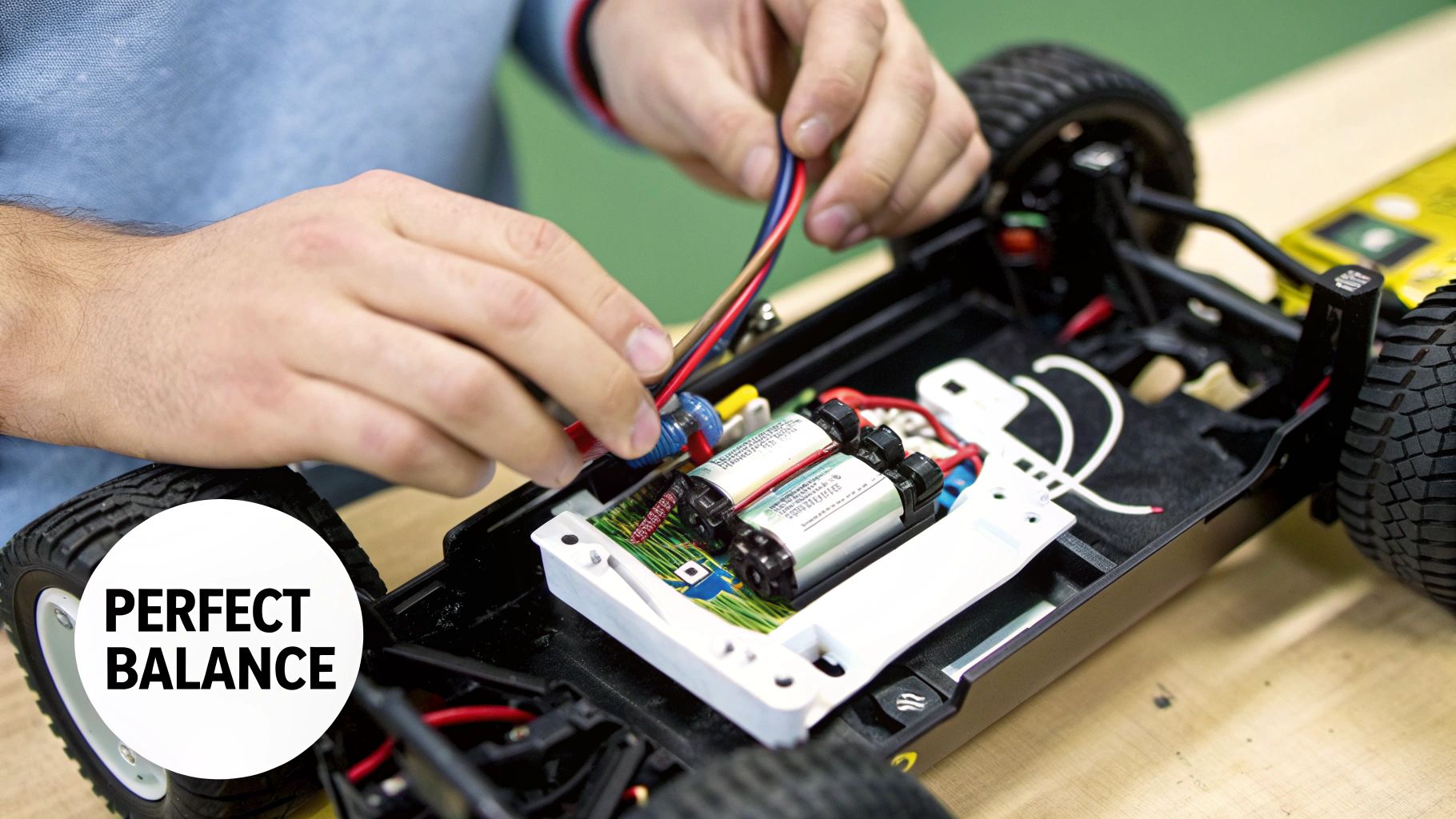
This process is more than just clean wiring. It's about choosing the right connectors, making sure every part of your electronic chain is compatible, and placing the battery to optimize your car's handling. It's this hands-on approach that lets you get the most out of the precision electronics we trust at Digital-RC.
Choosing the Right Connectors
The connectors linking your battery, ESC, and charger are the lifelines of your power system. In the demanding world of 1/10 and 1/12 scale racing, two main styles dominate because they’re efficient and reliable.
- Bullet Connectors (4mm & 5mm): These are the top choice for serious racers, period. They offer a direct, low-resistance connection that maximizes power transfer from the battery to the ESC. That means more punch and less power wasted as heat.
- Deans (T-Style) Connectors: While still effective, you don't see Deans as much in high-level racing anymore. They're reliable, but can have slightly higher resistance than good bullet connectors, which makes a small but noticeable difference in spec classes.
The key is to use high-quality, gold-plated connectors that fit snugly. A loose connection creates resistance, which generates heat, robs you of power, and can even cause a failure mid-race.
Ensuring System Compatibility
A powerful battery is useless if your system can't handle its output. Your battery, Electronic Speed Control (ESC), and charger must all be on the same page. Your ESC has to be rated for LiPo use and set up for a 1S 3.7V LiPo battery to trigger the correct low-voltage cutoff. This is what protects your pack from being run down too far.
A common problem we see is a battery's protection circuit module (PCM) tripping, making it show 0V at the plugs even if the cell is fine. This often happens if the ESC's cutoff is set too low. Always make sure your ESC settings match your battery's specs to avoid this headache.
For racers here in Canada, the 3.7V Li-Po battery is a great compact power source for 1/10 touring cars. These packs fit perfectly into tight chassis like those from Awesomatix and XRAY without messing up the car's balance. Onboard protection circuitry is designed to prevent over-discharge during intense races, and they operate reliably from -20°C to 60°C—handling everything from Prairie winters to coastal humidity. You can see how these compact batteries power Canadian racers on BBM Battery.
Pro Tips for Placement and Wiring
Once your components are matched up, the last step is a clean installation. Strategic placement and tidy wiring don't just look professional—they directly impact performance.
Strategic Battery Placement:
- Forward Bias: Moving the battery towards the front of the chassis adds steering grip, which is perfect for tight, technical tracks.
- Rearward Bias: Shifting the battery back gives you more rear traction, helping the car launch out of corners on lower-grip surfaces.
Use small pieces of double-sided tape to keep your battery from sliding, and always use fibre-reinforced tape to hold it firmly in the tray. A battery that shifts around can completely change your car's handling from one corner to the next, destroying your consistency. Clean wiring not only reduces the risk of snags but also improves airflow around your electronics, keeping them cooler and running more efficiently.
Troubleshooting Common LiPo Battery Issues
Even the best lipo battery 3.7v can run into problems, especially under the intense demands of RC racing. Think of this section as your trackside pit crew, ready to help you diagnose and solve common issues so you can stay in the race. Knowing how to spot the early warning signs of a failing battery can be the difference between a podium finish and a DNF (Did Not Finish).
The most obvious red flag is puffing or swelling. If your hard case starts to bulge or the pack feels soft, it’s a clear signal the internal cells are damaged and gassing out. This is a serious safety issue, and that battery needs to be retired immediately.
Another common symptom is a sudden drop in performance. Your car might feel sluggish or lose its punch out of the corners. This is usually tied to a spike in the battery's internal resistance (IR), which means it can no longer deliver power efficiently.
Identifying Problems Before They Cost You a Race
The best way to stay ahead of battery trouble is to be proactive. A simple check with a LiPo checker or your smart charger before and after each run gives you a complete health report.
- Check Cell Voltage: Use a LiPo checker to make sure the cell voltage is balanced and not dropping too low. A healthy rested 3.7V LiPo battery should sit around 3.8V for storage.
- Monitor Internal Resistance (IR): Keep an eye on your battery's IR over time. A significant jump from one week to the next is a clear sign the pack is starting to degrade.
- Inspect for Physical Damage: Always look for dents, cracks in the case, or damage to the wires and connectors. Any physical compromise can lead to a dangerous failure on the track.
Common Problems and Quick Solutions
Sometimes, the issue isn't the battery itself but a simple setup mistake. Racers often get tripped up by frustrating problems that have straightforward fixes.
A frequent issue is a battery that reads 0V at the terminals, even though you know it has a charge. This often happens when the battery's internal protection circuit module (PCM) has tripped due to an over-discharge event. Sometimes, briefly connecting it to a compatible LiPo charger can "wake up" the circuit and restore normal function.
Here's a quick troubleshooting guide for some common symptoms you might run into.
Common 3.7V LiPo Problems and Solutions
| Symptom | Possible Cause | Solution |
|---|---|---|
| Car Feels Slow | High internal resistance (IR) or low charge. | Check the IR with your charger. If it's high, the pack may be getting old. Make sure it's fully charged to 4.2V before your run. |
| Battery Won't Charge | Charger settings are wrong, or the battery voltage is too low for the charger to recognize. | Double-check that your charger is on the 1S LiPo setting. If the voltage is below 3.0V, the pack may be permanently damaged. |
| Short Runtime | The battery's capacity has degraded over time. | This is a normal part of a battery's life cycle. It’s time to replace it with a fresh pack from our collection at Digital-RC for competitive performance. |
When a battery consistently shows these symptoms, it’s telling you it’s time for retirement. Never throw a LiPo in the regular trash; take it to a local battery recycling centre to ensure it's disposed of safely and responsibly.
Frequently Asked Questions About 3.7V LiPo Batteries
Navigating the world of RC racing means you'll always have questions, especially when it comes to the heart of your car—a high-performance lipo battery 3.7v. At Digital-RC, we hear from racers across Canada every day. Here are clear, expert answers to some of the most common questions we get at the track.
Our goal is to give you quick, practical solutions that build your confidence in managing your power source. Think of this as your trackside cheat sheet for all things related to your single-cell LiPo batteries.
What Is the Difference Between a 1S and 2S LiPo Battery?
The "S" simply stands for series. A 1S battery has one 3.7V cell, making it lightweight and perfect for 1/12 scale cars and some 1/10 classes where rules demand it.
In contrast, a 2S battery has two 3.7V cells connected in series for a total of 7.4V. This setup delivers significantly more power and speed, which is why you see it in most 1/10 scale racing classes. Always check your class rules to know what's legal.
How Do I Know When My 3.7V LiPo Is Fully Charged?
A single 3.7V LiPo cell is fully charged when its voltage hits exactly 4.2V. That's the magic number.
A quality, LiPo-specific charger will automatically stop the process at this precise voltage. You should never, ever try to charge it higher—it's extremely dangerous and will permanently damage the battery.
For a deeper dive into battery health, it's worth learning about the ideal LiPo battery storage voltage for when you're not at the track.
Do I Need a Special Charger for My LiPo Battery?
Yes, absolutely. You must use a charger specifically designed for LiPo batteries.
These chargers use a critical CC/CV (Constant Current/Constant Voltage) charging algorithm that’s essential for both performance and safety. Using a charger made for another battery type, like NiMH, is a serious fire hazard and should never be attempted. It's a disaster waiting to happen.
How Does Cold Canadian Weather Affect My LiPo Performance?
Cold temperatures directly impact a LiPo's internal chemistry, increasing its internal resistance. This chokes its ability to deliver power, which you'll feel as a loss of "punch" or acceleration on the track.
On a chilly Canadian race day, keep your batteries in a warmer or even a pocket until just before your heat. This ensures they're ready to deliver optimal performance right from the start. Critically, never charge a battery that is near or below freezing—always let it return to room temperature first.
At Digital-RC, we're committed to equipping Canadian racers with the best gear and knowledge. Explore our curated selection of high-performance LiPo batteries and electronics to find the perfect power solution for your race car.