

A Racer's Guide to the Non Polarity Capacitor
Think of a non-polarity capacitor as a tiny, instant-recharge battery that smooths out the electrical chaos inside your RC car. Unlike polarized capacitors, you can install it in either direction, making it completely foolproof for hobbyists and a reliable choice for high-stakes racing.
The Role of a Non Polarity capacitor in Your RC Car
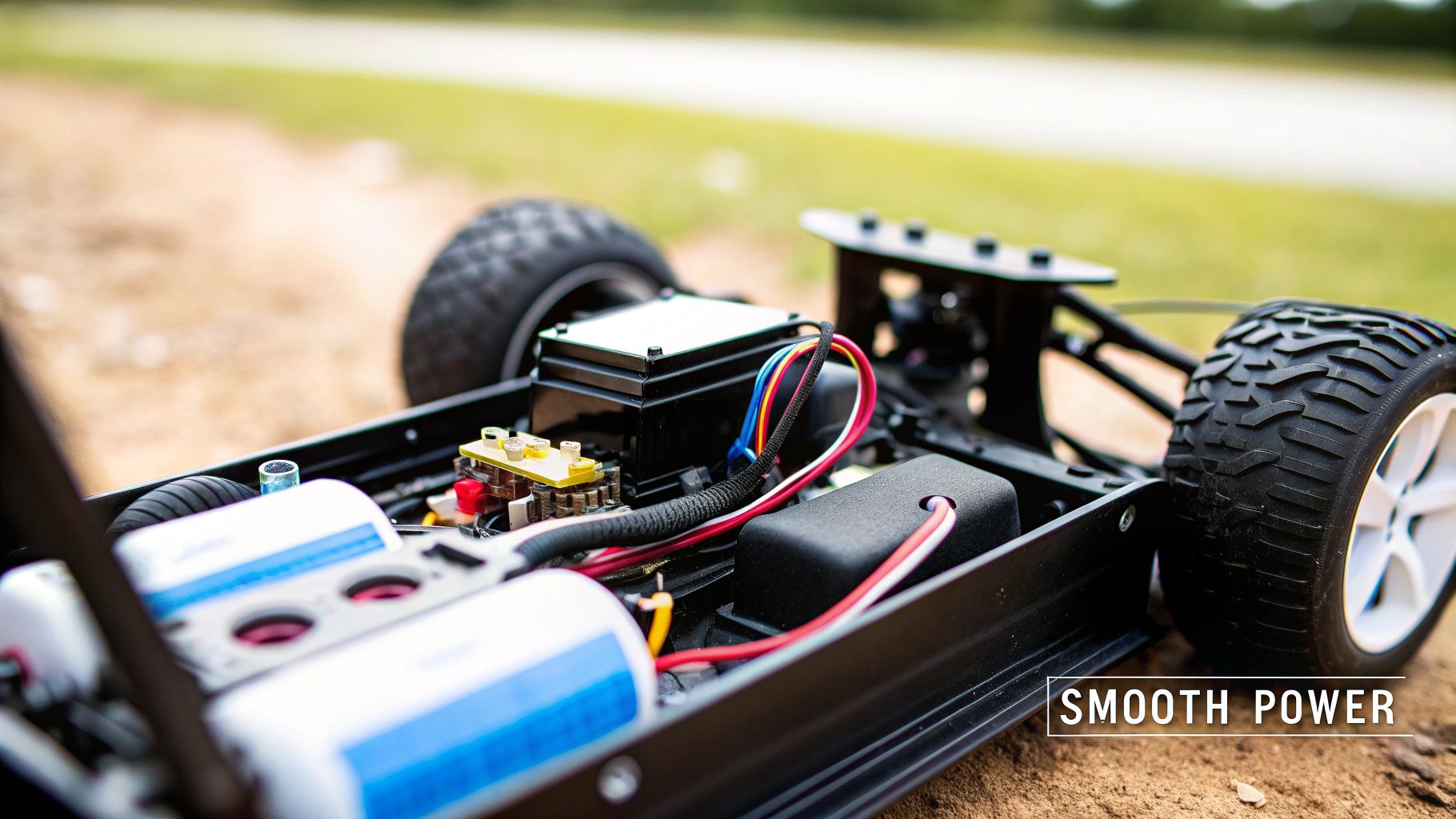
The power flowing from your LiPo battery to the Electronic Speed Control (ESC) and motor is like a river. Ideally, this river is smooth and constant. In reality, a powerful brushless motor creates turbulence—sudden surges and dips in the current.
A non-polarity capacitor acts as a small reservoir right beside this river. When the motor screams for a burst of power to accelerate, the capacitor instantly releases its stored energy to stop a voltage sag. When you hit the brakes hard and the motor generates a regenerative voltage spike, the capacitor absorbs it, protecting your sensitive electronics.
This constant balancing act gets rid of the electrical 'bumps' and 'dips' that can destabilize your system.
Polarized vs Non Polarity Capacitors at a Glance
For anyone working on RC electronics, understanding the practical differences between capacitor types is key. Here's a quick breakdown of what matters most.
| Feature | Polarized Capacitor (e.g., Electrolytic) | Non Polarity Capacitor (e.g., Ceramic) |
|---|---|---|
| Installation | Must be installed correctly (positive to positive). | Can be installed in either direction—no polarity. |
| Primary RC Use | Large-capacity power filtering on ESCs (often built-in). | Noise filtering, signal decoupling, and fine-tuning power delivery. |
| Risk of Error | High. Incorrect installation can cause failure (pop, smoke). | None. Installation is foolproof. |
| Typical Material | Aluminum Electrolytic, Tantalum. | Ceramic, Film. |
In short, non-polarity capacitors offer peace of mind and are incredibly versatile for the specific jobs they're designed for in an RC car's power system.
Why Installation Simplicity Matters
One of the biggest wins for any RC builder is the simple installation. Polarized capacitors have designated positive (+) and negative (-) terminals. Solder one on backwards, and you’re looking at catastrophic failure—sometimes with a loud pop and a puff of smoke.
A non-polarity capacitor is bidirectional. It works flawlessly no matter how you solder it to the positive and negative terminals. This completely removes the risk of installation error, giving you peace of mind when you’re working on your electronics.
This feature is invaluable whether you're a newcomer building your first kit or a seasoned racer making quick repairs in the pits between heats.
Gaining a Competitive Edge in Racing
In the high-pressure world of 1/10 touring and 1/12 pan car racing, consistency is everything. Every millisecond counts, and unpredictable electronics can be the difference between a podium finish and a disappointing race. The non-polarity capacitor is a critical shield for your expensive ESC and receiver.
It works tirelessly to absorb "voltage ripple"—the rapid fluctuations in voltage caused by the motor's high-frequency switching. This filtering action delivers several key performance benefits:
- Smoother Throttle Response: A cleaner power signal lets the ESC operate more efficiently, which translates to a more linear and predictable feel at your fingertips.
- Reduced Electronic Noise: It suppresses electromagnetic interference (EMI) that can cause glitches in your receiver or twitching in your servo, making sure your control inputs are precise.
- Enhanced Component Longevity: By absorbing harmful voltage spikes, the capacitor reduces the strain on your ESC's internal components, helping to extend its operational life.
The growing reliance on these parts is clear on competitive circuits. In the Canadian RC racing scene, non-polarity capacitors have become indispensable for smoothing power delivery in high-performance electronics. This trend reflects broader market growth, as the North American electric capacitor market—where Canada is a significant player—was valued at US$1.919 billion in 2020 and is projected to reach US$2.445 billion by 2027. You can see more on the market's expansion in this in-depth market analysis.
For a racer, this tiny component isn't just an add-on; it's a fundamental part of a reliable, high-performance power system.
How Capacitors Protect Your ESC and Sharpen Control
That tiny capacitor on your ESC isn't just for show—it's actively working to protect your power system and keep your car running with crisp, reliable precision. Think of it as both a bodyguard and a personal trainer for your electronics, doing three critical jobs at once.
In the world of high-power brushless systems, this little component is absolutely essential. Every time you punch the throttle or slam on the brakes, it steps in to manage the electrical chaos.
Acting as a Power Reservoir for Your ESC
Your Electronic Speed Control (ESC) is constantly managing a delicate flow of power. When you rocket out of a corner, the motor demands a massive, instant surge of current. If your battery can't deliver that power fast enough, the voltage can momentarily sag, leading to a "brownout" that might cause your receiver to reset or your servo to twitch.
A capacitor acts like a tiny, ultra-fast backup battery right next to the ESC. It stores a small amount of energy and discharges it instantly to fill those momentary gaps, making sure your ESC always has a steady supply of voltage.
On the flip side, during hard braking, a brushless motor acts like a generator, sending a spike of voltage back toward the ESC. This regenerative braking can create voltages far higher than your battery's normal rating.
The capacitor absorbs this sudden surge of energy, shielding the sensitive components inside your ESC from potentially damaging voltage spikes. This protection is critical for the longevity of your expensive electronics.
If you're interested in the bigger picture of electrical protection, it's worth reading about understanding surge protection devices in larger systems. While the scale is different, the core principle of taming harmful surges is exactly the same.
Filtering Out Destructive Motor Noise
Brushless motors are powerful, but they're also electrically "noisy." The high-frequency switching that makes them so efficient also creates a ton of electromagnetic interference (EMI). This EMI radiates through your car's wiring and can play havoc with your other electronics.
So, what does this interference actually look like on the track?
- Radio Glitches: You might experience a random loss of signal or momentary "hiccups" in control, even with a top-tier radio system.
- Twitchy Servos: Your steering servo could jitter or struggle to centre properly, especially under load.
- Inconsistent ESC Feel: The ESC's own processor can be affected, making your throttle feel less smooth and predictable.
A non-polarity capacitor acts as a filter, basically short-circuiting this high-frequency noise and sending it to ground. By cleaning up the power lines, it ensures your receiver and servo get the clean DC power they need to operate perfectly. For a deeper dive into the ESC itself, check out our complete guide to RC Electronic Speed Controls.
Ensuring Clean Power for Precision Control
The end result of all this filtering and power smoothing is a system that's dramatically more stable and responsive. Your control inputs are translated into action without delay or interruption. This is something you can actually feel on the track, especially if you're running high-end gear.
Take a precision Sanwa servo, for example. It relies on a clean power signal to deliver its famous speed and holding power. With a capacitor cleaning up electrical noise, that servo's response becomes sharper and more consistent, letting you hold a much tighter racing line.
Ultimately, a well-chosen non-polarity capacitor ensures your electronics can perform at their absolute peak, giving you the consistent, predictable control you need to win races.
Choosing the Right Non-Polarity Capacitor for Your Setup
Selecting the perfect non-polarity capacitor isn't just about grabbing any component off the shelf. It's about matching its specifications to your exact racing needs. Think of it like choosing the right tires for the track conditions—the correct choice can unlock performance, while the wrong one can hold you back or even cause damage.
When you're looking at different options, like the popular Team Powers 2S PS Capacitor V2, you'll see a bunch of technical specs. The key is translating those numbers into a real on-track advantage. Each value directly impacts how your RC car behaves under pressure, from launching off the starting grid to holding a tight line on the final lap.
This decision tree gives you a quick visual guide for how a capacitor solves common on-track problems.
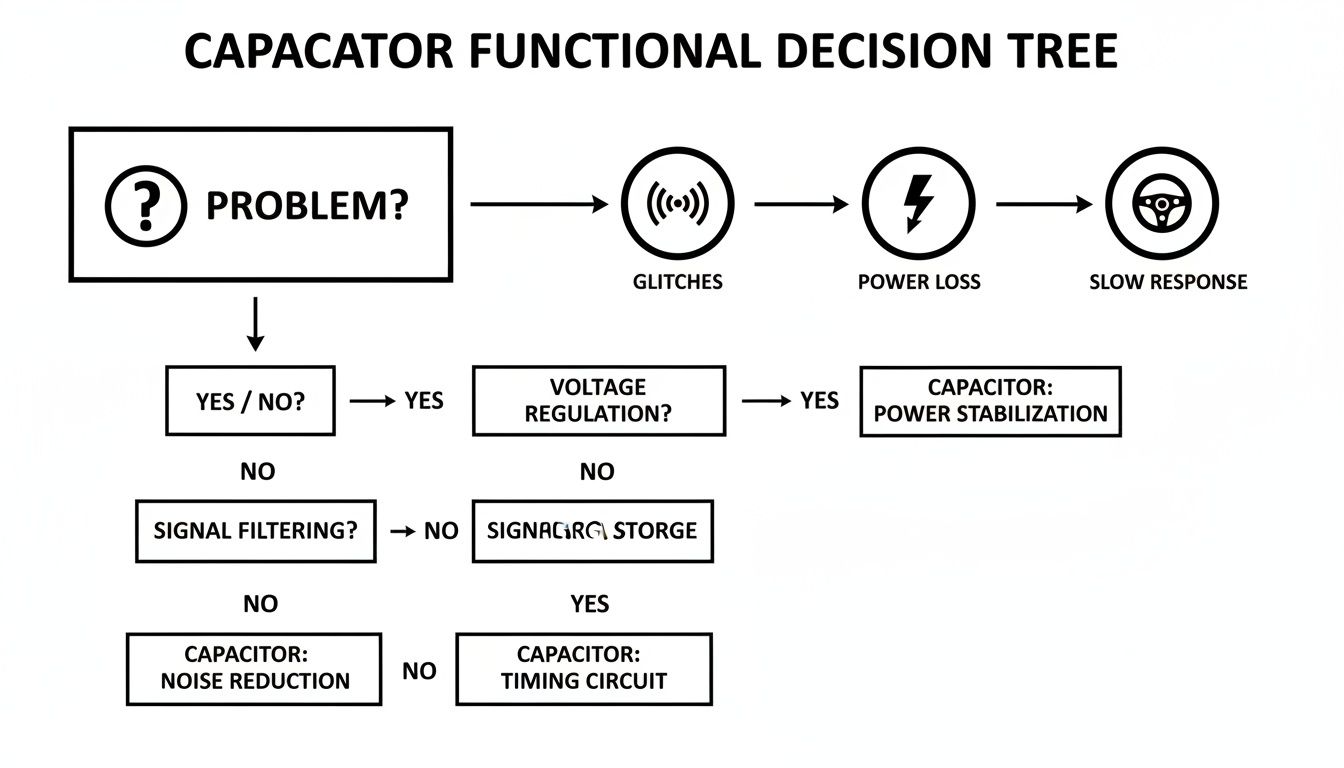
As you can see, issues like radio glitches, power loss, or a mushy throttle response often trace back to electrical noise and voltage ripple—precisely what a good capacitor is designed to clean up.
Demystifying Capacitance and Voltage Ratings
The two biggest numbers you'll see on any capacitor are its capacitance, measured in microfarads (µF), and its voltage rating, measured in volts (V). These aren't just random figures; they're the foundation of your decision.
-
Capacitance (µF): Think of this as the size of the capacitor's energy reservoir. A higher µF value means it can store more electrical charge. For a smooth 17.5T spec motor, a smaller capacitor is often enough. But for a power-hungry modified motor like a 4.5T, you need a much larger reservoir to smooth out the massive current spikes it creates.
-
Voltage Rating (V): This is simple: it's the maximum voltage the capacitor can safely handle. Your rule of thumb is to always choose a rating that comfortably exceeds your battery's maximum voltage. For a 2S LiPo that peaks at 8.4V, a 16V capacitor gives you a healthy safety margin against voltage spikes from hard braking.
Using an underrated capacitor is a recipe for disaster. A 10V capacitor on a 3S system won't last long—and its failure will be spectacular. Always check your battery voltage first.
Why Low ESR Is a Racer's Best Friend
Once you've got the basics down, the spec that separates good capacitors from great ones is Equivalent Series Resistance (ESR). In a perfect world, this would be zero, but in reality, all capacitors have some internal resistance.
For high-performance ESCs, a low ESR is non-negotiable. A capacitor with low ESR can dump its stored energy almost instantly, with no hesitation. This translates directly to crisper throttle response because less energy is wasted as heat inside the capacitor itself. High ESR, on the other hand, acts like a bottleneck, slowing down power delivery right when you need it most.
Temperature and Physical Package Considerations
Racing is tough on electronics. The temperature rating tells you how hot things can get before the capacitor's performance starts to suffer. A high-spec capacitor will keep doing its job even when your motor and ESC are screaming hot during a tough A-Main.
Finally, don't forget the physical package. The capacitor has to fit neatly in your chassis without getting in the way. A durable, well-sealed package will also stand up better to the vibrations and impacts of hard racing, preventing the leads from breaking under stress. You can browse a curated selection of capacitors for RC racing to find one with the right physical and electrical specs for your build.
To make things even easier, here's a quick cheat sheet for common racing classes.
Capacitor Selection Cheat Sheet for RC Racers
| Application / Racing Class | Recommended Capacitance (µF) | Minimum Voltage Rating (V) | Key Consideration |
|---|---|---|---|
| 1/10 17.5T Spec Touring/Buggy (2S) | 1000 - 2200 | 16 | Balance of response and low ripple. |
| 1/10 Modified Touring/Buggy (2S) | 2200 - 4700 | 16 | Maximum ripple suppression for high-power motors. |
| 1/8 Electric Buggy/Truggy (4S) | 2200 - 3300 (per cap) | 25 | Often use two caps; must handle high voltage spikes. |
| 1/12 Pan Car (1S) | 470 - 1000 | 10 | Smaller footprint and weight are critical. |
| Receiver Power (BEC smoothing) | 100 - 470 | 10 | Reduces brownouts for servos and receivers. |
This table provides a solid starting point, but always be ready to fine-tune based on your specific motor, ESC, and track conditions for that perfect feel.
Your Step-by-Step Capacitor Installation Guide
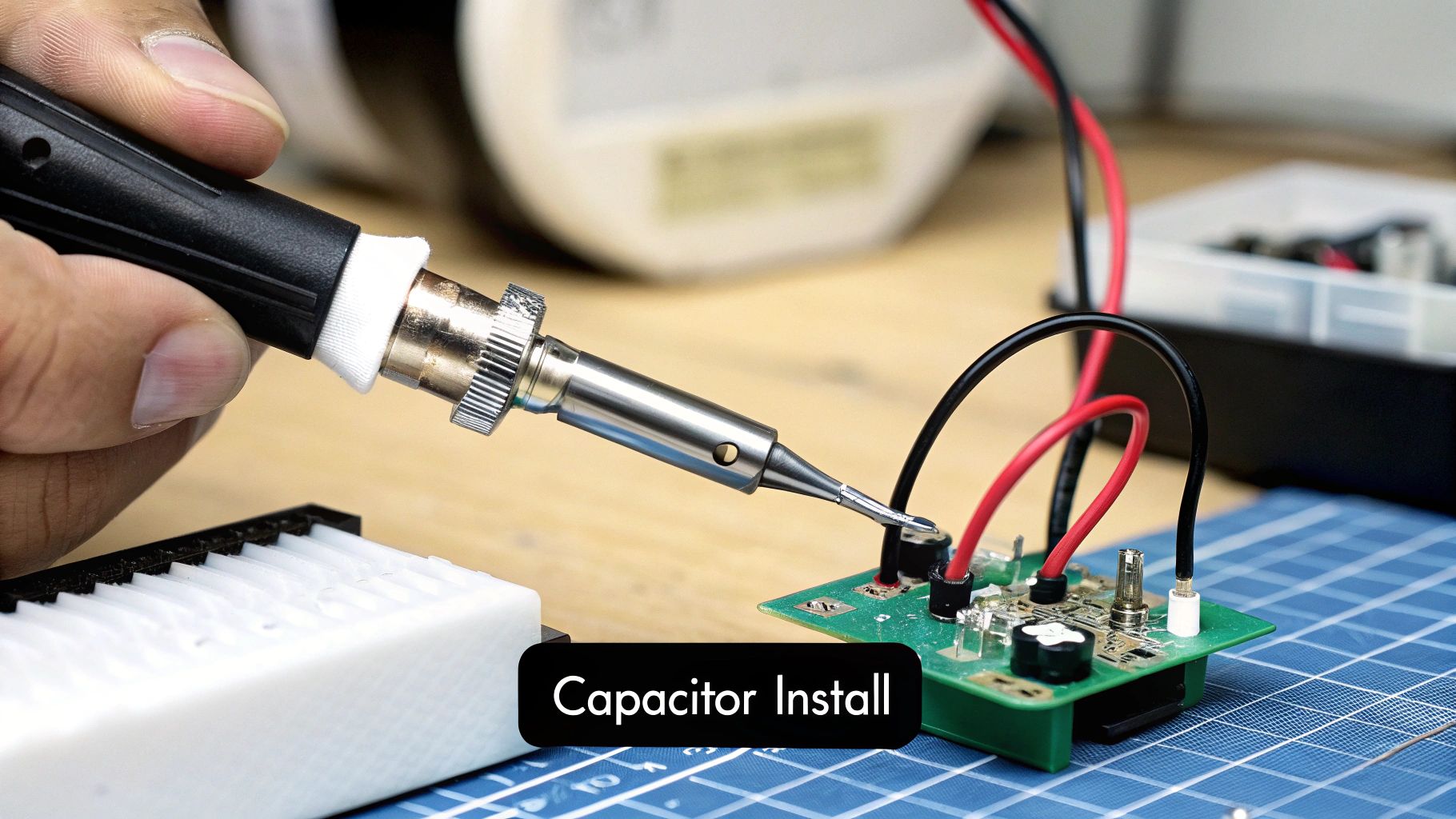
You’ve got the right capacitor—now it's time for a clean and secure installation. In the world of RC racing, a professional job isn't just about looking good. It’s about building a rock-solid connection that can handle the intense stress and vibration of a race without failing.
This guide will walk you through the essential steps for a solder job that’s both durable and electrically efficient. We’ll focus on the most common installations: directly onto an ESC’s battery posts and across a brushed motor’s terminals. Taking your time here is the key to reliability.
Mastering the Soldering Process
A great solder joint is the heart of any reliable electronic connection. It ensures minimal electrical resistance and maximum physical strength. Your goal should always be a shiny, smooth joint that flows seamlessly from the wire to the solder post.
Here’s how to get that perfect installation every time:
- Prep Your Gear: Start with a clean soldering iron tip heated to the right temperature. For hefty ESC posts, somewhere around 350-400°C is a great starting point. Have your quality solder, flux, and wire strippers ready to go.
- Tin the Wires: This is a non-negotiable step. "Tinning" the exposed ends of the capacitor's wires with a small amount of solder helps it flow instantly when you connect it to the ESC or motor.
- Heat the Joint, Not the Solder: This is the golden rule. Touch your hot iron tip to the ESC post or motor tab for a second or two. Apply the solder directly to the heated post, not the iron. The post will melt the solder, creating a solid bond.
- Make the Connection: Hold the tinned capacitor wire against the heated post and add just a bit more solder to fuse them together. Pull the iron away and hold the wire perfectly still for a few seconds until the solder solidifies.
This technique is the difference between a connection that holds up for years and one that fails on the first big jump.
Common Installation Points
Where you mount your non polarity capacitor comes down to what job you need it to do. For RC cars, two spots are overwhelmingly common.
- ESC Battery Posts: This is the number one spot for ripple-smoothing capacitors. You’ll solder the capacitor directly across the ESC’s main positive (+) and negative (-) battery terminals. Since it’s a non-polarity capacitor, you don’t have to worry about which wire goes to which terminal.
- Brushed Motor Terminals: On older brushed motor setups, small ceramic capacitors are soldered across the motor terminals (and from each terminal to the motor can) to suppress radio frequency interference that can cause glitching.
For any modern brushless racing application, the ESC battery posts are the critical mounting point. If you're looking for an excellent example built for this exact purpose, check out the Team Powers 2S PS Capacitor V2—it's a go-to choice for competitive racers.
Pro Tips for a Bulletproof Installation
Going the extra mile here will save you from frustrating trackside failures. A component shaking loose mid-race can easily cost you the win, so proper securing is a must.
Remember, vibration is the enemy of all electronics in an RC car. A well-secured capacitor is a reliable capacitor. Leaving it to flop around is an invitation for a broken solder joint or lead wire.
Here are a few pro tips to make sure your installation can handle the abuse:
- Use Heat Shrink Tubing: Always slide a piece of heat shrink over each solder joint to insulate it completely. This is your best defence against accidental short circuits that can instantly fry your ESC.
- Leave Some Slack: Never pull the capacitor's wires tight. Leaving a little bit of slack allows them to absorb vibrations and chassis flex without stressing the solder joints.
- Secure the Capacitor Body: This is the most important step for long-term durability. Use a small zip tie, quality double-sided tape, or a dab of shoe goo to firmly attach the capacitor's body to the chassis or another stable component.
Identifying and Replacing a Failing Capacitor
Even the best capacitors have a lifespan. Knowing the warning signs allows you to swap it out before it costs you a race.
- Visual Signs: Keep an eye out for a bulging or swollen capacitor case. If you see any fluid leaking, that's a dead giveaway it needs to be replaced immediately.
- Performance Glitches: A failing capacitor often causes issues like a stuttering throttle, radio glitches, or a noticeable loss of punch when you hit the gas.
To replace it, just desolder the old one and follow the installation steps above to put the new one in its place. It’s a quick bit of maintenance that can restore your car's performance and protect your other electronics.
Avoiding Common Mistakes and Compatibility Issues
Because these capacitors don't have a positive or negative side, installation is pretty forgiving. But a few simple mistakes in the pits can still sideline your race car or, even worse, permanently fry your expensive electronics. Getting this right isn't about memorizing complex theory; it's about respecting the limits of your components.
A small oversight can easily lead to a DNF (Did Not Finish) on the track, turning a great race day into a frustrating hunt for a burnt-out part.
The Unbreakable Rule of Voltage Rating
The single most critical mistake you can make is mismatching the capacitor's voltage rating to your battery. This rule is non-negotiable. The voltage printed on a capacitor is its absolute maximum survivable voltage—not its recommended operating level.
Pushing past this limit, even for a split second, can cause the capacitor to fail spectacularly. For example, if you run a 10V-rated capacitor with a 2S LiPo battery that peaks at 8.4V fresh off the charger, you're leaving almost no safety margin. The moment your ESC's regenerative braking creates a voltage spike, that capacitor is almost guaranteed to let go.
Think of the voltage rating like the redline on your car's engine. You can get close, but go over it, and you're in for immediate, catastrophic damage. For 2S racing, a 16V capacitor is the standard, giving you a solid safety buffer. For 4S systems, you absolutely need a 25V or 35V rating.
Performance Mismatches with High-Draw Motors
Compatibility goes beyond just safety—it's also about performance. Not all non-polarized capacitors are built the same, and the power level of your motor determines what you need. A high-draw modified motor puts a massive strain on the entire power system, creating huge voltage ripple.
To fight this, you need a capacitor with a very low Equivalent Series Resistance (ESR). A capacitor with a high ESR just can't dump its stored energy fast enough to keep up with the motor's demands. The result is a mushy throttle feel and extra stress on your ESC.
- Stock Motors (17.5T, 21.5T): These can often perform well with a standard, good-quality capacitor since the current demands are lower and more predictable.
- Modified Motors (4.5T, 5.5T): Absolutely require a high-performance, low-ESR capacitor, such as the Team Powers 2S PS Capacitor V2. It's the only way to handle the massive, instant current spikes you get under hard acceleration.
Choosing a cap with an ESR that’s too high for your motor is like trying to put out a bonfire with a squirt gun—it’s just not going to be effective.
Brand Synergy and Warranty Concerns
Finally, it’s always a good idea to see what your ESC manufacturer recommends. While the technical specs are what matter most, companies like Hobbywing and Team Powers put a ton of time into testing their ESCs with specific capacitors to find the perfect match for performance and reliability.
Sticking with the capacitor that came with your ESC, or one the brand specifically recommends, is the surest way to get the performance they designed for. More importantly, using a random third-party capacitor could potentially void your ESC's warranty if something goes wrong. When in doubt, trusting the manufacturer's choice is a safe bet that ensures your gear works together as a cohesive, well-matched system.
Common Questions About Non-Polarity Capacitors
Diving into the world of RC electronics, you're bound to have questions. As racers, we're always looking for ways to fine-tune our setups for that extra edge on the track. Here are some no-nonsense answers to the most common questions about non-polarity capacitors to help you make the right call for your racing program.
Getting these details right is what keeps your electronics performing reliably under pressure, lap after lap.
Can I Use a Capacitor With a Higher Voltage Rating?
Yes, you absolutely can—and in most cases, it’s a smart move. Using a capacitor with a voltage rating higher than your battery's maximum voltage gives you a critical safety margin. For example, running a 16V capacitor with a 2S LiPo battery (which tops out at 8.4V) is standard practice for a good reason.
That extra headroom easily soaks up the voltage spikes that happen during hard braking, protecting your ESC from getting fried. The only real trade-offs are that a higher-voltage cap might be slightly bigger and cost a little more, but for competitive racing, the added reliability is always worth it.
How Do I Know if My Capacitor Is Failing?
Capacitors don't last forever, and a bad one can cause all sorts of frustrating problems on the track. The signs of a failing cap can be either visual or performance-related. Spotting them early can save you from a DNF.
Make it a habit to inspect your capacitor for any physical signs of trouble.
- Visual Signs: The most obvious red flag is a bulging or swollen capacitor casing. You should also look for any fluid leaking around the base or leads, which is a sure sign of an internal failure.
- Performance Signs: A dying capacitor will often just make your car feel "off." You might get intermittent power cuts, weird radio glitches, a stuttering throttle response, or a clear drop in top speed and punch under hard acceleration.
If you notice any of these symptoms, your best bet is to replace the capacitor immediately. It's a small bit of preventative maintenance that can bring your car's performance back and protect your more expensive electronics.
Is Adding a Second Capacitor to My ESC a Good Idea?
For the vast majority of 1/10 and 1/12 scale racing, the single, high-quality capacitor that comes with a reputable ESC is perfectly matched for the job. Manufacturers spend a ton of time matching the capacitor's specs to the ESC's power demands.
While building a 'capacitor bank' by wiring in more caps can stabilize voltage further, it creates trade-offs that are usually a net negative in competitive racing.
Adding more components means adding more weight and more complexity to your wiring. In racing classes where every gram counts and a clean install is key to reliability, this can be a big disadvantage.
For the best performance and reliability, stick with what the manufacturer recommends. If you think your capacitor is underperforming, replacing it with a fresh, high-quality unit of the same spec is the right solution.
Does the Brand of Capacitor Really Matter?
While matching the core specs—capacitance (µF), voltage (V), and ESR—is the most important thing, the brand can absolutely make a difference. Reputable brands that focus on RC racing electronics invest in better materials and tighter manufacturing processes.
That investment pays off with real performance and reliability benefits on the track.
- Better Heat Tolerance: Premium capacitors hold their own even when your ESC and motor are running hot during a long A-Main.
- Lower Internal Resistance: Top-tier brands like Team Powers design their capacitors for the lowest possible ESR values, which translates directly to a crisper throttle response and less wasted power.
- Longer Lifespan: Higher-grade internal materials mean the capacitor can handle more charge cycles and the physical abuse of racing before it starts to degrade.
For club racing, a generic capacitor with the right specs might get you by. But for serious competition where reliability is everything, investing in a quality non-polarity capacitor from a trusted name is a smart move that protects your entire electronics package.
At digital-rc, we stock only the most reliable, race-proven components to keep your car at peak performance. Find the perfect non-polarity capacitor and other essential electronics for your 1/10 or 1/12 scale build by visiting us at https://digitalrc.ca.