

A Racer's Guide to High-Performance Radio Control Car Kits
In the world of competitive RC racing, victories are built, not bought. For serious racers, the path to the podium doesn’t start at the finish line—it begins on the workbench with a high-performance radio control car kit.
Your Winning Journey Starts with the Right Kit
If you're serious about competitive racing, there's a fundamental choice to make: build a kit or buy a Ready-to-Run (RTR) model. While RTRs offer instant fun, they're a compromise in performance, adjustability, and durability. True competitive racing demands more.
A high-performance radio control car kit is the definitive choice for anyone looking to master the track. The process is about more than just putting parts together; it’s about gaining an intimate understanding of your car’s mechanics. Think of it as the difference between driving a rental car and engineering a Formula 1 machine. Every screw you tighten and every component you install teaches you how to extract maximum performance when it counts.
The Builder's Advantage
Assembling your own chassis is the foundational step toward becoming a better racer. This hands-on experience gives you a deep mechanical knowledge that translates into a critical advantage on race day. When you know exactly how your car's suspension geometry affects cornering or how a differential adjustment changes power delivery, you can make faster, smarter tuning decisions on the fly. This knowledge is what separates the winners from the rest of the pack.
The satisfaction of building your own car is part of a growing trend. In Canada, construction sets and models have become a highly resilient part of the hobby market. Projections show steady revenue growth through 2030, highlighting a sustained demand for engaging, build-it-yourself products over pre-assembled toys. You can explore the data behind this growing hobby segment in Statista's Canadian market forecast.
Radio Control Car Kit vs Ready-to-Run (RTR)
So, what are the real-world differences between a kit and an RTR? For a competitive racer, the choice is clear. Kits offer a level of precision, customization, and performance that pre-built models simply can't match.
Here’s a head-to-head breakdown:
| Feature | Radio Control Car Kit | Ready-to-Run (RTR) Model |
|---|---|---|
| Assembly | Complete build required from the ground up. | Arrives fully assembled and ready to drive. |
| Performance | Top-tier; built with race-grade materials and precision engineering. | Entry-level to mid-grade performance; often uses lower-quality components. |
| Electronics | You choose the motor, ESC, servo, and radio to match your goals. | Comes with basic, pre-installed electronics. |
| Customization | Unlimited. Every component can be selected, tuned, or upgraded. | Limited. Upgrades are often restricted by proprietary designs. |
| Durability | Built with premium materials designed to withstand competitive racing. | Components are designed for casual use and may fail under race conditions. |
| Mechanical Skill | Building the kit provides deep knowledge of setup and tuning. | No initial mechanical knowledge required. |
| Ideal User | Competitive racers and serious hobbyists seeking ultimate performance. | Beginners and casual users looking for immediate fun. |
While an RTR gets you on the track instantly, a kit puts you in control of your destiny. You're not just a driver; you're the engineer, the mechanic, and the racer, all in one.
Your Partner in Performance
At Digital-RC, we understand what serious Canadian racers need. We are your dedicated partner, providing access to elite radio control car kits from world-championship-winning brands like Awesomatix and XRAY. Our curated selection ensures you start with a platform engineered for victory, not compromise.
Building a kit isn't just a step in the process; it is the process. The deep connection you form with your car on the workbench translates directly to confidence and control on the track. It's the ultimate competitive edge.
We support your racing journey with expert advice and a commitment to getting you what you need, fast. With our fast, free same-day delivery in applicable areas, you can get the parts you need without the long waits that kill a race weekend. Our goal is simple: to help you build, tune, and race at the highest level.
Anatomy of a High-Performance Racing Chassis
Before you can build a champion, you need to understand its DNA. Opening a modern Awesomatix A12 or XRAY X4 radio control car kit isn't like unboxing a toy—it's a collection of precisely engineered components, each playing a critical role in track performance. This isn't just a box of parts; it's the blueprint for a winning machine.
Understanding what each piece does is the first step toward making smart decisions during your build and, later on, during those crucial tuning sessions at the track.
This simple flowchart shows the fundamental choice every RC racer makes: diving into the rewarding world of kits or starting with a pre-built model.
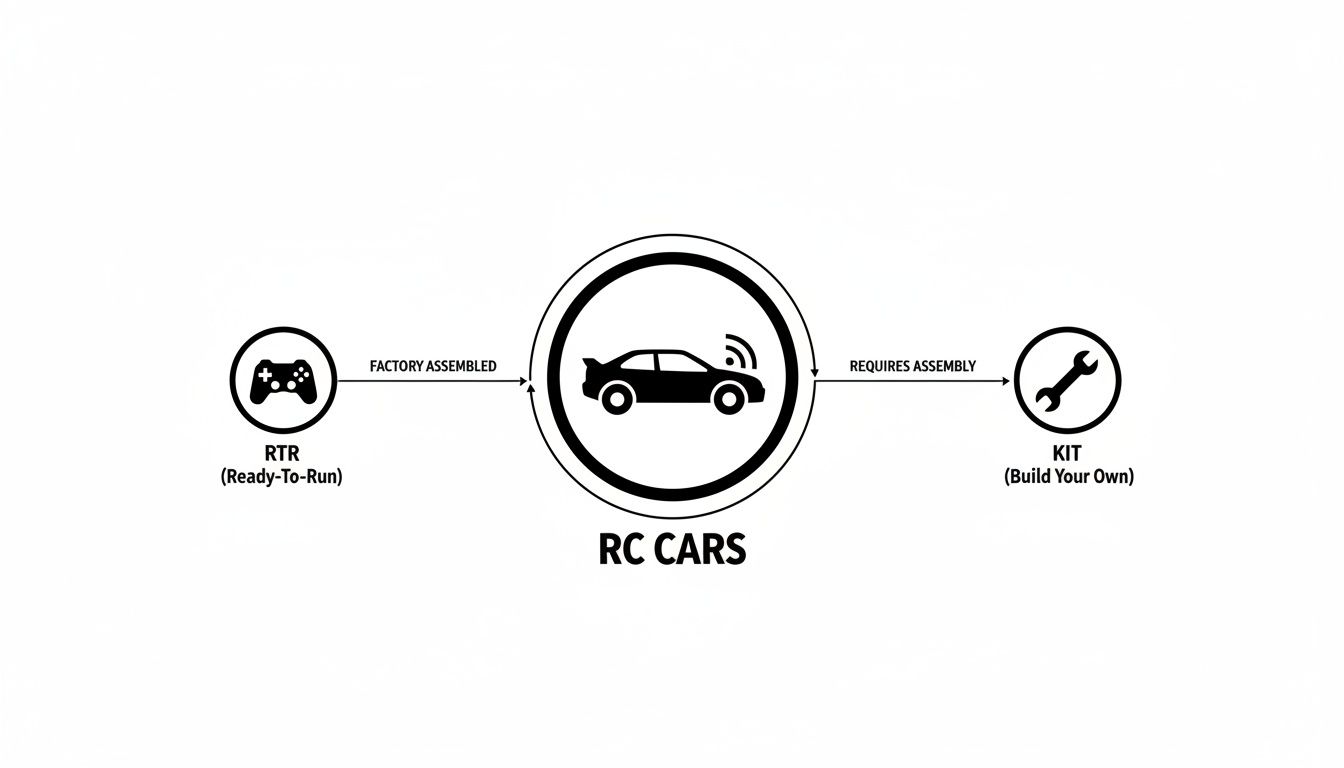
As you can see, the path of a kit builder—represented by the wrench—is a hands-on journey focused on mechanical mastery. It’s fundamentally different from the plug-and-play nature of an RTR.
The Backbone of Performance: The Chassis Plate
At the heart of any high-performance kit is the chassis plate. Think of it as the car's skeleton. It’s the foundation that every other component bolts onto, and its material and design dictate how the car flexes and responds to the track surface.
Modern kits from brands like Awesomatix and XRAY primarily use two materials:
- Carbon Fibre: Prized for its incredible stiffness-to-weight ratio. A stiff chassis provides a stable, predictable platform, making it ideal for high-grip surfaces like carpet where precision is everything.
- Aluminum: Often found as an optional tuning part. An aluminum chassis offers different flex characteristics, which can generate more grip and a more forgiving feel on lower-traction surfaces like asphalt.
The shape and cutouts in the chassis aren't just for looks; they are meticulously engineered to control torsional and longitudinal flex. This controlled flex is a key tuning element, allowing the car to generate mechanical grip as it navigates corners and bumps.
For a deeper look at how chassis material affects handling, our article exploring the Awesomatix A12X soft steel chassis explains the concept of engineering flex for specific track conditions.
Mastering Weight Transfer: The Suspension System
If the chassis is the backbone, the suspension is the muscle. Its job is to manage the car’s weight transfer during acceleration, braking, and cornering. A well-tuned suspension keeps the tires planted on the track, maximizing grip and stability.
Key components you'll assemble include:
- Suspension Arms: These connect the wheels to the chassis, dictating suspension geometry and movement.
- Shock Absorbers: Oil-filled dampers that control the speed of suspension movement, absorbing bumps and preventing the car from bouncing erratically.
- Sway Bars: These connect the left and right sides of the suspension to control body roll during cornering, keeping the car flat and responsive.
The advanced designs in our Awesomatix and XRAY kits feature incredibly precise adjustments for camber, caster, toe, and roll centres. This allows you to fine-tune the car’s handling to suit your driving style and the specific layout of the track.
Efficient Power Delivery: The Drivetrain
Finally, the drivetrain is tasked with transferring power from the motor to the wheels with ruthless efficiency. In 1/10 scale touring cars, this is typically a belt-driven system, known for its smooth and responsive power delivery.
The main elements of the drivetrain are:
- Belts: These connect the central spur gear to the front and rear differentials.
- Differentials: These allow the inner and outer wheels to rotate at different speeds during a turn—essential for smooth cornering. Modern kits use gear or spool differentials that can be tuned with different oil weights to alter handling characteristics.
Every component in an Awesomatix or XRAY kit, from the low-friction bearings to the precision-molded gears, is designed to minimize power loss. This ensures every bit of energy from your motor is translated into forward motion, giving you the edge you need to get ahead of the competition.
Building Your Electronics Power and Precision Playbook
If the chassis is the skeleton of your race car, then the electronics are its heart, brain, and nervous system. Getting these components right isn't just about picking powerful parts; it's about creating a perfectly matched system where every piece works in harmony to put power to the track.
This is especially true in competitive racing. The days of RC cars being simple toys are long gone. Market trends show that Canadian RC enthusiasts, particularly in demanding classes like 1/10 touring and 1/12 pan car, are approaching the hobby like a true motorsport. It's a serious game now, with global data showing 40–45% of RC car demand driven by racers and serious hobbyists. Electric-powered models make up about 60% of that market, thanks to massive leaps in battery and motor tech.
At Digital-RC, we live and breathe this stuff. That's why we stock the race-proven brands you see in the winner's circle, including Hobbywing, Team Powers, and Sanwa. Let's break down the "big four" electronic components you'll need to bring your kit to life.
Electronics Selection Guide for 1/10 & 1/12 Racing
Choosing the right electronics can feel overwhelming, but it's the key to unlocking your kit's potential. This table is a quick cheat sheet for the most common racing classes to get you pointed in the right direction.
| Component | 1/10 Touring Spec ('Blinky') | 1/10 Touring Modified | 1/12 Pan Car ('Blinky') |
|---|---|---|---|
| Motor | Team Powers Actinium V4 17.5T | Hobbywing G4R 5.0T | Team Powers Actinium V4 13.5T |
| ESC | Hobbywing XR10 Stock Spec G2 | Hobbywing XR10 PRO G2S | Hobbywing XR10 PRO G2S (in Blinky mode) |
| Servo | Sanwa PGS-LHII (Low Profile) | Sanwa PGS-CLII | Sanwa SRG-HR (Micro) |
| Battery | Team Powers TP-LIPO74V5800-2S-PH120C | Team Powers TP-LIPO74V6300-2S-PH130C | Team Powers TP-LIPO37V8100-1S-PH120C |
Remember, this is a starting point. Always check your local club's or event's specific rules to ensure your electronics package is legal for the class you plan to run.
The Motor and ESC: The Heartbeat of Your Car
Your motor and Electronic Speed Control (ESC) are a team. Think of the motor as the engine and the ESC as the throttle and engine management computer, telling the motor exactly how much power to deliver and when.
For any serious racing, brushless sensored motors are non-negotiable. A small sensor cable feeds the ESC precise information about the motor's position, giving you that buttery-smooth throttle feel and predictable braking you need to navigate a technical track. It’s a world away from the jerky, low-speed feel of sensorless systems.
The ESC is just as critical. In "spec" or "stock" classes, you’ll need an ESC like the Hobbywing XR10 Stock Spec G2 with its "blinky" mode. This setting disables all electronic timing and boost, putting everyone on a level playing field. For the unlimited power of modified classes, a more advanced ESC like the Hobbywing XR10 PRO G2S lets you fine-tune these settings to squeeze every last drop of performance from your motor.
Choosing the right ESC can feel complex, but it's one of the most important decisions you'll make for your radio control car kit. For a deeper dive into this topic, check out our comprehensive ESC Selection Guide to match your speed controller to your motor perfectly.
The Steering Servo: Precision in Every Corner
The servo is what translates your steering inputs into action at the front wheels. When it comes to racing, two numbers matter most: speed and torque.
- Speed: Measured in how quickly the servo can travel 60 degrees. A faster servo means a more responsive, agile-feeling car.
- Torque: This is the servo's muscle—its turning strength. More torque ensures your wheels hold their line under the heavy G-forces of cornering, rather than getting pushed around by the track.
We stock high-performance servos from brands like Sanwa that give you that perfect blend of lightning-fast response and unshakeable holding power, so you can hit every apex with confidence.
The Battery: The Fuel Tank
In electric RC, your Lithium Polymer (LiPo) battery is your fuel tank. Its performance directly affects your car's punch and how consistent it is from the start of the race to the end.
For most 1/10 scale touring cars, a 2S (7.4V) LiPo is the standard. The smaller 1/12 pan cars typically use a 1S (3.7V) pack. While capacity (mAh) determines your runtime, the C-rating is what dictates how much "punch" the battery can deliver during acceleration. Brands like Team Powers are trusted by racers for providing reliable, high-output power that doesn't fade when the race is on the line.
The Assembly Process: From Box to Track-Ready
Building your first high-end radio control car kit is a rite of passage for any serious racer. It’s an awesome feeling, popping the lid on a new kit and seeing hundreds of precision parts all bagged up and ready to go. Sure, it looks intimidating, but this process transforms a pile of parts into a consistent, repeatable racing machine you built from the first screw.
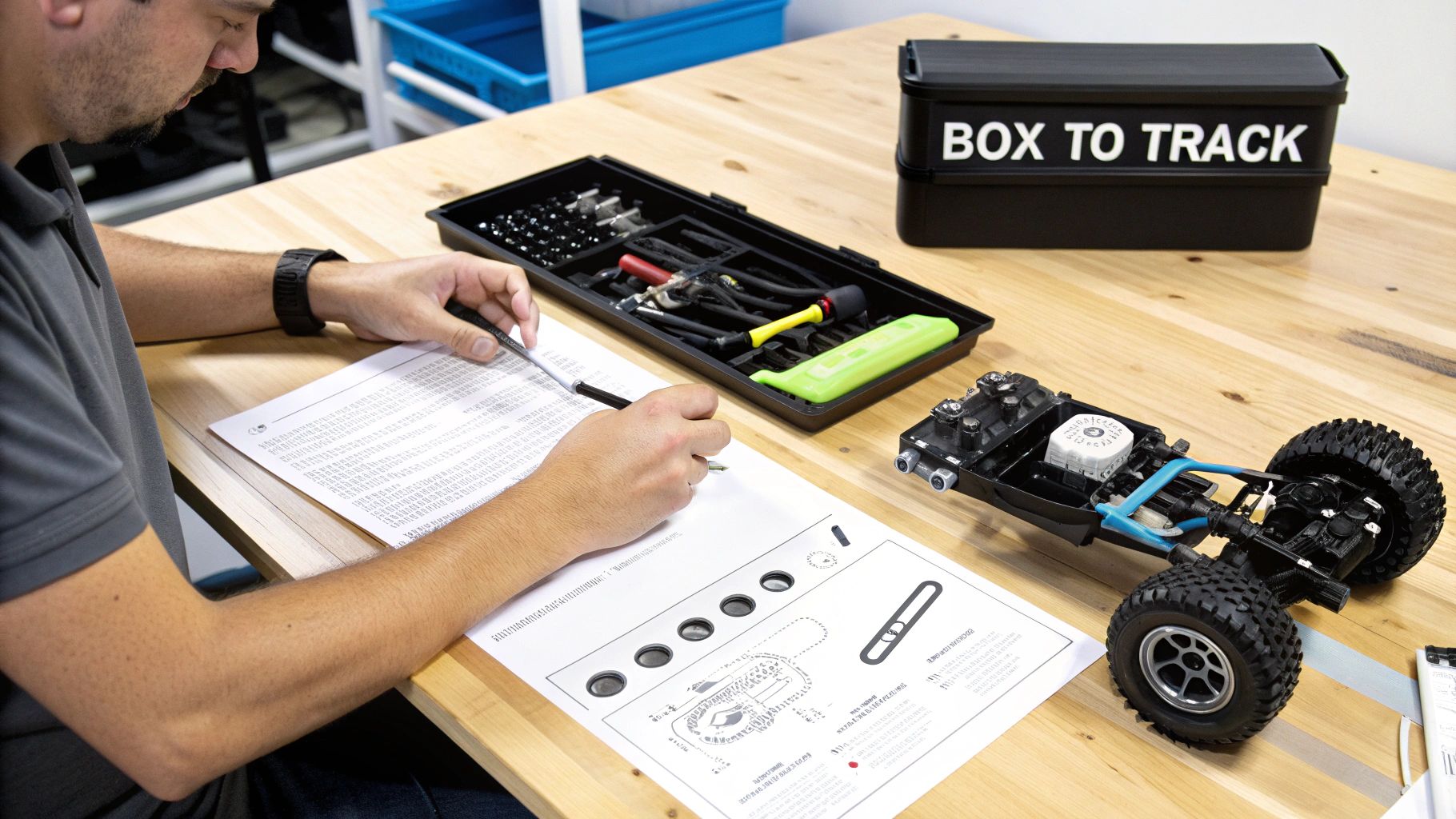
The best way to tackle a build is to break it down into logical phases. By focusing on one system at a time, you can get each part perfect before moving on, ensuring the finished car performs exactly as the designers intended.
Preparing Your Workspace
Before you even think about tearing open a parts bag, get your build area sorted. A clean, well-lit table is non-negotiable. I always recommend using a good pit mat—it stops tiny screws and pins from rolling away and disappearing forever.
Next, and this is crucial, read the instruction manual first. Don't just skim it. Brands like Awesomatix and XRAY provide incredibly detailed manuals for a reason. Understanding the build sequence ahead of time saves a ton of headaches later. This is also your chance to prep parts, like applying thread-lock to metal-on-metal screws or sealing carbon fibre edges to prevent them from splitting.
Building the Drivetrain and Suspension
Most kits start with the core of the car: the drivetrain and suspension. This is where you build your racer’s soul. You’ll begin by assembling the differentials, and your first major tuning decision comes right here—what weight of oil to use.
From there, you'll start bolting the suspension arms, hubs, and shock towers to the chassis. This is where the pro tips really make a difference. For example, when building the diffs, take the time to shim the gears properly. The goal is a whisper-quiet mesh with almost zero friction. A free-spinning drivetrain is a fast drivetrain. Period.
As you assemble the suspension, make sure every single part moves freely without any binding. A classic rookie mistake is over-tightening screws into plastic, which pinches the parts and kills suspension travel.
A car with a perfectly free suspension settles consistently and responds predictably to every tuning change you make. Taking the time to ream suspension arms and check for binding is a pro-level step that pays off in lap times.
Assembling and Bleeding the Shocks
Building a perfect set of oil-filled shocks is probably the single most critical step in any kit build. Flawlessly built shocks are the key to consistent handling over bumps and through corners. The goal is simple but demanding: build four identical shocks with zero air bubbles inside.
Follow these steps for perfect shocks every time:
- Fill Slowly: Fill the shock body with the recommended oil, leaving a little room at the top.
- Cycle the Piston: Slowly move the piston up and down to work out any air trapped underneath it.
- Let it Settle: Put the shocks in a stand and just let them sit for 10-15 minutes. You’ll see tiny air bubbles rise to the surface.
- Bleed Properly: Top off the oil and carefully install the shock cap or bladder. Use the bleeder screw or method in your manual to get rid of any excess oil. This ensures you get the correct rebound.
For a more detailed look, our complete guide to your first RC car kit build has more tips and visuals for these crucial steps.
Mounting Electronics and Prepping the Body
With the rolling chassis complete, it’s time to bring it to life with the electronics you’ve chosen. Plan the layout for the best possible weight balance and cleanest wiring. Solder your motor and battery connectors neatly and use heat shrink on every connection. No exceptions.
Use good double-sided tape to mount your ESC, receiver, and transponder. Route your wires carefully and use zip ties to keep them away from anything that moves, like belts, drive shafts, or the steering linkage.
The final step is to trim and paint your body, slap on the decals, and mount it to the chassis. This is the moment your creation goes from a collection of parts to a track-ready machine that’s uniquely yours.
Tuning, Upgrades, and Maintenance for Peak Performance
Your car is built, but the journey to the winner's circle has just begun. That mechanical knowledge you gained assembling your radio control car kit? It's now your greatest asset. Long-term success on the track really comes down to three things: precise tuning, smart upgrades, and consistent maintenance.
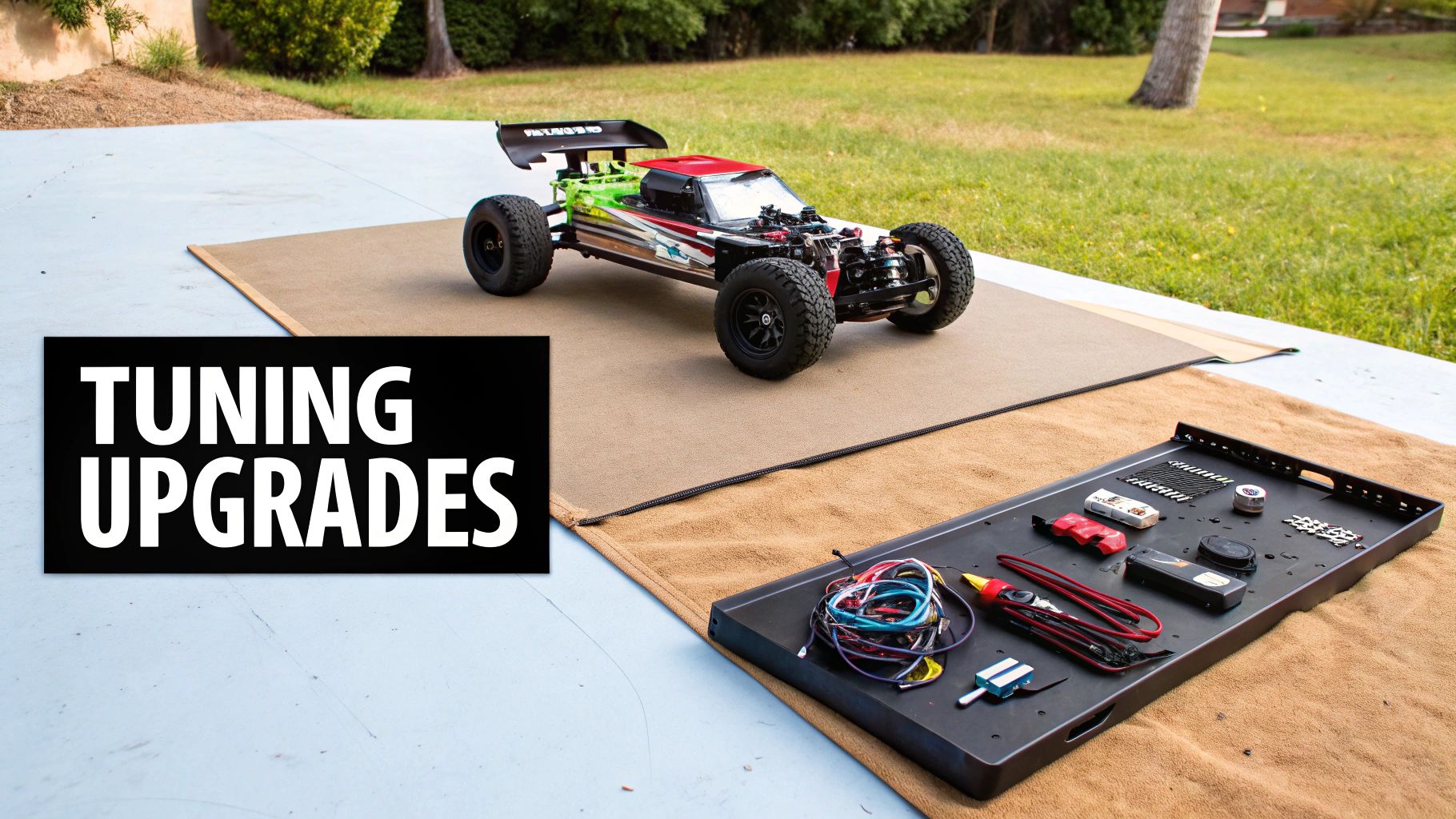
This is the ongoing process that transforms your car from its baseline setup into a machine perfectly dialled in for your driving style and the track in front of you. It’s where raw potential becomes repeatable performance.
Finding Speed in Small Adjustments
In competitive racing, tenths of a second separate the top qualifiers from the rest of the field. You find those fractions of time in tiny setup adjustments that change how your car interacts with the track. Mastering these fundamentals is the key to unlocking consistent pace.
Here are a few core tuning concepts you'll be working with constantly:
- Camber: This is the vertical angle of your tires relative to the track. Adjusting camber changes how much of the tire's contact patch is on the ground during cornering, which directly impacts side grip.
- Toe: This is the angle of the tires when you look at them from above. "Toe-in" points the front of the tires inward for more straight-line stability, while "toe-out" makes the car turn into corners more aggressively.
- Droop: This setting limits how far the suspension arms can travel downwards. More droop lets the chassis roll more in corners, generating grip on bumpy or low-traction surfaces. Less droop reduces body roll for a more responsive feel on smooth, high-grip tracks.
Think of tuning as speaking your car's language. A tiny change, like adding half a degree of front camber, can be the difference between a car that pushes wide in a corner and one that carves the perfect apex.
A Smart Path to Upgrading Your Kit
While kits from Awesomatix and XRAY are race-ready right out of the box, optional parts offer ways to fine-tune performance even further. The secret is to choose upgrades that provide measurable gains, not just ones that look cool. At Digital-RC, we stock the parts that top drivers actually use to find an edge.
Consider this upgrade path:
- Tuning Springs: An XRAY Spring-Set or Awesomatix SPR spring set is arguably the most effective tuning tool you can buy. Softer springs can generate more grip, while stiffer springs make the car feel more responsive.
- Chassis Flex Components: Parts like alternative top decks, such as the XRAY 1.6mm graphite top deck, or chassis braces let you alter the flex characteristics of your car—a critical adjustment for different grip levels.
- Weight Kits: Strategically adding XRAY or Awesomatix brass weights helps you meet minimum weight rules and fine-tune the car's balance for better handling.
The most effective upgrades are those that give you more tuning options. Focus on parts that allow you to adapt your car to changing track conditions, as this adaptability is what wins championships.
Proactive Maintenance for Maximum Reliability
The fastest car in the world is useless if it doesn't finish the race. A proactive maintenance schedule is your best defence against the dreaded "DNF" (Did Not Finish). Regular upkeep ensures your car remains consistent, predictable, and reliable every time you hit the track.
A solid maintenance routine is the foundation of competitive RC racing. It prevents minor issues from becoming race-ending failures and guarantees your car is always ready to perform at its peak.
Here’s a practical schedule to follow:
- After Every Run: Clean the chassis, check for loose screws, and inspect for any broken or bent parts.
- After Every Race Day: Rebuild your gear differential with fresh oil. Check all bearings to ensure they spin freely and replace any that feel gritty.
- Every Few Race Meets: Rebuild your shocks with new oil and O-rings to maintain consistent damping. Inspect drive belts for wear and check drive cups for any signs of thinning.
This disciplined approach ensures your investment in a high-quality radio control car kit pays off with maximum track time and consistent results.
Why Canadian Racers Choose Digital-RC
In a country as big as Canada, getting the right parts quickly isn’t just a nice-to-have—it’s a real competitive advantage. For serious on-road racers, a broken part during practice or a last-minute setup change can mean the difference between making the A-main and packing up early. That's exactly why Digital-RC has become the go-to source for the Canadian racing community.
We're not trying to be everything to everyone. Our focus is laser-sharp: we stock what competitive racers need to win. It starts with our curated selection of elite radio control car kits and performance parts from world-championship-winning brands like Awesomatix and XRAY. But our real value is solving the unique supply and logistics problems that Canadian racers face every season. We were built for this market, plain and simple.
Engineered for the Canadian Racer
The Canadian RC scene has its own set of challenges. With such a huge landmass and a spread-out population, finding a local hobby shop with high-end racing gear can be tough unless you're in a major city. This problem gets even bigger during our long winters, which drives demand for indoor on-road classes that require very specific, high-performance equipment. Market research, like this report on the global RC car market, confirms that vendors who price in CAD, ship quickly across the country, and make taxes simple are the ones who truly serve this dedicated community.
Digital-RC was built from the ground up to solve these exact problems. We’re not just another online store; we're a dedicated partner committed to keeping you on the track and in the race.
For a Canadian racer, waiting a week for a part from the US means a week of lost practice or a missed club race. We eliminate that delay. Our entire model is built around speed and access, because we know that’s what it takes to compete.
The Digital-RC Advantage
We've designed our entire operation to get rid of the usual headaches for Canadian racers. It's about more than just selling parts—it's about delivering a seamless experience that supports your racing program from the moment you place an order to the second you hit the track.
This commitment shows up in a few key ways:
- Transparent CAD Pricing: The price you see is the price you pay, in Canadian dollars. No surprises, no hidden currency conversion fees on your credit card statement.
- Zero Tax on All Orders: We’ve made budgeting for your race season easier by eliminating sales tax on every single order. What you see is what you pay.
- Free Same-Day Delivery: This is our game-changer. For racers in qualifying areas, orders placed before noon show up that same day—completely free. A crash in morning practice doesn't have to end your race weekend anymore.
By getting rid of long shipping delays and unexpected import fees, we make sure you get the performance parts you need, right when you need them. We're more than a retailer; we're a core part of the Canadian racing infrastructure.
Answering Your Top Questions
Stepping into the world of high-performance RC car kits always brings up a few questions, whether you're building your first chassis or you're a seasoned racer fine-tuning your setup. Here are some straight-up answers to the questions we hear most from the Canadian racing community.
What Tools Do I Absolutely Need to Build My First Kit?
A quality toolset isn't just a nice-to-have; it's the best investment you can make right alongside your kit. Good tools make the build smoother and, more importantly, prevent the headaches of stripped screws and damaged parts.
Here are the non-negotiables:
- A set of precision hex drivers. The most common sizes you'll need are 1.5mm, 2.0mm, and 2.5mm.
- Needle-nose pliers for grabbing tiny parts and adjusting turnbuckles.
- A sharp hobby knife for cleaning up plastic parts from the trees.
- Dedicated shock pliers. Trust us, you don't want to scratch your shock shafts.
Many kits will also call for specific nut drivers, like 5.5mm and 7.0mm. We carry curated toolsets from MIP and XRAY at Digital-RC that are perfect for any Awesomatix or XRAY assembly, so you know you have the right tool for the job from the very first screw.
How Do I Choose Between a 1/10 Touring Car and a 1/12 Pan Car?
This really comes down to two things: what people are racing at your local track and what kind of driving experience you're after. Your best first step is always to visit a local club and see which classes have the most entries.
1/10 touring cars like the XRAY X4 are incredibly versatile four-wheel drive platforms that work well on both carpet and asphalt. Their inherent stability makes them a fantastic starting point for new racers. On the other hand, 1/12 pan cars like the Awesomatix A12 are rear-wheel drive, feather-light, and unbelievably agile. They are the kings of high-grip indoor carpet but require a much more precise driving style.
Will Any Electronics Work with Awesomatix and XRAY Kits?
Yes, for the most part. As long as the components are the correct scale size, you're good to go. Both Awesomatix and XRAY design their kits around industry-standard mounting dimensions, so servos, motors, and ESCs from all the major brands will fit without any issues.
The real question isn't about brand compatibility—it's about making sure your electronics are legal for your specific race class. For example, a 'blinky' spec class demands an ESC and motor from an approved list. Our product descriptions for electronics from Hobbywing, Team Powers, and Sanwa always highlight race-legal specifications to make sure your chassis is ready for tech inspection.
Ready to build your next winner? Explore our championship-proven selection of radio control car kits, electronics, and performance parts at Digital-RC. With transparent CAD pricing, zero tax, and free same-day delivery, we're here to fuel your passion for racing. Find everything you need at https://digitalrc.ca.