

Your Ultimate Guide to Building Competitive RC Car Kits
Welcome to the competitive world of RC racing. If you're serious about getting to the top of the podium, your journey starts long before you ever hit the track. For any dedicated racer, the choice is clear: building from an RC car kit is the only way to unlock true performance and get a real competitive edge.
The Builder's Advantage in Competitive Racing
Think of a ready-to-run (RTR) car like a standard vehicle you drive off the lot. It’s convenient, sure, but it’s built for the masses. An RC car kit, on the other hand, is a high-performance machine you assemble piece by piece—just like a professional race team builds their car from the ground up. This hands-on process is more than just putting parts together; it's the first real step to becoming a faster, smarter racer.
This guide is for those ready to move past pre-assembled models. We're diving deep into why building from a kit is the definitive path for anyone with a competitive streak. You'll see how the build process itself gives you the intimate knowledge needed to fine-tune your car for victory.
Understanding Your Machine Inside and Out
When you build your own car, you learn what makes it tick. Every screw, every shim, every component passes through your hands. You’ll feel how the suspension geometry impacts cornering, see how the drivetrain transfers power, and understand how a tiny shock oil adjustment can completely change the car's behaviour on the track. This is deep mechanical insight you simply can't get from an RTR package.
The assembly process isn't just a prerequisite; it's your first training session. By the time you're done, you're no longer just a driver—you're a mechanic, a tuner, and a racer who knows precisely how to make the car respond to your commands.
This knowledge is your secret weapon on race day. Instead of guessing why the car is loose in a corner, you’ll be making quick, confident, and effective setup changes to shave precious tenths off your lap times.
A Growing Hobby with a Competitive Spirit
The appeal of building and racing is exploding across Canada. The RC car market is expanding fast, with an estimated annual growth rate somewhere between 13.9% and 14.8%. This surge is fuelled by incredible leaps in technology and a thriving, grassroots racing scene.
While electric RC cars dominate with a 60% market share because they're so easy to get started with, the real heart of the hobby is in competition and customisation. You can discover more insights about the expanding RC car market in North America to see just how big this is getting.
From picking the perfect chassis to soldering your electronics and dialing in the setup for your local track, every single step is part of your development as a racer. Let’s get you started on this rewarding journey.
Choosing the Right Competitive RC Car Kit
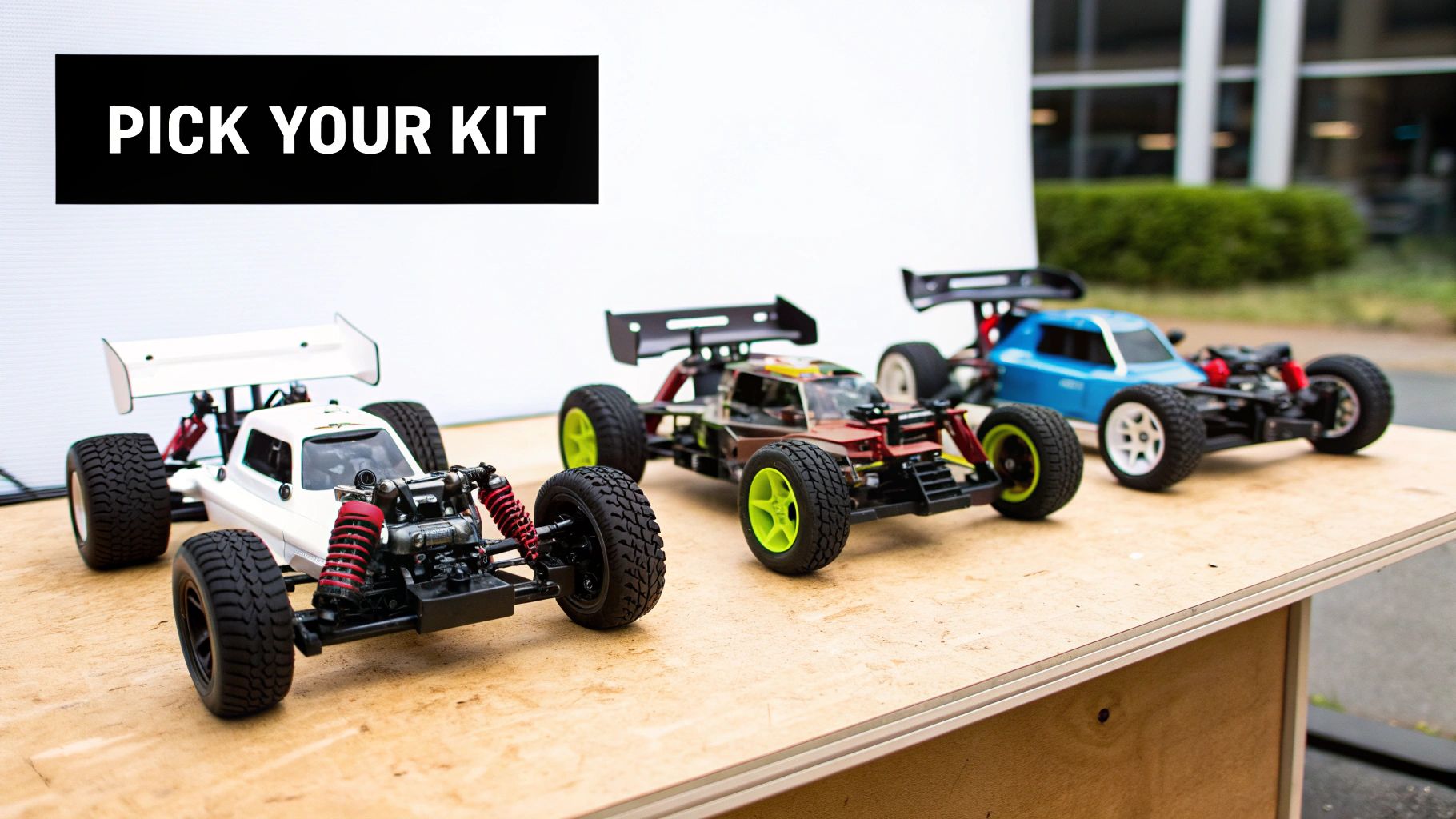
Picking your first competitive RC car kit is a huge step. It’s the single most important decision you'll make on your path to the podium, setting the foundation for your entire racing experience—from the build itself to your performance on the track. The options can feel overwhelming, but it all boils down to one simple question.
Where are you going to race? Your local track’s surface is the ultimate guide, whether it’s high-grip carpet, smooth asphalt, packed clay, or loose dirt. Since we specialize in on-road racing, we'll focus on the kits designed to dominate carpet and asphalt surfaces. Choosing the right tool for the job is half the battle.
On-Road Racing Disciplines
Once you know the terrain, you can dive into the different on-road racing classes. Each one offers a unique driving challenge and has its own distinct competitive feel.
To help you decide, here’s a quick breakdown of what to expect from each category.
Top On-Road RC Car Kit Classes
| Attribute | On-Road Touring Car Kits | On-Road Pan Car Kits (1/12, F1) |
|---|---|---|
| Primary Goal | Precision, cornering speed, and consistency on smooth surfaces. | Agility and mastering throttle control on high-grip surfaces. |
| Typical Environment | Indoor carpet tracks, outdoor asphalt circuits. | Predominantly indoor carpet tracks. |
| Driving Style | Requires smooth, precise inputs. Mistakes are amplified. | Demands extremely smooth throttle and steering; very responsive. |
| Key Skill | Finding the perfect racing line and maintaining momentum. | Adapting to extreme grip levels and driving with finesse. |
| Maintenance | Focused on fine-tuning setup and checking for wear on small parts. | Tire management (foam tires) and pod setup are critical. |
Ultimately, both paths offer incredible depth and competition. Your choice depends entirely on what kind of driving challenge excites you most.
On-Road Racing Kits
These kits are the F1 cars of the RC world, built for pure speed and precision on smooth surfaces. They demand clean driving and a deep understanding of setup.
- 1/10 Electric Touring Car: This is the pinnacle of on-road racing. These all-wheel-drive machines are incredibly fast and responsive, where races are often won or lost by hundredths of a second. A kit like the championship-proven XRAY X4'26 Touring Car is a perfect example of the cutting-edge tech in this class.
- 1/12 Pan Car: Lighter and simpler, these rear-wheel-drive cars are masters of high-grip carpet tracks. They are extremely agile and teach priceless lessons in throttle control and driving finesse. XRAY and CRC are top contenders in this class.
- Formula 1 (F1): These realistic, rear-wheel-drive chassis offer a unique driving experience that rewards smoothness. Brands like XRAY and Schumacher produce beautiful, high-performance F1 kits.
Your local track is your best resource. Before you buy anything, visit on a race day. See which classes have the most drivers and talk to people in the pits—their advice is priceless and guarantees you’ll have a full field to race against every week.
Understanding Scales and Chassis Materials
Beyond the class, you’ll see differences in scale and materials that directly impact performance, maintenance, and cost. For competitive on-road racing, 1/10 and 1/12 are the most common scales. 1/10 scale is dominant for indoor and outdoor venues, offering a great balance of speed and affordability. The smaller 1/12 scale vehicles are kings of indoor carpet tracks.
The landscape of RC car kits in Canada has seen a major shift. In the early 2000s, nitro was king, but by the mid-2010s, battery-powered electric kits had surged ahead. Today, they hold a 60% market share, thanks to their cleaner operation and ease of use. This trend has seen the market size double, with a dedicated following for on-road racing in urban centres.
Chassis material is another key decision. Kits use a strategic combination of materials optimized for a specific purpose.
- Carbon Fibre: Prized for its incredible stiffness-to-weight ratio. It's the go-to for high-end on-road touring cars, pan cars, and F1 kits, providing a rigid, hyper-responsive platform perfect for high-grip conditions.
- Aluminum: Often used for on-road chassis plates. Aluminum offers different flex characteristics than carbon fibre and is often used as a tuning option to change a car’s handling for specific surfaces.
- Composite Plastics: High-quality composites are used for suspension arms, hubs, and other key components. They offer a controlled amount of flex and are extremely durable.
By aligning your budget with your local race scene and your personal goals, you can choose an RC car kit that sets you up for a successful and rewarding journey from the very first lap.
Selecting Your Winning Electronics Combo
Now that you've got your chassis picked out, it's time to give your RC car kit a pulse. The electronics package—the motor, speed controller, servo, and battery—is the heart, brain, and muscle of your car. This combo is what turns your inputs on the radio into raw speed and razor-sharp handling on the track.
Think of it like building a custom engine. Every single part has to work perfectly with the others. If one piece can't keep up, the whole system suffers.
- The motor is your engine—it’s where the power comes from.
- The Electronic Speed Controller (ESC) is the throttle and brain, managing how that power gets to the wheels.
- The servo is the steering rack, pointing the car exactly where you want it to go.
- The battery is the fuel tank, supplying the juice to make it all happen.
Get this combination right, and you'll have a reliable, balanced system that delivers the power and control you need to be competitive. A mismatch will create a bottleneck and hold you back, no matter how good the individual parts are.
The Power Plant: Brushless Motors
Your first big decision is the motor. While brushed motors were the standard years ago, brushless technology now completely dominates competitive RC racing. The reason is simple: efficiency.
A brushed motor uses physical carbon brushes to make electrical contact, which creates friction, heat, and wear. Brushless motors, on the other hand, use magnets and sensors, which means almost no friction. More power from your battery goes straight to the wheels, the motor runs cooler, and it lasts a whole lot longer.
For racing, there's no debate. Brushless is the only way to go, with top brands like Hobbywing and Fantom leading the charge.
The Brain and Throttle: The ESC
The Electronic Speed Controller (ESC) is the command centre of your entire power system. It takes the signal from your receiver and tells the motor exactly how fast to spin, while also handling braking. A great ESC, like the popular Hobbywing XR10 series, delivers that power smoothly and reliably.
Matching your ESC to your motor is non-negotiable. An ESC that's too weak for your motor will overheat and fail, likely taking the motor with it. Always check the motor's "turn" rating (like 17.5T or 21.5T) and make sure the ESC is rated to handle it. Remember, a lower turn number means a faster, more power-hungry motor, which demands a more powerful ESC.
Your ESC is the brain of the operation. A quality ESC provides smooth throttle delivery, powerful braking, and advanced tuning options that can be adjusted to suit different track conditions, giving you a distinct competitive advantage.
For a deeper dive into this crucial component, you can explore our detailed guide on how to match your Electronic Speed Controller to your motor. It gives you a complete breakdown to help you make the right choice.
Steering Precision: Choosing the Right Servo
Your servo handles the steering, and its performance comes down to two key numbers: speed and torque.
- Speed: This is measured in how fast it can rotate 60 degrees (e.g., 0.08s/60°). A faster servo means your car reacts instantly to your steering inputs, which is critical for quick direction changes.
- Torque: Measured in ounce-inches or kilogram-centimetres, this is the servo's muscle. More torque is needed to hold the steering angle in high-speed corners, especially with touring cars.
For competitive on-road racing, a high-speed, digital servo from a brand like Futaba, KO Propo, or ProTek RC is a must-have. You need those lightning-fast reflexes to hit your apexes perfectly and navigate tight sections of the track.
The Fuel Tank: Decoding LiPo Batteries
Finally, we have the LiPo (Lithium Polymer) battery—your car's fuel. Modern LiPo batteries from brands like Fantom or ProTek RC pack a serious punch. Here are the numbers that matter:
- Voltage (S Rating): You'll see this as a number followed by "S" (e.g., 2S). This is the battery's raw power potential. Most 1/10 scale on-road classes run on 2S (7.4V) batteries.
- Capacity (mAh): Measured in milliamp-hours, this is your runtime. More mAh means you can drive longer. For a standard 5-minute race, a 5000-6000mAh battery is a solid choice.
- Discharge Rate (C-Rating): This number tells you how fast the battery can deliver its energy. A higher C-rating gives you more "punch" or acceleration off the line. For competitive racing, look for batteries with a C-rating of 100C or higher.
By carefully choosing a matched set of electronics, you're building a powerful and dependable foundation for a truly competitive RC car.
A Practical Guide to Assembling Your RC Kit
Building your rc car kit is where the magic really happens. This isn't just about following steps in a manual; it’s about laying the foundation for a car that’s fast, reliable, and consistent on the track. Think of your kit’s manual as the map, but this guide is the experienced co-driver calling out the corners.
The journey from a box of parts to a race-ready machine is where you learn your car inside and out. Every screw you turn and every gear you install teaches you something new, giving you an intimate understanding that’s crucial for tuning and maintenance down the road.
Preparation Is Everything
Before you even think about tearing open that first bag of parts, get organized. A clean, well-lit workspace is non-negotiable. I always use a pit mat—it stops tiny screws from bouncing into another dimension—and magnetic parts trays are a lifesaver for keeping everything sorted by assembly step.
Your tools are just as important as the kit itself. Sure, a basic set will get you there, but investing in quality tools makes the build smoother and prevents the soul-crushing moment you strip a screw head.
- Quality Hex Drivers: This is the one place you can't cut corners. Get a good set of precision metric hex drivers from brands like MIP or HUDY (1.5mm, 2.0mm, 2.5mm). A proper fit prevents damage and makes everything feel right.
- Needle-Nose Pliers: Essential for gripping small parts like ball ends without fumbling.
- Shock Pliers: A specialized tool, but worth its weight in gold. They let you grip shock shafts firmly without scratching the polished surface, which is critical for smooth suspension.
- Hobby Knife: Perfect for getting a clean cut on plastic parts trees and trimming off any lingering flash.
- Blue Thread-Locking Compound: Any screw going from metal into metal (like on a motor mount) gets a dab of this. It stops vibrations from loosening things up mid-race.
Key Assembly Stages and Pro Tips
As you get into the build, some stages demand a little extra care. Get these right now, and you'll save yourself a ton of headaches at the track.
First up, the drivetrain. As you build the differentials and transmission, check that every gear spins freely with absolutely no binding. A smooth drivetrain is an efficient one, meaning more of your motor's power actually makes it to the wheels. Setting the gear mesh between the pinion and spur is also critical—too tight and you'll strain your motor; too loose and you’ll be buying a new spur gear after one run.
Next, the shocks. Building perfectly smooth, air-free shocks is an art, and it directly translates to how your car handles bumps and flows through corners. Take your time here. Follow the manual for filling and bleeding them, and make sure every single shock feels identical in its compression and rebound.
The single most important check during assembly is ensuring the suspension moves freely. After building the suspension arms, hubs, and shocks, cycle the suspension up and down. It should be buttery smooth with no binding, allowing the shocks and springs to do their job without interference.
Finally, laying out your electronics requires some forethought. Plan your wiring before you start soldering or mounting anything. This ensures your wires are clear of moving parts, easy to access for maintenance, and just look clean and professional.
This diagram shows the basic flow of how everything works together.
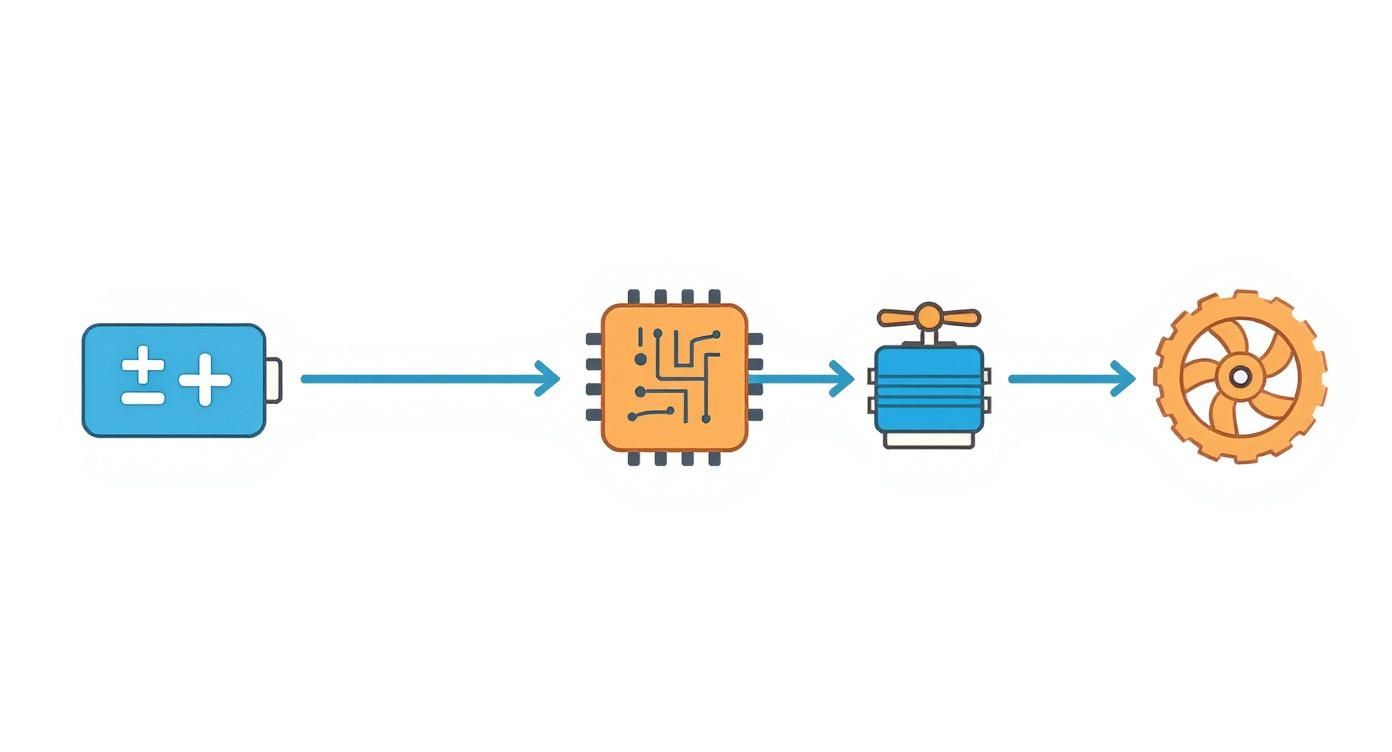
The battery feeds the ESC, which takes the signals from your receiver to control the motor and servo. It’s a simple concept, but a tidy installation prevents electrical gremlins and makes troubleshooting a breeze. Nail these steps, and you’ll have a reliable, high-performance machine that’s ready to race.
Your First Steps in Trackside Tuning
Getting your RC car kit built perfectly is a huge milestone, but it’s really only half the battle. The other half is won right at the track, making small, deliberate adjustments that take your car's handling from good to completely dialled in. We call this process tuning, and it’s how you adapt your machine to the specific grip levels, layout, and conditions you face on any given race day.
Think of your car's initial setup—the one from the manual—as a solid baseline. It's a great starting point. Tuning is the art of refining that baseline to find those last few tenths of a second. A single degree of camber change or a different weight of shock oil can be the difference between a car that feels lazy in the corners and one that carves through them with absolute precision. It's a constant conversation between you, your car, and the track.
The goal isn't just to set a single fast lap. It's to find a setup that's consistent and easy to drive for an entire five-minute race. This is where mastering the fundamentals becomes your greatest weapon.
Mastering the Foundational Settings
Before you even think about complex adjustments, every competitive racer needs to master the "big three" of chassis setup: ride height, camber, and toe. These three settings are the foundation of your car's handling. They should be the first things you check and adjust every single time you hit the track because they control the most critical element of performance: how your tires interact with the surface.
Ride Height: This is simply how high your chassis sits off the track.
- Lower Ride Height: On smooth, high-grip surfaces like carpet, a lower ride height is king. It drops the car's centre of gravity, which reduces body roll and makes the car feel more responsive.
- Higher Ride Height: This is your go-to for bumpy or lower-grip tracks. It allows for more weight transfer to help generate grip and gives you more clearance over any imperfections in the surface.
Camber: This is the vertical tilt of your tires when you look at them from the front or back.
- Negative Camber: The top of the tire leans inward. This is the standard for racing because as the car rolls in a corner, it keeps a larger part of the tire—the contact patch—flat on the track for maximum grip. Most setups run between -1.5 to -2.5 degrees.
- Positive Camber: The top of the tire leans outward. You'll almost never see this in on-road racing because it kills cornering grip.
Toe: This is the angle of your tires when you look down on them from above.
- Toe-in: The front edges of the tires point inward, toward the centre of the chassis. A bit of rear toe-in is very common because it adds stability, especially when you're hard on the throttle.
- Toe-out: The front edges of the tires point outward. A small amount of front toe-out can help the car turn in more aggressively right at the start of a corner.
Diving Deeper Into Suspension and Drivetrain
Once you have a solid handle on the basics, you can start making finer adjustments to the suspension and differential. These parts control how your car’s weight shifts around during acceleration, braking, and cornering—a dynamic process we call weight transfer.
Your shock package—the combination of shock oil viscosity and spring rates—is your main tool for managing this. Thicker oil (higher viscosity) slows down the shock’s movement, which can make the car feel more stable but a little less responsive. On the other hand, softer springs allow for more chassis roll, which can help generate more grip on slick surfaces.
Tuning is a process of elimination. Only change one setting at a time and run a few laps to feel the difference. This methodical approach is the only way to truly understand how each adjustment affects your car's handling.
The differential is another powerful tuning tool, especially in touring cars. The rear gear diff is typically filled with silicone fluid. Using thicker fluid makes the rear end feel more locked, which gives you better forward drive on high-grip tracks. Thinner fluid lets the wheels differentiate more easily, which can help the car rotate better through corners on lower-grip surfaces.
To help you get started, here's a quick look at how common adjustments can fix typical handling problems.
Basic Tuning Adjustments and Their Effects
| Tuning Adjustment | Effect on Handling | When to Use It |
|---|---|---|
| Increase Rear Toe-In | Increases rear stability; may cause understeer on corner entry. | When the car feels loose or "squirrely" on power. |
| Add Front Toe-Out | Improves initial turn-in; can make the car feel twitchy. | When you need more aggressive steering at corner entry. |
| Soften Front Springs | Increases front grip; can make the car push on corner exit. | To combat understeer from the middle to the exit of a corner. |
| Use Thicker Shock Oil | Slows suspension reaction; calms the car on high-grip tracks. | When the car feels too reactive or edgy on a high-bite surface. |
Of course, tires are arguably the most crucial tuning component of all, as they're what connect every single adjustment you make to the track surface. For a deeper dive into selecting the right compound and tread, our guide on choosing the best RC car tires provides essential insights. With this knowledge, you can start making confident, purposeful changes at the track, turning handling issues into opportunities for faster, more consistent laps.
Common Questions from the Pit Lane
Jumping into competitive RC car kits brings up a lot of questions, whether you're building your first chassis or you're a seasoned racer. Here are some quick, no-nonsense answers to the things we hear most often.
What's the Real Difference Between an RTR and a Kit?
The biggest split is between assembly and quality. A Ready-to-Run (RTR) car is exactly what it sounds like—it comes pre-built with all the electronics included. You just charge the battery and go. It’s built for convenience.
An RC car kit, on the other hand, is the racer's choice. You build the entire chassis piece by piece from the ground up. This means you also get to choose and install your own high-performance electronics—the motor, ESC, servo, and radio system. Kits are the standard for racing because they're built with superior materials and give you total control over the setup, which is essential for making those tiny adjustments that win races.
How Much Will a Competitive Kit Actually Cost Me?
The kit itself is just the starting point. A high-performance 1/10 scale touring car or pan car kit from brands like XRAY or Schumacher will typically run you between $700 and $1,100.
But that's just the rolling chassis. You'll need to budget for the brain and muscles of the car. Plan on spending another $500 to $1,000 for a competitive-grade motor, ESC, servo, radio system, batteries, a good charger, tires, and the essential tools to put it all together. It's a real investment, but one that pays off in performance and reliability on the track.
What Are the Must-Have Tools for My First Build?
You don't need a professional mechanic's toolbox, but a few key items are non-negotiable for a clean build. The single most important thing you can buy is a quality set of metric hex drivers. Get good ones like a HUDY or MIP set in 1.5mm, 2.0mm, and 2.5mm sizes. They'll save you from stripping screws and ensure every part is tightened perfectly.
Beyond the hex drivers, a few other tools will make your life a lot easier. Grab a pair of needle-nose pliers for tiny parts, dedicated shock shaft pliers so you don't scratch your dampers, a sharp hobby knife, and some blue thread-locking compound. That last one is crucial for any metal-on-metal screws that might vibrate loose.
How Do I Pick the Right Tires for My Local Track?
Tires are, without a doubt, the most critical tuning option you have. The absolute best way to figure out what works is to go to your local track on a race day. Walk through the pits and see what the fast, experienced guys in your class are running. Brands like Gravity RC, Sweep, and MR33 are popular choices, but the track surface, the temperature, and the layout all dictate which compound will hook up.
Ready to build your path to the podium? digital-rc is your Canadian source for premium on-road RC car kits, electronics, and race-proven parts. Explore our curated collections and get everything you need with fast, same-day delivery.