

A Racer's Guide to Competitive RC Car Kits to Build
For any serious RC racer, the best RC car kits to build are the ones that give you total control and an undeniable performance edge. We're talking about high-end chassis from brands like Awesomatix and XRAY. These kits aren't just a box of parts; they're your ticket to a faster, more consistent race machine.
Why Building a Kit Is Your First Step to Winning Races
Welcome to the sharp end of competitive RC racing. This is where races are won and lost in the pits, long before the tone ever sounds. A Ready-to-Run (RTR) car gets you on the track instantly, but it’s a compromise from the very start. Think of an RTR as a rental car—it’ll get you around the track, but it was never designed for the top step of the podium.
Building one of the top-tier RC car kits to build is a completely different game. It puts you in the driver's seat as both the driver and the lead mechanic of your own race team. Every screw you turn, every shim you place, and every drop of shock oil you measure is a decision that impacts performance. This isn't just assembly; it's a masterclass in race car dynamics.
The Knowledge Advantage
When you build your car from the ground up, you develop an instinct for how every single component interacts. This intimate knowledge is your secret weapon when the pressure is on. You'll know exactly what adjustment to make when the track grip changes because you're the one who built the differential, set the camber links, and bled the shocks.
This deep familiarity lets you diagnose problems in seconds and tune your car with surgical precision. It gives you a massive advantage over drivers who are just guessing at setup changes. Taking that competitive approach from day one is key, and it helps to draw inspiration from the highest levels of motorsport. For a closer look at what professional competition involves, check out resources covering major racing events like the Australian Grand Prix.
Unlocking Peak Performance
High-performance kits from premier brands like Awesomatix and XRAY are engineered with far better materials and much tighter tolerances than any RTR. That quality translates directly into speed and consistency on the track.
Building a kit isn't just a step in the process; it is the process. It transforms you from a driver into a racer, giving you the control and insight needed to push for the podium.
The components are designed to withstand the brutal stress of racing and offer a massive range of adjustments. This means you can dial in your car's handling to perfectly suit your driving style and the specific demands of any track, from high-bite carpet to abrasive asphalt. You simply can't achieve that level of fine-tuning with a pre-built model.
Choosing Your Chassis: The Foundation of Speed
The chassis is the skeleton of your RC car. Picking the right one is arguably the single most important decision you'll make on your way to the podium. In competitive on-road racing, two platforms dominate the scene: 1/10 Electric Touring and 1/12 Pan Cars.
It's not about which one is "better." It's about which chassis aligns with your driving style, your local track, and your ultimate goals as a racer. Think of it like choosing between two very different types of real-world race cars—each is a specialized tool for a specific job. Understanding their core philosophies is the first step.
1/10 Electric Touring: The All-Wheel-Drive Champion
Picture a world-class rally car—powerful, planted, and incredibly stable. That's the soul of a 1/10 Electric Touring Car. These are the RC car kits to build that racers often start with, featuring four-wheel drive, independent suspension, and oil-filled shocks. This sophisticated setup makes them exceptionally versatile and predictable.
That built-in stability gives you confidence. You can push harder into corners and power out with massive traction. Whether you're on high-grip carpet or a bumpy, lower-grip asphalt track, a touring car provides a forgiving foundation that's easier for new competitive racers to get a feel for.
Brands like XRAY are masters of this class. Their chassis, like the legendary XRAY X4, are engineered with a perfect blend of rigidity and flex, allowing the car to generate huge mechanical grip across a wide range of conditions.
1/12 Pan Car: The Formula 1 Machine
Now, shift your thinking to a lightweight, rear-wheel-drive Formula 1 car. It's a pure, unfiltered racing machine built for blistering speed and razor-sharp reflexes. That is the 1/12 Pan Car. These cars are much lighter and simpler, with a direct-drive rear axle and a pivot-ball front end.
This minimalist design translates into incredible efficiency and explosive acceleration. A pan car changes direction with an immediacy that a touring car just can't match. But all that raw performance demands precision. With less weight and only rear-wheel drive, they require a much smoother driving style and a deep setup knowledge to keep them hooked up.
Chassis from manufacturers like Awesomatix, such as the A12, showcase radical design philosophies. Their unique suspension systems and focus on an ultra-low centre of gravity make them absolute weapons on smooth, high-grip indoor carpet tracks where that agility can be fully unleashed.
The choice between a 1/10 Touring Car and a 1/12 Pan Car comes down to stability versus agility. One gives you the all-wheel-drive confidence of a rally car, while the other delivers the raw, lightning-fast reflexes of a Formula 1 machine.
This decision tree shows the strategic choice between starting with a kit for maximum control versus an RTR for convenience, both aimed at the same goal: winning.
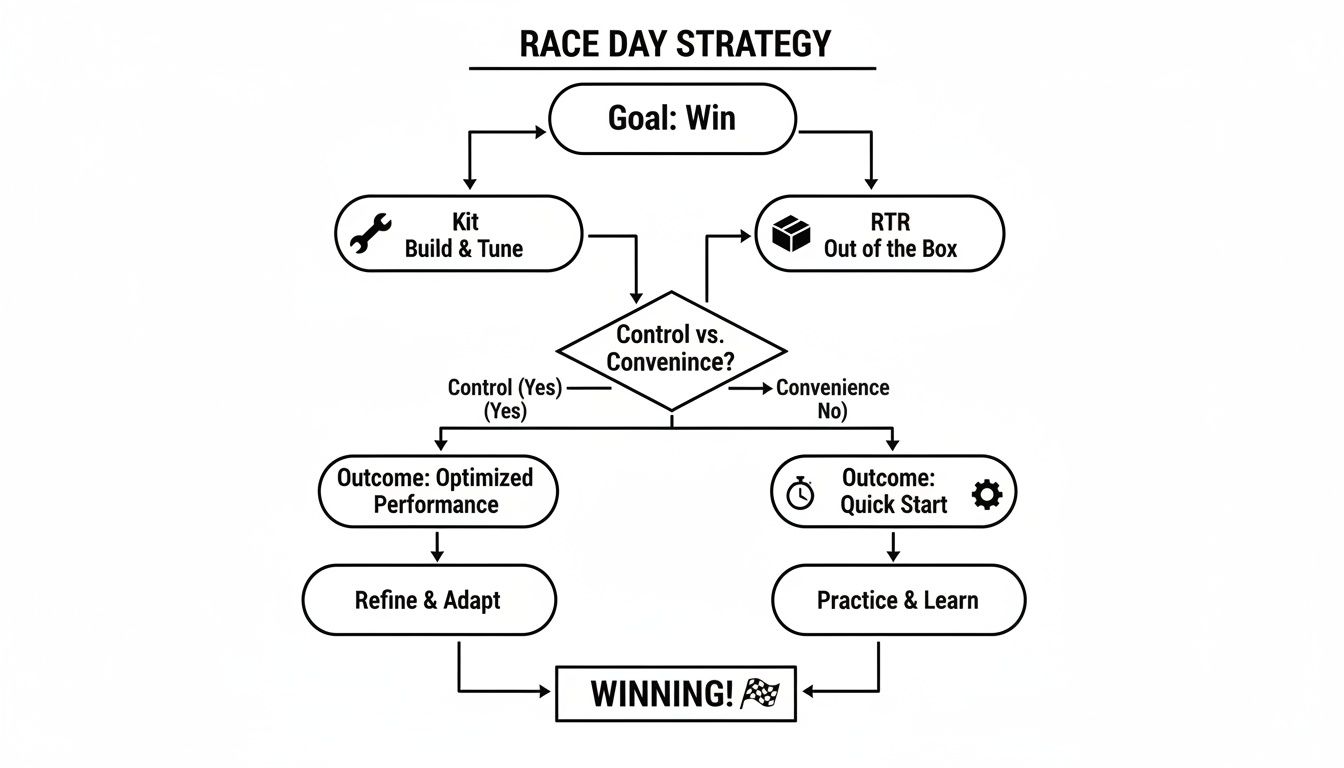
As the flowchart shows, for the optimized performance and ultimate control that competitive racing demands, building a kit is the superior path.
1/10 Touring Car vs. 1/12 Pan Car at a Glance
To help you decide, here’s a quick breakdown of how these two dominant platforms stack up against each other. Consider which characteristics are most important for your home track and your personal driving style.
| Feature | 1/10 Electric Touring Car | 1/12 Pan Car |
|---|---|---|
| Drivetrain | 4WD (Belt or Shaft) | RWD (Direct Drive) |
| Best For | All-around performance, asphalt, and medium-to-low grip carpet | High-grip carpet, smooth surfaces |
| Driving Style | Forgiving, stable, rewards aggressive driving | Demands precision, smoothness, and finesse |
| Complexity | Higher (independent suspension, shocks, differentials) | Lower (simpler design, fewer moving parts) |
| Acceleration | Strong and controllable | Explosive and immediate |
| Cornering | Stable and predictable | Extremely agile and responsive |
| Top Speed | Very high, especially on larger tracks | Extremely high, especially in modified classes |
| Learning Curve | Easier for beginners to be competitive quickly | Steeper, but incredibly rewarding for experienced drivers |
| Example Chassis | XRAY X4 | Awesomatix A12 |
Ultimately, both platforms are capable of winning races. The key is choosing the one that will become an extension of you on the track.
Making the Right Choice for You
Your decision should be guided by a few key factors. First, what’s your local track like? If it's a big, flowing asphalt circuit, the stability of a 1/10 touring car is a huge advantage. If you're racing on a tight, high-grip indoor carpet track, the insane agility of a 1/12 pan car could be the ticket.
Second, be honest about your own driving style and experience. If you're new to serious racing, a touring car’s forgiving nature is a much better learning platform. But if you’re an experienced driver who thrives on precision and challenge, a pan car will reward your skill with mind-blowing lap times. The best RC car kits to build are the ones that amplify your strengths and feel right at home in your environment.
Powering Your Build: The Heartbeat of Your RC Car
A world-class chassis is a phenomenal starting point, but it’s the electronics that bring it to life. Think of your chassis as the skeleton of a high-performance athlete; the electronics are the heart, muscles, and nervous system driving it to victory. Choosing the right combination here is just as critical as picking the right kit.
This system works in a beautiful, high-speed harmony. Your LiPo battery provides the raw energy, the Electronic Speed Controller (ESC) acts as the brain, the motor turns that energy into brutal speed, and the servo delivers the lightning-fast reflexes needed to navigate the track. A weak link in any one of these components will hold the entire car back.
The Electronic Speed Controller (ESC) and Motor
The ESC and motor are the dynamic duo of your car’s power system. The ESC takes the signals from your radio and tells the motor exactly how much power to unleash. It's the conductor of the orchestra, making sure every burst of acceleration and every bit of braking happens with perfect timing and control.
Motors, like the ones from Hobbywing, are rated in "turns." A lower turn number (like a 4.5T) means more power and higher top speed—perfect for modified racing. A higher turn number (like a 17.5T) offers smoother power delivery and is the standard for spec or "stock" racing classes. We stock a full range of Hobbywing motors to match any class you plan to race in.
The Steering Servo and LiPo Battery
While the motor handles getting you down the straightaway, the steering servo is what dictates your car's agility. It’s a small but powerful motor that controls the front wheels. In racing, a servo's speed and torque are everything. High torque ensures the wheels turn with authority, even under heavy cornering loads, while high speed allows for the quick, precise corrections that win races.
A top-tier servo from a brand like Power HD can be the difference between hitting an apex perfectly or missing it by a centimetre. This precision is fueled by the LiPo (Lithium Polymer) battery—the fuel tank for your electric race car. Measured in voltage (like 7.6V for a 2S pack) and capacity (mAh), the right battery from brands like Sunpadow provides consistent, powerful discharge from the start of the race to the finish line.
Your electronics package is a complete system. Every component has to complement the others. Pairing a high-end Hobbywing ESC with a potent Hobbywing motor and a lightning-fast Power HD servo creates a reliable, perfectly matched setup you can count on lap after lap.
Your electronics are the heartbeat of your race car—make sure it's a strong one.
Supporting Electronics for Race Day Success
Beyond the core four components, a few smaller electronics are non-negotiable for competitive racing. These unsung heroes make sure you can actually compete and keep your primary electronics running cool under pressure.
- Transponder: This is your car's unique ID for the track's timing system. It logs your lap times and race position every time you cross the start/finish line. The MyLaps RC4 Pro is the standard at most tracks.
- Motor Fan: High-performance brushless motors generate a surprising amount of heat. A small, high-RPM cooling fan from a brand like WTF (Wild Turbo Fan) is crucial for preventing your motor from overheating, which can cause power loss (fade) or even permanent damage.
Investing in a high-quality, perfectly matched electronic system is one of the smartest moves you can make. It delivers the reliable, consistent performance needed to turn your driving skill and a well-built chassis into podium finishes.
Equipping Your Pit: The Essential Tools for a Pro Build
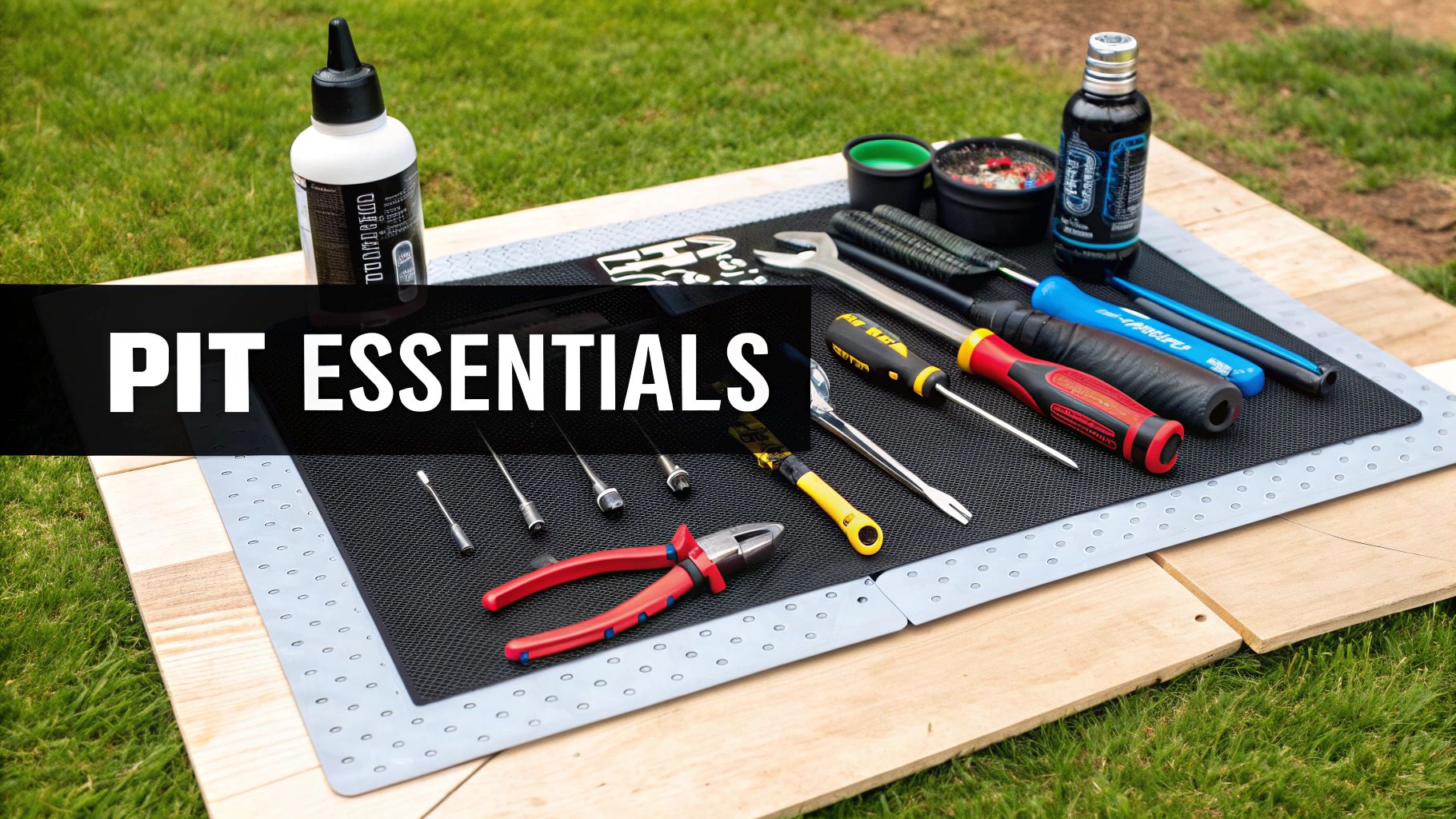
A championship-winning car isn't just assembled; it's meticulously crafted with precision. That kind of quality build demands the right tools in your pit area. A well-organised toolkit is just as important as the electronics you choose, allowing you to build consistently, make precise adjustments, and perform quick repairs when every second counts.
Investing in quality tools from the very beginning is one of the smartest moves a new builder can make. It’s tempting to grab cheap hardware store tools, but that path often leads to stripped screws and inaccurate measurements—small mistakes that can cause race-ending failures. High-quality tools are an investment in reliability and performance for all your future rc car kits to build.
The Must-Have Workshop Supplies
Before you even open the box on a new kit, there are a few foundational tools every builder absolutely needs. Think of these as the non-negotiables that form the backbone of any serious racer's pit space. They’ll handle the vast majority of your assembly and maintenance tasks.
- High-Quality Hex Drivers: This will be your most-used tool, period. We recommend a quality set like the ones from MR33 with hardened steel tips (like 1.5mm, 2.0mm, and 2.5mm) to avoid stripping the small hex screws common in modern race kits.
- Nut Drivers: Essential for wheel nuts and other hardware. A good set, typically including 5.5mm and 7.0mm, is a must.
- Shock Pliers: These specialized pliers are designed to grip shock shafts securely without scratching them and make popping on shock ends a breeze. They are invaluable for building smooth, consistent shocks.
- Hobby Knife: For trimming plastic parts from part trees and slicing decal sheets, a sharp hobby knife is indispensable.
Pro-Level Gear for Precision Tuning
Once you have the essentials covered, certain pro-level tools can truly elevate your tuning game. These items bring a higher degree of accuracy and repeatability to your work, helping you fine-tune your car’s setup for specific track conditions and squeeze out every last bit of performance.
A full setup station from Arrowmax is the gold standard here. It allows you to accurately measure and adjust critical geometry like camber, toe, and ride height. Add a set of digital calipers to the mix, and you'll get ultra-precise measurements for everything from shock length to suspension droop, ensuring your car is perfectly balanced side-to-side. While they are a bigger investment, these tools are critical for competitive racing.
The difference between a good build and a great build often comes down to the precision of your tools. Investing in gear like digital calipers and a setup station removes guesswork and replaces it with data-driven accuracy.
The Critical Role of Fluids and Chemicals
Your toolkit isn't complete without the right chemicals and fluids. These are the consumables that lubricate moving parts, dampen the suspension, and ensure your car holds together under the extreme forces of racing.
- Shock & Diff Oils: The viscosity of your shock oil (measured in cSt or Wt) directly impacts how your car handles bumps and jumps. We carry a wide selection from Ultimate Racing and Team Associated to cover any setup need.
- Thread Lock: This is non-negotiable. A small drop of blue (medium strength) thread lock on any metal-to-metal screw connection—like on a motor mount—prevents it from vibrating loose during a race.
- Grease: Use black grease for universal joints and clear grease for differential gears. This reduces wear and ensures everything operates smoothly.
Remember, a well-stocked pit needs more than just hand tools; it also needs the right power solutions. Managing your LiPo batteries is a critical part of race day, so be sure to learn about finding the best LiPo battery charger in our dedicated guide.
The Assembly Process: Pro Tips for a Perfect Build
Turning a box full of high-tech parts into a rolling chassis is one of the most rewarding parts of getting into rc car kits to build. This isn't just about following the instruction manual step-by-step; it’s about applying a professional touch to ensure your car is fast, durable, and consistent right out of the gate.
This is where you lay the foundation for a race-winning machine. You’d be surprised how much the small details here make a massive difference on the track. For anyone who truly enjoys the intricate process of building an RC car, checking out a practical guide to becoming an F1 mechanic offers a cool glimpse into the precision required at the top level of motorsport. That same focus on perfection is exactly what separates a good build from a great one.
Organizing for Success Before You Start
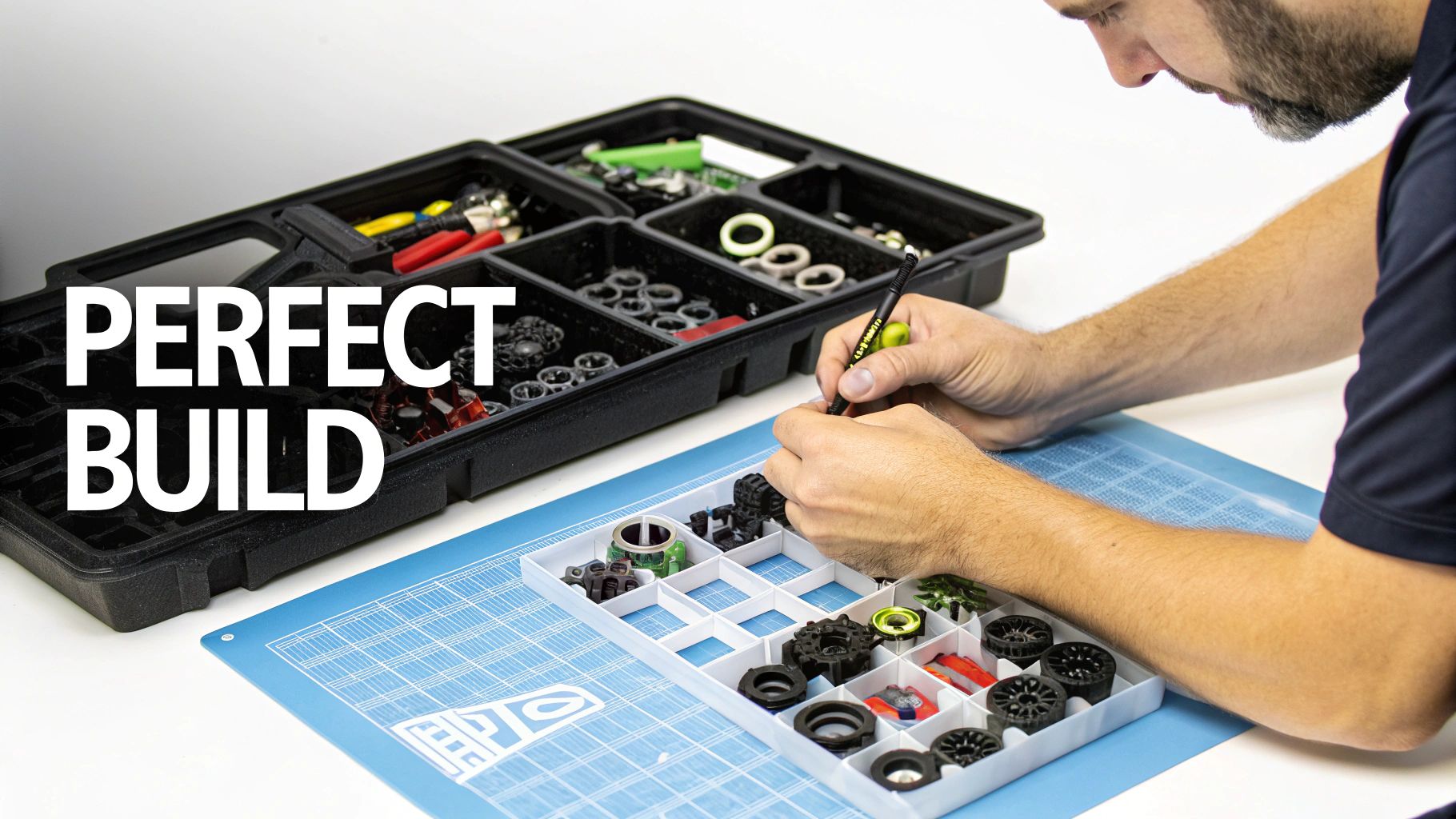
A clean, organized workspace is non-negotiable for a perfect build. Before you even think about opening the first parts bag, take a few minutes to set yourself up for success. This simple prep work prevents lost parts and makes the entire process way smoother.
- Use a Pit Mat: A dedicated RC pit mat from a brand like MR33 gives you a clean surface and, more importantly, stops tiny screws from bouncing into oblivion.
- Organize with Trays: Grab some magnetic parts trays or sectioned containers to keep your screws and small bits sorted by assembly step.
- Review the Manual: Seriously, read through the entire instruction manual once before you start. It gives you a mental map of the build and helps you anticipate any tricky steps coming up.
Building Flawless Differentials and Shocks
Your car's handling lives and dies with the differential and shocks. Races are won and lost based on how these components perform under pressure. Rushing these steps is a classic mistake that leads to an inconsistent, unpredictable car on the track.
A perfectly built gear differential should feel silky smooth, with zero binding or grittiness. When you fill it with fluid, remember to leave a small air gap for expansion and always use the correct gaskets to prevent leaks. Likewise, building air-free shocks is absolutely critical. After filling the shock body with oil, slowly work the piston up and down to bleed out any trapped air bubbles. Let them sit for a few minutes before capping them to ensure every last bubble has escaped.
A car with four perfectly matched, air-free shocks and a butter-smooth differential will be far more predictable and faster over a full race than one with a more powerful motor but an inconsistent suspension.
This level of detail is a huge part of why the hobby is growing. Canada's RC car market is seeing promising growth, with North America's RC toy car sales hitting $92.88 million in 2023. For builders of on-road kits, this reflects a surging interest in precision platforms like 1/12 pan cars, as the global RC car segment is projected to reach $2,800 million by 2031.
Achieving a Tweak-Free Chassis
A "tweaked" chassis is a builder's nightmare. It means the chassis is twisted or under tension, causing the car to handle differently when turning left versus right. Getting a perfectly flat, neutral chassis is a final, pro-level step that makes all the difference.
After assembly, place the car on a flat setup board without shocks or wheels. Loosen the top deck screws, let the chassis settle naturally, and then slowly re-tighten them in a cross pattern. This simple procedure ensures your car is perfectly balanced and ready for whatever the track throws at it.
Your Local Advantage with Digital-RC
For serious Canadian racers, building a fast car is only half the battle. The other half is getting the right parts, right when you need them. Waiting weeks for an order to cross the border can mean missing a club race or showing up to a big event completely unprepared. This is where having a dedicated local partner isn't just a convenience—it's a massive competitive advantage.
At Digital-RC, our entire operation is built for the Canadian on-road racer. We don't just stock thousands of random parts. Instead, we offer a carefully curated selection of race-proven chassis, electronics, and tools from brands like Awesomatix, XRAY, and Hobbywing. If it's on our site, you can be confident it’s built to perform.
Streamlining Your Racing Program
We've focused on eliminating the common frustrations Canadian hobbyists deal with every day. Every price you see is in Canadian dollars, and there are no hidden taxes or duties added at checkout. This straightforward pricing makes budgeting for your race season simple and predictable.
More importantly, we get that speed matters just as much off the track as it does on it. That’s why we offer free same-day delivery for orders placed before noon. A crash in morning practice doesn't have to end your race weekend anymore. You can get that critical part you need delivered in hours, not days.
Choosing a local supplier like Digital-RC transforms your entire racing program. It minimizes downtime, eliminates cross-border shipping delays, and gives you a direct line to the gear you need to stay competitive.
Supporting a Growing Canadian Hobby
The demand for high-quality hobby products in Canada is on the rise. In 2022, the Canadian toy and games market, which includes RC car kits, generated a massive $7.3 billion in retail sales. This growth shows a strong national interest in buildable kits like 1/10 touring and 1/12 pan cars—the very backbone of our competitive racing scene.
This passion is what fuels local racing communities. A huge part of success is having a great place to compete, and we’ve put together a resource to help you find one. Be sure to check out our guide on finding an RC car track near you in our article.
Choosing Digital-RC is about more than just buying parts. It’s an investment in a service that is laser-focused on your success as a Canadian racer. From the initial build of your kit to those last-minute repairs before the main event, we're here to provide the speed, reliability, and curated gear you need to stay on the track and fighting for the win.
Answering Your Questions About Building RC Kits
Getting into competitive RC racing can feel like a steep learning curve. If you're exploring the world of high-performance rc car kits to build, you probably have a few questions. Let's clear up some of the most common ones to help you understand what separates a good build from a podium-finishing machine.
What’s the Real Difference Between a Kit and an RTR Car?
It all comes down to control and quality. A Ready-to-Run (RTR) car is exactly what it sounds like—pre-assembled so you can use it immediately. But that convenience comes with a lot of compromises.
Every serious racer builds from a kit. A kit requires you to assemble the chassis piece by piece and install your own hand-picked electronics. This process not only gives you far superior components but also a deep, mechanical understanding of your car. That complete control over its performance is what winning races is all about.
How Much Should I Budget to Complete a Competitive RC Car Kit?
Building a race-ready car is an investment in your performance on the track. The chassis kit itself is a big part of the cost, but you'll also need to budget for a complete electronics package—motor, ESC, servo, and battery—along with tires, a body, and a good set of tools.
All in, a competitive 1/10 touring or 1/12 pan car setup can run anywhere from $1500 to over $2500 CAD, depending on the level of components you go for. Here at Digital-RC, our transparent CAD pricing with no tax helps Canadian racers put together a top-tier package without any hidden costs or surprises.
Which Class Is a Better Starting Point for a New Racer?
For almost every new racer, the 1/10 electric touring car class is the perfect place to start. Their four-wheel-drive systems and independent suspension make them incredibly stable and much easier to drive, which is a huge advantage on lower-grip tracks where it's easy to make a mistake.
While 1/12 pan cars are unbelievably quick and nimble, they are also far less forgiving. Their raw, rear-wheel-drive power demands a very high level of driving precision. We always recommend mastering the fundamentals in a touring car before you even think about jumping into the hyper-responsive world of pan car racing.
Instead of buying 'upgrades' for a brand-new kit, your first and most important investment should be in quality setup tools and a variety of tuning options like springs, diff oils, and tires. These will provide a much larger performance gain than most aftermarket parts.
What Are the Most Important First Upgrades for a New Kit?
This is a question we hear all the time, and the answer usually surprises people: none. Modern high-end kits from brands like Awesomatix and XRAY are engineered to be exceptionally competitive right out of the box. They are built with premium materials and incredibly tight tolerances, leaving very little room for immediate improvement.
What truly unlocks speed isn't a new aluminum part; it's the ability to properly adjust your car for different track conditions. Your time and money are much better spent learning setup theory and getting the right tuning options. That will make you a faster, more adaptable racer than someone who just bolts on expensive aftermarket parts.
Ready to build your next winner? Digital-RC is your dedicated Canadian source for the best on-road rc car kits to build, electronics, and tools. With transparent CAD pricing, no tax, and free same-day delivery, we get you the parts you need to hit the track faster.