

Your Guide to 1/10 Drift RC Cars in Canada
So, you're ready to dive into the world of 1/10 drift RC cars. Good choice. This isn't about just driving a remote control car; it's a mix of high-precision engineering and pure driving style. Think of it as mastering a controlled, high-speed slide, where every twitch of the throttle and turn of the wheel matters.
This guide is your complete roadmap, starting right here, right now.
Your Starting Point for 1/10 Drift RC Cars
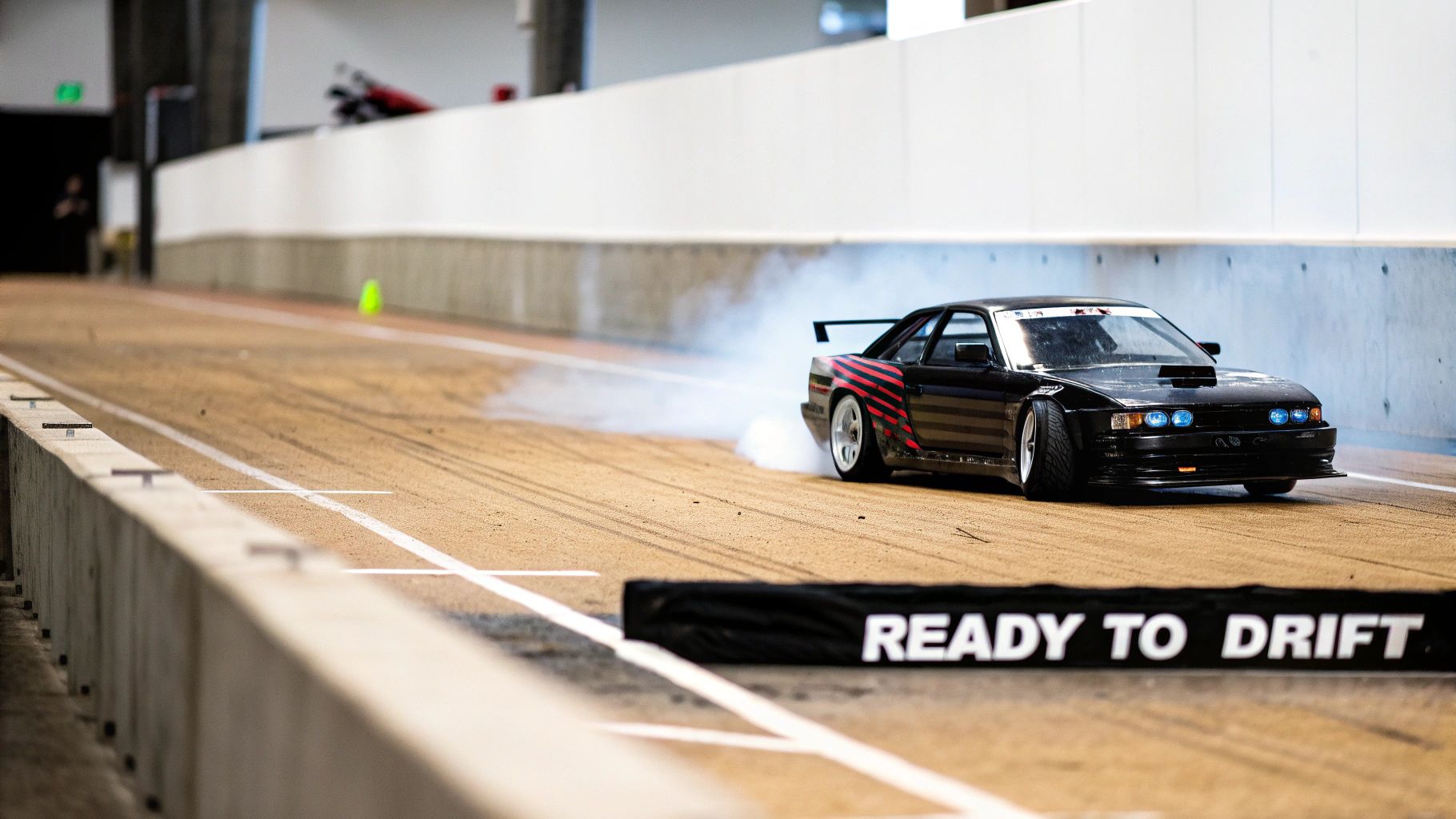
Getting into 1/10 scale RC drifting is an awesome journey. It’s less about raw speed and more about the art of the slide—balancing your inputs to pull off fluid, almost poetic manoeuvres. It’s a bit like automotive ballet, just on a smaller scale with a lot more tire smoke.
There's a reason 1/10 scale is the gold standard in the drift scene. It’s the perfect middle ground. You get the size needed for realistic performance and a massive selection of parts, making it the go-to for both total beginners and seasoned pros. Smaller cars can feel twitchy and unpredictable, while bigger scales demand a huge amount of space. The 1/10 platform just feels right.
Why This Hobby Is Exploding in Canada
Here in Canada, the RC drift community is growing fast, and it’s not hard to see why. A few things are really pushing it forward:
- It's Easy to Start: Modern Ready-to-Run (RTR) models and straightforward kits have dropped the barrier to entry way down.
- A Solid Community: There's a huge network of local clubs and online groups packed with people ready to help you out.
- Endless Customization: You can tweak everything. From the chassis and suspension geometry to the paint job on the body shell, your car can be 100% yours.
We’ve seen some serious growth in Canada, with sales climbing by about 12% annually between 2015 and 2022. It's also clear that a younger crowd is getting into it, with 68% of buyers being between 18 and 35. This isn't a fading hobby; it's a vibrant scene that's only getting bigger.
My goal with this guide is to give you everything you need. We'll walk through picking your first chassis, dialing in your suspension, and nailing the advanced tuning tricks that will make you stand out.
We’ll cover the fundamentals, like the key differences between RWD and AWD platforms, and get into the nitty-gritty of suspension tuning. The whole point is to give you the confidence to build, tune, and drive your car like you've been doing it for years.
And while most modern drift cars are RWD, don't be afraid to experiment. You can even get sideways with some pretty unconventional builds. For a real challenge, check out our article on how to drift with an FWD chassis.
The Chassis: Your Drift Machine's Foundation
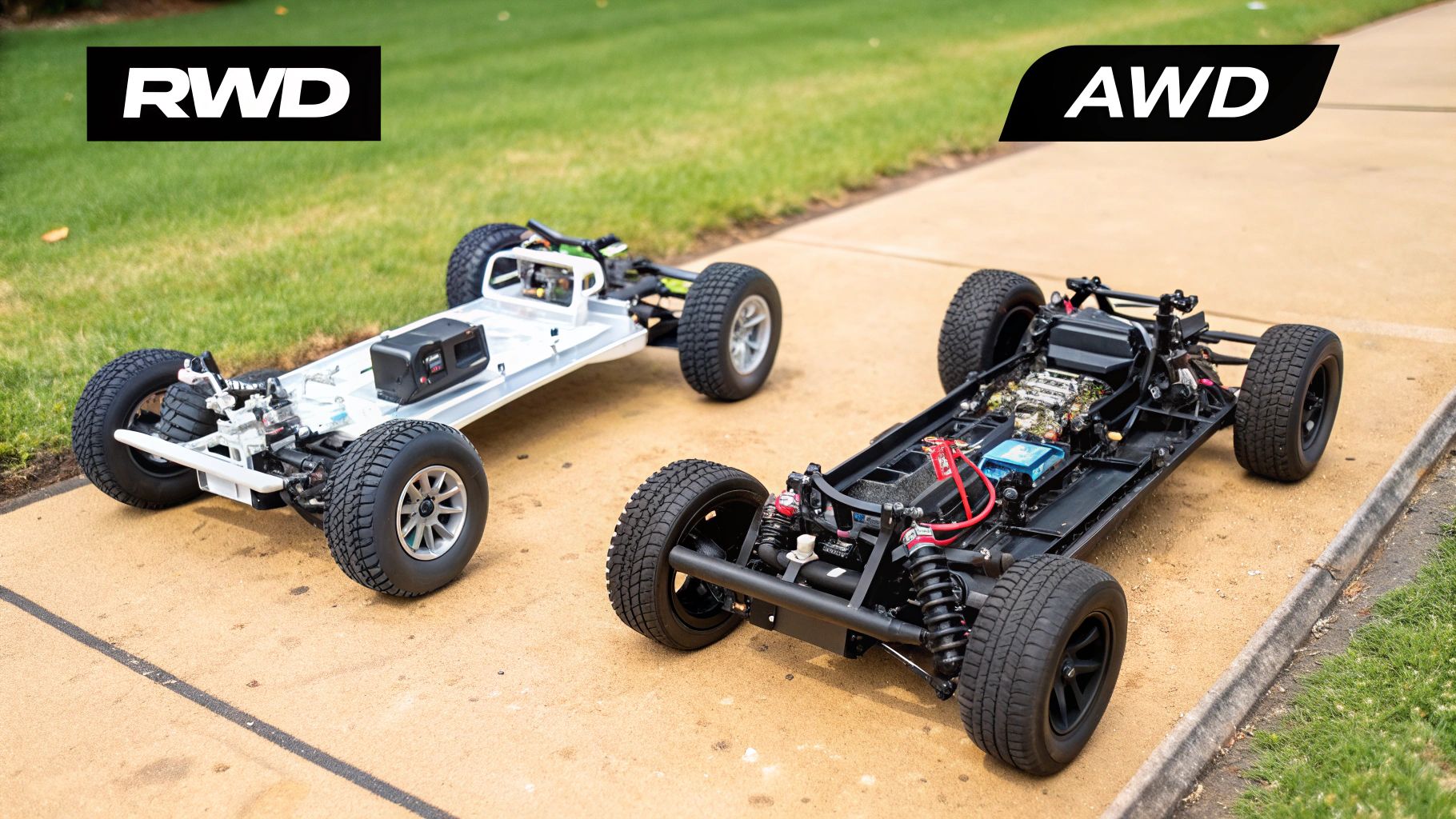
The chassis is the absolute backbone of your 1/10 drift RC car. It’s the platform where every single component gets mounted, and its design dictates the car's entire personality on the track. Think of it as the skeleton—it determines how the car moves, flexes, and reacts to every one of your inputs.
Choosing the right chassis is the first big decision you'll make. It really boils down to understanding the two fundamental drivetrain layouts: Rear-Wheel Drive (RWD) and All-Wheel Drive (AWD).
RWD vs. AWD: The Great Debate
Your choice between RWD and AWD will define your entire drifting experience, from the first time you power it on to your long-term goals in the hobby.
Rear-Wheel Drive (RWD)
RWD is the modern standard for competitive RC drifting, period. Just like its full-scale counterparts in professional drift series, a RWD chassis sends all its power to the rear wheels. This layout demands precision and active steering input, and it absolutely requires a gyroscope to help manage the counter-steer.
Driving an RWD car is a rewarding challenge. It’s a delicate dance of throttle control and steering, where you’re constantly correcting and guiding the car through a slide. This is the most realistic and authentic drift experience you can get.
All-Wheel Drive (AWD)
AWD, often called "50/50" or Counter-Steer (CS) depending on the power split, sends power to all four wheels. This makes the car inherently more stable and much easier to control during a drift. Picture a rally car on gravel—the front wheels pull the car through the corner while the rear wheels push it.
For an absolute beginner, an AWD chassis can be more forgiving. It lets you learn the basics without the steep learning curve of an RWD setup. That said, the modern drift scene, especially here in Canada, has shifted almost entirely to RWD.
Materials Matter More Than You Think
The material your chassis is made from has a massive impact on its performance, durability, and price tag. You’ll generally run into two main options when shopping for 1/10 drift RC cars.
-
Plastic Composites: Most entry-level and mid-range kits use a high-quality plastic or polymer composite. This stuff is great for beginners because it's affordable, durable, and has a bit of flex. That flex can make the car more forgiving on imperfect surfaces and easier to handle.
-
Carbon Fibre: High-end chassis are often built from carbon fibre and aluminum. Carbon fibre is incredibly lightweight and rigid, offering maximum precision and responsiveness. That stiffness translates every tiny adjustment you make directly to the track, but it's less forgiving of mistakes and comes at a premium price.
For most newcomers, a well-designed plastic composite chassis offers the perfect balance of performance and value. It gives you a solid foundation to learn on before you even think about moving up to a rigid carbon fibre platform.
"A chassis isn't just a frame; it's a dynamic system. The way it manages weight transfer and flex is the secret to a smooth, controllable drift. A good setup allows the car to flow, not fight, through a corner."
Key Chassis Dynamics: Weight and Stiffness
Beyond the drivetrain and materials, two fundamental principles govern how a drift chassis behaves: weight distribution and stiffness.
Weight Distribution
The placement of the motor, battery, and electronics is no accident. A rear-motor RWD chassis, for instance, puts more weight over the driven wheels, which increases traction and makes it easier to kick the back end out and hold a slide. On the flip side, a front-motor layout can offer more steering control. Fine-tuning this balance with small weights is a huge part of advanced setup.
Chassis Stiffness
Stiffness dictates how the car responds. A very stiff carbon fibre chassis provides instant feedback, making it feel sharp and direct. A chassis with more flex, like a plastic one, will feel a bit softer and slower to react, which can help absorb bumps and provide more mechanical grip.
Many modern chassis even offer "flex tuning" options, letting you adjust stiffness by adding or removing braces to suit your driving style and the track surface. Getting a handle on these concepts is the first step toward choosing a car that truly matches your skill and ambitions.
Choosing the Right Electronics and Powertrain
A bare chassis is a beautiful piece of engineering, but it's the electronics that really give it a pulse. Choosing the right powertrain and control system is like picking the engine and nervous system for your drift machine. This is where you decide its power, responsiveness, and overall feel on the track.
The journey starts with the motor, the heart of your 1/10 drift RC car. You’ve got two main paths to choose from: brushed or brushless. Think of a brushed motor as the reliable, naturally aspirated engine in a classic car—it's simple, affordable, and a fantastic starting point for learning the ropes.
A brushless motor, on the other hand, is the modern, turbocharged equivalent. It delivers a whole lot more power, runs more efficiently, and requires almost zero maintenance since there are no physical brushes to wear out. For serious performance, brushless is the undeniable champion.
Let's break down the practical differences.
Drift RC Electronics Comparison: Brushed vs. Brushless
This table cuts through the noise and shows you exactly what to expect from each system. For anyone just getting started, a brushed setup is a great, low-cost way to get on the track. But if you know you're in this for the long haul, jumping straight to brushless will save you an upgrade down the road.
| Feature | Brushed Motor System | Brushless Motor System |
|---|---|---|
| Performance | Smooth, predictable power delivery. Good for beginners. | High power, explosive torque, and top-end speed. |
| Efficiency | Lower efficiency, generates more heat. | Highly efficient, converting more power into motion. |
| Maintenance | Brushes wear out and require periodic replacement. | Virtually maintenance-free. No brushes to wear down. |
| Cost | Very affordable. The go-to budget option. | Higher initial investment but offers much better performance. |
| Tuning | Limited tuning options. | Highly tunable via the ESC (timing, boost, turbo). |
| Best For | First-time builders, budget-conscious drivers, learning. | Competitive drifters, performance enthusiasts, long-term builds. |
Ultimately, the choice comes down to your budget and goals. A brushed system will get you drifting, but a brushless system is what will help you master it.
Your Motor and Its Brain: The ESC
The motor provides the muscle, but the Electronic Speed Controller (ESC) is the brain. This small box translates signals from your radio into precise power for the motor. It handles your throttle, brakes, and reverse, acting as the central command unit for your car’s entire powertrain.
A basic ESC gets the job done, but the advanced models are where the magic happens. Features like 'boost' and 'turbo' timing are absolute game-changers for drifters. These settings inject extra electrical timing at high RPMs, giving you a controlled burst of speed on long sweepers or for initiating aggressive, high-speed entries. Dialing these in is key to a competitive setup.
Matching your ESC to your motor is one of the most critical steps in building a reliable drift car. A mismatched pair can lead to poor performance, overheating, and even permanent damage. Always make sure the ESC's amperage rating can handle the motor's power draw.
For a deeper dive, check out our complete guide on matching your Electronic Speed Controller to your motor. It’ll walk you through making a smart choice for a balanced and powerful system.
The Importance of a High-Performance Servo
Drifting is all about lightning-fast counter-steering—those constant, precise corrections that keep the car sideways in a controlled slide. This action relies entirely on your steering servo. A slow or weak servo just can't keep up with a modern RWD drift car, leading to sluggish response and frustrating spin-outs.
You need a servo that is both fast and strong. Look for two key specs:
- Speed: Measured in seconds per 60 degrees (e.g., 0.08s/60°). This tells you how quickly the servo can turn. The faster, the better for snappy, responsive steering.
- Torque: Measured in kg-cm. This is the servo's turning strength. High torque ensures the wheels turn precisely under load, even during aggressive transitions.
Investing in a quality digital servo is one of the best upgrades you can make for your 1/10 drift RC car. It directly translates your steering inputs into on-track performance, giving you the control needed to hold those long, beautiful drift angles.
Powering Up and Staying in Control
Finally, you need a solid battery to power everything and a radio system to stay in control. Modern RC drifting runs almost exclusively on Lithium Polymer (LiPo) batteries. They offer way better power density and consistent voltage compared to older tech, making sure your car performs at its peak from the start of the run to the end.
For Canadian hobbyists, a standard 2S (7.4V) LiPo is the perfect choice for pretty much any 1/10 scale application.
Your radio system—the transmitter and receiver—is your direct link to the car. While a basic system gets you going, a quality 2.4GHz radio offers a stable, interference-free signal. More importantly, it gives you features like endpoint adjustments and exponential rates, which let you fine-tune steering and throttle response to your exact preference. A good radio makes the car feel like a natural extension of your hands.
A Practical Guide to Tuning Your Drift Car
https://www.youtube.com/embed/pF1HYvzdNFk
Having a great chassis and top-tier electronics is just the entry ticket. The real magic in 1/10 drift rc cars happens on the setup stand—this is where the fine-tuning begins. It's the difference between a car that just goes sideways and one that flows effortlessly, almost like an extension of your own hands.
Tuning is a game of small, intentional adjustments. Forget chasing some mythical "perfect" setup. The goal is to understand what each tweak does to the car's behaviour. Once you know the why behind each change, you can dial in your car for any surface and make it drive exactly the way you want it to.
Mastering Suspension Geometry
The soul of a drift car lives in its suspension geometry. These angles are everything. They determine how your tires meet the track, which directly impacts your grip, how the car responds to your steering, and its ability to hold a clean, consistent slide. Think of it as a high-performance wheel alignment, but instead of straight-line stability, we're chasing maximum sideways control.
You'll mainly be fiddling with three key angles:
-
Camber: This is the vertical tilt of your wheels when you look at the car from the front. For drifting, negative camber (where the top of the tire leans inward) is a must. It keeps the outside tire's contact patch flat on the ground when the chassis rolls into a corner. A solid starting point is usually between -5 to -8 degrees up front and a milder -1 to -3 degrees in the rear.
-
Caster: This angle refers to the backward tilt of the steering axis. More positive caster is your friend in an RWD drift car. It creates a self-steering effect, helping the front wheels naturally want to straighten out, which makes holding and transitioning between drifts feel much more intuitive.
-
Toe: This is the angle of your wheels when viewed from above. Running a little toe-out on the front wheels (where the leading edge of the tires point away from each other) makes the car much more eager to dive into a drift. In the back, a touch of toe-in can add a bit of stability once you're fully sideways.
Dialing In Your Shocks and Weight Transfer
Your shocks are doing way more than just soaking up bumps; they're the conductors of your car's weight transfer. And in drifting, managing how that weight shifts around is the name of the game. A smooth, predictable weight shift is what lets you link corners together with that buttery-smooth flow we're all after.
There are two main things you'll adjust to get this right:
- Shock Oil (Viscosity): Thicker oil (a higher weight or cSt number) slows the piston down. This makes the car's weight transfer feel slower and more deliberate. Thinner oil does the opposite, making the car feel snappier and more responsive. A lot of drivers run a softer setup in the rear to help it squat and find grip when on the power.
- Springs (Rate): Softer springs allow the chassis to roll more, which can generate more mechanical grip. Stiffer springs keep the car flatter, making it feel more aggressive and quick to change direction. It’s common to pair softer rear springs with thicker rear shock oil to help the car dig in and drive forward out of a drift.
The real goal is finding that sweet spot where the car is responsive but not nervous or twitchy. It needs to shift its weight predictably into a drift and hold its angle without a fuss. That balance is what separates a good setup from a truly great one.
The Gyro: The RWD Drifter’s Secret Weapon
If you're driving an RWD 1/10 drift rc car, the gyro isn't optional—it's essential. This little electronic brain senses the car's rotation and automatically applies counter-steer faster than humanly possible, keeping the car from spinning out. Honestly, a modern RWD drifter would be nearly impossible to drive without one.
The most important setting on your gyro is the gain. This dictates how much assistance the gyro provides.
- Low Gain: The car will feel looser and more "raw." You'll have to do more of the steering work yourself, which can be fun but is much harder to drive consistently.
- High Gain: The gyro steps in more aggressively, making the car feel incredibly stable and "locked-in" while sliding. But if you go too high, you'll get a nasty wobble or oscillation in the front wheels, especially as you pick up speed.
Finding your perfect gain setting is all about feel and experimentation. The sweet spot is usually the highest you can go without seeing that front-end shake. Most modern transmitters let you adjust the gyro gain on the fly, so you can fine-tune it right from the driver's stand to adapt to the track. Master your geometry, shocks, and gyro, and you'll have a car that feels like it's reading your mind.
Perfecting Your Look with Wheels and Body Shells
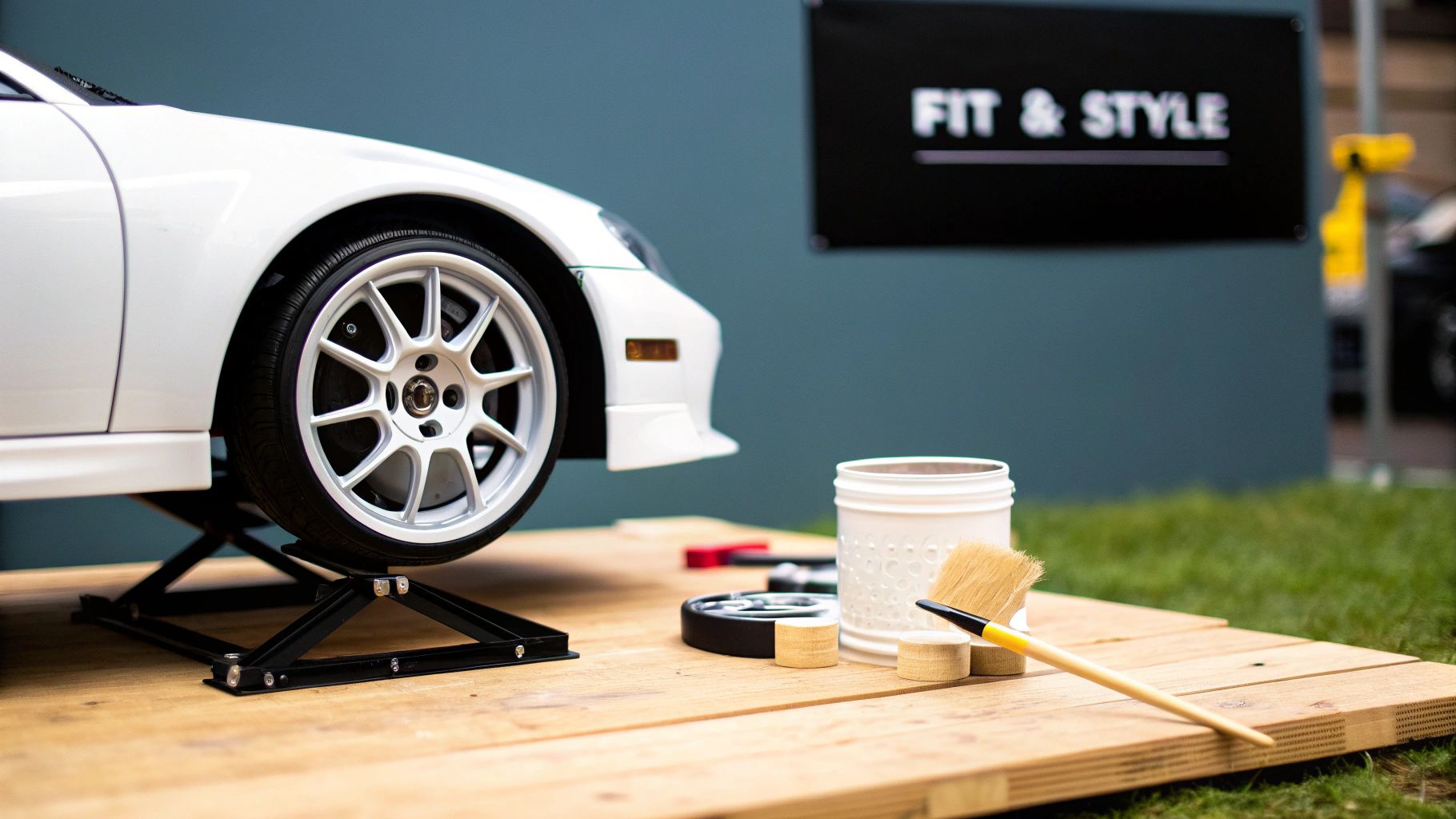
Once your chassis is dialled in and the electronics are humming, it’s time for the fun part—where performance meets personality. Your car's final look comes down to its wheels, tires, and body shell. These aren't just for show; they're the final pieces of the puzzle that define how your car performs and expresses your style on the track.
This is where the artistry of the hobby really shines. You get to transform a finely tuned machine into a one-of-a-kind build that genuinely turns heads. And it all starts with the only part of your car that actually touches the ground.
Choosing Your Drift Shoes: Tires and Wheels
Drift tires are the foundation of your car's feel. Forget everything you know about grippy racing tires—these are made from hard plastic compounds built for minimal friction. Think of it like picking the right shoes for the job; you wouldn't wear ice skates on a basketball court, and the same principle applies here.
- Polished Concrete: An incredibly slick surface like this actually requires a "softer" compound (which is still a hard plastic) to find a tiny bit of bite and maintain control.
- Asphalt or Carpet: These surfaces have more grip, so you need a harder, lower-friction compound. This ensures the car can break traction easily and slide smoothly without hooking up when you don't want it to.
Wheels are just as important, and it all comes down to one critical measurement: offset. This number tells you how far the wheel's mounting face is from its centreline. A higher offset pushes the wheel further out from the chassis, creating a wider, more aggressive stance. The ultimate goal is to get the wheels sitting perfectly flush with the fenders of your body shell—a look the community calls "fitment"—without any rubbing.
Getting the fitment right is a badge of honour in the drift scene. It shows an attention to detail that separates a good build from a great one. A wheel with the wrong offset can ruin the entire look and, worse, cause the tires to collide with the body during suspension travel.
Bringing Your Vision to Life with Body Shells
The body shell is your canvas. This is your chance to replicate an iconic street car, design a wild competition machine, or create something totally unique. For 1/10 drift RC cars, the options are nearly limitless, with manufacturers producing stunningly detailed polycarbonate replicas of legendary vehicles.
But creating a head-turning body is more than just picking a cool model. It’s a process that lets you put your own creative stamp on the build.
Mastering the Paint Job
Here's a tip for newcomers: you paint a polycarbonate body from the inside. This clever trick protects the finish from scuffs and scratches out on the track. It does, however, mean you have to think about your paint layers in reverse, starting with fine details and finishing with the main base colour.
- Preparation: This step is non-negotiable. Always wash the inside of a new shell with soap and water. This removes any mould-release agents from the factory that will prevent your paint from sticking properly.
- Masking: Use high-quality masking tape or a liquid mask to block off areas for different colours. This is how you get those crisp, clean lines for window trim, two-tone paint jobs, or intricate graphics.
- Painting: Apply thin, even coats. Use paint that's specifically made for polycarbonate, as other types will flake off. Rushing this with heavy coats will only lead to drips and a blotchy finish. Pro tip: always back dark colours with a coat of silver or white to make them truly pop.
Once the paint is dry, you can bring it to life with the final details. Sticker sheets, custom light kits, and scale accessories like mirrors, exhaust tips, and intercoolers add a layer of realism that makes your car stand out. With proper mounting using magnets or posts, your masterpiece will sit perfectly on the chassis, ready to hit the track.
Where to Shop and Find Resources in Canada
Jumping into the world of 1/10 drift RC cars is a blast, but knowing where to find the right gear and people in Canada is the key to getting started without any headaches. When you stick to local suppliers, you sidestep surprise duties and long shipping delays, all while supporting the Canadian RC scene. Think of this as your roadmap.
Shopping Canadian just makes sense. The price you see is the price you pay—no nasty surprises with customs or brokerage fees showing up at your door. This makes planning your build and budget way more straightforward. Plus, you get your stuff faster and returns are a whole lot simpler if something isn't quite right.
Reputable Canadian Online Retailers
For the good stuff—high-performance parts for on-road and drifting—a specialized shop is your best bet. Stores that live and breathe competitive-grade gear will have quality components that have been proven to work on the track. This is especially true for electronics and chassis parts where you just can't afford to have something fail. For a great place to start, you can check out the wide selection of RC cars in Canada from shops that really get what local drivers need.
Your Essential Toolkit and Spares
Trust me, the right tools and a small box of spares will be the difference between a minor hiccup and a ruined track day. A small tap into the wall is going to happen, but being ready for it means you’re back to drifting in minutes.
- Essential Tools: Don't even think about starting without a quality set of hex drivers (1.5mm, 2.0mm, 2.5mm), nut drivers, shock pliers, and a sharp hobby knife. These are non-negotiable.
- Must-Have Spares: Always, always have extra suspension arms, steering knuckles, and a spur gear on hand. These are the first things to go in a crash.
- Fluids and Adhesives: A little collection of shock oils in a few different weights and some thread-locking compound will handle almost all your tuning and basic maintenance.
Connecting with the Community
Honestly, the best part of the RC drift hobby is the people. Getting hooked in with other drivers is the fastest way to learn the ropes, find local spots to run, and get real-world advice on your build.
The Canadian RC drift community is incredibly welcoming. Whether you're a total beginner or a seasoned pro, there's always someone willing to share a setup tip, help you diagnose a problem, or just talk about the latest gear.
Start by looking for Canadian RC drift forums and Facebook groups for your region. These online hubs are where you'll find event announcements, buy-and-sell threads, and conversations about what's new and what works in 1/10 drift RC cars. Most areas also have clubs that run regular events at indoor and outdoor tracks—the perfect place to get some practice in and meet other drivers.
Common Questions About 1/10 Drift RC Cars
Getting into the world of 1/10 drift RC cars always brings up a few questions, especially when you’re figuring things out for the first time. Here are some straightforward answers to the things we hear most often from new drivers in the Canadian RC scene.
Should I Start with an RTR or a Kit?
A Ready-to-Run (RTR) car is your best bet if you just want to get out and start driving. It comes pre-built, so you can jump straight into learning the feel of the car, how to manage the throttle, and the basics of control without getting bogged down in a full assembly. It’s an awesome, low-stress way to get started.
On the other hand, if you’re the kind of person who loves tinkering and wants to understand your machine inside and out, a kit is an incredibly rewarding path. Building the chassis from the ground up teaches you exactly how everything works, which is invaluable when it comes to repairs and upgrades. Plus, you get total control over every single electronic component you put in it.
What Is a Realistic Starting Budget in Canada?
You might see some entry-level RTRs for around the $300 CAD mark, but a truly solid starting point is going to be somewhere between $500 to $700. This budget gives you enough room for a reliable car, a good quality LiPo battery and charger, and the basic tools you’ll need to keep it running.
Honestly, investing a little more right from the start almost always pays off. You end up with more durable gear that won't leave you frustrated with early breakages, and it gives you a much better platform to build on as your skills improve.
Where Can I Drive My RC Drift Car?
The absolute best experience will be at a dedicated RC drift track. These spots have smooth, purpose-built surfaces that are perfect for sliding and give you a consistent place to practice and compete.
If you don't have a track nearby, your next best option is a large, clean concrete surface. Think along the lines of:
- A polished garage floor
- A clean basketball or tennis court
- An empty parking lot (just make sure you get permission first)
The one thing you really want to avoid is rough, abrasive asphalt. It will chew through your hard plastic drift tires in no time and can easily scrape up and damage the underside of your chassis, leading to repairs you didn't need to make.
Ready to build your perfect drift machine? digital-rc offers a curated selection of high-performance kits, electronics, and accessories with fast, tax-free shipping across Canada. Find everything you need to hit the track at https://digitalrc.ca.