

Your Ultimate Guide to 2 Cell Batteries for RC Racing
In competitive on-road RC racing, the 2 cell battery is the regulated standard. It’s the powerhouse behind almost every podium finish. Often called '2S' LiPo packs, these batteries are the heart of 1/10 and 1/12 scale race cars, delivering the explosive punch needed for blistering lap times.
The Power Behind the Podium: What Are 2 Cell Batteries?
Every winning RC car has a powerful heart, and in the world of competitive on-road racing, that heart is almost always a 2 cell LiPo. But what does that really mean for your performance on the track?
Let’s break it down. Think of each individual battery cell as a small, high-performance engine. A single LiPo cell on its own has a nominal voltage of 3.7V. While that’s fine for some things, it just doesn't have the grunt needed for high-speed racing.
Understanding the "2S" Designation
This is where the magic happens. The "2S" in a 2S LiPo pack simply means two cells are wired in Series.
When you connect those two 3.7V "engines" in series, their voltages combine. You get a single, more potent power source that doubles the output to a 7.4V nominal voltage. That 7.4V figure is the sweet spot for modern 1/10 and 1/12 scale electronics.
This 7.4V is the baseline, the number printed on the battery case. But in racing, knowing the actual voltage at any given moment is critical.
A fully charged 2 cell battery will read 8.4V (4.2V per cell) right off the charger. This peak voltage delivers maximum punch for the first few laps. As you drive, the voltage drops, and managing this power curve is a huge part of race strategy.
Critical Voltages Every Racer Must Know
Here’s a quick-reference table breaking down the critical voltage levels every racer needs to know. Understanding these numbers isn’t just about performance—it's about keeping your batteries safe and healthy for the long haul.
| Understanding 2S LiPo Voltage States | |||
|---|---|---|---|
| Voltage State | Voltage Per Cell | Total Pack Voltage (2S) | Why It Matters on Race Day |
| Fully Charged | 4.2V | 8.4V | This is your starting line voltage. It provides maximum speed and acceleration right out of the gate. |
| Nominal | 3.7V | 7.4V | The battery's average or "resting" voltage. This is the standard spec used for classification. |
| Storage | 3.8V | 7.6V | Crucial for battery health. Storing packs at this voltage prevents degradation between race days. |
| Low Voltage Cutoff | ~3.2V - 3.3V | ~6.4V - 6.6V | Your ESC should be set to cut power here. Going lower causes irreversible cell damage. |
Mastering these numbers is non-negotiable for competitive racers. It ensures you get consistent performance and protects your investment.
In the world of Canadian on-road RC, 2S LiPos are the undisputed gold standard. They deliver the high discharge rates needed for the instant acceleration that wins races. That's why we stock brands like Sunpadow and Team Powers, which are proven performers at club levels where 75% of competitive builds now run 2S LiPos.
Knowing your battery is just as critical as your driving skill. It’s the foundation for choosing a pack that can put you on the podium. To dig deeper into the specifics, check out our guide on the 7.4V LiPo battery.
Matching Capacity and C-Rating to Your Motor
Choosing the right 2 cell battery is about more than just finding one that fits in the chassis. If you want consistent, race-winning performance, you have to perfectly match your battery's power delivery to what your motor is demanding. It all comes down to two numbers: capacity (mAh) and C-rating.
Think of them as a team. Capacity dictates how long you can run, while the C-rating determines how hard the battery can push when you mash the throttle. Getting this balance right is what unlocks your car’s true potential on the track.
Capacity Is Your Fuel Tank
Capacity, measured in milliamp-hours (mAh), is the easiest one to wrap your head around. It’s the direct equivalent of the size of a fuel tank. A higher mAh number means your battery holds more energy, which translates directly to longer runtimes. Simple as that.
For any serious racer, this is non-negotiable. You need a battery that can not only finish a long main event but do it without a noticeable drop in power—what we call 'fading'—in those crucial final laps. A battery that goes soft late in the race can easily be the difference between first and third.
For most 1/10 scale on-road classes, a capacity between 5000mAh and 6500mAh is the sweet spot. This range gives you plenty of runtime for a typical 5- to 8-minute race while keeping the battery's weight from messing with your chassis balance.
C-Rating Is All About Punch
While capacity is about endurance, the C-rating is all about raw, instant power. It represents the battery's ability to discharge its energy quickly—what racers call 'punch.' A higher C-rating means the battery can deliver a massive surge of current on demand without breaking a sweat.
This is absolutely critical when you're running high-draw electronics, like the powerful Hobbywing and Team Powers setups we stock. Those motor and ESC combos are hungry for amperage, especially when you’re trying to accelerate hard out of a tight corner. An under-specced battery acts like a bottleneck, starving the motor of the power it's screaming for.
The result is a sluggish, lazy car that just feels flat on the track. You can have the best motor in the world, but if your battery can't feed it, you'll never feel its true performance.
Calculating Your System's Needs
So, how do you know what C-rating you actually need? You can figure out the maximum continuous amperage your battery can supply with a simple formula:
(Capacity in Ah) x (C-Rating) = Max Continuous Amps
To get the capacity in Amp-hours (Ah), just divide the mAh by 1000. So for a 6000mAh Team Powers pack (that's 6.0Ah) with a 120C rating, it looks like this:
- 6.0Ah x 120C = 720 amps
That means the battery can safely deliver up to 720 amps of continuous current. This is way more than most 1/10 scale systems will ever pull, which gives you a huge performance safety margin. A battery with a high C-rating runs cooler and under less stress, leading to more consistent voltage and a longer lifespan. For a deeper dive, check out our complete guide to LiPo battery selection for maximum performance.
Matching Specs to Racing Classes
The ideal combination of capacity and C-rating often comes down to your specific racing class. The demands of a "blinky" stock class are a world away from a fire-breathing modified touring car.
- Stock Touring Car: A stock 17.5T or 21.5T motor has a fairly low current draw. A battery from our Sunpadow Platin series with 5500-6000mAh and a solid 100C rating is usually more than enough.
- Modified Touring Car: A mod motor (like a 5.5T) is incredibly power-hungry. For this, you want the highest C-rating you can get, typically 120C or higher, paired with 6000-6500mAh like those in our Team Powers Radon V4 lineup.
Ultimately, choosing the right 2 cell battery is a strategic decision. By matching capacity to your race length and C-rating to your motor's thirst for power, you create a balanced, efficient, and brutally fast setup that's ready for the podium.
A powerful 2 cell battery with the perfect capacity and C-rating is useless if it doesn't physically fit in your car. After you've nailed down the electrical specs, the next critical step is getting the physical dimensions and connections right. This part of the setup is a game of millimetres and grams, and it's essential for a predictable, well-handling car.
Two primary form factors dominate the 1/10 scale on-road scene: the standard "stick" pack and the more compact "shorty" pack. The one you choose can dramatically alter how your car feels and behaves on the track.
Stick Packs Versus Shorty Packs
A standard stick pack is that traditional, longer rectangular battery that fills the entire battery tray in most modern touring cars. They offer a stable, predictable weight distribution that works exceptionally well in many chassis designs right out of the box. A chassis like an Awesomatix touring car, for example, is often designed around the weight and dimensions of a standard pack, making it a drop-in solution for balanced performance.
A shorty pack, on the other hand, is significantly shorter and lighter. This is where the real tuning possibilities open up. By using a shorty pack in a chassis like an XRAY, you free up space in the battery tray. This lets you shift the pack forward or backward to fine-tune the car’s front-to-rear weight bias—the key to finding more steering on a tight track or more rear grip on a loose one.
The decision between a stick and a shorty isn't just about fitment; it's a strategic tuning choice. A heavier stick pack can sometimes help a car feel more planted on high-grip carpet, while a lighter shorty pack can make the car feel more nimble and aggressive.
Choosing the Right Connector
Once you've settled on a form factor, the next detail is the connector. In competitive racing, a solid, low-resistance connection is non-negotiable for delivering maximum power from your 2 cell battery to the ESC. You'll find that our high-performance packs feature either 4mm or 5mm bullet connectors.
These direct-plug connectors provide a much more efficient and reliable connection than the RTR-style plugs you might see elsewhere. The larger surface area of a 5mm bullet, for instance, allows more current to flow with less resistance. That means less heat buildup and more consistent power throughout a race. For this reason, many racers prefer 5mm connectors for modified racing, where current demands are at their absolute peak.
It's a small detail that makes a big difference. This growing demand for high-performance components is reflected across Canada's RC scene, which has benefited from the nation's broader electric vehicle battery market—a sector projected to double to USD 4.25 billion by 2033. For racers building XRAY pan cars or tweaking Zoo Racing bodies, this translates into better access to high-discharge 2S batteries that deliver consistent 7.4V under load. You can explore more about this growing market on imarcgroup.com.
Before you make a final choice, always measure your car’s battery tray and check the manufacturer's recommendations. Making sure your chosen battery fits perfectly—without binding or needing excessive foam spacers—is the final piece of the puzzle. A pack from our store that fits like a glove ensures your car is balanced, efficient, and ready to perform.
Mastering Your Charging and Safety Routine
Your high-performance 2 cell batteries are the heart of your race car, but that potent LiPo chemistry demands respect. Nailing down a consistent, safe charging routine is non-negotiable. It's not just about squeezing every last drop of power out of your packs—it's about ensuring their longevity and keeping you safe at the track and at home. This isn't a corner you can afford to cut.
The single most important piece of gear in this whole process is a quality balance charger, like the iCharger models we carry. It's a serious racer's best friend for a reason. Its main job is to make sure both cells inside your 2S pack are charged to the exact same voltage, a process we call balance charging.
Think of the two cells in your pack like two runners on a team. If one runner is stronger and finishes their lap faster (charges to a higher voltage), they get overworked while the other lags behind. A balance charger is the coach, making sure both runners stay perfectly in sync. This ensures the whole team—your battery—performs at its peak and wears out evenly.
Setting Up a Safe Charge
Charging a 2 cell battery is a straightforward job, but every single step is critical. Getting it right every time builds the muscle memory you need for a safe and effective race program.
Here's the routine:
- Select LiPo Balance Mode: Always, always choose the "LiPo Balance" or "Balance Charge" setting on your charger. This tells it to use the balance port and watch each cell individually.
- Set the Battery Type to 2S: Correctly identifying the pack as 2S ensures the charger sets the maximum voltage cutoff to 8.4V. No exceptions.
- Set a Safe Charge Rate (1C): The "C" is all about the battery's capacity. A 1C charge rate is the industry standard for safety and long-term battery health. To figure it out, just divide your battery's mAh by 1000. For a 6000mAh battery, a 1C charge rate is 6.0 amps.
Sure, you can charge at a higher rate with some packs, but it generates more heat and puts extra stress on the cells, which will absolutely shorten their lifespan. For racers, consistency is everything, and charging at 1C gives you that reliable foundation. If you're looking to upgrade, our detailed guide on the best LiPo battery chargers will help you find the perfect match for your needs.
This simple flowchart shows the core steps of choosing the right battery before you even think about charging, focusing on the chassis, the pack itself, and the plug.
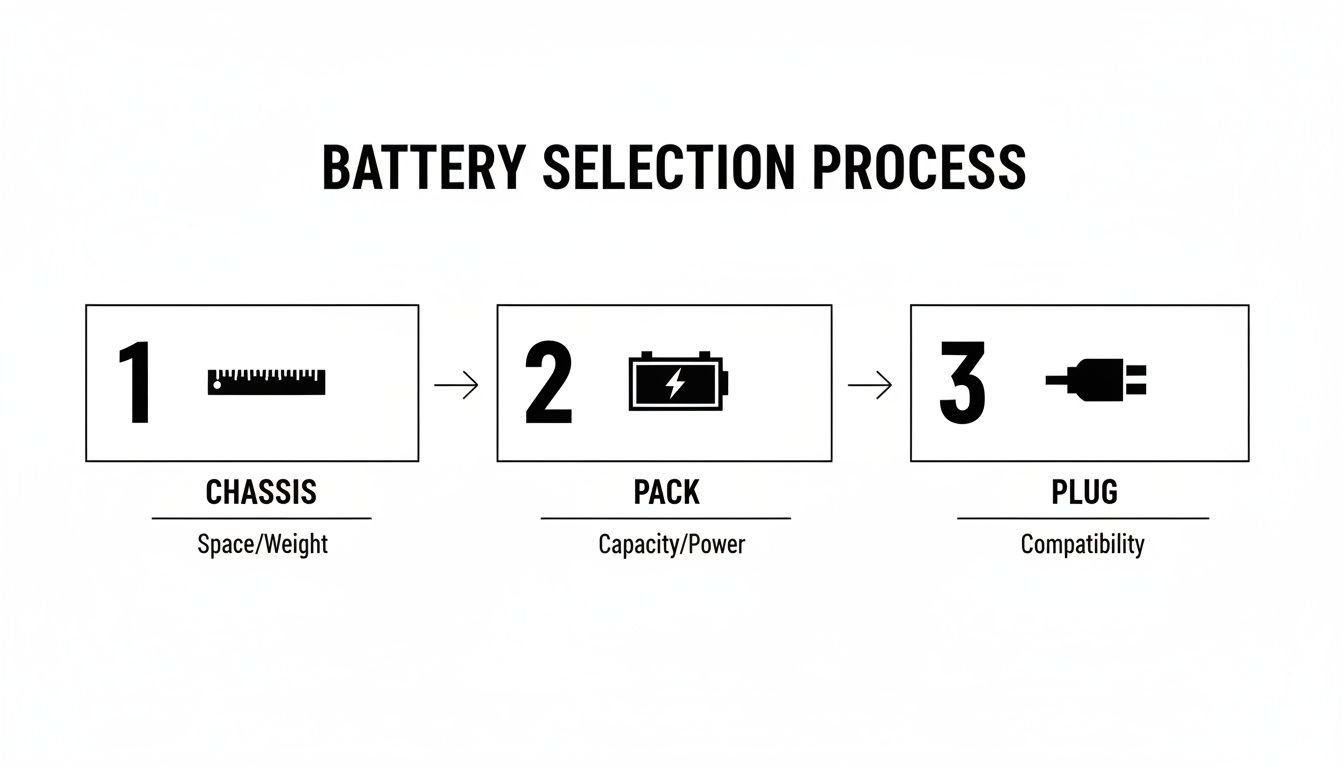
It’s a great reminder that a successful setup starts with making sure everything physically fits together perfectly, long before a charger is ever connected.
Non-Negotiable Safety Rules
Beyond the charger settings, there are a few universal safety rules every RC racer must live by. These aren't suggestions; they're habits designed to prevent the worst-case scenario and protect you, your gear, and your home.
- Always Use a LiPo-Safe Bag: This is your first line of defence, period. Charging your battery inside a fire-resistant LiPo bag or another fireproof container (like a metal ammo can) helps contain things if a cell fails.
- Never Charge a Damaged Pack: Before every single charge, give your battery a quick inspection. Look for any puffing, swelling, dents, or frayed wires. If you see any damage, do not charge it. A damaged LiPo is a serious fire risk.
- Never Leave a Charging Battery Unattended: This is the golden rule. You must be present and awake for the entire charge cycle. Stay in the room and be ready to pull the plug immediately if anything seems off.
Make these steps a non-negotiable part of your routine. Do that, and you can confidently and safely manage your 2 cell batteries, making sure they're always ready to deliver that race-winning power when you need it.
How to Extend the Life of Your RC Batteries
Your 2 cell batteries are a serious investment. Just like any other high-performance part on your car, they need the right care to keep delivering consistent power and a long service life. Nailing down a few key maintenance habits will protect your investment and pay off for seasons to come.
One of the quickest ways to kill a LiPo battery is to leave it fully charged. When a pack sits at its peak 8.4V, the internal chemistry is under constant stress, and that accelerates the aging process. This is a secret every top-level racer knows: never, ever store your batteries fully charged between race days.
The Importance of Storage Charging
The fix is a simple but absolutely critical step called a storage charge. This is a specific mode you'll find on any quality balance charger, and its only job is to bring each cell to its ideal resting voltage—around 3.8V per cell, or 7.6V for the total pack.
This voltage level is the sweet spot where the battery's internal chemistry is most stable. Storing your packs here dramatically slows down degradation, helping them keep their capacity and punch over hundreds of cycles. Making this a non-negotiable part of your post-race routine is one of the best things you can do for your gear.
A battery stored at 3.8V per cell is in a state of chemical equilibrium. Think of it like putting your car in neutral and turning off the engine instead of leaving it parked with the engine revving at redline. One is sustainable; the other is destructive.
Performing Regular Health Inspections
Beyond proper storage, you need to get in the habit of doing a quick physical inspection. Before you charge and after every run, take a moment to look over each of your 2 cell batteries.
You’re looking for any early signs of trouble that could point to an internal issue. These quick checks can prevent a dangerous failure at the track.
- Check for Puffing: Gently squeeze the sides of the hardcase. It should feel solid. Any softness, swelling, or "puffing" is a red flag that gas is building up inside. That battery needs to be retired immediately.
- Inspect Connectors: Look closely at the bullet connectors and the balance plug. Make sure they are clean, tight, and free of any corrosion or damage. A bad connection creates resistance, which means heat—and that robs your car of power.
- Examine the Case: Check the hardcase for any cracks or damage from impacts. A compromised case leaves the internal cells vulnerable to more damage down the road.
If you spot any of these issues, especially puffing, it’s critical to safely discharge and dispose of the battery.
The precision demands of Canada's 1/10 touring car racers have pushed the performance boundaries of 2S LiPo batteries. We see this firsthand with the popularity of brands like Sunpadow and Team Powers in our store. This growth has fueled innovation, with 85% of competitive 1/12 pan cars at major Canadian events now powered by 2S LiPos—that's a 40% rise since 2019. Tinkerers are achieving sustained discharge rates of 50C, leading to real gains in lap consistency and handling.
Just as you look to get the most out of your RC packs, understanding the general principles of how long a battery can last is crucial, even for bigger applications. The core concepts of managing charge cycles and avoiding stress are universal, and getting a broader perspective on battery lifespan can reinforce these good habits. By making these routines part of your trackside and at-home prep, you'll ensure your batteries deliver strong, reliable performance every time you hit the track.
Answering Your 2 Cell Battery Questions
Even the most experienced racers have questions about 2 cell batteries. Whether it's decoding the numbers on the label or figuring out what to do when a pack looks a bit sketchy, getting the right answers is key. Think of this as your trackside cheat sheet for the most common questions that pop up in the pits.
We'll cut through the confusion and give you the straight answers you need to keep your equipment running strong and safe, race after race.
What Does the S in 2S Actually Mean?
This is one of the first things new racers ask, and the answer is simple. The 'S' in "2S" just stands for Series. This means the battery pack is built with two individual 3.7V LiPo cells connected in a chain, positive-to-negative.
When you wire cells in series, their voltages add up. So, two 3.7V cells combine to create a single pack with a nominal voltage of 7.4V. It’s the perfect voltage level for nearly all 1/10 and 1/12 scale RC electronics.
It’s like stacking two D-cell batteries in a flashlight. You’re not making the flashlight run longer (that’s capacity), you’re making the bulb shine brighter by increasing the total voltage. A 2S pack does the exact same thing for your motor—it provides the voltage needed for serious punch and top speed.
You might occasionally see a 'P' for Parallel, which would keep the voltage at 3.7V while doubling the capacity. But for on-road racing, it's all about the 'S' connection.
Can I Use a Higher C-Rating Than My ESC Requires?
Yes, absolutely. In fact, for competitive racing, you should. This is a really important concept to get right. A battery's C-rating isn't about how much power it pushes out. It’s a measure of how much power it can safely deliver when your motor and ESC demand it.
Think of it like the electrical system in your house. The wall outlet can supply a ton of power, but your phone charger only draws the small amount it needs. Your ESC and motor are the ones in charge; they only pull the current they require. A high C-rating battery is just better prepared to handle those demands without breaking a sweat.
Running a 2 cell battery with a C-rating well above what your system needs has some big advantages:
- Less Voltage Sag: The battery can handle big bursts of throttle without the voltage dropping off, keeping your car feeling crisp and powerful all the way down the straightaway.
- Runs Cooler: Because the battery isn’t struggling to keep up, it operates at lower temperatures. Heat is the number one enemy of electronics and battery life.
- Longer Lifespan: A battery that isn't constantly pushed to its limit experiences far less stress on its internal chemistry, which means you'll get more charge cycles out of it.
For high-demand classes like Modified, a battery with a 120C rating or higher is practically a requirement to stay competitive.
My 2S LiPo Is Puffed or Swollen. Is It Safe?
No. A puffed, swollen, or even slightly soft LiPo battery is extremely dangerous. It must be taken out of service immediately and disposed of properly. There is zero room for debate on this one.
Puffing is a dead giveaway that the battery is failing internally. As a LiPo ages or if it's been damaged or over-discharged, the chemical reaction inside can start to produce gas. Since the cells are sealed inside a foil pouch, that gas has nowhere to go, causing the pack to swell up.
If you continue to use or charge a puffed battery, you're sitting on a serious fire hazard. The internal pressure can cause the cell to rupture, leading to a violent and hard-to-extinguish chemical fire.
If you find a puffed pack, follow these steps without exception:
- Stop using it. Don't even think about plugging it in again.
- Safely discharge it to 0V. The best way is with a dedicated LiPo discharger or a simple light bulb setup. Do this in a fireproof area, like on concrete, far away from anything flammable.
- Take it to a battery recycling facility. Do not just throw it in the household trash.
Get in the habit of giving your 2 cell batteries a gentle squeeze before and after every run. It takes two seconds and is the best way to catch a failing pack before it becomes a real problem.
How Do I Calculate a 1C Charge Rate?
This is the basic math every RC racer needs to know for safe charging. Charging at a '1C' rate means setting your charger's current (amps) to a number that matches your battery's capacity. It’s the gold standard for maximizing the lifespan of your LiPo packs.
Here’s the simple, two-step formula:
- Convert your battery's mAh to Ah: Just take the capacity in milliamp-hours (mAh) and divide it by 1000.
- That number is your 1C rate: The result is the correct 1C charge rate in amps.
Let's use a 6200mAh battery as an example:
- Step 1: 6200 mAh / 1000 = 6.2 Ah
- Step 2: Your 1C charge rate is 6.2 amps.
Set your charger to that amperage in LiPo Balance mode, and you’re good to go. While some batteries claim they can handle faster charging, sticking to 1C is what the pros do to ensure their packs are consistent and last as long as possible.
At Digital RC, we stock a curated selection of race-proven 2S LiPo batteries from top brands like Sunpadow and Team Powers, designed for maximum performance and reliability. Find the perfect power source for your chassis and get back on the track with confidence. Explore our collection at https://digitalrc.ca.