

Battery for Radio: Choosing the Best Power Source for Your RC
When you're a competitive RC racer, the battery you choose for your radio is one of the most important decisions you’ll make. It’s a choice that boils down to a few key things: battery chemistry (usually LiPo vs. LiFe), the right voltage, and a perfect fit inside your transmitter.
Get this right, and you’ve built a foundation for precise, glitch-free control.
Why Your Radio Battery Is a Race-Winning Component
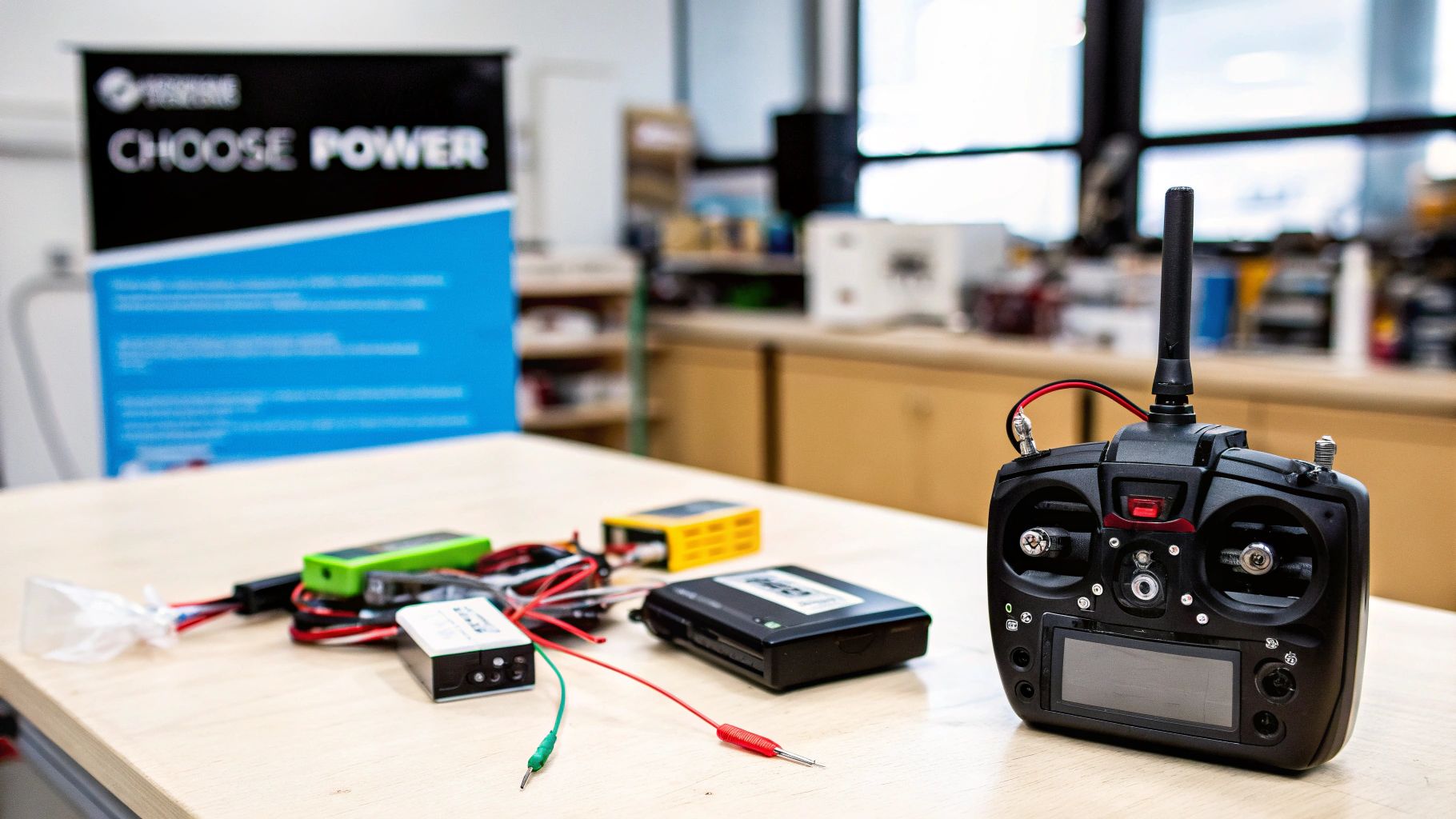
Think of your radio transmitter as the command centre for your entire race program. Every tiny steering correction and every bit of throttle input starts right there in your hands. The battery is the heart of that system, and if it misses a beat, everything falls apart.
A weak or dying battery is a recipe for disaster. It can cause everything from intermittent signal loss and strange, erratic behaviour to a complete shutdown of your car—usually at the worst possible moment. This is why you’ll never see an experienced racer leaving their radio’s power source to chance.
The difference between a podium finish and a frustrating DNF (Did Not Finish) can be as simple as the quality of the battery inside your controller. Consistent voltage ensures your radio’s electronics perform exactly as they were designed, giving you the crisp, instant response you need for high-stakes 1/10 and 1/12 scale on-road racing.
The Foundation of Reliable Control
A high-quality battery for your radio delivers more than just power; it provides confidence. When you’re focused on hitting the perfect apex, the last thing you want to worry about is whether your transmitter is about to die.
Investing in a dependable battery from a trusted brand like Arrowmax or Maclan Racing eliminates a huge variable, letting you focus completely on your driving.
A stable transmitter battery is the unsung hero of RC racing. It ensures your connection to the car is flawless, translating every subtle movement of your fingers into precise action on the track without hesitation or signal drop.
What to Consider First
Choosing the right battery means understanding a few key factors that directly impact performance, safety, and reliability. Before we get into the nitty-gritty, here are the core things you need to evaluate:
- Battery Chemistry: Your main options are Lithium Polymer (LiPo) and Lithium Iron Phosphate (LiFe). Each has its own pros and cons when it to voltage, weight, and safety.
- Voltage and Cell Count: Most modern transmitters are designed for 2S (7.4V) LiPo or 2S (6.6V) LiFe packs. Using the correct voltage is non-negotiable. Get this wrong, and you risk frying your radio's sensitive electronics.
- Physical Size and Fit: The battery must fit securely inside your radio's battery compartment without needing any modifications. Always measure the space before you buy.
A solid understanding of how your radio transmitter and receiver work together is fundamental to building a setup you can trust. This guide will walk you through everything you need to select, install, and maintain the perfect battery, ensuring your equipment is as competitive as you are.
LiPo vs NiMH: A Modern Racer's Guide to Battery Chemistry
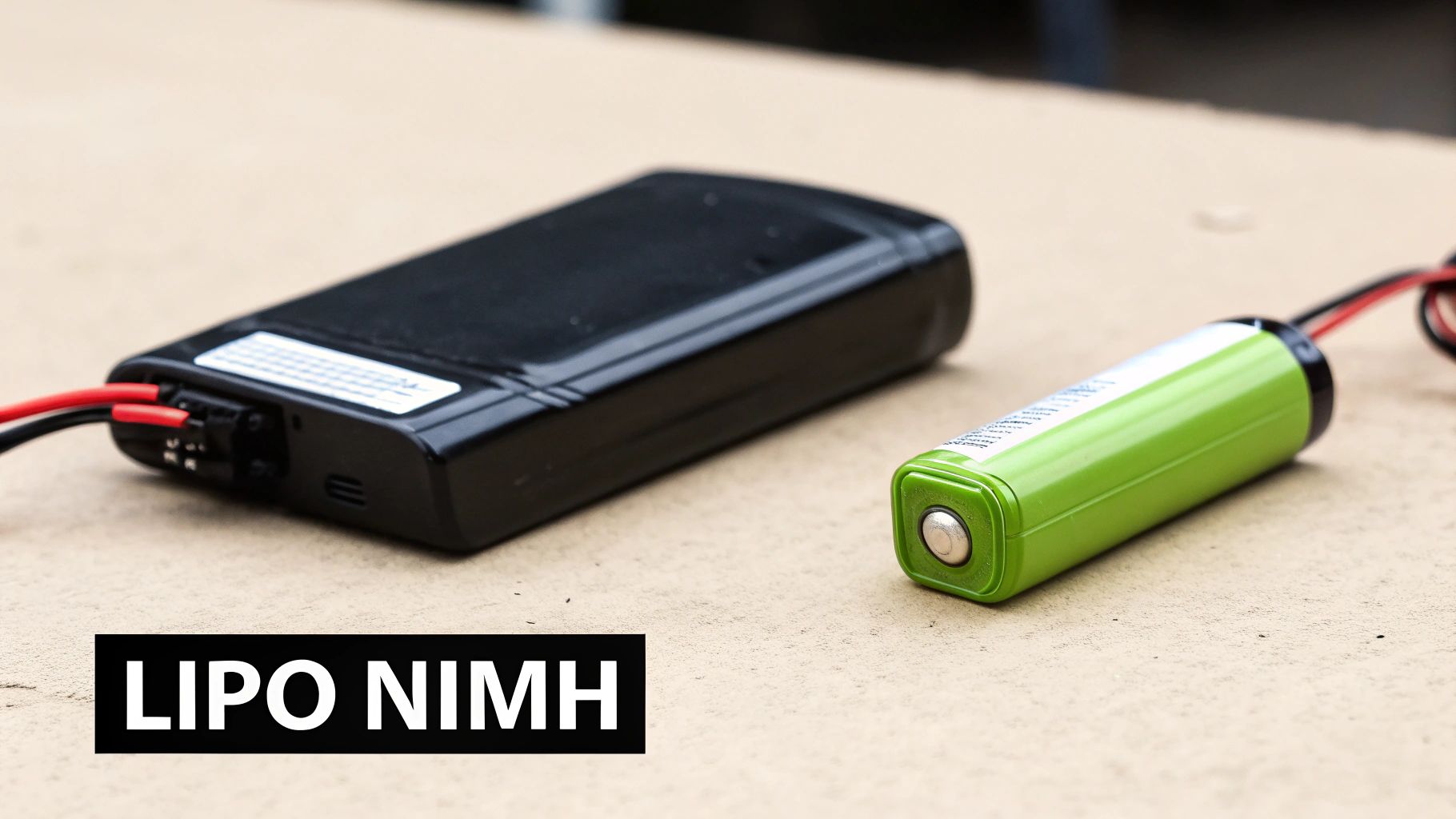
When it comes to powering your radio, you’re really looking at two main players: Nickel-Metal Hydride (NiMH) and Lithium Polymer (LiPo). Getting a handle on what makes them tick is the key to picking the right power source for your race program.
Think of it like choosing an engine. A NiMH pack is your reliable, old-school V8. It’s tough, forgiving if you aren’t perfect with its maintenance, and it just works. But it’s also heavy and doesn’t deliver its power with the same crispness as newer tech.
On the other hand, a LiPo is like a modern, high-strung turbocharged engine. It’s incredibly light, packs a massive punch for its size, and holds its power level consistently. That performance, however, demands a bit more respect and proper care.
Energy Density and Runtime
The biggest win for LiPo is its incredible energy density. In simple terms, for the same physical size, a LiPo battery can cram in way more energy than a NiMH. It’s like getting a bigger fuel tank that weighs less.
For a racer, that translates directly to longer runtimes. A LiPo-powered radio can easily go an entire race weekend on a single charge. No more topping it up between qualifiers. That peace of mind lets you focus on your car, not your gear.
Voltage Stability Under Load
The next big difference is how each battery delivers its power. NiMH batteries are known for "voltage sag"—the moment you start using them, the voltage drops and then slowly fades throughout the run.
LiPos are a different beast. They maintain a rock-solid voltage for almost their entire discharge cycle, only falling off right at the very end.
For a radio transmitter, stable voltage is crucial. It ensures the radio's complex electronics operate flawlessly from the start of the race to the very end, providing a consistent and predictable feel in your hands.
This stable power delivery means the feel of your radio never changes, giving you a more connected and responsive link to your car.
The Ergonomic Advantage of Lighter Weight
One of the most underrated benefits of switching to a LiPo in your radio is the weight savings. A typical LiPo transmitter pack can be up to 50% lighter than its NiMH counterpart.
That might not sound like a huge deal, but hold that radio for a long qualifying session or a tense A-main, and you'll feel it.
- Reduced Driver Fatigue: A lighter radio is simply less tiring to hold, helping you keep your focus sharp and your hands steady.
- Improved Balance and Feel: Cutting that weight changes the transmitter's centre of gravity, often making it feel more balanced and nimble.
This improved feel directly contributes to driver comfort and consistency—two things every serious racer is chasing. For competitive drivers in demanding classes like 1/10 and 1/12 scale on-road, this advantage alone makes LiPo the clear winner.
Want to dive deeper into the specifics? Check out our guide on LiPo battery selection for powering your RC setup for maximum performance. While NiMH is proven tech, the clear advantages in runtime, voltage stability, and ergonomics make LiPo the modern standard for anyone serious about racing.
Decoding Battery Specs for Peak Performance
Picking the right battery for your radio is about more than just finding one that fits. If you want consistent, reliable performance on the track, you need to understand the language written on the battery's label. These specs—voltage, capacity, and C-rating—directly translate into how your radio feels and operates during a race.
Let's cut through the jargon. Think of these numbers not as complex technical data, but as a practical guide to your radio's power system. Getting this right is the foundation for building a setup you can trust, from the first qualifier to the final lap.
Voltage (V) Is Power on Demand
Voltage, measured in volts (V), is like the water pressure in a hose. The higher the pressure, the more forceful and consistent the flow. For your radio, higher voltage provides a stronger, more stable 'push' to the internal electronics, ensuring every component gets the power it needs to operate flawlessly.
Most modern, high-performance radios from top brands like Sanwa and Futaba are designed specifically to run on a 2S (2-cell) LiPo battery. A 2S LiPo delivers a nominal 7.4V, which is the ideal pressure to keep the radio's screen bright, the processor snappy, and the signal transmission crisp and immediate.
Using the correct voltage isn't just a suggestion—it's a critical requirement. Starving a radio designed for 7.4V with too little voltage can lead to brownouts and glitches, while too much will fry its sensitive circuitry for good.
Capacity (mAh) Determines Your Runtime
If voltage is water pressure, then capacity, measured in milliamp-hours (mAh), is the size of your water tank. It's a simple concept: the higher the mAh rating, the longer your radio will run before it needs a recharge.
A battery with a 2500mAh rating just holds more juice than a 1500mAh pack. For any serious racer, a higher capacity battery offers peace of mind. It means you can get through a full day of practice, qualifiers, and mains without ever worrying about a low-voltage alarm breaking your concentration.
For a modern 2.4GHz transmitter, a battery in the 2000-3000mAh range is the sweet spot. That's more than enough runtime for even the longest race days.
Why C-Rating Is Different for a Radio Battery
The C-rating is probably the most misunderstood spec, especially when it comes to radio batteries. It tells you the maximum rate a battery can be safely discharged. For a power-hungry RC car motor that yanks huge bursts of current, a high C-rating (100C or more) is absolutely essential.
Your radio transmitter, however, is a completely different story. It sips power gracefully instead of gulping it down.
- Low Power Draw: Transmitters have a very low and steady power requirement compared to a motor.
- No Sudden Spikes: Unlike an ESC dumping current into a motor, a radio's demand is consistent and minimal.
This means a sky-high C-rating is totally unnecessary for a transmitter battery. A lower C-rating, usually between 5C and 20C, is perfectly fine and safe for this job. You don't need the "horsepower" of a high-C pack, just the steady, reliable energy it provides.
This focus on long-lasting, stable power is being reflected in the Canadian market. Canada’s dedicated battery market was valued at about USD 0.18 billion in 2024, with a forecast revenue of USD 0.36 billion by 2030. For Canadian RC racers, this growth strengthens the supply chain for LiPo and Li-ion packs perfectly sized for transmitters, which helps lower costs and increase selection. The specialized 1S and 2S radio batteries sold through outlets like digital-rc are benefiting from this momentum, making high-quality power more accessible than ever. You can explore more data on the Canadian battery market trends at nextmsc.com.
Matching Connectors for a Glitch-Free Connection
Beyond voltage and capacity, the physical plug connecting your battery to the radio is where reliability is truly made or broken. We’ve all seen it happen: a frustrating, mid-race glitch that costs you a win often comes down to a mismatched or loose connector causing intermittent power loss.
Getting this right isn't just a matter of convenience; it’s a critical step for a stable and predictable power supply.
Think of the connector as the final handshake between your power source and your radio's sensitive electronics. If that handshake is weak, communication falters. Even a tiny bit of wiggle can cause a momentary power cut when you move the radio, leading to a reboot or signal drop at the worst possible time. For competitive racing, a secure, correct fit is non-negotiable.
Identifying Common Radio Connectors
While there are tons of plug types in the RC world, radio batteries typically use just a few common styles. Learning to spot them is the first step toward guaranteed compatibility.
- JST-XH: This is the small white plug you’ll recognize as the balance lead on most LiPo batteries. It's also frequently used as the main power connector on radio batteries.
- Futaba J: A black, keyed connector with a small tab on one side that makes it impossible to plug in backward. It’s the standard on many Futaba radios and compatible systems.
- Universal/JR Servo Plug: This is the standard three-pin connector you find on every servo. It's often used for receiver battery packs and some transmitters as well.
Before you buy any battery for radio use, always take a close look at your transmitter's power input and compare it directly to the connector on the battery you’re considering.
A secure connector is your first line of defence against electronic gremlins. The goal is a connection that clicks firmly into place with zero wiggle room, ensuring uninterrupted power flow no matter how much you move around on the driver's stand.
Sanwa vs Futaba: A Note on Compatibility
Top radio brands often have their own preferences. For example, many Sanwa radios (like the popular M17) are designed to accept a specific JST-XH plug for power. In contrast, Futaba transmitters typically require the keyed Futaba J connector for that secure, locked-in fit.
Knowing what your specific radio needs is essential. Sure, you can make custom adapters if you're handy with a soldering iron, but they introduce another potential point of failure. An adapter lead can come loose or develop a bad connection over time, bringing back the very risk you were trying to eliminate.
For maximum reliability, the best practice is always to buy a battery with the correct plug already installed from the factory. At specialty shops like digital-rc, you'll find batteries made specifically for popular radio systems, featuring the right, high-quality connectors for a direct, glitch-free fit straight out of the box. It’s a simple choice that eliminates guesswork and gives you peace of mind on race day.
Charging, Storage, and Safety Best Practices
Owning a high-performance LiPo battery for your radio isn't just about plugging it in and going racing. It comes with a responsibility to care for it properly. These practices aren't just about making your battery last longer; they're about keeping your pit area safe and your radio reliable on the track. A consistent routine for charging, storage, and inspection is the mark of a serious racer.
Frankly, how you treat your LiPo battery is what separates a reliable power source from a potential hazard. Let's walk through the essential steps to keep your batteries in peak condition so they deliver flawless performance every single race day.
The Art of Safe LiPo Charging
Safely charging your LiPo battery is non-negotiable, and it requires the right gear and your full attention. A quality balance charger is the single most important tool in your arsenal, as it makes sure each cell inside your 2S pack is charged evenly.
The process itself is straightforward but demands precision. First, always connect both the main power plug and the smaller white balance plug to your charger. This is critical because it lets the charger see and adjust the voltage of each individual cell, preventing a dangerous imbalance.
Next, you have to set the charger correctly. For a standard 2S LiPo transmitter pack, this means selecting the LiPo Balance Charge mode, setting the cell count to 2S, and confirming the voltage at 7.4V.
One of the most crucial settings is the charge rate, which is measured in amps. The universal rule for both longevity and safety is simple: charge at a rate of 1C or less.
What is a 1C charge rate?
A 1C rate just means you charge the battery at a current equal to its capacity. So, for a 2500mAh battery, a 1C charge rate is 2.5 amps. For a 3000mAh battery, it's 3.0 amps. Sticking to this conservative rate is much gentler on the battery's internal chemistry, creating less heat and significantly prolonging its useful life.
Finally, and this is a big one, never charge a LiPo battery unattended. Always place the battery inside a LiPo-safe charging bag or a fireproof container during the entire charging cycle. This simple step contains any potential issues and is a standard safety rule at every organized race event.
LiPo Battery Safety Checklist
To make this crystal clear, here’s a simple checklist to run through every time you handle your LiPo packs. Following these steps will build good habits and keep you, your gear, and your pit area safe.
| Action | Best Practice | Why It Matters |
|---|---|---|
| Pre-Charge Inspection | Check for puffing, frayed wires, or damaged connectors before every charge. | Catches potential failures before they become a hazard on the charger. |
| Use a Balance Charger | Always connect both the main and balance plugs. Use the "Balance Charge" mode. | Prevents cell imbalance, which is a primary cause of LiPo failure and fire risk. |
| Set Correct Charge Rate | Charge at a 1C rate or lower (e.g., 2.5A for a 2500mAh pack). | Reduces heat and stress on the battery, maximizing its lifespan and safety. |
| Never Leave Unattended | Stay present and aware during the entire charging process. | Allows you to immediately react to any issues like overheating or swelling. |
| Use a LiPo Bag | Place the battery in a LiPo-safe charging bag or fireproof container. | Contains a potential thermal event, protecting your surroundings from damage. |
| Store Properly | After use, put the battery to a storage voltage (3.80V-3.85V per cell). | Prevents long-term degradation and keeps the battery in its most stable state. |
| Dispose of Safely | Take damaged or old LiPos to a designated battery recycling facility. | Protects the environment and prevents accidents from improper disposal. |
Making this checklist a part of your routine is one of the smartest things you can do in this hobby. It takes just a few minutes but provides priceless peace of mind.
Understanding Storage Charge: The Rubber Band Analogy
One of the most vital—and most often skipped—parts of LiPo care is the storage charge. Think of your LiPo battery like a rubber band. If you leave it fully stretched (fully charged) or completely slack (fully discharged) for a long time, it's going to lose its elasticity and strength. The exact same principle applies to your battery.
Leaving a LiPo fully charged at 4.2V per cell for more than a day or two puts a ton of stress on its internal chemistry, leading to premature breakdown and puffing. On the flip side, letting it sit completely empty can cause the voltage to dip below a safe level, permanently killing the cells.
The solution is to put your battery back into its "resting state" whenever you're not using it.
A storage charge brings each cell to approximately 3.80V to 3.85V. This is the most stable and least stressful state for the battery's chemistry. Nearly all modern chargers have a dedicated "Storage" function that automatically charges or discharges the pack to this perfect voltage.
Getting into the habit of storage charging your batteries after every race day is the single best thing you can do for their long-term health and performance. If you want to dive deeper, you can learn more about the specifics of LiPo battery storage voltage in our dedicated article.
Making sure you have the right connection for charging and use is also key. The diagram below shows the common connectors you'll run into.
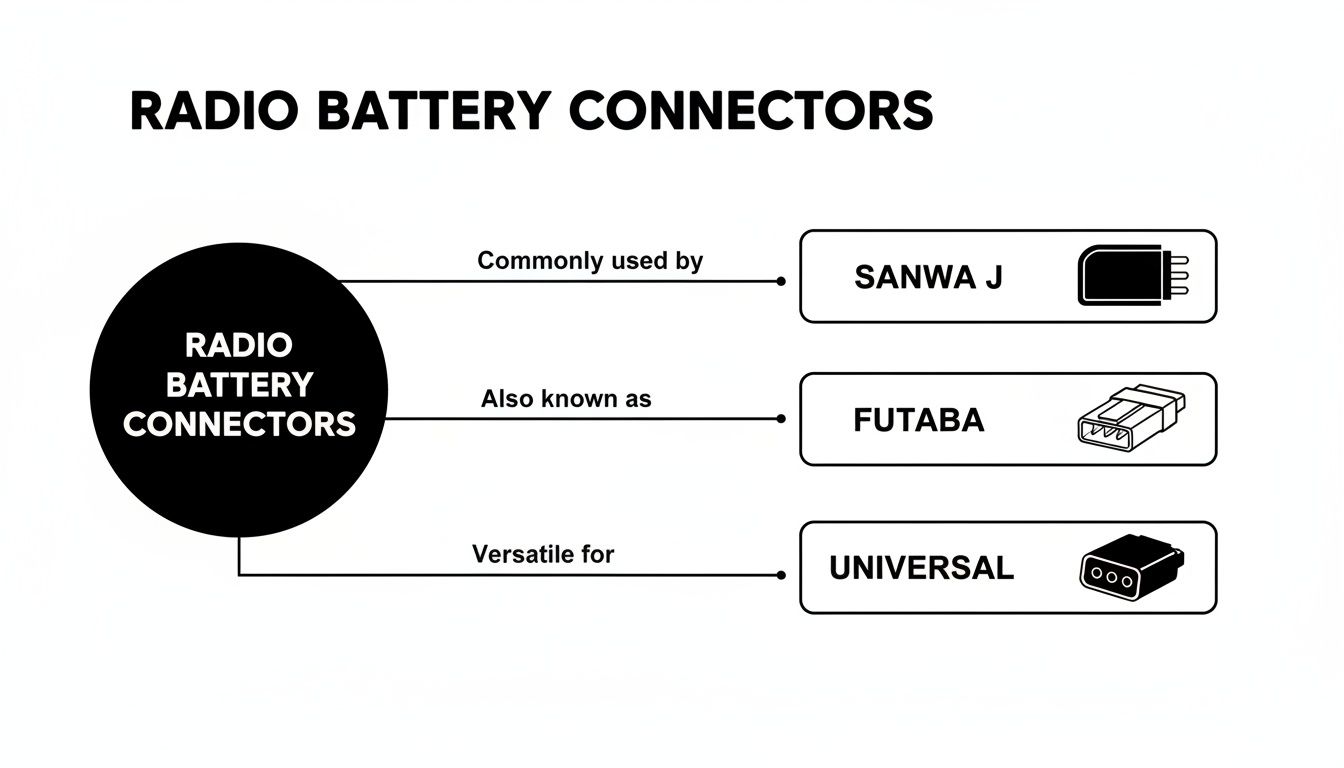
This visual guide shows the typical plugs for Sanwa, Futaba, and universal setups, highlighting why a perfect match is so important for reliability.
Inspection Routines and Responsible Disposal
A regular physical inspection is your first line of defence against battery failure. Before every charge and before you head to the track, do a quick check:
- Look for Swelling: Is the battery pack "puffed" or swollen at all? A puffed LiPo is a damaged LiPo, and it needs to be safely taken out of service immediately.
- Inspect Wires: Check for any frayed wires, cracked insulation, or damage right near the connector where stress occurs.
- Check Connectors: Make sure the connector pins are clean, straight, and still provide a snug, secure fit.
If you find a battery that's damaged or has simply reached the end of its life, you can't just toss it in the bin. LiPo batteries are hazardous waste and must be taken to a designated battery recycling centre or a local hazardous waste disposal facility.
Troubleshooting Common Radio Battery Problems
Even the best gear can have a bad day. When your race day is on the line, knowing how to quickly diagnose a battery problem is a critical skill. A systematic approach will help you nail down the root cause and get back on the driver's stand without missing a heat.
Most radio battery issues fall into just a few common categories. By working through them logically, you can skip the guesswork, pinpoint the exact problem, and save yourself a ton of time and frustration in the pits.
My Radio Won't Turn On
This one is always alarming, but it often has a surprisingly simple fix. Before you assume the worst, run through this quick diagnostic checklist.
- The Problem: The radio is completely dead. No lights, no sound—nothing happens when you hit the power switch.
- The Cause: This almost always points to a total lack of power. Either the battery is completely drained, or the physical connection between the battery and the radio has been broken.
- The Solution: First things first, grab a LiPo checker or use your charger to verify the battery's voltage. If it's dead, try to recharge it. But if the battery shows a healthy charge, the next step is to carefully inspect the plug. Make sure it's seated firmly in the radio's power port with zero wiggle room.
If your radio battery just won't take a charge, some universal diagnostic steps can be a lifesaver. While written for phones, these simple fixes for charging issues can help you quickly spot common problems like a bad cable or dirty contacts.
The Low Battery Alarm Triggers Too Fast
If your radio powers on but the low-voltage warning starts screaming almost immediately, it’s a clear sign that something is wrong with your power system.
A healthy LiPo battery should give you hours of stable voltage. An immediate alarm points to either a setting that's off or, more commonly, a battery that's reached the end of its life.
- The Problem: The low battery alarm sounds within minutes of turning on a freshly charged pack.
- The Cause: The most likely culprit here is a degraded battery. After hundreds of charge cycles, a LiPo's ability to hold its voltage under load just isn't what it used to be. Another possibility is an incorrect low-voltage cutoff setting in your radio's menu, which is triggering a false alarm.
- The Solution: Dive into your radio's settings and confirm the low-voltage alarm is correctly set for a 2S LiPo—usually somewhere around 6.6V to 6.8V. If the setting is correct, then the battery itself is almost certainly toast and needs to be replaced.
My LiPo Battery Is Puffed
A swollen or "puffed" LiPo battery is an unmistakable danger sign. This isn't something to ignore; you need to deal with it right away.
- The Problem: The battery pack has physically swollen. Instead of being firm, it feels soft and puffy.
- The Cause: That puffiness is gas building up inside the battery cells, typically from being over-charged, over-discharged, or physically damaged. It’s a sign of a serious internal failure and a major safety risk.
- The Solution: Immediately and safely remove the battery from service. Do not even think about charging, discharging, or using it again. A puffed LiPo is a fire hazard. It has to be properly neutralized and taken to a designated battery recycling facility for safe disposal.
Ultimately, running into these common issues really reinforces the value of investing in a high-quality battery and charger from the start. A reliable setup from a trusted source like digital-rc is the best defence against having these problems pop up in the first place.
Your Top RC Radio Battery Questions Answered
Even when you feel like you've got a handle on the tech, questions always pop up—especially about the batteries powering your transmitter. They're the heart of your control system, so it’s natural to have a few lingering uncertainties.
Let's clear up some of the most common questions racers ask about their radio batteries. These quick, straight-to-the-point answers will help you make the right calls and keep your gear running flawlessly.
How Long Does a LiPo Battery Last in a Radio?
A good quality 2S LiPo, somewhere in the 2000mAh to 3000mAh range, will easily last a full race day. In fact, today's 2.4GHz radios are so efficient that you'll often get multiple race weekends out of a single charge.
That said, if you're a serious competitor, the best habit to get into is topping off your battery before every big event. It's a simple step that completely takes the guesswork out of the equation, so you can focus on the track, not your battery meter.
Can I Use a LiFe Battery Instead of a LiPo?
Absolutely, and a lot of seasoned racers actually prefer Lithium Iron Phosphate (LiFe) packs. The big advantages are their rock-solid chemical stability and a slightly lower, safer nominal voltage of 6.6V for a 2S pack.
Before you make the switch, though, you have to do two things. First, double-check that your transmitter is compatible with that lower voltage. Second, you must use a modern charger with a dedicated LiFe charging mode to get it charged safely and correctly.
LiPo is still the go-to for its energy density, but a LiFe pack is a fantastic alternative if you prioritize maximum safety and a super stable voltage. Just be sure to check your radio's manual for voltage compatibility first.
Is a Balance Charger Really Necessary for My Radio Battery?
Yes. 100%. A balance charger is non-negotiable for any multi-cell LiPo or LiFe battery. Think of it as the single most important tool for keeping your battery healthy and safe.
A balance charger’s job is to make sure every individual cell inside your 2S pack is charged to the exact same voltage. This prevents dangerous imbalances that can kill a battery's lifespan, hurt its performance, and eventually become a serious safety hazard. It’s essential, preventative maintenance for your power source.
What Should I Do If My New Battery Connector Does Not Match?
The safest and most reliable move is always to buy a battery that comes with the right connector for your radio straight from the factory. You can find adapters, but they just add another potential point of failure—one more plug that could wiggle loose or develop a bad connection.
If you're a pro with a soldering iron, you could carefully swap the connector yourself. But for the vast majority of racers, the best practice is to just buy a direct-fit battery from the start. It eliminates any guesswork and guarantees a solid, glitch-free connection every single time.
At digital-rc, we stock a curated selection of high-performance LiPo and LiFe batteries with the correct connectors for top radio systems like Sanwa and Futaba. Find the perfect, reliable power source for your transmitter by visiting https://digitalrc.ca and get back to focusing on what matters—winning races.