

A Racer's Guide to Mastering Caster for Cars
When you're trying to dial in your on-road RC car, few settings have as much impact as caster. In simple terms, caster is the backward or forward tilt of the steering axis when you look at the car from the side. Getting the positive caster angle right—where the top of the axis tilts toward the rear—is what separates a good setup from a truly great one, especially when it comes to high-speed stability.
How Caster Angle Unlocks Your RC Car's Potential
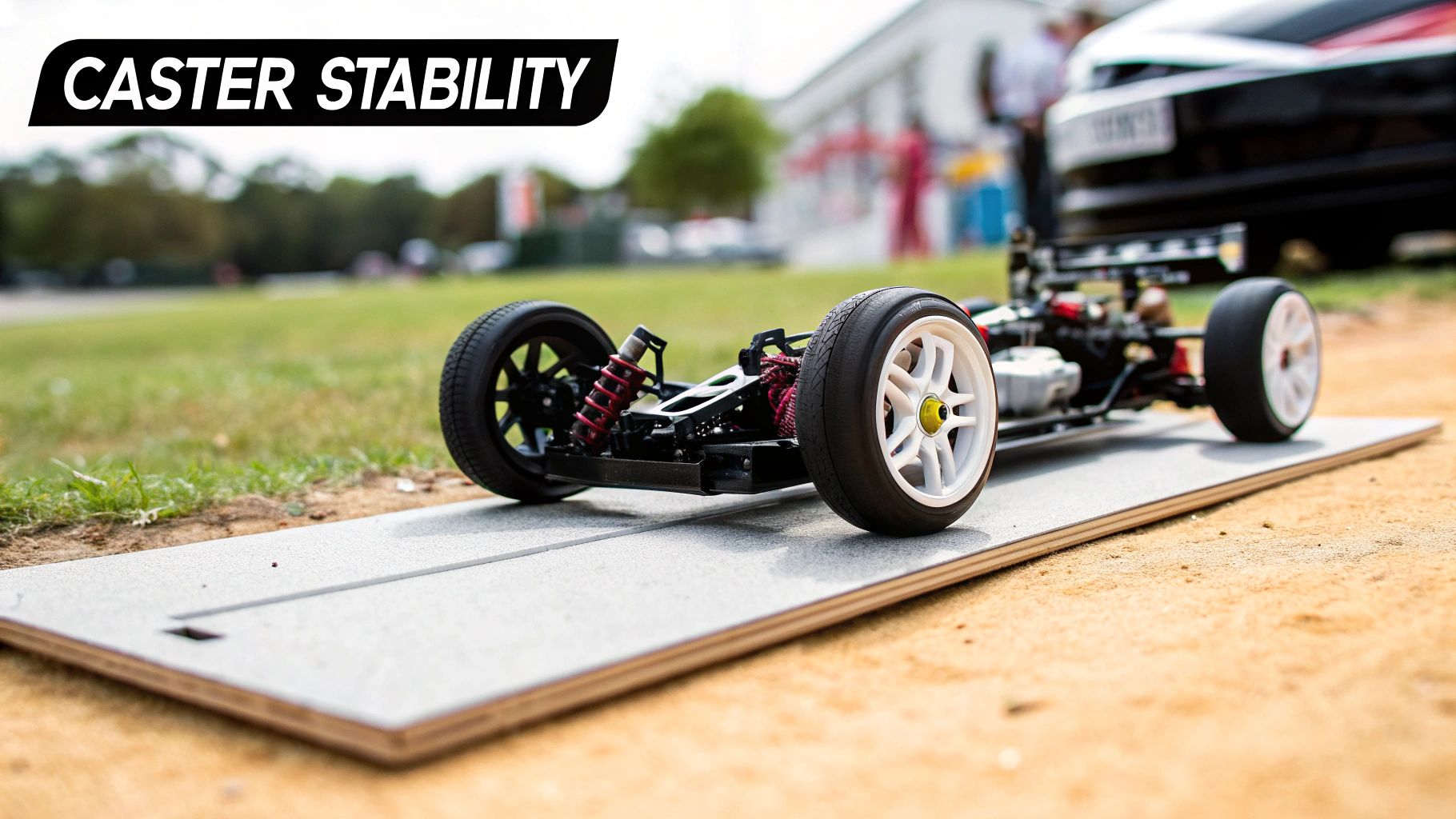
Ever notice how the front wheels of a shopping cart always want to straighten out? They trail behind the pivot point, which keeps the cart tracking straight as you push it. That’s caster in its most basic form, and in the world of competitive RC racing, it's one of the most powerful tuning tools you have.
This isn't just some minor adjustment; changing your caster angle fundamentally alters how your car behaves on track. It's the key to finding the perfect balance between aggressive, razor-sharp turn-in and smooth, predictable handling. Mastering it is essential for adapting your car to different surfaces, from low-grip asphalt to the high-bite carpet tracks where every fraction of a second matters. If you're exploring the hobby, you can see these principles in action across a wide range of modern high-performance RC cars in Canada.
The Foundation of Stability and Grip
The biggest benefit of positive caster is the self-centering effect it creates. As your car rockets down the straight, this geometry naturally forces the front wheels to return to a straight-ahead position. This is what delivers that "locked-in" feeling, keeping the car from wandering and giving you the confidence to stay on the power.
But its magic doesn't stop there. When you steer into a corner, positive caster dynamically increases the negative camber on the outside front tyre. This action tilts the top of that tyre inward, maximizing its contact patch with the track surface right when it's under the most load.
Key Takeaway: More caster generally gives you more straight-line stability and increased mid-corner grip. The trade-off is often a slightly slower initial steering response—a crucial balance every racer has to find for themselves.
Why Precision Matters
When you’re chasing tenths on the track, guesswork is your enemy. A tiny, half-degree change in caster can completely transform your car's handling, which is why consistent, repeatable adjustments are so important. This is where quality setup tools become non-negotiable.
The right equipment, especially a professional-grade setup system like those we carry at Digital-RC, lets you measure and set your caster with absolute accuracy. This precision guarantees three things:
- Your setup is perfectly symmetrical from side to side.
- You can always return to a trusted baseline setting after experimenting.
- You can make intentional, data-driven changes to solve specific handling issues.
By investing in precision, you're not just buying tools; you're gaining a real competitive edge. You're turning theory into faster, more consistent lap times on race day.
How Caster Actually Affects Your Car's Handling
Okay, so we know what caster is. Now let's get into the good stuff: why it has such a huge impact on how your car feels on the track. This isn't just about numbers on a setup sheet; it's about understanding the physics at play so you can make changes with a purpose.
At the core of it all is a concept called mechanical trail. Picture a line running straight through your steering axis and hitting the ground. Now, look at the very centre of where your tyre touches the track. The distance between those two points—the steering axis line and the centre of the contact patch—is your mechanical trail.
Think of it like the front wheel on a shopping cart. The wheel naturally wants to follow behind the pivot point, which keeps it straight. More positive caster increases this "trail," creating a stronger self-centring force in your RC car. This is exactly what gives you that locked-in, stable feeling when you're flat-out down a long straight.
The Caster and Camber Connection
But caster's real magic trick happens the second you turn the wheel. When you have positive caster dialled in, turning the steering causes the outside wheel to lean in, gaining negative camber, while the inside wheel leans out, gaining positive camber.
This dynamic camber gain is a game-changer for cornering. As your car rolls into a turn, all the weight shifts to the outside tyres. That extra negative camber on the loaded outside wheel presses the tyre's contact patch flat against the track surface, maximizing grip right when you need it most.
This relationship is a fundamental principle for tuning any performance caster for cars, from full-scale race cars to our 1/10 scale machines.
By adding more positive caster, you're essentially telling the car to dig its outside front tyre into the track harder as it corners. This generates more pure mechanical grip, letting you carry more speed through the middle of the turn.
This is one of the key trade-offs in any chassis setup. Cranking up the caster is a conscious choice to prioritize mid-corner grip and high-speed stability.
Finding That Sweet Spot
Of course, in the world of RC tuning, you never get something for nothing. The huge benefits of high positive caster come with a clear trade-off: your car's initial steering response. That same self-centring force that keeps the car stable also resists your initial command to turn.
This means a car with a lot of caster might feel a bit less "pointy" or aggressive right at turn-in. It can feel a little lazy when you first crack the wheel, even though it will have massive grip once it settles into the corner.
On the flip side, taking caster out makes the car feel much more nimble and eager to change direction.
-
Less Caster (e.g., 2 degrees):
- Pros: Super quick and aggressive steering response at the start of the corner. The car feels darty and changes direction in a flash.
- Cons: Can feel "twitchy" or nervous on high-speed sections. It also generates less dynamic camber, which can mean less grip mid-corner.
-
More Caster (e.g., 6 degrees):
- Pros: Incredible high-speed stability and a "locked-in" feel. Generates tons of mid-corner grip, making the car feel planted and predictable.
- Cons: Slower initial steering response. This can make the car feel like it "pushes" or understeers for a split second right at turn-in.
This is what tuning is all about. The goal isn't to max out one setting, but to find the balance that works for the track, the grip level, and your driving style. When you understand these principles, you can stop just copying setup sheets and start making smart, informed adjustments that lead directly to faster, more consistent laps.
A Practical Guide to Measuring and Adjusting Caster
Knowing the theory behind caster is one thing. Actually using it to find those last few tenths on the track? That happens on the setup board. Your car’s performance is born from precise, repeatable adjustments, and this guide will walk you through exactly how to measure and tune the caster on your touring or pan car.
To get real results, you have to move beyond guesswork. While a basic gauge might get you in the ballpark, a dedicated setup station is what separates a consistent, predictable car from one that feels different every lap. For any serious racer, investing in a quality system is non-negotiable. If you're after absolute precision, the Hudy Universal Setup System for 1/10 Touring Cars is the industry standard for a reason—it guarantees your adjustments are spot-on every single time.
This simple flow chart really nails the cause-and-effect relationship at play. The angle you set is the direct cause of the mechanical trail, which in turn creates the self-centering force that gives your car its stability.
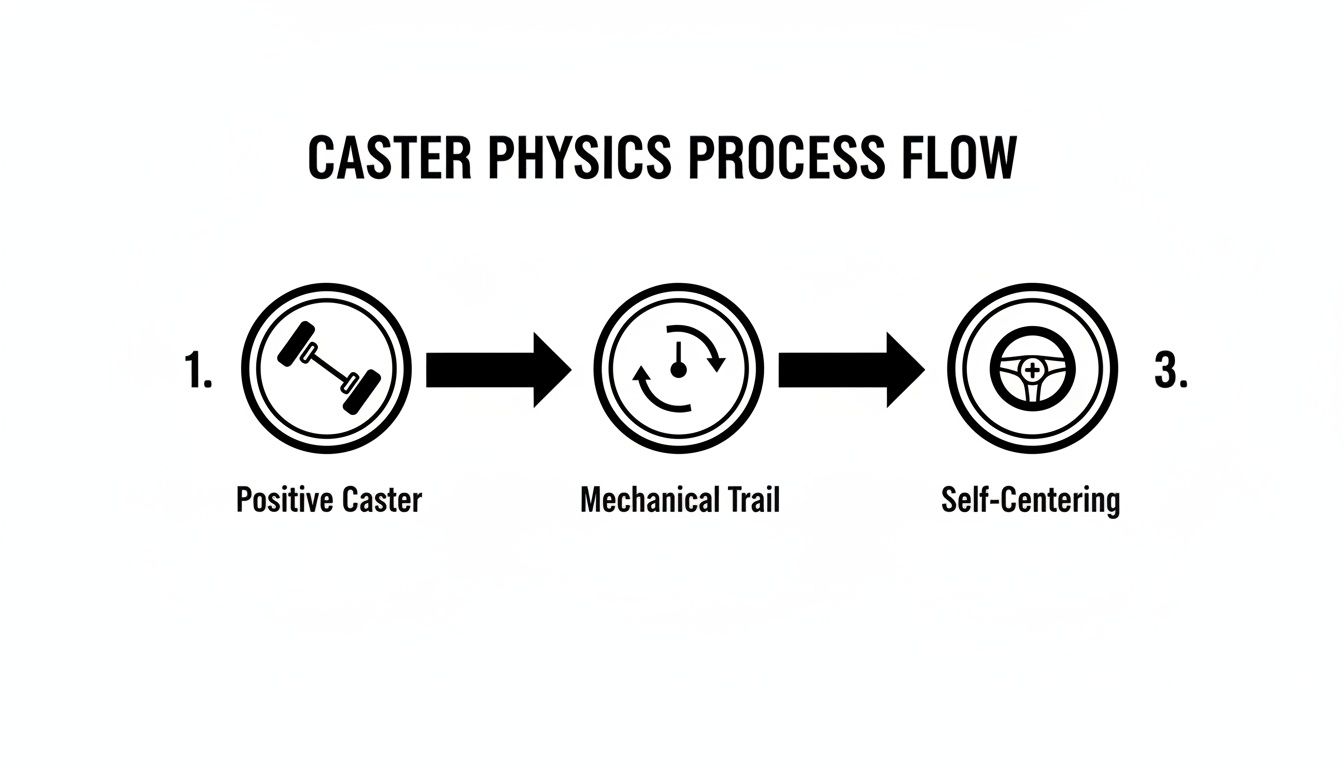
The key takeaway is that every handling characteristic we’ve talked about starts with the physical angle of that caster block. Get that right, and the rest follows.
Setting The Stage For Accurate Measurement
Before you even think about putting a gauge on the car, you need to prep your chassis correctly. Any shortcuts here will throw off your readings and lead to a car that just doesn't handle right. Rule number one: always work on a perfectly flat, level surface. A dedicated setup board is a must-have.
With the car on the board, make sure your ride height and droop are set to your baseline first. These settings dictate the suspension's resting position and will absolutely affect your caster reading. Get them dialed in before you touch any other geometry.
How Caster Is Adjusted On Most RC Cars
For on-road RC cars, there are a few common ways to change your caster angle, and the method you'll use comes down to your chassis design. Most modern touring cars give you tuneability by swapping out parts with different built-in angles.
Here are the most common methods you'll run into:
- Swapping C-Hubs or Steering Blocks: This is the go-to method for most touring cars. Manufacturers produce C-hubs in different angles, like 2, 4, and 6 degrees. To change caster, you just unbolt the old one and install the new one.
- Using Suspension Mount Inserts: Some higher-end chassis use adjustable suspension mounts with offset inserts, often called "pills." By rotating these pills in the front suspension mounts, you change the sweep of the suspension arm, which directly adjusts caster.
- Pillow Ball Suspension Adjustments: While you see this more on 1/8 scale cars and some pan cars, pillow ball systems offer incredibly fine tuning. You make adjustments by shimming the upper suspension arm forward or backward, which tilts the steering axis.
Each method gets the job done differently. Swapping C-hubs is dead simple and bulletproof—you get big, defined setup changes. Suspension inserts are more integrated, often letting you tune other parameters like kick-up at the same time.
Knowing which system your car has is the first step to making confident changes at the track.
Common Caster Adjustment Methods in RC Cars
So, how do these different adjustment styles stack up? Each has its place in the on-road racing scene, offering a different balance of ease, precision, and cost. This table breaks down the primary techniques you'll encounter.
| Adjustment Method | How It Works | Typical Chassis | Pros | Cons |
|---|---|---|---|---|
| Swapping C-Hubs | Physical replacement of the front C-hub with another part molded at a different caster angle (e.g., 4° vs 6°). | Most 1/10 Touring Cars (e.g. XRAY, Tamiya) | Simple, repeatable, and very durable. It's impossible to get the setting wrong once the part is installed. | Requires purchasing multiple parts. Adjustments are in fixed increments (usually 2° steps). |
| Suspension Inserts | Using offset composite or metal inserts in the suspension blocks to alter the angle of the front lower hinge pins. | High-end Touring Cars, some Pan Cars | Allows for very fine adjustments, often in 0.5° increments. Can adjust other settings simultaneously. | More complex to adjust. Can be confusing for beginners as it may also alter kick-up and arm sweep. |
| Pillow Ball Spacers | Adding or removing shims/spacers on the upper suspension arm to tilt the upper pillow ball forward or backward. | 1/12 Pan Cars, some 1/10 Pan Cars | Offers a wide range of adjustment without needing new parts. Allows for very small, precise changes. | Can be less durable in a hard impact. Requires careful measurement to ensure side-to-side symmetry. |
Ultimately, the best method is the one built into your chassis. The real secret is to master that system, use precise tools, and make one methodical change at a time. That's how you'll truly understand what each adjustment does for your car on the track.
Tuning Caster for Different Track Conditions
A winning setup is never a one-size-fits-all solution; it’s a direct response to the environment. Now that you understand the mechanics of adjusting caster, let's get into the 'when' and 'why' of making those changes. This is where we turn theory into a strategic advantage on the track.
The amount of available grip is the single biggest factor influencing your setup. A dusty, low-grip asphalt circuit and a high-bite carpet track are two completely different beasts, and your caster for cars needs to reflect that. The core principle is simple: more grip allows you to be more aggressive with your geometry.
Matching Caster to Track Grip
On a high-grip surface like black carpet, the track itself is already doing most of the work. Here, you can run less caster—think 2-3 degrees—to make the car feel nimble and responsive. The quick direction changes are a huge benefit, and you don't need the extra caster-induced camber to find grip because the carpet already provides it.
On the flip side, a slippery, low-traction asphalt track makes stability your best friend. In these conditions, increasing positive caster to 4-6 degrees is a go-to strategy. This adds that crucial self-centering effect to keep the car settled, while the dynamic camber gain helps claw for every bit of mid-corner grip you can find.
Don't forget that your tyres play a massive role in this equation. To get a handle on how rubber compounds and wear affect your setup choices, you can learn more about selecting the right RC car tires in our detailed guide.
Adapting to Track Layout and Size
Beyond the surface, the track's layout dictates how your car should behave. A large, flowing track with long sweepers demands a different setup than a tight, technical circuit full of hairpins.
-
Large, Flowing Tracks: For tracks where you spend a lot of time at high speed and in long-radius corners, more caster is your ally. The added stability keeps the car planted through fast sweepers, preventing it from feeling nervous or wandering off-line.
-
Tight, Technical Tracks: On smaller tracks with constant stop-and-go corners, a sharp turn-in is critical. Reducing caster will make the car feel more "pointy" and eager to rotate, letting you attack those tight corners more aggressively.
Pro Tuner's Tip: When you show up at a new track, start with a balanced baseline, like 4 degrees of caster. Run a few laps just to assess the grip level and the track flow. Only then should you decide if you need more stability (add caster) or more initial steering (reduce caster).
Tuning for Your Driving Style
Ultimately, the perfect caster setting is deeply personal and has to match how you drive. Two racers with identical cars on the same track might prefer completely different setups to be fast. There’s no single "right" answer here.
An aggressive driver who likes to throw the car into corners often prefers less caster. This complements their style by making the car react instantly. The car will feel alive and incredibly responsive, but it can be less forgiving of mistakes.
On the other hand, a smoother, more methodical driver might favour more caster. The added stability makes the car more predictable and easier to drive consistently, lap after lap. It smooths out steering inputs and provides a calm, planted feel that rewards precision.
The key is to experiment. By making small, one-degree adjustments and feeling the difference on track, you'll start to dial in a setup that feels like an extension of your own driving. This methodical approach is the fastest way to build confidence and turn your understanding of caster into real, on-track performance.
Troubleshooting Handling Problems with Caster
Even after you've nailed down the theory, you'll eventually have a day at the track where the car just won't cooperate. This is where your understanding of caster stops being academic and becomes your best problem-solving tool. Let's walk through how to diagnose common handling quirks and use caster to dial your car back in.
Think of this as your trackside cheat sheet. When you feel a specific issue, you can make a targeted change to the caster for cars and immediately see the results. It’s this methodical process that turns tuning from frustrating guesswork into a precise science, helping you find those last few tenths.
Remember the golden rule of chassis tuning: make only one change at a time. If you adjust caster, ride height, and camber all at once, you’ll have no idea what actually helped (or hurt). Isolate your adjustments so you can clearly measure the impact of each one.
Common Problems and Caster Solutions
Here’s how to translate what your car is doing on the track into a specific caster adjustment you can make in the pits.
Problem 1: The Car Feels Nervous or Twitchy on Straights
You know the feeling—the car wanders at high speed and needs constant little steering inputs just to keep it pointed straight. It feels unstable and robs you of that "locked-in" confidence you need down the main straightaway.
- Solution: Increase positive caster. This is your go-to fix. Adding more caster (say, moving from 4° to 6°) makes that self-centring effect stronger. It’s the most direct way to improve straight-line stability and calm the car down, making it much easier to drive at top speed.
Problem 2: Steering Feels Vague or Unresponsive at Turn-In
You turn the wheel, but the car feels lazy, like it doesn't want to start the turn. It pushes wide for a split second before finally taking a set, forcing you to slow down more than you want to at corner entry.
- Solution: Decrease positive caster. A numb-feeling front end often means you have too much caster. Reducing it (for example, going from 6° to 4°) will make the initial steering response much sharper and more aggressive. This helps the car dive into the corner with real authority.
The Role of Precision Tools in Troubleshooting
Let's be honest: effective troubleshooting is impossible without accurate data. You can't fix a handling problem if you aren't sure what your settings were to begin with or if your adjustments are different from left to right. This is where precision becomes your greatest ally.
The core of successful tuning lies in making deliberate, measured, and repeatable changes. A high-quality setup station is not a luxury; it’s an essential diagnostic tool that guarantees the adjustments you make are the adjustments you intended.
Using a top-tier system like the Hudy Setup Station ensures that when you decide to add one degree of caster, that’s exactly what you get—on both sides of the car. This level of accuracy eliminates variables and helps you build a true feel for how each small change affects handling. It turns frustrating tuning sessions into productive, confidence-building experiences.
Caster Questions From the Pits
Even after you've got the basics down, specific questions about caster always come up. Here are some quick, clear answers to the most common ones we hear from racers trying to translate theory into faster lap times.
Does Caster Angle Affect My Tyre Wear?
Yes, absolutely. That extra positive caster dynamically increases negative camber on the outside front tyre as you steer, which means you're putting a lot more force on the inside edge of that tyre.
Over a long race, this will definitely cause the inner shoulder of your front tyres to wear out faster. It's a classic tuning trade-off: you get a ton of extra mid-corner grip, but the price you pay is slightly uneven tyre wear. Keep an eye on your tyres and you'll learn to manage it.
What’s a Good Starting Caster Angle for My Touring Car?
For most 1/10 electric touring cars, 4 degrees of positive caster is a fantastic place to start. It’s a solid, widely-used baseline that works well on both carpet and asphalt.
This setting gives you enough straight-line stability to feel confident down the main straight without making the steering feel too lazy on turn-in. From that 4-degree baseline, you can start making small, methodical adjustments. Add a degree if you need more stability, or take one away for a sharper initial response, depending on what the track and your driving style are telling you.
Remember, a baseline is just that—a starting point. Get a feel for the car on the track, then tune from there. A solid baseline and precise tools are the foundation of any successful race program.
This approach is always better than making huge, random changes and hoping for the best.
Can I Run Different Caster Angles on the Left and Right Sides?
For on-road circuit racing with both left and right turns, you should almost always run symmetrical caster. Keeping the angles identical on both sides is what gives you consistent handling, whether you're diving into a right-hand sweeper or a left-hand hairpin.
Running different caster angles on the left and right is really a tool for oval racing, where you're only ever trying to optimize the car to turn one way. For a balanced road course car, symmetry is essential for predictable handling.
How Do I Know if I’m Using the Right Tools to Measure Caster?
The real test for any setup tool comes down to two words: repeatability and accuracy. A basic plastic gauge might give you a rough idea, but it’s just not good enough for competitive racing where a quarter of a degree can make a real difference on the track.
A high-quality, professional-grade setup system is essential for any serious racer. It’s the only way to eliminate guesswork and be certain your measurements are precise every single time you use it. This is critical because it confirms the changes you're making in the pits are actually having the effect you want on the track. When you adjust from 4 to 5 degrees, you need to know it's exactly one degree.
Investing in a premium setup station means you can trust your numbers, build a reliable database of setups, and make adjustments with total confidence. It’s one of the most important pieces of equipment you can own for improving your performance.
At digital-rc, we believe that precision tools are the key to unlocking your car's true potential. To achieve the accuracy discussed here, explore our curated collection of professional setup systems and tuning equipment. Get the gear you need to make every adjustment count.
Discover our range of setup tools at digital-rc.ca.