

Your Ultimate Guide to the Lipo 2s Battery for RC Racing
When you get serious about 1/10 scale RC racing, you quickly learn that the 2S LiPo battery is the high-performance heart of your car. It’s made up of two individual lithium polymer cells wired together in series, and this specific setup is the key to unlocking the power and runtime needed to be competitive. It's the standard for a reason.
What Is a 2S LiPo Battery
At its core, a 2S LiPo battery is a lightweight, powerful energy source engineered for the brutal demands of high-performance RC cars. The "2S" in its name literally means "2 cells in Series," which is the secret sauce behind its performance. Just think of it as stacking two smaller batteries together to double their combined voltage.
Each individual Lithium Polymer (LiPo) cell has a "resting," or nominal, voltage of 3.7 volts. When you connect two of them in series, their voltages add up.
3.7V (Cell 1) + 3.7V (Cell 2) = 7.4V (Total Nominal Voltage)
This 7.4V nominal voltage is the magic number. It's the standard power level that motors and Electronic Speed Controls (ESCs) in 1/10 and 1/12 on-road race cars are designed to handle for peak efficiency. If you're interested in the broader world of battery tech, you can delve deeper into various battery chemistries like Lithium-Ion, LiFePO4, and Lithium Titanate.
Understanding Charged Voltage
Now, here’s where it gets interesting for racers. You'll notice that a fully charged 2S LiPo battery actually reads 8.4 volts on your charger, not 7.4V. This higher number is the peak voltage each cell can hold when it's at 100% capacity (4.2V per cell).
This difference is critical on the track. The incredible punch and top speed you feel right off the starting line comes from that peak 8.4V charge. As you lay down laps, the voltage gradually drops back toward its nominal 7.4V level.
Getting a feel for this voltage curve is fundamental to race strategy and battery management. It’s the foundational knowledge you need to make smart decisions, whether you're shopping for new batteries or trying to squeeze every last drop of performance out of your current gear. For a complete look at what goes into choosing the right pack, check out our guide on LiPo battery selection for powering your RC setup for maximum performance. Think of this as the first step to mastering your power system.
Decoding The Numbers That Win Races
Understanding the numbers on your lipo 2s battery is like reading a car's telemetry data—it's the secret to unlocking consistent power and finding your way to the podium. These aren't just random specs; they're a direct forecast of how your car will perform when the tone goes off. Once you learn to translate the jargon, you can confidently pick the perfect battery from the digital-rc catalogue for your race class.
Let's break it down with a simple analogy. Think of your battery as both a fuel tank and the fuel line feeding your motor. Three key numbers dictate its performance: Capacity (mAh), C-Rating, and Internal Resistance (IR). Mastering these is the first step toward building a truly competitive power system.
This diagram gives you a quick visual of the basic 2S LiPo structure.
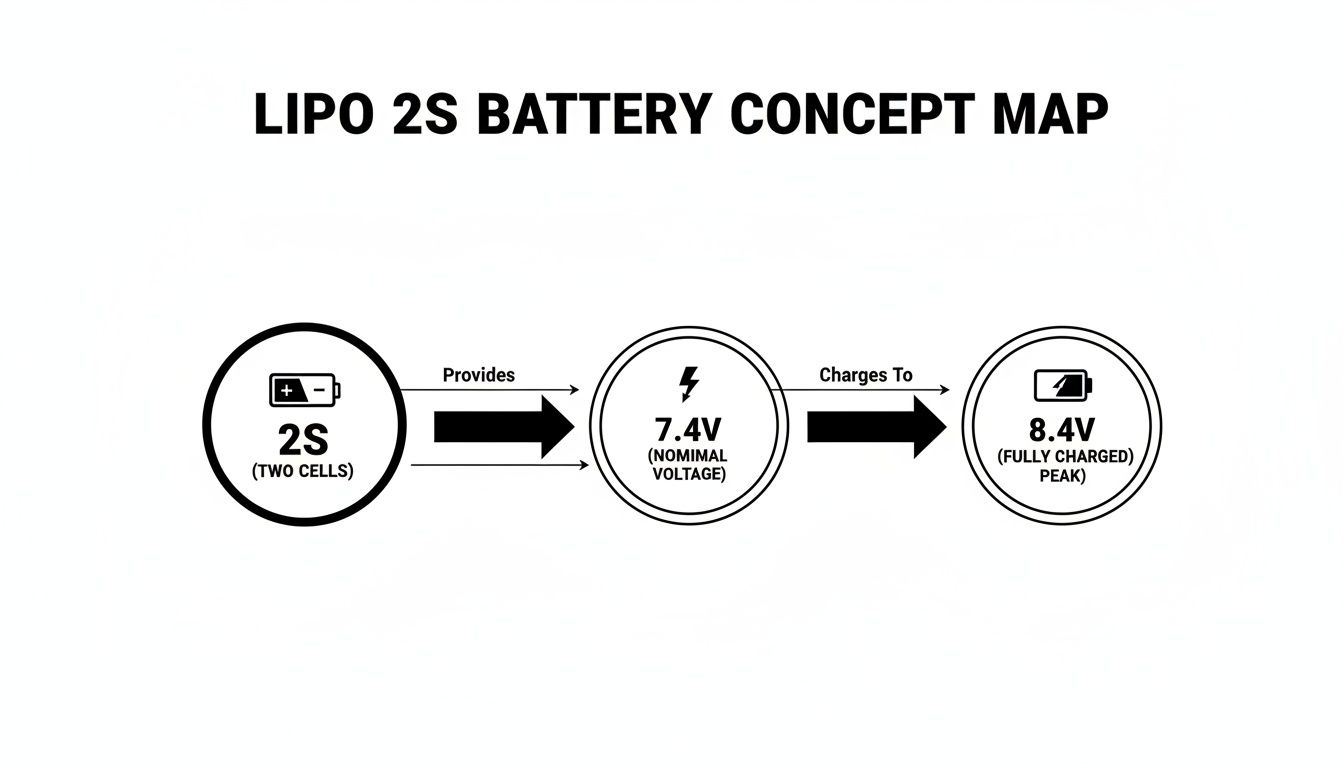
You can see how the two individual cells (the "2S") combine for a 7.4V nominal voltage, which climbs to a peak of 8.4V right off the charger.
To help connect these numbers to what you actually feel on the track, here's a quick reference table.
2S LiPo Specs And On-Track Performance
| Specification | Simple Analogy | How It Affects Your Race |
|---|---|---|
| Capacity (mAh) | The size of your fuel tank | More mAh means longer runtime. It's what keeps you from fading at the end of an 8-minute main. |
| C-Rating | The width of your fuel line | Higher C-rating delivers more "punch" or instant acceleration out of corners and down the straight. |
| Internal Resistance (IR) | A clog in the fuel line | Lower IR means more efficient power, less heat, and consistent voltage all the way to the finish line. |
Think of these three specs working together. A big tank is useless if the fuel line is too narrow, and even the best setup will feel weak if there's a clog in the system.
Capacity (mAh): Your Racing Runtime
Capacity, measured in milliamp-hours (mAh), is the easiest one to get your head around. It's the size of your fuel tank. A 6000mAh battery holds more energy and will run longer than a 4000mAh pack, plain and simple.
For racers, this translates directly to making it through the entire race without a noticeable power drop. In a 5-minute qualifier or an 8-minute main, you need enough capacity to stay strong until the end. This is especially true in demanding modified classes, where power-hungry motors need a bigger tank to draw from.
C-Rating: Your Instant Power On Tap
If capacity is the fuel tank, the C-Rating is the diameter of the fuel line. It determines how fast the battery can dump its energy into the motor. A higher C-Rating means the pack can handle a huge, sudden demand for current without the voltage sagging.
A higher C-Rating provides more "punch." It’s that instant, neck-snapping acceleration you feel when you hammer the throttle on the straightaway or pull out of a tight corner.
This is where matching the battery to your class becomes critical.
- Stock Racing: In spec classes with tamer motors, the current draw is lower and more consistent. A moderate C-rating, like a Team Powers 120C battery, is usually more than enough to get the job done.
- Modified Racing: Big modified motors are incredibly thirsty. A high C-Rating like you'd find in a Team Powers 130C pack is non-negotiable. It’s what you need to feed those massive amperage spikes and make your car lunge forward with maximum force.
Running an under-rated battery in a mod car is like trying to feed a V8 engine through a drinking straw. The battery will get hot, struggle, and choke the motor of the power it's capable of producing.
Internal Resistance (IR): The Hidden Performance Killer
Internal Resistance, or IR, is the most technical of the three but is arguably the most important metric for any serious racer. Measured in milliohms (mΩ), IR represents the battery's built-in opposition to current flow. Think of it as a clog or restriction in that fuel line.
Lower IR is always better. A battery with low internal resistance delivers power more efficiently, which means less voltage drop under load, less heat, and more consistent power from the start of the race to the finish. A fresh, high-quality lipo 2s battery from digital-rc might have an IR as low as 1-2 mΩ per cell.
As a battery ages and goes through charge/discharge cycles, its IR will inevitably creep up. That "flat" or sluggish feeling you get late in a run? That's often your battery's IR climbing, preventing it from delivering the punch it used to have. Monitoring your pack’s IR with a good charger is a pro-level move for tracking its health and knowing exactly when it's time for a replacement.
Choosing The Right Battery Shape And Connector
You can have the most powerful lipo 2s battery on the market, but it’s not going to do you any good if it doesn’t physically fit your chassis or if the connector is choking off power. It’s easy to get lost in the numbers, but the physical package—its shape, size, and connector type—is a massive part of tuning your car's handling and making sure every last drop of power actually reaches the motor. Getting this combination right is a key setup decision that directly impacts balance, agility, and on-track electrical efficiency.
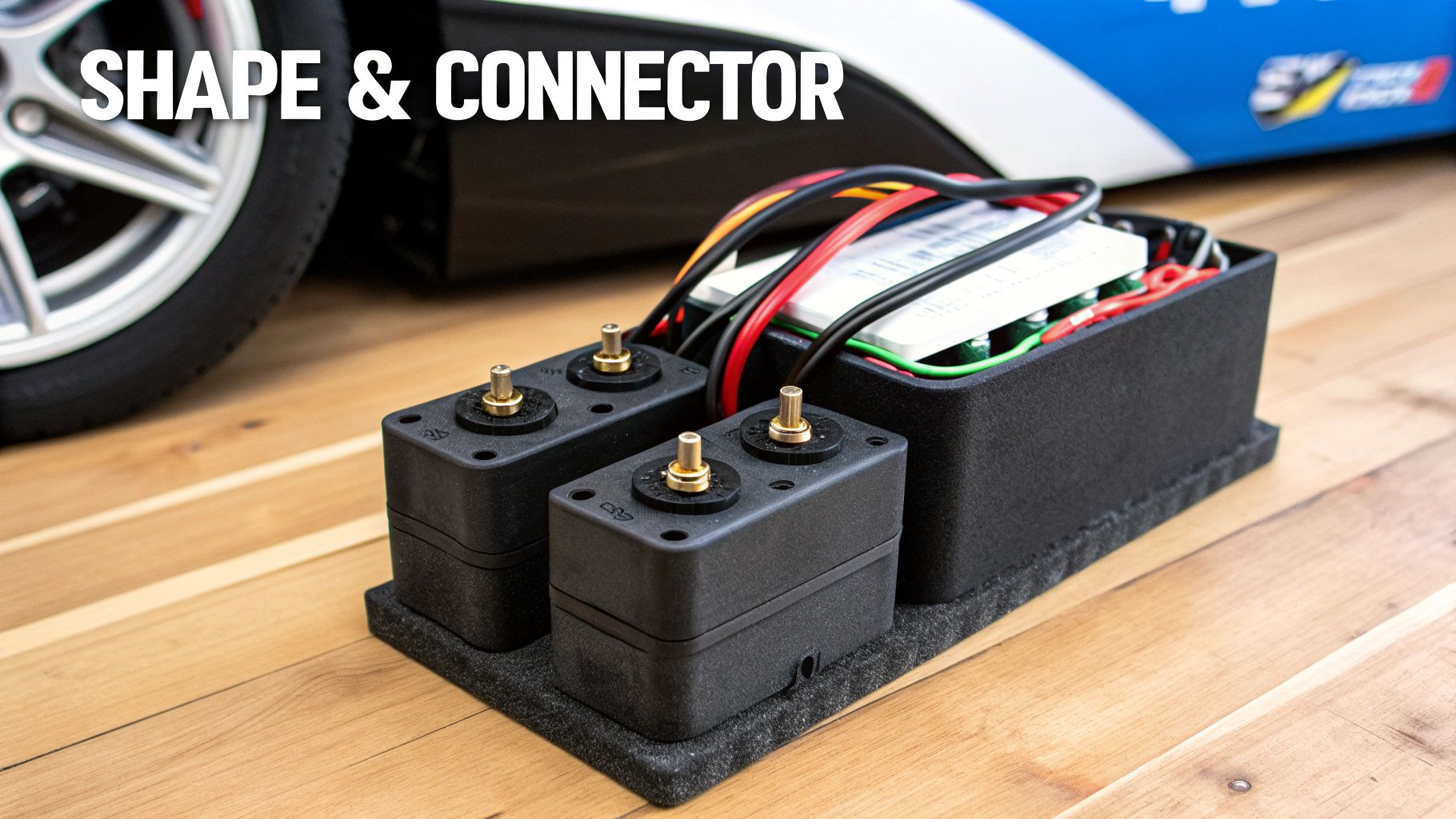
It all starts with understanding how a battery's shape affects your car’s dynamics and how the connectors can either help or hurt your performance.
Connectors: The Pathway To Power
In competitive RC racing, every milliohm of resistance is your enemy. The connectors on your battery are the physical bridge to your ESC, and a bad connection is like a kink in a garden hose—it restricts flow, robs you of power, and generates useless heat. This is exactly why you'll see racers at digital-rc almost exclusively using high-current bullet connectors.
- 5mm Bullets: These have become the standard for high-power racing, especially in modified touring cars. Their large surface area creates a super low-resistance connection, letting maximum current flow without a significant voltage drop. Most of our Team Powers batteries come equipped with these.
- 4mm Bullets: A bit smaller, but 4mm bullets are still a rock-solid choice for stock classes where the current demands aren't quite as extreme. They provide a reliable connection and are a common sight in pits everywhere.
The quality of your solder joint is every bit as important as the connector itself. A cold or messy solder job introduces a ton of resistance, completely wiping out the benefits of a high-end battery and connector. A clean, shiny, and well-flowed joint is non-negotiable for a competitive edge.
How Battery Shape Affects Handling
The physical shape of your lipo 2s battery is one of the most powerful tuning tools you have. It directly influences your car's weight distribution, balance, and centre of gravity (CG). Thankfully, modern chassis designs give you the flexibility to choose a battery that helps you achieve your setup goals.
At digital-rc, you’ll find a few common shapes, each with its own advantages:
- Standard Pack: The classic "brick" shape. You don't see them as much in modern touring cars, but they offer the highest capacity and are still used in classes with longer run times or where nimble handling isn't the top priority.
- Low-Profile (LP) Pack: These are much thinner than standard packs, which gets the weight lower in the chassis. A lower CG almost always means better cornering speed and stability, making the car feel more planted and responsive.
- Shorty Pack: Just like the name says, these packs are shorter and lighter. Their smaller size gives you a huge amount of freedom to adjust weight balance. You can slide a shorty forward for more aggressive steering or move it back to get more rear traction on a slick track. This versatility makes them an incredibly popular choice for competitive 1/10 scale racers.
Ultimately, picking the right shape and connector comes down to your race class and tuning philosophy. A modified touring car driver will likely grab a lightweight LP shorty pack with 5mm bullets to get the lowest CG and least electrical resistance possible. On the other hand, a stock class racer might opt for a standard shorty pack to meet minimum weight rules while still getting that crucial tuning flexibility. Matching the physical battery to your car is the final piece of the power puzzle.
Pairing Your Battery With Your Motor And ESC
Think of your RC car's electronics as a tightly-knit team. The lipo 2s battery is the heart, the Electronic Speed Control (ESC) is the brain, and the motor is the muscle. For a race-winning performance, these three have to work in perfect harmony. A mismatch creates bottlenecks, generates a ton of heat, and ultimately robs you of both speed and reliability.
The core principle is simple: your battery must be able to supply more current than your motor and ESC will ever ask for. This headroom is your safety margin, keeping the entire system running cool and efficient. It's like having a fuel pump that can deliver far more fuel than your engine can possibly use—it never has to strain.
Matching C-Rating To Current Draw
This is where C-rating comes in. It's the measure of your battery's ability to deliver current on demand. The motor is what creates that demand, especially under heavy load like punching it out of a tight corner. Your ESC is just the gatekeeper managing the flow.
If your motor tries to pull 120 amps but your battery can only safely push out 100 amps, things go south fast. The battery's voltage will sag hard, it will get dangerously hot, and its internal chemistry will start to break down.
A battery with too low a C-rating for the motor is the number one reason a power system feels "flat" or sluggish. It's literally starving the motor of the energy it needs to hit max torque and RPM, leading to slower lap times and a real risk of permanent battery damage.
To avoid this, you need to match your lipo 2s battery to the demands of your racing class.
- For Stock Racing: A spec motor, like a Team Powers 21.5T, has a pretty modest current draw. A high-quality battery with a 100C to 120C rating, paired with a solid ESC like the Hobbywing XR10 Stock Spec, gives you more than enough punch without piling on unnecessary weight.
- For Modified Racing: A fire-breathing modified motor, like a Team Powers 4.5T, is incredibly hungry for current. To feed this beast, you need a top-tier battery with at least a 130C rating or higher. Pairing this with a tough-as-nails ESC like the Hobbywing XR10 Pro G2S ensures the system can handle massive amperage spikes without even flinching.
How Gearing Changes Everything
Your car's gearing is the wild card in this whole equation. Every time you change your pinion or spur gear, you're directly changing how much load the motor is under. That, in turn, changes how much current it pulls from the battery.
Being "under-geared" (using a smaller pinion) lets the motor rev up fast but can kill your top speed. On the flip side, "over-gearing" (using a larger pinion) gives you more top-end speed but puts a massive strain on the motor during acceleration. This high load causes a huge spike in current draw.
This is exactly why a racer with a premium, low-IR, high C-rating battery can get away with aggressive gearing. Their battery can handle the demand. If you tried that same gearing with a lesser battery, you'd likely overheat and watch your power fade halfway down the main straight.
The constant improvement in battery technology is a huge factor here. Canada's broader battery market was valued at USD 4.13 billion in 2022 and is projected to hit USD 14.95 billion by 2030, driven by the kind of innovation that directly benefits RC racers. You can see what's driving this growth in the Canada battery market report.
Ultimately, building a reliable electronics package means looking at the whole system. When you're picking out your next lipo 2s battery from the digital-rc collection, think about your motor, ESC, and your typical gearing strategy. A well-balanced system isn't just faster—it's far more consistent and durable over a long race season.
Charging And Balancing Your LiPo For Safety
Proper battery care is a non-negotiable part of RC racing. It’s what gives you consistent performance on the track, extends the life of your expensive batteries, and most importantly, keeps you safe. A lipo 2s battery packs a serious punch, and handling it requires respect and a solid routine. Don't worry, the process is straightforward once you get the hang of it.
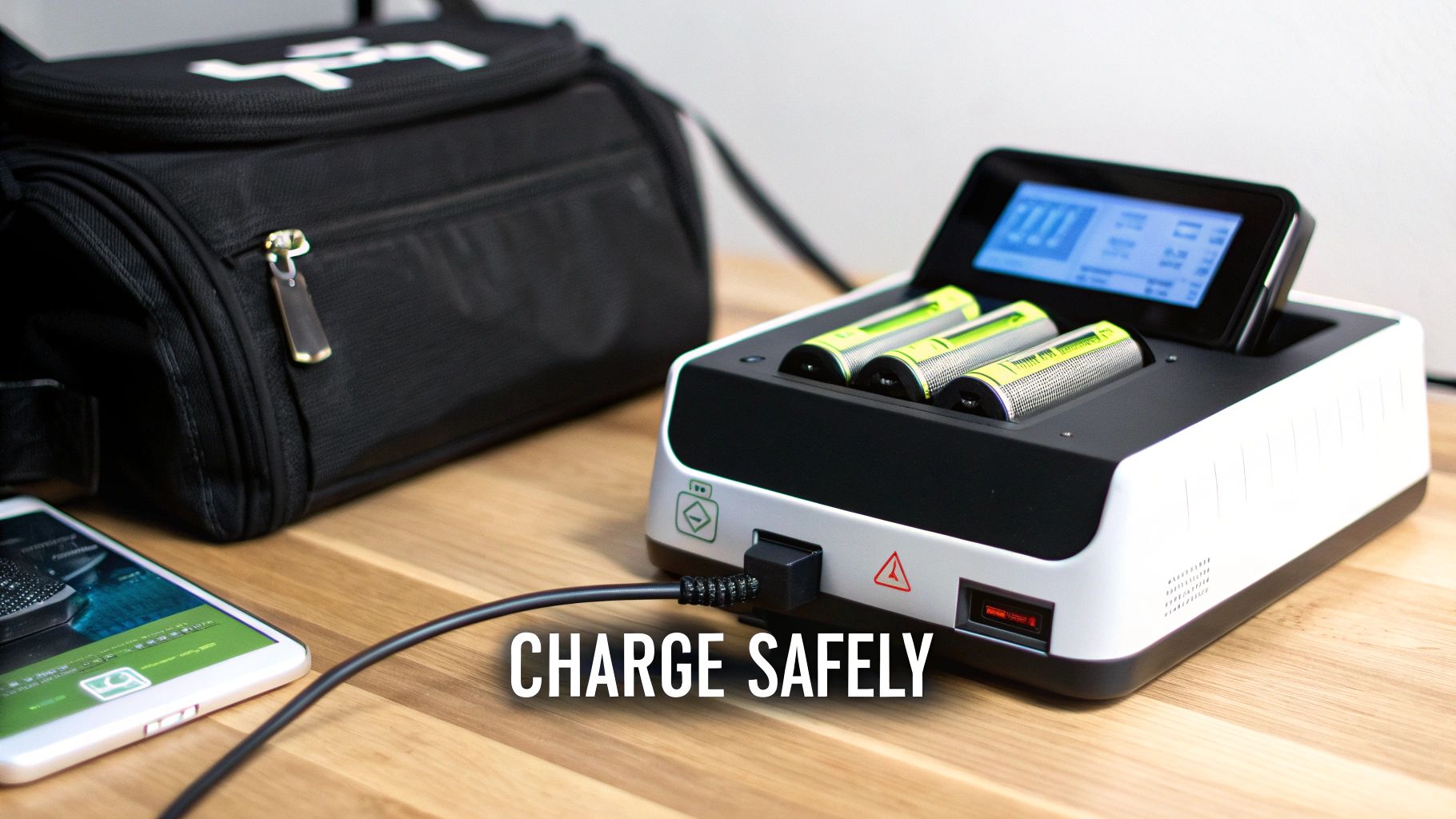
This guide will walk you through the essentials of charging and balancing your packs correctly. Follow these steps, and you’ll have the confidence that you're protecting your gear and creating a safe environment, both at home and at the track.
The Golden Rule: Balance Charging
A 2S battery isn't just one unit; it's made of two individual cells working together. Through every charge and discharge cycle, these cells can drift slightly out of sync. You might find one cell sitting at 3.80V while the other is down to 3.75V. That imbalance is a performance killer and a real safety risk.
This is where balance charging comes in. By plugging in both the main power leads and that smaller white balance plug, your charger can read and manage each cell individually. The goal is to make sure both cells hit a perfect 4.20V at the exact same time.
A balanced pack is a happy pack. Seriously, consistent balance charging is the single best thing you can do to get the most power, runtime, and life out of your race batteries. It stops one cell from getting overworked, which is the main reason packs fail early or start to puff up.
Setting The Correct Charge Rate
The charge rate, measured in amps, is simply how fast you’re pushing energy back into the battery. The universal standard for a safe charge rate is “1C”. The "C" just stands for capacity.
It's super easy to figure out. A 6000mAh battery has a 1C charge rate of 6.0 amps. A 4500mAh battery? That's a 4.5 amp charge rate. Sure, some newer batteries say they can handle higher rates like 2C or more, but sticking to 1C is the best way to make them last. It’s less stressful on the cells and helps them maintain that low internal resistance you need for punch. Of course, you need the right gear for the job, and you can learn more in our guide on the best LiPo battery charger to match your needs.
Essential LiPo Safety Protocols
You need a strict safety checklist that you follow every single time you charge. No exceptions. The biggest danger with LiPo batteries is getting complacent.
- Never Charge Unattended: This is the big one. Never, ever leave a charging battery alone or let it charge overnight. You have to be there to react immediately if something goes wrong.
- Use a LiPo-Safe Bag: Always place your battery inside a fire-resistant LiPo bag or a metal ammo can when charging. Think of it as your first line of defence, designed to contain a fire if a battery fails.
- Charge on a Fireproof Surface: Put your charger and LiPo bag on something that won't burn, like a concrete floor, ceramic tile, or a metal tray. Keep anything flammable far away.
As the demand for lithium-ion tech grows, we're seeing some great local investment. In 2024, Canada's manufacturing got a big boost with a new commercial plant in Saint-Bruno-de-Montarville, Quebec, which is a huge step for our country's battery industry. For racers buying from digital-rc, this kind of domestic growth could mean even better access to top-tier 2S LiPo batteries. By sticking to these safety rules, you make sure every charge is just a boring, uneventful routine—and that’s exactly what you want.
Proper Storage to Maximize Battery Lifespan
How you treat your lipo 2s battery between race days has a massive impact on its health, punch, and ultimately, how many race weekends it will survive. A battery left in the wrong state can suffer permanent chemical damage, robbing you of the power and capacity you paid for. Proper storage isn’t complicated—it’s just a simple discipline that protects your investment.
The single most important concept here is storage voltage. LiPo batteries are chemically happiest when they’re only partially charged, not sitting full and not left empty. Leaving a battery topped off at its peak 8.4V for days on end puts constant stress on the cells, causing them to degrade and often leading to the dreaded puffing. On the flip side, leaving it dead flat can cause the voltage to drop so low that the cells are damaged beyond repair.
The Magic Number for Storage
The ideal storage voltage for any LiPo cell is right around 3.8V to 3.85V. For a 2S pack, that means you're aiming for a total voltage of about 7.6V. At this level, the internal chemistry is relaxed and stable, which slows down the aging process dramatically.
Think of a fully charged battery like a stretched elastic band—it's full of potential energy but also under constant tension. Storage voltage is like letting that band relax to its neutral state, preserving its strength for when you need it next.
Luckily, you don’t have to guess. Nearly every modern charger, like the ones we recommend at digital-rc, comes with a dedicated “Storage” function. Just plug in your battery, select that mode, and the charger automatically brings each cell to that perfect 3.8V mark, whether it needs to charge up or discharge down. You can get a deeper look at why this is so critical in our guide on LiPo battery storage voltage.
Creating the Ideal Storage Environment
Once your pack is at the right voltage, where you keep it is just as important. The goal is simple: find a spot that’s cool, dry, and secure.
- Temperature: Heat is the enemy of any battery. Storing your LiPos in a cool place, like a basement or an insulated part of your garage, is a great way to preserve them. Hot cars or direct sunlight are absolute no-gos.
- Container: Always store your LiPos in a fire-resistant container. A purpose-built LiPo-safe bag or a metal ammo can are both excellent, affordable options that add a crucial layer of safety.
This bit of extra care helps ensure every battery you get from digital-rc delivers the consistent, reliable power you expect. The Canadian secondary battery market, which includes our high-performance LiPos, generated a massive USD 2,649.8 million in 2024, with lithium-ion tech making up 83.87% of that. As the technology continues to advance, protecting the batteries you invest in becomes more important than ever. Discover more insights about Canada's secondary battery market and see just how big this industry has become.
Your Top LiPo Battery Questions Answered
Even the most seasoned racers have questions about their LiPo 2S battery from time to time. This is where we tackle the common queries we hear at the track, with practical answers built for high-performance RC racing. Our goal is to get you sorted quickly so you can get back to what matters: laying down fast laps.
What Do S and P Mean on a LiPo Battery?
You’ll almost always see an "S" or "P" in a battery's technical name, and they simply describe how the individual cells inside are wired together. Understanding the difference is key to knowing why your car uses the battery it does.
-
S is for Series: When cells are wired in series, their voltages add up. A 2S battery means two 3.7V cells are linked (3.7V + 3.7V) to create a single pack with a nominal voltage of 7.4V. This is the standard for 1/10 and 1/12 scale racing, delivering the power needed for the electronics.
-
P is for Parallel: Connecting cells in parallel adds their capacity (mAh) while the voltage stays the same. A 2P pack would have double the runtime of a single cell but would still only be a 3.7V battery.
For competitive RC, 2S is what you will almost exclusively find at shops like digital-rc because it hits that voltage sweet spot.
How Do I Know When My LiPo is Worn Out?
Every battery has a finite lifespan. Knowing when to retire a pack is non-negotiable for both performance and safety. A worn-out battery won't just cost you a race; it can be a serious hazard in the pits.
Keep an eye out for these three key warning signs:
- A noticeable drop in performance. If your car feels "flat," lacks its usual punch, or can't make the full race distance anymore, the battery is likely tired.
- Any physical swelling or "puffing." If the hard case is bulging or feels soft, the internal cells have failed. You must safely retire and dispose of this battery immediately.
- High internal resistance (IR). A quality charger can measure this. A fresh, top-tier pack might have an IR of 1-2mΩ per cell. Once you see those numbers creeping above 5-7mΩ, the battery is on its way out.
When you spot any of these signs, it's time for a replacement. It's the only way to stay competitive and, more importantly, safe.
A healthy battery is a predictable one. Regularly checking your pack's physical condition and IR is a pro-level habit that prevents surprise failures on race day.
Is It Okay To Use a Higher C-Rating Than I Need?
Yes, absolutely. In fact, it's often a smart move. Think of the C-rating as the battery's maximum power potential. Your ESC and motor will only ever draw the amount of current they actually need at that moment.
Using a LiPo 2S battery with a C-rating well above your system's demand means the pack is working comfortably within its limits. It isn't being stressed, which translates to a few key benefits: it runs cooler, delivers more consistent voltage under load, and will generally have a longer, healthier service life. There's no performance downside to a higher C-rating—only a potential increase in cost and weight.
Ready to find the perfect power source for your race car? At digital-rc, we stock a curated selection of race-proven 2S LiPo batteries designed for peak performance. Check out our collection and get the competitive edge you need.