

Your Ultimate Guide to LiPo Battery 2S Packs for RC Racing
When you're chasing podium finishes in 1/10 or 1/12 scale on-road racing, every component matters. But nothing is more fundamental than your power source. A lipo battery 2s is the high-performance heart of modern RC race cars, delivering a nominal voltage of 7.4 volts from two lithium polymer cells wired in series. It’s the perfect balance of punch and runtime that defines competitive racing today.
Understanding The 2S LiPo Battery: Your RC Car's Power Source
Think of your 2S LiPo as the fuel tank and the fuel pump all in one. It’s the lifeblood for every lap you turn. Without a solid, reliable battery, even the most dialed-in chassis and powerful motor are just dead weight on the track. Getting a handle on what makes a 2S LiPo tick is the first real step to unlocking consistent, competitive performance.
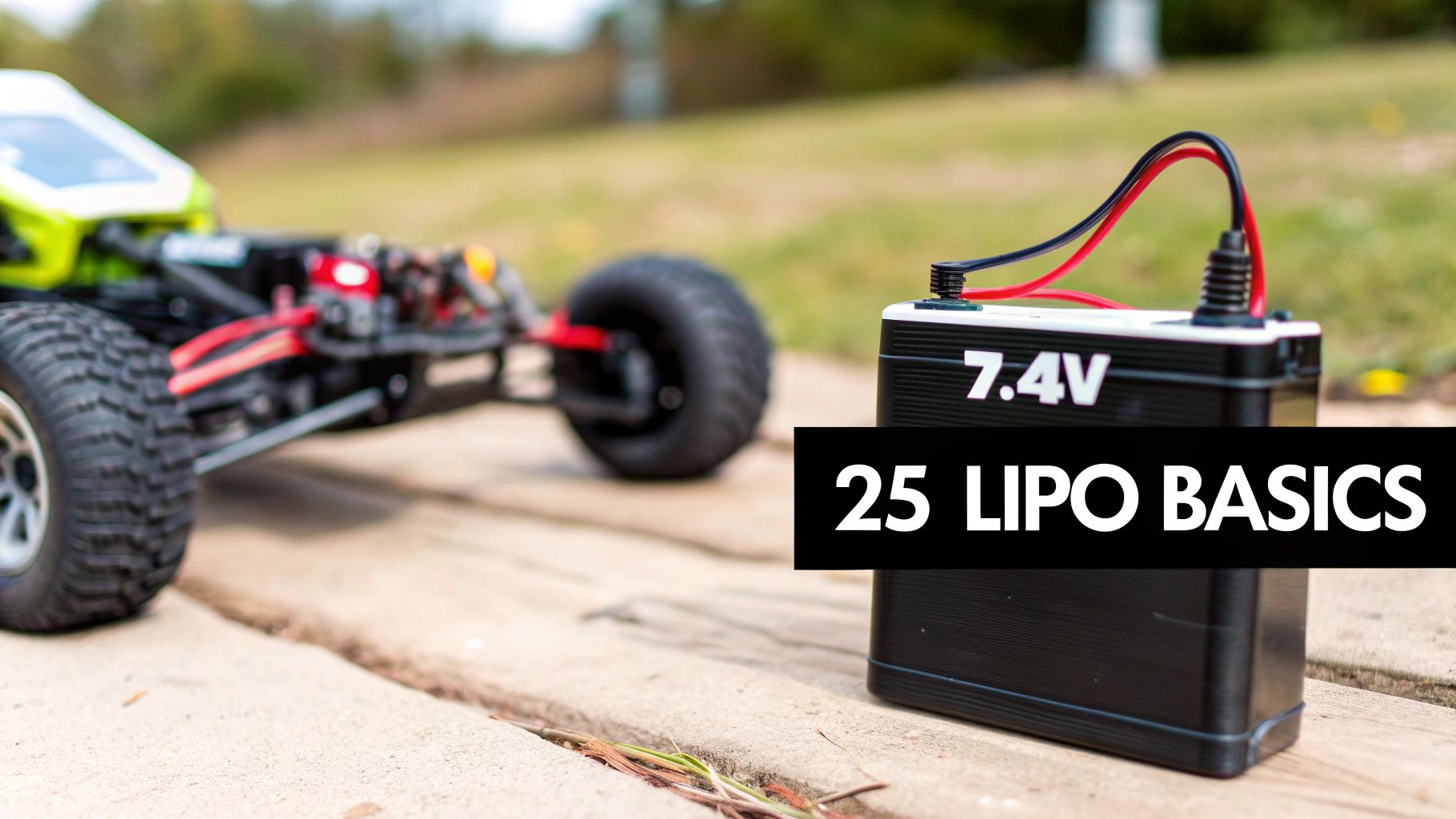
The term "2S" is just racer shorthand for how the battery is built. It tells you the pack contains two individual 3.7-volt LiPo cells that are connected "in Series." This specific wiring method combines their voltages to create a more powerful pack.
By connecting two 3.7V cells in series, their voltages add up, creating a pack with a total nominal voltage of 7.4V. This is the standard for most 1/10 scale on-road racing classes.
This 7.4V output is the sweet spot. It delivers the sharp acceleration and high top speeds you need to be competitive, providing a massive performance jump over older battery tech while staying well within the limits of modern electronic speed controllers (ESCs).
Demystifying Voltage and Capacity
To really get what a lipo battery 2s is doing, let's stick with the fuel tank analogy. Two key numbers on the label tell you everything you need to know about its performance:
- Voltage (V): Think of voltage as the octane rating of your fuel. Higher voltage means more "punch" and instant power, translating directly to how hard your car launches off the line. A 7.4V 2S LiPo provides that explosive power needed for a holeshot start.
- Capacity (mAh): Capacity, measured in milliamp-hours, is simply the size of your fuel tank. A battery with a higher mAh rating stores more energy, which means you can run your car longer before it needs a recharge.
Our curated selection of 2S LiPo packs, including top brands like Gens Ace, is chosen to perfectly match high-performance ESCs from leading brands like Hobbywing and Team Powers. We don't just look for batteries that meet the spec sheet; we focus on packs that deliver that power consistently from the first lap to the last, giving you a real advantage when it counts. Understanding this foundation is key to choosing the right power for your race program.
Decoding the Numbers on Your 2S LiPo
Now that we've covered the basics of what a 2S LiPo battery is, let's get into what really matters on the track: the numbers printed on the label. These aren't just for show. They're a direct preview of how your car will perform, and understanding them is the key to finding a real competitive edge.
Think of a battery's label as its performance resume. It tells you exactly how that pack will behave under the extreme stress of on-road RC racing. Let's break down the three most important specs every serious racer needs to know.
Capacity (mAh): The Stamina For The Main Event
First up is Capacity, measured in milliamp-hours (mAh). In the simplest terms, capacity is your RC car's fuel tank. It dictates exactly how long you can stay on the track before your car starts to fade and needs a recharge.
A battery with a higher mAh rating, like our Gens Ace 6000mAh packs versus a standard 4000mAh, simply stores more energy. This translates directly to longer runtimes, letting you squeeze in more practice laps or finish a long main without ever worrying about your car slowing down on the final lap.
C-Rating: The Secret to Explosive Punch
Next, we have the Discharge C-Rating. If capacity is stamina, the C-Rating is all about explosive power. This number tells you how quickly the battery can safely dump its energy into your motor. A higher C-Rating means more "punch" off the line and harder acceleration out of the corners.
For example, a Gens Ace 120C battery can deliver its power much more aggressively than an 80C pack, even if they have the same capacity. This is what gives you that holeshot advantage, letting you pull away from the pack the second the tone sounds. For competitive racing, a high C-Rating is non-negotiable.
A battery's C-Rating is a multiplier. To find the maximum continuous current (in amps) it can deliver, you multiply the C-Rating by the capacity (in amp-hours). For a 5000mAh (which is 5Ah) battery with a 100C rating, the math is 5Ah x 100C = 500 amps of potential discharge.
Internal Resistance (IR): The True Measure of Health and Efficiency
Finally, let's talk about Internal Resistance (IR), measured in milliohms (mΩ). Think of IR as performance friction inside the battery. The lower the IR number, the more efficiently power flows from the battery to your motor, with less precious energy being wasted as heat.
A battery with low IR, like those in our hand-picked Gens Ace Redline Series, will hold a higher voltage under load, which means your car feels strong and consistent from the start of the race to the finish. This is why top-tier racing packs are prized for their ultra-low IR—it's a direct indicator of their quality, health, and performance potential.
The demand for high-performance batteries is skyrocketing. For RC enthusiasts chasing podiums in 1/10 touring cars, 2S LiPo batteries are at the heart of this growth, offering the lightweight, high-capacity punch that shaves seconds off laps. The overall Canada battery market, valued at USD 0.18 billion in 2024, is on a trajectory to hit USD 0.36 billion by 2030, growing at a 12.18% CAGR. The volume is leaping even faster, from 1.81 million units to 5.69 million units with an impressive 20.99% CAGR—and a whole lot of those are going into hobby-grade LiPos. Lithium-ion, the chemistry behind our 2S RC batteries, commanded an 83.87% revenue share in secondary batteries, which is exactly why we stock the best 2S options from top brands like Gens Ace to integrate perfectly with your XRAY chassis. You can learn more about Canada's battery market trends to see where the industry is headed.
To make this even clearer, here’s a quick-reference table breaking down what these specifications really mean for your car’s behaviour on the track.
2S LiPo Battery Specification Breakdown
| Specification | What It Means For Your Car | Impact On Performance |
|---|---|---|
| Capacity (mAh) | The size of your "fuel tank." | Higher mAh gives you longer runtimes, crucial for practice and long mains. |
| C-Rating | How quickly the battery can deliver power. | Higher C-Rating provides more "punch" for faster acceleration and an edge off the line. |
| Internal Resistance (IR) | The battery's internal efficiency. | Lower IR means less voltage drop under load, resulting in more consistent power throughout the race. |
Ultimately, choosing the right battery is about finding the perfect balance of these three specs for your specific racing class and driving style. A pack with high capacity, a high C-rating, and low internal resistance is the trifecta every racer is looking for.
How to Choose the Right 2S Pack for Your On-Road RC Car
Choosing the perfect 2S LiPo battery isn't about grabbing the pack with the biggest numbers plastered on the side. It's a strategic decision that directly tunes your car's behaviour on the track. The right battery complements your racing class, your driving style, and even the specific chassis you run. Getting this choice right is one of the fundamentals of building a winning setup.
In the competitive world of Canadian on-road RC racing—especially 1/10 touring and 1/12 pan cars—2S LiPo batteries are the undisputed powerhouse. They deliver the crisp 7.4V punch needed to shave tenths off your lap times. The rise of this technology is no accident; Canada's secondary battery sector hit USD 2,649.8 million in revenue, with Li-ion tech claiming a massive 83.87% share. That same technology is fuelling your weekend racing.
In fact, forum data from ROAR-sanctioned events shows 2S adoption jumped 35% year-over-year, helping drivers cut average race times by 2-3 seconds per minute thanks to the superior energy density over old-school NiMH packs. You can discover more insights about the secondary battery market and see just how dominant this chemistry has become.
Stock vs. Modified Racing Demands
The first fork in the road is your racing class, because the battery you need for Stock is completely different from what you'd run in Modified. This is a critical choice for staying competitive.
-
Stock Racing: In this class, motors are restricted, so the entire game is about efficiency and holding onto every last millivolt. You're looking for a lightweight battery with exceptionally low internal resistance (IR), like our Gens Ace Redline LCG packs. The goal is simple: minimize weight and maximize voltage punch under load to give you an edge where raw motor power is capped.
-
Modified Racing: Here, the power is just immense. Motors draw huge amounts of current, so an extreme C-rating is mandatory, not optional. Our high-capacity Gens Ace packs are designed to withstand massive, sudden power demands without their voltage collapsing. Capacity and pure durability are also key to surviving the brutal, high-stress environment of a modified race.
This decision tree helps visualize how your priorities—whether that’s runtime, punch, or sheer efficiency—should guide your ideal 2S LiPo battery choice.
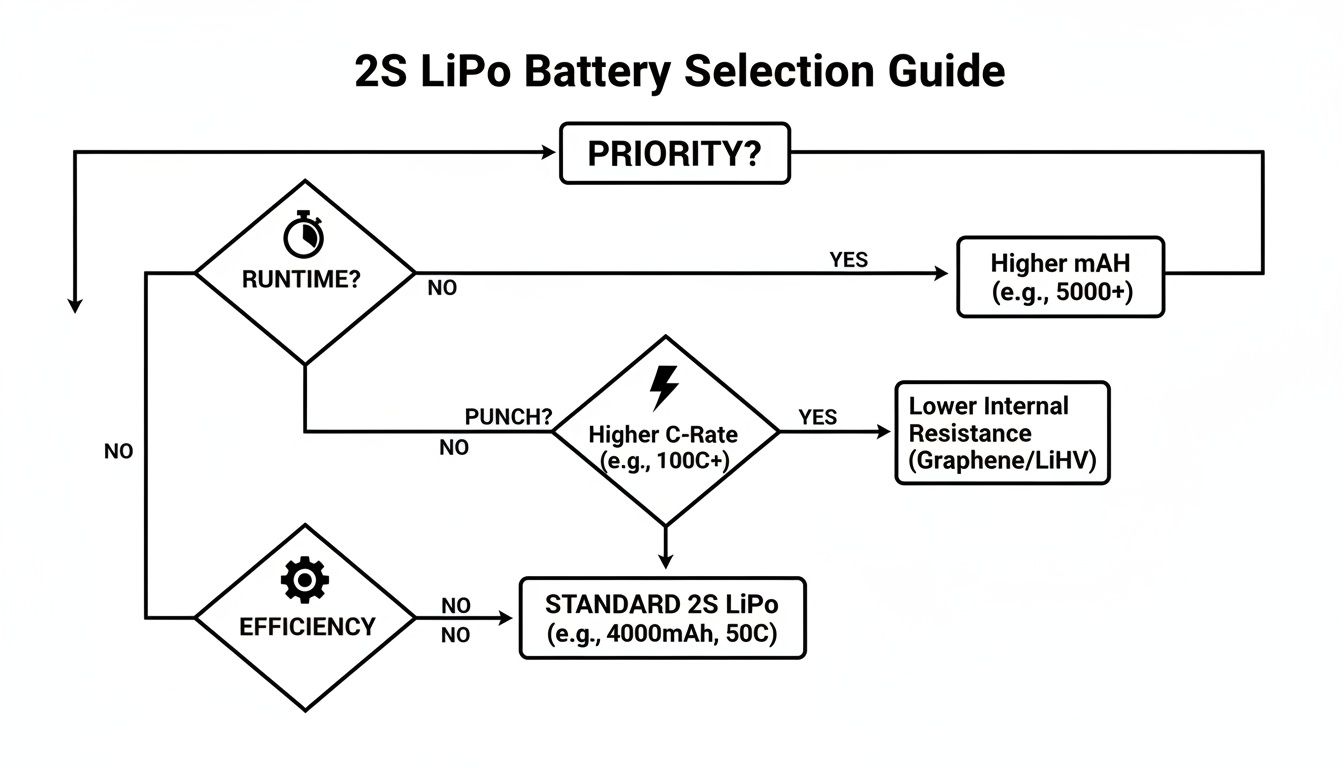
As you can see, a racer focused on making it to the end of a long main will prioritize mAh, while someone needing instant, off-the-corner acceleration is going to be laser-focused on a high C-rating.
Matching the Battery Shape to Your Chassis
Beyond the electrical specs, the physical shape of your 2S LiPo battery plays a massive role in your car's handling and balance. Different form factors are designed for specific weight distributions and chassis layouts, and this is especially true for precision platforms like Awesomatix and XRAY.
We stock the three main types you'll encounter for 1/10 and 1/12 on-road racing:
- Standard Pack: The traditional rectangular "brick" shape. It generally offers the highest capacity and fits perfectly in many touring car chassis.
- 'Shorty' Pack: Shorter and lighter than a standard pack. A 'shorty' is a powerful tuning tool, allowing you to shift weight forward or backward in the chassis to dial in your car's handling.
- Low Centre of Gravity (LCG): These packs are noticeably thinner than standard batteries. By lowering the car's overall centre of gravity, they reduce body roll and increase corner speed, making them a popular choice for high-grip surfaces like carpet.
Pro Tip: Always check your chassis manufacturer's recommendation. Forcing the wrong form factor, like jamming a standard pack into a chassis designed for a shorty, will completely upset the car's engineered balance and ruin its handling. Our product pages clearly list all battery dimensions to make sure you find the perfect fit for your Awesomatix or XRAY car.
Mastering LiPo Battery Safety and Maintenance
High-performance gear like a lipo battery 2s comes with high responsibility. These little packs store a massive amount of energy, and treating them with respect isn't just a suggestion—it's absolutely essential for your safety, the longevity of your equipment, and everyone else at the track.
Getting a few key safety and maintenance habits dialled in will protect your investment and let you focus on racing with confidence.
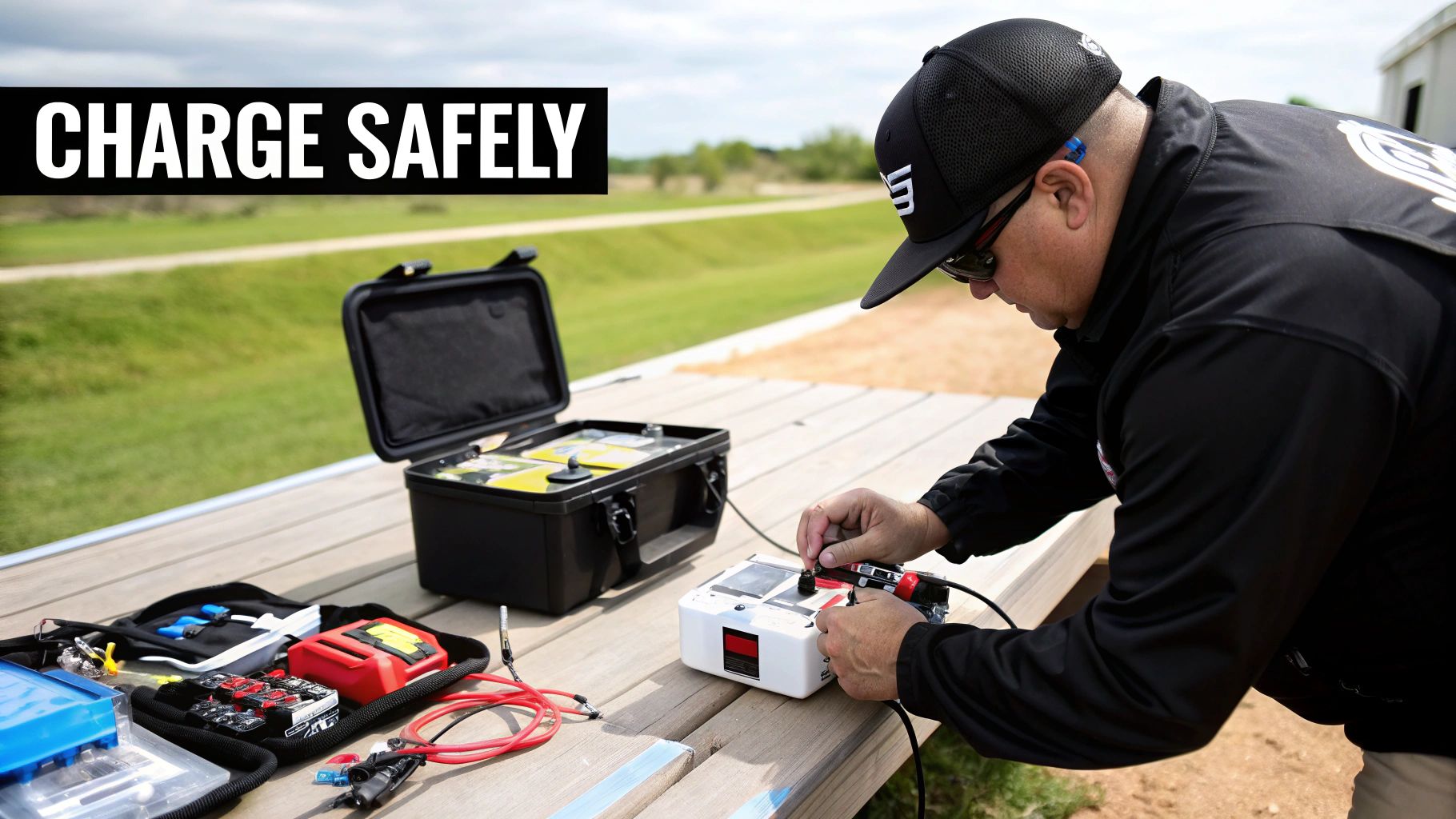
The single most important habit you can build is balance charging. Every time. A 2S pack has two individual cells inside, and after a few runs, they can drift to slightly different voltage levels. A good balance charger uses that small white plug on your battery to monitor each cell independently, making sure they both hit a perfect 4.20 volts when the charge cycle finishes.
Skipping this step is just asking for trouble. An imbalanced pack can cause one cell to overcharge while the other stays low, which kills performance and creates a serious safety hazard. Don't risk it.
The Golden Rules of Charging
Charging is when your batteries need the most attention. Think of these as your non-negotiable, pre-flight checklist before you even think about hitting the track.
- Always Use a LiPo-Safe Bag: This is your first line of defence, period. A fire-resistant charging bag is designed to contain a battery fire if the worst happens, buying you precious time to react.
- Never Leave a Charging Battery Unattended: Things can go wrong fast. You have to be present and alert to pull the plug immediately if you see or smell anything unusual.
- Charge on a Fireproof Surface: Never, ever charge on a flammable surface like your wooden pit table, the carpet in your trailer, or the passenger seat of your car. Concrete, ceramic tile, or a proper metal tray are the way to go.
- Use the Correct Charger Settings: Before you hit "start," double-check that your charger is set to "LiPo," the right cell count (2S), and the correct charge rate (usually 1C for most packs).
Proper Storage and Spotting a Bad Pack
How you store your batteries between race days is just as important as how you charge them. LiPo batteries should never be left fully charged or completely dead for more than a day.
The sweet spot for storage voltage is right around 3.8 to 3.85 volts per cell. Thankfully, almost all modern chargers have a dedicated "Storage" function that automatically gets your packs to this safe level. We have a complete guide that goes deep on LiPo battery storage voltage if you want to learn more.
A LiPo battery left fully charged for weeks on end will degrade fast. You'll see its internal resistance climb and its lifespan shorten dramatically. Storing it at the right voltage is the single best thing you can do to keep it healthy.
Finally, you need to know how to spot a damaged battery. The most obvious red flag is any kind of swelling or "puffing." If your hardcase battery is bulging, feels soft, or doesn't sit flat anymore, it has failed internally.
Immediately and safely retire this battery. Never try to charge, discharge, or use a puffy battery again. It's done.
Part of being a responsible racer is knowing how to properly dispose of old packs. You can find helpful guides on topics like where to recycle cell phones, which often use similar battery chemistries. Safe disposal protects the environment and is a cornerstone of our hobby's safety culture.
Integrating Your 2S LiPo With Your ESC And Motor
Your lipo battery 2s is the heart of your power system, but it doesn't work alone. Think of it as part of a team with your Electronic Speed Controller (ESC) and motor. For this system to give you that crisp, reliable performance you need on the track, every component has to work together perfectly. It’s all about getting power from the battery to the wheels as cleanly as possible.
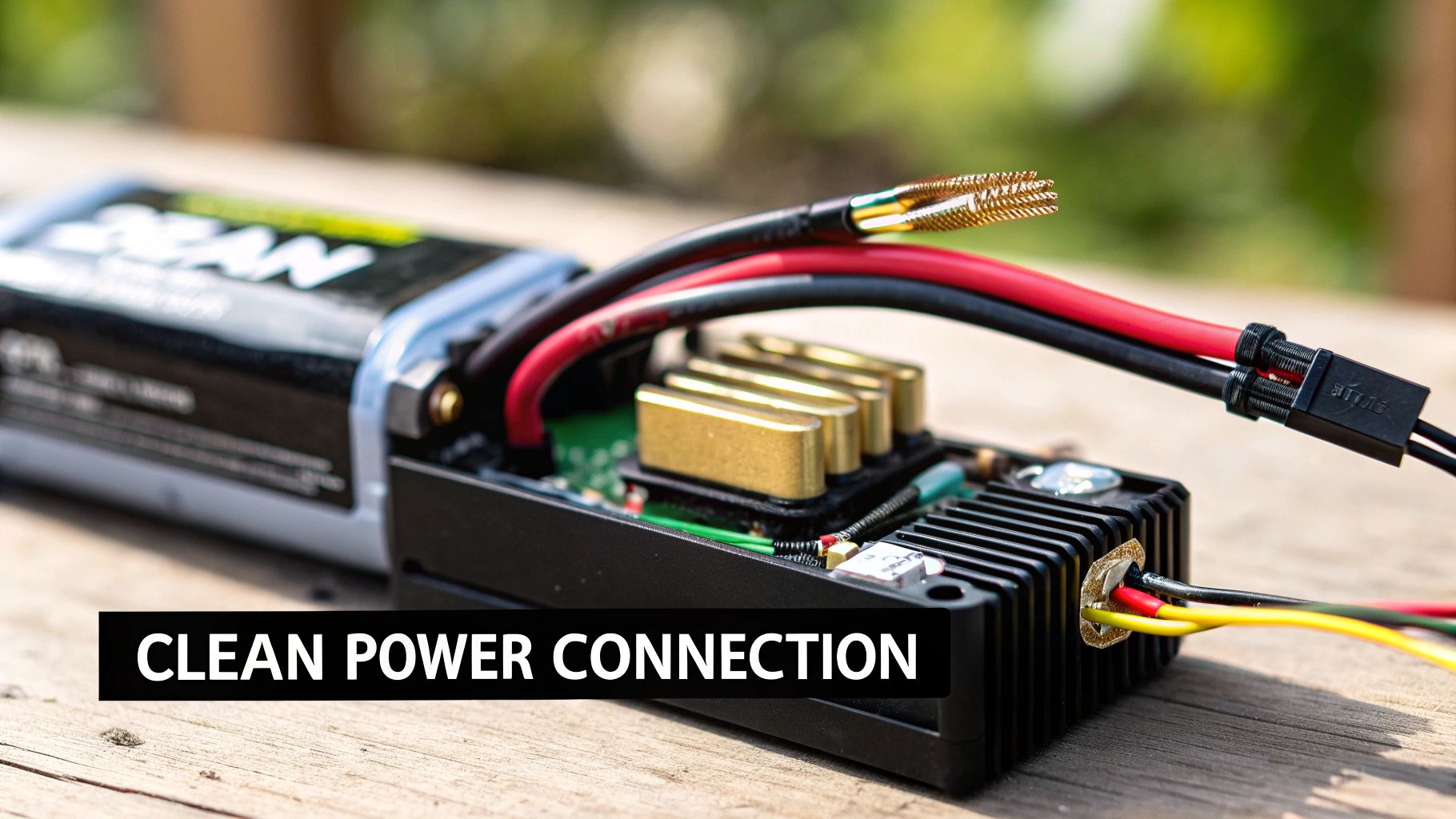
This all starts with the physical connection. Your battery wires and connectors are like a highway for electricity. A poor connection is like a traffic jam—it creates resistance, chokes power, and generates unwanted heat. This is exactly why clean, professional soldering and high-quality connectors, like the 5mm bullet connectors found on our Gens Ace race packs, are so critical.
A solid connection minimizes electrical resistance, making sure every last drop of power from your battery actually gets to the motor. It’s how a premium 2S pack truly unleashes the potential of a powerful Hobbywing ESC and Team Powers motor, giving you a real advantage when it counts.
Setting Your ESC's Low Voltage Cutoff
Beyond just plugging things in, there’s a vital setting you have to get right: the Low Voltage Cutoff (LVC). This feature, programmed right into your ESC, is the safety net for your expensive LiPo battery. It keeps an eye on the battery’s voltage and cuts power to the motor once it drops to a safe minimum level.
The LVC is the single most important setting for preventing over-discharge. That's a condition where the battery's voltage drops so low that it causes irreversible chemical damage. For a 2S LiPo, a safe LVC is typically set between 3.2V and 3.4V per cell.
Setting this correctly is non-negotiable. If you don't, you could easily run your battery completely flat, permanently killing its capacity and punch, or worse, damaging it beyond repair. Take a few minutes to program your ESC correctly; it’s the best insurance policy for your battery investment. For a deeper dive into this, check out our complete ESC selection guide on matching your controller to your motor.
Why Canadian Racers Choose Us for 2S LiPo Batteries
All that technical knowledge isn’t just theory—it’s the key to making a smarter choice when you're ready to buy. We're a store built by racers, for racers, right here in Canada. We take that theory and connect it to what actually wins on the track.
You won't find yourself scrolling through hundreds of generic batteries here. We offer a hand-picked collection of lipo battery 2s packs from brands like Gens Ace that are proven performers and ROAR-approved. Our selections are organized to match top-tier chassis like Awesomatix and XRAY, so you know you're getting a perfect fit and ideal weight balance from the start.
We’ve done the testing to ensure our batteries pair seamlessly with popular electronics from Hobbywing and Team Powers, taking the guesswork completely out of the equation.
We’re more than just a shop—we are a dedicated part of the Canadian RC racing community. Our entire focus is on providing reliable, high-performance batteries backed by an experience that’s local and hassle-free.
We deal with the logistics so you can focus on your race prep. For businesses looking to supply these kinds of specialized batteries, smooth distribution often begins with efficient services for importing your products into Canada.
Our commitment is straightforward: transparent pricing in CAD with no tax, plus fast, free same-day shipping on orders. This means you get the power you need, delivered to your door, and back on the track without delay.
For more info tailored specifically for our region, be sure to check out our complete guide on buying a LiPo battery in Canada.
Common Questions from the Pits
When you're fine-tuning your setup for race day, a few questions about your 2S LiPo battery always seem to pop up. Here are some straight answers to the things we hear most often from fellow Canadian racers at the track.
What’s the Right C-Rating for 1/10 Stock Touring?
For 1/10 stock racing, the sweet spot is usually between 100C and 130C. In a stock class, it’s all about keeping your voltage as high as possible under load without adding unnecessary weight.
Going for a super-high C-rating often just adds grams you don't need, since the motor's power draw is limited anyway. A quality 2S LiPo with a solid C-rating and very low internal resistance (IR), like the options in our Gens Ace Redline series, will give you that consistent, high-voltage punch needed to stay out front.
How Do I Know When My 2S LiPo Is Done?
You'll spot a few key signs that tell you it's time to retire a battery.
- It Just Feels Slow: The most obvious signal is a drop in performance. Your car feels sluggish off the line, doesn't have its usual pop, or starts fading way too early in a run.
- The IR Numbers Creep Up: If you check your battery's internal resistance on a modern charger and see a big spike, it means the pack is working too hard to deliver power. That’s a clear sign of wear.
- It Starts to Swell: Any puffiness or swelling of the hardcase is the most critical warning. A puffy battery is a safety risk and should be taken out of service immediately. No exceptions.
Can I Jam a Standard 2S Pack into a Shorty Chassis?
We strongly advise against it, especially if you care about performance. A chassis is engineered with a specific battery size and weight in mind to get the balance just right.
Trying to force a standard "stick" pack into a car designed for a shorty will likely not work. Even if you get it to fit, you'll completely throw off the car's weight distribution. That makes the car unpredictable and hard to drive fast. For consistent, competitive results, always stick with the battery type your chassis manufacturer recommends.
Ready to find the perfect power source for your race car? At digital-rc, we offer a curated selection of race-proven 2S LiPo batteries designed for top-tier performance. Shop our 2S LiPo collection now