

Your Guide to LiPo Battery Canada for RC Cars
If you're a serious on-road RC racer in Canada, you already know that the right LiPo battery isn't just a part—it's the heart of your car. Finding a lipo battery canada specialists recommend is the key to unlocking consistent power, speed, and runtime. At Digital-RC, we stock race-proven brands like Team Zombie and Pro Amps to give you a competitive edge, all available locally without the headaches of cross-border shipping.
Why a Canadian-Specific LiPo Guide Matters
Welcome to the definitive guide for Canadian on-road RC racers. Choosing the right Lithium Polymer (LiPo) battery is one of the most critical decisions you'll make for your car. It's the component that breathes life into your setup, and this guide is built to cut through the noise and address the specific challenges we face right here in Canada—from product availability to our unique shipping rules.
We're here to demystify the numbers that matter—voltage, capacity, C-ratings—and show you the real-world advantage of buying from a Canadian specialist like us at Digital-RC.
This focus is more important than ever. The broader lithium-ion battery market in Canada, which includes the LiPo cells we use, is projected to hit USD 2.65 billion in 2024. And it’s not slowing down, with forecasts showing a 6.4% growth rate through 2030, driven by everything from EVs to our high-performance hobby. You can read more about Canada's secondary battery market trends to see how this growth is shaping the hobby. This boom just highlights why having a trusted local source is so vital.
Your Roadmap to RC Performance
Think of this guide as your roadmap. We’ll cover everything you need to know to make sharp, informed decisions that translate directly to better performance on the track.
Our goal is to help you:
- Understand the Numbers: We'll break down what voltage (S rating), capacity (mAh), and C-rating really mean for your car's punch and endurance.
- Select the Perfect Match: Get clear, practical advice on choosing the right battery for popular chassis like Xray and Awesomatix, using examples from our selection of Team Zombie and Pro Amps batteries.
- Prioritize Safety: Master the non-negotiable rules for safe charging, storage, and disposal right here in Canada.
- Navigate Canadian Rules: We’ll cover the basics of shipping LiPo batteries within Canada and explain why buying local is the easiest, safest solution.
By the end, you’ll have the confidence to choose, maintain, and use your LiPo batteries to unlock your car’s true potential on Canadian tracks.
Decoding LiPo Specs for Peak Performance
Picking the right LiPo battery can feel like you're trying to crack a secret code. All those numbers and letters—2S, 5000mAh, 100C—are the key to your RC car’s performance. Understanding this code is the first step to unlocking more speed, longer runtimes, and the competitive edge you need on the track.
Let’s break these specs down with some simple analogies to show you exactly what they mean for your on-road car.
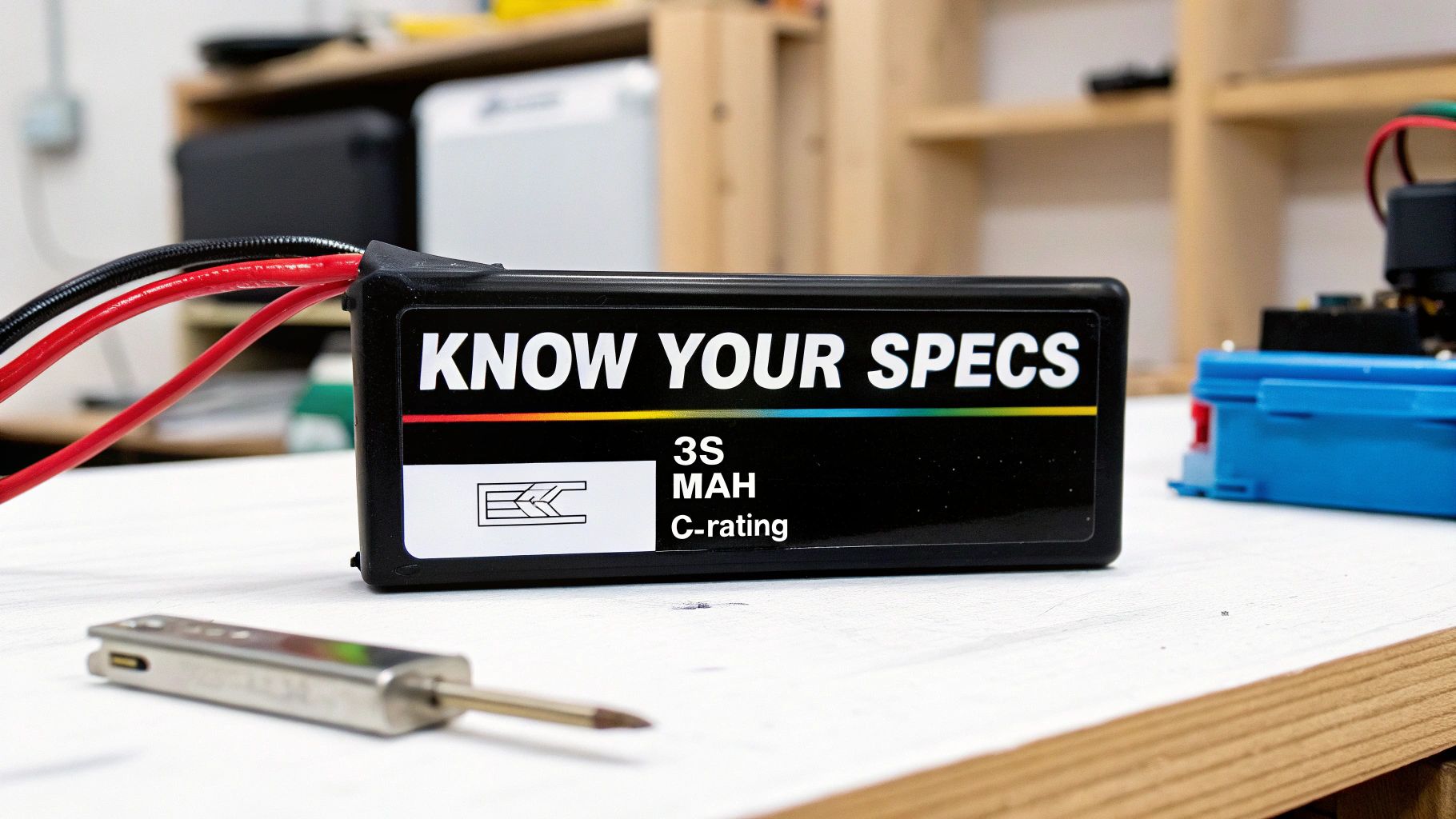
Think of your LiPo as the complete power system for a high-performance engine. It's not just one component; it's the engine block, the fuel tank, and the fuel line all rolled into one. Each spec on the label tells you about a different part of that system.
Voltage (S Rating): Your Engine Size
The first number you'll usually see is something like "2S." This refers to the battery's voltage, and it’s the most direct indicator of your car's top-speed potential.
- Analogy: If your RC car is a vehicle, voltage is its engine size. A bigger engine (higher voltage) has more raw power and can achieve higher RPMs, translating directly into faster straight-line speed.
A "1S" battery has one cell with a nominal voltage of 3.7V. A "2S" battery has two cells connected in series, doubling the voltage to 7.4V. For almost all 1/10 scale on-road touring cars in Canada, a 2S LiPo battery is the standard, giving you that ideal balance of power and control.
Capacity (mAh): Your Fuel Tank
Next up is capacity, which is measured in milliamp-hours (mAh). This number simply tells you how long you can run before you need to head back to the pits for a recharge.
- Analogy: Capacity is the size of your car's fuel tank. A battery with 6000mAh holds more "fuel" than one with 3000mAh, meaning it will last longer on the track.
But a bigger fuel tank also adds weight. In competitive racing, finding that perfect balance between runtime and a lightweight, agile chassis is what separates the winners from the rest of the pack. For a typical five-minute race, a 5000-6000mAh battery like the ones we stock from Team Zombie is often the sweet spot, providing plenty of power without adding unnecessary mass.
C-Rating: Your Fuel Line
The C-rating is probably the most misunderstood spec, but it's absolutely critical for acceleration. It represents the maximum rate at which the battery can safely push out its stored energy.
- Analogy: The C-rating is the diameter of your fuel line. You can have a huge engine and a full tank of gas, but if the fuel line is too narrow, the engine will starve for fuel the moment you hit the throttle. A higher C-rating means a wider fuel line, allowing the battery to deliver a massive surge of current for that explosive acceleration out of corners.
A 5000mAh battery with a 100C rating can theoretically deliver a continuous current of 500 amps (5000mA x 100). This ensures your motor and ESC get all the power they need, precisely when they ask for it.
Key Takeaway: While voltage determines top speed and capacity dictates runtime, the C-rating governs your car's "punch" or acceleration. A low C-rating will bottleneck your entire power system, leading to sluggish performance and potentially damaging the battery.
To make things a bit easier, here’s a quick cheat sheet to help you match battery specs to the most common on-road classes.
On-Road RC LiPo Battery Spec Cheat Sheet
| Specification | What It Means (Analogy) | Common Choice for 1/10 Touring Car | Common Choice for 1/12 Pan Car |
|---|---|---|---|
| Voltage (S) | The car's "engine size" | 2S (7.4V) | 1S (3.7V) |
| Capacity (mAh) | The size of the "fuel tank" | 5000-6500mAh | 7000-8400mAh |
| C-Rating | The width of the "fuel line" | 100C or higher | 120C or higher |
This table gives you a solid starting point, but always check the rules for your specific racing class, as they can sometimes have strict limits on battery specs.
Connectors and Balance Leads
Finally, the plugs on your battery are its lifeline. The main connector (like the 5mm bullet plugs found on our Team Zombie and Pro Amps packs) handles the heavy lifting, delivering power straight to the ESC. It absolutely must be a solid, low-resistance connection to avoid power loss and heat buildup.
The smaller plug is the balance lead. This little guy is essential for your battery's health and safety. Since a LiPo pack is made of multiple cells (like in a 2S battery), the balance lead allows your charger to monitor and charge each cell individually. This ensures all cells remain at an equal voltage, which is vital for performance and preventing dangerous overcharging.
Proper charging is only half the battle. To learn more about battery health, check out our guide on the importance of LiPo battery storage voltage. How you store your batteries is just as important as how you charge them.
Choosing the Right LiPo for Your RC Car
Alright, you’ve got a handle on what all the numbers and letters on a LiPo mean. Now it’s time to move from theory to the track. Picking the perfect lipo battery canada racers need is about more than just grabbing the biggest numbers off the shelf—it's an art of matching the power source to your specific on-road RC car for the best possible balance, handling, and punch.
This is where buying from a local Canadian specialist who lives and breathes this stuff really makes a difference. We’ll walk you through some clear, practical recommendations for popular chassis, pairing them with battery combos from our shop that are proven to work for different racing classes.
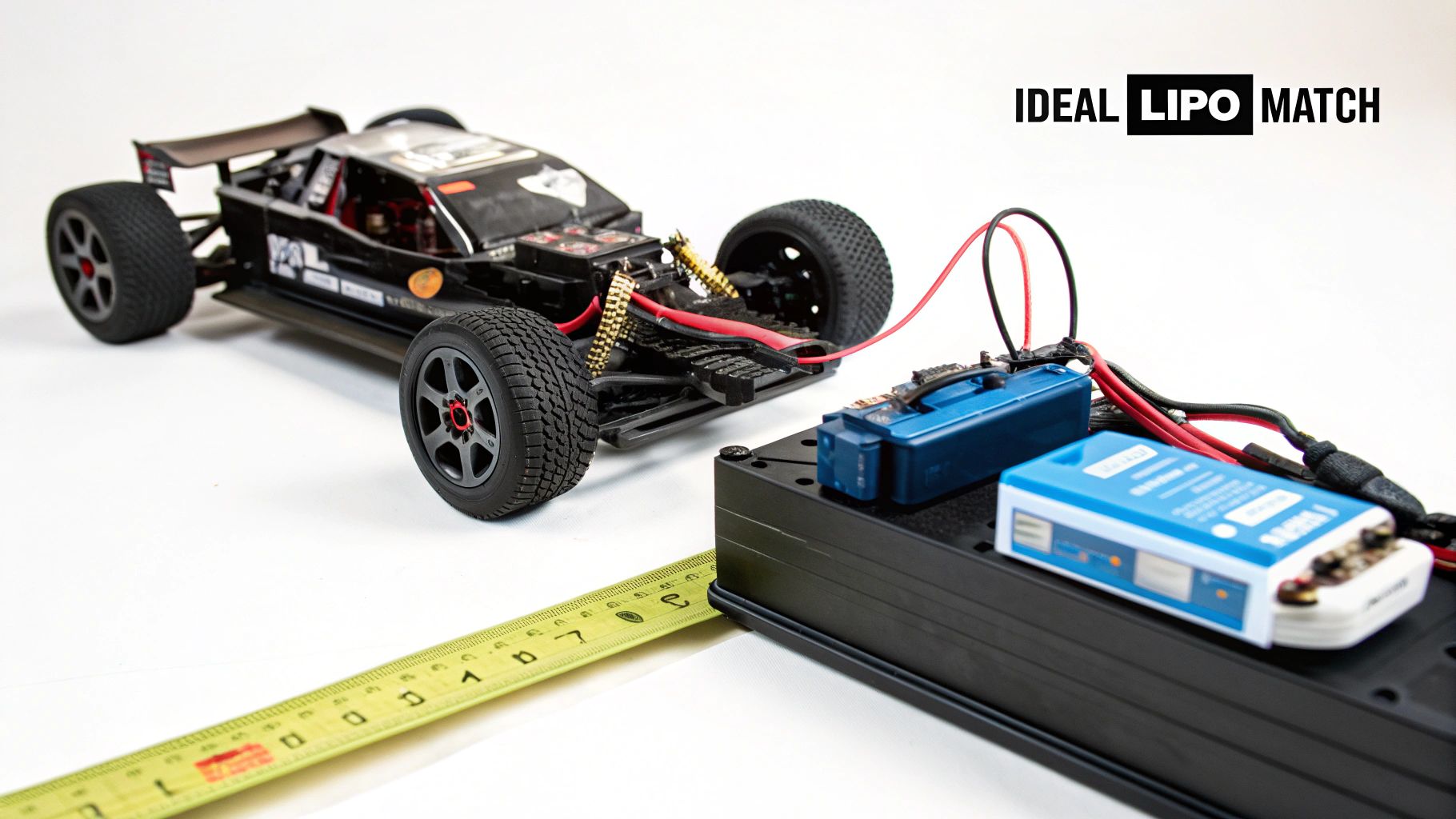
Matching Batteries to Your On-Road Chassis
Different racing classes and chassis have their own unique power demands. A battery that feels amazing in a high-grip carpet touring car might be completely wrong for a nimble, lightweight pan car. Let's break it down with some real-world examples you'll find right here in our shop.
For competitive 1/10 scale touring car racing, especially in the popular stock classes, a chassis like the Xray X4 or Awesomatix A12 is all about finding that delicate balance. A 2S battery is the standard, but the real strategy comes down to capacity versus weight. A lower-capacity battery like our Team Zombie 4000mAh packs is lighter, making the car feel more agile and way easier to balance side-to-side. This is often the ticket for tight, technical tracks where quick direction changes are key.
On the flip side, if you're in a high-speed modified class or on a big, flowing track that works the motor hard, a higher-capacity battery like a Team Zombie 6000mAh is your friend. It ensures you have enough juice to finish the race without your car's performance dropping off in the last minute—a frustrating phenomenon we call "fading."
The Critical Role of Weight and Balance
Don’t underestimate this: your LiPo is one of the heaviest single things in your RC car. Its weight and physical size have a massive impact on how your car handles. An unbalanced car is an unpredictable one, fighting you in the corners and refusing to turn the same way left and right.
A well-balanced chassis is a predictable one. The goal is to achieve a perfect 50/50 left-to-right weight distribution. Using a battery that's too heavy can force you to bolt on a bunch of dead weight to the other side, which just makes the car heavier overall and raises its centre of gravity—killing its performance.
This is exactly why we stock batteries in different shapes and sizes, like the "shorty" and "low-profile" (LGC) packs from Team Zombie. These options give you the flexibility to move weight around and fine-tune your car’s balance to suit any track condition. To dive deeper into this, check out our detailed guide on LiPo battery selection for maximum performance for more pro insights.
Recommendations for Canadian Racers
Here are a few specific pairings that we've seen dominate on Canadian tracks:
- For 1/10 Stock Touring (e.g., Xray X4): Go for a lightweight, low-profile 2S LiPo like the Team Zombie 5000mAh 150C. The lower weight makes the car nimble, while a high discharge rate gives you that critical punch needed in competitive stock motor classes.
- For 1/10 Modified Touring (e.g., Awesomatix A12): A standard-size 2S LiPo like the Team Zombie 6000mAh with a C-rating of 150C+ is the sweet spot. This combo delivers the sustained power needed to feed a hungry modified motor for a full, demanding five-minute run.
- For 1/12 Pan Cars: These agile cars almost always use a 1S LiPo. For this class, the name of the game is maximizing capacity. Our Team Zombie 8400mAh pack is a top choice, ensuring you have consistent power for the entire eight-minute race.
This kind of detailed matching is just one part of a bigger picture. The Canadian battery market is booming, with some analysts predicting it could hit USD 14.95 billion by 2030. This growth is powered by everything from electric vehicles to high-performance hobbies like ours, highlighting the growing need for specialized power solutions. You can discover more insights about the Canadian battery market to see how this trend is shaping technology right here at home.
LiPo Safety: Charging, Storage, and Disposal
Let's be clear: handling a LiPo battery demands a healthy dose of respect. These things are compact powerhouses storing a massive amount of energy. Treating them right isn't just a good idea—it's non-negotiable for anyone in the RC hobby. Think of this section as your complete safety manual for charging, storing, and eventually getting rid of your LiPo batteries, written for racers right here in Canada.
Proper LiPo care isn't just about squeezing every last bit of performance out of them; it's about preventing accidents. A damaged or improperly charged LiPo is a serious fire risk. Mastering these safety protocols is one of the most important skills you can develop as a racer.
The Golden Rules of Safe Charging
Charging is when your battery is most vulnerable. A modern, quality balance charger is an essential piece of kit, but it’s only as safe as the person using it. Following these steps every single time you charge is critical.
A balanced approach is everything. Your charger must be set to "LiPo Balance Charge" mode. This isn't optional. It ensures the charger monitors and adjusts the voltage of each individual cell through the balance lead, keeping them perfectly matched. An imbalance is often the first warning sign that something's wrong.
Here are the non-negotiable rules for every charge cycle:
- Set the Correct Cell Count: Always, always double-check that your charger is set to the correct cell count (1S, 2S, etc.) to match the battery. Charging a 2S pack on a 3S setting is a guaranteed way to start a fire.
- Stick to a 1C Charge Rate: The "C" in charging is tied to the battery's capacity. For a 5000mAh battery, a 1C charge rate is 5.0 amps. Don't exceed 1C unless the manufacturer explicitly says it's safe. Charging too fast generates heat, and heat is the enemy of a healthy LiPo.
- Never Leave a Charging Battery Unattended: This is the single most important rule. You need to be present and awake for the entire process. If something goes wrong, you have to be there to react immediately.
Essential Safety Gear for Every Racer
Investing in a few key pieces of safety gear isn't optional—it’s a basic requirement for responsible LiPo ownership. These items give you a critical layer of protection during charging and storage.
The most fundamental piece of safety equipment is a LiPo-safe charging bag or a fire-resistant box. These are made from materials designed to contain a fire if a battery fails. Always place your battery inside one before you hit the start button on your charger. For more robust protection, especially if you're managing multiple packs, you can look into dedicated Lithium Ion Battery Charging Safety Cabinets.
Safety First, Always: A quality charger with built-in safety features is your first line of defence. It can detect problems like over-voltage, reverse polarity, and cell imbalances, automatically shutting down the charge to prevent a dangerous situation.
Choosing the right charger is just as important as choosing the right battery. To help you make an informed decision, you can learn more by checking out our guide on the best LiPo battery chargers available in Canada.
Proper Storage for Long-Term Health
How you store your batteries between race days has a massive impact on their lifespan and safety. Leaving a LiPo fully charged or completely drained for extended periods will cause permanent damage to its internal chemistry.
The ideal storage voltage is around 3.8 to 3.85 volts per cell. Thankfully, most modern chargers have a dedicated "Storage Charge" function that will automatically bring the battery to this perfect level. Make it a habit: after a race day, always take the time to storage-charge your packs.
Store your batteries in a cool, dry place inside a LiPo-safe bag or container. Never leave them in your car, in direct sunlight, or anywhere they could be exposed to extreme temperatures.
Responsible Disposal in Canada
Sooner or later, every LiPo reaches the end of its life. You'll know it's time when it starts to puff or swell, can no longer hold a balance, or you see a significant drop in performance. Don't be tempted to use a damaged battery—it's extremely dangerous.
You can't just toss old LiPo batteries in the garbage. They're considered hazardous waste and have to be disposed of at an approved facility. Before you take them for disposal, you must fully discharge the battery to 0 volts to make it inert. You can do this with your charger's discharge function or a simple light bulb setup.
Here in Canada, resources like Call2Recycle have a network of drop-off locations, often at local hardware stores or municipal waste depots. This is where you can safely and responsibly recycle your old batteries. Always check their website to find an approved spot near you.
How to Ship LiPo Batteries within Canada
Figuring out the rules for shipping a LiPo battery across Canada can feel a little intimidating, but it doesn't have to be a showstopper. For hobbyists, getting a handle on the regulations from Transport Canada and the major couriers is the key to getting your power packs from A to B safely and legally.
This is exactly why buying from a local Canadian supplier like us is your simplest, most hassle-free option.
Because of their high energy density, LiPo batteries are classified as dangerous goods. That label means they need special handling, packaging, and labelling to be moved around, especially by air. For an individual trying to ship a battery to a friend across the country, this can mean a mountain of paperwork and strict carrier rules that are a real pain to manage.
Honestly, that whole process—from getting the packaging right to navigating courier policies—is a huge part of why buying from a Canadian specialist just makes sense. We take care of all the regulatory headaches for you.
Courier Rules and Ground Shipping
Most couriers, including Canada Post, have pretty specific limits on shipping lithium batteries. Air transport is heavily restricted, which makes ground shipping the go-to method for getting them across the country. Even then, the packages have to be labelled with specific hazmat warnings so everyone handling them knows what's inside.
For businesses shipping these batteries, the compliance rules are even tighter. If you're using a carrier like UPS, you need to know the whole process for getting certified to ship hazardous materials. You can get a sense of what's involved from resources like this guide on UPS Hazmat certification for lithium batteries.
The Local Advantage: When you order from a Canadian store, you completely sidestep all the international shipping drama. There are no customs forms, no surprise import duties or brokerage fees, and zero risk of your package getting held up at the border over paperwork.
This whole safety lifecycle—from charging to storage to disposal—is a critical piece of the puzzle.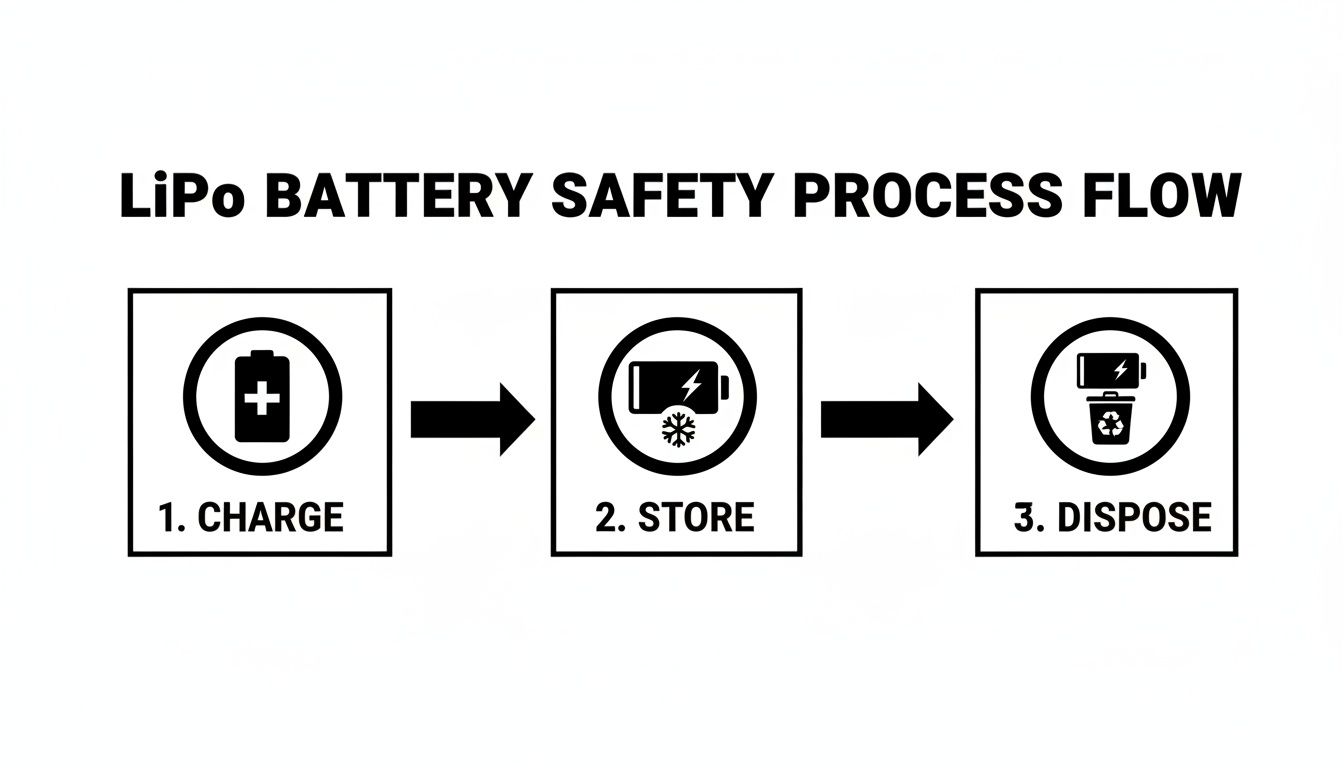
Following these steps isn't just good practice; it's part of the bigger picture of why these shipping regulations exist in the first place.
Why Buying a LiPo Battery in Canada Is Simpler
The truth is, these shipping complexities are why a strong domestic supply chain is so important. The North American market for lithium-ion batteries is exploding—it's projected to hit USD 92.25 billion by 2030, and Canada is a huge part of that. As more cells cross our borders for all kinds of uses, having a streamlined, local source for specialized RC batteries becomes even more critical.
When you buy your LiPo batteries from a Canadian supplier, you get to skip every single one of those logistical hurdles.
- No International Shipping Headaches: Your order ships from within Canada. It's faster and way less complicated.
- No Customs or Duties: The price you see is the price you pay. No nasty surprises when the delivery driver shows up.
- Guaranteed Compliance: We make sure every single shipment meets Canadian transport regulations, so you don't even have to think about it.
At the end of the day, buying your LiPo batteries from a Canadian expert isn’t just about making your life easier—it’s about reliability. It’s the simplest, fastest, and most dependable way to get the power you need, so you can focus on what really matters: hitting the track and winning races.
When you're racing to win, every decision matters—not just what parts you choose, but where you get them. Buying your high-performance LiPo battery in Canada from a dedicated specialist isn't just a matter of convenience. It’s a genuine strategic advantage that gets you on the track faster and with way less frustration.
The biggest headaches for any serious racer often happen off the track. Think customs delays, surprise fees, and waiting weeks for a critical part to arrive. Ordering from a Canadian store cuts right through that noise.
Say Goodbye to Cross-Border Headaches
The second you order from an international supplier, the clock starts ticking against you. Suddenly, you're at the mercy of customs agents and international shipping logistics that are completely out of your control. For a racer, that kind of uncertainty just doesn't work.
The Bottom Line: Buying local means your gear ships from within Canada, straight to your door. This one simple move eliminates cross-border shipping delays, surprise brokerage fees, and confusing currency exchange rates. It's the cleanest, most reliable way to get the power you need.
Instead of trying to calculate import duties and exchange rates, you get a straightforward purchase in Canadian dollars. The price you see is the price you pay. Simple as that.
Speed and Support When It Counts
Picture this: you puff your go-to battery during practice on a Thursday, and the big race is that weekend. If you ordered from overseas, you're done. Ordering from a Canadian specialist like us? You can have a replacement in your hands in a day or two, getting you back on the track without missing a beat.
This local advantage goes beyond shipping. You're also getting support from people who actually race and live the Canadian RC scene. We know the tracks, the popular classes, and the specific challenges you're up against. When you have a question, you’re not talking to a faceless call centre—you're talking to a fellow racer who can give you solid, practical advice.
Supporting a Canadian business also strengthens our racing community. It keeps the best products and expertise right here at home, which helps build a more competitive and vibrant scene for everyone. For any serious Canadian racer, buying local is faster, smarter, and the only real choice for maintaining a competitive edge.
Your Top LiPo Battery Questions, Answered
When you're chasing podium finishes, you need to know your gear inside and out. That’s especially true for LiPo batteries—the heart of your on-road RC car. We get a lot of questions from Canadian racers, so we’ve put together some straight answers to help you feel confident on the track.
How Long Will My LiPo Last?
This question really has two parts: how long it runs per charge, and how many charges it can handle over its lifetime.
Your runtime on a single charge depends entirely on your setup. A big 6000mAh pack in a stock touring car might give you a few solid practice runs. But in a power-hungry modified car, that same battery might just have enough juice for one intense five-minute race.
The overall lifespan is all about charge cycles. A well-cared-for LiPo can easily see 200-300 charge cycles, sometimes even more. The secret is proper maintenance. Always use a balance charge, never let the voltage drop below 3.0V per cell, and put your batteries to a storage charge after every race day. These simple habits make a massive difference.
Can I Use a C-Rating That’s Higher Than I Need?
Absolutely. In fact, it's a smart move.
Think of your motor and ESC as an engine that pulls power from the battery. A higher C-rating is like giving that engine a much wider fuel line. It won't pull more fuel than it needs, but the delivery becomes effortless.
This means a battery with a higher C-rating runs cooler and is under less stress, which usually leads to a longer, healthier life. On the flip side, using a C-rating that’s too low is a recipe for disaster. It starves your system, forcing the battery to overwork itself. This causes overheating, poor performance, and can lead to catastrophic failure.
Rule of Thumb: A higher C-rating is always safe and often better. A C-rating that’s too low for your setup is a risk you should never take.
What are the Warning Signs of a Dying LiPo?
Knowing when to retire a battery isn't just about performance—it's about safety. A failing LiPo will give you clear signals that you can't ignore. Keep an eye out for these red flags:
- Puffing or Swelling: This is the big one. If the battery's hard case is bulging or feels squishy, the internal cells have become unstable. It's done.
- A Sudden Drop in Punch: If your car feels lazy or "fades" way earlier in a run than it used to, the battery can no longer deliver the current your motor is demanding.
- Won't Hold a Balance: Is your charger working overtime to balance the cells? Or is one cell's voltage always lagging behind the others? That's a clear sign the battery is no longer stable or reliable.
If you see any of these signs, the battery's service life is over. For your safety and the safety of everyone at the track, it's time to retire it responsibly.
At digital-rc, we give Canadian racers the power and reliability they need to compete at the highest level. Check out our curated selection of race-proven LiPo batteries and get fast, local shipping without any cross-border headaches.
Find your perfect power source at https://digitalrc.ca