

Your Guide to Choosing the Right Lithium Battery Bag
A lithium battery bag isn't just an accessory—it's a purpose-built, fire-resistant container designed to limit the chaos if a LiPo battery decides to have a bad day. It’s the single most important piece of safety gear you can own for charging, storing, and transporting your high-energy LiPo packs.
Why a LiPo Bag Is Your Most Important Insurance Policy
Let's be real. In the world of RC racing, a LiPo bag is non-negotiable. It’s your insurance policy for your gear, your pit space, and your peace of mind. Every racer understands the incredible amount of energy we pack into modern LiPo batteries. And while they're usually reliable, the risk of a thermal runaway—a violent, unstoppable chemical reaction—is always there in the back of your mind.
Picture this: it’s a busy race day. The pits are packed. You’ve got a battery on the charger when you hear that dreaded hiss, see the pack start to swell, and then whoosh. Without a LiPo bag, that single failure could take out your multi-thousand-dollar car, your radio, and everything else on your pit table. Worse, it puts the racers pitted next to you at risk.
Containing the Uncontrollable
When a LiPo goes, it doesn't just smoulder. It’s an explosive, intense release of heat, toxic gas, and fire. This is exactly where a quality lithium battery bag earns its keep. Made from materials like woven fibreglass, its one and only job is to contain that initial, violent burst of energy.
The bag smothers the first flames and absorbs that immediate, intense heat, preventing the fire from spreading to your other batteries, your hauler bag, or the back of your car on the way home. It buys you those critical few seconds you need to react—to kill the power, get the bag somewhere safe, and stop a small problem from turning into a full-blown disaster.
A LiPo bag won’t extinguish a fire completely. Think of it as a first responder for your batteries. It contains the initial event and gives you the crucial time to manage the situation safely.
Protecting Your On-Road Investment
Whether you're charging a lightweight 1S pack for your 1/12 pan car or a high-power 2S shorty for a 1/10 touring car, the risk is identical. Your batteries are the heart of your race program, and that's an investment worth protecting.
At digitalrc.ca, we get it. We know what goes into a competitive race program. That's why we stock safety gear, like the ProTek R/C LiPo Charging Bag, specifically designed for the battery packs serious racers use. It's all about helping you protect your equipment so you can stay focused on what really matters—crossing the finish line first.
How to Select the Perfect Lithium Battery Bag
Picking the right lithium battery bag isn’t about grabbing the biggest or most expensive one off the shelf. It’s about matching the bag’s features to what you actually need as an RC racer. The whole process really comes down to three things: size, material, and how it closes. Get these right, and you’ve got a safety tool that’s both practical and effective.
A common mistake I see is racers buying a bag that’s way too big for their batteries. It might feel safer, but a cavernous bag lets a failing battery bounce around, which can cause even more damage. On the flip side, a bag that’s too tight is just as bad—it traps heat and chokes off airflow, which is the last thing you want during a charge cycle.
Finding the Right Fit for Your Batteries
The sweet spot is a bag that holds your battery comfortably with about an inch of room on all sides. That little bit of extra space is critical. It allows for proper airflow to keep things cool while charging and gives the bag room to expand and contain the initial blast if a pack decides to vent.
Think about it this way: a racer using a standard 2S shorty pack for a 1/10 touring car needs a completely different size than someone charging up a bigger LCG stick pack. Before you buy, just measure your largest LiPo and add a couple of inches to each dimension. That’s your target size.
This simple flowchart breaks down why a LiPo bag is a no-brainer for anyone in the RC racing hobby.
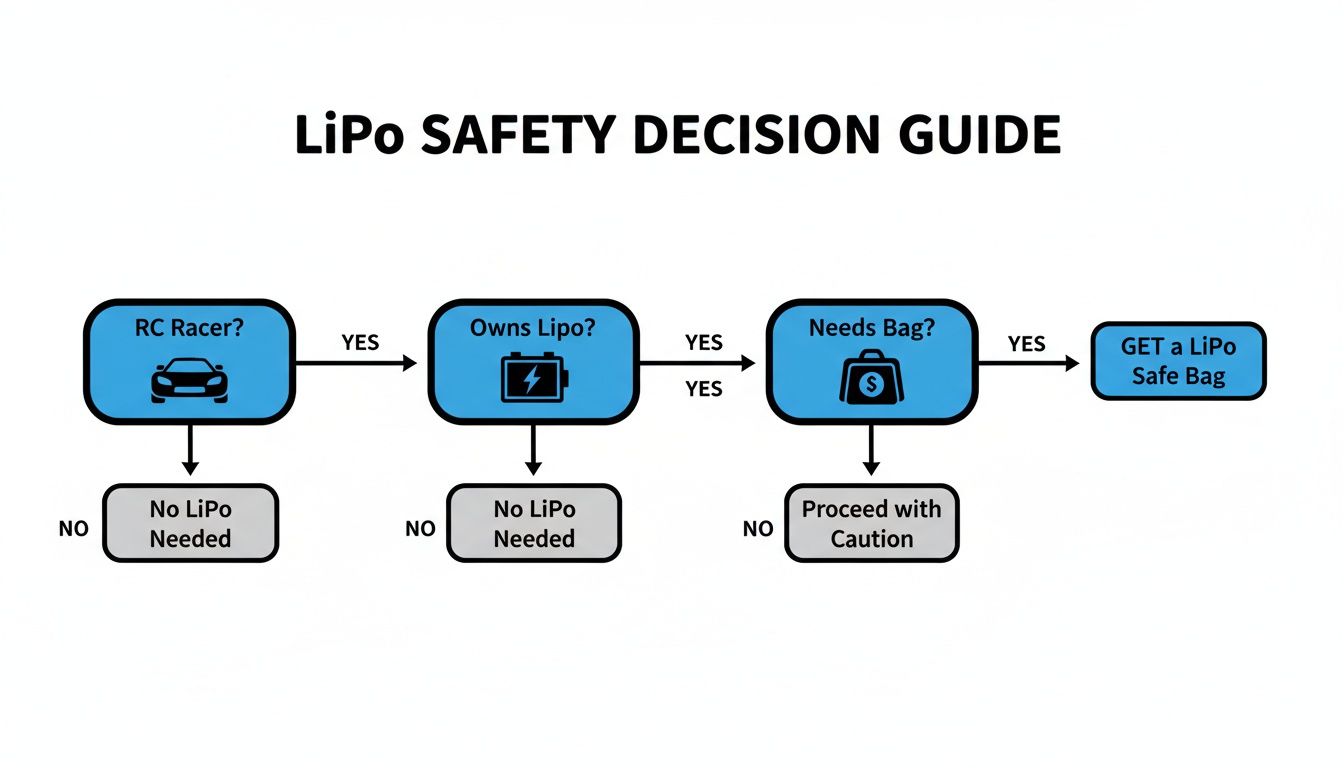
As you can see, if you're an RC racer running LiPo batteries, a specialized safety bag isn't just a good idea—it's essential equipment.
Understanding Materials and Closures
The material is hands-down the most important feature of your lithium battery bag. You want to look for bags made from multi-layered, silicone-coated fiberglass. This stuff is purpose-built to handle extreme heat and contain flames. The silicone coating is a great touch, too, because it adds durability, stops the fiberglass from fraying, and makes the bag easier to handle.
Just as important is the closure system. You’ll notice that quality bags, like the ProTek R/C LiPo Charging Bag we carry, use a heavy-duty hook-and-loop (Velcro) flap. That’s by design. It creates a solid seal to contain flames and debris, but it's also designed to vent the intense pressure and gas that builds up during a thermal runaway. A zippered bag might look more secure, but it can fail explosively under that kind of pressure.
Pro Tip: When you seal your bag, run your fingers firmly along the entire length of the Velcro flap. A partial seal leaves a weak spot where flames could escape, defeating the whole purpose of the bag.
To help you sift through the options, this table breaks down the key features to look for when choosing a bag for your RC LiPo packs.
Lithium Battery Bag Feature Comparison
| Feature | What to Look For | Why It Matters for RC Racers |
|---|---|---|
| Material | Multi-layered, silicone-coated fiberglass | This is your first line of defence against fire. It contains flames and intense heat, preventing a battery failure from spreading in your pit area or home. |
| Size & Fit | About 1-inch clearance around your largest battery | Ensures proper airflow for cooling during charging and gives the bag room to expand and contain pressure during a venting event without bursting. |
| Closure System | Heavy-duty, wide hook-and-loop (Velcro) flap | Creates a strong seal that can withstand the initial force of a LiPo fire but is designed to safely vent high-pressure gases, unlike a zipper which can fail catastrophically. |
| Stitching | Fire-retardant thread (e.g., Kevlar) | The seams are often the weakest point. Fire-retardant stitching ensures the bag doesn't fall apart at the critical moment, keeping everything contained. |
| Durability | Double-stitched seams and reinforced flap | RC gear gets thrown around. A well-built bag will stand up to regular use at the track and during transport without fraying or tearing. |
Ultimately, finding the best bag is about balancing these features. You need one that's built tough enough to handle a worst-case scenario but practical enough for everyday charging and transport. A well-chosen lithium battery bag provides a reliable first line of defence, giving you peace of mind whether you're charging at home or prepping in a crowded race pit.
Mastering Safe Charging and Storage Habits
A quality lithium battery bag is your first line of defence, but it's the consistent, safe habits you build around it that truly prevent accidents. Think of the bag as part of a larger safety system—one that works best when you combine it with smart charging protocols and proper battery care.
Turning these steps into second nature is the key to worry-free racing.
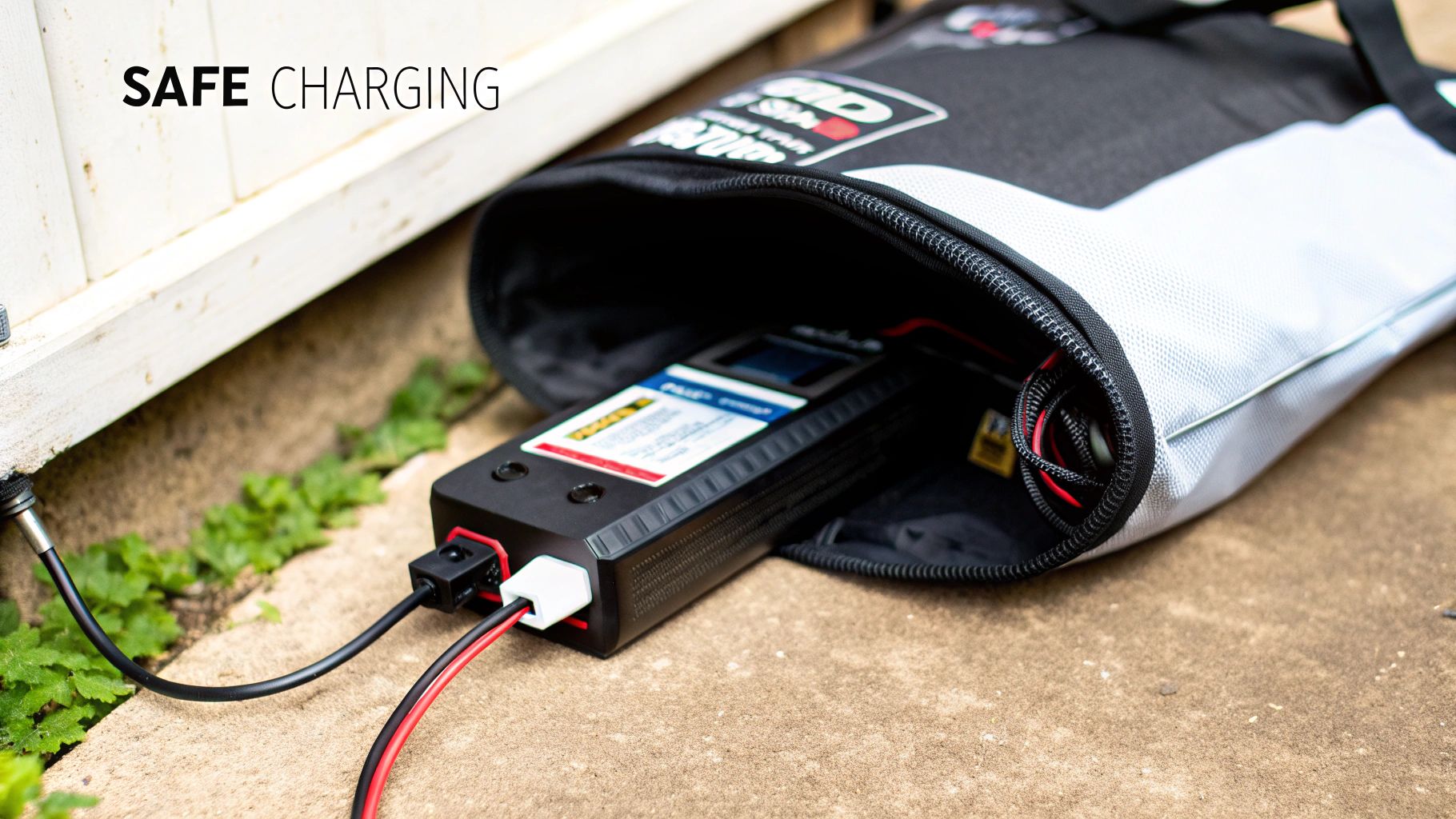
Here's the single most critical rule: never leave a charging battery unattended. A catastrophic failure can happen in seconds, and being there to manage the situation is your best tool. Even with top-tier gear, vigilance is irreplaceable.
Creating a Safe Charging Station
Your charging environment is just as important as the bag itself. Before you even plug in, always place your lithium battery bag on a non-flammable surface. A concrete garage floor, a ceramic tile, or even a metal baking sheet are all excellent choices. You absolutely want to avoid charging on wooden workbenches, carpet, or anywhere near flammable stuff like paints or chemicals.
Once your bag is in a safe spot, follow these simple protocols every time:
- Place one battery inside the bag. Never charge multiple LiPos in the same bag. A failure in one can easily set off the others.
- Run the charging leads through the purpose-built vent flap, making sure the main body of the bag is sealed up.
- Firmly press the Velcro flap closed along its entire length. This creates a secure seal that can contain initial flames but still allows pressure to vent safely.
A common mistake I see is people only partially sealing the bag or leaving the flap wide open. This completely defeats the purpose, giving fire and debris an easy escape route. A properly sealed bag is a contained environment.
Best Practices for LiPo Storage
Proper storage is crucial, not just for safety but for the longevity of your batteries. When you're done at the track, don't just toss your packs into a toolbox. The ideal state for long-term storage is at a specific voltage, which helps preserve the battery’s internal chemistry and dramatically reduces risk.
You're aiming for a storage voltage of roughly 3.8 to 3.85 volts per cell. Thankfully, most modern chargers have a dedicated "storage" function that automatically brings the battery to this sweet spot. If you've just run a pack, it will charge it up; if it's a full pack, the charger will discharge it down. To get the most out of your gear, maximizing the charge of your battery packs is a key skill to develop.
Once at storage voltage, pop your batteries back inside their lithium battery bag. Store that bag in a cool, dry place away from direct sunlight or extreme temperatures—a metal cabinet or an ammo can (with the rubber seal removed to prevent pressure build-up) is perfect. This consistent routine protects your investment and ensures your gear is always ready for the next race day.
Of course, a great routine starts with great equipment. If you're looking to upgrade, check out our guide on choosing the best LiPo battery charger to complement your safety setup.
Traveling Safely with Your LiPo Batteries
Hitting the road for a big race adds another layer of prep, especially when it comes to transporting your LiPo batteries. Whether you're just driving across the province or hoping on a plane, you need to know the rules for ground and air travel to keep your trip stress-free.
When you're driving, the biggest risk is physical damage. A loose battery rattling around in your hauler bag is just asking for trouble. Always pack your LiPos inside a proper lithium battery bag first, then wedge them securely in your hauler so they can’t get smacked or punctured by a loose hex driver.
Navigating Air Travel Regulations
Flying with LiPos is a different ball game entirely. Airlines and transport authorities have strict, non-negotiable rules. If you don't follow them, you can bet your expensive packs will be confiscated on the spot.
It's also important to remember that these are specialized safety requirements. You can't just toss them into any old bag; generic grey mailing bags won't cut it. You absolutely need purpose-built protection.
Here’s the simple checklist I follow every single time I fly:
- Carry-On Only: This is non-negotiable. LiPo batteries are flat-out banned from checked luggage. They must be in your carry-on where cabin crew can deal with any potential issues.
- Individual Protection: Every battery needs its own space to prevent short circuits. Put each one in its own small lithium battery bag or, if you still have it, its original retail box.
- Tape the Terminals: A quick but critical step. Cover all exposed terminals and connectors with a bit of electrical tape. This prevents them from accidentally touching each other or any other metal items in your bag.
Making Inspections Smooth and Simple
Using a durable, high-quality lithium battery bag does more than just contain a potential fire—it also sends a clear message to security agents. It shows them you're a responsible hobbyist who knows what they're doing. When they see your packs neatly organized and protected, the whole inspection process goes faster.
Presenting your batteries properly in a designated safety bag shows you understand and respect the regulations. It cuts down on questions and helps you breeze through security, letting you focus on the race ahead.
Prepping your LiPos for travel is just a fundamental part of RC racing. For a deeper dive into the specific rules and best practices here at home, you can learn more about handling your LiPo battery in Canada with our detailed guide. Taking those few extra minutes to pack correctly ensures your safety and the safety of everyone around you.
How to Inspect and Maintain Your LiPo Bag
A LiPo bag is one of the most critical pieces of safety gear in your pit box, but it’s not a "set it and forget it" item. Just like you check your chassis for cracks or your tires for wear, your LiPo bag needs a quick look-over to make sure it can still do its job if things go wrong. Making this a regular habit before a race day is a simple step that makes a world of difference.
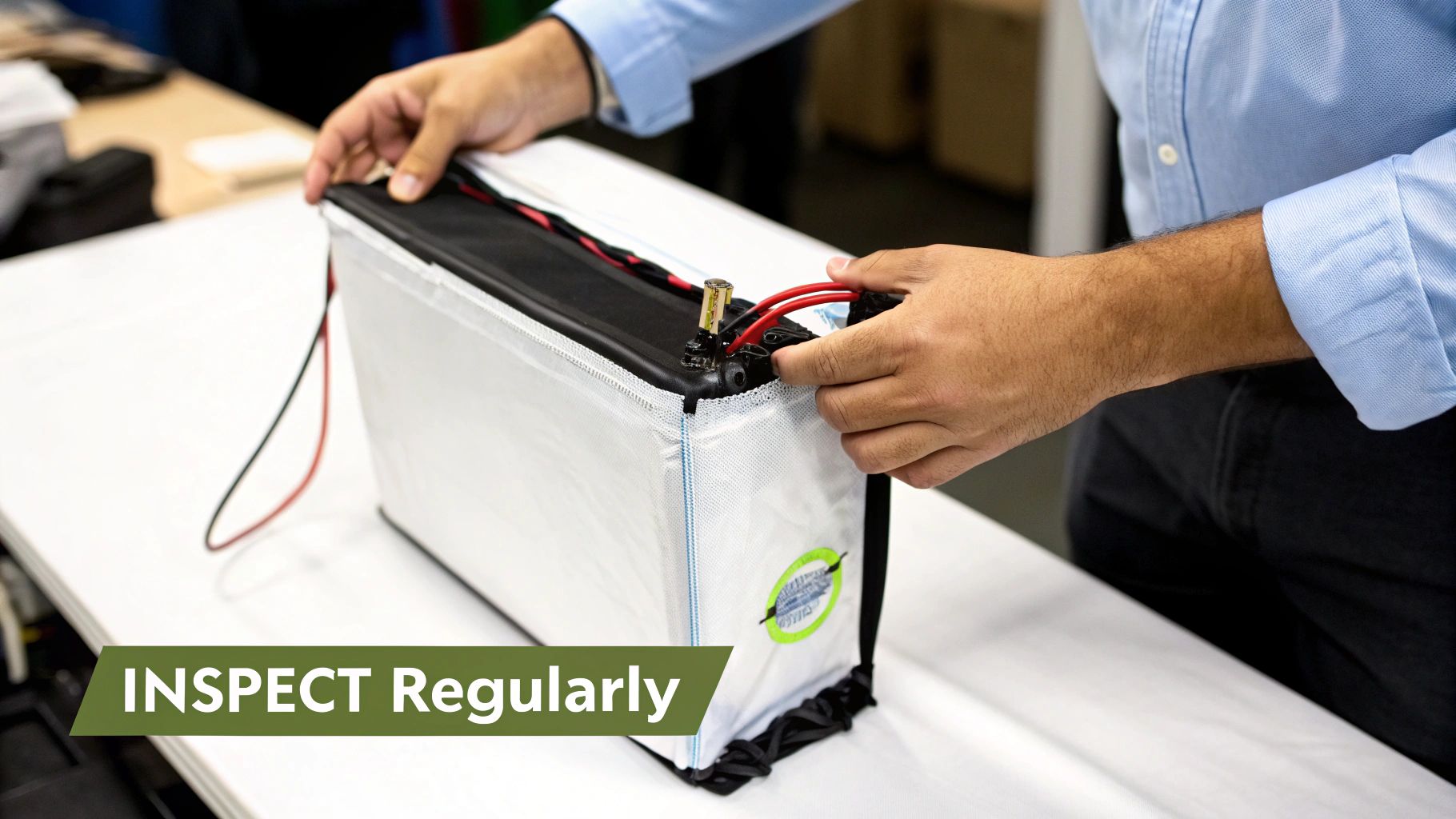
Think of your bag as having a limited lifespan. Every time you toss it in your hauler, open the flap, and seal it shut, the materials get a little bit of wear and tear. It all adds up, and eventually, it can compromise the bag's ability to contain a battery fire.
What to Look For During Inspection
A good inspection only takes a few seconds. Run your eyes and hands over the entire bag, specifically looking for any signs that it’s getting tired.
Here are the main failure points to check:
- Fraying Seams: Pay close attention to the stitching, especially around the edges and the main flap. Any loose threads or seams that look like they’re pulling apart are a huge red flag. That’s exactly where a bag will split open under pressure.
- Worn-Out Velcro: That hook-and-loop closure is what keeps everything contained. If it’s clogged with dirt or the fibres are so worn they barely stick, the bag can't create a proper seal against flames and pressure.
- Discolouration or Stains: Any dark spots, burn marks, or weird stains on the fire-retardant material could mean it's been exposed to heat or chemicals. Both can seriously weaken the fabric's integrity.
This rule is simple and non-negotiable: If your lithium battery bag is ever involved in a battery venting event, it must be replaced immediately. Even if it looks okay on the outside, its protective qualities are gone. It did its job once and cannot be trusted to do it again.
When to Replace Your Bag
Getting rid of a damaged or compromised bag is easy—just toss it. The small cost of a new one from a trusted supplier like digitalrc.ca is nothing compared to the risk you take by using worn-out gear.
With Canada's battery market projected to hit USD 0.36 billion by 2030, the power and availability of LiPo packs are only going to grow. This trend makes having reliable, well-maintained safety equipment more important than ever for everyone in the RC community. You can discover more insights about this expanding market and what it means for hobbyists.
Common Questions About LiPo Bags
Even with a good grasp of what a LiPo bag does, a few key questions always come up in the pits. Getting straight answers to these builds the confidence you need to handle high-performance LiPo packs the right way.
Let's break down some of the most common ones to clear up any confusion.
Can I Charge Multiple LiPo Batteries in One Bag?
This one comes up a lot, and the answer is a hard no. You should only ever charge one battery per bag.
The whole point of a LiPo bag is containment. If you stick a bunch of packs in a single bag and one of them decides to let go, it’s going to take the others with it. That turns a small, contained incident into a much bigger, much more dangerous fire. Isolate every battery during charging—if you need to charge multiple packs at once, use multiple smaller bags. It's that simple.
What’s the Difference Between a LiPo Bag and a Sack?
In the RC world, you’ll hear "bag" and "sack" thrown around to mean the same thing. Generally, a "bag" is the flexible, woven fibreglass pouch with a Velcro flap that has become standard in RC racing.
Sometimes you'll hear "sack" or "box" used for more rigid, often metal, storage containers. But for the fast-paced environment of an RC track, the lightweight, portable bags we offer are far more practical for tight pit spaces and travel. They offer certified protection without the bulk.
The name doesn't matter nearly as much as the material. The only thing you need to worry about is that your choice is made from proper fire-retardant materials like silicone-coated fibreglass, designed specifically to handle the intense heat of a LiPo failure.
Does a LiPo Bag Actually Stop a Fire?
This is a critical point to understand: a LiPo bag is not a fire extinguisher. Its real job is to contain the initial thermal runaway. When a LiPo fails, it’s a violent event with flames, intense heat, and pressure. The bag is designed to smother that initial burst and keep it from spreading to your car, your charger, or other flammable stuff on your pit table.
It buys you precious seconds to kill the power and get the bag somewhere safe, like outside on the concrete. The bag itself will almost certainly be destroyed in the process—it’s built to absorb that energy. That's why you should always have a fire extinguisher on hand as your plan B.
The power crammed into modern LiPo batteries is no joke. In 2023, Canada's lithium-ion battery cathode market generated USD 1,145.7 million, and it's projected to hit USD 4,408.8 million by 2030. That growth reflects the advanced chemistries we're using in our RC packs, making purpose-built safety gear absolutely essential. You can learn more about the growth of Canada's Li-ion battery market.
Do I Need a Bag for Storing Discharged Batteries?
Yes, absolutely. A so-called "discharged" or "dead" battery still holds a residual charge. It's never truly empty. If that battery gets damaged—say, it gets punctured rattling around in your hauler bag—it can still short out and become a fire risk.
Storing all your LiPo packs in a proper bag, no matter their charge level, should be a non-negotiable part of your routine. It’s a simple habit that protects them from accidental damage during storage and transport, keeping your gear and your home safe.
At digitalrc.ca, we stock the proven safety gear you need to protect your investment and race with confidence. From durable LiPo bags to high-quality chargers, we have everything to build a safe and reliable power program for your 1/10 touring or 1/12 pan car.
Shop our complete collection of LiPo safety gear at digitalrc.ca