

Mastering rc car 1/10 Racing in Canada: A Complete Guide
When you walk into any competitive on-road RC race in Canada, you'll see one class dominate the pits: the 1/10 scale. For anyone serious about racing, this is the definitive starting point—the perfect blend of raw speed, technical precision, and endless customization.
This scale isn't just a popular choice; it's the heart of the Canadian racing scene.
Why 1/10 Scale RC Cars Are the Gold Standard in Canada
Ever wonder why nearly every serious on-road racer runs a 1/10 scale car? It all comes down to the perfect sweet spot. If a real-world touring car is about 4.5 metres long, its 1/10 scale counterpart comes in at a nimble 45 cm. That size is big enough for incredible detail and high-performance components, yet small enough to be explosive on a huge variety of indoor and outdoor tracks.
This isn't just about convenience. It’s a formula for pure excitement. The 1/10 scale platform delivers a thrilling mix of blistering speed, razor-sharp handling, and nearly infinite tuning options. It’s the go-to for everyone from weekend club racers to seasoned pros competing at the national level.
The Ecosystem of Competition
The dominance of 1/10 scale is no accident. It's backed by a massive ecosystem of manufacturers, aftermarket parts suppliers, and dedicated racing communities right here in Canada. This platform has seen decades of refinement, leading to incredibly sophisticated chassis designs and a staggering selection of performance parts.
This widespread support has cemented its place at the top. The 1/10 scale category has seen explosive growth, with sales of hobby-grade models jumping by an estimated 25% in recent years, largely fuelled by ROAR-affiliated racing events across the country.
To get a better sense of what makes this scale the preferred choice for competitive racers, let's break down its key advantages.
Key Advantages of the 1/10 Scale for Canadian Racers
| Attribute | Advantage for Racers |
|---|---|
| Performance Balance | The perfect combination of weight, power, and size for dynamic handling and high speeds on most tracks. |
| Parts Availability | A massive selection of chassis kits, electronics, tires, and hop-up parts from brands like XRAY, Awesomatix, and Hobbywing. |
| Competitive Scene | The largest and most competitive race classes at club, regional, and national levels across Canada. |
| Tuning Potential | Near-limitless setup adjustments allow racers to fine-tune their car for any track surface or layout. |
| Track Accessibility | Ideal size for the majority of indoor carpet and outdoor asphalt RC tracks found in Canada. |
These factors combined make the 1/10 scale the undisputed king for anyone looking to step onto the podium.
For any competitive racer, the 1/10 scale isn't just another option—it's the standard. It offers the fiercest competition, the best parts support, and the clearest path to building a winning car.
Here at digital-rc, we live and breathe this stuff. We're Canada's go-to source for the race-proven kits, electronics, and components you need to build a machine that's ready to win, all backed by the service Canadian racers demand. To dive deeper into the local scene, check out our guide on the landscape of RC cars in Canada.
The Anatomy of a Podium-Ready 1/10 RC Car
Building a winning rc car 1/10 is an exercise in precision. Every single component, from the carbon fibre chassis to the tiniest screw, plays a critical part in how the car feels and behaves on the track. Understanding this anatomy is the first step toward building a machine that doesn't just compete, but consistently finds its way to the top of the timing sheets.
Think of the chassis as the car's skeleton. It’s the foundation that everything else bolts onto, and its design dictates the car's potential for handling, stability, and durability. For serious racers, brands like XRAY and Awesomatix are the gold standard for a reason. Their chassis kits, available right here at digital-rc, are crafted from high-grade carbon fibre and precision-milled aluminum.
This isn't just for looks; these materials are chosen to provide a calculated blend of rigidity and flex. A stiff chassis ensures that your suspension adjustments translate directly to the track, giving you predictable and repeatable handling. At the same time, controlled flex allows the car to generate mechanical grip as it navigates bumps and corners, keeping the tires glued to the racing surface.
This concept map breaks down why the 1/10 scale is the sweet spot for racers, linking its size directly to speed, realism, and a huge potential for customization.
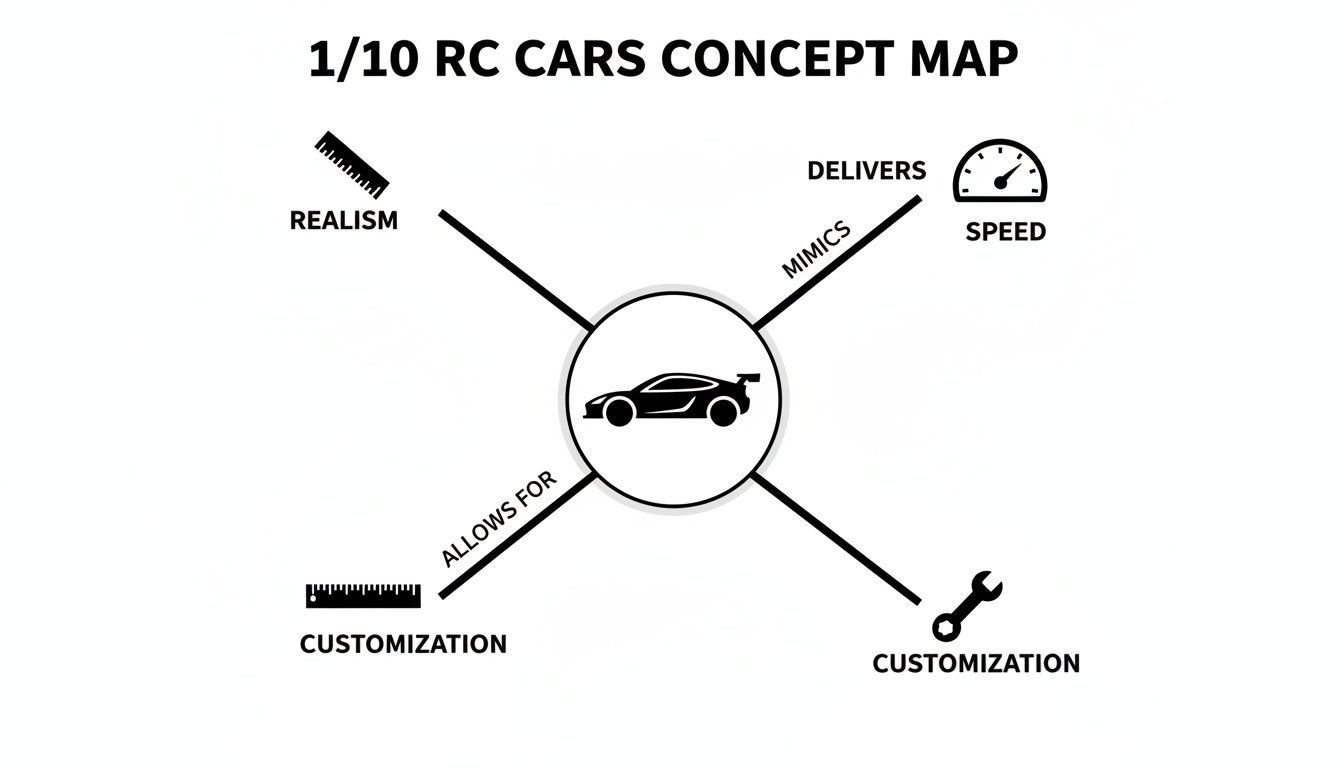
You can see how these three pillars—speed, realism, and customization—all feed into each other, making the rc car 1/10 platform a complete system for competitive racing.
The Heartbeat of the Machine: Electronics
If the chassis is the skeleton, then the electronics are the car's heart and nervous system. They deliver power and control with split-second accuracy, and a racer's success often comes down to the quality and synergy of their electronic components.
Let's break down the essential trio:
- ESC and Motor: The Electronic Speed Controller (ESC) and motor are a team. The ESC is the brain, translating your throttle inputs from the radio into smooth, controllable power for the motor. A race-grade combo from Hobbywing provides that buttery-smooth throttle feel that's absolutely vital for navigating tight corners and accelerating cleanly out of them. A powerful motor gives you raw speed, but without a great ESC, that power is just unusable wheelspin.
- Servo: The steering servo points the front wheels where you want them to go. In a race where milliseconds matter, a slow or imprecise servo is a huge liability. That’s why top competitors rely on lightning-fast, high-torque servos from brands like Power HD or AGFRC. These units deliver instant, precise steering response, allowing you to hit your apexes perfectly, lap after lap.
- LiPo Battery: Your battery is the fuel tank. For 1/10 scale on-road racing, this typically means a 2S (7.4V) LiPo battery. Choosing a high-quality battery, like those from Sunpadow, with a high C-rating ensures you get consistent voltage and power delivery through the entire race, preventing that dreaded fade in the final, most crucial laps.
These parts aren't picked at random. They have to work together seamlessly to create a responsive, reliable power system you can count on.
The Drivetrain: Putting Power to the Pavement
The drivetrain is what takes the motor's power and gets it to the wheels. In 1/10 scale touring cars, this is usually a highly efficient belt-drive or shaft-drive system connecting both the front and rear differentials. The goal here is simple: minimize friction and power loss, ensuring every watt from your motor contributes to forward motion.
The secret to a winning car isn't just having the most powerful motor; it's about having the most efficient and reliable system to deliver that power to the track consistently.
This system's reliability is non-negotiable. A broken belt or a stripped gear means your race is over, instantly. That's why meticulous maintenance and using high-quality components, like precision bearings and durable gears, are essential for anyone serious about winning. At digital-rc, we stock the specific bearings, belts, and gears needed for top-tier chassis like XRAY and Awesomatix, so you can keep your drivetrain at a competitive level.
Mastering Grip: Tires and Bodies
Finally, we get to the two components that directly interact with the racing world: the tires and the body. You can have the best chassis and electronics money can buy, but without the right tires, you're going nowhere fast.
Tires are arguably the single most important tuning component on any rc car 1/10. Their compound, tread (or lack thereof for carpet), and insert decide how much grip the car has. On any given race day, track conditions can change, and having the right set of tires is often the difference between a podium finish and a frustrating weekend.
The car's body is much more than just a decorative shell; it’s a critical aerodynamic tool. Different body styles from manufacturers like Xtreme and ZooRacing are engineered to produce varying levels of downforce and steering response. A high-downforce body can plant the car in high-speed sections, while a body with more steering focus can help the car rotate better in tight, technical infields. Choosing the right body for the track layout is a key piece of the setup puzzle, allowing you to fine-tune the car's balance and feel at speed.
Choosing Your On-Road Racing Class
On-road RC racing isn't just one thing. It's a whole world of different classes, and each one demands a completely unique driving style and setup philosophy. If you're jumping into the competitive scene with a rc car 1/10, your first big decision is picking your battlefield. This choice will define everything that follows, from the chassis you build to the lines you take on the track.
When it comes down to it, the two most popular forms of on-road racing represent a fascinating clash of engineering and driver skill. Getting a handle on what makes them tick is the key to finding a class that fits your local track, your goals, and your own personal driving style.
The All-Rounder: 1/10 Touring Cars
Think of a 1/10 scale touring car as a rally machine purpose-built and refined for the race track. These are the workhorses of the on-road world, built with sophisticated four-wheel-drive (4WD) systems, fully independent suspension, and oil-filled shock absorbers at all four corners.
That design gives them incredible stability and makes them surprisingly forgiving. A 4WD touring car feels planted, digging into the track and finding grip on all kinds of surfaces, from high-bite indoor carpet to outdoor asphalt. This makes it a fantastic starting point for new racers because the car is just easier to drive consistently at speed.
Here at digital-rc, we see racers get incredible results with touring car chassis from top brands like XRAY and Awesomatix. They provide a stable, predictable platform that responds perfectly to setup changes.
The Purebred Racer: 1/10 Pan Cars
On the other end of the spectrum, you have the pan car—a featherlight, rear-wheel-drive (RWD) beast designed for one thing: pure, raw speed on smooth, high-grip tracks. Picture a Formula 1 car in 1/10 scale, and you’re pretty close. They get their name from their simple, flat "pan" chassis, which acts as the foundation for a rear power pod and a very minimalist front end.
Driving a pan car is a completely different world. They are brutally fast and unbelievably agile, rewarding a driver who is smooth and precise. With that RWD layout, throttle control is everything; get on the power too hard, too soon, and you’ll be spinning out.
But on a prepped surface like indoor carpet, nothing can touch their corner speed and acceleration. This class takes more finesse, but the connection it gives you between driver and machine is absolutely electrifying.
Choosing between a touring car and a pan car is about deciding what kind of challenge you want. Do you prefer the stable, all-surface grip of a 4WD machine or the razor's-edge precision of a lightweight RWD rocket?
Class Popularity in Canada
The Canadian RC racing scene really highlights these differences. We’ve seen significant growth in pan car racing, especially in urban centres. Participation in 1/12 pan car events—a close cousin to the 1/10 class—has jumped 40% since 2022, often fuelled by the popularity of smaller indoor tracks in cities like Toronto and Montreal.
However, at major events like the Western Canada Challenge in Edmonton, the versatile 1/10 touring cars consistently dominate. They make up 72% of total entries, hitting corner speeds of over 45 km/h thanks to their advanced aerodynamics and precision setups. You can dig deeper into these trends in the Canadian recreation and hobby statistics.
Often, your local track is your best guide. If your club races on a big, flowing asphalt track, a touring car is probably your best bet. If it’s a tight, high-grip carpet circuit, the pan car will be king. Whichever path you choose, digital-rc has the race-proven parts, from complete touring car kits to pan car essentials, to help you build a competitive rc car 1/10 for any Canadian track.
Mastering Setup to Shave Seconds off Your Lap Times
The fastest car on the track is rarely the one with the most horsepower. It’s the one with the best setup. A perfectly dialled-in car is predictable, consistent, and gives you the confidence to push harder, lap after lap. This is where races are truly won and lost—in the tiny, precise adjustments that translate raw power into controlled speed.
We're moving beyond basic theory and into the actionable tuning that directly shaves seconds off your lap times. The secret to dominating the competition isn't just knowing what to change, but understanding the why behind each adjustment so you can adapt to any track condition.
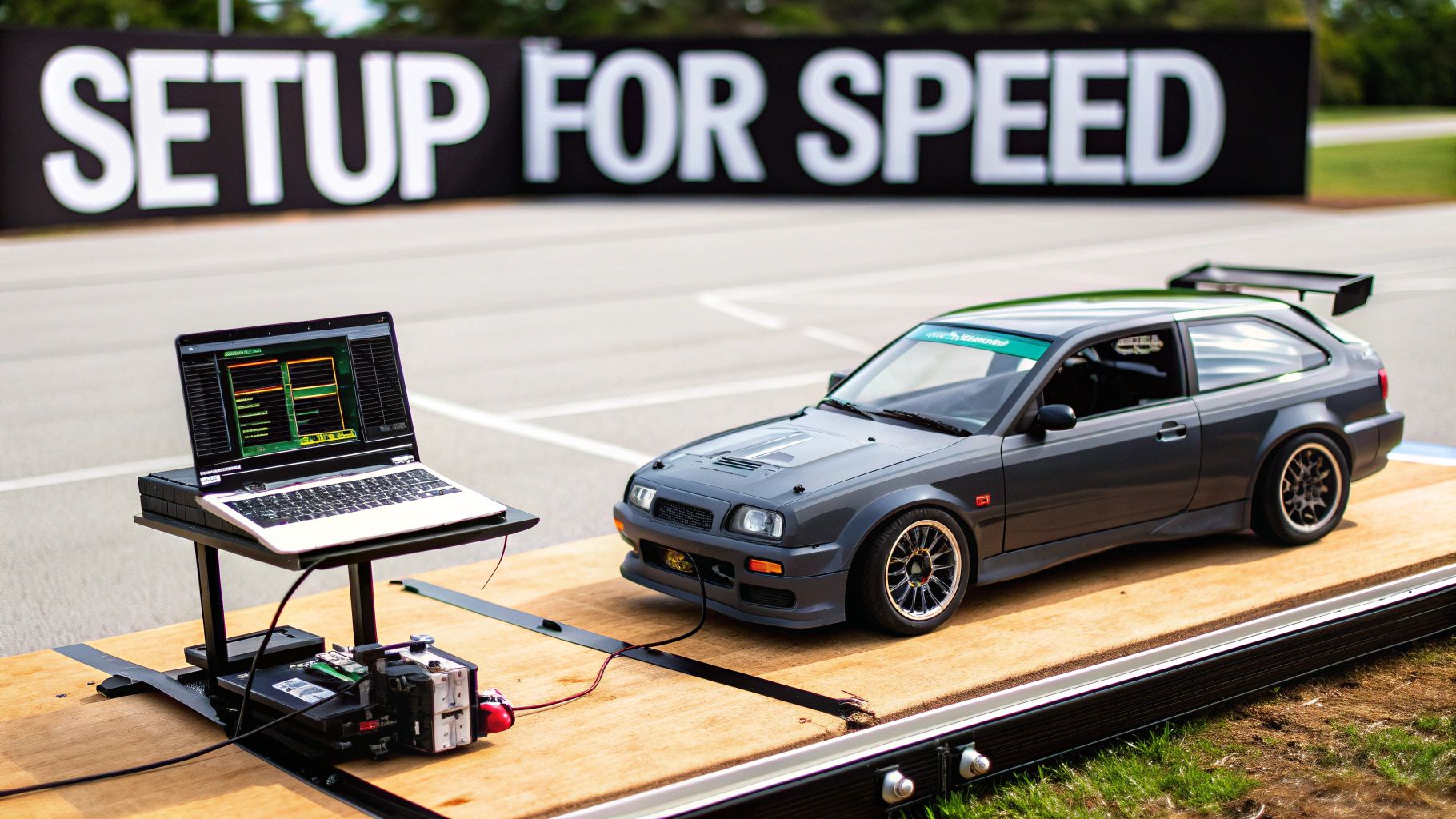
Controlling Weight Transfer with Suspension Droop
Suspension droop is one of the most powerful—and often misunderstood—tuning tools at your disposal. Think of it as how far your suspension arms can fall away from the chassis. This adjustment is your key to controlling how the car’s weight shifts during acceleration, braking, and cornering.
More droop allows for more weight transfer. For instance, increasing rear droop lets more weight shift to the back under acceleration, which can seriously improve forward traction on lower-grip surfaces. On the flip side, limiting droop makes the car feel more responsive and agile, which is perfect for high-grip carpet tracks where quick direction changes are everything.
- More Droop: Increases chassis roll, generating more mechanical grip. This is your friend on bumpy or low-traction tracks.
- Less Droop: Stiffens the car's response, making it feel more direct and aggressive. This is what you want on smooth, high-grip surfaces.
Finding that perfect balance is crucial for a car that is both fast and easy to drive.
Dialing in Grip with Camber and Toe
Camber and toe angles dictate how your tires meet the racing surface, which directly impacts grip, stability, and even tire wear. Getting these angles right is non-negotiable if you want to maximize your car’s cornering potential.
Camber is the vertical angle of your tires. When the top of the tire tilts inward toward the chassis, that's negative camber. The goal here is to make sure the tire's contact patch is flat on the ground during cornering as the chassis rolls. The sweet spot for negative camber is usually between -1.5 to -2.5 degrees to maximize grip through the turns.
Toe, on the other hand, is the horizontal angle of the tires.
- Toe-in: The front edges of the tires point toward each other. A little rear toe-in adds valuable straight-line stability.
- Toe-out: The front edges of the tires point away from each other. A bit of front toe-out delivers more aggressive turn-in at the start of a corner.
The secret to a winning setup isn't finding one magic number. It's about understanding how small, incremental changes to camber, toe, and droop work together to create a car that perfectly suits your driving style and the track layout.
Finding the Sweet Spot with Gear Ratio
Your gear ratio is the critical link between your motor's RPM and your car's speed. It’s a constant trade-off between gut-punching acceleration and blistering top speed. A lower gear ratio (a larger spur gear or smaller pinion) gives you that explosive launch out of corners. A higher gear ratio delivers more speed on the long straights.
The perfect gear ratio depends entirely on the track. On a tight, technical layout with short straights, you’ll want quicker acceleration to punch out of the corners. On a large, flowing track, that higher top speed will give you the edge. The goal is to gear the car so the motor hits its max RPM just before you need to brake for the next corner, squeezing out every last bit of available power.
The Tools of the Trade
Consistency is king in racing, and you can't be consistent without precision tools. Eyeballing your camber or setting droop with a ruler just won't cut it when you're competing. This is exactly why top-level racers invest in quality setup systems, digital calipers, and ride height gauges.
The rc car 1/10 racing scene in Canada is growing fast, with the hobby expected to contribute an estimated CAD 50 million annually to the niche retail sector by 2025. National-level builders report that handling can improve by as much as 20% simply by using quality shims, smooth bearings, and precision setup tools. These figures show why the on-road scene is so vibrant in Canada's RC culture.
Here at digital-rc, we stock the essential tools you need to achieve repeatable, podium-worthy performance. From precision shims for fine-tuning your suspension geometry to high-quality bearings that ensure your drivetrain runs silky smooth, we provide the components that turn a good car into a great one. For a deeper look into professional-grade equipment, check out our article on why the HUDY Universal Setup System is essential for 1/10 touring car racing.
Essential Maintenance for Race Day Reliability
There's an old saying every racer knows by heart: to finish first, you must first finish. Nothing ends a great race day faster than a mechanical failure, turning a potential podium spot into a frustrating DNF. Reliability isn't just an advantage; for your rc car 1/10, it's the absolute foundation of competitive racing.
This is where a solid maintenance routine becomes your most valuable tool in the pits. Consistent checks before and after every single run transform your car from a collection of parts into a dependable machine you can push to the limit with confidence.
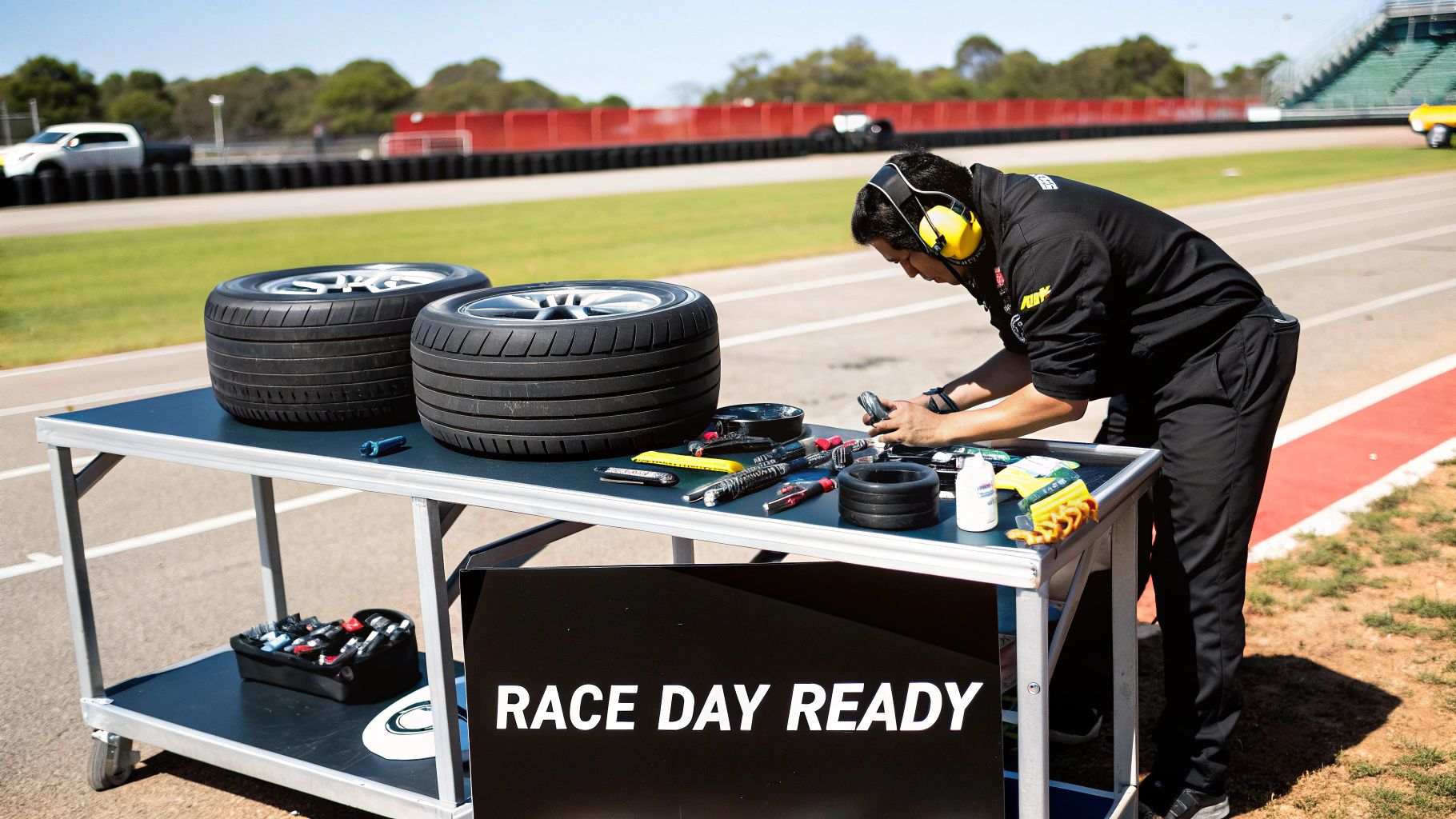
Pre-Race and Post-Race Checklists
The secret to catching small problems before they become race-enders is a simple, repeatable checklist. It doesn't have to be complicated, but you have to do it every time.
Your pre-race check is all about making sure the car is 100% ready for the green flag:
- Screw Check: Go over every accessible screw on the chassis. Vibration will loosen anything and everything over time, especially critical fasteners on the motor mount and suspension.
- Battery Voltage: Confirm your LiPo is fully charged and the cells are balanced. A weak or unbalanced pack leads to inconsistent power and weird handling quirks.
- Suspension Action: Push down on each corner of the car. The suspension should feel buttery smooth and rebound consistently without binding or sticking.
After a run, the post-race check helps you find any issues that cropped up on the track:
- Drivetrain Cleaning: A quick blast with compressed air and a brush keeps debris out of your belts, pulleys, and gears. A clean drivetrain is a fast, reliable drivetrain.
- Bearing Inspection: Give each wheel a spin by hand. If you hear or feel anything gritty or noisy, that bearing is done. Swap it out immediately.
- Damage Assessment: Do a close inspection of the suspension arms, steering blocks, and the main chassis. Look for any stress marks or tiny cracks from on-track battles.
Trackside Troubleshooting Quick Guide
Even with the best prep, things happen. Knowing how to quickly diagnose an issue in the pits can be the difference between packing up early and making the A-main. Here’s a quick guide to help you figure out what’s wrong when your car starts acting up.
| Symptom | Potential Cause | Quick Fix or Check |
|---|---|---|
| Sudden Oversteer/Understeer | A loose suspension component (e.g., camber link) or a broken part. | Check all suspension links and pivot points for play or damage. |
| Power Loss or Glitching | Loose battery or motor connection, or an overheating ESC. | Verify all wire connections are secure. Check motor and ESC temps. |
| Inconsistent Steering | A failing servo, loose servo saver, or stripped servo horn. | Check for play in the steering linkage and listen for unusual servo noises. |
| Car Pulls to One Side | Incorrect steering trim, uneven tire wear, or a tweaked chassis. | Reset steering trim on your radio. Inspect tires and place the car on a flat setup board. |
This table covers the basics, but the real key is being prepared before something breaks.
The ultimate insurance policy for a successful race weekend is having the right spare parts on hand. A broken suspension arm or a failed bearing shouldn't end your day if you're prepared.
Every serious racer has a small box with common spares like suspension arms, steering blocks, high-quality bearings, and a spare spur gear from digital-rc. This prep, combined with a good understanding of your LiPo battery, is what keeps you on the track. For more on this, check out our detailed guide on LiPo battery care in Canada. It’s what separates the front-runners from those packing up early.
Your Competitive Edge with Digital-RC
Any serious Canadian racer knows the competitive edge isn't just found on the track—it’s built long before you get there. Choosing the right partner for your rc car 1/10 program is one of the most important decisions you'll make. At digital-rc, we're not just another online store. We are a resource built from the ground up to help you win, not just sell you parts.
Our entire operation is designed around what competitive racers actually need. We stock a carefully curated selection of elite, race-proven brands like XRAY, Awesomatix, and Hobbywing. This means you get access to the exact same gear the pros use to win at national and international events, so you can be confident your car is built with components that can handle the pressure.
Designed for Canadian Racers
We know the unique challenges of the Canadian racing scene because we're part of it. That’s why we’ve built our service to get rid of the common frustrations and get you what you need, fast. This commitment shows in the core benefits that give you a real, practical advantage.
- CAD Pricing with No Tax: The price you see is the price you pay. Everything is listed in Canadian dollars, and we cover the tax. This makes budgeting simple and gets rid of any surprises at checkout.
- Free Same-Day Delivery: Your time is your most valuable asset. Place an order before noon, and we provide free same-day delivery. This gets you the parts you need to repair, rebuild, or upgrade your car without missing a beat.
This focus on speed and simplicity means less time waiting for a package and more time at the track practising.
Success in racing is about minimizing variables. By providing predictable pricing, rapid delivery, and easy access to the right parts, we help you focus on what matters most—driving.
Effortless Parts Sourcing
Finding the exact part you need for your rc car 1/10 shouldn't feel like a treasure hunt. A broken component or a last-minute setup change demands a fast, accurate solution. Our website is organized to save you time and eliminate the guesswork.
With dedicated collections for top chassis brands and logical categories for electronics, tires, and tools, you can find compatible components effortlessly. This structured approach means you can quickly find a specific bearing for your XRAY kit or the right pinion gear for your Hobbywing motor. It's not just about convenience; it's about having a reliable system that supports your racing program, helping you stay prepared, confident, and ready for every race.
Your 1/10 Scale RC Car Questions Answered
We get a lot of questions from the Canadian racing community about getting the most out of their rc car 1/10. This section dives straight into the common queries we see at the track, giving you clear answers to solve problems and race with confidence.
What Is the Best Motor for a 1/10 Scale Touring Car?
This is the big one, and the answer comes down to what class you're running. Sanctioned racing in Canada is almost always split into "spec" or "modified" classes, and your motor choice has to match.
- Spec Racing: These classes are all about creating a level playing field. Everyone runs the same motor turn, typically a 17.5T or 21.5T. The goal is to make driver skill and car setup the deciding factors. A top-tier Hobbywing G4 or Team Powers motor in the correct turn is a race-winning choice.
- Modified Racing: This is the no-holds-barred "open" class. Here, you'll see incredibly fast motors, often in the 4.5T to 6.5T range. The speed is intense, and your throttle control becomes absolutely critical.
Before you buy anything, your first step should always be checking the rules for your local club or the specific event you plan on racing.
Do I Really Need a High-End Radio System?
Absolutely. A quality radio system is one of the most important investments you can make in your racing program. While any basic 2.4GHz radio gets the car moving, a high-end system like those from FlySky gives you two massive advantages on the track.
The first is latency—the time it takes for your input to translate into the car's reaction. Top-tier radios have a near-instantaneous response, which is crucial for making those tiny, split-second corrections that separate a good lap from a great one. The second advantage is the massive range of adjustability, letting you fine-tune things like throttle and steering curves right from the transmitter to dial the car into the track conditions.
Which Spare Parts Should I Always Have in My Pit Box?
Nothing ends a race day faster than a simple mechanical failure you can't fix. A well-stocked parts box is your best insurance policy. For a competitive rc car 1/10 touring car, these are the non-negotiable spares you need to have on hand:
- Front and rear suspension arms
- Steering blocks and C-hubs
- A complete set of high-quality bearings
- A spare spur gear
These are the parts that take the most abuse in a crash. Having them ready to go means you can get back in the race instead of packing up early.
At digital-rc, we stock the race-proven parts you need to compete and win. With CAD pricing and free same-day delivery, we're here to keep you on the track. Find your next upgrade at https://digitalrc.ca.