

Your Ultimate Guide to Building a Competitive RC Car Kit
If you're serious about competitive on-road RC racing, forget the pre-built models. A true RC car kit is your ticket to the grid, giving you a meticulously engineered foundation for a machine built to win. This is where you get total control over performance, customization, and setup.
From Box to Podium: The Competitive RC Racing Journey
Welcome to the world of competitive on-road RC racing. This is where high-performance engineering meets pure driver skill—a world away from toy-grade cars. A genuine racing RC car kit from a top-tier brand like Awesomatix, XRAY, or Mugen Seiki is a hand-picked collection of components, ready for you to assemble into a track-dominating machine.
This guide is all about why starting with a quality kit is the only real path for a serious racer. It puts performance directly into your hands, offering a level of fine-tuning that ready-to-run models just can't touch. From chassis flex to shock oil viscosity, every single detail is your call.
Understanding the On-Road Racing Scene
The on-road racing discipline is blowing up, and it's demanding more from both drivers and their gear. The Canadian remote control car market shows just how much excitement there is, valued at USD 43.63 Million in 2024 and projected to climb to an impressive USD 153.39 Million by 2033.
That incredible growth, marked by a compound annual growth rate (CAGR) of 15.18%, points to a serious demand for premium car kits, factory parts, and performance upgrades. You can dive deeper into these numbers over at Deep Market Insights.
Your journey starts with choosing a class. We'll break down the two premier on-road categories to help you decide which path is right for you:
- 1/10 Scale Touring Cars: These are the versatile all-rounders. Their all-wheel-drive systems are equally at home dominating on both carpet and asphalt tracks.
- 1/12 Scale Pan Cars: Think of these as lightweight, rear-wheel-drive specialists. They're built for pure speed and agility, delivering maximum grip on indoor carpet circuits.
A competitive RC car kit isn't just a box of parts; it's a blank canvas. The build process itself is a crucial part of racing. It teaches you the mechanics, the physics, and the soul of your car before you even hit the track.
The Canadian Racer's Advantage
Finally, we'll cover how Canadian racers can get a serious competitive edge. Sourcing your RC car kit and essential parts from a local specialist like digital-rc means getting the best gear from brands like Hobbywing and Sanwa without the headaches of international shipping delays and surprise fees.
Quick access to components means more time at the bench tuning and less time waiting for the mailman. It's the first step on your journey from the builder's bench to the winner's podium.
What to Expect Inside Your RC Car Kit
Cracking open a fresh competition RC car kit from a manufacturer like Awesomatix, XRAY, or Mugen Seiki is a moment every serious racer remembers. It’s your first step in building a precision racing machine from the ground up, component by component. Let's break down what you’ll find inside the box—and just as importantly, what you won't.
Think of it like building a high-end gaming PC from scratch. The kit gives you the core architecture—the motherboard and chassis, so to speak. You’re getting the fundamental structure that dictates how the car will perform, how it will handle, and how it will respond to your commands on the track.
What you'll find is a collection of high-grade carbon fibre, meticulously machined aluminum, and premium composite plastics. This includes the chassis plate itself, the complex suspension arms and hubs, the complete drivetrain, and all the specialized hardware to bring it together. These are the bones of your new race car.
The Core Components Included
When you unbox your kit, you're getting every single piece needed to assemble a "rolling chassis." This is the car's complete mechanical assembly, but without any of the electronics or running gear. It's a deliberate choice that separates high-end racing kits from all-in-one, ready-to-run models.
Here’s what’s typically in the box:
- Chassis and Pod Plates: The carbon fibre or aluminum foundation of the entire vehicle.
- Suspension System: Includes everything from control arms and shock absorbers to turnbuckles and hubs that allow for fine-tuning.
- Drivetrain: All the gears, belts or shafts, differentials, and axles needed to get power to the wheels.
- Hardware and Bearings: Every last screw, nut, and ball bearing required for assembly, ensuring a smooth and efficient build from the start.
This modular approach is what gives competitive racers their edge. It ensures the foundational mechanics are engineered to the absolute highest standard, ready for a power system that perfectly matches your needs.
The real advantage of an RC car kit isn't just what's in the box, but the freedom it gives you with what's not in the box. This intentional separation empowers you to build a machine perfectly suited to your driving style, the track surface, and specific class rules.
What You Will Need to Purchase Separately
While the kit provides the mechanical heart of the car, the components that give it life and personality are chosen by you. This is where you really start tailoring your build for peak performance. Key items like the motor, ESC, servo, and battery are always sold separately.
This is a huge advantage, not a drawback. It gives you total control to select electronics from top-tier brands like Hobbywing and Sanwa that are perfectly matched to your goals. For instance, you can choose a specific motor wind required for a "spec" racing class or an ultra-fast, high-torque servo for the lightning-quick steering response needed in touring car racing.
Here are the other essential items you’ll need to complete your RC car kit:
- Electronics Package: Motor, Electronic Speed Control (ESC), steering servo, and receiver.
- Power Source: A LiPo battery and a compatible charger.
- Tires and Wheels: Specific compounds and styles are chosen based on the track surface (carpet or asphalt).
- Body Shell: An unpainted polycarbonate body that you will need to cut, paint, and mount.
- Pinion Gear: This small gear attaches directly to the motor shaft and is critical for setting your final drive ratio.
This method ensures your build is uniquely yours—optimized for the podium right from the very first component.
Choosing Your Chassis: 1/10 Touring Car vs. 1/12 Pan Car
Picking the right platform is probably the single most important decision you'll make at the start of your on-road racing journey. It defines everything: your driving style, your setup routine, and even the tracks where you’ll be the most competitive. This isn't just a choice between two sizes—it's about two completely different engineering philosophies, each built for a specific racing environment.
Your first step is to get familiar with the two dominant on-road classes. Let's break down the 1/10 scale touring car and the 1/12 scale pan car so you can find an rc car kit that lines up perfectly with your goals and, most importantly, your local racing scene.
This diagram gives you a clear picture of what comes in a typical kit versus what you'll need to buy separately.
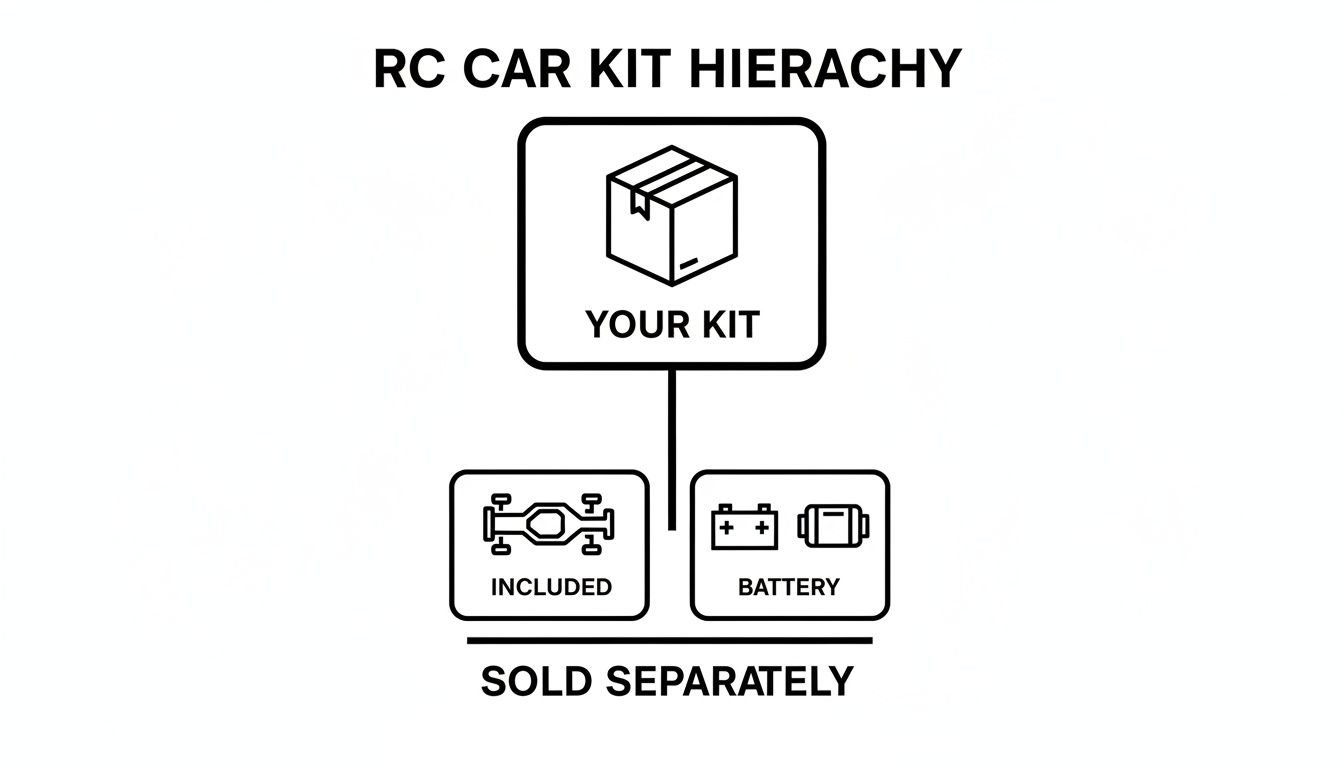
As you can see, the kit provides the heart of the car—the chassis and all the mechanical bits. The electronics that give it life and power are left for you to choose, allowing you to build the exact car you want.
The 1/10 Touring Car: The All-Round Competitor
Think of the 1/10 scale touring car as the workhorse of on-road RC racing. These are sophisticated all-wheel-drive machines with complex, four-wheel independent suspension, much like a real-world performance car. This design makes them incredibly versatile, able to perform on almost any surface, from high-grip indoor carpet to bumpy outdoor asphalt.
Kits from top-tier brands like Awesomatix, XRAY, and Mugen Seiki are true engineering marvels. They are packed with adjustments for camber, caster, toe, droop, and roll centres, giving you an insane amount of control to dial the car in for any track condition.
- Drivetrain: Usually a belt or shaft-driven all-wheel drive system, delivering fantastic traction and stability.
- Suspension: Fully independent with oil-filled shock absorbers, allowing for super precise handling tweaks.
- Tires: Rubber tires are the norm, with different compounds available to match track temperature and grip.
Because they're so complex, touring cars have a steeper learning curve for both setup and maintenance. But that adaptability is exactly why they're the most popular class at many clubs across Canada, so you'll never have a shortage of people to race against.
The 1/12 Pan Car: The Carpet Specialist
If a touring car is the versatile all-rounder, then the 1/12 scale pan car is the focused, razor-sharp specialist. These cars are much simpler by design, with a rear-wheel-drive layout, a solid rear axle, and a basic front suspension. They are unbelievably lightweight and built for one thing: pure, raw speed on high-grip indoor carpet.
The name "pan car" comes from its flat, pan-style chassis where all the components are mounted directly. The car's handling is managed through a pivoting rear "pod," with fine-tuning done via side springs, damper tubes, and the viscosity of the centre shock oil.
A 1/12 pan car is a masterclass in momentum and precision. With its direct drive and foam tires, it rewards a smooth, flowing driving style. It’s less about fighting the car through corners and more about guiding it with surgical accuracy.
Their simple design makes maintenance a breeze, but their lightning-fast reflexes mean they are incredibly sensitive to setup changes. A tiny adjustment can make a huge difference in how the car feels on the track. You can dive deeper into how chassis work in our guide on RC car chassis basics.
Comparison of 1/10 Touring and 1/12 Pan Car Kits
To help you decide, here’s a quick side-by-side look at what makes each class unique.
| Feature | 1/10 Touring Car | 1/12 Pan Car |
|---|---|---|
| Drivetrain | All-Wheel Drive (Belt or Shaft) | Rear-Wheel Drive (Direct) |
| Suspension | Fully Independent, Oil Shocks | Rear Pivot Pod, Basic Front |
| Best Surface | Carpet & Asphalt (Versatile) | High-Grip Carpet (Specialized) |
| Tires | Rubber | Foam |
| Complexity | High (Many Adjustments) | Low (Fewer, Sensitive Adjustments) |
| Driving Style | Aggressive, Point-and-Shoot | Smooth, Momentum-Based |
Ultimately, one isn't "better" than the other—they're just different tools for different jobs.
Making Your Decision
While the broader remote control toy car market is huge, electric RC cars are the clear favourite, making up 60% of the segment in 2024. This just goes to show that Canadian racers looking for high-performance kits from Digital RC are part of a dedicated, specialized community. Our entire inventory of 1/10 touring and 1/12 pan car kits is curated for serious enthusiasts like you who demand precision over mass-market toys.
So, how do you choose? It really comes down to your local track. If your club races mostly on indoor carpet, a 1/12 pan car is a fantastic, lightning-fast choice. But if you have access to both carpet and asphalt tracks, the sheer versatility of a 1/10 touring car makes it the more logical starting point for a long and successful racing journey.
Selecting Your Electronics Package
With your chassis sorted, it’s time to bring your new kit to life. The electronics package is the heart, brain, and nervous system of your RC car kit. Getting this part right is what turns a rolling chassis into a legitimate racing machine.
Each component has a job to do, and the goal is to create a balanced, reliable system that unlocks the full potential of your chassis. This is where your car gets its speed, its responsiveness, and its personality on the track. Let’s break down what you need to get to the podium.
The Four Pillars of Performance
Your electronics package is really four key components working in harmony. A bottleneck in any one of these areas will hold back the entire car, so choosing wisely is critical.
- The Motor: This is your car's muscle. It provides the raw horsepower and torque needed to launch off the line and pull down the straights.
- The Electronic Speed Control (ESC): Think of this as the brain. The ESC takes the signals from your radio and translates them into smooth acceleration and braking for the motor.
- The Steering Servo: These are the reflexes. A fast, precise servo is what allows you to clip apexes perfectly and navigate tight chicanes without a hint of hesitation.
- The LiPo Battery: This is your fuel tank. A quality battery delivers consistent, high-current power from the start of the race to the finish, ensuring you're just as fast on the last lap as you were on the first.
When these four parts work together seamlessly, you have a solid foundation for a competitive race car.
Matching Your Motor to Your Class
The first big decision is your motor, and this is almost always dictated by the rules of your racing class. On-road racing is generally split into two main categories: "spec" and "modified." It's all about controlling horsepower to create a level playing field.
Spec racing means everyone runs the same motor, typically a 17.5T or 21.5T brushless motor. The idea is to make the race about driver skill and chassis setup, not just who has the most power. Brands like Hobbywing offer race-proven spec motors that are staples in these classes, delivering the reliable, consistent performance needed to meet strict rules.
Modified racing is the "open" class. Here, the gloves are off. You can run incredibly fast, low-turn motors like a 4.5T or 5.5T. This class is a masterclass in throttle control and managing extreme power. For anyone new to racing, starting in a spec class is the best way to build your fundamental driving skills before jumping into the deep end.
Choosing the right electronics is about more than just raw power; it's about balance. A powerful motor is useless without an ESC that can handle it, a servo that can keep up, and a battery that can supply consistent current. Synergy is the goal.
Servos and Power Systems for Your Chassis
The chassis you chose also plays a big role in your electronics selection. The needs of a 1/10 touring car are vastly different from a 1/12 pan car.
A 1/10 touring car, with its all-wheel-drive system and more complex suspension, puts a lot of demand on the steering. You'll need a fast and powerful steering servo to keep up. A high-speed, low-profile servo from a brand like Sanwa is the go-to for competitive touring car drivers because it delivers the crisp, responsive, and perfectly centred steering you need for consistency. For more on this, check out our ESC selection guide.
On the other hand, a 1/12 pan car is all about shaving every possible gram. For this class, you’ll be looking for a lightweight, low-profile servo and a smaller, single-cell (1S) LiPo battery. The entire power system is designed for maximum efficiency and minimal weight to preserve the car's natural agility and corner speed.
Ultimately, your goal is to build a reliable, perfectly balanced system that works with your chassis and fits the rules of your chosen racing class.
From Assembly to Initial Setup
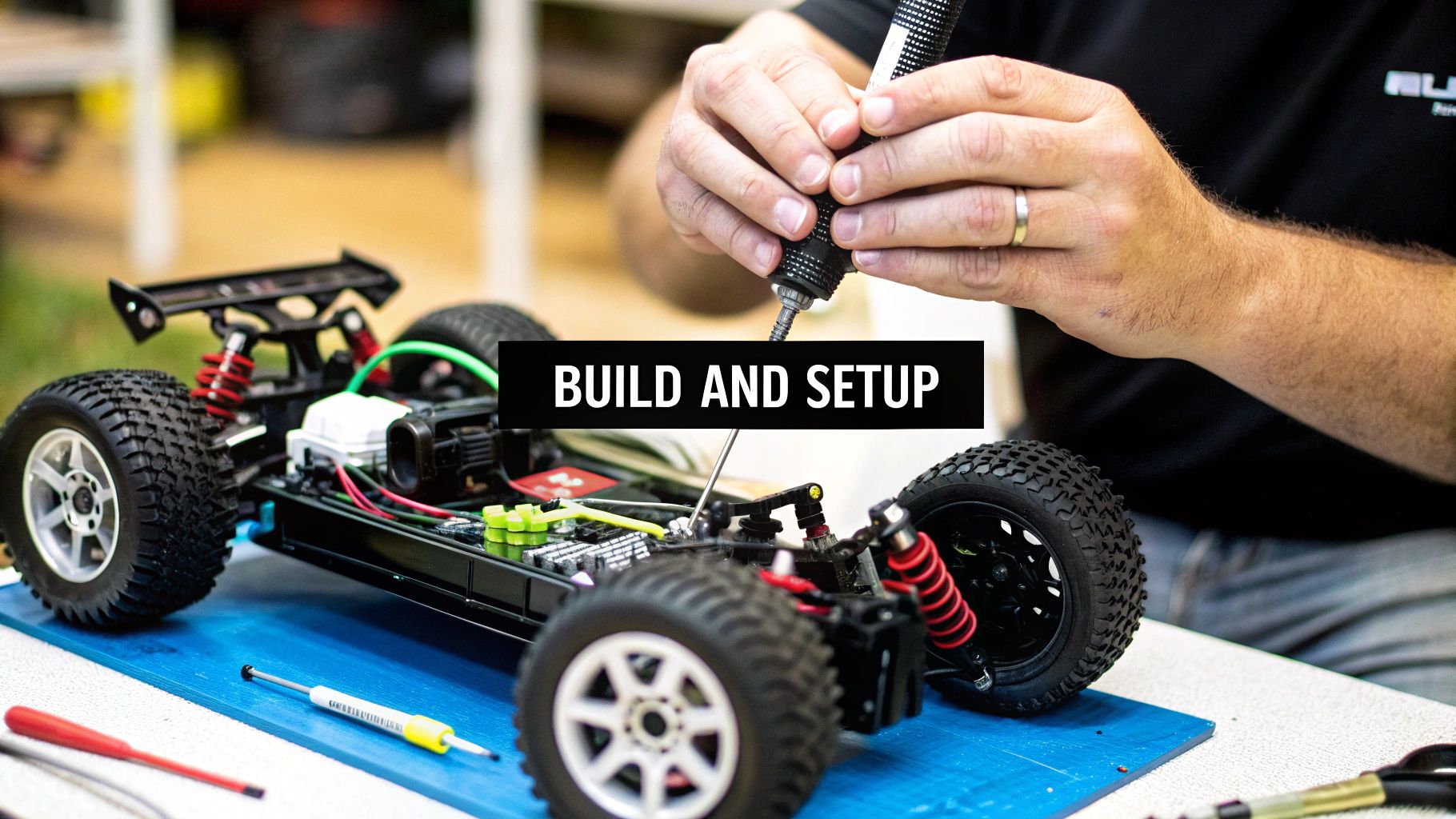
This is where the magic happens. The build process is your chance to transform a box of precision-machined parts into a legitimate, high-performance racing machine. But it's more than just following instructions; it's an education.
When you build your own RC car kit, you develop an intimate understanding of how every single component works together. That knowledge is priceless when you're trying to diagnose a handling issue or make a quick setup change between heats.
Think of yourself as the factory race mechanic for your own car. Your goal is precision and patience. Rushing this stage is the surest way to build a car that’s inconsistent and a nightmare to tune later on. Get a clean, organized workspace ready with good lighting. It makes a world of difference.
Best Practices for a Flawless Build
Any seasoned racer will tell you that a successful build comes down to good habits. It’s the small things you do on the workbench that separate a solid, reliable car from one that's constantly giving you problems.
Your instruction manual is your bible. Modern kits from top brands like Awesomatix, XRAY, and Mugen Seiki have incredibly detailed, computer-generated manuals that leave nothing to chance. Follow every step in order, and don't get tempted to skip ahead.
Here are a few tips that will make your build professional-grade:
- Use Quality Tools: Cheap hex drivers will strip screws and cause you endless frustration. Invest in a quality set—it pays for itself. A dedicated setup station is also essential for getting accurate measurements later.
- Apply Thread-Lock Correctly: Use a tiny drop of blue thread-lock on any screw going from metal to metal, like into an aluminum motor mount. Never, ever use it on screws going into plastic; it will make the plastic brittle and weak.
- Build Smooth Drivetrains and Shocks: When you build your differentials and shocks, you're aiming for silky-smooth, drag-free movement. A gritty diff or a sticky shock will make your car’s handling completely unpredictable.
The assembly phase is your first setup opportunity. How you build your shocks, the shims you use in your drivetrain, and the care you take in freeing up your suspension all contribute directly to the car's baseline performance.
If you're looking for a deeper dive into the fine points of assembly, we put together a comprehensive guide on the complete RC car kit build process that expands on these tips.
Establishing Your Baseline Setup
Once your rolling chassis is built, the next crucial step is the initial setup. This isn’t about fine-tuning for a specific track just yet. It’s about establishing a neutral, predictable starting point that will be easy to drive and respond logically to any adjustments you make down the road.
The "kit setup" included in the manual is almost always the best place to start. It’s a configuration developed by factory drivers to work well on a huge variety of surfaces.
Your first adjustments should focus on three fundamental settings. Using a setup station to get these right is non-negotiable for competitive racing.
- Ride Height: The distance from the bottom of the chassis to the ground. This affects how the car rolls in corners and handles bumps.
- Camber: The angle of your tires relative to the racing surface. This has a massive impact on cornering grip.
- Droop: This setting controls how far the suspension arms can travel downward, influencing weight transfer and traction.
By meticulously building your kit and nailing a solid baseline setup, you create a consistent platform. Your car is no longer just a collection of parts—it’s a reliable tool you can confidently tune to conquer any track you visit.
Why a Canadian RC Specialist Matters
Where you buy your RC car kit is just as important as which brand you choose. For racers in Canada, grabbing your gear from a dedicated local shop like digital-rc isn't just about convenience—it's a massive strategic advantage. It turns the whole buying process from a roll of the dice into a sure thing.
We’ve all been there. You find a sweet deal on an Awesomatix kit or a Hobbywing ESC from an international seller, and then the headaches begin. Surprise duties at the border, annoying currency conversion fees, and shipping delays that stretch for weeks can keep you off the track right when you need to be putting in practice laps.
A Canadian-focused specialist gets rid of all that noise. The whole point is to get you the parts you need, when you need them, without the cross-border logistical nightmare.
The Benefits of Buying Canadian
Shopping with a Canadian retailer means the experience is clean and simple. All prices are in Canadian dollars, so what you see at checkout is exactly what you pay. No more guessing games with exchange rates. Even better, with no tax on any orders and free same-day delivery for local racers, you can budget perfectly and get back to your workbench right away.
Think about it: you break a key part during a Thursday night practice session. Instead of waiting a week for a replacement to clear customs, you can have it in your hands that same day. That kind of speed and reliability is what keeps you in the game.
Sourcing your gear locally isn't just about making life easier; it's a competitive choice. Immediate access to parts means less downtime and more track time, giving you a real edge over rivals stuck waiting on international shipments.
A Curated Inventory Built for Racers
A true specialist shop does more than just move boxes. They offer a hand-picked inventory, meaning every single item—from an XRAY chassis to a Sanwa servo—has been selected because it performs and fits within the competitive on-road racing scene. You spend less time wondering if a part will work and more time dialing in your setup.
While some market reports show that offline retail still makes up about 70% of remote control car sales, a specialized online shop offers something unique. It blends the ease of e-commerce with the deep-level expertise of a pro shop, solving the classic frustrations racers have with the limited stock and slow access at big-box stores. You can dig into these market trends on Business Research Insights if you're curious.
This focused approach guarantees that whether you need a specific pinion gear or a full electronics package, you're getting race-proven equipment that will help you find those precious tenths of a second on the track.
Got Questions? We've Got Answers.
Jumping into the world of competitive RC car kits can feel overwhelming, whether it's your first build or your tenth. We get a lot of questions from racers, so we've put together some straight answers to the most common ones we hear trackside.
Our goal is to give you the practical, no-nonsense info you need to build with confidence, solve problems quickly, and get your car dialled in.
What are the absolute must-have tools for building a kit?
While every RC car kit has its quirks, a few core tools are non-negotiable for a clean, professional build. You absolutely need a quality set of metric hex drivers (1.5mm, 2.0mm, and 2.5mm are the big three), a sharp hobby knife for trimming parts, and a good pair of needle-nose pliers.
To make life easier, investing in a shock stand and air remover will help you build perfectly consistent shocks every time. Once you're ready for setup, a digital calliper and a dedicated setup station are vital for nailing those precise ride height and camber measurements.
Think of your tools as your pit crew. Good tools prevent stripped screws, ensure accuracy, and make the whole build process smoother and more enjoyable. They're a long-term investment in your racing program.
How do I figure out which tires and body to buy?
Tires and bodies are always sold separately because they're the primary way you tune your car's performance. For tires, the choice is almost always made for you by your local track. Just ask the race director or one of the veteran racers what the "spec" tire is for your class. This keeps everyone on a level playing field.
Body selection is all about feel and handling. Different bodies generate different levels of downforce and steering aggression. For instance, a Mon-Tech body might give you more aggressive turn-in, while a ZooRacing body could add some much-needed rear stability. A good strategy is to start with a neutral, all-around body and then experiment as you get more comfortable with the car.
What's the biggest mistake new builders make?
Hands down, the most common pitfall is over-tightening screws, especially when they're going into plastic or carbon fibre. It's so easy to strip the threads or even crack a part, which can lead to a race-ending failure. Just use a light touch and stop turning the moment the screw feels snug.
Another frequent error is skipping the prep work. Taking a minute to trim any leftover plastic flashing from moulded parts is huge. It ensures everything fits together perfectly, leading to a smoother, more reliable car. It's these small details that make a massive difference in performance and consistency on the track.
Ready to build your next winner? At digital-rc, we stock the latest kits and performance parts from Awesomatix, XRAY, Hobbywing, and more. Get CAD pricing, no tax, and free same-day delivery on your order. Find everything you need to hit the track at https://digital-rc.ca.