

Build Your Winning Remote Control Car Kit From Box to Podium
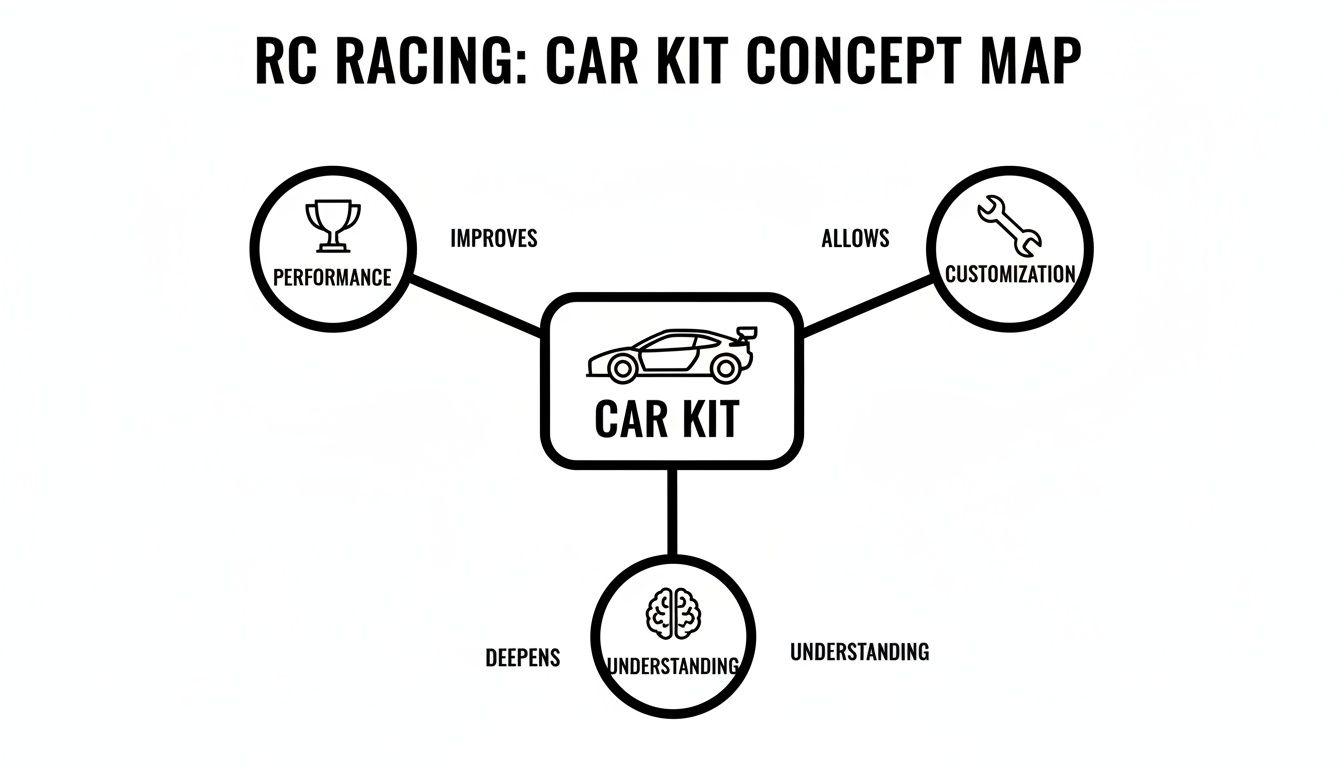
A competitive remote control car kit isn't a toy. It's your starting point for high-performance racing—a collection of precision-engineered parts that you assemble yourself. This builder-focused approach gives you unmatched customization and a deep, mechanical understanding of your vehicle. That knowledge is the foundation for reaching the podium.
From Parts to Performance: The Builder’s Advantage
Welcome to the thrilling world of competitive RC racing, where success is engineered long before your tires ever touch the track. This journey is all about transforming a box of premium components into a precision racing machine. The builder's advantage isn't just about having a faster car; it's about understanding why it's faster.
When you build your car from the ground up, you gain an intimate connection with every screw, spring, and gear. This hands-on experience is the first critical step toward consistent, podium-worthy results.
The Two Paths to On-Road Dominance
In the specialized field of on-road racing, two classes reign supreme. Each demands a unique approach to building and tuning, and at Digital-RC, we focus on providing Canadian racers with the very best options for these categories.
- 1/10 Touring Cars: These are the versatile workhorses of on-road racing. With all-wheel drive and complex independent suspensions, they excel on a variety of track surfaces, from asphalt to carpet. Brands like XRAY and Awesomatix are masters of this class.
- 1/12 Pan Cars: Think of these as the featherweight fighters, built for pure speed on high-grip indoor tracks. Their simple, direct-drive RWD design makes them incredibly responsive and efficient—a specialty of innovative brands like Awesomatix.
The decision to build from a kit is the most significant choice a competitive racer makes. It shifts your mindset from being a driver to being an engineer, giving you full control over your car's setup and performance potential.
As you get ready to assemble your race car, it's interesting to think about the journey those components took to get to you. Understanding the logistics behind what is kitting in the e-commerce world offers a glimpse into how your carefully selected parts were bundled into a complete package.
This guide is your roadmap, from unboxing those first pristine parts to fine-tuning your setup for that final tenth of a second. We're here to be your partner in this process, offering elite brands that give you a true competitive edge.
What’s Inside a High-Performance RC Chassis?
Think of a competitive remote control car kit not just as a box of parts, but as a complete performance system. When you open a kit from a world-class brand like XRAY or Awesomatix, you’re looking at an intricate puzzle where every single piece is engineered for one thing: speed. Understanding these core components is the first step toward building a car that dominates the track.
The foundation of any build is the chassis. This flat plate is the car’s skeleton, the mounting point for every other component. In elite 1/10 touring and 1/12 pan car kits, the chassis is almost always cut from high-grade carbon fibre.
There’s a good reason for this. Carbon fibre gives you an incredible strength-to-weight ratio, but its real magic is in its controlled flex. How the chassis twists and bends under cornering load is a primary tuning tool, directly affecting grip and responsiveness.
The Drivetrain: Putting Power to the Pavement
The drivetrain is the car's muscle, tasked with transferring the motor's raw power to the wheels as efficiently as possible. In on-road racing, you'll find two main designs, each with its own personality on the track.
- Belt-Drive Systems: Common in XRAY touring cars, these use reinforced belts to connect the motor to the front and rear differentials. The result is a silky-smooth power delivery, a huge advantage on lower-grip tracks where you want to avoid sudden wheel spin.
- Gear-Drive and Shaft-Drive Systems: Championed by brands like Awesomatix, these use gears and a central shaft for an incredibly direct power transfer. This setup is known for its explosive acceleration, making it a force to be reckoned with on high-grip carpet tracks where instant punch is king.
At the heart of the drivetrain are the differentials. These complex gear units let the inside and outside wheels spin at different speeds in a corner—absolutely essential for carving a smooth arc. Tuning them with different weight oils is a fundamental way to change how your car behaves.
The Suspension: Reacting to the Race Track
If the chassis is the skeleton, the suspension is the nervous system. It’s constantly reading the track surface to keep the tires planted for maximum grip. It's a system of several key parts working in perfect harmony.
Below is a quick breakdown of the core mechanical parts you'll be working with.
Core Mechanical Components of a Competitive RC Kit
| Component Group | Key Parts | Function on the Track |
|---|---|---|
| Chassis | Main Plate, Top Deck, Pod Plates | Provides the structural foundation and dictates the car's flex characteristics, influencing grip and responsiveness. |
| Drivetrain | Belts/Shafts, Differentials, Pulleys/Gears | Transfers motor power to the wheels. Fine-tuning affects acceleration, efficiency, and cornering behaviour. |
| Suspension | Shock Absorbers, Springs, Suspension Arms | Manages weight transfer and keeps tires in contact with the track surface for consistent grip over bumps and through turns. |
Each of these groups offers a deep well of tuning adjustments to find that perfect setup.
The most obvious suspension parts are the shocks and springs. The springs hold the car's weight, while the oil-filled shocks control, or "dampen," the speed of the suspension's movement. A simple change in spring rate or shock oil can totally transform how the car handles bumps and transitions in corners.
A well-tuned suspension is what separates a good car from a great one. It's the difference between a car that feels "on edge" and one that inspires confidence, allowing you to push harder and run more consistent laps.
Connected to the shocks are the suspension arms and linkages. These dictate the suspension geometry, controlling critical variables like camber (the tire's vertical angle) and toe (the tire's horizontal angle). Even a half-millimetre adjustment here can have a huge impact on turn-in, mid-corner stability, and traction on corner exit. For a deeper look at this foundational component, you can learn more about the intricacies of the RC car chassis in our detailed guide.
By understanding how the chassis, drivetrain, and suspension work together, you go from being just a driver to being a race engineer. Every part in your remote control car kit is a dial you can turn to find that perfect setup, giving you a real advantage when the race tone sounds.
Choosing the Right Racing Platform for You
Your first big decision on the road to the winner's circle happens long before you hit the track. It's choosing the right type of remote control car kit. This choice sets the stage for everything that follows—your build experience, how you tune the car, and your ultimate performance on race day.
The most fundamental split is between a Ready-to-Run (RTR) car and a true competition kit. While RTRs get you driving immediately, they're designed for casual fun, not serious racing. Racers who want to compete at a high level almost always start with an unassembled kit, and for good reason.
A proper kit gives you higher-quality components, endless tuning adjustments, and the invaluable mechanical knowledge you gain from building it yourself. Every part in a high-end XRAY or Awesomatix kit is engineered for one thing: performance. It’s the only way to build a solid foundation for top-tier competition.
The Great Divide: RTR vs. Competition Kit
Think of it like this: an RTR is like buying a car straight off the showroom floor. It runs perfectly fine, but it’s full of compromises made to keep the price down and appeal to a broad audience. A competition kit is like building a race car from the ground up with hand-selected, purpose-built parts.
- Ready-to-Run (RTR): These come pre-built, usually with basic electronics included, so you can start driving right away. The trade-off is softer plastics, looser manufacturing tolerances, and a lack of the precision adjustments needed to shave tenths off your lap times.
- Competition Kit: This is a box of precision-machined parts you assemble yourself. It comes with no electronics, giving you complete freedom to choose a race-winning motor, ESC, and servo combination. The materials—like high-grade carbon fibre and 7075 aluminum—are chosen for maximum strength and performance under the stress of racing.
Choosing a kit over an RTR is your first real commitment to competitive racing. You're investing in performance, control, and your own skills as both a driver and a mechanic.
This passion for building and tuning is what drives the hobby forward. In fact, North America's remote control toy car market, where Canada is a major player, held a massive 34.6% global share valued at USD 102.51 million. The growth is fueled by a culture of dedicated hobbyists who, like our customers, demand more than what an off-the-shelf product can offer. The electric segment's 60% dominance shows how high-performance LiPo batteries and brushless systems—the heart of any modern competition build—have become the standard. You can dig deeper into these numbers in the full remote control toy car market report.
Touring Car or Pan Car: Your On-Road Specialty
Once you've decided to build a kit, your next choice is the racing class. Here at Digital-RC, we focus on the two main on-road platforms, each with a completely different design and driving feel.
A 1/10 scale touring car is the RC equivalent of a high-tech rally car. It has a complex, four-wheel independent suspension and is almost always all-wheel-drive (AWD). This setup gives it incredible versatility and allows it to generate huge amounts of grip on everything from slick asphalt to high-bite carpet. If your local track runs races on different surfaces, a top-tier touring car from a brand like XRAY or Awesomatix is a perfect, adaptable choice.
On the other hand, a 1/12 scale pan car is a purebred racing scalpel. Its design is a masterclass in lightweight simplicity and efficiency. Featuring a direct-drive rear-wheel-drive (RWD) system with a solid axle, it's incredibly agile and responsive. This design, however, demands a perfectly smooth, high-grip surface to work its magic—which means it's almost exclusively an indoor carpet racer. For drivers who want the ultimate precision tool for carpet tracks, an Awesomatix pan car is the pinnacle of the class.
The best way to decide? Go to your local track. Talk to the racers there and see what classes are popular. Lining up on the grid in a popular class is the fastest way to get racing and improve your skills.
Mastering the Build Process Step by Step
This is where the real connection to your new car begins. Assembling a kit isn't just about following instructions; it's a hands-on education that turns a box of parts into a race-winning machine. The knowledge you pick up here is your secret weapon for fast trackside repairs and setup tweaks later on.
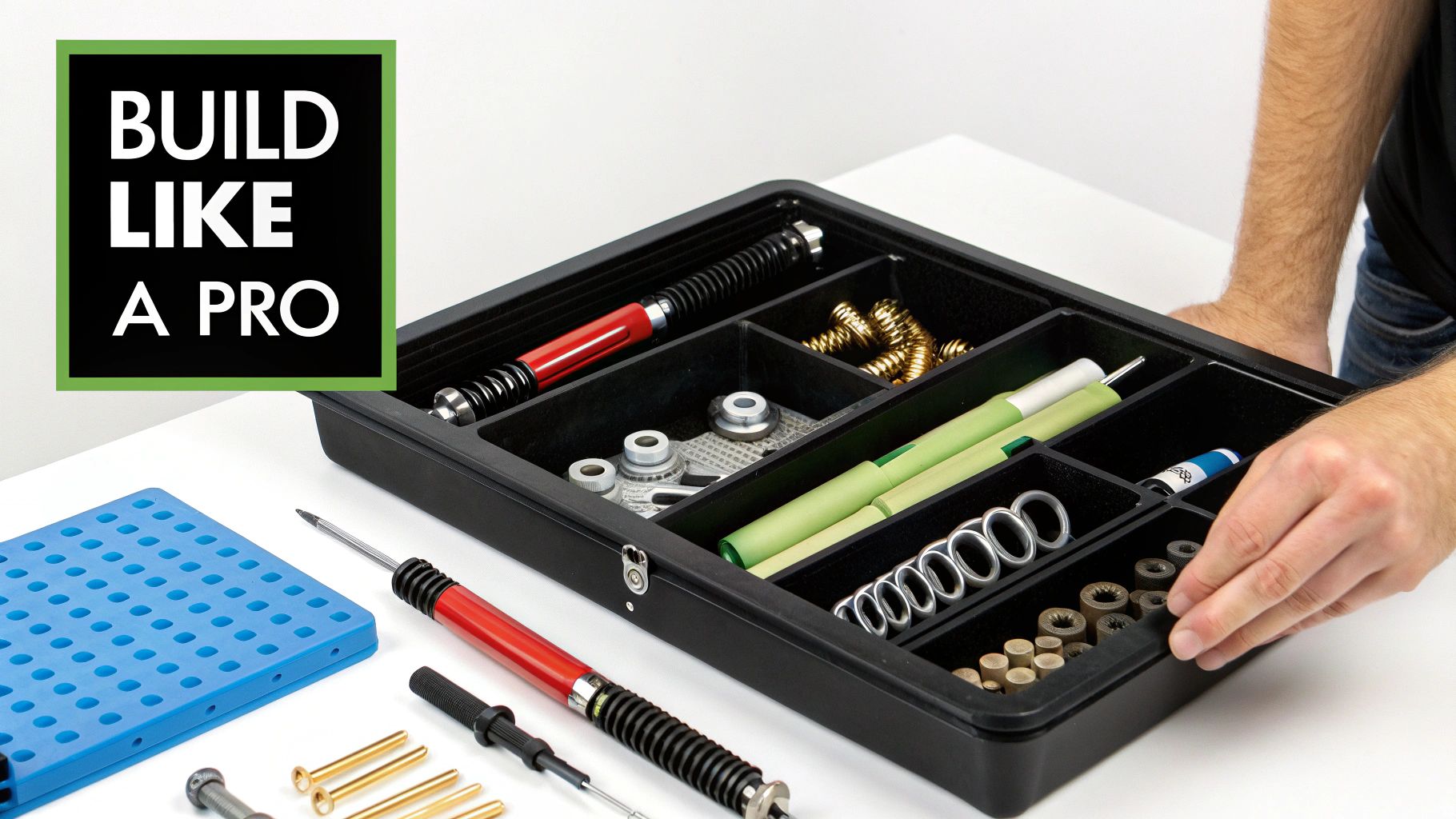
A good build starts before you even touch a part. Get yourself a clean, well-lit workspace. A pit mat is essential—it protects your table and stops tiny screws from disappearing into the void. Pro drivers use a segmented parts tray to keep everything organized, and you should too. It saves a ton of time and frustration.
Essential Tools and Pro Techniques
The right tools make all the difference. Ditch the cheap L-wrenches that come with some kits—they’ll just strip delicate screw heads. Invest in a quality set of hex drivers. Brands like Zoo Racing make precision tools specifically for the abuse of building and maintaining a competitive RC car.
As you get into the build, you’ll hit a few key steps that demand extra care. Nailing these techniques is what separates a good car from a great one.
- Building Perfect Shocks: This is practically an art form. Your goal is four identical shocks with perfectly smooth action and absolutely zero air bubbles. Air in the oil makes your car's handling unpredictable because the damping becomes inconsistent. Take your time, let the oil settle, and bleed every last bit of air out.
- Setting Gear Mesh: The "mesh" is the tiny gap between your pinion and spur gear. Too tight, and you'll generate a ton of friction, heat, and unnecessary wear on your motor. Too loose, and you'll strip the teeth right off the spur gear the first time you punch the throttle. The classic trick is to slide a small piece of paper between the gears as you tighten them to get the spacing just right.
- Applying Thread-Lock: Any screw that goes from metal into metal and is subject to vibration needs a tiny drop of blue thread-lock. Think motor mount screws or suspension pivot balls. This simple step prevents a critical screw from backing out mid-race and causing a catastrophic failure.
The Build as a Learning Process
The real payoff from building your own kit is the deep, intuitive understanding you gain of how every single part works together. Each page of the manual unlocks another piece of the performance puzzle.
By the time you've tightened the final screw, you're no longer just a driver; you're the car's chief mechanic. You'll know exactly which screw adjusts the camber, how to change the differential action, and what it feels like when a bearing starts to go bad. This knowledge is priceless when you have five minutes between heats to diagnose a handling issue.
This hands-on experience demystifies the car. Abstract setup terms like "roll centre" and "droop" become real, tangible adjustments you’ve made with your own hands. You start to see the car as a complete system, where a tiny change in one spot can have a ripple effect across the entire chassis.
As you get better at building, you'll start to appreciate a well-written guide. If you ever think about sharing your own custom mods or detailed build logs, learning how to create step-by-step guides is a fantastic skill to have. Ultimately, by embracing the build, you gain the confidence to push your car—and your driving—to its absolute limit.
Selecting Your Winning Electronics Package
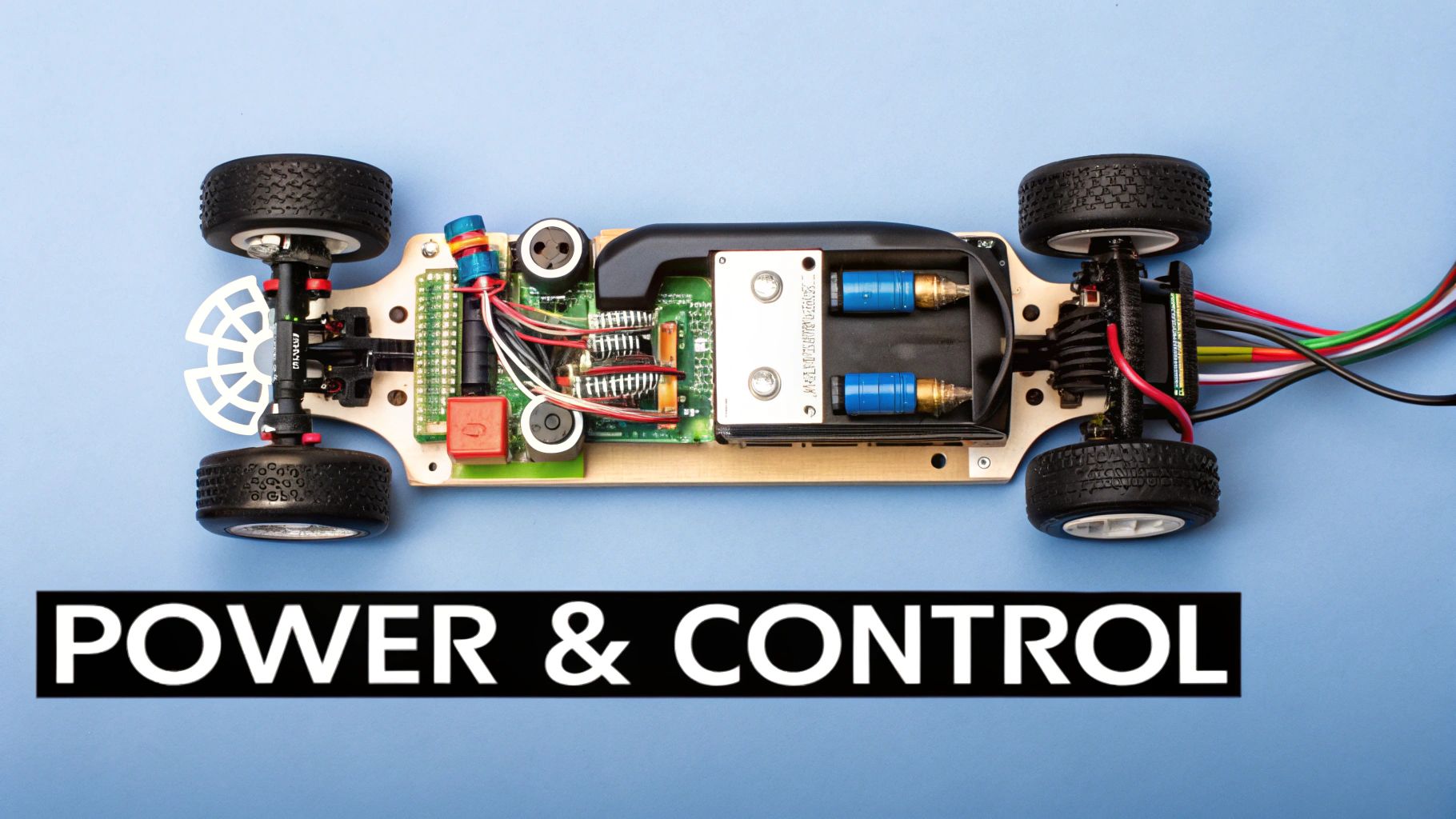
A perfectly built chassis is just a rolling sculpture until you give it a heart and a mind. The electronics package is what breathes life into your remote control car kit, turning a static model into a race-winning machine. Let's break down how to choose a combination that delivers reliable power and pinpoint control when every millisecond counts.
Your focus should be on the 'big four' components that dictate how your car accelerates, brakes, and steers: the Electronic Speed Control (ESC), the motor, the steering servo, and the battery. Getting this combination to work in harmony is absolutely critical for success on the track.
The Brains and Brawn: ESC and Motor
Think of the Electronic Speed Control (ESC) as the car’s central nervous system. It takes your throttle and brake inputs from the receiver and translates them into precise power delivery to the motor. A high-quality ESC from a proven brand like Hobbywing isn't just about making the car go; it opens up a massive range of tuning options, letting you fine-tune everything from drag brake strength to power delivery curves.
The motor is the engine, and in competitive racing, you'll run into two main categories:
- Spec Motors: These have a fixed turn rating (like 17.5T or 21.5T) that’s mandated by the race rules to create a level playing field. The game here is all about maximizing efficiency and nailing the perfect gear ratio.
- Modified Motors: This is where the gloves come off. Modified is all about raw power, with very low turn ratings (think 4.5T or 5.5T). Taming this beast with a smooth throttle finger and a perfectly tuned ESC is the secret to blistering lap times.
Brands like Team Powers are known for producing motors that deliver consistent, reliable power—exactly what you need when you're fighting for the win. Whether you're in a spec or modified class, a premium motor and ESC combination is simply non-negotiable.
Precision Control: The Steering Servo
Your steering servo is the direct link to the car's front wheels. In the fast-paced world of on-road racing, your ability to make tiny, instant corrections is what separates a good lap from a great one. This is where a lightning-fast, high-torque servo is absolutely essential.
A slow or imprecise servo is like trying to draw a perfect circle with a crayon. A top-tier servo, like one from Sanwa, is like using a drafting compass—it goes exactly where you tell it to, with no hesitation or slop. That precision gives you the confidence to push the car right to its limits.
This passion for precision is strong in Canada, which thrives within North America's leading 36% global market share for RC cars. Hobbyists account for over 40% of these sales, driving the demand for advanced kits and electronics. Electric RC cars command 60% of this segment, a perfect fit for the indoor pan car racing popular among Canadian tinkerers who love optimizing their ESCs and batteries. You can explore more data on the North American remote control toy car market for deeper insights.
The Power Source: Choosing Your LiPo Battery
Finally, the battery is your fuel tank. For competitive on-road racing, Lithium Polymer (LiPo) batteries are the universal standard because of their high power density and light weight. The specific type you need is dictated by your racing class.
- 2S (7.4V) LiPo: This is the standard for 1/10 scale touring cars.
- 1S (3.7V) LiPo: This is used in the ultra-lightweight 1/12 scale pan cars.
When picking a battery, look for a high "C" rating. This indicates its discharge capability—a higher number means it can deliver more power on demand for better acceleration. Investing in a quality LiPo from a reputable brand like Team Powers ensures you have consistent voltage and punch throughout an entire five-minute race.
To dive deeper into the world of speed controllers, check out our guide on the RC Electronic Speed Control. Combining the right ESC, motor, servo, and battery creates a complete system that works in harmony, giving you the reliable and responsive performance needed to stand on top of the podium.
Sourcing Your Kit in Canada with Digital-RC
If you're a Canadian racer, you know the drill. Finding a competitive remote control car kit and the right parts can be a real headache. Sourcing from outside the country often means playing a guessing game with currency conversion, getting hit with surprise import duties, and waiting on shipping delays that can completely derail a race weekend.
This is exactly why we started Digital-RC. We’re a Canadian-based specialty shop built for the on-road racing community. Our entire focus is on getting you what you need quickly and affordably, without all the usual frustrations. When you shop with us, you're not just buying parts—you're getting a home-track advantage before you even open the box.
The Digital-RC Advantage for Canadian Racers
We built our entire operation around what matters most to you: speed, simplicity, and value. Forget the cross-border headaches. We handle the logistics so you can spend less time waiting for the mail and more time on the track.
Here’s what makes shopping with us a different experience:
- All Pricing in Canadian Dollars (CAD): The price you see is the price you pay. No more mental math or nasty surprises on your credit card bill. It makes budgeting for your race season simple and predictable.
- Zero Tax on Every Order: This is a huge saving that adds up fast, whether you're grabbing a full Awesomatix kit or just a few spare parts. It makes top-tier equipment that much more accessible for every racer in Canada.
At Digital-RC, our mission is simple: support Canadian racers with a better way to buy. We cut out the financial friction and logistical delays so you can build, tune, and compete at your best, no compromises.
Get on the Track Faster
In racing, timing is everything. A broken part on Thursday can easily mean missing the race on Saturday if you can’t get a replacement in time. We’ve designed our logistics to be the fastest and most reliable in the country for competitive RC parts.
Our commitment to your race program includes free same-day delivery for all orders placed before noon. This service is an absolute game-changer. A last-minute need for a specific part—or even a whole new kit—doesn't have to keep you on the sidelines.
From your first kit to every upgrade down the road, we deliver the speed you need to stay in the fight. If you want to learn more about finding quality parts locally, check out our guide on finding RC car stores near you. This exceptional service, combined with our carefully curated selection of elite brands, is what makes us the ultimate resource for the Canadian RC racing community.
Common Questions About Building a Remote Control Car Kit
Diving into your first competitive remote control car kit can feel a little overwhelming. You've got the box open, the manual laid out, and a hundred tiny bags of parts staring back at you. It's totally normal to have questions.
Here are some of the most common things we get asked by racers across Canada, whether they're seasoned pros or just getting started.
What Are the Absolutely Essential Tools I Need?
First things first, a quality set of hex drivers is non-negotiable. Forget the little L-wrenches that come with some electronics. You need proper drivers in 1.5mm, 2.0mm, and 2.5mm sizes—these will handle nearly every screw in your build.
A few other must-haves for your toolbox include a good pair of needle-nose pliers for getting into tight spots, a sharp hobby knife for cleaning up plastic parts, and dedicated shock pliers. Trust me, using regular pliers on your shock shafts is a quick way to scratch them and cause leaks.
Investing in proper RC-specific tools from brands like Zoo Racing isn't just about making the build easier; it's about preventing stripped screw heads and ensuring everything is assembled with precision. You'll also find that most kits call for nut drivers, typically 5.5mm and 7.0mm, for things like wheel nuts and ball studs.
How Do I Choose Between a Belt-Drive and a Gear-Drive Car?
This one comes down to where you'll be racing most often. Belt-drive cars, like the top-tier touring car kits from XRAY, are known for their buttery-smooth power delivery. That smoothness is a massive advantage on lower-grip tracks where you’re trying to avoid wheelspin and keep the car hooked up.
On the other hand, gear-drive cars, a design perfected by the engineers at Awesomatix, give you an incredibly direct and instant connection to the wheels. This setup shines on high-grip carpet tracks where you need that immediate punch out of the corners. The best advice? Go to your local track, walk the pits, and see what the fast guys are running.
The most important decision isn't about which system is "better," but which one is better suited to where you'll be racing. Matching your chassis to your track is a fundamental step toward success.
Should I Stick to One Brand for All My Electronics?
Definitely not. In fact, it’s rare to see a top-level racer running a complete electronics package from a single manufacturer. The goal is to build the best possible system for your specific car and racing class, and that almost always means mixing and matching components.
A championship-winning setup might use a Sanwa servo for its unmatched precision, a Hobbywing ESC for its powerful software and tuning options, and a Team Powers motor for its proven reliability. The key is ensuring everything is compatible. You need to make sure your ESC can handle your motor (spec vs. modified) and that your servo can handle the voltage you plan to run.
Why Aren't Bodies and Tires Included in the Kit?
Because they are two of the most powerful tuning tools you have. The "best" tire or body changes completely from track to track, and even day to day. A certain tire compound from a brand like MR33 might be the hot ticket at one track, giving you incredible grip, but be totally useless at another with different carpet or asphalt.
It’s the same story with bodies. Different styles from brands like Mon-Tech or Zoo Racing create different aerodynamic effects. One might give you more aggressive steering, while another provides more rear stability. Selling them separately gives you the freedom to choose the perfect combination for the race you're at, ensuring your car is perfectly dialled in for the conditions.
Ready to build your path to the podium? Explore our curated selection of high-performance kits and parts at digital-rc and experience the advantage of Canadian-based support and tax-free shopping. Find your next winning chassis today at https://digitalrc.ca.