

Your Ultimate Canada LiPo Battery Guide for RC Racing
Picking the right canada lipo battery is the secret sauce to unlocking your RC car’s real potential on the track. For on-road racers, this isn’t just a small decision—it directly dictates your speed, consistency, and competitive edge. It's one of the most critical choices you'll make for your setup.
Choosing the Right RC LiPo Battery in Canada
In the hyper-competitive world of on-road RC racing, the LiPo battery is the heart of your machine. It’s so much more than a simple power source. It’s the component that defines your car's punch out of the corners, its top speed down the straightaway, and its ability to hold that power through a grueling five-minute qualifier.
Making the right choice can feel overwhelming, but this guide is here to cut through the noise. We'll get straight into what matters most for Canadian racers, breaking down the essentials of our hand-picked 1S and 2S LiPo batteries from top brands like Hobbywing and Team Powers, built for 1/10 touring and 1/12 pan cars.
Your Home-Track Advantage
Getting your batteries from a Canadian supplier like digital-rc gives you a real home-track advantage. The benefits are practical and immediate, keeping you on the track without the usual headaches.
- CAD Pricing: Everything is in Canadian dollars. No more guessing games with currency conversion fees or surprise costs on your credit card statement.
- No Tax: All orders ship with no tax, making top-tier performance gear that much more affordable.
- Free Same-Day Delivery: Get the power you need, right when you need it. Forget about waiting for packages to clear customs or dealing with cross-border shipping delays.
This local focus is backed by a growing domestic industry. By 2025, Canada's battery manufacturing revenue is projected to hit $484.3 million, with lithium-ion accumulators—the tech behind our LiPos—leading the charge. This growth means a reliable supply of high-performance batteries for Canadian racers.
Think of this guide as your roadmap to making smarter, faster, and more confident battery choices. We'll demystify core concepts like C-ratings and capacity, showing you exactly how they translate to performance on the track. For a deeper look at specific configurations, check out our guide on the 7.4v LiPo battery.
How to Decode LiPo Specs for Peak Performance
A LiPo battery label can look like a foreign language, but cracking that code is your first step to shaving seconds off your lap times. These specs aren't just technical jargon; they're the blueprint for your car's power delivery, runtime, and overall competitiveness on the track.
Think of it like this: capacity (mAh) is your fuel tank, telling you how long you can run. The C-rating is your fuel line, dictating how fast that power can surge to your motor. Finally, the cell count (S) is the octane rating—a higher number means a bigger punch. Understanding how these three work together is the key to unlocking real performance.
There's a reason this tech dominates high-demand racing. Canada's secondary battery market hit USD 2,649.8 million in 2024, and the lithium-ion batteries used in RC racing commanded a staggering 83.87% revenue share. That stat highlights their unbeatable edge where high discharge rates and sustained speed are everything. You can read the full research on secondary batteries in Canada to see just how prevalent this technology has become.
Matching Cell Count to Your Racing Class
The most fundamental spec on any LiPo is the cell count, shown by the "S" number. Each "S" stands for a single 3.7V cell. In the world of on-road RC, the choice almost always boils down to a 1S or 2S pack. Your racing class makes that decision for you.
-
1S LiPo (3.7V): This is the standard for 1/12 scale pan cars. These lightweight, nimble machines don't need the raw voltage of a 2S pack. A 1S configuration gives you the perfect blend of power and low weight, crucial for explosive acceleration and razor-sharp handling on tight, technical tracks.
-
2S LiPo (7.4V): This is the go-to for 1/10 scale touring cars. The higher voltage delivers the punch and top-end speed needed for these larger, heavier cars on bigger tracks. It provides the sustained power required to drive sophisticated 4WD systems at a blistering pace.
Using the wrong cell count isn't a matter of preference—it's a matter of compatibility. Your ESC and motor are designed for a specific voltage range. Mismatching them will lead to poor performance at best, and fried electronics at worst.
This decision tree gives you a quick visual guide for picking the right battery based on your car, budget, and where you get your parts.
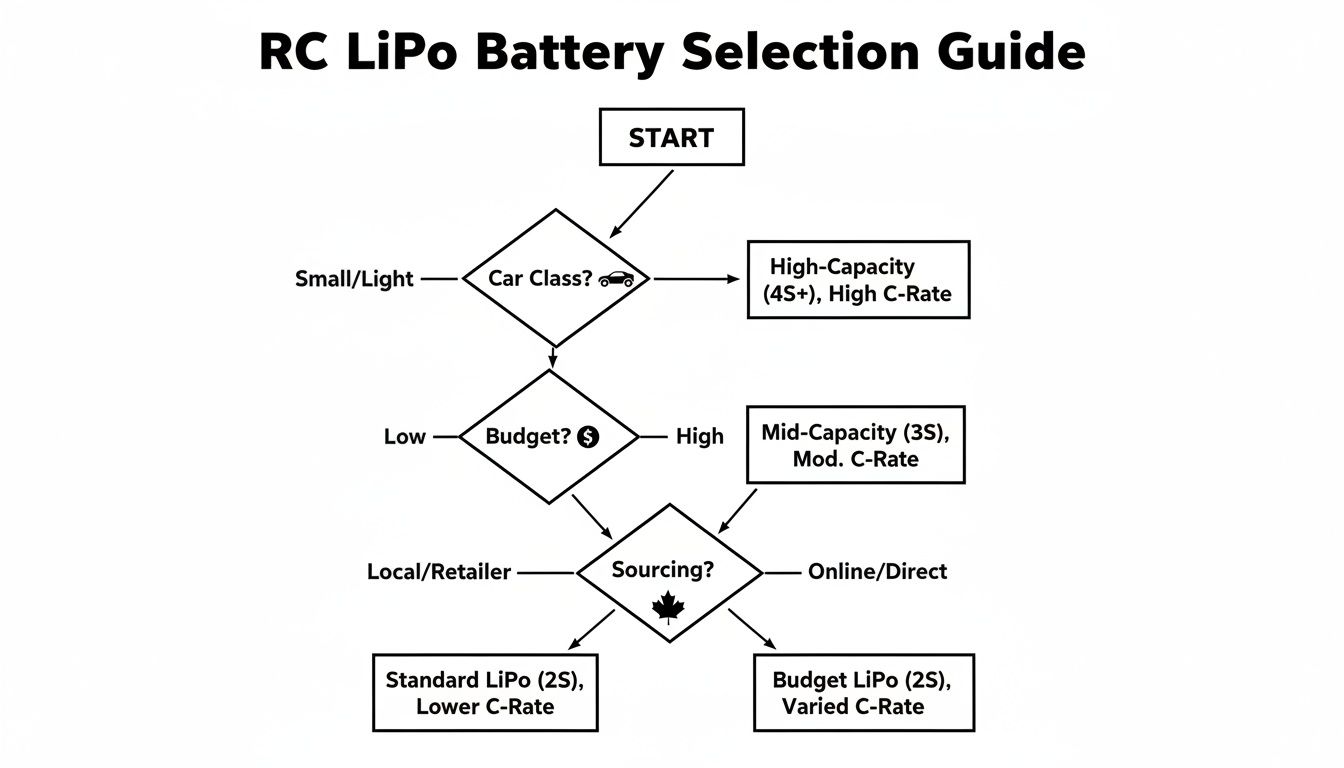
As you can see, your car class is the first and most important filter, immediately pointing you toward either a 1S or 2S LiPo.
Capacity vs. C-Rating: The Performance Trade-Off
Once you've locked in your cell count, the next decision is balancing capacity (mAh) and C-rating.
Capacity, measured in milliamp-hours (mAh), is all about runtime. A higher mAh means you can stay on the track longer before pitting. Simple enough. The C-rating, or discharge rate, measures how quickly the battery can safely dump its energy. A higher C-rating gives you more "punch" and keeps your voltage from sagging under a heavy load.
But here's the trade-off: higher capacity and C-ratings almost always mean a heavier, bulkier battery. In on-road racing, where weight and balance are everything, finding the right compromise is critical. A battery with massive capacity might hurt your car's agility more than the extra runtime helps your final result.
This table breaks down how our 1S and 2S packs are typically configured for their respective classes, helping you see how these specs translate to real-world racing.
Choosing Your LiPo Battery: 1S vs. 2S for On-Road Racing
| Specification | 1S LiPo Battery | 2S LiPo Battery |
|---|---|---|
| Primary Class | 1/12 Scale Pan Car, World GT-R | 1/10 Scale Touring Car (Stock & Modified), Formula 1 |
| Voltage | 3.7V (Nominal) | 7.4V (Nominal) |
| Key Advantage | Extremely lightweight, improving the car's agility and cornering speed. | Delivers higher voltage for more power, punch, and top-end speed. |
| Best For | Technical tracks where nimble handling and quick direction changes are vital. | Larger tracks where maintaining high speeds on long straights is necessary. |
| Typical Range | 8000-8400mAh with 120C+ ratings | 5000-6400mAh with 120C+ ratings |
Ultimately, choosing the right LiPo isn't about finding the biggest numbers. It’s about matching the battery's characteristics to your car, your class rules, and the demands of the track you're racing on.
Fitment, Connectors, and Safe Charging
Once you’ve nailed down the specs, it’s time to focus on the details that separate a great race day from a frustrating one. How a battery physically fits in your chassis and how you charge it are just as critical as its voltage or C-rating. A perfect fit keeps your car balanced and predictable, while proper charging protects your investment and, more importantly, keeps you safe.
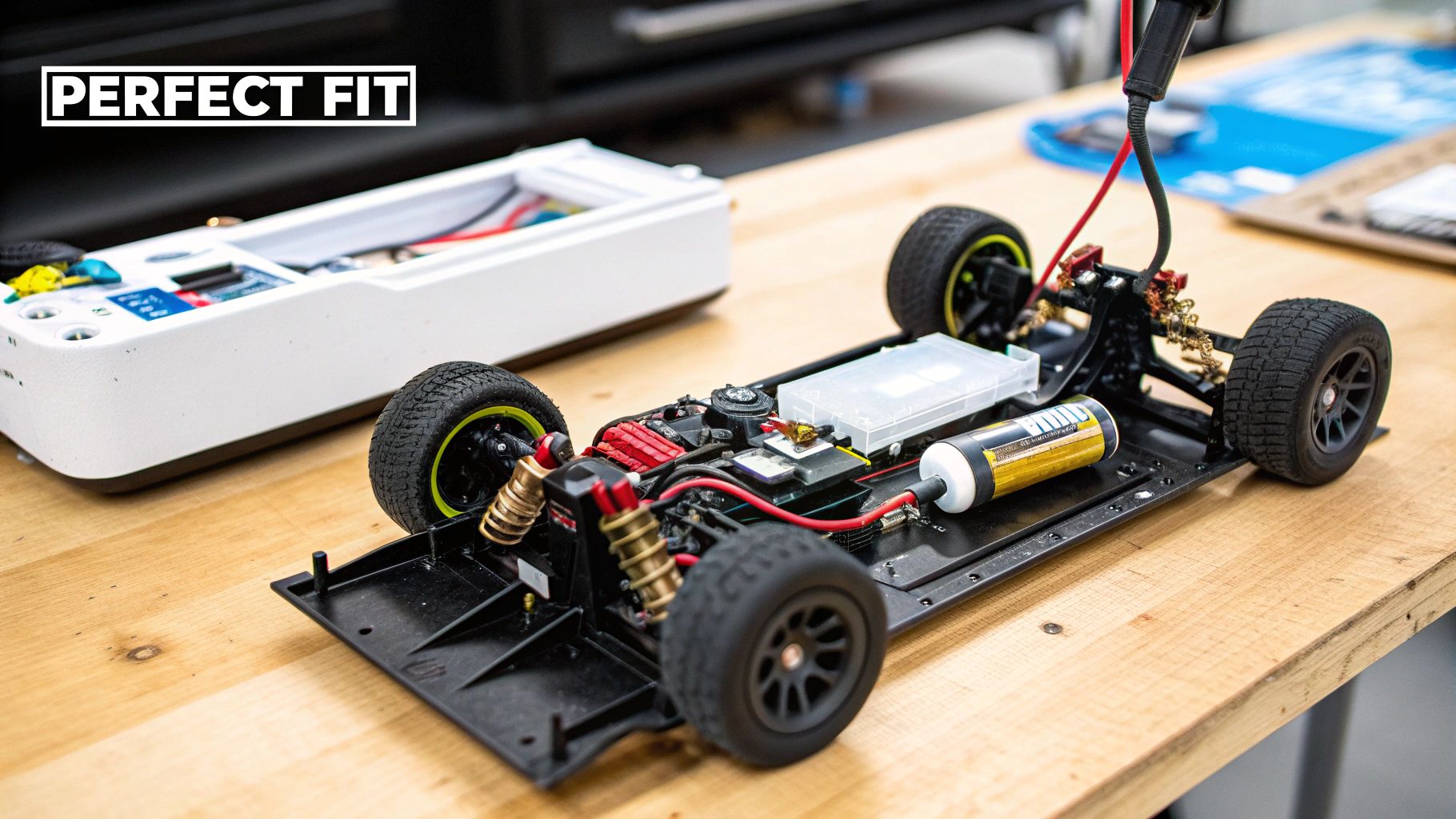
Let’s start with connectors. All our race-spec batteries come equipped with high-quality 5mm bullet connectors. They create a direct, low-resistance connection between your battery and ESC, ensuring every ounce of power gets to your motor without creating heat or voltage drop. A weak solder joint or a cheap connector is just asking for inconsistent performance or a failure mid-race.
Getting the Chassis Fit Just Right
In a precision-tuned chassis from Awesomatix or XRAY, every millimetre and gram counts. A battery that’s too tall, too long, or even a few grams too heavy can completely throw off your car's handling. It's not just about cramming it in there; it’s about preserving the car’s intended weight distribution and centre of gravity.
- Dimensions Are Everything: Our selection of Hobbywing and Team Powers batteries is curated to fit perfectly in popular touring and pan car chassis. Always check the product dimensions against your battery tray.
- Weight and Balance: The battery is the heaviest single component in your car. Use it to your advantage. Get a set of scales and use the battery’s position to nail your left-to-right balance and fine-tune your front-to-rear weight bias.
The good news for Canadian racers is that our local cleantech sector is booming, ensuring we have a solid supply of top-tier cells. In 2024, Canada's lithium carbonate market—a key ingredient for our batteries—hit USD 1,407.0 million in revenue, with Li-ion batteries making up 61.85% of that. This homegrown focus means we get reliable, high-performance canada lipo battery packs right when we need them.
Safe Charging: The 1C Rule and Balancing Act
If there's one thing you absolutely cannot skip, it's safe charging. Getting this wrong is not only dangerous but will also kill your expensive race packs in no time. A quality balance charger isn't an optional extra; it's essential equipment. It’s also worth understanding the basics of a Battery Management System (BMS), which is the brains behind protecting the battery during charging and discharging.
The foundation of safe LiPo charging is the 1C rule. It’s a simple guideline: set your charger’s amperage to match the battery's capacity. Just divide the battery's mAh by 1000 to get the right number.
The 1C Charging Formula:
(Battery Capacity in mAh) / 1000 = Max Safe Charge Rate in AmpsSo, for a 6000mAh battery, the 1C rate is 6.0 amps. For an 8400mAh pack, it’s 8.4 amps.
Sure, some batteries claim they can handle higher charge rates like 2C or even 5C, but pushing them that hard stresses the internal chemistry. Stick to the 1C rule. Your batteries will thank you with a much longer and more reliable service life.
The other half of the equation is balance charging. A 2S LiPo has two cells inside, and they must always have the same voltage. By using that small white balance plug, your charger monitors each cell individually and keeps them perfectly matched. If you skip this, you’ll end up with an unbalanced pack where one cell gets overcharged while the other is undercharged—a guaranteed way to permanently damage it. To get the full picture, check out our guide on how to choose the best LiPo battery charger.
And one last thing: always, always use a LiPo-safe charging bag or a fire-resistant box. It’s a simple step that contains any potential issues and gives you critical peace of mind while you’re powering up for your next win.
Mastering LiPo Safety, Storage, and Disposal
If you want your LiPo batteries to last and keep you safe at the track and at home, you have to treat them with respect. This is more than just following a list of rules; it's about building smart habits that protect you, your gear, and your investment. Let's walk through the essentials for storage, transport, and disposal, specifically for racers here in Canada.
Proper storage is easily the most important habit you can develop. You should never leave a LiPo sitting fully charged or completely dead for any length of time. Both extremes put a ton of stress on the battery's internal chemistry, causing permanent damage and cutting its performance and lifespan short.
The key is to keep your packs at a storage voltage of roughly 3.8V to 3.85V per cell. At this voltage, the battery's chemistry is at its most stable, minimizing degradation and the risk of something going wrong. Think of it as putting the battery into hibernation—it’s not ready to race, but it’s safe and sound for a long rest.
Best Practices for Home Storage
Once you've got your LiPo to the right storage voltage, where you put it is just as important. You need a cool, dry place, far away from anything flammable. A dedicated spot in a garage or workshop, out of direct sunlight and away from big temperature swings, is perfect.
For Canadian racers, this is a big deal during our brutal winters and hot summers. Leaving a LiPo in a freezing shed or a car baking in the sun will kill its cells for good. While LiPos can handle a wide range of temperatures during use, storing them requires much more stable conditions.
To add that crucial layer of safety, always use one of these solutions:
- LiPo-Safe Bag: Made from fire-resistant materials, these bags are designed to contain a fire if the worst happens. They’re cheap, portable, and an absolute must-have.
- Metal Ammunition Can: A popular choice if you have a lot of batteries. They’re tough and provide excellent containment. Just make sure you remove the rubber seal from the lid to let it vent in the unlikely event of a failure.
Nailing these simple steps takes the anxiety out of battery storage and makes it a routine part of your race prep. For a deeper dive into the science, our guide explains everything you need to know about LiPo battery storage voltage.
Transporting LiPos to the Track
Getting your batteries to the track safely is simple if you follow a few guidelines. While Transport Canada has specific rules for shipping batteries, carrying them to a local race is much more straightforward.
Always carry your LiPo batteries in a LiPo-safe bag or a hard case. This keeps them from getting punctured by tools or other sharp objects in your pit bag. Make sure the terminals are covered or protected so there's no chance of a short circuit. It's also a good idea to secure them inside your vehicle so they don't slide around. If you’re flying to a major event, always check the airline’s policy on LiPo batteries beforehand—they can be very strict.
Responsible Disposal and Recycling
Every LiPo has a limited lifespan. When you notice a pack is puffy, damaged, or just won't hold a charge anymore, it's time to retire it responsibly. Never just toss a LiPo battery in your regular garbage. It's a huge environmental hazard and, more importantly, a serious fire risk for sanitation workers and facilities.
The right way to do it involves two steps:
- Fully Discharge the Battery: Use your charger's discharge function or a simple light bulb rig to safely drain the battery all the way down to 0V. This makes it chemically inert and safe to handle.
- Recycle It Properly: Take the fully discharged battery to a designated battery recycling centre. Many electronics stores and municipal waste depots across Canada have collection programs.
When your LiPos reach the end of the road, proper disposal is non-negotiable. Look into specialized battery recycling solutions to find certified facilities that can handle them correctly and keep them out of landfills.
Troubleshooting Common Issues and Extending Battery Life
Even the best LiPo batteries take a beating in the high-stakes world of RC racing. This section is your pit-side guide to spotting common problems and getting the most out of every pack. Learning to catch issues early and sticking to a few good habits will keep your batteries delivering consistent, race-winning power for a long time to come.
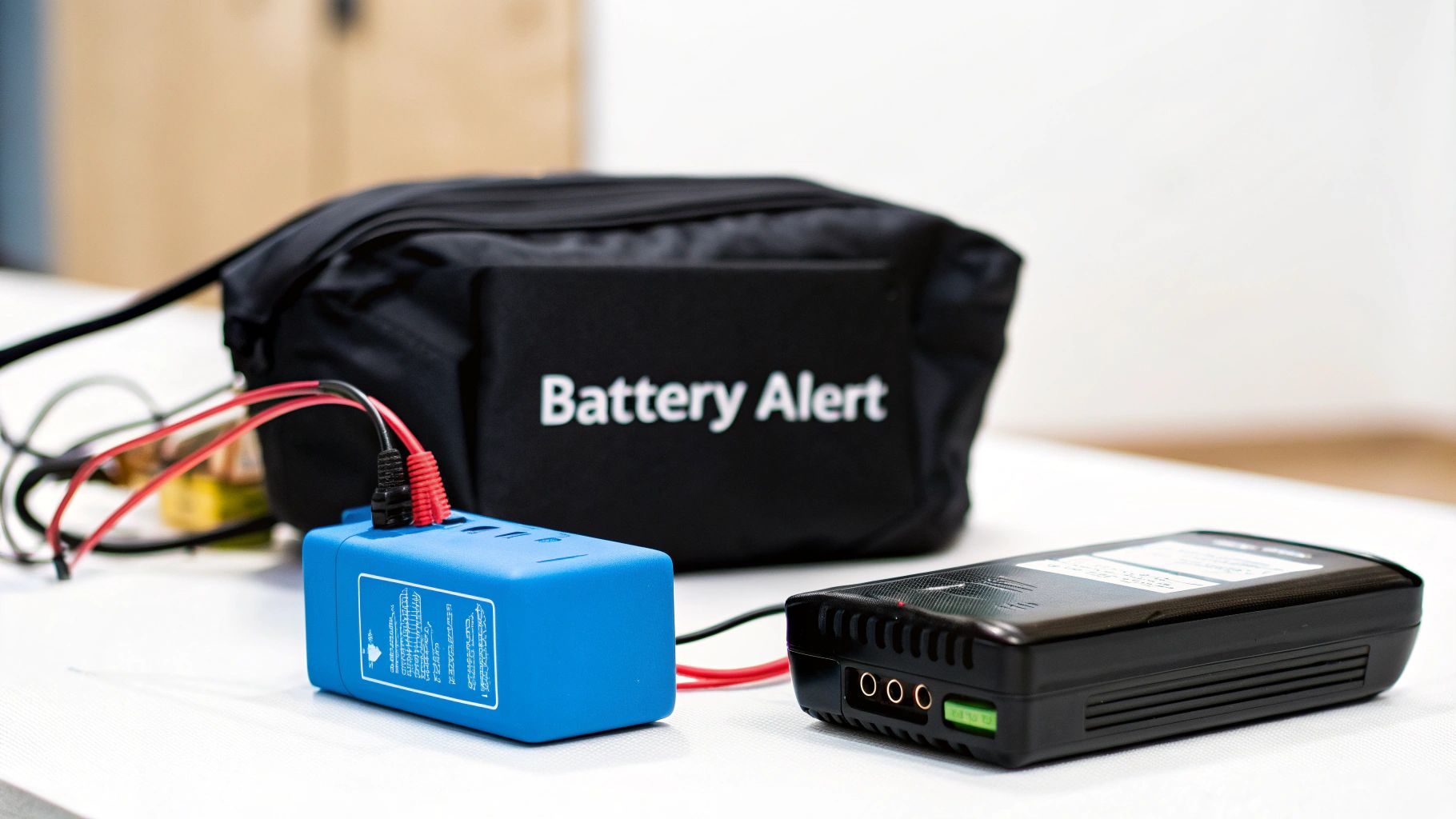
We'll tackle the most frequent issues you'll run into, starting with the big one: a swollen or "puffed" battery. You'll also learn how to diagnose other problems, like stubborn cell imbalances or a pack that just won't hold a charge anymore, with simple checks you can do right at your pit table.
Identifying Critical Battery Failures
Knowing when a battery is done is a non-negotiable safety skill. The most obvious—and most dangerous—sign is puffing, where the battery's hard case starts to bulge or swell.
That swelling is caused by gas building up inside the cells. It's a clear sign the internal chemistry is breaking down from being over-discharged, over-charged, physically damaged, or just plain old. This is an irreversible failure.
A puffed LiPo is a serious warning. There's no fixing it. That battery is now a major fire risk and needs to be retired from service immediately and safely. Trying to use or charge a puffed battery is asking for trouble.
Besides puffing, a few other red flags tell you a battery has reached the end of the road:
- Physical Damage: Any cracks, dents, or deep gouges in the hard case have compromised the battery's safety.
- Persistent Cell Imbalance: If your balance charger constantly fights to get the cells even, or one cell is always way lower than the others, that pack is on its way out.
- Drastic Drop in Performance: A sudden loss of runtime or a noticeable lack of punch on the track means the battery can't deliver the current you need for racing anymore.
Proactive Care to Maximize Battery Lifespan
The best way to deal with problems is to stop them before they start. Making your canada lipo battery packs last longer comes down to consistent, smart habits. A simple checklist will pay off in both performance and longevity.
Here are the essentials for proactive care:
- Monitor Your Charge Cycles: LiPos don't have a "memory" like old-school batteries, but they do have a limited number of charge/discharge cycles. Keeping a rough count of how many runs are on each pack helps you know when performance might start to fade.
- Avoid Over-Discharging: This is the #1 killer of LiPo batteries. Always set your ESC's low-voltage cutoff (LVC) to 3.4V per cell at a minimum. Never, ever run a battery completely dead. The moment you feel the power fade, pull it off the track.
- Use a Battery Checker Regularly: A simple handheld battery checker is one of the most valuable tools in your pit box. Check the voltage of each cell before and after every single run. It’s a real-time health report that helps you spot an imbalanced cell before it becomes a real problem.
- Adhere to Storage Voltage: As we've covered, don't store your batteries full or empty. Always use your charger's storage function to bring them to 3.8V per cell before putting them away.
By building these simple diagnostic and care routines into your race-day prep, you turn your batteries from a simple consumable into a well-maintained piece of high-performance gear. This disciplined approach ensures you get the most power and the longest possible life from every pack you buy.
Why Canadian Racers Trust digital-rc
Understanding the theory behind a Canada LiPo battery is one thing. Getting the right one in your hands, ready for race day, is something else entirely. This is where your prep meets reality. Sourcing your gear from a dedicated Canadian specialist like digital-rc gives you a serious advantage that’s about more than just buying a part—it’s about building a faster, more reliable, and more convenient racing program.
When you're competing, every detail counts. The last thing you need is to be worrying about currency conversion, surprise taxes, or cross-border shipping delays when you should be focused on your setup. digital-rc cuts through all that noise, creating a seamless experience designed from the ground up for the Canadian RC racing community.
Performance and Value Curated for Canada
The first thing you’ll notice is the curated product selection. You won't find yourself scrolling through endless pages of generic, low-performance batteries. Instead, the focus is squarely on race-proven 1S and 2S LiPo packs from top-tier brands like Hobbywing and Team Powers—the same gear you see on the podium at major events.
This careful selection means every battery meets the intense demands of on-road racing. Better yet, every price is listed in Canadian dollars (CAD), and all orders are processed with no tax. That transparency means the price you see is the price you pay, making it simple to budget for your race season without nasty surprises.
The real game-changer is the logistics. For racers in a pinch, there's nothing worse than waiting for a critical part. digital-rc offers free same-day delivery on orders placed before noon, ensuring you're never caught without the right battery for a last-minute practice session or a big race weekend.
A Streamlined Path to a Faster Car
Beyond just batteries, digital-rc is built to be a complete partner in your racing journey. The store is structured to simplify the often-tricky process of matching electronics to a specific chassis. This is especially valuable for racers running popular platforms like Awesomatix and XRAY.
You'll find organized collections that make it easy to find compatible components. Need a new ESC, motor, or servo to go with your new LiPo? You can quickly find options that are known to work well together, taking the guesswork out of building a competitive electronics package.
This approach saves you time and prevents costly compatibility mistakes. Instead of spending hours digging through forums and spec sheets, you can confidently select parts that are proven to fit and perform in your specific car. It’s not just about selling parts; it's about providing a reliable, efficient ecosystem that helps Canadian racers in their pursuit of speed.
Ultimately, this mix of a hand-picked product lineup, transparent Canadian pricing, and unbeatable delivery speed is why so many racers trust digital-rc. It's an advantage built on performance, value, and a deep understanding of what on-road competitors in Canada truly need to win.
Frequently Asked Questions About LiPo Batteries
Stepping into the world of LiPo batteries always brings up questions, especially when you're chasing every last tenth of a second on the track. Here are some of the most common things we get asked by Canadian RC racers, with straight-to-the-point answers.
What C-Rating Is Best for 1/10 Touring Car Racing?
For the brutal demands of 1/10 scale touring car racing, you need a high C-rating. It's that simple. This is what delivers the instant, explosive punch required to launch out of corners and pull on the straights.
We strongly recommend a canada lipo battery with a continuous discharge rating of at least 100C. A high rating like this ensures your battery can handle the massive current draw from today’s brushless systems without a significant voltage drop. That drop, often called "voltage sag," is what kills your car's punch and fades your top speed by the end of a run. Here at digital-rc, we stock race-proven batteries from Hobbywing and Team Powers, selected specifically for their ability to deliver consistent power under punishing race conditions.
How Do I Know When My LiPo Battery Is Unsafe?
Knowing when to retire a battery is one of the most critical safety skills in RC racing. There are a few unmistakable signs that a LiPo has reached the end of its life and become a hazard.
The most obvious and urgent sign is "puffing" or swelling. If you notice the hard case of your battery is bulging, even slightly, it's done. You need to immediately and safely discharge it for proper disposal. This is not something you can fix or ignore.
Other clear indicators of an unsafe battery include:
- Physical Damage: Any visible cracks, deep dents, or punctures in the battery's hard case.
- Poor Performance: A major, sudden drop in runtime or a noticeable lack of power on the track.
- Imbalance Issues: When the cells will no longer balance during charging, with one cell's voltage consistently lagging behind the others.
Never, under any circumstances, attempt to use or charge a damaged or swollen LiPo battery. The risk just isn't worth it. Retire it safely and get a new one.
Can I Use a 1S Battery in a 2S Car?
No, you can't use a 1S (3.7V) battery in a car and electronic speed control (ESC) system designed for a 2S (7.4V) battery. Your ESC and motor are engineered to operate within a very specific voltage range.
Feeding them half the required voltage will result in terrible performance, if the car even moves at all. It can also put a lot of unnecessary strain on your electronics. You must always use the cell count specified for your electronics and your racing class. As a rule, 1S batteries are standard for 1/12 scale pan cars, while 2S batteries are the required norm for virtually all 1/10 scale touring car classes.
At digital-rc, we take the guesswork out of finding the right power source for your race car. Our curated selection of high-performance LiPo batteries is chosen specifically for Canadian on-road racers, offering the punch, reliability, and consistency you need to compete. https://digital-rc.ca