

Mastering The Art of Drifting With FWD RC Cars
Think drifting is just for rear-wheel-drive cars? Think again.
Yes, drifting with FWD is not only possible, but it’s one of the most incredible tests of a driver's skill you can find. Unlike RWD drifting, where you can rely on overpowering the rear wheels with throttle, FWD drifting is a delicate art. It's all about manipulating weight transfer, braking, and making precise steering inputs to get the car to slide and, more importantly, to control it.
Why Drifting With FWD Is The Ultimate Skill Test
Sliding a front-wheel-drive car pushes your understanding of vehicle dynamics to the absolute limit, and that’s what makes it so rewarding. This isn't about raw power; it's about technical finesse. It’s a driving discipline that forces you to master the physics of making a front-heavy car pivot on command.
Instead of a simple throttle kick to break the rear end loose, you learn to use sharp steering inputs and careful braking to shift the car's weight. The goal is to deliberately unload the rear tires, reducing their grip just enough to induce a beautifully controlled oversteer.
The Art of Controlled Instability
At its core, FWD drifting is about turning a car's natural tendency to understeer on its head. You're creating instability on purpose and then managing it through the entire corner. This process sharpens every single one of your on-road skills—from corner entry to hitting the apex and powering out—because it demands a much higher level of precision.
A few key principles make this all possible:
- Weight Transfer: Abruptly lifting off the throttle or giving the brakes a quick tap shifts the car's mass forward. This lightens the rear end and is the key to breaking traction.
- Momentum Management: Carrying the right amount of speed into a corner is crucial. Too much, and you'll plow straight ahead with understeer. Too little, and the car won't have the energy to initiate and hold a slide.
- Chassis Balance: A proper setup is non-negotiable. A well-tuned 1/10 touring car chassis from a premium brand like Xpress, ARC, or Awesomatix provides the massive range of adjustments needed to get the car balanced just right for this unique style of driving.
This isn't just sliding around; it's a calculated dance with physics. Mastering FWD drifting demonstrates a true understanding of car control that goes far beyond simply mashing the throttle.
By focusing on these elements, you can transform a high-grip racing machine into a surprisingly agile drift car. It unlocks a whole new and exciting way to enjoy your time at the track.
Your Essential FWD Drift Chassis Setup
Turning a high-grip FWD touring car into a predictable, slide-happy machine is all about a strategic chassis overhaul. You're essentially re-engineering the car's balance to encourage the rear end to step out on command. It all starts with the mechanical grip at each corner, focusing on suspension, alignment, and most importantly, the right tires.
The core principle is simple: create a massive grip imbalance between the front and rear of the chassis. You need the front wheels to bite hard and pull the car through the corner, while the rear wheels have just enough grip to be stable but break loose with minimal effort. This is the entire foundation of controlled drifting with FWD.
Crafting a Grip Imbalance with Suspension
Your suspension is the main tool you'll use to manipulate weight transfer. To get a slide going, you need weight to shift off the rear tires when you back off the throttle or touch the brakes. The easiest way to get this done is by creating a stiffer front end and a much softer rear end.
Start by looking at your shocks. A solid starting point is to use a heavier shock oil in the front shocks compared to the rear. For example, you might run 500cst oil in the front and a much lighter 300cst in the rear. This slows down the front suspension's reaction time, making it feel stiffer, while letting the rear stay more compliant and reactive to weight shifts.
To complement the shock oils, you'll need to pick the right springs.
- Front Springs: Go with a harder spring rate for the front. This limits body roll and keeps the front end planted during aggressive steering inputs.
- Rear Springs: Use a softer spring rate in the rear. This encourages the chassis to roll more at the back, which helps lift the inside rear tire and kills overall rear grip during cornering.
This stiff-front, soft-rear setup is fundamental. It makes the car want to pivot the second you lift off the throttle or apply the brakes—exactly the behaviour you're looking for to initiate a drift.
Alignment Tuning to Reduce Rear Grip
Once the suspension is sorted, alignment is your next job. The goal here is to further reduce the contact patch and stability of the rear tires. While a standard grip setup is all about maximum rear stability, a drift setup does the complete opposite.
Adjust your rear camber to a more aggressive negative value, something around -2 to -3 degrees. This tilts the top of the tires inward, reducing the amount of rubber touching the track when you're going straight. Next, tackle the rear toe angle. Instead of toe-in for stability, you'll want to run zero toe or even a slight bit of toe-out (around 0.5 degrees). Rear toe-out makes the back of the car feel nervous and eager to rotate, which is a huge help for getting the slide started.
You can learn more about how to get your car dialled in by checking out our guide on 1/10 drift RC cars.
The Non-Negotiable Tire Combination
Here's the deal: all the chassis tuning in the world won't matter without the correct tires. This is arguably the most critical part of a successful FWD drift setup. The formula is non-negotiable: grippy rubber tires on the front and hard plastic tires on the rear.
This tire combination is the secret sauce. The front rubber tires provide the traction you need to pull the car, steer, and maintain control. Meanwhile, the hard plastic rear tires offer almost zero grip, letting them slide smoothly and predictably. Trying to drift with rubber tires on all four corners will only lead to frustration, unpredictable snaps, and shredded tires.
To make it easier to see the changes you're aiming for, here’s a quick comparison of a standard grip setup versus what you'll need for FWD drifting.
FWD Grip vs Drift Setup At a Glance
| Tuning Component | Standard Grip Setup | FWD Drift Setup | Objective |
|---|---|---|---|
| Front Tires | Medium/Soft Rubber | Soft Rubber | Maximize front-end traction for steering and pull. |
| Rear Tires | Medium/Soft Rubber | Hard Plastic/T-Drift | Eliminate rear grip for easy, controlled sliding. |
| Front Shocks | Medium Oil (e.g., 400cst) | Heavier Oil (e.g., 500cst) | Stiffen the front to reduce dive and improve response. |
| Rear Shocks | Medium Oil (e.g., 400cst) | Lighter Oil (e.g., 300cst) | Soften the rear to encourage weight transfer forward. |
| Front Springs | Medium/Soft | Stiff/Hard | Limit front body roll and keep the tires planted. |
| Rear Springs | Medium | Soft | Encourage rear body roll to reduce inside tire grip. |
| Rear Camber | -1 to -1.5 degrees | -2 to -3 degrees | Reduce the rear tire contact patch. |
| Rear Toe | 1 to 2 degrees Toe-In | 0 to 0.5 degrees Toe-Out | Make the rear unstable and eager to rotate. |
This table should give you a clear roadmap. Start with these settings, get a feel for the car on the track, and don't be afraid to make small tweaks to find the balance that perfectly suits your driving style.
Mastering On-Track FWD Driving Techniques
Alright, your chassis is dialled in. Now it’s time to translate those mechanical tweaks into actual performance on the track. Forget everything you know about RWD drifting—drifting with FWD is a completely different ball game. It’s a game of finesse, where brake and steering inputs are your primary tools, not raw power.
You can't just mash the throttle to kick the tail out. Instead, you have to learn how to manipulate the car's weight and momentum to get it sliding. This takes a different mindset and a much more delicate touch on the controls.
Initiating The Drift
The classic technique, and the first one you should master, is the Scandinavian Flick (also called a feint drift). This move is all about using sharp, opposing steering inputs to aggressively shift the car’s weight, forcing the rear end to break loose.
It’s a quick, fluid motion. Here’s how it works:
- As you approach a corner, give the wheel a quick, slight turn away from the direction you want to go. This loads up the suspension on one side.
- Immediately—and aggressively—snap the steering back into the corner.
- This violent change in direction throws the car's weight across the chassis, unloading the rear tires and causing them to swing out into a drift.
The biggest mistake people make here is being too slow. The "flick" needs to be a decisive, snappy motion. This is where a quality, high-speed servo really earns its keep. A fast servo from a brand like Sanwa gives you the lightning-quick response needed for these sharp counter-steering inputs.
Getting the foundational setup right is what makes these techniques possible. This breakdown shows how it all connects.
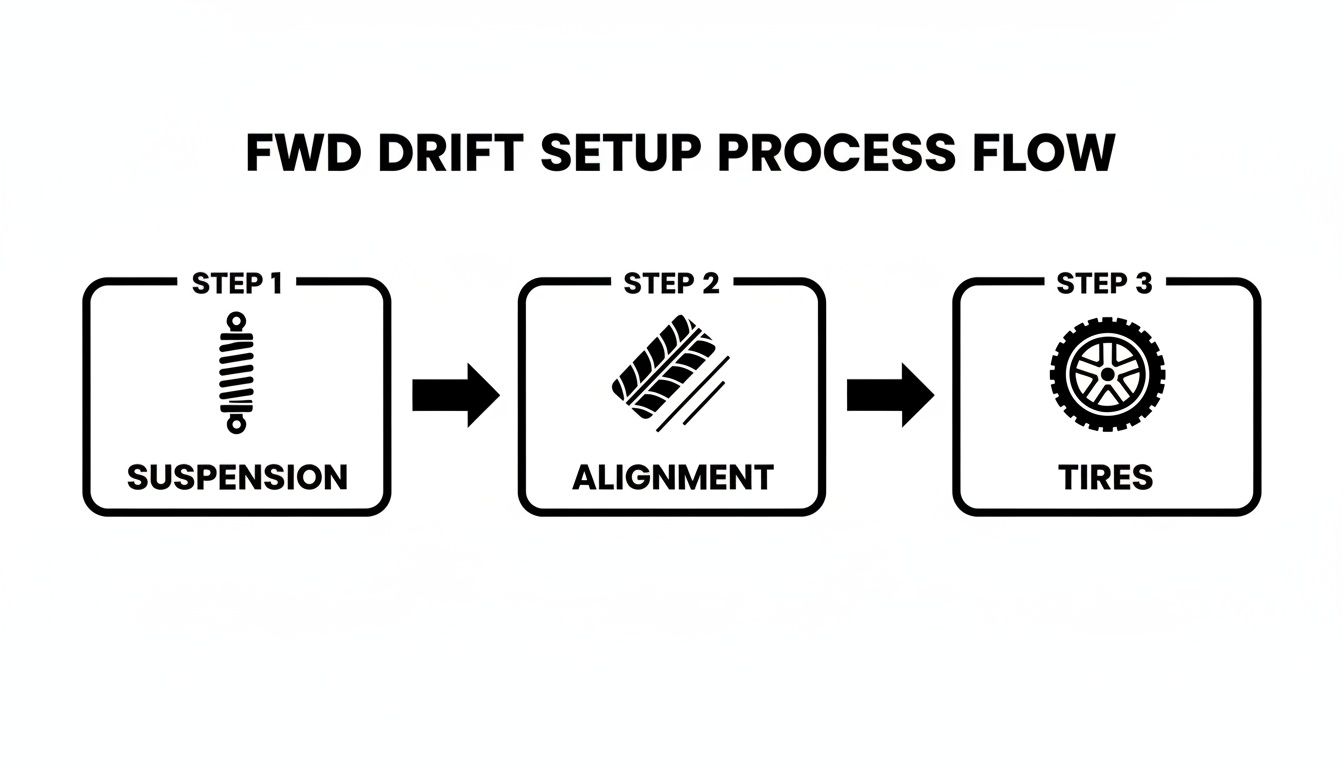
This visual guide nails it: suspension, alignment, and tire choice all work together to create the controlled instability you need to get a FWD car sideways.
Using Deceleration to Your Advantage
Beyond the flick, you can use braking and throttle lift to get the car sliding. These techniques are a bit more subtle and are perfect for linking corners or making small adjustments mid-drift.
Lift-off oversteer is the easiest method to learn. As you enter a turn carrying some speed, just abruptly lift your finger off the throttle. The sudden deceleration shifts weight to the front, lightens up the rear end, and encourages a gentle slide. From there, you can use tiny blips of the throttle to manage the drift angle.
For a more aggressive entry, give a brake-induced drift a try. As you turn in, give the brakes a quick, sharp tap. This pitches the car’s weight forward far more dramatically than just lifting off the throttle, creating a more pronounced and immediate slide. A finely tuned Sanwa transmitter is a huge help here, giving you the precision to just "tap" the brakes without locking them up.
Maintaining a Consistent Arc
Once you’re sliding, holding a smooth, consistent arc is all about balance. You'll be using a constant combination of small steering corrections and precise throttle modulation. Remember, the front wheels are always pulling the car forward, so your throttle input has a direct and immediate effect on the drift's angle and speed.
Having the right spares on hand during a practice day is absolutely critical. The RC drifting scene in California really blew up in the 2010s, and the big indoor events showed everyone how important it was to be able to fix your car trackside. You'd see guys back on track in minutes after a mishap because they had the right parts. These popular event recaps show just how intense the competition gets and how the community comes together to push the driving skill forward.
Fine-Tuning Your Electronics for Ultimate Slide Control
While mechanical grip sets the foundation for FWD drifting, your electronics are the car's central nervous system. Getting your Electronic Speed Control (ESC), motor, and servo to work in perfect harmony is what separates a clumsy, unpredictable slide from a smooth, controlled arc. This is where you dial in the car's reflexes to match your own.
A high-quality ESC is really the heart of the whole operation. For FWD drifting, one feature is absolutely paramount: an adjustable drag brake. We pretty much exclusively recommend a premium ESC from a brand like Hobbywing, simply because their programming options give you the precise control you need to get this right.
The drag brake automatically applies a bit of braking force the moment you let off the throttle. By setting a moderate drag brake percentage, you can initiate a smooth weight transfer to the front just by lifting your finger. It makes slide entries feel intuitive and effortless. Honestly, this single setting is a genuine game-changer for consistency.
If you want to go deeper on this, our comprehensive guide on RC Electronic Speed Controls covers everything you could possibly want to know.
Choosing The Right Motor For Smoothness
When it comes to motors, more power is definitely not better for FWD drifting. Your goal isn't to obliterate the tires with raw speed; it's to have fine-grained control over the front wheels as they pull the car through a slide. A super-powerful, low-turn motor can be twitchy and make it incredibly difficult to modulate the throttle with any kind of precision.
Instead, you'll want to opt for a smoother, higher-turn motor. A sensored motor from a brand like Team Powers or Hobbywing is an excellent choice because it offers incredible throttle resolution at low speeds. That smoothness allows you to make tiny adjustments to maintain or tweak your drift angle without upsetting the car's balance.
The perfect motor feels connected and linear. You want a powerband that lets you feed in just enough throttle to hold the line, not one that delivers a sudden jolt of power and pulls the car straight.
The Critical Role Of A High-Speed Servo
Finally, let's talk about your servo. In FWD drifting, you're constantly making rapid steering inputs—from the initial flick to tiny counter-steering corrections mid-drift. A slow or imprecise servo just can't keep up. That's usually what causes those frustrating spin-outs or the inability to hold a consistent angle through a corner.
This is where investing in a top-tier servo from a brand like Sanwa or Futaba pays off big time. A fast, high-precision servo gives you the incredible speed needed for those lightning-quick adjustments.
When you're picking one out, keep these key things in mind:
- Speed: Look for a transit time of 0.08s/60° or faster. This ensures the wheels can snap to the correct angle the instant you command it.
- Torque: It’s less critical here than in high-grip racing, but you still need enough torque to hold the wheels against the forces of the drift without getting pushed around.
- Precision: A quality servo will return to centre accurately every time and hold its position without any jitter. That provides the consistency you need to link corners together smoothly.
By carefully selecting and tuning your ESC, motor, and servo, you give yourself the tools needed for total slide control. Each component plays a vital role in creating a car that responds predictably to your every command.
Troubleshooting Common FWD Drifting Issues
Even with the perfect setup on paper, hitting the track will always reveal a few surprises. Drifting with FWD is a game of balance, and it doesn't take much to throw things off. This trackside guide will help you diagnose and fix the most common handling quirks you'll run into.
Don't get frustrated if the car isn't sliding perfectly on the first battery pack. That's totally normal. Every chassis and every driver has a unique feel, and finding that sweet spot is a huge part of the fun. Think of each problem less as a failure and more as a clue telling you exactly what your car needs.
The golden rule here is to change only one thing at a time. If you start adjusting shocks, camber, and your ESC all at once, you’ll never know which change actually fixed the problem. Patience and a methodical approach are your best friends in the pits.
Solving Stubborn Understeer
This is the big one. You flick the car into a corner, and instead of the rear stepping out, the front just pushes wide. That’s classic understeer, and it's a clear sign your rear end still has way too much grip compared to the front.
If your car is pushing, here’s your troubleshooting checklist:
- Rear Tires: Are they hard enough? If you're running anything other than hard plastic or a proper T-Drift compound, you're just making life difficult for yourself.
- Rear Suspension: Is it too stiff? Try a lighter shock oil or softer springs in the back. This encourages more body roll, helping the rear tires break traction.
- Front Caster: Adding more positive caster can increase front-end bite as you turn the wheel, helping to pull the car through the corner. For a deeper dive, check out our guide on how caster works for RC cars.
Taming Uncontrollable Spin-Outs
The flip side of the coin is a car that snaps into a spin the second it starts to slide. This tells you the rear is breaking loose too aggressively, or the front end simply can't keep up to manage the angle.
To fix this, the first place to look is your own inputs and your car's front-end setup. A slow steering servo just won't be able to make the quick counter-steer corrections you need to catch a slide. Also, make sure your front tires have enough grip to pull the car forward through the drift. If they're too hard for the surface, the car will just pivot around them instead of carrying momentum.
When your car is spinning out, the first reflex is to blame the setup. But it's often a driving issue. Ensure your steering inputs are smooth and deliberate after the initial flick; jerky movements with the throttle or steering will almost always end in a spin.
This whole process of trackside tuning is a core part of the RC hobby and is what helps build strong racing communities. The RC drifting scene in Southern California, for example, exploded when media coverage started showing racers wrenching on their cars between runs. These event recaps and forum discussions created a shared knowledge base, making it easier for new drivers to solve problems and get competitive. You can read more about how media shaped the drift scene) and its community.
Got Questions About FWD Drifting?
Jumping into the world of front-wheel-drive drifting is a technical challenge, so it's only natural to have a few questions. We see the same ones pop up all the time, so here are some clear, straightforward answers to get your car dialled in and sliding like a pro.
Can I Use Any FWD Touring Car For Drifting?
Pretty much, yes. Almost any 1/10 scale FWD touring car chassis can be turned into a solid drifter. The most important thing isn't the brand, but how much adjustability the chassis offers.
This is why platforms from builders like Xpress, ARC, or Awesomatix are so popular for this—they give you precise control over the settings that matter.
You absolutely need to be able to adjust:
- Camber and toe angles to kill rear grip and get the car to pivot.
- Multiple shock mounting positions for fine-tuning weight transfer.
- Access to optional springs and sway bars to find that perfect balance.
A chassis with that level of tuning flexibility is your ticket to a consistent, controllable slide.
What Are The Best Tires For FWD Drifting?
Getting the tire combination right is everything. This is non-negotiable and easily the single most important part of your entire setup. You have to run two completely different types of tires on the front and rear. No exceptions.
Your go-to combo will be grippy rubber tires up front and super low-grip tires on the back. For the rear, hard plastic drift-specific tires are the standard. They slide predictably with almost no resistance. Up front, you'll need standard rubber touring tires from a brand like Team Powers or Rush to provide the traction required to pull the car through the corner and manage your drift angle.
Think of it this way: the front tires are for pulling and steering, while the rears are just along for the ride. The real tuning secret is finding the perfect front tire compound to match your local track surface.
Is FWD Drifting Harder Than RWD?
It's just... different. FWD drifting presents a unique set of challenges compared to RWD. With a rear-wheel-drive car, you're constantly playing with the throttle to maintain and tweak the slide.
FWD, on the other hand, is all about mastering weight transfer, aggressive braking, and surgical steering inputs. It's a completely different muscle memory.
Many drivers find that kicking the car sideways in FWD requires more deliberate technique and practice. But once you get the slide initiated, holding the angle can feel surprisingly stable. Honestly, mastering this discipline is one of the best ways to level up your driving skills because it forces you to develop a much deeper understanding of vehicle dynamics.
Ready to build your ultimate FWD drift machine? At Digital-RC, we have the premium car kits, electronics, and tuning parts you need.