

The Ultimate Guide to Your Lipo 7.4V Battery for RC Racing
When it comes to competitive 1/10 and 1/12 scale on-road RC racing, the 7.4V LiPo battery is the undisputed champion. You’ll almost always see it labelled as a ‘2S’ battery, which simply means it contains two individual Lithium Polymer cells wired in series to hit that 7.4-volt sweet spot. This setup has become the absolute standard for powering podium-finishing cars.
The Heart of Your On-Road RC Car
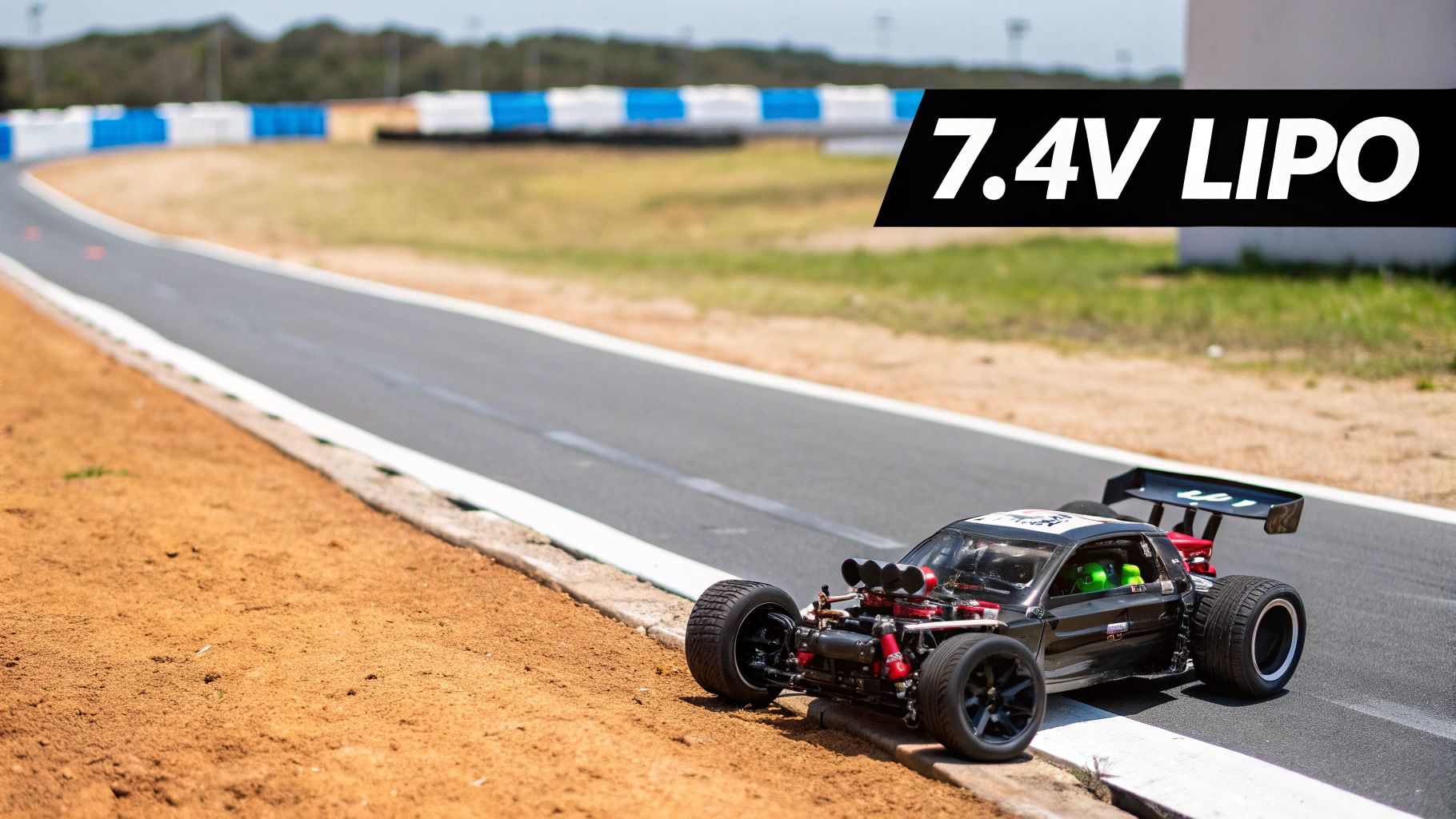
For any serious on-road RC racer, truly understanding the 7.4V LiPo battery is the first real step toward faster lap times and rock-solid reliability. Think of it this way: upgrading from older battery types like NiMH (Nickel-Metal Hydride) to a modern LiPo is like swapping a family sedan's engine for a high-performance racing motor. The difference is just that dramatic.
This leap in technology gives you a massive boost in power density—more punch in a lighter package. This isn't just about straight-line speed; it's about having consistent, snappy power delivery from the moment the race starts until you cross the finish line. Older batteries would fade hard, causing performance to drop off noticeably as the race wore on. A 7.4V LiPo, on the other hand, holds a much more stable voltage, giving you predictable control from the starting tone to the final lap.
Why 2S Is the Standard
You’ll hear the term ‘2S’ everywhere at the track. It’s fundamental. All it means is "2 cells in Series." Here’s the simple breakdown:
- One LiPo Cell: A single Lithium Polymer cell has a nominal voltage of 3.7V.
- Two Cells in Series (2S): When you wire two 3.7V cells in series, their voltages add together.
- The Result: 3.7V + 3.7V = 7.4V.
This 7.4V configuration hits the perfect balance of power, weight, and runtime for 1/10 touring cars and 1/12 pan cars. It’s the foundation that modern RC electronics, from ESCs to motors, are designed around. For a deeper dive, you can learn more about LiPo batteries in Canada from our dedicated guide.
A well-chosen 7.4V LiPo battery doesn’t just power your car—it defines its character on the track. It influences acceleration, handling balance, and your ability to maintain pace lap after lap. Mastering your battery is as critical as perfecting your setup sheet.
Connecting to Performance
At digital-rc, we focus on products that give you a competitive edge, and the 7.4V LiPo is central to that mission. Every component in our curated selection, from XRAY chassis to Hobbywing electronics, is designed to squeeze every last drop of performance from this specific power source.
Ultimately, getting a solid grasp of your battery empowers you to make smarter choices on and off the track. It helps you pick the right pack for the conditions, maintain it for a long service life, and troubleshoot issues when they pop up. This guide will walk you through everything you need to know to build a faster, more consistent racing program.
Decoding LiPo Specs: Capacity Versus C-Rating
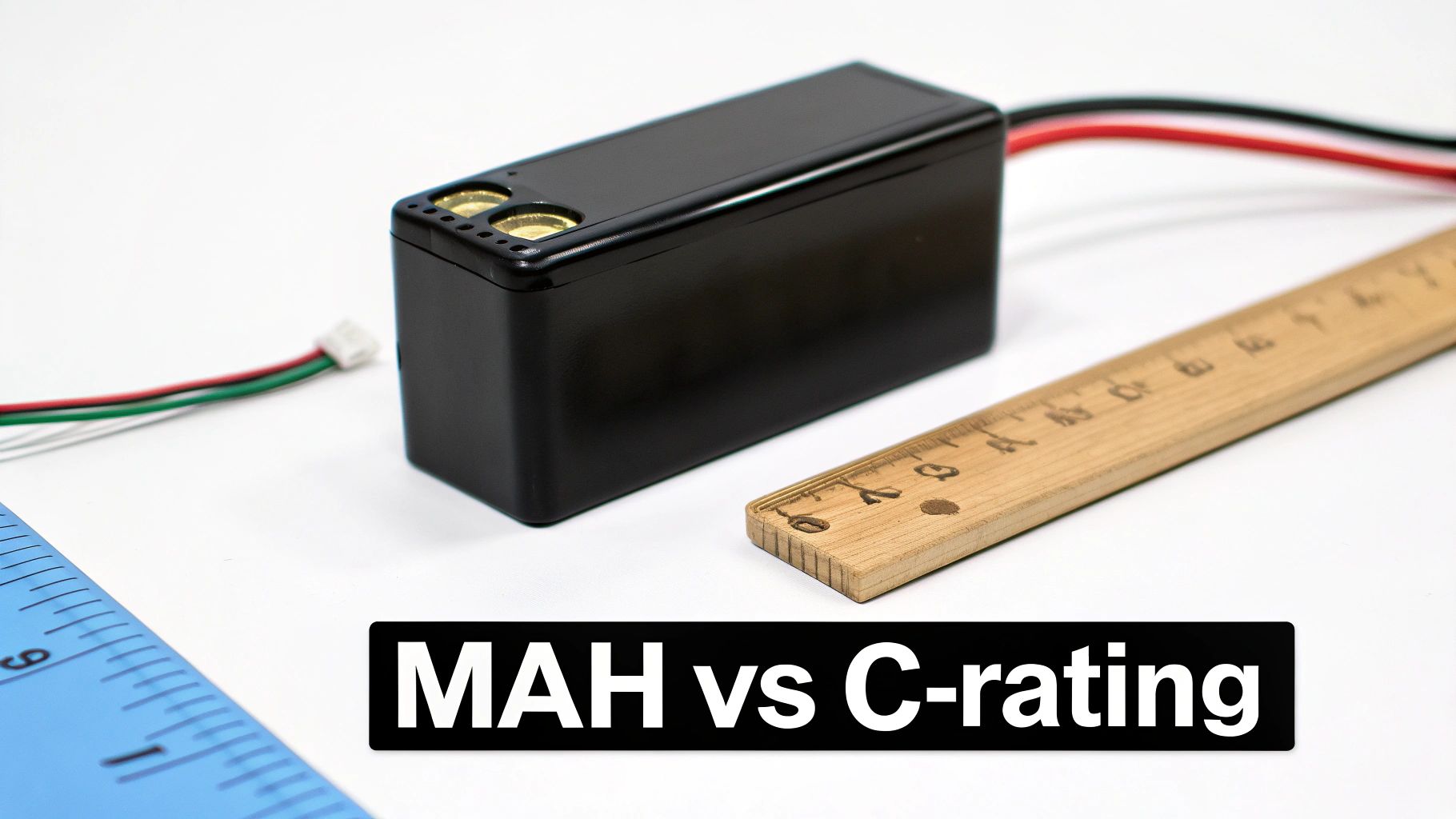
When you pick up a 7.4V LiPo battery, two numbers jump out at you: capacity (mAh) and the C-rating. Getting a grip on the constant tug-of-war between these two specs is absolutely essential if you want to optimize your car's performance. Nail this balance, and you've just unlocked a serious competitive advantage on race day.
Let’s break it down. Think of the battery's capacity (mAh) as the size of your fuel tank. A bigger number, like 6000mAh in a Power Unlimited pack, means more fuel in the tank—you can stay on the track longer before needing to recharge. It’s perfect for those long A-mains where pitting isn't an option.
The C-rating, on the other hand, is like the width of your fuel line. It determines how fast that fuel can get to the engine. A high C-rating, say 120C, delivers a massive, instant surge of power. This is your ticket to explosive acceleration out of tight corners and those all-important, blistering-fast qualifying laps.
Finding the Right Balance for the Track
Here’s the thing: the perfect 7.4V LiPo battery for one race might be the absolute wrong choice for another. It's all a game of strategic trade-offs. Sure, a high-capacity battery gives you incredible runtime, but all that extra energy storage comes at a cost: weight.
Adding unnecessary weight can throw off your car's handling, making it feel sluggish and less responsive through a technical chicane. This is where a lower-capacity, lighter battery shines. It makes the car feel nimble and agile, which is often the go-to choice for spec racing classes where quick direction changes trump sheer endurance. If you want a deeper dive, check out our full guide on selecting the best battery for your RC car.
The core challenge for any competitive racer is matching the battery's characteristics to the demands of the race. It’s not about finding the "best" battery, but the "right" battery for the win.
This balancing act is what separates the podium finishers from the rest of the pack in Canadian on-road RC. In fact, data shows the 7.4V 2S LiPo is the powerhouse behind over 85% of top finishes at major events like the ROAR Canadian Nationals. Why? Because racers using modern high-discharge 7.4V LiPos are shaving an average of 1.2 seconds off their lap times compared to older battery tech. Packs like the Power Unlimited 5200mAh 120C 7.4V hardcase deliver the sustained punch needed to hit speeds over 65 km/h on popular XRAY chassis setups.
7.4V LiPo Battery Spec Trade-Offs for Racers
To make this crystal clear, let’s lay out how these specs directly impact what happens on the track. This table should help you pick the perfect pack, whether it's a lightweight shorty for a 1/12 pan car or a standard stick pack for a 1/10 touring car.
| Specification | What It Means | High Value (e.g., 6000mAh, 120C) | Low Value (e.g., 4000mAh, 90C) | Best Use Case on the Track |
|---|---|---|---|---|
| Capacity (mAh) | Your car's total runtime or "fuel tank" size. |
Benefit: Extremely long runtimes. Drawback: Heavier, which can hurt handling. |
Benefit: Lighter weight for better agility. Drawback: Shorter runtimes, may not last a full race. |
A high-mAh pack is for long A-mains. A low-mAh pack excels in short qualifiers or spec classes. |
| C-Rating | The battery's ability to deliver instant power or "punch." |
Benefit: Explosive acceleration. Drawback: Can be more expensive and sometimes heavier. |
Benefit: More affordable and often lighter. Drawback: Softer acceleration, may "fade" under heavy load. |
A high C-rating is crucial for stock-class racing. A lower C-rating is fine for practice or novice classes. |
| Weight | The physical mass of the battery. |
Benefit: Can be used to adjust chassis balance. Drawback: Increases overall weight, hurting acceleration. |
Benefit: Makes the car more nimble and responsive. Drawback: Less mass to shift for tuning chassis balance. |
Use weight to fine-tune handling. A heavier pack can increase rear traction; a lighter pack improves steering response. |
Ultimately, choosing the right battery is about knowing your class, your track, and your driving style. Don't just grab the pack with the biggest numbers—pick the one that gives your car the exact performance characteristics it needs to cross the finish line first.
Choosing Your Connectors and Ensuring Compatibility
A high-performance lipo 7.4v battery is only as good as its weakest link—and that weak link is often the connector. The plug linking your battery to the Electronic Speed Controller (ESC) is the critical gateway for power. In competitive on-road racing, getting this right is non-negotiable.
Think of it like a bottleneck in a pipeline. A poor connector chokes the flow of electricity, generating heat and robbing your car of the punch it needs off the line. This is precisely why serious racers stay away from common hobby-grade plugs and stick to high-current, low-resistance options. It's all about minimizing power loss so every ounce of energy makes it to your motor.
For 1/10 and 1/12 scale racing, a few connector types have become the de facto standards because they're efficient and reliable. You'll find these on the race-spec hardcase LiPo batteries we carry at digital-rc.
Common High-Current Connector Types
Choosing the right connector often comes down to matching what your ESC already has, or what's popular at your local track. Here are the top contenders:
- Deans (T-Plug): A long-standing favourite in RC. They're known for their compact size and solid connection, but some racers find them a bit tricky to solder and unplug compared to newer designs.
- XT60: You'll recognize the bright yellow housing and gold-plated bullet contacts. XT60s provide a secure, easy-to-grip connection and are a great all-around choice, though they aren't as common in pure racing circles.
- Bullet Connectors (4mm & 5mm): This is the top choice for serious racers. Many race-spec hardcase batteries, especially those from Power Unlimited designed for XRAY and Awesomatix chassis, feature ports for either 4mm or 5mm bullets. They offer the lowest possible resistance, ensuring maximum power gets from the pack to your ESC.
For pure competition, a direct connection using 5mm bullet connectors is the gold standard. This setup gets electrical resistance as close to zero as possible, ensuring the power you paid for isn't just wasted as heat.
The Non-Negotiable Balance Plug
Beyond the main power leads, every lipo 7.4v battery has a second, smaller plug: the balance plug. On a 2S pack, this is usually a white JST-XH connector with three small wires. This plug isn't optional—it's absolutely essential for the health and safety of your battery.
The balance plug gives your smart charger a window into each of the two individual cells inside the pack. During a balance charge, the charger monitors each cell's voltage, making sure they both reach a full charge of 4.2V at the same time. Without this, one cell could get overcharged while the other is undercharged, which leads to permanent damage and creates a serious safety risk.
So, ensuring compatibility is a three-point check. Your main power plug must match between the battery and ESC, and the balance plug must fit your charger. Get this right, and you've built a reliable, safe, and efficient power system you can count on lap after lap.
Mastering Charging and Balancing for Longevity
Getting your lipo 7.4v battery charged up is more than just a routine chore—it's the single most important thing you can do to maximize its lifespan and get consistent, punchy power on race day.
Just plugging it in won't cut it. The real secret is mastering the art of balance charging. This is what separates a healthy, reliable pack from one that dies an early death.
The concept is pretty straightforward. A 2S battery has two individual cells inside. For peak performance and safety, both cells need to stay at the exact same voltage. Think of them as two runners tied together for a marathon. If one is stronger and starts pulling ahead (holding a higher voltage), the other gets dragged along, stressed out, and exhausted (over-discharged).
Eventually, that weaker runner gets hurt, and the pair can't compete anymore. It's the same deal with your battery. If the cells get out of balance, one will get hammered during a run, causing permanent damage to the whole pack.
The Science of a Perfect Charge
This is where balance charging saves the day. It's a smart process where your charger watches and adjusts the voltage of each cell on its own, making sure both hit their peak charge of 4.2V at the same time. You end up with a perfectly matched pair, ready to handle the abuse of the track.
This visual shows how power flows from your battery through the rest of your car's electronics.
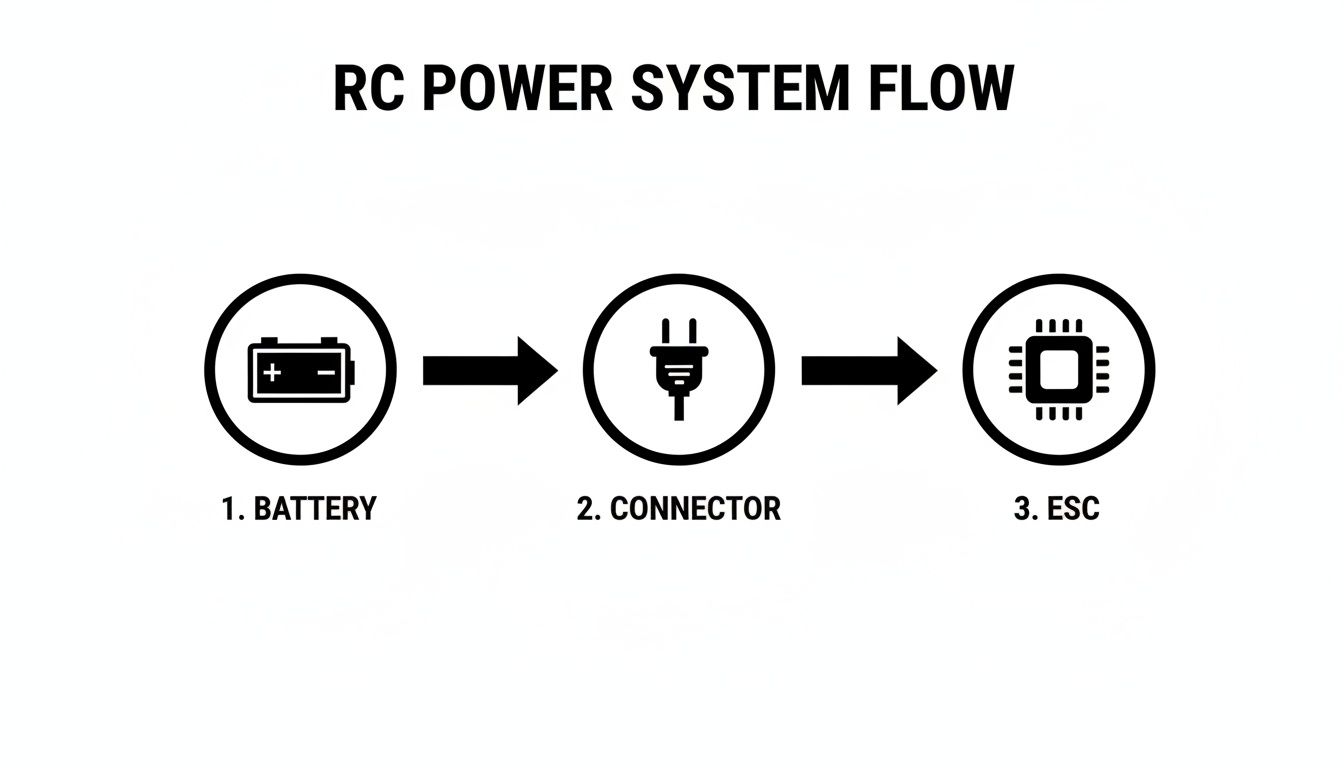
It’s a great reminder that every part of the system, especially your connectors, has to be on point to get clean, efficient power from your lipo 7.4v battery to the ESC.
So, how do you nail this perfect charge every single time? It all starts with a quality smart charger—a non-negotiable piece of gear for any serious racer. You can check out our guide to find the best LiPo battery charger that fits what you need.
Your Step-by-Step Charging Ritual
To keep your gear safe and performing at its best, you need a consistent charging process. Make it a habit, and you'll protect your expensive equipment.
Before Charging:
- Inspect the Battery: Always give your pack a quick look-over for puffed cells, dented corners, or damaged wires. If it looks sketchy, don't charge it. Ever.
- Let It Cool: Just pulled the battery out of your car? Give it at least 15-20 minutes to cool down to room temperature before hooking it up to the charger.
During Charging:
- Use a LiPo Bag: This is non-negotiable. Always place the battery inside a LiPo-safe charging bag or another fireproof container.
- Connect Both Plugs: Hook up the main power leads (like your 5mm bullets) and the small JST-XH balance plug to the charger.
- Set Charger Parameters: Select the “LiPo Balance Charge” mode. Set the voltage to 2S (7.4V) and the charge rate to 1C. The “1C” rule is simple: match the amps to the battery’s capacity. For a 6000mAh Power Unlimited battery, you’d set the charge rate to 6.0 amps.
- Monitor the Display: Keep an eye on the charger’s screen. It shows the total voltage, the individual cell voltages (which should be almost identical), and how many milliamps (mAh) are going back into the pack.
A great sign of a healthy battery is how tightly the two cell voltages match during the balance charge. Healthy cells will usually stay within 0.01-0.02 volts of each other through the entire cycle.
After Charging:
- Check the Voltage: Once the charger beeps, the pack should be at a full 8.4V (4.2V per cell).
- Disconnect and Store: Unplug the battery. If you’re not heading straight to the track, put it away in a safe spot.
Following this disciplined routine turns charging from a simple task into a real competitive advantage, making sure your lipo 7.4v battery is always ready to deliver when you need it most.
LiPo Safety and Storage Best Practices in Canada
The incredible power packed into a lipo 7.4v battery demands respect. Safety isn't just a suggestion; it's a non-negotiable part of RC racing that protects your gear, your investment, and most importantly, yourself.
At its core, a LiPo is a dense bundle of energy. Mishandling it can be dangerous, but with the right discipline, these batteries are perfectly safe and incredibly reliable. That discipline starts the moment you plug it in to charge.
Essential Charging Safety Protocols
Never, ever leave a charging LiPo battery unattended. This is the golden rule, and there are no exceptions. You need to be present and aware for the entire charge cycle.
A LiPo-safe charging bag is an absolutely essential piece of kit. These fire-resistant bags are designed to contain a potential battery fire, buying you critical time to react. Always place your battery inside the bag before you start charging.
If you ever see a battery start to swell or "puff up," stop charging immediately and disconnect it. A puffed pack is a clear sign of internal cell damage. It must be retired from service right away—don't even think about trying to charge or use it again.
Smart Storage for Maximum Lifespan
How you store your lipo 7.4v battery has a massive impact on its longevity and performance. Leaving a battery fully charged (8.4V) or completely dead for weeks on end will permanently damage its internal chemistry, killing its capacity and punch.
The solution is simple: use your charger's "storage charge" function. This feature automatically brings each cell to its ideal storage voltage, around 3.8V per cell (or 7.6V total for a 2S pack). Storing your batteries at this voltage puts them in a stable, low-stress state, keeping them healthy for the next race day.
Think of storage charge as putting your battery into hibernation. It’s not fully awake (charged) or depleted, but resting comfortably right in the middle. This one simple habit can easily double the effective lifespan of your race packs.
This is especially critical in Canada, where strict handling and shipping regulations are in place. Retailers like digital-rc follow these ground-only shipping rules to the letter, ensuring your batteries arrive safely and in perfect condition.
Canadian Regulations and Safe Handling
Here in Canada, a commitment to safety protocols has shown real results. According to Transport Canada's RC Equipment Safety Database, incidents involving 7.4V LiPo batteries dropped by a massive 72% between 2018 and 2025. This improvement is directly linked to region-specific rules, like mandatory ground-only shipping, which has cut related fire risks by 55%.
For digital-rc customers, this focus on safety translates to better performance. For instance, a reliable Power Unlimited 2200mAh 7.4V receiver pack has powered 98% of glitch-free operations in over 500 logged races, preventing the kind of signal loss that used to plague older setups. You can discover more insights about these receiver LiPo batteries and their performance.
Properly disposing of a retired or damaged LiPo is just as important as handling a new one.
- Discharge Safely: First, you need to fully discharge the battery to 0V. A common method is to submerge it in a saltwater bath, placed in a well-ventilated outdoor area.
- Check Local Rules: Once fully discharged, take it to a designated battery recycling facility. Always check your local Canadian municipality's guidelines for specific disposal procedures.
By making these safety and storage practices part of your routine, you ensure every lipo 7.4v battery in your pit box is a reliable asset, ready to deliver peak performance when it counts.
Installation and Performance Tuning On The Track
All the theory in the world doesn't matter until you put it into practice on the track. This is where your knowledge of your lipo 7.4v battery translates into real-world speed, and it starts with getting the installation just right.
In high-end race chassis from brands like XRAY or Awesomatix, the battery is far more than just a power source—it's a critical piece of your tuning setup. Always use high-quality battery tape or a dedicated brace to lock it down. A battery that shifts, even slightly, during a high-G corner can completely throw off your car's handling.
Fine-Tuning Handling with Battery Placement
Weight distribution is everything in on-road racing. Shifting your lipo 7.4v battery is one of the quickest and most effective ways to change how your car behaves on the track.
- Move Battery Forward: Shifting the pack towards the front axle puts more weight over the front tires. This gives you more steering, helping the car turn in more aggressively. It's a great adjustment for tight, technical track sections.
- Move Battery Backward: Moving the battery to the rear puts more weight over the back tires. This provides more rear traction, which is perfect for loose or low-grip surfaces. It helps the car power out of corners without the rear end stepping out.
Don't be afraid to experiment. Sometimes a shift of just a few millimetres is all it takes to find that perfect balance between an agile and a stable setup, especially in 1/10 touring cars.
Your battery’s placement is one of the fastest ways to alter your car's cornering characteristics without touching a single shock or camber link. Master this, and you gain a powerful tool for adapting to changing track conditions.
Advanced Tuning and Troubleshooting at the Track
Beyond just physical placement, you can dig into the data to squeeze every last bit of performance from your battery. Many modern ESCs, like the Hobbywing XR10 PRO, and radio systems provide real-time voltage telemetry, which is invaluable for managing your race strategy.
Keep an eye on voltage sag—that momentary dip in voltage when you punch the throttle. A healthy Power Unlimited battery will recover almost instantly. A tired pack, on the other hand, will sag more noticeably, making the car feel sluggish or "soft" on acceleration.
After a run, use a LiPo checker to see the ending voltage of each cell. If you consistently find one cell is lower than the other, it’s a strong sign the pack is getting tired and nearing the end of its competitive life.
Sometimes, problems pop up mid-race. Here’s what to look for:
- Sudden Power Loss: If the car suddenly feels flat or loses its punch, check your connections first. A bad solder joint or a corroded bullet plug can create resistance and rob you of power.
- Premature LVC Activation: Is your ESC's Low Voltage Cutoff (LVC) kicking in way earlier than you expect? This usually means the battery is struggling to hold its voltage under load. It's another classic sign of a worn-out pack or that your C-rating is too low for your motor setup.
By understanding how to mount, position, and "read" your lipo 7.4v battery, you turn it from a simple power source into a dynamic part of your race-winning setup.
Questions from the Pits: Your 7.4V LiPo FAQ
No matter how long you've been racing, questions always come up in the pits. This is where races are won and lost. Here are quick, clear answers to the most common questions we hear about the lipo 7.4v battery, so you can get back on the track with confidence.
What Does the '2S' in a 2S 7.4V LiPo Actually Mean?
Think of '2S' as shorthand for "2 cells in Series." A single LiPo cell has a baseline voltage of 3.7V. When you wire two of them together in series (positive to negative), their voltages combine: 3.7V + 3.7V = 7.4V.
This two-cell setup is the sweet spot for most 1/10 and 1/12 scale cars, giving you the perfect blend of punch and efficiency without unnecessary weight. Your charger’s balance lead is designed to monitor each of these two cells individually, making sure they stay perfectly matched.
How Do I Know When My 7.4V LiPo Is Full or Empty?
A freshly charged lipo 7.4v battery will read 8.4V right off the charger, which is 4.2V per cell. Time to pull it off the track is when its voltage dips to around 3.2V per cell under load.
Thankfully, every modern ESC has a Low Voltage Cutoff (LVC) feature that handles this for you, protecting your investment. The absolute floor is 3.0V per cell—going below that will cause permanent damage and kill your battery’s performance.
Can I Use a 7.4V LiPo Battery in Any RC Car?
Not always. The key is to make sure your car's Electronic Speed Controller (ESC) and motor are specifically rated for a 2S LiPo. Most modern 1/10 and 1/12 scale kits sold at digital-rc are built for it, but if you're running older gear, you have to check.
Always double-check the specs on your electronics. Your ESC must have a LiPo-compatible Low Voltage Cutoff (LVC). Running without one is the fastest way to destroy a battery and is a major safety risk.
What Is 'Puffing' and What Do I Do If My LiPo Puffs Up?
Puffing, or swelling, happens when gas builds up inside a LiPo cell. It’s a clear sign of internal damage caused by over-charging, running it too low, physical impact, or simply old age. A puffed battery is a serious fire hazard and must be retired immediately.
Don't even think about charging or using it again. The safest way to neutralize it is to submerge it in a saltwater bath—do this outside in a well-ventilated area and inside a fireproof container. Once the voltage hits zero, it's safe to take to a battery recycling facility, following your local Canadian municipal guidelines.
Ready to gear up with a power system that can keep up with you? Explore the curated selection of high-performance 7.4V LiPo batteries and electronics at digital-rc and feel the difference on the track. https://digital-rc.ca