

Build Your Ultimate RC Auto Kit Like a Pro
So, you’re thinking about getting into serious RC racing. The first big choice you'll face isn't about motors or tires—it's whether to buy a pre-built, ready-to-run (RTR) car or to build your own from an RC auto kit.
For anyone looking to compete, the answer is always the kit. Why? Because assembling the car yourself gives you an unmatched advantage. You learn every screw, every link, and every setting. That intimate knowledge is what separates the front of the pack from everyone else when you need to make a fast setup change between heats.
This guide is your roadmap, taking you from a box of precision-engineered parts to a machine that's built to win.
Your Journey from Box to Podium Begins Here
Building a high-performance RC car from a kit isn't just about following instructions. It's an education. You're not just assembling a toy; you're engineering a dedicated racing machine designed for one purpose: to be faster than the competition.
The satisfaction of hitting the track with a car you built with your own hands is incredible. Knowing every detail of the chassis, from the suspension geometry to the drivetrain, gives you a level of control and understanding an RTR car can never offer.
An RC auto kit is your direct path to a faster, more reliable, and completely personalized race car. The feeling of winning with something you built yourself? That’s the real trophy.
The Heart of Canadian RC Racing
This isn't a niche hobby; it's a growing passion shared by a dedicated community across Canada. The on-road racing scene, in particular, is exploding. Projections show the Canadian RC market is set to grow at a CAGR of around 7.5% through 2033, and kit sales are a huge part of that.
Back in 2019, kits made up about 28% of Canadian RC purchases. By 2023, that number jumped to 42%, driven by racers who demand top-tier performance right out of the box.
For this guide, we'll zero in on the two most popular on-road racing classes:
- 1/10 Scale Touring Car: These all-wheel-drive machines are the backbone of club racing. They're incredibly versatile and a blast to drive on both carpet and asphalt.
- 1/12 Scale Pan Car: Built for pure, raw speed on high-grip indoor carpet, these lightweight, rear-wheel-drive rockets are insanely fast and demand absolute precision.
Both classes require a solid foundation, and that starts with a quality rc auto kit from a championship-winning brand like Awesomatix or XRAY. Building one of these kits is a rewarding process that sets you up for success. If you're new to this, our complete guide to your first RC car kit build is a great place to start. This is where your path from builder to racer truly begins.
Choosing Your Chassis: The Foundation of Speed
Picking the right RC auto kit starts with the chassis. This is the single most important decision you'll make. Think of the chassis as the skeleton of your car—it dictates everything from handling and durability to its ultimate potential on the track. It’s the difference between building a nimble rally car versus a purebred Formula 1 machine. Both are fast, but they get there in completely different ways.
In competitive on-road RC racing, the scene is dominated by two platforms: 1/10 Scale Touring Cars and 1/12 Scale Pan Cars. Each one is a master of its own domain, engineered for a specific purpose and track environment.
This flowchart lays out the fundamental choice every racer faces: starting with a convenient, ready-to-run car or committing to a high-performance kit.
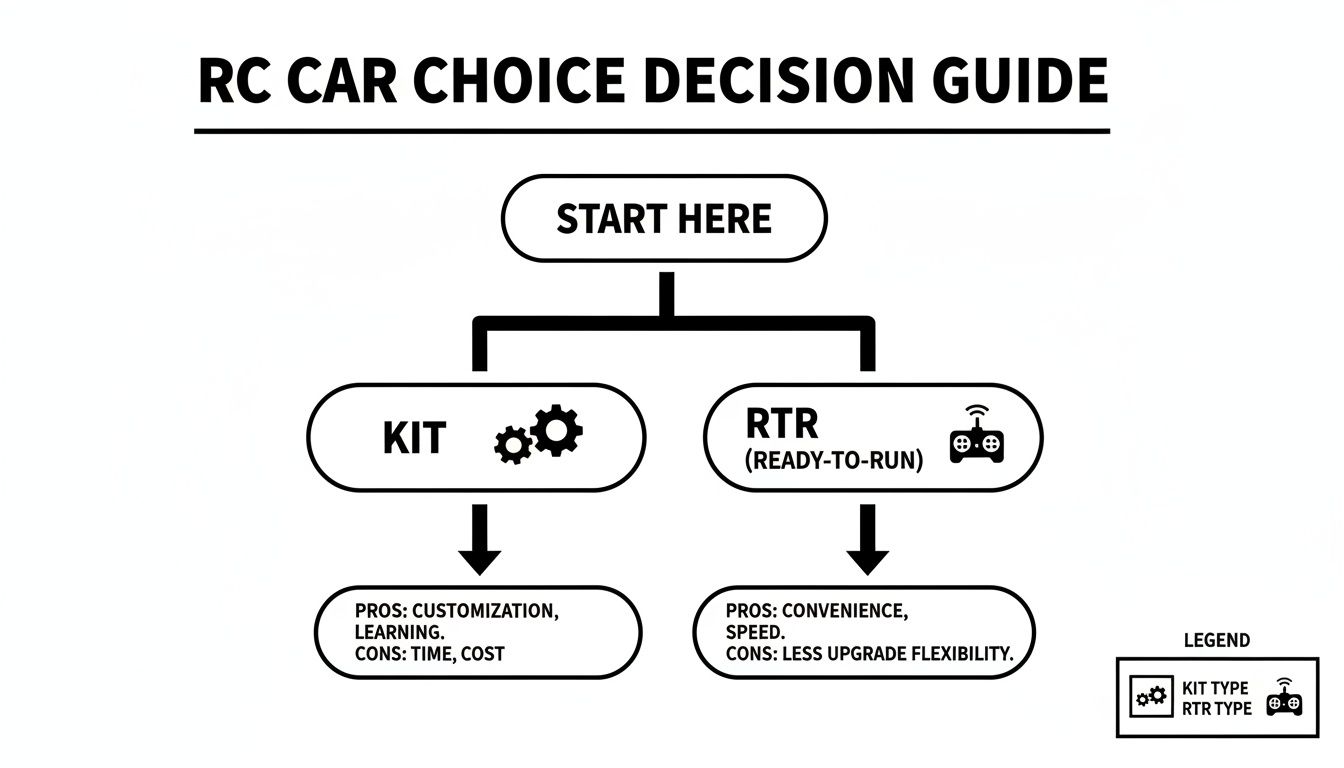
For anyone serious about racing, the path is clear. The "Kit" option provides the deep understanding and infinite customization you need to chase podium finishes.
1/10 Touring Cars: The All-Round Champions
A 1/10 scale touring car, like the legendary XRAY T4, is the versatile workhorse of the RC world. Its defining feature is a sophisticated, all-wheel-drive system—usually belt-driven—that delivers incredible grip and stability across a huge range of surfaces, from outdoor asphalt to indoor carpet.
These cars are built much like their full-scale counterparts, featuring fully independent suspension with oil-filled shocks at all four corners. This complexity opens up a massive window for adjustments, letting you dial in the car's handling to perfectly match any track condition. It’s this adaptability that has made them the most popular racing class in Canada.
You can see this trend in the numbers. Organized on-road events in Canada saw a 28% rise between 2019 and 2024, with 1/10 touring cars accounting for 52% of total participation. The Canadian RC market hit CAD 420 million in 2024 and is projected to grow at an 8.2% CAGR to 2033. Kits make up 38% of this volume—around 22,500 units—while 1/12 pan cars have seen a 25% surge since the pandemic pushed racing indoors.
1/12 Pan Cars: The Apex Predators of Carpet
If a touring car is a rally champion, a 1/12 scale pan car is an unapologetic F1 machine. Models like the Awesomatix A12 are engineered for one thing and one thing only: absolute speed on high-grip indoor carpet tracks. Their design philosophy is all about simplicity, efficiency, and shedding every possible gram of weight.
Instead of a complex AWD system, pan cars feature a minimalist, direct-drive, rear-wheel-drive layout. The suspension is also drastically simplified, relying on a pivot-ball front end and a rear "pod" that uses damper tubes and a centre shock to manage traction. The result is an incredibly lightweight and efficient platform with explosive acceleration and cornering speeds that are simply unmatched on the right surface.
The core difference comes down to complexity versus efficiency. Touring cars use sophisticated suspension and AWD to adapt. Pan cars strip away everything non-essential to achieve pure, raw speed on a perfect surface.
To help you decide, we've broken down the key differences in a head-to-head comparison.
1/10 Touring Car vs. 1/12 Pan Car at a Glance
| Characteristic | 1/10 Touring Car (e.g., XRAY T4) | 1/12 Pan Car (e.g., Awesomatix A12) |
|---|---|---|
| Drivetrain | All-Wheel Drive (AWD), typically belt-driven | Rear-Wheel Drive (RWD), direct drive |
| Suspension | Fully independent, 4 oil-filled shocks | Front pivot-ball, rear pod with damper tubes |
| Ideal Track | Asphalt, low-to-medium grip carpet | High-grip indoor carpet |
| Key Strength | Versatility and adaptability | Raw speed and cornering ability |
| Complexity | High (many tuning options) | Low (focused, minimalist setup) |
| Driver Feel | Stable, forgiving, and predictable | Aggressive, precise, and demanding |
This table shows two very different philosophies. The touring car is your adaptable all-rounder, while the pan car is a specialized weapon built for a single mission.
Making the Right Choice for You
Your decision really comes down to where you'll be racing and what kind of driving experience you're after. Ask yourself these questions:
- Where will you race? If your local track is asphalt or a lower-grip carpet, a 1/10 touring car is the clear winner. If it’s a high-grip, purpose-built carpet track, a 1/12 pan car will have a significant speed advantage.
- What is your experience level? Touring cars tend to be more forgiving for newcomers thanks to their stable AWD platform. Pan cars, with their RWD setup and blistering pace, demand more precision from the driver.
- What kind of setup do you enjoy? If you love tinkering with complex suspension geometry and fine-tuning every last detail, a touring car offers endless possibilities. If you prefer a simpler, more direct setup focused on pure performance, a pan car is perfect.
Ultimately, both platforms represent the pinnacle of RC engineering. By understanding their core philosophies, you can select the perfect RC auto kit to match your racing ambitions. To dig deeper into what makes these machines tick, check out our guide on the core components of an RC car chassis.
Selecting Electronics That Win Races
A bare chassis is pure potential, but the electronics you choose will give your RC auto kit its soul. This is the central nervous system of your race car—the combination of motor, speed control, battery, and servo that dictates its speed, responsiveness, and endurance on the track.
Think of it as a high-performance symphony. Each component has to play its part perfectly for the whole system to deliver a winning performance.
Choosing the right electronics isn't about just grabbing the most expensive parts off the shelf. It's about building a balanced, synergistic package where every component complements the others. A beast of a motor is useless if the speed control can't handle the current, and the fastest servo in the world won’t matter if your battery fades halfway through a race.
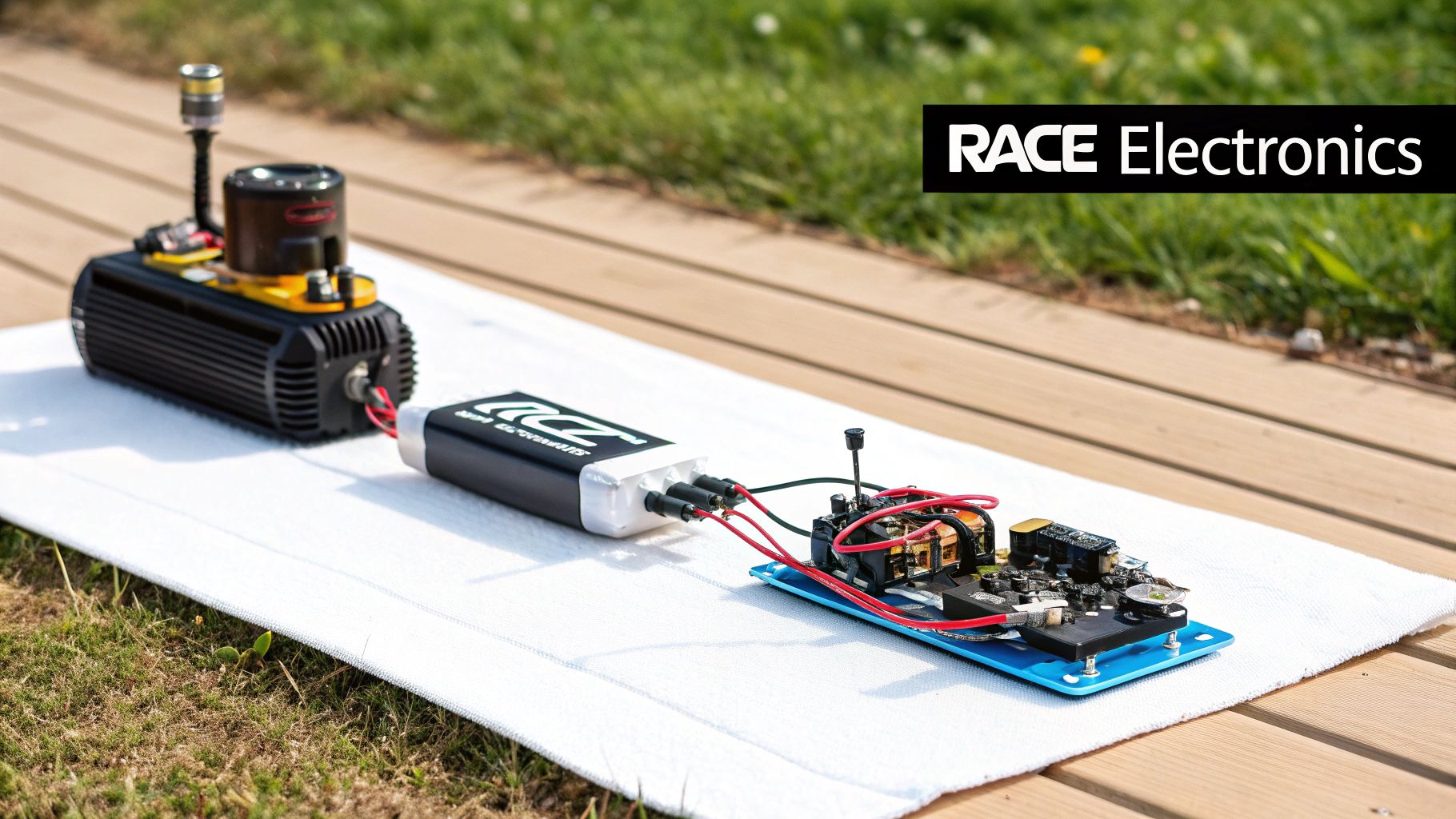
The Motor and ESC: The Heart and Brain
If the motor is the heart of your car, generating raw power for those blistering straightaways, then the Electronic Speed Control (ESC) is the brain. It takes the signals from your radio and tells the motor exactly how much power to unleash, and when.
This relationship is absolutely critical. A top-tier motor from a brand like Team Powers or Hobbywing demands an ESC that can keep up. Mismatching these components is a recipe for poor performance, overheating, and even permanent damage. For competitive racing, a sensored motor and ESC combo is the only way to go. It provides a much smoother, more predictable power delivery—something you'll need when you're driving on the absolute edge of traction.
Think of the ESC as the motor’s translator. A sensored system creates a perfect, lag-free conversation between the two, giving you that immediate and smooth throttle response needed to win races.
For builders wanting a deeper dive on this crucial component, we have a detailed guide that explains everything you need to know about your RC Electronic Speed Control. It breaks down the technical details that will give you a serious competitive edge.
Power Delivery: The Battery's Crucial Role
Your battery is way more than just a fuel tank. Yes, it holds the charge, but its real job is to deliver a steady, high-amperage current without voltage drop—or "fade"—for an entire five- or eight-minute race. This consistency is what makes your car just as fast on the last lap as it was on the first.
The type of battery you'll need is determined by your chosen chassis:
- 2S (7.4V) LiPo Batteries: These are the standard for 1/10 scale touring cars. The higher voltage provides the punch needed to power their all-wheel-drive systems and heavier chassis.
- 1S (3.7V) LiPo Batteries: You'll find these exclusively in 1/12 scale pan cars. The lower voltage is mandated by class rules and is perfectly suited to the lightweight, efficient RWD platform.
Choosing a quality LiPo battery like those from Sunpadow with a high C-rating (discharge rate) ensures your motor and ESC are never starved for power. This is a non-negotiable part of building a competitive RC auto kit.
Steering Precision: The Servo's Impact
Finally, there's the servo—the component that handles steering. In the world of on-road racing, where races are won and lost by milliseconds, steering response is everything. A slow or weak servo can make even the best-handling chassis feel sluggish and imprecise.
This is exactly why top-level racers almost universally trust brands like Sanwa. A high-speed, high-torque servo gives you two massive benefits:
- Lightning-Fast Response: It translates your steering inputs into wheel movement instantly, letting you hit your lines with surgical precision.
- Holding Power: It has the muscle to hold the wheels at the desired angle, even under the heavy G-forces of high-speed cornering.
When you're putting your RC auto kit together, investing in a quality servo is one of the most noticeable upgrades you can possibly make. It's the direct link between your brain and the car's direction, and a premium servo makes that connection feel instantaneous. By carefully selecting each of these four electronic components, you're building a cohesive system that works in perfect harmony—turning your chassis into a true podium contender.
Final Touches: Tires, Bodies, and Gearing
With your chassis and electronics sorted out, it's time to zero in on the parts that connect your car to the track and cut through the air. These aren't just minor details; the tires, body, and gearing are the finishing touches that turn a good RC auto kit into a dominant racing machine.
Think of it this way: your chassis and electronics are a world-class engine. But that engine is useless without the right transmission and tires to actually put the power down. This is where you find your real competitive edge, translating all that raw potential into faster lap times.
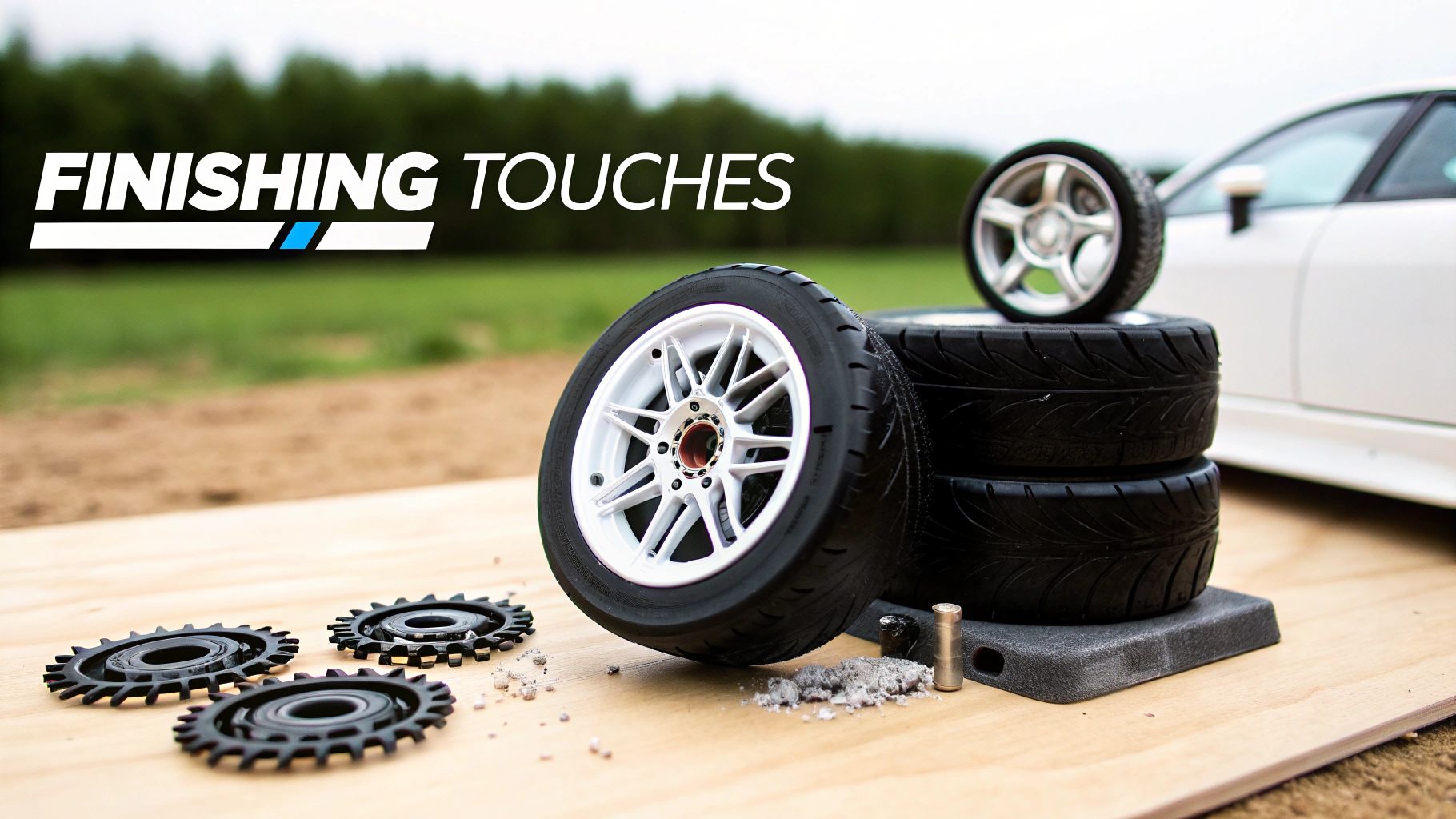
Tires: The Single Most Important Setup Choice
Ask any veteran racer what the most important setup decision is, and you'll hear the same answer over and over: tires. You can have the best motor and a perfectly balanced car, but if your tires aren't hooking up with the track surface, none of that matters. Your car's only connection to the ground is through those four small patches of rubber.
Every track is different. A high-grip carpet track requires a totally different rubber compound than a dusty, outdoor asphalt circuit.
This is exactly why building a small collection of tires is so important. Brands like Zoo Racing offer a whole range of compounds, each designed to work best in a specific temperature window and on a particular surface. Getting this right isn't just a step; it's the first and most critical step to unlocking your car's true pace.
Aerodynamics: Bodies That Carve Corners
Your RC car's body is so much more than just a pretty shell—it's a critical aerodynamic tool. At the speeds these cars hit, air becomes a powerful force you can manage to seriously improve handling. High-performance bodies from brands like Mon-Tech and Zoo Racing are engineered in wind tunnels, just like full-scale race cars.
These bodies are designed to generate downforce, which literally pushes the car into the track for more grip, especially through high-speed corners. But they also play a huge role in the car's overall balance.
A body with an aggressive front-end design can sharpen up your steering response, while a different wing and rear-end design can add crucial stability. Swapping bodies is one of the fastest ways to completely change your car's handling characteristics between races.
This kind of aero tuning is a key part of finding the perfect setup. It lets you add or remove grip exactly where you need it, tailoring the car's behaviour to your driving style and the demands of the track. A well-chosen body can be the difference between a car that feels nervous and one that feels totally planted and confidence-inspiring.
Gearing: Translating Power into Speed
Finally, let's talk about gearing. This is how you fine-tune the power delivery from your motor to the wheels. Your car's gearing comes down to two key parts: the pinion gear (on the motor) and the spur gear (in the drivetrain).
The ratio between the number of teeth on these two gears dictates your car’s acceleration and top speed. Finding the right ratio is a constant balancing act.
- Lower Gear Ratio (Smaller Pinion/Larger Spur): This gives you wicked acceleration but a lower top speed. It's perfect for tight, technical tracks with lots of corners and short straights.
- Higher Gear Ratio (Larger Pinion/Smaller Spur): This delivers a much higher top speed but with slower acceleration. This is your go-to for big, flowing tracks with long straights where you can really let the car stretch its legs.
Nailing the gear ratio for a specific track is a fundamental skill in RC racing. It ensures your motor is running in its most efficient powerband, which maximizes performance and helps prevent overheating. A correctly geared RC auto kit will feel punchy out of the corners and still have the legs to hang with the competition down the straights.
Building a Clean and Reliable Race Car
Once you've got all the parts for your RC kit laid out, the real work begins. This is where you shift from just following the instructions to thinking like a pro builder. A clean, meticulously built car isn't just for looks—it’s faster, more consistent, and a whole lot easier to work on when you're under pressure at the track.
The tiny details you put in during the build are often what separate a mid-pack car from a podium finisher. Think of a perfectly shimmed drivetrain, silky-smooth shocks, and properly secured hardware. This foundation of reliability is what lets you push the car to its absolute limit, lap after lap. Your journey to the top step of the podium starts right here on your build table.
Prepping Components Like a Pro
Before you even turn a single screw, the top builders are already at work prepping their components. This ounce of prevention saves a ton of time and avoids race-ending failures later on. One of the most critical steps, especially with modern carbon fibre kits, is treating the chassis and shock towers.
Carbon fibre can delaminate or split along the edges after a hard hit. To stop this from happening, racers use a simple but incredibly effective trick.
- Seal the Edges: Run a bead of thin CA glue (super glue) along all the exposed carbon fibre edges.
- Let it Soak In: The glue will wick into the layers of the carbon fibre, bonding them together and making the part much stronger.
- Wipe Away Excess: Before it dries, just wipe off any extra glue with a paper towel for a clean, professional finish.
This tiny step dramatically increases the durability of your chassis and could be the difference between finishing a race and a costly DNF (Did Not Finish).
Building a Flawless Drivetrain
A free-spinning, efficient drivetrain is the secret to unlocking maximum speed and runtime. Any friction or "binding" in the system is just wasted power—it robs your motor, heats up your electronics, and slows you down. The goal is a drivetrain that feels buttery-smooth and spins forever with a flick of your finger.
We get there through a process called shimming. Shims are just tiny, ultra-thin washers that let you make micro-adjustments to the position of bearings and gears.
Your goal is to eliminate all side-to-side "slop" in the drivetrain components without introducing any binding. The perfect build has near-zero play and spins forever. This attention to detail is a hallmark of a competitive race car.
By carefully adding shims to your differentials and other rotating parts, you ensure perfect gear mesh and alignment. This doesn't just make the car faster; it also makes your bearings and gears last a whole lot longer.
The Art of the Perfect Shock Build
In on-road racing, consistent handling is king, and your shocks are at the heart of that consistency. Building them right is an art form that pays off big time on the track. A poorly built shock with air bubbles will give you unpredictable damping and make the car feel erratic.
Here are the keys to building perfect shocks every single time:
- Clean Everything: Start by cleaning all the shock parts to get rid of any oils left over from manufacturing.
- Fill Slowly: Pour the shock oil into the body slowly to avoid creating air bubbles right from the start.
- Bleed Properly: Use a shock pump or just patiently cycle the piston up and down to work every last bubble out. You're looking for a perfectly smooth, consistent feel from top to bottom.
- Match Pairs: Make sure each pair of shocks (front and rear) has the exact same length and rebound. This balance is critical for predictable cornering.
Taking your time here ensures your car will handle the same on lap one as it does on the final lap of the main.
Final Assembly Best Practices
As you bring all the pieces together, a few final habits will make sure your kit is truly race-ready. First, always use a bit of thread-locking compound on any metal-to-metal screw connections, like your motor mount screws. This simple step prevents critical hardware from vibrating loose mid-race.
Second, get your hardware organized. Kits come with a ton of different screw sizes. Keeping them sorted makes the build faster and stops you from using the wrong screw in the wrong place, which can lead to stripped threads or damaged parts.
By following these pro-level techniques, you're not just assembling an RC kit. You're building a reliable, durable, and highly tunable racing platform—the solid foundation you need to win.
Why Canadian Racers Trust digital-rc
Building a winning RC car is about more than just bolting parts together. It’s about having a partner you can rely on, one who gets the unique demands of competitive racing. For serious racers across Canada, that partner is digital-rc. We're not just another online store; we're a strategic resource built from the ground up for speed, precision, and convenience.
Our entire approach starts with a hand-picked selection of elite, race-proven brands. You won’t waste time scrolling through endless pages of questionable parts here. Instead, you get immediate access to championship-winning chassis from Awesomatix and XRAY, backed by dominant electronics from Hobbywing, Team Powers, and Sanwa. This sharp focus ensures every single component we carry is engineered to give you a real performance advantage on the track.
The digital-rc Advantage
Beyond our product selection, we’ve systematically eliminated the common frustrations Canadian racers have learned to live with. All our pricing is in straightforward Canadian Dollars (CAD), and every order ships with no tax. This clean, transparent approach lets you focus on your build, not on surprise fees or confusing currency conversions.
This dedication to the Canadian scene is making an impact. On-road racing is seeing huge growth, and recent data shows competitive racers—who make up 55% of buyers—are investing in full kits, spending an average of CAD 650 per purchase. Digital platforms captured 40% of the market share by 2024, and for us, same-day delivery has boosted conversions by 30% among racers scrambling for last-minute parts. When 68% of club surveys name kit quality as the top factor for podium finishes, having instant access to critical parts like Zoo Racing tires and Sanwa servos makes all the difference. You can find more insights into the global remote control toy car market on market.us.
At digital-rc, we know that race day doesn't wait. A broken part on Friday shouldn't end your entire weekend. We built our service around solving that exact problem.
Maybe our biggest advantage is our game-changing delivery promise. We offer free same-day delivery on orders placed before noon. This service is an absolute lifeline when you need a part for a Friday night club race or a weekend trophy event. It means you can fix a crash, try a new setup, or grab fresh tires with a speed no one else can match. It’s this commitment to keeping you on the track that has made digital-rc an indispensable part of the Canadian RC racing scene.
Common Questions About Building Your RC Auto Kit
Stepping into the world of building an RC auto kit can feel like a big leap, but the good news is that most challenges you'll face are common hurdles with straightforward fixes. Whether this is your first build or you're a seasoned racer, a few key questions always seem to pop up.
Think of this as your trackside pit support, ready to guide you through those initial head-scratching moments and get you on the right path.
What Tools Do I Absolutely Need to Start My Build?
A solid foundation of quality tools makes all the difference. While you can assemble a kit with a basic set, investing in proper tools from the start prevents stripped screws, ensures every component fits perfectly, and translates directly into a precise, reliable race car.
You'll need a core set of high-quality hex drivers—1.5mm, 2.0mm, and 2.5mm are the workhorses for modern kits like an XRAY T4 or Awesomatix A12. Beyond that, a good pair of needle-nose pliers, a sharp hobby knife, and a few specialized items like shock pliers and a camber gauge will make the entire process more accurate and, frankly, more enjoyable.
How Do I Choose the Right Spec Motor for My Touring Car?
This is an easy one: your motor choice is almost always dictated by the rules of your local racing class. Most club racing centres around "spec" or "stock" classes, which mandate a specific motor turn (like 17.5T or 21.5T). The whole point is to level the playing field, putting the focus on driver skill and car setup rather than raw horsepower.
For anyone new to racing, starting in a spec class is the absolute best way to learn the fundamentals of driving and tuning. Choosing a reliable, race-proven motor from brands like Hobbywing or Team Powers ensures you have a consistent and competitive power plant, freeing you up to focus on hitting your lines and tweaking your setup.
My New Kit Feels Slow and Handles Poorly. What Did I Do Wrong?
Don't worry, this happens to everyone! It’s rarely one big mistake but usually a combination of small setup details that need dialling in. Before you start tearing the car apart, run through this simple diagnostic checklist.
A new kit that feels "off" is almost always a setup issue, not a build error. The solution lies in checking for binding, establishing a baseline setup, and, most importantly, getting your tire selection right for your local track.
First, check for any binding in the drivetrain. Lift the car and spin the wheels by hand; they should rotate freely with very little resistance. If they don't, something's too tight. Next, make sure your car is set to the "kit setup" found in the manual. This is a fantastic, neutral baseline to start from.
Finally, and this is the big one, talk to the local racers at your track about tires. The correct tire compound and additive from a brand like Zoo Racing is often the single biggest factor in unlocking your car's true pace.
At digital-rc, we provide the championship-winning kits, electronics, and support you need to build a competitive race car right out of the box. Explore our curated selection of high-performance parts today.