

Mastering the Circuit: Your Guide to On-Road RC Cars Tracks
Welcome to the world of on-road RC racing. If you're serious about being competitive, you need to understand that the track is both your biggest challenge and your best teacher. Knowing the circuit is every bit as important as nailing your car's setup.
Think of this guide as your track walk before the first qualifier.
Your Starting Grid for On-Road RC Racing
In on-road RC, the track is so much more than just a place to drive. It's a living, breathing part of the race that forces you to make smart setup choices. Your tyre compound, your battery choice, even your shock oil—every single decision is a direct response to the unique challenges the circuit throws at you. This is where your skills as a driver and a mechanic truly come together.
Unlike off-road racing with its bumps, jumps, and loose dirt, on-road tracks are all about precision, consistency, and finding that last hundredth of a second. Success starts long before the tone sounds. It begins with understanding the surface you're racing on, the layout of the corners, and how it all comes together.
Foundational Track Concepts
To get you up to speed, let's break down the three pillars of any competitive RC circuit. Get these right, and you’ll be making smarter decisions on race day.
- Track Surfaces: This is the foundation of your setup. A high-grip carpet track demands a completely different approach to tyres and suspension than a smooth, sealed asphalt circuit.
- Circuit Layouts: The mix of tight hairpins, flowing sweepers, and long straights dictates your racing line. It influences everything from the gear ratio you choose to how you tune your diff.
- Electronic Timing: At the heart of every modern race is a precision timing system. Your car needs a compatible personal transponder to log your lap times down to the thousandth of a second.
Once you grasp these core ideas, you stop just driving on the track and start racing it. Every setup change becomes a calculated move to find more corner speed and drop your lap times.
Ultimately, this guide will give you a clear roadmap for tackling any on-road circuit you encounter. We'll connect the theory to the real-world products you need, from high-performance setup stations and electronics to the specific tires and batteries from brands like R1 Wurks and Hobbywing that give you an edge right out of the box.
Decoding Track Surfaces and Layouts
The track surface is the canvas where every race unfolds. If you want to be fast, understanding its character isn't just a good idea—it's non-negotiable. For on-road RC, your entire car setup, from the tyres you glue up to the shock oil you choose, is a direct response to the grip under your wheels.
Two main battlegrounds dominate the on-road scene: old-school outdoor asphalt and modern high-grip indoor carpet. Each one throws a completely different set of challenges at you and demands a unique approach to wring out every last tenth of a second.
Think of it like choosing the right shoes for a sport. You wouldn't wear basketball high-tops to run a 100-metre sprint, and the same logic applies here. A setup that’s dialled on the almost glue-like surface of a carpet track would make a car feel like it’s driving on ice on a lower-grip asphalt circuit. Mastering the surface is the first real step toward building a winning car.

As you can see, the surface, layout, and timing system all feed into each other, dictating your strategy and the gear you bring to the track.
The Two Faces of On-Road Racing Surfaces
Asphalt and carpet couldn't be more different. Asphalt is the classic outdoor surface, often sealed to provide a smooth, consistent finish. Its grip level can be all over the place, changing with the ambient temperature, how much sun is hitting the track, and even the amount of dust in the air. This variability is what makes tyre choice and additive so critical. A compound that hooks up perfectly on a cool morning might feel greasy and slow by the afternoon heats.
High-grip carpet, on the other hand, is a whole different beast. Found at most indoor tracks, surfaces like the black ETS (Euro Touring Series) carpet provide immense, unwavering traction. The challenge here isn't finding grip, but managing it. Cars will traction-roll in a heartbeat if the setup is wrong, and races are won by thousandths of a second through pure, repeatable precision.
On carpet, races are often decided by who can carry the most corner speed without tipping over. On asphalt, it’s about adapting to changing conditions and managing tyre wear over the course of a run.
To help break it down, here’s a look at how these common surfaces stack up against each other.
On-Road RC Track Surface Comparison
| Surface Type | Grip Level | Recommended Tyre Type | Key Setup Consideration |
|---|---|---|---|
| Asphalt (Sealed) | Medium, Variable | Belted Rubber (Medium to Hard) | Managing temperature and dust; tyre additive is key. |
| Asphalt (Unsealed) | Low to Medium | Belted Rubber (Soft to Medium) | Suspension needs to be softer to generate mechanical grip. |
| ETS Carpet (Black) | Very High, Consistent | Specific Rubber or Foam | Preventing traction roll with stiff suspension and body choice. |
| Ozite Carpet (Grey) | High, Consistent | Foam or Soft Rubber | Requires aggressive setup; managing tyre wear on foams. |
Each surface demands a specific approach to your car’s setup and the tyres you run. There’s no single "best" setup—it’s always a response to the track in front of you.
From Surface to Setup: The Product Connection
Your choice of surface directly dictates the gear you need to be competitive. For instance, a soft foam tyre that’s unbeatable on high-bite ETS carpet would be shredded to pieces in minutes on an abrasive asphalt track.
- For Asphalt: You’ll need durable, belted rubber tyres that resist "ballooning" at high speeds. Additives from brands like MR33 are used to soften the rubber and build heat for better grip, while a good tyre cleaner is mandatory for getting dust off between runs.
- For Carpet: Spec-series rubber or foam tyres with precise compounds are the norm. Here, additives create a chemical bond with the surface for maximum adhesion. Our selection of proven tyre additives ensures you have the right formula for any condition.
Navigating Common Track Layouts
Beyond the surface, the layout of the RC cars tracks dictates the rhythm of the race. For popular classes like 1/10 touring cars, layouts are usually a balanced mix of technical, tight sections and fast, flowing corners.
Nailing the racing line—the absolute fastest path around the circuit—is everything. It’s all about finding the perfect turn-in point, hitting the apex, and getting on the power at the right moment to carry maximum speed onto the next straight.
Common features you'll need to master include:
- Chicanes: Quick left-right or right-left sections that test your car's agility and responsiveness.
- Sweepers: Long, flowing corners where you carry a ton of speed and ride the edge of traction.
- Hairpins: Tight, 180-degree turns that demand hard braking on entry and perfect throttle control on exit.
Learning how to string these elements together separates the front-runners from the rest of the pack. To get a better handle on finding a place to practice, check out our guide on how to find RC race tracks, which will help you get prepped for your next race day.
What Makes a Great RC Track?
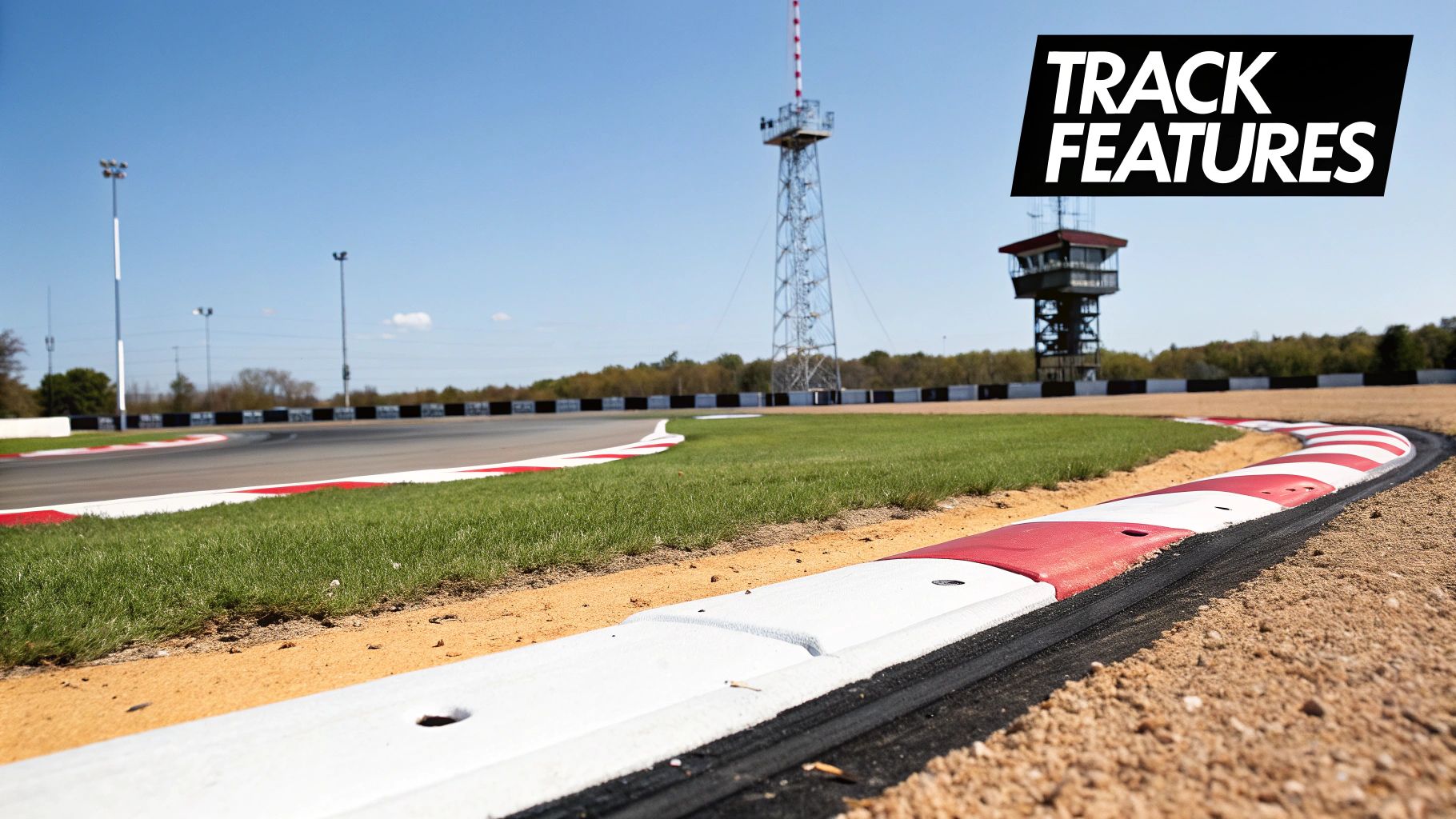
A proper race track is more than just a patch of asphalt or carpet. It's an arena, deliberately designed to push your driving skill, your nerve, and your car's setup to the absolute limit. The features that mark the track's edges and clock your laps are every bit as important as the racing surface itself.
These elements turn a simple layout into a competitive battlefield where every hundredth of a second is earned. Knowing how to read them and use them to your advantage is what separates the rookies from the podium finishers.
Barriers and Curbs: The Lines You Can't Cross
The most obvious features on any track are the barriers. They define the circuit and serve as the ultimate penalty for pushing too hard. The type of barrier a track uses completely changes how you attack a corner.
- Forgiving Barriers: Many clubs use flexible plastic piping or tubes. Tapping one of these might upset your car and cost you time, but you can usually gather it up and keep going. They encourage you to flirt with the track limits.
- Unforgiving Barriers: On the other hand, solid wood boards offer zero forgiveness. One mistake here often means a broken A-arm and a walk of shame back to the pits. These demand absolute precision.
Curbing is another key feature, often painted red and white just like a full-size F1 circuit. These raised sections on the inside of corners are there for a reason. Skilled drivers can "use the curb" to tighten their line and carry more speed through a turn, but get it wrong, and you'll unsettle the chassis or even break a wheel.
The Heart of the Race: Timing Systems
While barriers define the physical space, the electronic timing system is what turns practice into a real competition. This is the heart of all modern rc cars tracks, delivering the hard data that separates first place from second. Without it, you’re just driving in circles. With it, you’re racing.
The system is brilliantly simple. A large wire loop, called an antenna, is embedded in the track surface right at the start/finish line. Every time your car crosses this loop, it sends a signal to a decoder in the race director’s booth.
This technology is the official timekeeper. It doesn't guess, and it doesn't make mistakes. It logs your lap times down to the thousandth of a second with perfect accuracy, every single time.
To get in on the action, your car needs a personal transponder. This tiny, lightweight device sends out a unique signal that the track's antenna picks up. Each time you cross the line, the system knows it was you and logs your lap.
To get race-ready, our store stocks a range of MyLaps-compatible transponders, which are the standard for virtually every competitive track worldwide. Installing one is your ticket to official competition.
Tuning Your Car for Maximum Track Performance
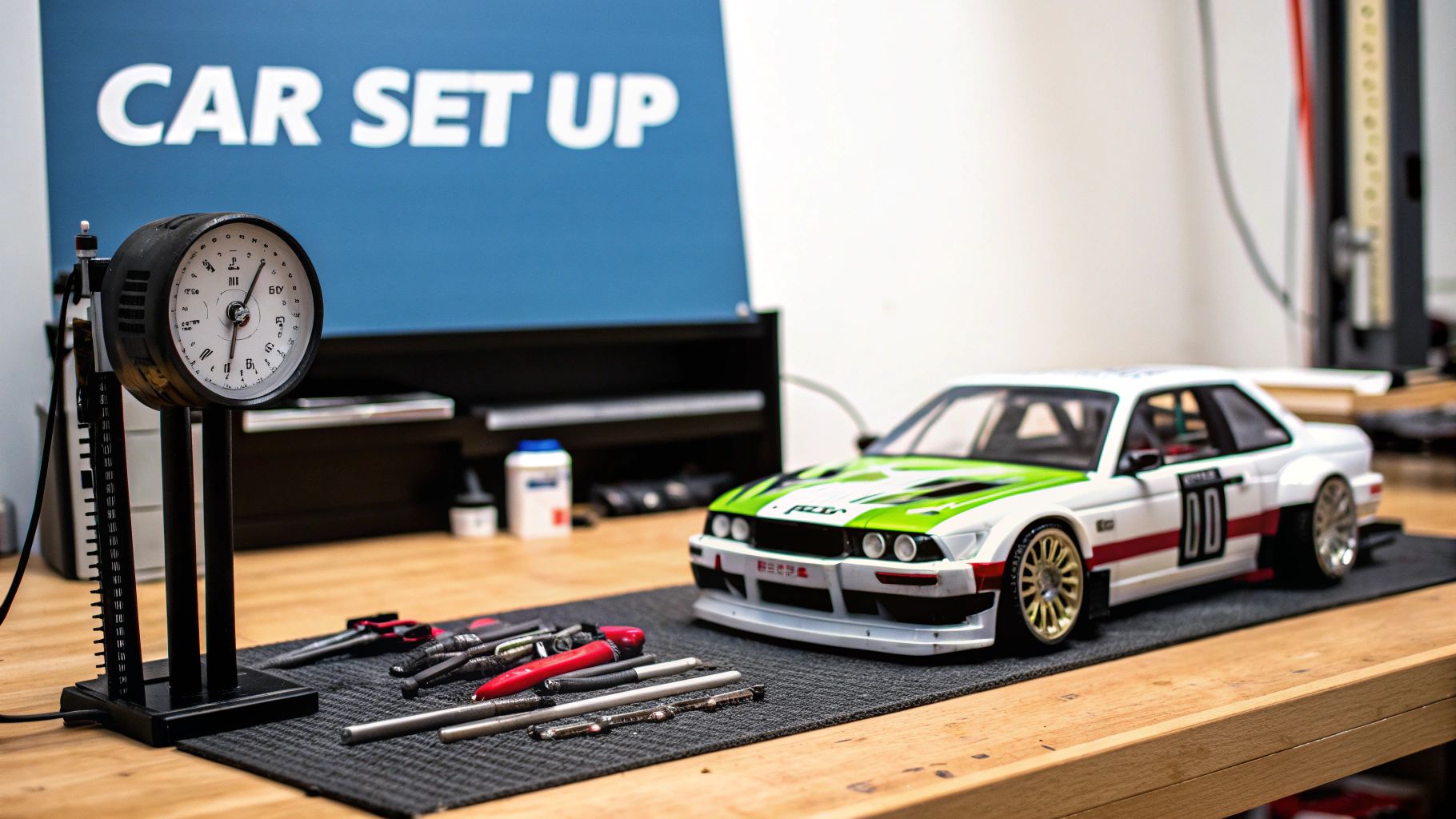
Owning a great car gets you to the track, but a perfectly dialled-in setup is what gets you on the podium. On competitive rc cars tracks, the ability to fine-tune your car for specific conditions is the secret to finding those last few tenths of a second. This is where the real work begins.
Think of a stock setup as an off-the-rack suit—it gets the job done, but it’s far from a perfect fit. Tuning is the art of tailoring that car to the track, making sure every component works together to put maximum power down cleanly and consistently. Tiny, precise adjustments can completely change how your car enters a corner, holds a line, and rockets out of the apex.
Demystifying Core Setup Adjustments
A setup sheet can look intimidating at first, but the core principles are refreshingly simple once you know what you’re changing. Let's break down the essential tweaks that will transform how your car feels on the track.
-
Ride Height: This is simply the distance between your chassis and the track surface. Lowering it drops the centre of gravity for less body roll on high-grip tracks. Raising it can help the chassis clear bumps and generate more mechanical grip on lower-traction surfaces.
-
Camber: Look at your car from the front—camber is the vertical angle of the tires. Negative camber tilts the top of the tire inward, just like a motorcycle leaning into a turn. This maximizes the tire's contact patch during cornering, giving you more grip exactly when you need it.
-
Toe: Now look at your car from above. Toe-in points the front of the tires slightly toward each other, which adds straight-line stability. Toe-out points them away from each other for a more aggressive, snappy turn-in at the cost of some stability.
-
Droop: This setting dictates how far your suspension arms can travel downward. More droop allows for more weight transfer, which is a big help on bumpy or low-grip tracks. Less droop keeps the car flatter and more responsive—perfect for smooth, high-bite carpet.
The Right Tools for Repeatable Results
Guesswork is the enemy of a competitive setup. To make these adjustments with precision time and time again, you need the right tools.
A winning setup is a precise formula, not a lucky guess. Using digital gauges and setup stations removes the guesswork, ensuring your car is identical every time it hits the track. This consistency is the foundation of going faster.
Essential tools like a digital ride height gauge and a digital camber gauge give you exact measurements down to a tenth of a millimetre. For the ultimate in precision, an all-in-one setup station from a brand like SkyRC lets you measure camber, toe, and caster at the same time, ensuring your chassis is perfectly square. To understand how these changes work together, check out our guide on how different RC car tires impact your setup.
Matching Power to the Pavement
Mechanical grip is only half the story. Your power system needs to be just as dialled-in as your suspension.
For a tight, technical indoor track with instant grip, you need explosive acceleration. A high C-rating LiPo battery from a brand like R1 Wurks delivers the punch required for those quick bursts out of corners. On a big, flowing asphalt track, raw top speed becomes the priority. Here, you might adjust your Hobbywing motor’s timing to squeeze out more RPM.
The ability to tune both the chassis and the electronics is what separates the front of the pack from the middle. This focus on adjustability has deep roots in racing; legendary brands like Associated Electrics revolutionized the hobby with the 1984 RC10, which introduced features like tunable oil-filled shocks that set the standard for track performance we still build on today. You can learn more about the history that shaped modern RC cars on Wikipedia.
The Roots of RC Racing: History, Community, and the Local Track
Every time you line up on the grid, you're taking part in a hobby built on decades of passion and innovation. Modern RC car tracks didn't just pop up overnight. Their story is deeply connected to full-scale motorsport, with the earliest enthusiasts taking direct cues from the iconic racing venues of their time.
The first miniature circuits were often simple ovals, a direct reflection of the speedways that dominated the real-world auto racing scene. It was a straightforward start, but as the technology inside the cars got better, the tracks had to evolve right alongside it.
The real shift happened in the 1970s and 80s. As more advanced chassis, stronger batteries, and better suspension systems hit the market, racers needed something more demanding than a basic loop. This constant push from a passionate community of drivers is what drove the evolution from simple ovals to the technical, challenging road courses we race on today.
The Local Club: Where It All Happens
This innovation wasn't born in a corporate lab; it was happening in the pits and on the drivers' stands of local clubs. These clubs became the proving grounds where racers would swap setup tips, battle it out on the track, and build friendships that lasted long after the last battery was charged.
It's this social fabric that truly defines RC racing.
A local RC club is so much more than just a place to race. It's a support network for newcomers, an incubator for talent, and the social hub where the passion for the sport is shared and passed down.
You can't overstate the influence these communities have had. Certain regions, like Southern California, became epicentres for RC development for a reason. The area has a rich motorsport heritage, with legendary venues like Saugus Speedway—a track that grew from rodeo grounds into a premier 1/3-mile paved oval for stock cars. You can dive deeper into this history by exploring L.A.'s bygone racing days on PBSSoCal.org.
This deep-rooted local racing culture directly fuelled the RC scene, which helps explain why so much innovation in both car technology and track design came out of that area.
How to Find and Join Your Local RC Racing Scene
There comes a point where the driveway just won't cut it anymore. To really sharpen your skills and get faster, you need to get on a real circuit. Finding a local track and plugging into the racing community is the single best step you can take to improve and get more enjoyment out of this hobby.
And thankfully, finding a track is easier than ever.
The search almost always starts online. A quick lookup for "RC track near me" or "1/10 touring car racing Ontario" will usually point you in the right direction. Social media, especially Facebook, is an absolute goldmine here—most clubs have active groups where they post race schedules, results, and setup advice.
What to Look for in a Club
Once you’ve got a few options, keep an eye out for signs of a healthy community. A great club has a well-maintained track, a welcoming vibe for new drivers, and consistent race days. Don't be shy. Reach out online or just show up on a practice day to get a feel for the place.
If you want to understand what makes these groups tick, it's worth taking a look to explore examples of successful communities of practice. The same principles of shared learning and engagement apply directly to the RC racing world.
When a community invests in a great facility, people show up. The Rescue Community Center RC track in Northern California, for example, drew over 100 participants for its first major race. Facilities like this have seen local engagement jump by a massive 40%, proving just how powerful a great track can be.
Your First Day at the Track
Showing up for the first time can feel a little intimidating, but the RC community is famously helpful. My advice? Get there early to grab a spot in the pit area and just start introducing yourself. Be mindful of basic pit etiquette—keep your area tidy and respect your neighbours' space. It goes a long way.
A typical race day is pretty straightforward. You'll run several qualifying heats to set the starting grid for the main events. That's where your final finishing position is decided. The goal is simple: learn something, have fun, and don't stress about being the fastest person there on your first day.
For a deeper dive on how to lock in the perfect place to race, check out our dedicated article on finding an RC car track near you. It’ll give you all the tools you need to get connected and hit the track with confidence.
Got Questions About RC Car Tracks? We've Got Answers.
Stepping into the world of on-road RC car tracks can feel a little overwhelming. There's a ton to learn, but don't worry—every single pro started right where you are. Here are some of the most common questions we hear at the track, answered straight up.
What Gear Do I Absolutely Need for My First Track Day?
Okay, let's get you packed. You've got your car, transmitter, and a few charged batteries. What's next? You'll need a basic tool kit from a brand like Arrowmax with the right hex and nut drivers for quick fixes. Also, pack a spare set of tires, a proper LiPo-safe charger like one from SkyRC, and a pit mat to keep everything organized.
Most racers bring a small table and chair to set up a comfortable pit space. But here's the most important tip: find out if the track uses a personal transponder for timing laps. If they do, make sure your MyLaps transponder is installed and working before you get there. Nothing's worse than being ready to race and finding out you can't be timed.
How Do I Figure Out the Right Tires for a Specific Track?
Tire choice is everything, and it all comes down to the surface and temperature. For carpet racing, you'll be looking at specific rubber or foam tires, often with different compounds depending on how much grip the track has. Many clubs and series run a 'spec tire' to keep the playing field level, so always check the rules first.
If you're racing on asphalt, you'll need belted rubber tires that can take the abuse of an abrasive surface. Honestly, the fastest way to get it right is to walk up to the experienced local racers and ask what they're running. The RC community is your best resource, and they'll know exactly what hooks up on their home track.
"Your tires are the single most important setup decision you will make. Never be afraid to ask the fast drivers what they're running; the local community is your best source of information."
What's the Real Difference Between a Club Race and a Major Event?
Think of a club race as your local track's regular get-together. They're usually held weekly or bi-weekly, and the vibe is super relaxed. It's the perfect place to learn the ropes, test out new setups without pressure, and just have a good time with fellow racers.
A major series event is a whole different ball game. These are big, highly competitive races that draw top drivers from all over the region, or even the country. They're way more structured, run on a tight schedule with strict rules, and often take up a full weekend. The skill level—and the pressure—are cranked way up.
At digital-rc, we stock everything you need to hit the track with confidence, from essential setup tools by SkyRC and Arrowmax to race-winning electronics from R1 Wurks and Hobbywing. Gear up with parts that are proven to perform. Visit https://digitalrc.ca to get race-ready.