

A Complete Guide to On-Road RC Racing Tracks
In the world of competitive RC, the track isn't just a surface—it's the entire arena. It’s where a dialed-in setup and pure driving skill separate the winners from the rest of the pack. Getting a handle on the different RC racing tracks you'll encounter is the first real step toward the podium, because every single surface demands its own unique strategy for car setup and tire choice.
Understanding Your Arena: The World of RC Racing Tracks
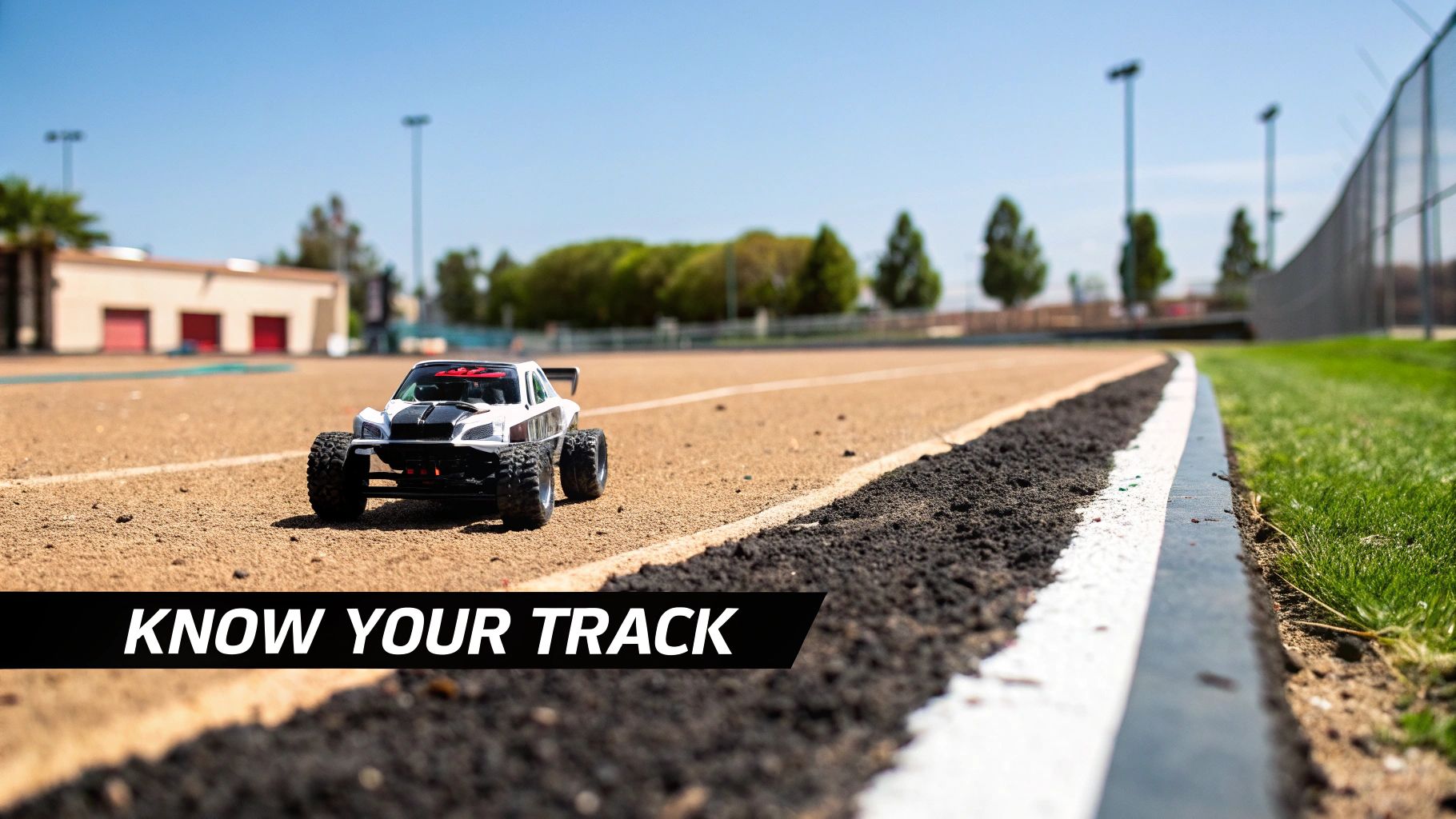
Welcome to the heart of radio-controlled competition. Whether you're a newcomer or a seasoned pro, the ability to read a track's nuances is what shaves those precious tenths off your lap times. Think of this guide as your pre-race briefing—everything you need to analyze, adapt, and conquer any circuit you come across.
The track surface is its personality. Just like a sprinter picks different spikes for a clay court versus a synthetic track, an RC racer has to tune their car for the ground underneath it. For on-road racing, the battleground is usually split between two main environments: indoor and outdoor. Each one brings its own set of challenges and opportunities.
Indoor Vs. Outdoor Circuits
Indoor RC racing tracks are all about consistency. Since they’re sheltered from the weather, you get predictable conditions race after race. This makes them the perfect lab for fine-tuning your setup to perfection. The most common surface you'll find is high-grip black carpet, which creates an intense, high-speed racing environment where a single mistake can cost you the race.
Outdoor tracks, on the other hand, throw a ton of variables your way. Things like temperature, humidity, and even how much sun is hitting the asphalt can completely change the grip level from one heat to the next. This dynamic environment really tests a driver's ability to adapt and make setup tweaks on the fly.
It all boils down to control versus adaptability. Indoor carpet racing rewards a perfectly locked-in, repeatable setup. Outdoor asphalt racing often favours a more versatile car that can handle changing grip levels and a few bumps along the way.
The Critical Role of Surface Type
The material your car is running on has the single biggest impact on its behaviour. It dictates everything from which tires you glue up to how you set your suspension. Understanding these surfaces isn't just a good idea—it's non-negotiable if you want to be competitive.
The main on-road surfaces you’ll run into are:
- High-Grip Carpet: Often called "black carpet," this stuff provides insane, consistent traction. It lets you carry incredible corner speeds but can be super unforgiving, leading to the dreaded "traction roll" if your setup isn't spot-on.
- Asphalt: The classic outdoor surface. Asphalt can be anything from smooth and grippy to bumpy and abrasive. It demands durable tires and a setup that finds that sweet spot between stability and agility.
RC Track Surface Characteristics at a Glance
To quickly see how these surfaces stack up, here’s a simple breakdown. This table gives you a snapshot of what to expect from common on-road track materials and where to start with your tire choice.
| Surface Type | Typical Grip Level | Common Environment | Recommended Tire Type |
|---|---|---|---|
| High-Grip Carpet | Very High, Consistent | Indoor | Foam or Carpet-Specific Rubber |
| Asphalt | Medium to High, Variable | Outdoor | Treaded or Slick Rubber |
| Treated Asphalt | High, Consistent | Outdoor | Slick or Pre-Mounted Rubber |
| Concrete (Polished) | Low to Medium, Slick | Indoor/Outdoor | Soft Compound Rubber |
Think of this table as your starting point. The best choice always depends on the specific track and conditions on race day, but this gives you a solid foundation to build from.
Ultimately, mastering the environment is the first rule of racing. Finding the right place to practice is a huge first step, and you can learn more about how to find an RC car track near you in our detailed guide. By learning to read the track and predict how your car will react, you're building a winning strategy before the starting tone even sounds.
Every track has a story to tell, and you can read it in the layout. More than just a racing surface, a track's dimensions, its barriers, and the flow of its corners give it a unique personality. If you want to be fast, you need to learn to speak its language. Understanding this anatomy helps you see the challenges ahead and start building a winning strategy before your tires even touch the ground.
When you get to the competitive level, especially in 1/10 and 1/12 scale on-road, track dimensions are no accident. Lane widths are usually between 2.5 and 3.5 metres—wide enough to allow for passes but narrow enough to keep the racing close and intense. While the overall size of a track can change, sticking to this lane width standard means you’ll feel at home whether you’re at a local club race or a major national event.
This dedication to the sport runs deep across Canada. Kamloops, B.C., for example, has been a hub for RC racing for almost thirty years, playing host to countless national championships. The local scene there has evolved from racing in gyms to purpose-built outdoor facilities, showing just how much passion and grit it takes to keep a racing community alive and kicking. You can check out the fascinating history of RC tracks in Kamloops to see how these venues grow with the sport.
Barriers: The Unforgiving Walls
The edges of the track are just as critical as the surface you're driving on. Barriers define the racing line, and they’re there to punish your mistakes. The type of barrier a track uses directly impacts how hard you can push into the corners and how much risk you can afford to take.
You’ll typically run into a few common types:
- CRC Click Track: This is the go-to for most indoor tracks. It’s a modular system of flexible plastic pipes that gives a little on impact. You can often glance off it without much, if any, damage, which really encourages tight, wheel-to-wheel racing.
- Plywood or Wood Barriers: Old-school and unforgiving. Hitting a wooden board is like hitting a wall, because it is one. An impact here can easily end your day with a broken chassis or suspension arm, forcing you to drive with a lot more precision.
- Fire Hose or Plastic Tubing: Often found at club tracks or temporary layouts, these are pretty forgiving. They absorb impacts well, but they have a nasty habit of snagging a wheel or flipping your car if you hit them at just the wrong angle.
A track lined with forgiving CRC barriers invites you to dive-bomb corners, using the pipe to help pivot the car. But if you see plywood walls, you better respect them. Drive a clean, smooth line or you'll be staring at a DNF (Did Not Finish).
Reading the Layout: Key Track Features
A track layout is really just a series of questions designed to test you, your car, and your setup. Learning to identify these features helps you build a car that’s balanced for the whole circuit, not just one or two corners.
- Sweepers: These are the long, fast, flowing corners where you find out just how much high-speed grip and stability your car has. A well-balanced car feels planted here, carrying its momentum all the way through the turn.
- Chicanes: A quick left-right or right-left combo. Chicanes are all about agility and how quickly your car can change direction. This is where your steering and chassis responsiveness are truly put to the test.
- Hairpins: The tightest turns on the circuit, usually a full 180-degree corner. Hairpins challenge your car's brakes and its ability to punch out of a slow corner with good traction. A bad setup will feel lazy here, either pushing wide or spinning the tires on exit.
Every single one of these elements forces a trade-off. A car set up to be a hero in the fast sweepers might feel like a boat in a tight chicane. The real skill in mastering the anatomy of different RC race tracks is finding that sweet spot—that perfect compromise. To learn more about how it all connects, take a look at our complete guide on understanding RC race tracks and their impact on your strategy.
How Track Surfaces Dictate Your Car Setup
The ground beneath your RC car is the single most important factor in your setup. Think of it as a silent partner in your race program, influencing every decision you make, from which tire compound to glue up to what shock oil you run. Learning to "read" the surface is the key to unlocking consistent performance on race day.
It helps to think about it in extremes. Tuning for a high-grip, black carpet track is a lot like setting up a full-scale Formula 1 car. Everything is about precision, maximizing corner speed, and managing immense grip. The setup needs to be razor-sharp.
On the other hand, prepping a car for a dusty, outdoor asphalt track is more like building a rally car. It has to be tough and adaptable enough to handle bumps, changing grip levels, and general abuse. Here, a forgiving setup often beats a purely aggressive one.
The Carpet Versus Asphalt Dilemma
High-grip indoor carpet presents a unique challenge: too much traction. The grip levels can be so high that the car wants to flip over in the corners—a phenomenon we call traction rolling. Your entire setup becomes a balancing act to keep the car from tipping. This usually means running stiffer suspension, specific tire compounds, and sway bars to keep the chassis flat.
Outdoor asphalt is a completely different world. The grip is almost always lower and far less consistent. As the sun beats down, track temperatures change, and a setup that felt dialed in the morning can feel loose and unpredictable by the afternoon. Asphalt is also way more abrasive, which means faster tire wear and the need for a more durable setup.
The core principle is simple: on high-grip surfaces, you tune to manage traction. On lower-grip surfaces, you tune to find traction. This mental shift is crucial for making the right setup calls.
Tires and Additives: The Foundation of Grip
No setup change in the world can make up for running the wrong set of tires. They are your car's only connection to the track, and getting this part right is everything. On RC racing tracks with high-grip carpet, pre-mounted rubber tires designed specifically for that surface are the standard.
To squeeze out even more performance, racers use tire additives—often called "sauce." These chemicals soften the rubber just enough to help it bite into the carpet fibres for maximum grip. Applying the right amount of sauce and letting it soak for the correct amount of time is an art form that can absolutely make or break your race.
For asphalt, your options are much broader. You might use slick tires on a clean, high-grip surface or a treaded tire if the track is dusty. The game here is matching the rubber compound to the surface temperature and how abrasive it is. A compound that's too hard won’t generate enough heat to grip, while one that's too soft will overheat and be destroyed in just a few laps. To get deeper into this, check out our complete guide on how to choose the right RC car tires for any surface.
The right setup helps your car navigate the track's unique challenges, from wide-open sweepers to tight, technical sections.
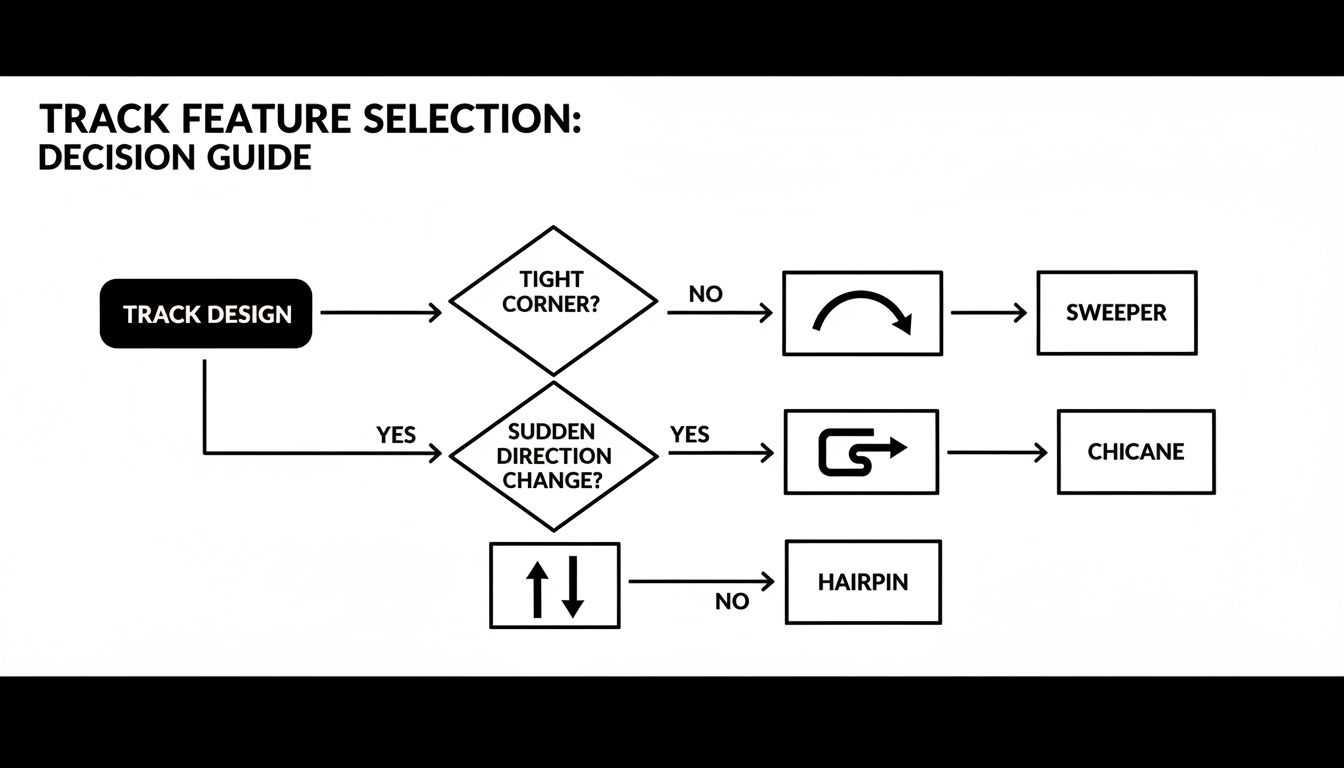
As you can see, a fast sweeper demands high-speed stability, a chicane requires quick direction changes, and a hairpin tests your car's braking and acceleration. Your setup has to find the right compromise to handle all three effectively.
Core Setup Adjustments by Surface
Once your tires are sorted out, you can start fine-tuning the car’s handling with mechanical adjustments. While a full setup sheet can be intimidating, a few key parameters change dramatically when you move between carpet and asphalt.
Setup Adjustments by Track Surface
Here’s a quick-glance table showing how you might adjust a typical 1/10 touring car when going from a high-grip indoor track to a medium-grip outdoor one.
| Setup Parameter | High-Grip Carpet (Indoor) | Medium-Grip Asphalt (Outdoor) |
|---|---|---|
| Ride Height | Lower (e.g., 4.5mm) | Higher (e.g., 5.5mm) |
| Shock Oil | Heavier (e.g., 500cst) | Lighter (e.g., 400cst) |
| Camber | More Negative (e.g., -2.0°) | Less Negative (e.g., -1.5°) |
| Tire Additive | Heavy Application | Light or No Application |
| Downforce | Lower Wing Setting | Higher Wing Setting |
These adjustments all work together. A lower ride height on carpet reduces chassis roll and helps prevent traction rolling. On asphalt, a higher ride height lets the car soak up bumps and generate more mechanical grip. Heavier shock oil slows the car’s reactions, keeping it stable on a smooth surface, while lighter oil lets the suspension move more freely over imperfections.
At the end of the day, it's about understanding these core principles. By analyzing the track surface and making deliberate setup choices, you can turn your car into a specialized machine that's ready to compete at the front of the pack.
Mastering Track Layouts and Racing Lines
A track's layout is what gives a race its rhythm. It's what separates drivers who are just following the car in front from those who are actively dissecting the circuit. Every corner, every straight, and every transition is a puzzle, and solving it lap after lap is how you win on competitive RC racing tracks.
Think of it like a musician reading sheet music. A skilled driver learns to read the flow of the track. Some layouts are wide open and flowing, full of big sweepers that reward drivers who can carry incredible corner speed. These circuits are all about high-speed stability and precision.
Then you have the opposite: tight, technical tracks packed with hairpins and chicanes. These layouts demand aggressive braking and explosive acceleration out of the corners. Here, it’s all about agility and how quickly your car can change direction. The first step to a winning setup is figuring out the fundamental character of the track you're on.
The Concept of the Racing Line
The shortest way around a track is to hug the inside barrier, but that’s almost never the fastest way. The racing line is the ideal path through a corner—or a series of them—that lets you carry the most speed and slash your lap time. It’s a game-changing concept that turns driving from a simple reaction into a strategic execution.
Visualizing this line is everything. It’s about using the entire width of the track to make each corner as wide and as straight as you possibly can. This usually means approaching a turn from the outside edge, clipping the inside point (the apex), and letting the car's momentum carry it back to the outside on exit. This sets you up perfectly to get on the power for the next straight.
The golden rule of the racing line is simple: "slow in, fast out." By braking a little earlier and giving up a tiny bit of entry speed, you can position your car perfectly at the apex to get back on the throttle sooner and harder. That exit speed is what you carry all the way down the following straight, and it’s what makes a massive difference to your lap time.
Dissecting Different Corner Types
Mastering the racing line isn't a one-size-fits-all deal. You have to adapt your approach for every corner, because each one demands a unique strategy for braking, turning, and accelerating.
Here are the most common corner combinations you'll find on RC racing tracks:
- The 90-Degree Corner: This is your bread-and-butter turn. The classic line is to brake straight, turn in from the outside to hit a mid-corner apex, and then power out, using all the available track on the exit.
- The Hairpin (180-Degree Corner): This is a brutal test of braking and acceleration. The "slow in, fast out" mantra is absolutely critical here. You have to get the car rotated early at a lower speed to line up a dead-straight exit for maximum power-down.
- The Sweeper: A long, constant-radius corner where it's all about maintaining momentum. The line is a smooth, wide arc, often with a late apex. The goal is to scrub off as little speed as possible while keeping the car balanced right on the edge of traction.
- The Chicane (S-Bend): This quick left-right or right-left transition is tricky. You have to compromise your line through the first part to get a much faster exit out of the second part. You're essentially trying to straighten the path as much as you can, treating the two corners as one connected element.
Once you learn to spot these corners and apply the right line, you stop just driving around the track. You start seeing the circuit as a series of connected challenges, each with an optimal solution. That strategic mindset is the foundation of competitive driving and the real key to unlocking your pace.
Prepping Your Pit for Race Day Success
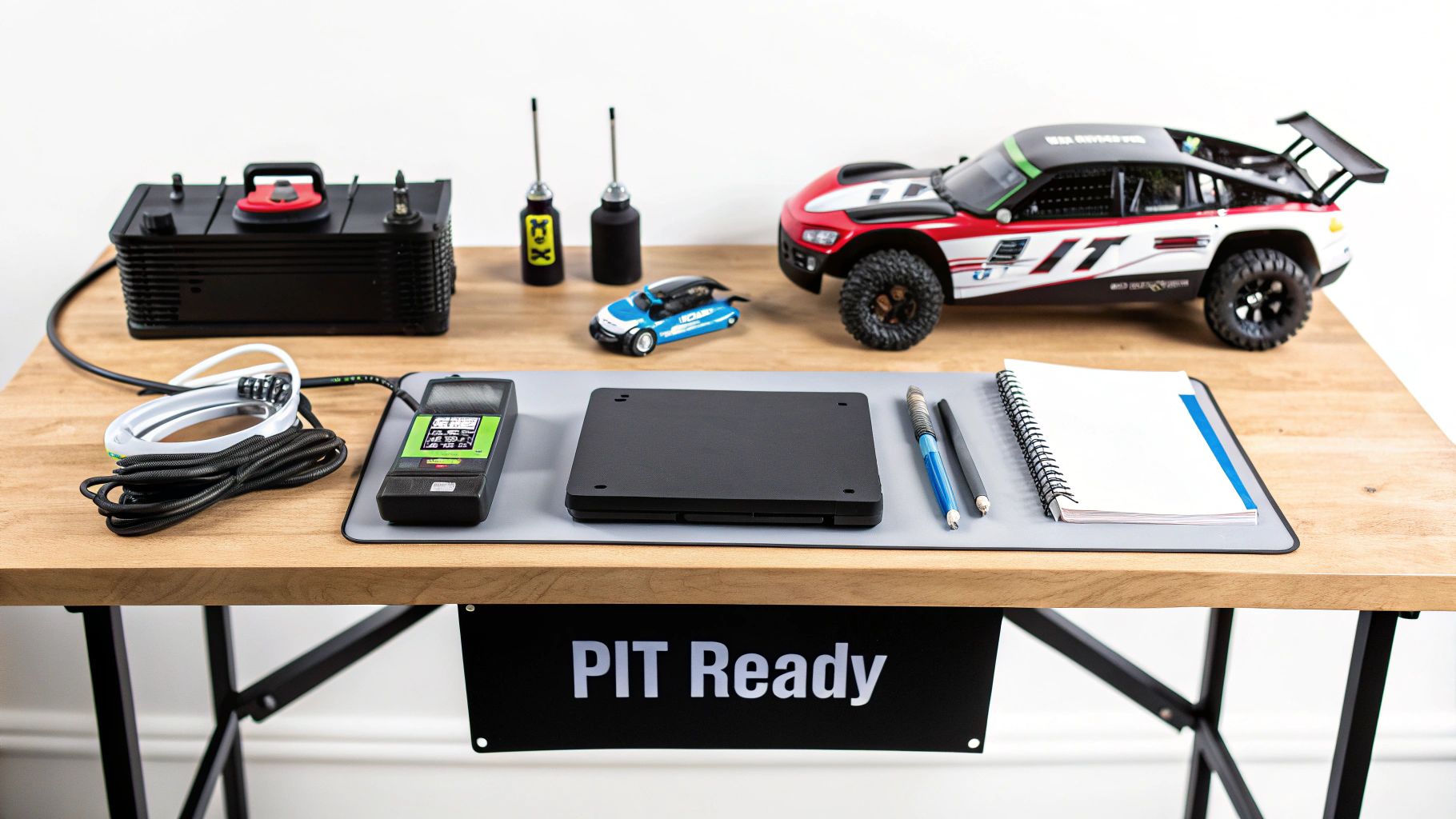
A race isn’t won when the starting tone sounds—it’s won long before, right in your pit area. Every serious competitor knows that an organised, well-equipped pit space is their secret weapon. It’s what transforms a chaotic race day into a controlled, strategic session.
Think of your pit space as your command centre. This is where you'll make critical setup changes, recharge batteries, and mentally reset for the next heat. A cluttered table leads to stress and mistakes, but a tidy, efficient setup lets you focus on one thing: driving.
Building Your Trackside Workshop
At its core, your pit setup needs to be functional. This starts with a solid foundation like a pit board or mat, giving you a clean, flat surface to wrench on your car. A reliable power supply is just as critical for running chargers, tire warmers, and any other electronics you need throughout the day.
For racers who travel, a quality mobile solution is a game-changer. Investing in a robust set of tool cabinets on wheels keeps your tools, spares, and setup gear perfectly organised and ready to roll. An organised pit means you spend less time hunting for a 1.5mm driver and more time figuring out how to shave another tenth off your lap time.
The next layer is precision. A proper setup station is non-negotiable for making accurate, repeatable adjustments to camber, toe, and ride height. Without one, you're just guessing.
A well-organised pit space is more than just convenience; it’s a performance tool. When you can quickly and accurately make a setup change between heats, you gain a tangible advantage over competitors who are scrambling to find the right part.
The Technology of Competition
Modern racing at RC racing tracks is built on precise technology that keeps everything fair. The single most important piece of tech in your bag will be your personal transponder. This small device sends out a unique signal that gets picked up by a timing loop under the track surface, automatically recording your lap times with perfect accuracy.
Without a compatible transponder, you can't officially race. The MyLAPS system is the global standard, so getting one is a mandatory step for any aspiring racer. It’s the electronic key that gets you on the grid.
This structure is what makes legitimate competition possible, a concept championed by organisations like ROAR (Remotely Operated Auto Racers). Founded way back in 1967, ROAR is the oldest sanctioning body for RC racing, and its standards helped shape the competitive framework used by countless clubs across Canada.
Race Day Etiquette and Safety Protocols
Being a good racer goes beyond your skill on the driver's stand; it’s about your conduct in the pits and on the track. Sportsmanship and safety are the glue that holds our racing community together. One of your most important jobs on race day won't even involve your own car: marshalling.
When you’re not racing, you'll be expected to marshal the heat after yours. This means standing at a designated corner and keeping a close eye out for crashed cars. Your job is to get them back on their wheels safely and quickly so the race can flow smoothly for everyone.
Finally, equipment safety is paramount, especially when it comes to LiPo batteries.
- Charging Safety: Always use a proper LiPo charger and never, ever leave batteries unattended while they're charging.
- LiPo Safety Bags: You must charge and store your LiPo batteries in a fire-resistant LiPo bag. This is a non-negotiable safety rule at every single track.
- Battery Condition: Never use a puffy, dented, or damaged LiPo. A compromised battery is a serious fire risk and needs to be disposed of properly.
Show up prepared with the right gear, a good attitude, and a respect for the rules, and you'll have a great day at any of Canada’s premier RC racing tracks.
Your Essential Digital-RC Trackside Toolkit
Theory is one thing, but showing up at the track ready to compete is another. Turning what you know about setup into a podium finish comes down to having the right tools, reliable electronics, and the correct consumables for the job. This is the stuff that belongs in every serious racer's pit box, and you can get it all right here at Digital-RC.
We've hand-picked a collection of proven, race-winning products that give you a real edge, from your first practice lap all the way to the A-Main. This is about building a proper race program.
Tires and Traction Compounds
Let's be clear: tires are the single most important performance part you will ever buy. They're your car's only connection to the track. For high-grip carpet, you need specific rubber compounds that can handle the insane cornering forces without traction rolling. On asphalt, you're looking for something that can take the heat and wear over a long run.
We stock the top-tier rubber tires for both worlds. When you pair them with the right traction additive—or "sauce," as we all call it—you get the predictable grip needed to push the car to its absolute limit. Getting this combination right isn't optional if you're hunting for those last few tenths of a second.
Setup and Tuning Tools
The secret to a fast car is repeatability. You need to be able to measure and adjust your car’s geometry with total precision. This is how you duplicate a winning setup or make small, intentional changes you can actually feel on the track. Eyeballing your camber or ride height just doesn't fly in competitive racing.
A fast car is a consistent car. Investing in quality setup tools like a ride height gauge and a camber gauge is the first step toward building a vehicle that behaves the same way lap after lap, giving you the confidence to drive it hard.
These aren't luxuries; they're the foundation of any serious pit box. They take the guesswork out of setup and let you turn your car's handling into a science, no matter which RC racing tracks you visit.
Power and Electronics
Your power system is the heart of your car. A solid, high-performance LiPo battery delivers the consistent voltage needed for that explosive punch off the line and unwavering speed for an entire five-minute run. Pair it with a top-tier charger from a brand like Hobbywing, and you can be sure your batteries are always conditioned for peak performance.
And you can't race if you're not being counted. A personal transponder, like the industry-standard MyLAPS RC4, is a mandatory piece of gear for any official race event. It’s your ticket to the timing loop, making sure every single lap is recorded.
Maintenance and Spares
Racing is brutal on equipment. Parts wear out, and sometimes they break. Being prepared with a handful of critical spares can be the difference between finishing your race day on a high note or packing up early with a broken car.
Every racer should have these in their pit box:
- Bearing Sets: Fresh, clean bearings are free horsepower. They cut down on drivetrain friction and boost efficiency.
- Shims: Absolutely essential for taking the slop out of your suspension and setting a perfect gear mesh.
- Spur and Pinion Gears: Having different gear ratios lets you tune your car's acceleration and top speed for any track layout or motor.
Stocking your box with these essentials from Digital-RC means you’re always ready to keep your car in top form and handle any surprise repairs that come your way.
Questions We Hear at the Track
Getting into on-road RC racing means learning a new language, and a lot of that revolves around the track itself. If you're just starting out or visiting a new club, you're bound to have questions. Here are some of the most common ones we get asked, with straight-up answers from our experience.
What’s the Best Surface for a Beginner?
This one might surprise you. While you’d think the super-consistent, high-grip carpet is the easiest place to start, it can actually be pretty unforgiving for a newcomer. That insane level of grip makes the car incredibly sensitive to setup changes and very prone to traction rolling if you haven't dialled it in just right.
Honestly, a well-prepped, medium-grip asphalt track is often a much better classroom. It forces you to learn the fundamentals of throttle control and car setup without the razor-sharp reactions of a carpet car. That said, the best advice is always to find a local club with a welcoming vibe, no matter what surface they run on. The people are more important than the pavement.
How Often Will I Need New Tires?
Tire life is one of those "how long is a piece of string?" questions—it completely depends on the surface. On a really abrasive outdoor asphalt track, you might only get one or two full race days out of a fresh set of rubber before the performance falls off a cliff.
On the other hand, a good set of spec tires on indoor black carpet can stay competitive for several race weekends, as long as you're cleaning and prepping them properly after every run. Just keep an eye on them. If you see uneven wear or feel a noticeable drop in grip, it's time for a new set. Your tires are the single most important part of your car's performance.
Your tires are the foundation of your entire setup. Having a fresh, race-ready set in your pit box is never a bad idea. A worn-out set can make a perfectly good car feel unpredictable and slow.
What are the Must-Have Setup Tools?
If you're planning to do more than just turn laps, a few tools are non-negotiable for making precise, repeatable adjustments at the track. At the bare minimum, every racer's pit box should have:
- A quality ride height gauge to set your chassis height perfectly every time.
- A reliable camber gauge to dial in your tire's contact patch.
- A set of precision hex drivers that won't round out those tiny screws.
These three tools cover the absolute basics of your car's suspension geometry. Once you get serious, a full setup station is the next logical step. It's a worthwhile investment that pays for itself in consistency and performance.
Do I Really Need to Buy My Own Transponder?
Yes, absolutely. If you want to participate in any official club race or bigger event, a personal transponder is mandatory. Every track has a timing loop buried under the start/finish line that picks up a unique signal from the transponder in your car.
This is how the system logs all your lap times, figures out your qualifying position, and scores the main events. The MyLAPS RC4 has been the industry standard for years, and it's a required piece of kit for anyone who wants to race competitively.
At Digital-RC, we stock all the essential tools, electronics, and spares you need to be competitive at any RC racing track. Find everything from setup gauges to transponders right here at https://digitalrc.ca.